Impeachment Professors: Welcome to My World | American Crossroads

Editor’s Note: Take special note of the fourth academic Professor Jonathan Turley who cared to differ with his colleagues regarding impeachment and the grounds thereof. As a result he may suffer the consequences of stepping “out of line” from the other hard core socialist academia who testified before the House Judiciary Committee.

Commentary by Mary Grabar

Welcome to my world all you people appalled by the testimony of professors presenting Constitutional grounds for impeaching President Donald Trump.

Are you disgusted by the display of feminist rage, graduate student earnestness, and droning about the “framers” by tenured elites who have built careers presenting the Constitution as a “living document”?

Ha! Welcome to my world where I spent 20 years until 2013 studying and teaching college English.

I would still be in that world, having to listen to morning-after faculty lounge debates about the relative merits of these three scholars, were it not for the fact that a department chair, and then a college president, did not like op-eds I wrote, because the First Amendment applied only to people with their views. Then the privately funded program under which I was teaching at Emory University ended.

It’s not that I could get beyond the low-paying year-to-year contracts. My thesis and dissertation focused on dead white male cis-gendered (with no “homosexual,” or even “homo-social” tendencies) Christian writers. So I never had a chance.

During my years of struggle, I would try to convey what it was like to those on the outside—family members, friends, and people I met. I described the witchy cackling at meetings, screams about oppression from lecterns, inquisitorial stares from colleagues passing by in hallways, and examples of “scholarship”—like the poster with the giant phallus (and more that I can’t describe in this forum) adorning the office door of the head of “Sexuality Studies,” which was within the English department at Emory. Every day I trudged past that looming phallus, above the poster of Shakespeare in drag advertising a “Shakesqueer” conference.

Oh, that’s just those crazy English professors, said people in the business world and in the sciences. They looked at me slant-eyed after I stammered, “but, but … the giant phallus, and …”

Today, the standards of academe have infiltrated the business world. My former skeptics on the political right no longer post political comments on Facebook. Techies such as James Damore and CEOs are fired for their words and actions that have nothing to do with their job performance. Math and science professors are required to sign statements pledging allegiance to diversity, which means admitting less-qualified women and minorities. They’re required to believe their magical diverse powers will ensure that bridges do not collapse and patients, with their skulls cut open on the operating table, do not die. They must embrace Afrocentric math, “women’s ways of knowing” anatomy, and the path-breaking theory of Lysenkoism.

My world was the faculty lounge (the office with broken-down furniture where several instructors at one time held “office hours”). It’s a world where even such poorly paid hacks thought they were better, smarter, and holier than the majority of Americans and 100 percent of Republicans.

These people need not even look at evidence or consider scholarly shoddiness because they know that if it comes from the wrong source, it is wrong, as an Amazon review respondent who agreed with commentator “Prof. JayG” that I had not cited “any evidence” in my book “Debunking Howard Zinn,” affirmed. My book is simply “right-wing trash.” No doubt, philosophy professor David Detmer still believes I suffer from “Zinnophobia.”

Such “profs” do not need to read entire books and review footnotes because of their superior abilities to “deconstruct” texts. The deconstructionist theorists I had to read in graduate school saw the real meaning of an author’s words. While mere mortals may attach the signifier (the word) to the signified (the thing or concept), the deconstructionists could see beyond. They used this ability to also discern the motives of outsiders: white people, heterosexuals, men, Republicans—and those inside and outside these groups (excluding Republicans) who did not adhere to their ever-evolving standards of what today is called “wokeness.”

These people, unlike mortals, do not need facts. This was true about Donald Trump’s election. They knew there was cause to impeach him immediately after the election, and they said so to their students. I saw this here in Clinton, New York. Mere days after the election, professors chaperoned students from Hamilton College on the “hill” to the village square, where they marched and yelled “Impeach!” before they got on the luxury buses for the mile-and-a-half ride back to campus.

This ability to see beyond evidence has been honed for a long time. Back when a few middle-class Americans dared to form a “tea party” movement to protest with speeches, bunting, and prayer against the newly elected “global citizen” President Barack Obama’s agenda of “transforming” this country, the Ph.D.s and other super-intellects discerned that this was not really the desire of law-abiding, hard-working Americans to prevent their country from turning into Cuba. They knew, just knew, that this was racism.

So were the questions about Obama’s longtime “god-damning America” pastor, Weatherman friend Bill Ayers, brobuddy Hugo Chavez, and Communist Party USA mentor Frank Marshall Davis. Obama’s fundraising party comments about “bitter” Bible- and gun-toting Americans were simple truth. His declaration of being able to rule with his pen and phone was not any threat to the Constitutional separation of powers at all. The Obama Youth Brigade Formation’s chants of “because of Obama I’m inspired to be the next” architect, engineer, lawyer, etc., repeating points of Obama’s platform, and shouts of “Yes, we can!” were signs of rejuvenated youthful optimism.

Whereas professors had proudly sported bumper stickers proclaiming “Somewhere in Texas a village has lost its idiot” during the George W. Bush administration, they recognized Obama’s words as poetic genius.

Michelle Obama, a broad-shouldered statuesque woman was treated like the most beautiful and fashionable woman in the world—even when she dressed up like a giant banana. But a supermodel married to a Republican can have no fashion sense. Melania Trump’s white coat in a Christmas video among white-themed Christmas decorations, “exude[d] cold, dismissive aloofness”—so unlike the Santa Clausy Mao Christmas tree decorations in the Obama White House!

The fact that such reactionary outlets such as Fox News reported this as if there was something wrong with having the author of the famous Little Red Book on the tree alongside a drag queen and Obama etched into Mount Rushmore proves how close-minded they are. They’re incapable of seeing the brilliance of a theory developed by the natural genius Karl Marx whose social justice work was supported by the wealthy industrialist Friedrich Engels. (And isn’t it nice that George Soros and other billionaires support similar scholarship these days?)

Marx understood history so well because he had deconstructed it and could see the patterns. Therefore, he was able to predict the future. And he could tell what would usher in a paradise.

When everyday people, like peasants, or reporters doing reporting instead of going to the Kremlin’s fancy parties, presented counter-evidence (in the case of peasants by dropping dead from starvation), the professors shot back. They accused the few reporters jotting down the numbers of beggars and dead bodies (like William Henry Chamberlin and Eugene Lyons) of being reactionaries. They accused the peasants of bringing on their own starvation by not working enthusiastically enough on the collective farms the government had so generously provided them.

Even after Kruschev had denounced Stalin for errors, the professors did not lose faith. They knew socialism could work—if only the “right” people were in charge.

The professors in the 1960s kept teaching about the superiority of socialism, hoping as Bill Ayers and company did, that through the reeducation of their charges they would usher in and rule over a socialistic utopia. And even though the Vietnamese fled North Vietnam, the people there really wanted a communist government. These thinkers knew that Ho Chi Minh was more of a democrat than the slave-owning writer of the Declaration of Independence, Thomas Jefferson.

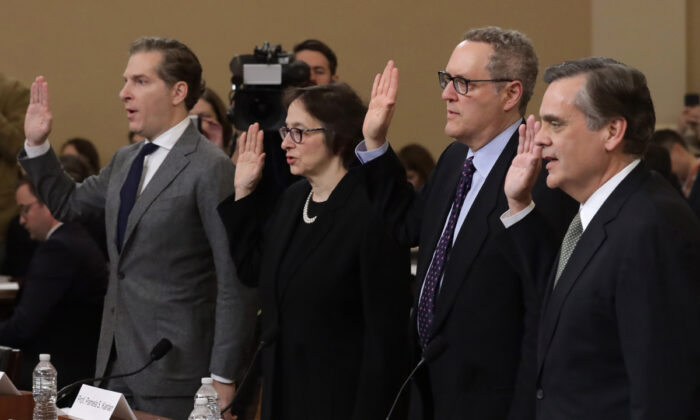
So, when I recently watched the testimony by the Constitutional scholars Pamela Karlan (Stanford), Noah Feldman (Harvard), and Michael Gerhardt (University of North Carolina), I thought, welcome to my world.

Welcome to my world where someone like Karlan, who at a 2017conference claimed she had to cross the street from Donald Trump’s hotel (the building apparently shoots cootie rays onto the sidewalk) and to know that Trump did not “believe in” democracy, “the rule of law,” or a “free press.” The legal scholar had denounced “voter suppression” (no, no, not about New Black Panthers outside the Philadelphia polling station in 2008; those were civil rights activists) and claimed that Trump’s sexual assault record was higher than “99.99% of all of the people who have entered this country illegally.” (Let us hope the FBI takes note of this inside information.)

In addition to being an ace legal mind, she was able to go beyond Freud and diagnosed Trump as not being able to tell the difference between truth and falsity. She claimed that he was trying to “destabilize the courts” and predicted that he would blame a Muslim on a future terroristic attack like the one in Oklahoma City in 1995.

At the hearing, she explained that “one of the most important provisions of our original Constitution is the guarantee of periodic elections for the presidency.” Therefore, this president needed to be removed. There are so many reasons—like the president’s reference to “Russia, if you’re listening,” i.e., to get on it about Hillary Clinton’s missing emails. All smart people know that this is not a joke, for Republicans are incapable of making jokes.

But those with Ph.D.s learn all the clever inside jokes at conferences. It was too bad that the rubes didn’t understand Karlan’s witty reference to the president’s 13-year-old son. She told Americans that “Trump is not a king” and that he could “name his son Barron” but could not “make him a baron.” But they just didn’t get it. So she magnanimously gave a “qualified apology,” pointing out that Trump had much to apologize for himself—like being born. And like all those feminists attacking phallologocentrism in “Paradise Lost” and “Huckleberry Finn,” she was applauded for “schooling” a “Trump crony,” Congressman Doug Collins (R-Ga.).

In my world, earnest graduate students presented comparison/contrast papers at conferences knowing, just knowing, that someone would recognize their genius. Noah Feldman may have known that his “insights” had been discussed thousands of times before at such insider events, but for the benefit of the folks he spelled it out, explaining that the “framers provided for the impeachment of the president because they feared the president might abuse his power of his office.”

“Let me begin now,” he continued, “of why the framers provided for impeachment in the first place. The framers borrowed the concept of impeachment from England, but with one enormous difference. The House of Commons and the House of Lords could use impeachment in order to limit the ministers of the king, but they could not impeach the king. And in that sense, the king was above the law.”

He then asked his enthralled audience, “I would like you to think now about a specific date in the Constitutional Convention, July 20, 1787. It was the middle of a long hot summer. …”

Feldman had been cogitating on impeachment for a while. Back in 2017, Feldman and Jacob Weisberg compared and contrasted “the collusion of Donald Trump’s presidential campaign and Russia” to Watergate, likening “Trump’s firing of FBI Director James Comey and warnings to Special Prosecutor Robert Mueller” to “President Nixon’s Saturday Night Massacre.”

Feldman also contributed to a collection edited by Cass Sunstein, who served in the Obama White House Office of Information and Regulatory Affairs. Titled quite originally “Can It Happen Here? Authoritarianism in America,” the book delved, naturally, into Trump’s authoritarianism. (Sunstein’s earlier book, “Nudge,” spelled out how the government could “nudge” citizens to do what it knew was good for them.) Sunstein, in his introduction, took some creative Sinclair Lewis-like liberties, presenting a future as Lewis did in his novel, even though it was fiction and did not come true then—even under a president who tried to pack the Supreme Court so he could fully take over the economy and who let in British spies to encourage war fervor.

Gerhardt (who has evolved on the Constitution since the Obama presidency) also lectured about the difference between the British system under monarchy and “in our constitution” where “no one, not even the president is above the law” and where there is “a separation of powers.” He concluded “from the public evidence” that the president had attacked the Constitution’s “safeguards against establishing a monarchy in this country.”

With all this talk of kings and monarchy I was reminded of the June 18, 2018, issue of Time Magazine, which on the cover presented Trump looking into a mirror and seeing his reflection with a crown and a king’s regalia—not that I’m doubting that the three professors came to their opinions after a careful review of the evidence—even over a pre-cooked mail-order turkey on Thanksgiving.

Then there was Jonathan Turley, an independent who has always voted Democrat, but who just didn’t get it. He blasphemed in stating that he didn’t believe that there was enough credible evidence to impeach and that Democrats were offering “passion” instead of “proof.” He dared to write about it, along with describing receiving “threatening messages and demands” that he be “fired from George Washington University”—even before he had finished his testimony. I fear that he may fall victim to the kind of purge to which others have succumbed, like Trotsky, and like the more recent one attempted on feminist professor Laura Kipnis.

Over 500 legal scholars after the testimony affixed their names to an open letter to Congress, stating their agreement with Karlan, Feldman, and Gerhardt. Turley had better see the light—that the king must be impeached—soon!

Whoever let him teach at George Washington Law School anyway?

The American people do not appreciate the wisdom of their betters, but President Bernie Sanders will be sure to remind them of how lucky they are to live in a country where the government provides all the food they need and where all they need do is stand in line for it, and not even worry their little brains about what to eat because the Director of the Department of Nutritional Guidance, Provision, and Distribution, Michelle Obama, will see to it that every American gets as much as he, she, they, or it truly needs. Now let’s move! Hop on that tractor! You have a quota to fill.

Mary Grabar holds a doctorate in English from the University of Georgia and is a resident fellow at the Alexander Hamilton Institute for the Study of Western Civilization. Grabar is the author of “Debunking Howard Zinn: Exposing the Fake History that Turned a Generation against America,” recently published by Regnery History.

Source: American Crossroads

House Judiciary Committee Releases Report Defining Grounds for Impeachment | The Epoch Times

Editor’s Note: What is particularly disturbing is that the Judiciary Committee chairman was associated with the Socialist Party long before he was a U.S. Congressman. Afterwards, he led the Congressional Progressive Caucus which from a policy standpoint is synonymous with the Socialist Party. Now, he’s overseeing a report interpretation what the founders meant by the impeachment clause. Curious and dangerous!

The House Judiciary Committee released on Saturday a report that attempts to define what the founders of the Constitution meant in their impeachment clause, days after the Speaker Nancy Pelosi (D-Calif.) asked the committee’s chair to move forward in impeaching President Donald Trump.

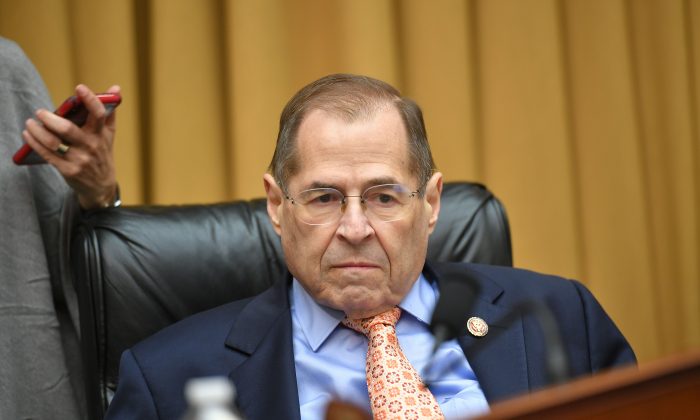
The 52-page report, titled “Constitutional Grounds for Presidential Impeachment” (pdf), is meant to act as a guide for impeachment as the committee’s Chairman Jerrold Nadler (D-N.Y.) prepares to draft articles of impeachment against the president.

The report was drafted by majority staff and provides details about the “history, purpose, and meaning” of Article II, Section 4, of the Constitution—the impeachment clause.

House Democrats are investigating in their impeachment inquiry allegations that the president had leveraged his office during a call with Ukraine in July where he asked the Ukrainian president to look into corruption accusations on former Vice President Joe Biden—who is running for president in 2020.

The release of the report comes after the House heard from a panel of four legal scholars to provide their understanding of what they think are impeachable offenses and how to apply it to the facts. Many of the academics had previously criticized Trump or have defended the impeachment against the president. The empaneled scholars drew criticism from the president’s allies and opponents of impeachment due to their apparent anti-Trump bias.

The report, which updates a 1974 version of the document that was used during the impeachment inquiry into President Richard M. Nixon, lays out reasoning to justify the House Democrat’s interpretation of what the impeachable offenses include. The Constitution does not explicitly define what “high crimes and misdemeanors” are, which is then open to legal analysis. According to the document, treason and bribery, abuse of power, betrayal involving foreign powers, and corruption are considered impeachable offenses.

“Within these parameters, and guided by fidelity to the Constitution, the House must judge whether the President’s misconduct is grave enough to require impeachment,” the report states. “That step must never be taken lightly. It is a momentous act, justified only when the President’s full course of conduct, assessed without favor or prejudice, is ‘seriously incompatible with either the constitutional form and principles of our government or the proper performance of constitutional duties of the presidential office.’”

The report also serves as a formal rebuttal of hotly contested issues during the impeachment process that the Democrats have deemed as “fallacies” such as the law that governs House procedures for impeachment, which states: “the law that governs the evaluation of evidence, including where the President orders defiance of House subpoenas, and whether the President is immune from impeachment if he attempts an impeachable offense but is caught before he completes it.”

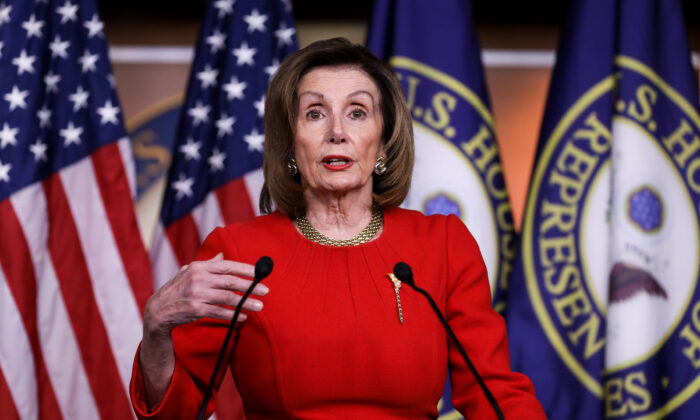
On Wednesday, during a brief press conference, Pelosi said Trump’s dealings with Ukraine “have seriously violated the Constitution.” She added, “He is trying to corrupt, once again, the election for his own benefit. The president has engaged in abuse of power, undermining our national security and jeopardizing the integrity of our elections.”

In response, Trump raised concerns about the House Democrat’s actions, warning that the extraordinary act of impeaching a president will be used on future presidents, as some legal scholars and Republicans have previously noted.

“This will mean that the beyond important and seldom-used act of Impeachment will be used routinely to attack future Presidents. That is not what our Founders had in mind. The good thing is that the Republicans have NEVER been more united. We will win!” Trump wrote.

Source: The Epoch Times

GOP Sen. Kennedy on Impeachment Inquiry: ‘It’s Not Only Dumb’ — ‘It’s Dangerous’ | Breitbart

Editor’s Note: We couldn’t agree more.

In a Friday interview with Fox News Channel’s “America’s Newsroom,” Sen. John Kennedy (R-LA) issued a stark warning for the House Democrats’ impeachment process over the alleged quid pro quo demand during a phone call between President Donald Trump and Ukraine President Volodymyr Zelensky.

Kennedy said the process is “not only dumb,” but it is also “dangerous” because it could lead to future “partisan impeachment” pushes.

“This whole process is not only dumb, but it’s dangerous,” Kennedy cautioned. “This is going to be the first partisan impeachment in the history of our country, and I’m worried that it’s going to establish a new normal. Some day we’ll have a Democratic president and then half of the country will be pushing us to impeach him or her. They’ll say, ‘Well, you did it to Trump, now do it to the new president.’ And I think that’s dangerous.”

Source: Breitbart News

2016 United States presidential election | Wikipedia

Editor’s Note: Despite the liberal media dominating the leftist narrative and the Democrats leading the charge in the impeachment inquiry, it seems the tables are turning positively towards reclaiming and restoring the Republic and the principles that once made America great. Since the impeachment inquiry began In September 2019 Trump’s twitter numbers have increased from 62.5 million to 66.6 million in little over a month. Polls have shown between a 50% overall support for the Trump Administration. The Republican Party has raised $305 million in this last quarter towards Trump’s reelection bid. Over 95% of Republicans stand behind Trump and his policies. What is also outstanding is how these numbers are comparable to the 2016 election results with the popular vote of 62,984,828, electoral vote of 304 with 30 states carried.

The 2016 United States presidential election was the 58th quadrennial American presidential election, held on Tuesday, November 8, 2016. The Republican ticket of businessman Donald Trump and Indiana Governor Mike Pence defeated the Democratic ticket of former Secretary of StateHillary Clinton and U.S. Senator from Virginia Tim Kaine, despite losing the popular vote.[2] Trump took office as the 45th president, and Pence as the 48th vice president, on January 20, 2017.

Trump emerged as the front-runner amidst a wide field of Republican primary candidates, while Clinton defeated Senator Bernie Sanders and became the first female presidential nominee of a major American party. Trump’s populist, nationalist campaign, which promised to “Make America Great Again” and opposed political correctness, illegal immigration, and many free-trade agreements,[3] garnered extensive free media coverage.[4][5] Clinton emphasized her extensive political experience, denounced Trump and many of his supporters as bigots, and advocated the expansion of President Obama’s policies; racial, LGBT, and women’s rights; and “inclusive capitalism“.[6] The tone of the general election campaign was widely characterized as divisive and negative.[7][8][9] Trump faced controversy over his views on race and immigration, incidents of violence against protestors at his rallies,[10][11][12] and his alleged sexual misconduct, while Clinton’s campaign was undermined by declining approval ratings[13] due to concerns about her ethics and trustworthiness,[14] and an FBI investigation of her improper use of a private email server, which received more media coverage than any other topic during the campaign.[15][16]

Clinton led in nearly every pre-election nationwide poll and in most swing state polls, leading some commentators to compare Trump’s victory to that of Harry S. Truman in 1948 as one of the greatest political upsets in modern U.S. history.[17][18] While Clinton received 2.87 million more votes than Trump did (the largest margin ever for a losing presidential candidate),[19] Trump received a majority of electoral votes and won upset victories in the pivotal Rust Belt region. Trump won six states that Democrat Barack Obama had won in 2012: Florida, Iowa, Michigan, Ohio, Pennsylvania, and Wisconsin.[20] Ultimately, Trump received 304 electoral votes and Clinton garnered 227, as two faithless electors defected from Trump and five defected from Clinton. Trump is the fifth person in U.S. history to become president while losing the nationwide popular vote.[b] He is the first president with neither prior public service nor military experience, and the oldest person to be inaugurated for a first presidential term.

The United States government’s intelligence agencies concluded on January 6, 2017, that the Russian government had interfered in the 2016 elections[22][23][24] in order to “undermine public faith in the U.S. democratic process, denigrate Secretary Clinton, and harm her electability and potential presidency”.[25] A Special Counsel investigation of alleged collusion between Russia and the Trump campaign began in May 2017[26][27]and ended in March 2019. The investigation concluded that Russian interference to favor Trump’s candidacy occurred “in sweeping and systematic fashion”, but “did not establish that members of the Trump campaign conspired or coordinated with the Russian government”.[28]

Source: Wikipedia

Jerrold Nadler: another socialist in Congress | Metro Voice

Editor’s Note: What is particularly disturbing is that the Judiciary Committee chairman was associated with the Socialist Party long before he was a U.S. Congressman. Afterwards, he led the Congressional Progressive Caucus which from a policy standpoint is synonymous with the Socialist Party. 

Jerrold Nadler, the socialist we will be exposing may surprise many people that really do not know who they elected. Let us hope that becomes true so we can get rid of these socialists within our Congress and Senate and replace them with people who will follow the Constitution rather than the ideology of the socialists they work for.

It was way back in the 1940s when the Socialist Party realized that the Democratic Party had begun to follow the same ideology as the Socialist Party. Just how can we make such a strong statement about the Democratic Party? It is simple.  It started with the man who tossed his Socialist Party into the Democratic Party after making the following statement.

“Norman Thomas, the six-time Socialist Party candidate for U.S. President, said the following in a 1944 speech:

“The American people will never knowingly adopt socialism. But, under the name of ‘liberalism,’ they will adopt every fragment of the socialist program, until one day America will be a socialist nation, without knowing how it happened…. I no longer need to run as a Presidential Candidate for the Socialist Party. The Democratic Party has adopted our platform.”

You must be wondering what this has to do with what is going on today.

We will now expose the man named Jerrold Nadler, the man who is working on impeaching or setting up impeachment ideas against President Donald Trump. We decided to look at Nadler because what he was stating sounded an awful lot like what prior socialists such as Elijah Cummings, among others, were saying. After a quick look into Mr. Nadler’s background, we found a very deep association and links to the Socialist Party and links to the Communist Party. Many will say, “So what?” but go back and read just what the Socialist and Communist Parties represent and you will quickly find that they both hate the United States Constitution and they both hate freedom. Both of those very far left parties work toward destroying our nation from within by placing their puppets, like Nadler and others, in office to slowly work their ideology into the American dream.

Here’s the truth about Jerrold Nadler, what he is and why he should never be in the position he is in now or ever.

Nadler got his start in 1992 as shown below.

“In 1992, longtime Democratic U.S. Congressman Ted Weiss died one day before his party’s primary election for New York City’s newly redrawn Eighth District. Using a weighted voting system, a convention of nearly 1,000 Democratic county committee members selected Nadler to replace Weiss on the November ballot. Nadler won easily and has had no serious challenge in any of his congressional re-election bids since then.” 

Here we see he won an election from a man that died in office. While there is not much in that, it does go downhill and deep into the socialistic ideology from there.

“Upon his election to the House of Representatives, Nadler promptly joined the Congressional Progressive Caucus and became a leader of the Congressional Pro-Choice Caucus. For an overview of his voting record on a number of key issues during the course of his legislative career, click here.”

So, just after his election, he joins the “Congressional Progressive Caucus.” This is not a good group to be in, but he was very quick to join showing his socialistic ideology was set before his election. Now, just what is the Congressional Progressive Party? Basically speaking, it is just a cover name for the Socialist Party.

But let’s take a brief look at this group that is ever expanding in the Democratic Party.

“The Congressional Progressive Caucus (CPC) was founded in 1991 by Bernie Sanders, a self-identified socialist who had recently been elected to the U.S. House of Representatives. Sanders’ CPC co-founders included House members Ron Dellums, Lane Evans, Thomas Andrews, Peter DeFazio, and Maxine Waters. The Institute for Policy Studies (IPS) was also involved in CPC’s founding and in Caucus activities thereafter; IPS continues to advise CPC on various matters to this day.

Another key player in establishing CPC was the Democratic Socialists of America(DSA), which has maintained a close alliance with the Caucus ever since. In 1997, DSA’s political director, Chris Riddiough, organized a meeting with CPC leaders to discuss how the two groups might be able to “unite our forces on a common agenda.” Among those who participated in the meeting were Bernie Sanders, labor leader Richard Trumka, professor Noam Chomsky, feminist Patricia Ireland, Rev. Jesse Jackson, Senator Paul Wellstone, journalist William Greider, and the socialist author Barbara Ehrenreich.

Beginning in 1997, CPC worked closely with the newly launched “Progressive Challenge, a coalition of more than 100 leftist organizations that sought to unite their activities and objectives under a “multi-issue progressive agenda.” To view a list of many of the major groups that co-sponsored the Progressive Challenge, click here.”

The first thing that should jump out from the page is that this group was started by none other than Bernie Sanders, a very strong socialist. Also, take notice that Maxine Waters is also involved with this, and there will be more on her in a future article. Getting back to Nadler’s association with this group, we also see that it is closely associated with the Democratic Socialists of America, just another Socialist branch of the now-defunct Democratic Party.

Let’s take a look at what Jerrold Nadler has aligned himself with.

“Throughout his years in politics, Nadler has maintained close ties to socialist organizations. In 1977, for instance, he was a member of the Democratic Socialist Organizing Committee (DSOC), and by 1983 he had joined the Democratic Socialists of America (DSA), which grew out of DSOC. On May 1, 1989, Nadler served on the sponsoring committee for a New York DSA screening of the pro-union film Matewan. That same year, he personally asked New York’s DSA to endorse his candidacy for NYC Comptroller. In 1990, Nadler endorsed the New York mayoral campaign of DSA member David Dinkins. In July 1996, DSA’s Political Action Committee endorsed Nadler for Congress. Each year from 1995-97, Nadler spoke at the DSA’s annual Socialist Scholars Conferences, where he participated in panel discussions with such notables as Stanley AronowitzWilliam Kornblum, and Frances Fox Piven. According to DSA’s rival Social Democrats USA, Nadler remains a DSA member to this day.”

Here, we see that Jerrold Nadler has maintained very close ties to the Socialist Party and organizations. Do the people in New York know this? Do the People of New York understand what this means? We would have to guess that if they do, they do not understand what the socialist ideology is trying to do to our nation.

Jerrold Nadler was on a panel with known anti-United States individual, Frances Fox Piventhat is a lady who worked hard to destroy the United States and the idea of freedom.  Look it up and see her background.  Just what we have shown here should be enough for a normal group of people to have an idea that Nadler is not good for their freedom.  After all, socialism does not promote freedom.  Just look at Venezuela, Cuba, and so many other socialist states.

“In 2003 Nadler, urged on by the ACLU and People For the American Wayintroduced legislation aimed at defeating the Bush administration’s Terrorism Information Awareness (TIA) program, which sought to help the government root out terrorists by analyzing and cross-referencing various databases for evidence of suspicious patterns of Internet activity, travel, credit-card purchases, and donations to charities and political causes. By Nadler’s reckoning, the TIA initiative constituted a massive “assault on our rights” and represented “perhaps the closest realization of an Orwellian ‘Big Brother’ government to date.”

Nadler fought to stop a program that would root out terrorists. That does not sound like someone that is out to protect the people who voted for him. However, Nadler doesn’t care because he believes he can never be defeated.  Yet, maybe it is just that the people who vote for him have not been told he is a flaming socialist.  Nadler is even making a statement that terrorists should not be drawn out if they have in mind to harm this nation. Just look at his words and try to understand how could this man have the people in his district in mind when he stated that. Let us take a look at something that he says below and see how close it resembles what he is now trying to do with President Trump.

“In a similar spirit, Nadler characterized the PATRIOT Act as an example of unnecessary “governmental intrusion” into the lives of Americans. Especially outrageous to Nadler was a PATRIOT Act clause enabling FBI investigators to access library records in the course of a terrorism investigation. “If [Attorney General] John Ashcroft has his way, bookstore customers could be investigated for something as arbitrary as buying Hillary Clinton’s new book,” warned Nadler. “People are outraged,” he added, “by the loss of civil liberties…. The government … should not be in the thought-police business.” Further, Nadler denounced the PATRIOT Act as “little more than the institution of a police state.”

Today, Nadler is making the very statement he hates in the paragraph above.

“People are outraged,” he added, “by the loss of civil liberties…. The government … should not be in the thought-police business.” Further, Nadler denounced the PATRIOT Act as “little more than the institution of a police state.”

Notice the phrase, “The government should not be in the thought police business.” But today he is using that very idea to go after President Trump even after President Trump has been cleared of all charges, or in Nadler’s case, all thoughts. Let us show just what Nadler thinks about our Constitution.

“In January 2011, when the new Speaker of the House, Republican John Boehner, announced his intention to open the year’s first session of Congress with a reading of the U.S. Constitution, Nadler complained that Republicans “are reading it [the Constitution] like a sacred text.” Boehner’s “ritualistic reading” was “total nonsense” and “propaganda,” said Nadler, adding that the document’s need for amendments to abolish slavery and other injustices showed that it was, from its inception, “highly imperfect.”

Here we see that Nadler complained about the reading of our Constitution, calling Boehner’s reading, “Total Nonsense and propaganda.” This is what seems to show his total dislike for the Constitution.

Now, let us show his connections to the Communist Party.

“* In 1997 Nadler was one of 33 original co-sponsors of the Job Creation and Infrastructure Restoration Act which was introduced into Congress by California Rep. Matthew Martinez. This emergency federal jobs legislation, supported by the New York State Communist Party, was designed to create jobs at union wages in financially foundering cities by putting the unemployed to work on infrastructure projects such as rebuilding schools, housing, hospitals, libraries, public transportation, highways, and parks. Rep. Martinez had already introduced an earlier version of this bill in the previous Congress at the request of the Los Angeles Labor Coalition for Public Works Jobs, whose leaders were known supporters or members of the Communist Party USA. To view a list of all the co-sponsors, click here.”

This shows that Jerrold Nadler supported a bill pushed forward by a group associated with the Communist Party.  Notice here how the Communist Party works:  placing people into jobs for which that may or may not be paid. This is how the Communist Party works:  it makes people think it is great because it creates certain jobs and after they get you into their group, then they use you to do their evil bidding. Of course, we all know that Communism has failed everywhere it has grown because it cannot sustain what it lays claim to be.

Let us close with a final show of what Nadler will do to keep his office.

“* During a June 2014 House briefing with Obama administration officials on the recent trade of five high-ranking Taliban commanders in exchange for American Sgt. Bowe Bergdahl, Nadler suggested that the Taliban, as non-state actors, had a status comparable to that of American soldiers who had fought the British during the Revolutionary War. When reports of Nadler’s statement sparked some public controversy, the congressman clarified: “I was told they [the Taliban] were unprivileged combatants, not prisoners of war, and I was trying to figure out the extent of that legal distinction. I was told they wore no uniform so I was curious if that gave them the legal status of militias in the American Revolution — who also did not wear uniforms…. In no way was I comparing their values, their efforts, and their cause to that of our founding fathers, and to suggest otherwise is absurd.”

Nadler quickly changed his tone when people questioned his words.

Maybe today “WE THE PEOPLE” should once again drag him across the rug to explain why he is thinking of placing impeachment charges on President Trump when he has been cleared of everything, not to mention the entire mess began with a very false report about collusion with Russia. By the way, does Nadler even know that once it comes up that the entire Russia idea was false it could overturn everything?  No doubt, he would once again be giving a very different explanation to the people.

With all this, we have to wonder if maybe the voters in New York were blindfolded when they voted for him, but he did not have anyone run against him. That is another way the socialists keep winning.  They set up districts where no one wants to challenge them.

Jerrold Nadler is a Socialist in Democrat clothing and has ties to the Communist Party too. Why in the world would people vote for an individual who has ties to groups that do not honor or like the Constitution?  Don’t you think it is time to get rid of this socialist and replace him with a person who honors the Constitution and freedom?

Source: Metro Voice

Constitution under siege: The Electoral College battle | Metro Voice News

“Every vote should count.” To many that sounds fair. It sounds right. But is it? “The Electoral College is wrong. The person who gets the most votes should be president.” Does that sound right to you?

The answer varies but falls under one fundamental belief: Do you believe America to be a democracy or a republic.

From that divide, you will understand the main difference between what conservatives are trying to preserve and what liberals are trying to fundamentally transform.

During the 2000 Presidential Election, many in the media and the left believed that Al Gore would win the Electoral College and Bush would in the popular vote. This was the last time the media and the Left staunchly defended the Electoral College while lying the groundwork for the very assault on it. It was after this election that I started studying what the Electoral College is and its importance.

So what is the Electoral College? Each state is afforded a certain number of votes, the amount of senators (2) combined with the amount of representatives in the house (which varies according to population). This makes the minimum amount of votes a state gives as three. These votes are determined by the popular vote each state making the winner the President of the United States.

The emphasis on States is important. Each state in America has different needs and desires. Each state under the Electoral College gets to choose which candidate they want as president by majority vote. (That’s the democracy in the republic you hear about.) The candidate that gets the most votes (270 at this time) from these states wins the Presidency. Under this system, each state matters and therefore the people of each individual state are important.

Under a popular vote, the one with the most votes wins. It’s simpler and therefore easier to circumvent most people. That means cheating is easier. Also ignoring large sects of this country also becomes expedient.

Elections are expensive. Under the popular vote, the middle is ignored because all a candidate need win is the big cities of the east and west coast. The Midwest, the Southwest, and parts of the South will no longer matter because their votes won’t win elections. Look at the state of New York. NYC rules the state, and the Democrat Party rules NYC with an iron fist.

Under a popular, every vote counts. That sounds great, but not every vote should count. “Every four years, the dead rise and vote democrat in Chicago,” the old joke says. The truth is sadder; in that, in many big cities, the dead vote. Add to that the millions of illegal aliens that vote. Then add to that those who vote more than once. Then add to that all those miraculous ballots that appear in bags which were handily put to the side in case needed to overturn an election barely won by a Republican which was how Al Franken won his seat in the Senate and many Republicans lost elections in 2018 they won on election night. Every vote counts. In the past election, some counties had more people vote in them than actually lived there by the thousands. Obviously, they all voted Democrats.

Once you put all those numbers together, it’s easy to see popular votes are easily doctored, and elections can easily be stolen. This is especially true because of an outwardly bias media who is out to cover for those on their side of the political aisle and dreg up the basest stories from the most unreliable sources to bury their competition. Many are willing to accept this because they want their candidate to win no matter what the cost. But what happens, when it’s someone they don’t like? At that point it doesn’t matter, because the republic is dead, and the government class rules us all without any checks or balances.

Ignorance is the greatest ally to the enemies of our Constitution. The reason so many are in favor of abolishing the Electoral College is that we have and Education system controlled by the Left who purposely keep their students from learning the importance of America’s greatness and what is needed to keep her free. Our institutes of educations have become indoctrination center of leftist ideology (socialism, humanism, atheism, etc.). Generations of children have become adults with no real understanding of our Constitution, and its greatness.

The Constitution is under siege. The States lost the battle for the Senate. Now the states may lose the battle of the Electoral College. We lose this and we lose the right to choose our leaders. The Republic needs you and me to educate the ignorant and show them why our founders were all against Democracies and why they chose a Republic instead.

Source: Metro Voice News

The Deep State Goes to War With President-Elect, Using Unverified Claims, as Democrats Cheer| The Intercept

IN JANUARY 1961, Dwight Eisenhower delivered his farewell address after serving two terms as U.S. president; the five-star general chose to warn Americans of this specific threat to democracy: “In the councils of government, we must guard against the acquisition of unwarranted influence, whether sought or unsought, by the military-industrial complex. The potential for the disastrous rise of misplaced power exists and will persist.” That warning was issued prior to the decadelong escalation of the Vietnam War, three more decades of Cold War mania, and the post-9/11 era, all of which radically expanded that unelected faction’s power even further.

This is the faction that is now engaged in open warfare against the duly elected and already widely disliked president-elect, Donald Trump. They are using classic Cold War dirty tactics and the defining ingredients of what has until recently been denounced as “Fake News.”

Their most valuable instrument is the U.S. media, much of which reflexively reveres, serves, believes, and sides with hidden intelligence officials. And Democrats, still reeling from their unexpected and traumatic election loss, as well as a systemic collapse of their party, seemingly divorced further and further from reason with each passing day, are willing — eager — to embrace any claim, cheer any tactic, align with any villain, regardless of how unsupported, tawdry, and damaging those behaviors might be.

The serious dangers posed by a Trump presidency are numerous and manifest. There is a wide array of legitimate and effective tactics for combating those threats: from bipartisan congressional coalitions and constitutional legal challenges to citizen uprisings and sustained and aggressive civil disobedience. All of those strategies have periodically proven themselves effective in times of political crisis or authoritarian overreach.

But cheering for the CIA and its shadowy allies to unilaterally subvert the U.S. election and impose its own policy dictates on the elected president is both warped and self-destructive. Empowering the very entities that have produced the most shameful atrocities and systemic deceit over the last six decades is desperation of the worst kind. Demanding that evidence-free, anonymous assertions be instantly venerated as Truth — despite emanating from the very precincts designed to propagandize and lie — is an assault on journalism, democracy, and basic human rationality. And casually branding domestic adversaries who refuse to go along as traitors and disloyal foreign operatives is morally bankrupt and certain to backfire on those doing it.

Beyond all that, there is no bigger favor that Trump opponents can do for him than attacking him with such lowly, shabby, obvious shams, recruiting large media outlets to lead the way. When it comes time to expose actual Trump corruption and criminality, who is going to believe the people and institutions who have demonstrated they are willing to endorse any assertions no matter how factually baseless, who deploy any journalistic tactic no matter how unreliable and removed from basic means of ensuring accuracy?

All of these toxic ingredients were on full display yesterday as the Deep State unleashed its tawdriest and most aggressive assault yet on Trump: vesting credibility in and then causing the public disclosure of a completely unvetted and unverified document, compiled by a paid, anonymous operative while he was working for both GOP and Democratic opponents of Trump, accusing Trump of a wide range of crimes, corrupt acts, and salacious private conduct. The reaction to all of this illustrates that while the Trump presidency poses grave dangers, so, too, do those who are increasingly unhinged in their flailing, slapdash, and destructive attempts to undermine it.

FOR MONTHS, THE CIA, with unprecedented clarity, overtly threw its weight behind Hillary Clinton’s candidacy and sought to defeat Donald Trump. In August, former acting CIA Director Michael Morell announced his endorsement of Clinton in the New York Times and claimed that “Mr. Putin had recruited Mr. Trump as an unwitting agent of the Russian Federation.” The CIA and NSA director under George W. Bush, Gen. Michael Hayden, also endorsed Clinton and went to the Washington Post to warn, in the week before the election, that “Donald Trump really does sound a lot like Vladimir Putin,” adding that Trump is “the useful fool, some naif, manipulated by Moscow, secretly held in contempt, but whose blind support is happily accepted and exploited.”

It is not hard to understand why the CIA preferred Clinton over Trump. Clinton was critical of Obama for restraining the CIA’s proxy war in Syria and was eager to expand that war, while Trump denounced it. Clinton clearly wanted a harder line than Obama took against the CIA’s long-standing foes in Moscow, while Trump wanted improved relations and greater cooperation. In general, Clinton defended and intended to extend the decadeslong international military order on which the CIA and Pentagon’s preeminence depends, while Trump — through a still-uncertain mix of instability and extremist conviction — posed a threat to it.

Whatever one’s views are on those debates, it is the democratic framework — the presidential election, the confirmation process, congressional leaders, judicial proceedings, citizen activism and protest, civil disobedience — that should determine how they are resolved. All of those policy disputes were debated out in the open; the public heard them; and Trump won. Nobody should crave the rule of Deep State overlords.

Yet craving Deep State rule is exactly what prominent Democratic operatives and media figures are doing. Any doubt about that is now dispelled. Just last week, Chuck Schumer issued a warning to Trump, telling Rachel Maddow that Trump was being “really dumb” by challenging the unelected intelligence community because of all the ways they possess to destroy those who dare to stand up to them:

And last night, many Democrats openly embraced and celebrated what was, so plainly, an attempt by the Deep State to sabotage an elected official who had defied it: ironically, its own form of blackmail.

BACK IN OCTOBER, a political operative and former employee of the British intelligence agency MI6 was being paid by Democrats to dig up dirt on Trump (before that, he was paid by anti-Trump Republicans). He tried to convince countless media outlets to publish a long memo he had written filled with explosive accusations about Trump’s treason, business corruption, and sexual escapades, with the overarching theme that Trump was in servitude to Moscow because they were blackmailing and bribing him.

Despite how many had it, no media outlets published it. That was because these were anonymous claims unaccompanied by any evidence at all, and even in this more permissive new media environment, nobody was willing to be journalistically associated with it. As the New York Times’ Executive Editor Dean Baquet put it last night, he would not publish these “totally unsubstantiated” allegations because “we, like others, investigated the allegations and haven’t corroborated them, and we felt we’re not in the business of publishing things we can’t stand by.”

The closest this operative got to success was convincing Mother Jones’s David Corn to publish an October 31 article reporting that “a former senior intelligence officer for a Western country” claims that “he provided the [FBI] with memos, based on his recent interactions with Russian sources, contending the Russian government has for years tried to co-opt and assist Trump.”

But because this was just an anonymous claim unaccompanied by any evidence or any specifics (which Corn withheld), it made very little impact. All of that changed yesterday. Why?

What changed was the intelligence community’s resolution to cause this all to become public and to be viewed as credible. In December, John McCain provided a copy of this report to the FBI and demanded they take it seriously.

At some point last week, the chiefs of the intelligence agencies decided to declare that this ex-British intelligence operative was “credible” enough that his allegations warranted briefing both Trump and Obama about them, thus stamping some sort of vague, indirect, and deniable official approval on these accusations. Someone — by all appearances, numerous officials — then went to CNN to tell the network they had done this, causing CNN to go on air and, in the gravest of tones, announce the “Breaking News” that “the nation’s top intelligence officials” briefed Obama and Trump that Russia had compiled information that “compromised President-elect Trump.”

CNN refused to specify what these allegations were on the ground that it could not “verify” them. But with this document in the hands of multiple media outlets, it was only a matter of time — a small amount of time — before someone would step up and publish the whole thing. BuzzFeed quickly obliged, airing all of the unvetted, anonymous claims about Trump.

Its editor-in-chief, Ben Smith, published a memo explaining that decision, saying that — although there was “serious reason to doubt the allegations” — BuzzFeed in general “errs on the side of publication” and “Americans can make up their own minds about the allegations.” Publishing this document predictably produced massive traffic (and thus profit) for the site, with millions of people viewing the article and presumably reading the “dossier.”

One can certainly object to BuzzFeed’s decision and, as the New York Times noted this morning, many journalists are doing so. It’s almost impossible to imagine a scenario where it’s justifiable for a news outlet to publish a totally anonymous, unverified, unvetted document filled with scurrilous and inflammatory allegations about which its own editor-in-chief says there “is serious reason to doubt the allegations,” on the ground that they want to leave it to the public to decide whether to believe it.

But even if one believes there is no such case where that is justified, yesterday’s circumstances presented the most compelling scenario possible for doing this. Once CNN strongly hinted at these allegations, it left it to the public imagination to conjure up the dirt Russia allegedly had to blackmail and control Trump. By publishing these accusations, BuzzFeed ended that speculation. More importantly, it allowed everyone to see how dubious this document is, one the CIA and CNN had elevated into some sort of grave national security threat.

ALMOST IMMEDIATELY AFTER it was published, the farcical nature of the “dossier” manifested. Not only was its author anonymous, but he was paid by Democrats (and, before that, by Trump’s GOP adversaries) to dig up dirt on Trump. Worse, he himself cited no evidence of any kind but instead relied on a string of other anonymous people in Russia he claims told him these things. Worse still, the document was filled with amateur errors.

While many of the claims are inherently unverified, some can be confirmed. One such claim — that Trump lawyer Michael Cohen secretly traveled to Prague in August to meet with Russian officials — was strongly denied by Cohen, who insisted he had never been to Prague in his life (Prague is the same place that foreign intelligence officials claimed, in 2001, was the site of a nonexistent meeting between Iraqi officials and 9/11 hijackers, which contributed to 70 percent of Americans believing, as late as the fall of 2003, that Saddam personally planned the 9/11 attack). This morning, the Wall Street Journal reported that “the FBI has found no evidence that [Cohen] traveled to the Czech Republic.”

None of this stopped Democratic operatives and prominent media figures from treating these totally unverified and unvetted allegations as grave revelations. From Vox’s Zack Beauchamp:

BuzzFeed’s Borzou Daragahi posted a long series of tweets discussing the profound consequences of these revelations, only occasionally remembering to insert the rather important journalistic caveat “if true” in his meditations:

Meanwhile, liberal commentator Rebecca Solnit declared this to be a “smoking gun” that proves Trump’s “treason,” while Daily Kos’s Markos Moulitsas sounded the same theme:

While some Democrats sounded notes of caution — party loyalist Josh Marshall commendably urged: “I would say in reviewing raw, extremely raw ‘intel,’ people shld retain their skepticism even if they rightly think Trump is the worst” — the overwhelming reaction was the same as all the other instances where the CIA and its allies released unverified claims about Trump and Russia: instant embrace of the evidence-free assertions as Truth, combined with proclamations that they demonstrated Trump’s status as a traitor (with anyone expressing skepticism designated a Kremlin agent or stooge).

THERE IS A real danger here that this maneuver could harshly backfire, to the great benefit of Trump and to the great detriment of those who want to oppose him. If any of the significant claims in this “dossier” turn out to be provably false — such as Cohen’s trip to Prague — many people will conclude, with Trump’s encouragement, that large media outlets (CNN and BuzzFeed) and anti-Trump factions inside the government (CIA) are deploying “Fake News” to destroy him. In the eyes of many people, that will forever discredit — render impotent — future journalistic exposés that are based on actual, corroborated wrongdoing.

Beyond that, the threat posed by submitting ourselves to the CIA and empowering it to reign supreme outside of the democratic process is — as Eisenhower warned — an even more severe danger. The threat of being ruled by unaccountable and unelected entities is self-evident and grave. That’s especially true when the entity behind which so many are rallying is one with a long and deliberate history of lying, propaganda, war crimes, torture, and the worst atrocities imaginable.

All of the claims about Russia’s interference in U.S. elections and ties to Trump should be fully investigated by a credible body, and the evidence publicly disclosed to the fullest extent possible. As my colleague Sam Biddle argued last week after disclosure of the farcical intelligence community report on Russian hacking — one that even Putin’s foes mocked as a bad joke — the utter lack of evidence for these allegations means “we need an independent, resolute inquiry.” But until then, assertions that are unaccompanied by evidence and disseminated anonymously should be treated with the utmost skepticism — not lavished with convenience-driven gullibility.

Most important of all, the legitimate and effective tactics for opposing Trump are being utterly drowned by these irrational, desperate, ad hoc crusades that have no cogent strategy and make his opponents appear increasingly devoid of reason and gravity. Right now, Trump’s opponents are behaving as media critic Adam Johnson described: as ideological jellyfish, floating around aimlessly and lost, desperately latching on to whatever barge randomly passes by.

There are solutions to Trump. They involve reasoned strategizing and patient focus on issues people actually care about. Whatever those solutions are, venerating the intelligence community, begging for its intervention, and equating its dark and dirty assertions as Truth are most certainly not among them. Doing that cannot possibly achieve any good and is already doing much harm.

George Washington’s Farewell Warning: Partisanship would lead to the “ruins of public liberty,” our first president said. He was more right than he knew. | POLITICO Magazine

washington

By John Avlon

When Barack Obama takes to the lectern to deliver his farewell address in Chicago on Tuesday, he’ll likely have a few things to say about a political climate that has grown viciously polarized over the past 8 years and culminated in a bruising, insult-driven campaign in 2016. If he does call out the destructive effects of hyper-partisanship on our democracy, he will be following in the footsteps of the first farewell address, by George Washington, printed in the American Daily Advertiser on September 19, 1796.

Washington warned of the dangers of political factions to democratic republics throughout history. His aversion to partisanship reflected the fact that just a few decades earlier, in 1746, political parties had driven England to civil war. This first farewell address, from our only truly independent president, hearkens back to an age when distrust of political divisions was perhaps higher than it is now—and offers a solution to what ails us today.

“I was no party man myself,” Washington wrote Thomas Jefferson,“and the first wish of my heart was, if parties did exist, to reconcile them.” As our first and only independent president, Washington’s independence was a function not only of his pioneering place in American history but also of political principles he developed over a lifetime.

To Washington, moderation was a source of strength. He viewed its essential judiciousness as a guiding principle of good government, rooted in ancient wisdom as well as Enlightenment-era liberalism. Much could be achieved “by prudence, much by conciliation, and much by firmness.” A stable, civil society depends on resisting intolerant extremes. The Constitution did not mention political parties, and during the debate over ratification, James Madison and Alexander Hamilton praised the Constitution’s “spirit of moderation” in contrast to the “intolerant spirit” of “those who are ever so much persuaded of their being in the right in any controversy.”

Washington was nonpartisan but he was not neutral. He was decisive after consulting differing opinions. “He seeks information from all quarters, and judges more independently than any man I ever knew,” attested Vice President John Adams.

Washington understood the danger of demagogues in a democracy. He was a passionate advocate of moderation as a means of calming partisan passions and creating problem-solving coalitions. Adams also believed that “without the great political virtues of humility, patience, and moderation … every man in power becomes a ravenous beast of prey.”

And it was a source of personal pain for Washington to see his Cabinet degenerate into exaggerated suspicions and vicious slanders during his presidency. Most frustrating was to watch his motives twisted and attacked for partisan gain by “infamous scribblers” in the newspapers. Even in the days after winning independence from Britain, Washington warned of the dangerous interplay between extremes. “There is a natural and necessary progression from the extreme of anarchy to the extreme of tyranny,” he wrote in his Circular Letter to the States, and “arbitrary power is most easily established on the ruins of liberty abused to licentiousness.” As liberty in France turned to anarchy and then tyranny during his administration, it confirmed his deepest instincts.

As a young man, Washington devoured the popular early-eighteenth century essays of Joseph Addison in the Spectator of London. Addison was the author of his favorite play, Cato, and while reflecting on the sources of England’s bloody civil war in the 1640s, he had written an influential essay on “the Malice of Parties.” It’s worth quoting at length: “There cannot a greater judgment befall a country than a dreadful spirit of division as rends a government into two distinct people, and makes them greater strangers, and more averse to one another, than if they were actually two different nations. The effects of such a division are pernicious to the last degree, not only with regard to those advantages which they give the common enemy, but to those private evils which they produce in the heart of almost every particular person. This influence is very fatal both to men’s morals and their understandings; it sinks the virtue of a nation, and not only so, but destroys even common sense. A furious party spirit, when it rages in its full violence, exerts itself in civil war and bloodshed; and when it is under its greatest restraints, naturally breaks out in falsehood, detraction, calumny, and a partial administration of justice. In a word, it fills a nation with spleen and rancor, and extinguishes all the seeds of good nature, compassion and humanity.”

Addison was not the only wise voice warning the revolutionary generation against the danger of hyper-partisanship. The English poet Alexander Pope declared that party spirit “is but the madness of many for the gain of a few.” The early 18th-century British opposition leader Henry St. John, 1st Viscount of Bolingbroke, described parties as “a political evil.” Informed by experience in both journalism and politics, Bolingbroke wrote that “a man who has not seen the inside of parties, nor had opportunities to examine nearly their secret motives, can hardly conceive how little share principle of any sort, though principle of some sort or other be always pretended, has in the determination of their conduct.”

The founding fathers’ suspicion of faction was rooted in the classical tradition that celebrated the virtue of moderation—and the subsequent independence of thought and action that moderation can create. “According to the classical doctrine, membership in a political party inevitably involved defending the indefensible vices of one’s allies and attempting to dominate one’s fellow citizens in order to satisfy a narrow self-interest,” wrote historian Carl J. Richard in The Founders and the Classics in 1994. “In the eighteenth century the greatest compliment one man could pay another was to call him ‘disinterested.’ To be disinterested was to place justice above all considerations, including one’s own interests and those of one’s family, friends and political allies.”

Throughout his career in Virginia’s House of Burgesses and as president of the Constitutional Convention, Washington took labors to remain in the role of moderate. In his twenties, while serving in the Virginia legislature, when the House of Burgesses was divided between moderates and militants in their resistance to the British royals, Washington played a pivotal role by bridging the divides with personal diplomacy, dining with leaders of the different factions.

During the war, there was no political will to raise revenue to pay the soldiers. Washington’s frustration with the weak and fractured Congress helped form his belief that a strong central government led by an honest, energetic executive was essential to a successful democracy.

Amid “the want of harmony in our councils—the declining zeal of the people,” Washington wrote his friend Gouverneur Morris, “it is well worth the ambition of a patriot statesman at this juncture to endeavor to pacify party differences—to give fresh vigor to the springs of government—to inspire the people with confidence.”

Washington’s call for a “patriot statesman” echoed Bolingbroke’s call for a “Patriot King” in a widely read 1749 pamphlet that articulated an antidote to the corruption and fanaticism of parties that led to England’s civil war. For Bolingbroke, the ideal was a benign monarch who could “defeat the designs, and break the spirit of faction” in a parliamentary democracy, toward the goal of delivering “true principles of government independent of all.” Washington’s substitution of “statesman” for “king” reframed the concept for an American audience. The ideal of a strong leader who operated beyond partisanship retained its attractiveness.

When Washington became president, he intended to establish a government above faction and special interests. “No local prejudices or attachments; no separate views, nor party animosities,” he promised in his first inaugural address, “will misdirect the comprehensive and equal eye which ought to watch over this great assemblage of communities and interests.”

Washington did not want or expect unanimity of opinion in his Cabinet, perhaps reflecting the idea that in a place where everyone thinks alike, no one is thinking very much. He was aware of his limits on specific issues—especially law and finance. A competition of ideas and opinions was something to be celebrated, as he made clear in a letter to the governor of North Carolina two months after taking the oath of office: “A difference of opinion on political points is not to be imputed to freemen as a fault, since it is to be presumed that they are all actuated by an equally laudable and sacred regard for the liberties of their country.”

But as Washington preached an enlightened self-interest consistent with classical liberalism, dissension grew in his Cabinet ranks, as political divisions hardened and suspicions drove onetime allies apart. He was always aware that these fault lines could rupture the fragile federal government.

“My greatest fear has been that the nation would not be sufficiently cool and moderate in making arrangements for the security of that liberty,” he wrote after nine months in office. “If we mean to support the liberty and independence which it has cost us so much blood and treasure to establish,” he wrote to Rhode Island governor Arthur Fenner, “we must drive far away the demon of party spirit and local reproach.”

In the spring of 1796, when he picked back up the first draft of his farewell address, which Washington had asked Madison to draft in his first term, Washington added new language explaining to the public that given the “considerable changes … both at home and abroad, I shall ask your indulgence while I express with more lively sensibility the following most ardent wishes of my heart.”

The next line in the draft drove right to the rise of faction: “That party disputes among all the friends and lovers of their country may subside, or, as the wisdom of Providence hath ordained that men, on the same subjects, shall not always think alike, that charity and benevolence, when they happen to differ, may so far shed their benign influence as to banish those invectives which proceed from illiberal prejudices and jealousy.”

In a line he deleted from the final draft, Washington went even further, warning that in a large republic, a military coup was unlikely to undermine democracy, even if backed by the wealthy and powerful. The base of the country was too broad. “In such republics,” he said, “it is safe to assert that the conflicts of popular factions are the chief, if not the only, inlets of usurpation and tyranny.”

Washington acknowledged that the spirit of party “unfortunately, is inseparable from our nature, having its root in the strongest passions of the human mind. It exists under different shapes in all governments.” But he understood partisans’ perspective, stating plainly, “there is an opinion that parties in free countries are useful checks upon the administration of the government and serve to keep alive the spirit of liberty. This within certain limits is probably true.”

Beyond those wise limits, Washington warned, rampant factions were a “fatal tendency” in democracies. The thin history of republics up to that point showed that partisan factions led by “cunning, ambitious and unprincipled men” distorted democracies by pursuing narrow agendas at the expense of the national interest. Washington identified regional parties based on “geographical discriminations” as a particular danger, because they undermined national unity in pursuit of power. “Designing men may endeavor to excite a belief that there is a real difference of local interests and views” by misrepresenting the “opinions and aims” of people from other states and regions. “You cannot shield yourselves too much against the jealousies and heartburnings which spring from these misrepresentations,” Washington warned. “They tend to render alien to each other those who ought to be bound together by fraternal affection.”

But the greatest danger could spring from the chaos of a dysfunctional democracy, compounded by relentless party warfare, which, Washington warned, would erode faith in the effectiveness of self-governance and open the door to a demagogue with authoritarian ambitions. “The disorders and miseries which result gradually incline the minds of men to seek security and repose in the absolute power of an individual; and sooner or later the chief of some prevailing faction, more able or more fortunate than his competitors, turns this disposition to the purposes of his own elevation, on the ruins of public liberty.”

Washington’s remedy was modest but comprehensive: Partisanship could not be removed from democracy, but it could be constrained by vigilant citizens and the sober-minded separation of powers. “The common and continual mischiefs of the spirit of party are sufficient to make it the interest and duty of a wise people to discourage and restrain it,” Washington wrote. Doubling down for emphasis, he added that “there being constant danger of excess, the effort ought to be, by force of public opinion, to mitigate and assuage it.”

For Washington, this wise balance was the prime pillar of our political liberty. By devoting so much of his farewell address to warning about the dangers of hyper-partisanship, Washington penned a manifesto for moderation, a guide for future leaders and citizens who would try to walk the line between the extremes, focused on the never-ending task of forming a more perfect union.

Now, in 2017, after an eight-year presidency that promised to bridge our divides but confronted the political reality of polarization and the election of a successor whose victory has highlighted the deep divisions in America, Washington’s vision for vigorous citizens checking the rise of extreme partisanship is striking in its relevance. We need to heed Washington’s warning.

Source: POLITICO Magazine