What To Do if The Police Stop You at a Music Festival | Showbams

festival-lawyer_2postWritten by The Festival Lawyer

I know what you are thinking. What the heck’s a Festival Lawyer?

Is it a Public Defender who helps you out if you get arrested at a concert? No. (Although, to be honest, I wish I had thought of that as a job option after law school).

I’m a criminal defense attorney with a background as a former prosecutor. But I also have a background as a drummer, a DJ, and avid festival goer. The idea behind “The Festival Lawyer” column is to combine these backgrounds to give you legal and practical advice that will make you a safer, more responsible Festival Goer.

Advice like how to protect your rights if the police approach you at a concert. Or how to recognize the symptoms of a drug or alcohol overdose. We will talk about things like California’s Medical Marijuana laws or what to do if stopped for a DUI on your way to a concert. But mainly, the column will be focused on how we can make the Festival Experience work better for everyone as a more responsible, positive community.

As an aside, I’ve noticed that as soon as I start talking about knowing your rights, a certain percentage of people start complaining that I am somehow “teaching people how to commit crimes.”

This is dangerous nonsense. We don’t live in a police state (well, not yet anyway). As citizens it is not only our right but our duty to know and defend our Constitutional Rights and keep an eye on the police.

Anyway, let’s start with a hypothetical situation where the police stop you out of the blue in the middle of a music festival and start questioning you. They don’t say why they are stopping you but just immediately ask permission to search your person and backpack.

What should you do?


1. Like the Clash said, “Know Your Rights.”

Okay, quick criminal procedure tutorial.

In any encounter with the police, a Judge will be looking after the fact at whether the police had a right to stop you in the first place. This is because the 4th Amendment of the Constitution says that you have a right as a citizen to freely go about your business unless the police can show they had a belief you were engaged in criminal activity.

What the police have to show to a Judge later depends completely on whether the Judge finds that you were being “arrested”, “detained” or were “free to leave”.

If the police arrest you, they have to show they had “Probable Cause” to believe you were committing a crime.

On the other hand, the police will probably argue that they weren’t arresting you but just “detaining” you. A “detention” is a situation where the police stop you briefly while they investigate a crime but haven’t arrested you yet. In a detention, the police have a much lower burden of proof. They only have to show a “reasonable suspicion” as to why they were detaining you. Or the police may argue that their entire contact with you was just a “consensual encounter” where you were free to go at anytime. In a consensual encounter, they don’t really need to justify why they stopped you because they were just talking to you and you were “free to leave”, (Because people always feel free to walk away when contacted by the police, right?)


2. Remember the Festival Lawyer’s Key Phrases.

So knowing the above, what should you do If a cop stops you?

The first question out of your mouth should be, “Am I being detained?” Then, “Why? What am being stopped for? Am I free to go, or am I under arrest?”

Memorize this. Repeat it out loud: “Am I being detained? Why? Am I free to go, or am I under arrest?”

Yes I am aware that like the cop in 99 Problems, the cop may not appreciate you being so “sharp as a tack” and view you as a potential troublemaker.

So your job in this situation is to keep calm and cool. Be respectful but clear and firm in what you are saying. It is completely reasonable (and legal) to ask why you are being stopped and whether you are free to go. By asking from the start if you are under arrest or free to leave you are forcing the officer to tell you exactly what is happening and whether you are a suspect.


3. Miranda Rights Myths vs. Reality

One of the most common urban myths out there is that the police have to read you your Miranda rights or the arrest gets thrown out of court.

Not true. The police don’t have to read you these rights. In fact, the police have the right to completely lie to you in any interview. The only time they have to read Miranda rights is if:

  • A) You are under arrest
  • B) They want to use a statement you made after being arrested in court against you.

The Right against Self Incrimination is in the Bill of Rights for a reason. USE IT. You should NEVER give a statement to the police without a lawyer. Period. No exceptions.

In the above scenario, questions like “whose backpack is this?” should be answered with a firm, “Officer, I am choosing to remain silent. I want a lawyer.”


4. Do not give the authorities consent to search you.

One other major Constitutional right you have is the right to be free from an unlawful search of your person and property.

So lets say you are already in a Festival when the police approach you. They won’t let you leave and ask for permission to search your backpack. (Obviously, security has a right to search you as you enter a festival and go through their initial security screening.)

Cops always make it seem like you’re some kind of a criminal if you express the slightest hesitation about having your property searched without a warrant. You can expect to hear an “If you have nothing to hide, why can’t we search your stuff?” type of verbal approach from the cops.

Know this…If the police are asking you permission to search you or your property, it usually means they know they are making an illegal search. Let that sink in for a second. When the police ask you “Can I search this bag?”, they KNOW they are asking you to let them make a search they are not legally entitled to make.

My advice? Respectfully tell the police officer, “I’m not giving you consent to search my property.” If they ask what you have to hide, don’t argue with them. Simply say again, “Officer, I’m sorry I’m not giving you consent to search my person or my property. If I’m free to leave I’d like to leave. If not, I’d like a lawyer please…”

At this point, they can still search you if they have probable cause, but what you’ve done with your statements is make them declare their reason for doing so and force them to show they are legally entitled to search you.


5. Document the Encounter.

In future columns we are going to talk a lot about what a Festival Buddy is and what their responsibilities are. In this scenario, the Festival Buddy’s job isn’t to yell “Hey man leave him alone” or drunkenly argue with the cops. Festival Buddy’s job is to whip out his or cell phone and document the entire encounter.

SPOILER ALERT – COPS REALLY FREAKING HATE THIS. The best thing to happen to Civil Liberties in this country was the invention of the cell phone camera and YouTube. But just bear in mind, cops will do just about anything to avoid having you upload your video of them on YouTube or on Social Media.

This is an area where your own comfort level has to dictate how far you push it. Legally, since you are in a public place you are completely entitled to film and record what is happening. But cops will sometimes argue that you are “interfering with an investigation” and threaten to arrest you. Or if you have had anything to drink they will suddenly decide that you are “publicly intoxicated” and try to arrest you. As a Festival Buddy you have to decide if you can safely film what is happening. That’s because your other job as FB is to stay out of custody and post bail and let your buddy’s family know he just got arrested.

I suggest that you say the following if cops order you to turn off your camera.

“Officer, I’m not interfering with you in any way. I am just documenting this arrest. This is a public place and I’m entitled to record this”.

While making this statement, I would make a show of backing up and getting out of the way to prove that you are not interfering but just observing.

If that doesn’t work and your Latin is good you can just tell them, “Quis custodiet ipsos custodes” (pssst…that’s a joke but go ahead and Google it kids)

If things get crazier, be sure to get footage of the cop screaming “turn that camera off” before you turn it off. Everyone (You Tube, Media, Juries, Internal Affairs) loves footage of cops screaming “turn off that camera” to a calm person who is doing nothing but saying “I’m not interfering, just watching to make sure you are following the law.”

Okay that’s it for this column. Be sure to follow me on Twitter @Festivallawyer and be sure to tweet at me for comments on this story or future story ideas. I’ll be back in two weeks with a new column!


BIO – The Festival Lawyer is not a professional writer (duh). I am also not a journalist or concert promoter. I am just a fan who has gone to concerts all my life. I like to say that I’ve gone to a “saw Pink Floyd, The Clash, White Stripes before they broke up” and “I wish I had started wearing ear plugs a long time ago” years-worth of concerts. I’m hoping you will consider The Festival Lawyer your legal spirit guide.

Source: Showbams
Police Made One Marijuana Arrest Every 42 Seconds in 2012 | U.S. News & World Report

By Steven Nelson

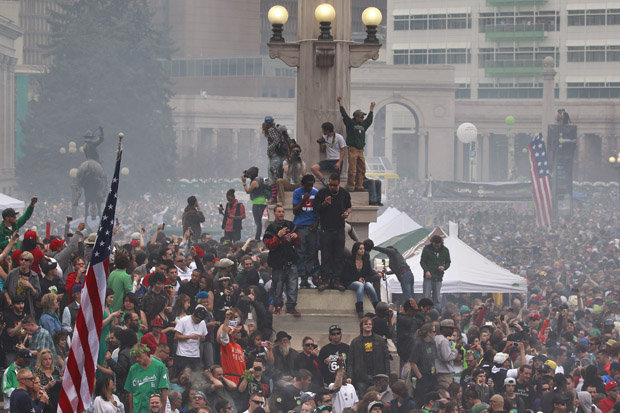
MarihuanaJumpingforJoyResidents of two states voted to legalize marijuana in 2012, but despite an increase in public support for liberalizing drug policy, American police arrested about the same number of people last year on pot-related charges as in 2011.

Data released Monday by the Federal Bureau of Investigation show there were an estimated 1,552,432 arrests for drug-related crimes in 2012 – a slight uptick from the 1,531,251 drug arrests in 2011.

Marijuana offenses accounted for 48.3 percent of all drug arrests, a slight reduction from 49.5 percent in 2011, which itself was the highest rate since before 1995.

Most marijuana-related arrests were for possession of the drug. By mere possession, there was one marijuana arrest every 48 seconds in 2012. Including arrests for distribution, there was a pot-related arrest every 42 seconds, the same interval as in 2011.

Advocacy groups that back campaigns to legalize or decriminalize weed said police should prioritize solving violent crimes – the number of which bumped upward from 2011 to 2012 – over arresting marijuana users.

According to the FBI’s Uniform Crime Report data, there were an estimated 1,214,462 violent crimes reported to police in 2012, a 0.7 percent increase. FBI Director James Comey noted in a statement this was the first overall increase in violent crime in six years.

Just 40.1 percent of the 84,376 forcible rapes reported to police and 28.1 percent of the 354,520 robberies were solved by law enforcement. Around 62.5 percent of the 14,827 murder cases were closed, as were 55.8 percent of the 760,739 aggravated assaults.

“As a former prosecuting attorney myself, I believe it is irresponsible to squander our limited law enforcement resources on this disastrous public policy failure,” said Dan Riffle, Marijuana Policy Project federal policies director, in a statement. “That is especially true when so many violent crimes remain unsolved. Every second spent arresting and prosecuting adults for marijuana is time that could have been spent preventing and solving real crimes.”

The group Law Enforcement Against Prohibition, made up of former and current law-enforcers who want to dampen drug prohibition, said the same.

“Each one of those arrests is the story of someone who may suffer a variety of adverse effects from their interaction with the justice system,” said LEAP Executive Director Neill Franklin, a former Maryland policeman, in a statement. “Commit a murder or a robbery and the government will still give you a student loan. Get convicted for smoking a joint and you’re likely to lose it.”

A poll released in April by the Pew Research Center found 52 percent of American adults believe marijuana should be legal.

It’s possible the national arrest tally for marijuana will be lower in 2013. State and local police enforce most anti-pot laws, and Washington and Colorado residents, who make up around 4 percent of the total U.S. population, will enjoy a largely arrest-free year.

The FBI report said there were 12,196,959 arrests for any reason in 2012, around one every two seconds.

Source: U.S. News & World Report

SWAT Team Raids Organic Farm, Confiscates Blueberries | Huffington Post

By Radley Balko

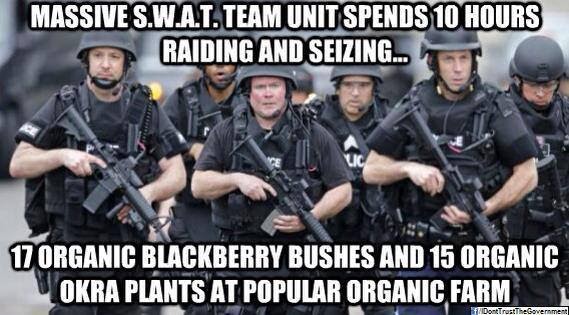
SWATTeamA small organic farm in Arlington, Texas, was the target of a massive police action last week that included aerial surveillance, a SWAT raid and a 10-hour search.

Members of the local police raiding party had a search warrant for marijuana plants, which they failed to find at the Garden of Eden farm. But farm owners and residents who live on the property told a Dallas-Ft. Worth NBC station that the real reason for the law enforcement exercise appears to have been code enforcement. The police seized “17 blackberry bushes, 15 okra plants, 14 tomatillo plants … native grasses and sunflowers,” after holding residents inside at gunpoint for at least a half-hour, property owner Shellie Smith said in a statement. The raid lasted about 10 hours, she said.

Local authorities had cited the Garden of Eden in recent weeks for code violations, including “grass that was too tall, bushes growing too close to the street, a couch and piano in the yard, chopped wood that was not properly stacked, a piece of siding that was missing from the side of the house, and generally unclean premises,” Smith’s statement said. She said the police didn’t produce a warrant until two hours after the raid began, and officers shielded their name tags so they couldn’t be identified. According to ABC affiliate WFAA, resident Quinn Eaker was the only person arrested — for outstanding traffic violations.

The city of Arlington said in a statement that the code citations were issued to the farm following complaints by neighbors, who were “concerned that the conditions” at the farm “interfere with the useful enjoyment of their properties and are detrimental to property values and community appearance.” The police SWAT raid came after “the Arlington Police Department received a number of complaints that the same property owner was cultivating marijuana plants on the premises,” the city’s statement said. “No cultivated marijuana plants were located on the premises,” the statement acknowledged.

The raid on the Garden of Eden farm appears to be the latest example of police departments using SWAT teams and paramilitary tactics to enforce less serious crimes. A Fox television affiliate reported this week, for example, that police in St. Louis County, Mo., brought out the SWAT team to serve an administrative warrant. The report went on to explain that all felony warrants are served with a SWAT team, regardless whether the crime being alleged involves violence.

In recent years, SWAT teams have been called out to perform regulatory alcohol inspections at a bar in Manassas Park, Va.; to raid bars for suspected underage drinking in New Haven, Conn.; to perform license inspections at barbershops in Orlando, Fla.; and to raid a gay bar in Atlanta where police suspected customers and employees were having public sex. A federal investigation later found that Atlanta police had made up the allegations of public sex.

Other raids have been conducted on food co-ops and Amish farms suspected of selling unpasteurized milk products. The federal government has for years been conducting raids on medical marijuana dispensaries in states that have legalized them, even though the businesses operate openly and are unlikely to pose any threat to the safety of federal enforcers.

Radley Balko is a senior writer and investigative reporter for The Huffington Post. He is also the author of the new book, Rise of the Warrior Cop: The Militarization of America’s Police Forces.

Sources: Huffington Post

‘Rampant Injustice’: The IRS And DOJ Raid Small Businesses With Paramilitary, Gestapo Style Tactics | Breitbart

By Debra Heine

A short documentary by Jan Morgan of JanMorganMedia, called “Rampant Injustice”  exposes the federal abuse of power that has taken place since Obama was elected. This underexposed video documents the  egregious trampling of the Constitutional rights of Americans during white collar crime investigations by the Department of Justice and the Criminal Investigation Division of the Internal Revenue Service.

Between 2009 and 2011, IRS audits against small businesses increased 32%. Federal warrants against businesses have also increased substantially with many of the raids conducted by SWAT teams.

Among the hundreds of businesses raided by the IRS and Department of Justice, using paramilitary, gestapo like tactics, was Mountain Pure Water Bottling Company and Duncan Outdoors, Inc., both situated in Arkansas and Gibson Guitar located in Tennessee. Their stories are profiled in the documentary which has been up on YouTube since October 31 of last year. The abusive targeting practices of the IRS toward conservative organizations  have finally made the news,  but these stories need exposure too.

The IRS and DOJ are out of control, and have been at war against small businesses.

At 8:00 a.m. on January 18, 2012, 40 -50 heavily armed, hostile government agents raided Mountain Pure water, scaring the dickens out of everyone in the building.

What you’re about to see is a reenactment of something that really happened.  The owner, John Stacks told me on the phone that it was even worse than depicted in the video.

He says he was cursed at, spat on,  and bullied in such an egregious fashion, he felt like they were trying to provoke him to react violently. His son, Court Stacks, the General Manager, had a loaded gun pointed to his face. His seven and a half month pregnant wife watched news coverage of the raid at home in horror. She would later lose the baby.

“I am not a militant”, Jerry Miller the Comptroller of Mountain Pure Water said. “They’ve thrown the Constitution away!”

John Stacks (a Republican) and his  son Ryan, an attorney, were not allowed to enter the building. Why? According to Miller, one of the agents told him, “we’re the federal government and we can do anything we want to.”

“They threw our liberties out the window”,
Miller concluded. “They treated us like third class citizens…if people are not outraged, they need to be. This used to be America – now it’s not.”

“I never fathomed that something to this extent could take place in the United States”, said Ryan Stacks. He went on to say they were being  treated similarly to “some type of terrorists, essentially.”

Duncan Outdoors faced a similar gestapo like raid with the eerily familiar refrain from one of the officers, “we’re from the IRS and we can do anything we want.”

John Stacks told me he lost business over the episode, because people generally think you’ve done something wrong when you get raided by the feds. Stacks’ “crime” stems from financial records being sought regarding a FEMA loan he got after a tornado destroyed one of his properties in May of 2008. The harassment started about a year and a half later, he said, on a loan he’s never been late in  paying.

“This documentary is not about the guilt or innocence of the citizens involved”, said Jan Morgan, an Investigative TV Journalist and Conservative Columnist said at the end of the video. “It is about the increasing number of unconstitutional, paramilitary, gestapo style raid tactics involving two agencies of the federal government.”

*Clarification: It was an SBA loan he secured through FEMA to recover the tornado losses to his home, warehouse, and associated equipment.

Mr. Stacks told James Simpson of AIM that the SBA “apparently doesn’t believe that assets listed as damaged in the storm were actually damaged.”

Source: Breitbart