
By Aaron Tang
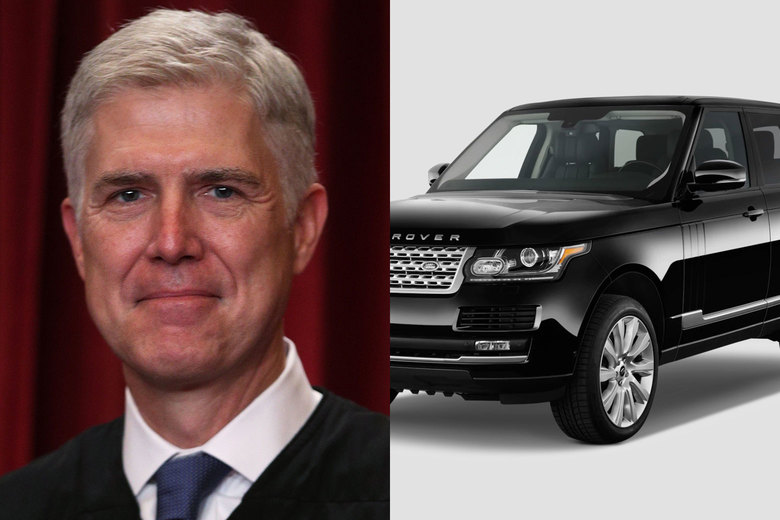 Tyson Timbs made an impulse buy. Then he made a series of mistakes.
After his father died, Timbs used roughly $42,000 of his father’s life insurance proceeds to buy a 2012 Land Rover. To support his heroin addiction, Timbs drove the Land Rover across Indiana to buy, transport, and sell drugs. Undercover police officers caught him in May 2013, and he was sentenced to one year of home detention, five years of probation, and roughly $1,200 in fines and court fees.
But that was not the end of the case. Under Indiana law, the state may seize any vehicle used in drug trafficking. So Indiana initiated a forfeiture action against Timbs’ Land Rover. The vehicle is itself a party to the case, leading to one of the more entertaining case titles in recent memory: Tyson Timbs and a 2012 Land Rover LR2 v. Indiana. While the name is unusual, forfeiture actions of this sort are quite common; by one count, states generated more than $250 million through forfeiture actions in 2012 alone.
This dispute is set make it all the way to our nation’s highest court later this month with important implications for law enforcement agencies and criminal justice reform. The case could rest on the say of one Supreme Court Justice in particular: Neil Gorsuch.
Although there was little dispute that the Land Rover was used in a crime, an Indiana district court judge denied the state’s attempt to seize it, reasoning forfeiture would violate the Eighth Amendment’s prohibition against “excessive fines.” After all, this is a crime for which Timbs was not even sentenced to a day in jail, and the total fines and court fees amounted to just a fraction of the Land Rover’s value. But the Indiana Supreme Court reversed, holding that the Eighth Amendment’s excessive fines clause does not even apply to the states. The U.S. Supreme Court granted certiorari to decide whether this striking conclusion is correct.
The state question here may be confusing. For a long period in our nation’s history, the Bill of Rights was understood only as a shield against federal encroachment on our rights. That changed with the 14th Amendment, which applied some (but not all) of the Bill of Rights’ protections at the state level. The precise pathway through which these rights are incorporated has long been a source of consternation for legal scholars, but the modern-day test is straightforward: States may not violate a right contained in the Bill of Rights if the right was “deeply rooted in our nation’s history and tradition.”
Timbs makes a forceful argument that the right to be free from excessive fines is deeply rooted in our history and tradition. That right first emerged in our Bill of Rights as an outgrowth from the 1689 English Bill of Rights and was quickly replicated across state constitutions. Indeed, by the time of the 14thAmendment’s enactment in 1868, 35 of the 37 states in the union had a ban against excessive fines. The need for protections against excessively punitive governmental exactions has only become more pressing with revelations of prosecutorial power abuses aimed at generating revenue in places like Ferguson, Missouri. For this very reason, Timbs drew supporting briefs from a wide array of groups ranging from the NAACP and ACLU to the U.S. Chamber of Commerce and Pacific Legal Foundation.
This should be the perfect case for a libertarian originalist like Neil Gorsuch. But it turns out there is an antecedent constitutional question in the case, and the historical evidence on that front points strongly in Indiana’s favor. That question is whether what Indiana has done—seize a vehicle used to traffic drugs through civil proceedings—can be said to constitute a fine.
There is ample evidence that the original meaning of the term “fine,” as it was used when the Eighth and 14th Amendments were ratified, did not extend to these kinds of civil forfeitures. After all, the federal government had a tradition of routinely seizing private property in ways that seem excessively harsh to the modern ear.
Consider the 1818 case of the Little Charles, a ship that the federal government seized after it sailed to Antigua in violation of an American embargo. In an opinion written by none other than Chief Justice John Marshall, the court reasoned that the ship could be subject to forfeiture even if it violated the embargo “without the authority, and against the will of the owner.”
Or take the Louisa Barbara case. Under an 1819 federal law, a ship could only carry a certain number of passengers based on its weight. The Louisa Barbara violated the limit by carrying 178 passengers—one more than it was authorized to carry. Yet the federal government proceeded to seize the entire ship. Federal courts were unmoved by the owner’s defense that many of the 178 passengers were children.
Stories of similarly harsh civil forfeitures fill Indiana’s brief in this case. Yet, as Indiana convincingly argues, no litigant even thought to argue that such forfeitures implicated the Eighth Amendment’s excessive fines clause. The first such argument was raised under a state constitution’s excessive fines clause in 1920 and failed; no court deemed a civil forfeiture to be an excessive fine until a federal court did in 1992—a position the Supreme Court ultimately agreed with the following year.
This history is what makes this case so hard for someone like Neil Gorsuch. If he follows the history and tradition of the Eighth Amendment to its logical extreme, the excessive fines clause would have nothing to say about an excessively harsh civil forfeiture. So, according to this thinking, Indiana could have seized Timbs’ vehicle due to its involvement in small scale drug trafficking even if it was the tawdriest of Ferraris. At the same time, there is the trouble of the aforementioned case called, Austin v. United States, in which the Supreme Court held in 1993 that the excessive fines clause does in fact cover civil forfeitures, at least when initiated by federal authorities. Yet Gorsuch has shown little reluctance to overrule settled precedent in his time on the bench so far. Finally, there is some evidence that the term “fine” was historically used interchangeably with “forfeiture,” which means that an ordinary member of the public in 1791 or 1868 may well have thought the latter encompassed by the former.
The court should acknowledge that both understandings of “fine” are plausible—one that includes forfeitures and one that does not. At that point, it seems wiser to decide which is the correct understanding of the Eighth Amendment by looking to the broader principles undergirding the Constitution, precedent, and the dire consequences of a rule authorizing limitless civil forfeitures for petty crimes. Each of those considerations weighs in Timbs’ favor. Or more precisely, they weigh in favor of a certain 2012 Land Rover and its odds of being reunited with its owner.
Source: Slate

 By Faisal Khan

 Liberty International News