When Laws and Liberties Test Each Other’s Limits | NY Times

By Stephen Holden

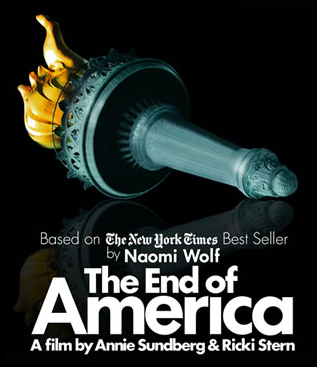
“The End of America,” an unsettling documentary polemic about the erosion of civil liberties in the wake of 9/11, brings up matters many of us would rather not contemplate in the middle of a financial crisis and on the eve of a new administration. Federal laws enacted during the last seven years that threaten our constitutional rights, it reminds us, remain in effect.

The pointedly inflammatory film, adapted from Naomi Wolf’s book “The End of America: A Letter of Warning to a Young Patriot,” compares the Bush administration’s attempts to discourage dissent and to wield increasingly unchecked power to the events preceding the establishment of 20th-century dictatorships in Germany, Italy, Chile and elsewhere. Without explicitly invoking the word, it implies that since 2001 the United States has drifted toward fascism in the name of fighting terror.

Tightly constructed and fiercely one-sided, “The End of America,” directed by Annie Sundberg and Ricki Stern (“The Devil Came on Horseback”), interweaves excerpts from a lecture in New York given by Ms. Wolf with film clips and interviews illustrating her contention that the rise of those dictatorships created a “blueprint” that the Bush administration, consciously or not, has followed.

According to Ms. Wolf, the first and fundamental tool for acquiring power is the manipulation of fear. In the shell-shocked post-

9/11 climate, the overwhelming public reaction to the Patriot Act of 2001, which gave law enforcement agencies expanded powers of surveillance, was mute acceptance of whatever was deemed necessary to keep us safe. Since then, she says, a color-coded system of terror alerts has been effectively wielded to keep us on edge.

From here, Ms. Wolf describes a 10-step program toward authoritarian rule that includes the creation of secret prisons where torture takes place; the deployment of a paramilitary force (Blackwater, which the film calls a contemporary American variation on Mussolini’s private army of “black shirts”); the development of an internal surveillance system; the harassment of citizens’ groups; and the arbitrary detention and release of ordinary civilians.

The film’s most disturbing moments are its accounts of James Yee, a United States Army chaplain at Guantánamo, who was accused of espionage and held in solitary confinement for 76 days before being released, and Maher Arar, a Syrian-born Canadian telecommunications engineer, who was detained at Kennedy International Airport, then later deported to Syria, where he was imprisoned for a year and tortured. He was eventually cleared of charges of terrorism.

The seventh step, selecting key individuals for harassment, cites the Dixie Chicks and Dan Rather as prominent cases. The eighth step, the restriction of the press, focuses on the case of Josh Wolf, a journalist jailed for 226 days for refusing to turn over videotapes he made of police brutality at a July 2005 demonstration in San Francisco.

The ninth step, the equating of political dissidents with traitors, fleetingly examines the Bush administration’s floating of the word “treason” to describe The New York Times’s publication of classified information about the government’s monitoring of overseas telephone calls. All these middle steps might be described as examples of selective intimidation intended to inhibit dissent. The case histories are glossed over.

The final step in Ms. Wolf’s Top 10 is the suspension of the rule of law. She cites the refusal of Bush administration insiders subpoenaed to appear before Congress to testify in the United States attorneys scandal. The film ends on a note of stern warning: the 11th step might be the imposing of martial law.

If the film’s vision of the steps leading toward a homegrown fascist state qualifies as paranoid, there is still enough here to make you shiver. Could it happen here? Maybe. A little fear — not the collective panic that followed 9/11 — can be a useful thing.

Source: New York Times/Movies
Liberty and Taboos

TabooScreen

Sirius Media produced and packaged a film of one of my seminars in Vancouver, BC entitled The Taboo of Sovereignty, Money, Love and Power” several years ago at the Vancouver Public Library. The film is about the conversations we’re afraid to engage in as a society. The film has not been released.

In the meantime if you want a taste of some of my favorite videos visit the VodPod ICResource channel or YouTube ICResource channel and subscribe. There’s even a short clip somebody posted of the infamous Johnny Liberty speaking on freedom and sovereignty way back in 1995 at the Granada Forum.

Johnny Liberty & Braveheart

Felt all that William Wallace experienced and more without the bloodshed and war. He was motivated by a desire for freedom as well as the patriotism of his country free from English despotism. Having lost his beloved in death to the nobles occupying his country he was vengeful and angry at the injustice.

Then as now the hope of the masses was to experience true freedom, but such hope was lost when they were not willing to unite, stand together and pay the price. Like Wallace I experienced the loneliness and betrayal of my brethren who were unwilling to take a stand even for their own sovereignty.

When push came to shove as the IRS came knocking down my door, they ran for the hills. When I was arrested and sent to prison all but a few walked away and left me alone without support or even the comfort of solidarity. Such cowardice is met with the loss of something so dear it’s unspeakable.

Yet there were those who stood by, weathered the storm, comforted and loved me while I was in prison. Those dear souls were enriched and forever blessed.

Different than Wallace I falsely admitted guilt for crimes I didn’t commit. This was not though an act of cowardice, but an act of self-love. Such an admission was necessary to minimize the prison sentence and return home to my loved ones as soon as possible.

I was not willing to be martyred or sacrificed at the hands of an unjust court for a cause too few believed in. Still I believe in the sovereignty of the people, to one day awaken to that fact and act accordingly. But this was not the time for the people to rise up and challenge their government as I’d expected, hoped and done myself for over a decade.

Admittedly, I was weakened by the fight, alone to the core, but refused to fight anymore. My spiritual path was to surrender and allow the greater power to enter my heart from within, not challenge the hardened walls of external authority.

Reclaiming internal authority over our lives, over my life was the essence of the teachings all those years (not to topple the government). In my utter defeat I lost one kind of power and gained yet another without the horrible death and torture Wallace suffered while screaming out “Freedom!”

His cry, as was mine, was for liberty and justice to prevail once more in the “land of the (allegedly) free.” Distinctly from Wallace my battle cry was to “wake up America (and the world).” Like Wallace I’ll cry “Freedom” until the end of my days.

So in prison I waited and bided my time well. I did my time as punishment for the crimes of standing courageously tall against an impossible force, telling the truth amidst very dangerous situations and being a responsible leader. I went boldly where very few men have had the courage to go. I may have been the last free American, a man who hadn’t already embraced the slave state-of-mind.

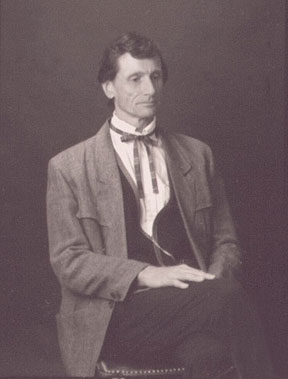
My friends, there’s a greater story yet to be told. But for now I am a silent, forgotten legend of a man who once lived tall and raised his banner of “liberty” for all to see. This “Johnny Liberty” rides no more in America.

This “John David Van Hove” is a free-spirit still (as the judge observed), a free man in the spiritual realms, the incarnation of Hyoka and Crazy Horse, a “braveheart” indeed who took “liberty” as far as he could and challenged external authority and the law that plundered his people.

Now, he’s refocused on being a true human being, recognizing and remembering always the bell that tolls within, a “liberty” that still rings true to his soul.

Johnny Liberty’s “Are You Sovereign” Presentation | Granada Forum (1995) | YouTube Videos

Additional Videos