John Pilger on ISIS: Only When We See the War Criminals In Our Midst Will the Blood Begin to Dry | Films for Action

By John Pilger

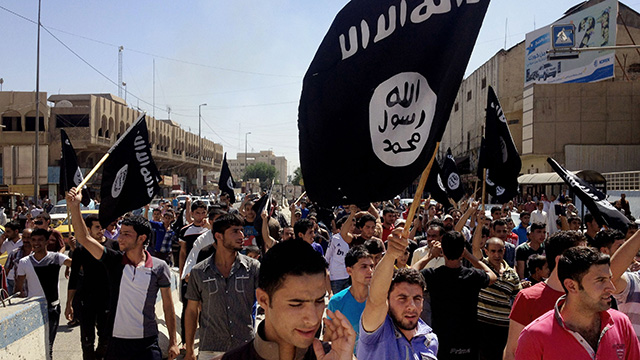
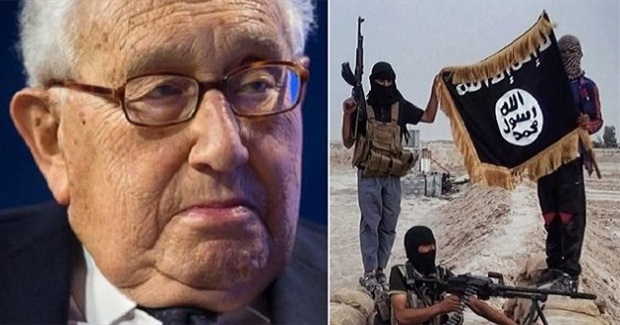
KissingerISISIn transmitting President Richard Nixon’s orders for a “massive” bombing of Cambodia in 1969, Henry Kissinger said, “Anything that flies on everything that moves”.  As Barack Obama ignites his seventh war against the Muslim world since he was awarded the Nobel Peace Prize, the orchestrated hysteria and lies make one almost nostalgic for Kissinger’s murderous honesty.

As a witness to the human consequences of aerial savagery – including the beheading of victims, their parts festooning trees and fields – I am not surprised by the disregard of memory and history, yet again. A telling example is the rise to power of Pol Pot and his Khmer Rouge, who had much in common with today’s Islamic State in Iraq and Syria (ISIS). They, too, were ruthless medievalists who began as a small sect. They, too, were the product of an American-made apocalypse, this time in Asia.

According to Pol Pot, his movement had consisted of “fewer than 5,000 poorly armed guerrillas uncertain about their strategy, tactics, loyalty and leaders”. Once Nixon’s and Kissinger’s B52 bombers had gone to work as part of “Operation Menu”, the west’s ultimate demon could not believe his luck.

The Americans dropped the equivalent of five Hiroshimas on rural Cambodia during 1969-73. They levelled village after village, returning to bomb the rubble and corpses. The craters left monstrous necklaces of carnage, still visible from the air. The terror was unimaginable. A former Khmer Rouge official described how the survivors “froze up and they would wander around mute for three or four days. Terrified and half-crazy, the people were ready to believe what they were told… That was what made it so easy for the Khmer Rouge to win the people over.”

A Finnish Government Commission of Enquiry estimated that 600,000 Cambodians died in the ensuing civil war and described the bombing as the “first stage in a decade of genocide”. What Nixon and Kissinger began, Pol Pot, their beneficiary, completed. Under their bombs, the Khmer Rouge grew to a formidable army of 200,000.

ISIS has a similar past and present. By most scholarly measure, Bush and Blair’s invasion of Iraq in 2003 led to the deaths of some 700,000 people – in a country that had no history of jihadism. The Kurds had done territorial and political deals; Sunni and Shia had class and sectarian differences, but they were at peace; intermarriage was common. Three years before the invasion, I drove the length of Iraq without fear. On the way I met people proud, above all, to be Iraqis, the heirs of a civilization that seemed, for them, a presence.

Bush and Blair blew all this to bits. Iraq is now a nest of jihadism. Al-Qaeda – like Pol Pot’s “jihadists” – seized the opportunity provided by the onslaught of Shock and Awe and the civil war that followed. “Rebel” Syria offered even greater rewards, with CIA and Gulf state ratlines of weapons, logistics and money running through Turkey. The arrival of foreign recruits was inevitable. A former British ambassador, Oliver Miles, wrote recently, “The [Cameron] government seems to be following the example of Tony Blair, who ignored consistent advice from the Foreign Office, MI5 and MI6 that our Middle East policy – and in particular our Middle East wars – had been a principal driver in the recruitment of Muslims in Britain for terrorism here.”

ISIS is the progeny of those in Washington and London who, in destroying Iraq as both a state and a society, conspired to commit an epic crime against humanity. Like Pol Pot and the Khmer Rouge, ISIS are the mutations of a western state terror dispensed by a venal imperial elite undeterred by the consequences of actions taken at great remove in distance and culture. Their culpability is unmentionable in “our” societies.

It is 23 years since this holocaust enveloped Iraq, immediately after the first Gulf War, when the US and Britain hijacked the United Nations Security Council and imposed punitive “sanctions” on the Iraqi population – ironically, reinforcing the domestic authority of Saddam Hussein. It was like a medieval siege. Almost everything that sustained a modern state was, in the jargon, “blocked” – from chlorine for making the water supply safe to school pencils, parts for X-ray machines, common painkillers and drugs to combat previously unknown cancers carried in the dust from the southern battlefields contaminated with Depleted Uranium.

Just before Christmas 1999, the Department of Trade and Industry in London restricted the export of vaccines meant to protect Iraqi children against diphtheria and yellow fever. Kim Howells, parliamentary Under-Secretary of State in the Blair government, explained why. “The children’s vaccines”, he said, “were capable of being used in weapons of mass destruction”. The British Government could get away with such an outrage because media reporting of Iraq – much of it manipulated by the Foreign Office – blamed Saddam Hussein for everything.

Under a bogus “humanitarian” Oil for Food Programme, $100 was allotted for each Iraqi to live on for a year. This figure had to pay for the entire society’s infrastructure and essential services, such as power and water. “Imagine,” the UN Assistant Secretary General, Hans Von Sponeck, told me, “setting that pittance against the lack of clean water, and the fact that the majority of sick people cannot afford treatment, and the sheer trauma of getting from day to day, and you have a glimpse of the nightmare. And make no mistake, this is deliberate. I have not in the past wanted to use the word genocide, but now it is unavoidable.”

Disgusted, Von Sponeck resigned as UN Humanitarian Co-ordinator in Iraq. His predecessor, Denis Halliday, an equally distinguished senior UN official, had also resigned. “I was instructed,” Halliday said, “to implement a policy that satisfies the definition of genocide: a deliberate policy that has effectively killed well over a million individuals, children and adults.”

A study by the United Nations Children’s Fund, Unicef, found that between 1991 and 1998, the height of the blockade, there were 500,000 “excess” deaths of Iraqi infants under the age of five. An American TV reporter put this to Madeleine Albright, US Ambassador to the United Nations, asking her, “Is the price worth it?” Albright replied, “We think the price is worth it.”

In 2007, the senior British official responsible for the sanctions, Carne Ross, known as “Mr. Iraq”, told a parliamentary selection committee, “[The US and UK governments] effectively denied the entire population a means to live.”  When I interviewed Carne Ross three years later, he was consumed by regret and contrition. “I feel ashamed,” he said. He is today a rare truth-teller of how governments deceive and how a compliant media plays a critical role in disseminating and maintaining the deception. “We would feed [journalists] factoids of sanitised intelligence,” he said, “or we’d freeze them out.”

On 25 September, a headline in the Guardian read: “Faced with the horror of Isis we must act.” The “we must act” is a ghost risen, a warning of the suppression of informed memory, facts, lessons learned and regrets or shame. The author of the article was Peter Hain, the former Foreign Office minister responsible for Iraq under Blair. In 1998, when Denis Halliday revealed the extent of the suffering in Iraq for which the Blair Government shared primary responsibility, Hain abused him on the BBC’s Newsnight as an “apologist for Saddam”. In 2003, Hain backed Blair’s invasion of stricken Iraq on the basis of transparent lies. At a subsequent Labour Party conference, he dismissed the invasion as a “fringe issue”.

Now Hain is demanding “air strikes, drones, military equipment and other support” for those “facing genocide” in Iraq and Syria. This will further “the imperative of a political solution”. Obama has the same in mind as he lifts what he calls the “restrictions” on US bombing and drone attacks. This means that missiles and 500-pound bombs can smash the homes of peasant people, as they are doing without restriction in Yemen, Pakistan, Afghanistan and Somalia – as they did in Cambodia, Vietnam and Laos. On 23 September, a Tomahawk cruise missile hit a village in Idlib Province in Syria, killing as many as a dozen civilians, including women and children. None waved a black flag.

The day Hain’s article appeared, Denis Halliday and Hans Von Sponeck happened to be in London and came to visit me. They were not shocked by the lethal hypocrisy of a politician, but lamented the enduring, almost inexplicable absence of intelligent diplomacy in negotiating a semblance of truce. Across the world, from Northern Ireland to Nepal, those regarding each other as terrorists and heretics have faced each other across a table. Why not now in Iraq and Syria.

Like Ebola from West Africa, a bacteria called “perpetual war” has crossed the Atlantic. Lord Richards, until recently head of the British military, wants “boots on the ground” now. There is a vapid, almost sociopathic verboseness from Cameron, Obama and their “coalition of the willing” – notably Australia’s aggressively weird Tony Abbott – as they prescribe more violence delivered from 30,000 feet on places where the blood of previous adventures never dried. They have never seen bombing and they apparently love it so much they want it to overthrow their one potentially valuable ally,  Syria. This is nothing new, as the following leaked UK-US intelligence file illustrates:

“In order to facilitate the action of liberative [sic] forces… a special effort should be made to eliminate certain key individuals [and] to proceed with internal disturbances in Syria. CIA is prepared, and SIS (MI6) will attempt to mount minor sabotage and coup de main [sic] incidents within Syria, working through contacts with individuals… a necessary degree of fear… frontier and [staged] border clashes [will] provide a pretext for intervention… the CIA and SIS should use… capabilities in both psychological and action fields to augment tension.”

That was written in 1957, though it could have been written yesterday. In the imperial world, nothing essentially changes. Last year, the former French Foreign Minister Roland Dumas revealed that “two years before the Arab spring”, he was told in London that a war on Syria was planned. “I am going to tell you something,” he said in an interview with the French TV channel LPC, “I was in England two years before the violence in Syria on other business. I met top British officials, who confessed to me that they were preparing something in Syria… Britain was organising an invasion of rebels into Syria. They even asked me, although I was no longer Minister for Foreign Affairs, if I would like to participate… This operation goes way back. It was prepared, preconceived and planned.”

The only effective opponents of ISIS are accredited demons of the west – Syria, Iran, Hezbollah. The obstacle is Turkey, an “ally” and a member of Nato, which has conspired with the CIA, MI6 and the Gulf medievalists to channel support to the Syrian “rebels”, including those now calling themselves ISIS. Supporting Turkey in its long-held ambition for regional dominance by overthrowing the Assad government beckons a major conventional war and the horrific dismemberment of the most ethnically diverse state in the Middle East.

A truce – however difficult to achieve – is the only way out of this imperial maze; otherwise, the beheadings will continue. That genuine negotiations with Syria should be seen as “morally questionable” (the Guardian) suggests that the assumptions of moral superiority among those who supported the war criminal Blair remain not only absurd, but dangerous.

Together with a truce, there should be an immediate cessation of all shipments of war materials to Israel and recognition of the State of Palestine. The issue of Palestine is the region’s most festering open wound, and the oft-stated justification for the rise of Islamic extremism. Osama bin Laden made that clear. Palestine also offers hope. Give justice to the Palestinians and you begin to change the world around them.

More than 40 years ago, the Nixon-Kissinger bombing of Cambodia unleashed a torrent of suffering from which that country has never recovered. The same is true of the Blair-Bush crime in Iraq. With impeccable timing, Henry Kissinger’s latest self-serving tome has just been released with its satirical title, “World Order”. In one fawning review, Kissinger is described as a “key shaper of a world order that remained stable for a quarter of a century”. Tell that to the people of Cambodia, Vietnam, Laos, Chile, East Timor and all the other victims of his “statecraft”.  Only when “we” recognise the war criminals in our midst will the blood begin to dry.


Source: John Pilger

A Primer: What is the Islamic State, and Why Are We Fighting Them? | BillMoyers.com

By Joshua Holland

Who Are These Islamic State Guys?

IS is a group of violent Islamic fundamentalists that first formed in Iraq in the aftermath of the US invasion as Jama’at al-Tawhid wal-Jihad, or “The Organization of Monotheism and Jihad.” It has gone by many names; today, it is also known as the Islamic State, The Islamic State of Iraq and Syria (ISIS) and the Islamic State of Iraq and the Levant (ISIL). As the latter name implies, they ultimately aspire to create an ultra-conservative Islamic state in Iraq, Syria, Lebanon, Israel, Jordan, Cyprus and Southern Turkey.

To simplify a complex history, the organization, which was most familiar to Americans as “Al-Qaeda in Iraq,” began in late 2004 as a home-grown Iraqi Sunni insurgency group that pledged allegiance to Osama Bin Laden. It has expanded into Syria during that country’s civil war, where it attracted extremists from around the world and grew in numbers and strength. Last October, Liz Sly reported for The Washington Post that “thousands of Arabs and other non-Syrian Muslims” had “streamed into Syria over the past two years to join in the fight.”

Experts say that IS has now become so powerful and well-organized that it’s misleading to call it a “terrorist group.” Jessica Lewis of the Washington-based Institute for the Study of War told Time Magazine that it now has “an advanced military leadership… They have incredible command and control and they have a sophisticated reporting mechanism from the field that can relay tactics and directives up and down the line,” she said. “They are well-financed, and they have big sources of manpower, not just the foreign fighters, but also prisoner escapees.”

Martin Chulov reports for The Guardian that IS has “secured massive cashflows from the oilfields of eastern Syria, and supplemented those revenues by robbing banks and looting antiquities.” According to Chulov, the network may have access to $2 billion.

Writing for The Atlantic, Aaron Zelin notes that IS has established a very severe form of Islamic law in areas it has occupied, while also employing “a soft-power governing strategy that includes social services, religious lectures, and da’wa(proselytizing) to local populations.” And at The Nation, Robert Dreyfuss suggeststhat there’s “a real danger that ISIS and its allies can set up a rump statelet in northwest Iraq and northern and eastern Syria controlled by ISIS, and its allies, including groups more closely affiliated to Al Qaeda.”

What’s the Regional Context Here?

This is both an Iraqi conflict, and also a tangled web of proxy wars fought along various regional fault lines.

This chart, by Hayes Brown and Adam Peck from ThinkProgress, is a helpful guide to all of the parties in this highly interconnected conflict:

Media accounts often focus on the discord between the Gulf states, led by Saudi Arabia, and the “Shiite crescent” — Iraq and Iran, where Shiites are the majority; Lebanon, where Hezbollah is a powerful faction; and Syria, where the Alawites (an offshoot of Shia Islam) are a dominant minority. As the chart above illustrates, this tension also affects Turkey, which has launched multiple strikes against Kurdish separatists in Iraq, and the Israeli-Palestinian conflict.

The Pew Research Center finds that throughout the region, from Tunisia to Egypt, there are “widespread fears” that the “violence in Syria would spill over into neighboring states.”

Are We Responsible for This Mess?

APTOPIX Mideast IraqThat’s an oversimplification.

It also takes a short view of history: As the birthplace of the three major Abrahamic religions — and the repository for a good chunk of the world’s oil reserves — the Middle East has long been plagued by conflict. The European colonial powers that sliced up the territory according to their own needs also deserve a lot of credit for its current instability — at GlobalPost, Charles Sennott writes that ISIS is in the process of “tearing up the map” created by France and Great Britain during World War I.

That said, it’s impossible to deny that the US invasion of Iraq in March 2003, plus a series of ideologically informed decisions by the Bush administration that followed, is the proximate cause of the bloody conflict raging there today.

The Bush administration went into Iraq with a “small footprint” — that is, insufficient forces to provide security — fired the army and police as part of its “de-baathification” program, privatized the Iraqi economy instead of investing in adequate public services and established a Shiite-dominated government that marginalized the Sunni community.

At The New Yorker, Dexter Filkins argues that the current wave of extremism in Iraq is “America’s legacy.” He writes: “When the Americans invaded they destroyed the Iraqi state—its military, its bureaucracy, its police force, and most everything else that might hold a country together.”

In 2004, The Atlantic’s James Fallows reported that “the Administration will be condemned for what it did with what was known. The problems the United States has encountered are precisely the ones its own expert agencies warned against.” Naomi Klein reported for Harper’s that the administration’s free-market ideology was the root cause of many of the problems that plagued US reconstruction efforts. In 2007, Nir Rosen wrote in The Washington Post that an “obsession with sects informed the U.S. approach to Iraq from day one of the occupation, but it was not how Iraqis saw themselves — at least, not until very recently. Iraqis were not primarily Sunnis or Shiites; they were Iraqis first, and their sectarian identities did not become politicized until the Americans occupied their country, treating Sunnis as the bad guys and Shiites as the good guys. ” That same year, Raed Jarrar and I said that US officials in Iraq had thwarted a number of plans for peace and reconciliation that had been put forth by parties that opposed the occupation.

The US also played a major role in Nouri al-Maliki’s rise to power following the handover from the Iraqi Coalition Government. Maliki has governed in a fiercely sectarian manner — Al-Monitor states that many “inhabitants of Mosul see the Iraqi army as a Shiite occupation army from Baghdad, and some civilians welcomed ISIS when they entered Mosul and removed all Iraqi army checkpoints. And while The Washington Post’s David Ignatius wrote back in 2007 that “the most important fact about Maliki’s election is that it’s a modest declaration of independence from Iran,” Maliki spent a decade in exile in Iran and, despite some ideological differences, the party he heads, Dawa, has received consistent support from Tehran.

Dexter Filkins reported for The New Yorker that a crucial deal that brought the current Iraqi government together was orchestrated by Qassem Suleimani, the head of Iran’s Quds Force and the architect of Syrian President Bashar al-Assad’s war against the Syrian insurgency.

Source: Bill Moyers


The Plan Acccording to U.S. General Wesley Clark (Ret.) | YouTube

In an interview with Amy Goodman on March 2, 2007, U.S. General Wesley Clark (Ret.), explains that the Bush Administration planned to take out 7 countries in 5 years: Iraq, Syria, Lebanon, Lybia, Somalia, Sudan, Iran.

We didn’t have to invade them, but just throw out their governments and divide the countries with the help of destabilisation.

  • Iraq – ✓[2003]
  • Afghanistan – ✓ [2001]
  • Libya – ✓ [ The fall of Gaddafi 2011 ]
  • Sudan – ✓[Divided last year in two states after US sponsored terrorism.]
  • Somalia – ✓ [US puppets in government]
  • Lebanon – [In progress right now. The Syrian war is spreading across the borders just last week]
  • Syria – [In progress right now. US financed terrorism]
  • Iran – The final stage. And it will be loud one.

Islamic charity founder Pete Seda ‘vindicated’ by ruling saying feds tried to turn tax fraud into terrorism | The Oregonian

By Bryon Denson

A federal appeals court Friday overturned the 2010 criminal conviction of Pete Seda, a key figure in an Ashland charity accused of supporting terrorism by smuggling money 10 years earlier to Chechen guerrillas at war with the Russian Federation.

The 9th U.S. Circuit Court of Appeals opinion accuses federal prosecutors of improperly influencing the outcome of Seda’s trial by concealing that they had paid a witness. The government also exceeded the scope of a search warrant and omitted facts that might have helped the defense, the court ruled.

“This is a tax fraud case that was transformed into a trial on terrorism,” Circuit Judge M. Margaret McKeown wrote in the panel’s 2-1 opinion.

The Iranian-born Seda, whose formal name is Pirouz Sedaghaty, was charged with falsifying a 2000 tax form filed on behalf of the U.S. wing of the Al-Haramain Islamic Foundation Inc., a Saudi Arabian charity. The U.S. government accused the charity of sending $150,000 through Saudi Arabia to fund terrorist activities and support the Chechen mujahideen “under the guise of humanitarian aid,” McKeown wrote.

Seda’s defense team, headed by Federal Public Defender Steven T. Wax, argued that Seda’s accountant caused the discrepancy in his client’s 2001 tax form and that Seda had a long, fruitful history as a man peacefully advancing the word of Islam.

A jury in Eugene’s U.S. District Court found Seda guilty of defrauding the U.S. government by making false statements on the tax return. He was later sentenced to 33 months in prison.

Wax told The Oregonian that he and Seda had waited nervously for the 9th Circuit opinion since arguing the case before the panel last December. When he got the news, Wax phoned Seda at a Portland halfway house — where he was serving the final day of his sentence since leaving prison in May.

“Pete was quite pleased to finally have some vindication of his position,” Wax said. “He has denied his guilt from the outset of these proceedings and is quite happy that the circuit has recognized that the trial was not a fair one.”

Amanda Marshall, the U.S. attorney for Oregon, said her office is reviewing the opinion and considering its options. Those range from dismissing the case to holding a new trial to filing appeals that might take the case all the way to the U.S. Supreme Court.

“Any decision about whether we will seek further review will have to be made in consultation with the (U.S. Department of Justice) Criminal Division and Solicitor General’s Office,” Marshall said in a prepared statement.

Government prosecutors withheld “significant impeachment evidence” by not telling the trial court that one of its key witnesses had been paid by the FBI, the appeals court found.

The panel also concluded that FBI agents, who obtained a search warrant from a U.S. magistrate for Seda’s home and the charity’s office, “went well beyond” the limitations imposed by the order when they searched Seda’s computer hard drives.

“The appeal illustrates the fine line between the government’s use of relevant evidence to document motive for a cover-up and its use of inflammatory, unrelated evidence about Osama Bin-Laden and terrorist activity that prejudices the jury,” McKeown wrote.

U.S. District Judge Michael Hogan did not properly follow the Classified Information Procedures Act as he tried the Seda case, the appellate panel found.

The law, known as CIPA, is intended to protect government secrets from disclosure at trial while ensuring that defendants are given substitute documents — typically written summaries — of classified materials. The appeals court found that the substitution approved by Hogan did not provide Seda “with substantially the same ability to make his defense as would disclosure of the specified classified information.”

Government prosecutors in Oregon have used CIPA to protect U.S. secrets in a number of national security cases. Those include the 2002 Portland Seven terrorism case, the 2009 spy case against former CIA officer Jim Nicholson and the trial of Mohamed Mohamud, the man found guilty in January of attempting to set off a bomb at Portland’s 2010 holiday tree-lighting ceremony.

The appellate ruling on CIPA won’t change the law, but it’s likely to give judges who find themselves trying national-security cases some pause, said Tung Yin, a professor at Lewis & Clark Law School who has followed the Seda case.

The ruling, he said, will serve as “a reminder to pay a little more attention to the substitutions and make sure they are crafted neutrally.”

Source: The Oregonian

Top US Government Insider: Bin Laden Died In 2001, 9/11 A False Flag | Prison Planet

By Paul Joseph Watson

Top US government insider Dr. Steve R. Pieczenik, a man who held numerous different influential positions under three different Presidents and still works with the Defense Department, shockingly told The Alex Jones Show yesterday that Osama Bin Laden died in 2001 and that he was prepared to testify in front of a grand jury how a top general told him directly that 9/11 was a false flag inside job.

Pieczenik cannot be dismissed as a “conspiracy theorist”. He served as the Deputy Assistant Secretary of State under three different administrations, Nixon, Ford and Carter, while also working under Reagan and Bush senior, and still works as a consultant for the Department of Defense. A former US Navy Captain, Pieczenik achieved two prestigious Harry C. Solomon Awards at the Harvard Medical School as he simultaneously completed a PhD at MIT.

Recruited by Lawrence Eagleburger as Deputy Assistant Secretary of State for Management, Pieczenik went on to develop, “the basic tenets for psychological warfare, counter terrorism, strategy and tactics for transcultural negotiations for the US State Department, military and intelligence communities and other agencies of the US Government,” while also developing foundational strategies for hostage rescue that were later employed around the world.

Pieczenik also served as a senior policy planner under Secretaries Henry Kissinger, Cyrus Vance, George Schultz and James Baker and worked on George W. Bush’s election campaign against Al Gore. His record underscores the fact that he is one of the most deeply connected men in intelligence circles over the past three decades plus.

The character of Jack Ryan, who appears in many Tom Clancy novels and was also played by Harrison Ford in the popular 1992 movie Patriot Games, is also based on Steve Pieczenik.

Back in April 2002, over nine years ago, Pieczenik told the Alex Jones Show that Bin Laden had already been “dead for months,” and that the government was waiting for the most politically expedient time to roll out his corpse. Pieczenik would be in a position to know, having personally met Bin Laden and worked with him during the proxy war against the Soviets in Afghanistan back in the early 80′s.

Pieczenik said that Osama Bin Laden died in 2001, “Not because special forces had killed him, but because as a physician I had known that the CIA physicians had treated him and it was on the intelligence roster that he had marfan syndrome,” adding that the US government knew Bin Laden was dead before they invaded Afghanistan.

Marfan syndrome is a degenerative genetic disease for which there is no permanent cure. The illness severely shortens the life span of the sufferer.

“He died of marfan syndrome, Bush junior knew about it, the intelligence community knew about it,” said Pieczenik, noting how CIA physicians had visited Bin Laden in July 2001 at the American Hospital in Dubai.

“He was already very sick from marfan syndrome and he was already dying, so nobody had to kill him,” added Pieczenik, stating that Bin Laden died shortly after 9/11 in his Tora Bora cave complex.

“Did the intelligence community or the CIA doctor up this situation, the answer is yes, categorically yes,” said Pieczenik, referring to Sunday’s claim that Bin Laden was killed at his compound in Pakistan, adding, “This whole scenario where you see a bunch of people sitting there looking at a screen and they look as if they’re intense, that’s nonsense,” referring to the images released by the White House which claim to show Biden, Obama and Hillary Clinton watching the operation to kill Bin Laden live on a television screen.

“It’s a total make-up, make believe, we’re in an American theater of the absurd….why are we doing this again….nine years ago this man was already dead….why does the government repeatedly have to lie to the American people,” asked Pieczenik.

“Osama Bin Laden was totally dead, so there’s no way they could have attacked or confronted or killed Osama Bin laden,” said Pieczenik, joking that the only way it could have happened was if special forces had attacked a mortuary. Read more…

The Idea of Enemies is Killing Us | Baltimore Chronicles

By Deb Reich

“In a globally internetworked world, we are all going to learn to work together because there’s no viable alternative.”

Consider this: The “enemies paradigm” and the perspective it represents are obsolete. We humans on this Earth are in the process of moving onward, beyond that worldview, into a different era. In the new era, there will still be groups of people we may see as our adversaries, but they will not be enemies. There will still be bad problems, but we will solve them more ably, working together with the people we used to think of as our enemies. In a globally internetworked world, we are all going to learn to do this because there’s no viable alternative. It begins with adopting a different mental map.

The organizing principle of the new mental map is the idea of No More Enemies. It belongs to everyone on the planet. It’s a simple idea, really. The concept of “enemies” is no longer serving humanity. It has, demonstrably, become very destructive and is overdue for retirement. The old enemies-oriented worldview is being displaced by emergent new paradigms of partnership, shared responsibility, and co-evolving. Humanity is struggling to redesign itself, using new tools. New technologies of medical imaging, for instance, give us a crucial biofeedback loop to evaluate the impact of our own thoughts and cultural habits on our health, our behavior, our society, our planet. That gives us new information to help us co-redesign our way of understanding and interacting with our world. The evidence is there in plain sight…we just have to connect the dots.

“We, the people, are not the problem. The problem is the paradigm: the enemies paradigm.”

As a Jewish American Israeli woman who has spent years living and working with Muslim and Christian Arabs in Israel/Palestine, I know what I’m talking about. We, the people, are not the problem. The problem is the paradigm: the enemies paradigm.

Many of us have already discarded the enemies-based map of reality. We know that we have like-minded partners elsewhere in the Middle East, and far beyond. Our shared mantra, from Rela Mazali: We refuse to be enemies. We are trying to swing the regional momentum away from violence and fear and toward pluralism and equality. But history, the educational system, industry, army, religious extremism and government are all against us (so far). What we mainly have is our vision of a different way: No More Enemies.

“In Israel, successive governments have built a gigantic wall of brutality in the vain hope of protecting the folks on one side from the aspirations on the other side: never a sustainable strategy.”

In Israel, successive governments have built a gigantic wall of brutality in the vain hope of protecting the folks on one side from the aspirations on the other side: never a sustainable strategy. Our wall is like all such walls: constructed and funded by successive regimes, meant to keep at bay those whom the authorities wish to exclude, and to intimidate those who dissent. This wall is made of cement and electronic sensors and barbed wire, but the mortar binding it is made of powerful existential anxieties, of memories of historical suffering and injustice, and of continuing bloodshed mixed with fear, fear, fear.

And now—inevitably—there is this global picket line that has sprung up around Israel in response. BDS (boycott, divestment, sanctions), the Palestinian-led boycott movement is a call for equal rights for every person in this land and is supported worldwide by hundreds of thousands of people across a broad political spectrum. Most of them can agree on little else; oppression often makes strange bedfellows. Although not a boycott enthusiast, I have publicly supported this one as a nonviolent way of leveraging policy change here—because the alternative (business as usual) will be much worse for everyone concerned, long-term.

Clearly, things in Israel and Palestine have gone horribly wrong over the years. There has been heroism, and barbarism, on every side (all exhaustively documented). A vast river of self-righteous rhetoric has flowed under the bridge. None of that has mended what’s wrong here, and the situation is surely not going to fix itself. By rejecting Wallmania and working together, however, we can transform this scenario and get a life for us and our neighbors. The dissidents next door are equally committed. Maybe you’ve seen some of them on TV recently. This is deep change coming, which is why it evokes a backlash. We say: No fear. No more enemies.

“Palestinian nonviolence is not new.”

Did you know that the nonviolent Palestinian independence movement is not new? It is not new but it has been successfully smothered for decades, both by the somewhat discredited romance with “armed struggle” and by Israeli government repression. No longer. As its leaders are jailed, harassed, and even killed, this movement only grows stronger. In recent years, significant segments of Palestinian civil society, including young people, have indeed renounced violence. They have renounced it in English, Hebrew, and Arabic. They have done so sincerely, authentically, publicly, and repeatedly until, right now, there may be more Palestinians than Israelis deeply committed to nonviolent change. And—despite the militants who get all the headlines—the Palestinian people’s commitment to nonviolence seems to be increasing, week by week, while the trend in Israel, sadly, seems to be going the other way.

“The world finally seems to be waking up to the fact that justice for Palestinians is an urgent existential necessity—for Palestinians, for Israelis, maybe for the planet.”

The Israeli elite (like other entrenched elites hereabouts) is frightened, and that is dangerous. It’s important for people abroad not to demonize ordinary Israelis now, now that the world finally seems to be waking up to the fact that justice for Palestinians is an urgent existential necessity—for Palestinians, for Israelis, maybe for the planet. The Israeli people need your tough love, not your condemnation. The Israeli legislature, seemingly lacking any imaginative scheme for a different and more constructive shared future with the neighbors, is working hard to criminalize domestic dissent here. And the harder it works to do that, the more unequivocally we who dissent are obliged to declare where we stand.

We stand with all our Palestinian and Israeli sisters and brothers who refuse to be enemies. We stand with the Jewish, Christian and Muslim traditions of compassion. We stand with the peaceful protestors and nonviolent demonstrators and former combatants who have laid down their guns and are risking their lives for a different future, unarmed. We stand with Palestinians in refugee camps and in the diaspora who have waited for two or three generations now, for a chance to come back home. They are people, people like us, and they are homesick. Why do so many Israelis and Jews abroad insist on seeing them as a threat? They are a huge, untapped resource of vibrant human energy waiting to be allowed the chance to contribute to a more beautiful, more egalitarian, and more sustainable community in Israel/Palestine.

The song humanity needs to be singing now, in our region and elsewhere, is called No More Enemies. The history it will celebrate has only just begun to unfold. This is the new Exodus. As it moves us out of the old landscape of enemies and into new and unknown territory, maybe the right troubadour will appear who can find the words and melody for this song, and help us sing it. In harmony.

Source: Baltimore Chronicle

Fresh Violence Rages in Libya | Al Jazerra

Libyan forces loyal to Muammar Gaddafi are waging a bloody operation to keep him in power, with residents reporting gunfire in parts of the capital Tripoli and other cities, while other citizens, including the country’s former ambassador to India, are saying that warplanes were used to “bomb” protesters.

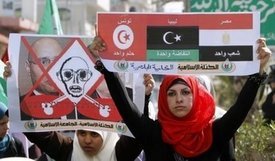
A Palestinian student holds up a placard displaying the Libyan flag flanked by the Tunisian (left) and Egyptian (right) flags during a protest against Libyan leader Moamer Kadhafi in Gaza City on Tuesday. (AFP/Mahmud Hams) Nearly 300 people are reported to have been killed in continuing violence in the capital and across the north African country as demonstrations enter their second week.

Navi Pillay, the UN high commissioner for human rights, has warned that the widespread attacks against civilians “amount to crimes against humanity”, and called for an international investigation in possible human rights violations.

Witnesses in Tripoli told Al Jazeera that fighter jets had bombed portions of the city in fresh attacks on Monday night. The bombing focused on ammunition depots and control centres around the capital.

Helicopter gunships were also used, they said, to fire on the streets in order to scare demonstrators away.

Several witnesses said that “mercenaries” were firing on civilians in the city, while pro-Gaddafi forces warned people not to leave their homes via loudspeakers mounted on cars.

Residents of the Tajura neighbourhood, east of Tripoli, said that dead bodies are still lying on the streets from earlier violence. At least 61 people were killed in the capital on Monday, witnesses told Al Jazeeera. Read more…

“The Genie Is Out of the Bottle”: Assessing a Changing Arab World | Al Jazerra

With Noam Chomsky and Al Jazeera’s Marwan

Massive public protests continue to sweep the Middle East and North Africa in countries including Bahrain, Libya, Yemen and Iran—many being met with violent government crackdowns. We speak to Marwan Bishara, senior political analyst at Al Jazeera English, and MIT Professor Emeritus Noam Chomsky. “Perhaps the Arab moment has come,” Bishara says, “It’s clear that the genie is out of the bottle. I think change is coming to the Middle East, to the Arab world.” Bishara also discusses the “Palestine Papers,” the more than 1,600 secret documents that recorded Middle East peace talks between Israel, the Palestinian leadership and the United States, which were leaked to Al Jazeera and published in January. Read more…

After Weeks of Revolution, ‘Day of Cleaning’ in Cairo | AOL News

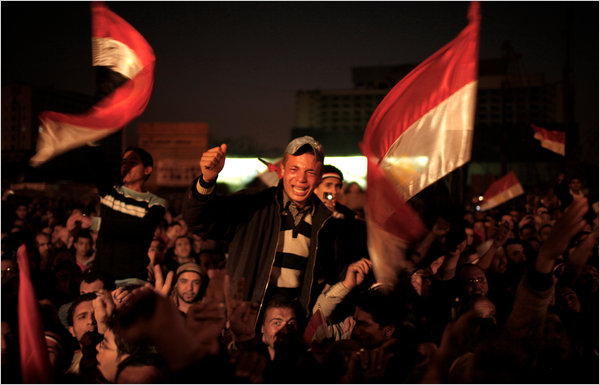
At the epicenter of the protest that brought down the three-decade regime of Egyptian President Hosni Mubarak, young men and women took to the streets again today — only this time, with a different agenda. Armed with brooms, gloves and trash bags, they launched a massive cleanup following 18 straight days of unrest that debilitated the country.

“We’re taking care of the square, and then we’ll clean up the whole country,” Mohammed El Tayeb said while standing amid the volunteer cleaning crews sweeping up Tahrir Square. “This is a beautiful country. Now it’s ours and we’re going to take care of it.”

Across the crowded square, young men walked with paper signs taped to their chests that read: “Sorry for the disturbance, we’re building Egypt.” After days of protests that had such names as the “Day of Rage” and “Day of Millions,” today’s gathering was called the “Day of Cleaning.” A new era has dawned upon the country of 80 million. Read more…

U.S. Military Intervention in Egypt: A Chapter in America’s Saudi Arabian End-Game | Collapse.net

By Dale G. Sinner

US military intervention in Egypt is prompting speculation over motives. Extraction of American citizens is the stated objective, but does evacuating the American expat community in Egypt warrant the flotilla of US warships recently positioned in the Suez Canal?  Does evacuating this expat community warrant the helicopters, Special Forces squads, and 2,200 Marines aboard those ships?  Here in the land of endless budget cuts, the obvious answer is “doubtful”.

While protests flare across North Africa, why would the US stir up already seething anti-American sentiment in the region with such a move?  Could today’s intervention lead to a long-term, “stabilizing” US presence in Egypt? Or could these events presage something far greater?  What of Egypt’s neighbor to the East – Saudi Arabia – home to a quarter of world oil reserves?

Egyptian President Hosni Mubarak is clearly defying US pressure to step down from an office he’s held for nearly 30 years.  Continued port strikes and unrest threaten vital ship traffic along the Suez Canal, and the likelihood of imminent military extraction of American citizens may present a tantalizing opportunity for oil elites to close the circle around the Arabian peninsula and place a major US force presence in Egypt – a presence with a potentially ominous goal: the eventual destabilization and Balkanization of the Arabian peninsula.

The Saudi royals are clearly opposed to US intervention in Egypt.  See here, here, and here.  This opinion regarding US meddling is understandable, as even the slightest provocation could spark similar civilian revolt on the Saudi side of the Red Sea.

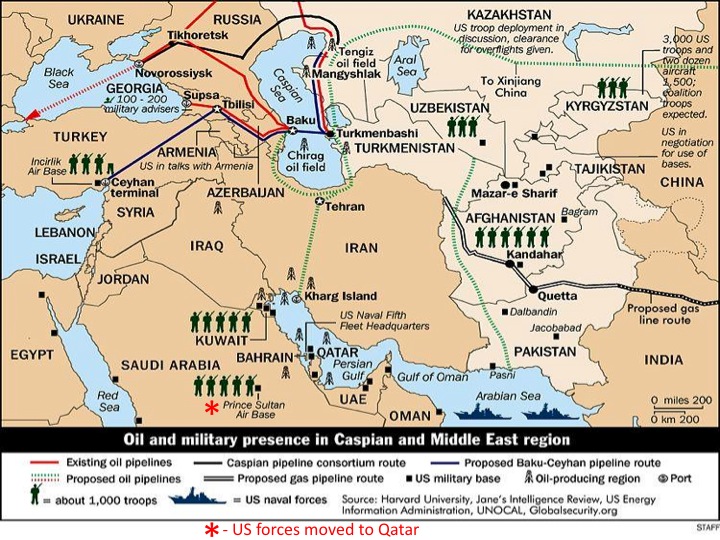
US forces were evicted from Saudi Arabia in mid-2003 and relocated to neighboring Qatar, but material and troop strength in US CENTCOM’s theatre of operations – including the permanent US “mega bases” in Iraq, might suggest a more lucrative alternative to Iran as the central target of US military strategic planning (see map below). Read more...