Handcuffs Have no Place in Public Schools | Care2 Petitionsite

A student who was handcuffed to a railing for an entire day for not wearing a belt had to eat his lunch while handcuffed. Another student, 15 years old, was handcuffed to a railing for hours just for greeting her friend too loudly in the hallway.

This type of punishment is disturbing and inappropriate. Tell Jackson Public School District in Mississippi that you want it to end. »

These students are not being punished for criminal behavior, but for very minor offenses, like not wearing the right color of shoes. The punishments violate the U.S. Constitution and make the children feel like they are going to school in a prison, which ultimately will only increase their likelihood to become criminals.

A lawsuit filed by the Southern Poverty Law Center is in progress.

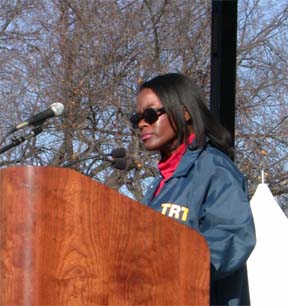
Sherry Jackson To Be Released from Prison

Dear Friends and Supporters,

First and foremost, I would like to thank you for all your prayers, love, and support. Your prayers kept me strong in the midst of the storm. Your financial support helped restore my health and keep our house from foreclosure. Thank you!

It’s almost over. I was released from Coleman Prison Camp on February 15, 2011. I was released to a transitional facility (halfway house) up until April 1st and then allowed to go home on “home confinement”. Officially, I will be in the Bureau of Prisons custody until August 8, 2011. At that time, I will begin a one-year probation period, answering to a probation officer once a week. Then I will be able to travel and have more freedom of speech. The time between now and August 8th will be spent restoring relationships and re-familiarizing myself with the world around me (especially technology).

I wrote 5 books in prison, one of which I would like to become a movie. (No, I didn’t waste my time playing cards and watching television.) I will have to do a little more research on two of the books, type all of the books into Microsoft Word and get them copyrighted and published. I plan to continue public speaking. I also plan to attend Bible College this fall and start a women’s ministry. (Any tuition or publication gifts will be greatly appreciated. In addition, I will be speaking out on social issues, like PRISONS.

I solicit your prayers in these areas.

I plan to produce a monthly e-mail to anyone who is interested in hearing what is going on, where I will be speaking, if I will be on radio, when a book is released…. I will not bombard you with e-mails. Any additional e-mails will be sent only if I will be in your area. I will not sell or otherwise give out your information to anyone else. I invite you to let me know if you want to be on my list and I will only be contacting those who request it. If you don’t have an e-mail address, I will snail-mail you the same information that is sent out by e-mail. I don’t plan on doing the Facebook or Twitter thing at this point, so this e-mail newsletter will be my main method of contact. If you want to be in contact with me, please let me know by mailing your name, e-mail, home phone, cell phone, and mailing address to me at 1560 Fieldgreen Overlook, Stone Mountain, GA 30088. Otherwise, I will not bother you. I know how overwhelming electronic media can be.

I plan to release the first newsletter in August, so please respond as soon as possible so I can get your information keyed into the database before then. If you know of others who would like the newsletter and didn’t receive this letter, please feel free to invite them on my behalf to respond also. Again, thank you so much for your support and prayers. I never felt unloved.

– Sherry Jackson

The American Freedom Campaign Agenda

Editor’s Note: The American Freedom Agenda Act of 2007 (H.R. 3835), which addresses most of the issues outlined below, was introduced by U.S. Rep. Ron Paul on October 15, 2007. Click here to read the text of the bill.

At critical moments in our history, Americans have been called upon to protect our Constitutional guarantees of liberty and justice. We face such a moment today. The American Freedom Campaign is a non-partisan citizens’ alliance formed to reverse the abuse of executive power and restore our system of checks and balances with these ten goals:

  1. Fully restore the right to challenge the legality of one’s detention, or habeas corpus, and the right of detained suspects to be charged and brought to trial.
  2. Prohibit torture and all cruel, inhuman or degrading treatment.
  3. Prohibit the use of secret evidence.
  4. Prohibit the detention of anyone, including U.S. citizens, as an “enemy combatant” outside the battlefield, and on the President’s say-so alone.
  5. Prohibit the government from secretly breaking and entering our homes, tapping our phones or email, or seizing our computers without a court order, on the President’s say-so alone.
  6. Prohibit the President from “disappearing” anyone and holding them in secret detention.
  7. Prohibit the executive from claiming “state secrets” to deny justice to victims of government misdeeds, and from claiming “executive privilege” to obstruct Congressional oversight and an open government.
  8. Prohibit the abuse of signing statements, where the President seeks to disregard duly enacted provisions of bills.
  9. Use the federal courts, or courts-martial, to charge and prosecute terrorism suspects, and close Guantanamo down.
  10. Reaffirm that the Espionage Act does not prohibit journalists from reporting on classified national security matters without fear of prosecution.

When Laws and Liberties Test Each Other’s Limits | NY Times

By Stephen Holden

“The End of America,” an unsettling documentary polemic about the erosion of civil liberties in the wake of 9/11, brings up matters many of us would rather not contemplate in the middle of a financial crisis and on the eve of a new administration. Federal laws enacted during the last seven years that threaten our constitutional rights, it reminds us, remain in effect.

The pointedly inflammatory film, adapted from Naomi Wolf’s book “The End of America: A Letter of Warning to a Young Patriot,” compares the Bush administration’s attempts to discourage dissent and to wield increasingly unchecked power to the events preceding the establishment of 20th-century dictatorships in Germany, Italy, Chile and elsewhere. Without explicitly invoking the word, it implies that since 2001 the United States has drifted toward fascism in the name of fighting terror.

Tightly constructed and fiercely one-sided, “The End of America,” directed by Annie Sundberg and Ricki Stern (“The Devil Came on Horseback”), interweaves excerpts from a lecture in New York given by Ms. Wolf with film clips and interviews illustrating her contention that the rise of those dictatorships created a “blueprint” that the Bush administration, consciously or not, has followed.

According to Ms. Wolf, the first and fundamental tool for acquiring power is the manipulation of fear. In the shell-shocked post-

9/11 climate, the overwhelming public reaction to the Patriot Act of 2001, which gave law enforcement agencies expanded powers of surveillance, was mute acceptance of whatever was deemed necessary to keep us safe. Since then, she says, a color-coded system of terror alerts has been effectively wielded to keep us on edge.

From here, Ms. Wolf describes a 10-step program toward authoritarian rule that includes the creation of secret prisons where torture takes place; the deployment of a paramilitary force (Blackwater, which the film calls a contemporary American variation on Mussolini’s private army of “black shirts”); the development of an internal surveillance system; the harassment of citizens’ groups; and the arbitrary detention and release of ordinary civilians.

The film’s most disturbing moments are its accounts of James Yee, a United States Army chaplain at Guantánamo, who was accused of espionage and held in solitary confinement for 76 days before being released, and Maher Arar, a Syrian-born Canadian telecommunications engineer, who was detained at Kennedy International Airport, then later deported to Syria, where he was imprisoned for a year and tortured. He was eventually cleared of charges of terrorism.

The seventh step, selecting key individuals for harassment, cites the Dixie Chicks and Dan Rather as prominent cases. The eighth step, the restriction of the press, focuses on the case of Josh Wolf, a journalist jailed for 226 days for refusing to turn over videotapes he made of police brutality at a July 2005 demonstration in San Francisco.

The ninth step, the equating of political dissidents with traitors, fleetingly examines the Bush administration’s floating of the word “treason” to describe The New York Times’s publication of classified information about the government’s monitoring of overseas telephone calls. All these middle steps might be described as examples of selective intimidation intended to inhibit dissent. The case histories are glossed over.

The final step in Ms. Wolf’s Top 10 is the suspension of the rule of law. She cites the refusal of Bush administration insiders subpoenaed to appear before Congress to testify in the United States attorneys scandal. The film ends on a note of stern warning: the 11th step might be the imposing of martial law.

If the film’s vision of the steps leading toward a homegrown fascist state qualifies as paranoid, there is still enough here to make you shiver. Could it happen here? Maybe. A little fear — not the collective panic that followed 9/11 — can be a useful thing.

Source: New York Times/Movies

Beijing 2008 – Olympic Prisoners

Scores of Chinese journalists, bloggers and human rights activists were arrested, put under house arrested or expelled from Beijing before and during the Olympic Games. The Games have now finished and we call for their release.

Hu Jia

Hu Jia was sentenced to three and a half years in prison on 3 April 2008, for posting articles on websites and giving interviews to foreign journalists. He had criticised the poor state of freedom of expression before the Games. Hu was arrested on 27 December 2007, for “inciting subversion of state power” before being tried by a Beijing court on 18 March. He was transferred on 8 May to Hubai prison in Tianjin, 200 kilometres east of the capital, where he is being held in harsh conditions. His wife, Zeng Jinyan, and their young daughter are under house arrest in Beijing.

Sign the petition for his release.

Yang Chunlin

Main mover of the campaign “We want human rights not Olympic games”, Yang Chunlin was sentenced on 24 March 2008 to five years in prison, followed by two years loss of civil rights by the intermediate court of Jiamusi, in the north-east, for “inciting subversion of state power”. He was maltreated during the early period of his detention.

Yu Changwu and Wang Guilin

Activists Wang Guilin and Yu Changwu are in custody for having taken part in Yang Chunlin’s campaign “We want human rights not Olympic Games”. Wang Guilin was sentenced on 28 January 2008, to 18 months re-education through work, while Yu Changwu continues to be held secretly.

Dhondup Wangchen and Jigme Gyatso

Dhondup Wangchen, director of a documentary on Tibet, and Jigme Gyatso, his friend and cameraman, have been held since March 2008 for interviewing Tibetans, particularly in the Amdo region. The film about the work of Dhondup Wangchen and Jigme Gyatso is a 25-minute short entitled Leaving Fear Behind (www.leavingfearbehind.com), which was shown during the Olympic Games. In it, Tibetans in the Amdo region gave their opinions about the Dalai Lama, the Olympics and Chinese law. Dhondup Wangchen is believed to be held in Ershilipu prison, in the city of Xining, where his brother-in-law tried without success to see him. Jigme Gyatso was reportedly seen for the last time in a detention centre in the town of Kachu, in Ganzu province.

Chen Guangcheng

Blind lawyer Chen Guangcheng is serving a prison sentence of four years and three months in Linyi prison in Shandong province in southern China. He was sentenced for bringing a law suit against the local authorities in connection with a campaign of sterilisation and forced abortions. On the eve of the Beijing Paralympics, the Chinese authorities blocked the mobile phones of Chen’s associates and family members. This police action affected the residents of his village and his lawyer, Li Fangping. Several foreign journalists were prevented from meeting his family.

Du Daobin

Writer Du Daobin was arrested in Yingcheng on 21 July 2008 by the authorities in Hubei province, central China. Local police were apparently reacting to his stance ahead of the Games. He was found guilty of “inciting subversion of the state” and sentenced on 11 June 2004 to three years in prison, followed by four years house arrest. Du Daobin posted a number of pro-democracy articles online and some urging greater freedom of expression in China. He actively called for the release of Liu Di, a young student imprisoned in 2003 for pro-democracy articles she posted on Internet forums.

Wang Guilan

Petitioner and human rights activist, Wang Guilan, was sentenced to 15-months re-education through work on 28 August 2008 for agreeing to a telephone interview with a foreign journalist the previous month. Wang had been arrested in Beijing on 28 February 2008, after writing an open letter on human rights ahead of the Olympic, which attracted more than 12,000 signatures. From 17 April, she was placed in a prison in Hubei to prevent any activities during the Olympics. She is currently being held in Enshi, Hubei. She has been arrested several times since 2001.

Zhang Wenhe

Pro-democracy activist Zhang Wenhe waved a banner in Beijing streets in October 2007, that read, “We want human rights and democracy and not the fascist Olympic Games” that led to his arrest and forced incarceration in a psychiatric hospital.

Zheng Mingfang

Human rights activist, Zheng Mingfang, was sent to a re-education through work camp for two years at the beginning of April 2008, because of an open letter she wrote about the Olympics. She was arrested by the authorities in Beijing on 29 February 2008, shortly before a parliamentary session. She is reportedly being held in Xian district in Tianjin, east of the capital. She is beginning to go blind and was reportedly ill-treated during her period in detention. Her husband has spoken about the methods used by the authorities since her arrest to prevent her from communicating with foreigners “a central condition of Zheng’s release”, according to district police officials.

Source: Reporters Without Borders