Russia accuses Ukraine of staging murders to generate Western headlines | Russia Times (RT)

Defense Ministry accuses Kiev of trying to frame its soldiers

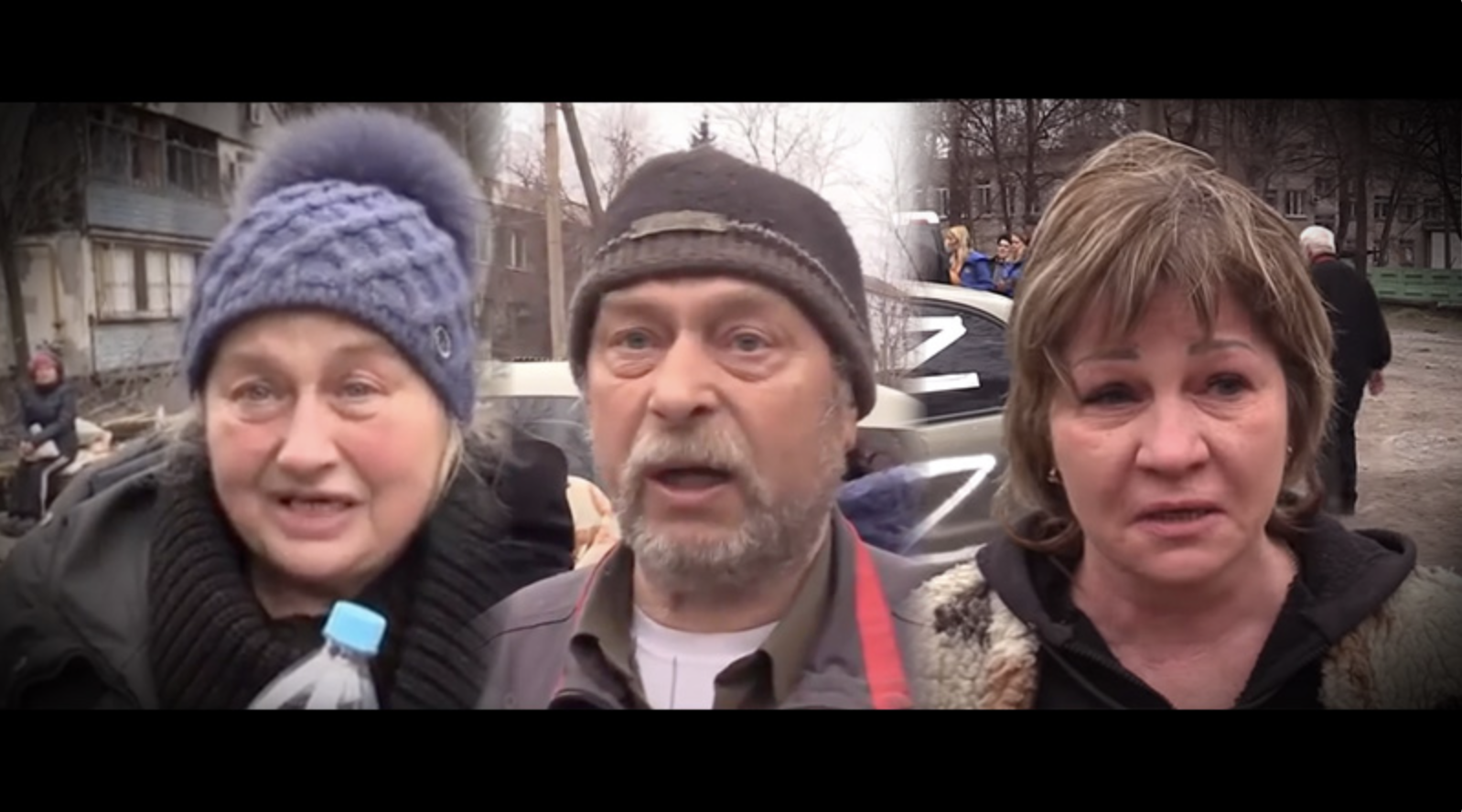
Russia’s Defense Ministry claimed, on Tuesday, that Ukrainian security services have staged more alleged killings of civilians in several towns and villages in order to elicit sympathy by prompting media headlines in the West. Officials believe that Kiev is trying to create a narrative of Moscow being responsible for war crimes. 

Moscow insists that the same tactics were used by Kiev to blame Russian forces for atrocities in the town of Bucha last week.

“The troops of the 72nd Ukrainian Main Center for Psychological Operations conducted another staged filming of civilians allegedly killed by violent actions of the Russian armed forces in order for it to be distributed through the Western media,” spokesman Major General Igor Konashenkov said during a briefing.

According to “confirmed information,” the filming took place in the village of Moschun some 23km northwest of the Ukrainian capital Kiev on Monday, he insisted.

Similar false flag operations have been carried out by the Ukrainian side in the cities of Sumy, Konotop and elsewhere, Konashenkov insisted. He didn’t provide direct evidence to support his claims. 

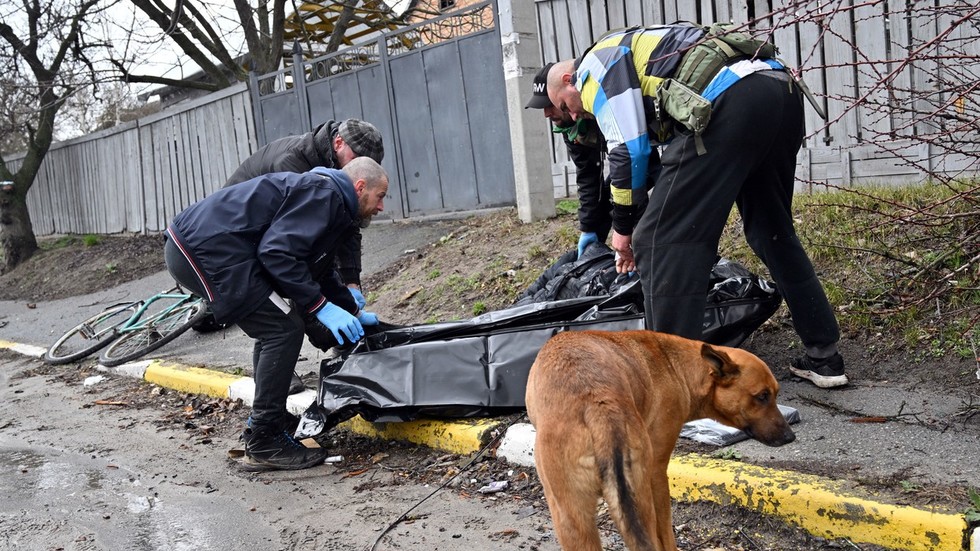
On Saturday, Ukraine distributed graphic footage of multiple corpses lying in the streets of Bucha, alleging that they were executed by Russian troops. Again, no unequivocal proof was furnished. 

Moscow, which insists that it has not targetted civilians during its operation in Ukraine, has rejected those accusations as a “provocation” and accused Kiev of mounting a false flag operation. 

Officials pointed out numerous inconsistencies in the Ukrainian story, including the fact that the video emerged several days after the Russian forces withdrew from Bucha, and that the local mayor didn’t mention any killings in his video address declaring the “liberation” of the city.

Despite this, the West has immediately decided who to blame for the purported atrocities. US President Joe Biden has demanded a “war crimes trial” for his Russian counterpart Vladimir Putin. However, unlike Moscow, Washington doesn’t recognise the International Criminal Court. 

Meanwhile, the EU promised to send its experts to aid Ukrainian authorities in collecting evidence at the site.

Moscow launched a large-scale offensive against Ukraine in late February, following Ukraine’s failure to implement the terms of the Minsk agreements signed in 2014, and Russia’s eventual recognition of the Donbass republics in Donetsk and Lugansk. The German and French brokered protocols had been designed to regularize the status of those regions within the Ukrainian state.

READ MORE: Biden wants ‘war crimes trial’ for Putin

Russia has now demanded that Ukraine officially declare itself a neutral country that will never join the US-led NATO bloc. Kiev insists the Russian offensive was completely unprovoked and has denied claims it was planning to retake the two rebel regions by force

Source: Russia Times (RT)

Pitchforks Are Coming: Iversen Predicts Public Unrest if Inflation Continues | Children’s Health Defense

By David Charbonneau, Ph.D.

Political commentator Kim Iversen warned rising corporate profits combined with higher prices and empty shelves will create a consumer backlash against corporations and fundamentally change the way the people view the government.

Political commentator Kim Iversen last week on The Hill’s “Rising” warned of coming civil unrest if inflation and supply shortages continue while corporate profits soar.

Iversen and co-hosts Ryan Grim and Robby Soave skewered BlackRock CEO Robert Kapito for complaining of “an entitled generation that has never had to make sacrifices before.”

Iversen reported that U.S. corporate profits hit a record high in the fourth quarter of 2021, jumping 25%, even as the gross domestic product dropped 6.9%.

“So, what does this mean exactly?” she asked.

“It means,” she said, “inflation is good for big businesses, which upped their prices in response to supply and labor shortages and saw profit margins increase 25% to $2.94 trillion — the largest gain since 1976.”

She singled out the oil industry, saying, “We know that while gas prices are taking a toll on working people, 25 of the world’s biggest fossil fuel corporations are reaping in record profits … [and] oil giant BP, for example, has hit its highest profits in eight years.”

According to Iversen, corporations are using “the slight inflation that we did see in the beginning” as an excuse to hike prices over the long term.

She said:

“If you combine the supply-chain problems with the energy price increases with the corporate greed, you’ve basically explained all of the inflation that we’ve experienced.”

Iversen cited a March 29 MSNBC tweet that questioned why Americans are dissatisfied with this “booming economy:”

This trend isn’t sustainable, even for the interests of corporations, since a “middle class that is poor” won’t be able to buy any products, Iversen said.

As a solution, she suggested supporting Bernie Sanders’ new proposal to tax windfall profits from the pandemic at 95%.

Soave then reported on BlackRock CEO Kapito’s controversial comments about the economy.

Speaking last month at the Texas Independent Producers and Royalty Owners Association, Kapito said, “For the first time, this generation is going to go into a store and not be able to get what they want,” adding, “ … we have a very entitled generation that has never had to sacrifice.”

“I think this generation has sacrificed,” said the 32-year-old Soave. “I think there’s been plenty of sacrificing.”

While conceding his generation was never forced to serve in a war, he cited other burdens, such as student loan debt and the difficult economy his generation confronted upon graduating in the wake of the 2008 financial meltdown.

Kapito graduated from the Wharton School in 1979 and immediately joined a Boston investment firm. He earned an MBA from Harvard in 1983 and went on to co-found BlackRock in 1988.

According to corporate proxy reports obtained by salary.com, Kapito made $22,115,203 in 2020. Wallmine reports his estimated net worth at $303 million (other estimates, in the wake of the pandemic, are closer to $400 million).

Kapito, who turned 65 in February, has no published record on the web of military or civil service and would have been 15 years old when Richard Nixon announced the end of U.S. operations in Vietnam.

According to Blaze Media, Kapito’s warning came just days after Bloomberg economists advised Americans to consider budgeting an extra $5,200 this year — or $433 monthly — to prepare for historically high inflation.

Summing up the current economic trends, Iversen predicted:

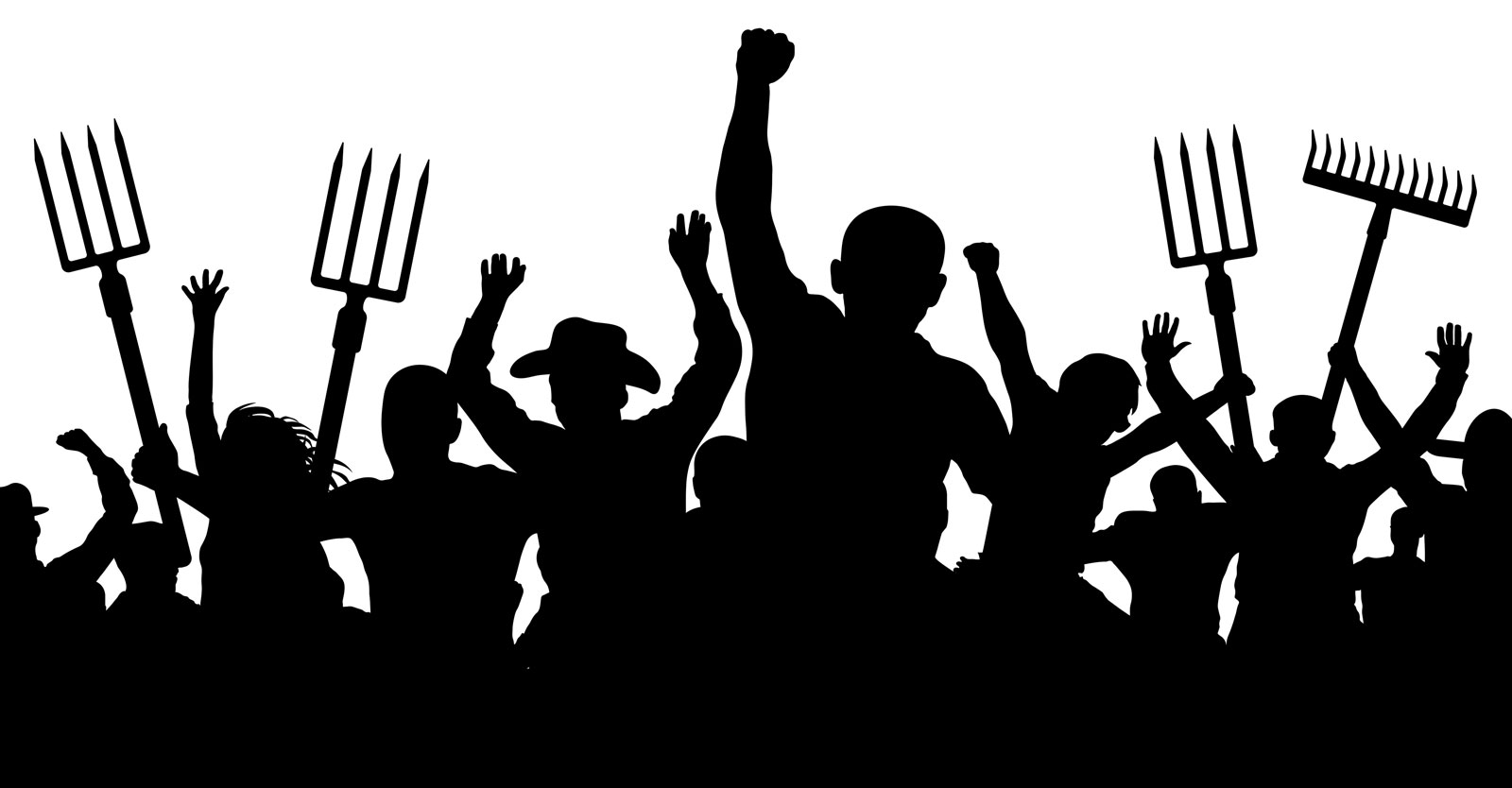
“Look, the pitchforks are coming, guys. So either they do something about this, or the pitchforks are coming. If people can’t go to the grocery store and buy what they need, if they’re seeing like what this BlackRock executive is saying … if we walk into the stores and the shelves are empty and we’re not in a pandemic anymore and we can’t commute where we need to commute because gas prices are too high, this is going to change fundamentally the way the people view the government, and it’s not going to be good.”

Source: Children’s Health Defense

Ukrainian Citizens Say ‘Fascist’ Neo-Nazi Azov Brigade ‘Only Shoot Civilians’ | InfoWars

By Kelen McBreen

Independent journalist and US Navy veteran Patrick Lancaster is in Mariupol, Ukraine to provide on-the-ground coverage of the brutal conflict taking place.

Lancaster is one of the few English-speaking reporters covering the war while traveling with the DPR and LPR rebels and Russian troops, but he encourages people to follow journalists on both sides.

A report uploaded Tuesday shows citizens of Mariupol describing a nearby factory said to be occupied by the infamous Azov Brigade, a neo-Nazi outfit fighting with the Ukrainian military.

One man said he was almost hit twice by a sniper, and declared, “Azov”, when asked who the sniper was fighting for.

After Lancaster suggested the sniper may have thought he was in the military, the man explained he was wearing the clothes seen in the video and that “they shoot at civilians.”

“They don’t shoot military, only civilians,” the man added. “They eliminate civilians. They are actual fascists.”

Another man interviewed by Lancaster echoed the theory that the snipers in the neighborhood are “Nazi guys”, saying, “Ukrainian Nazis are shooting, they just kill people. They kill civilians, women, men, everybody.”

Asked to explain for the camera who the Azov fighters are, the man said, “They collected all the nationalists, some are even from prison. They pay good money to them, and they kill people just for no reason.”

When Lancaster told the locals US and European media claim Russia is destroying cities and killing people, the man said in his experience, “Russia doesn’t shoot at people at all.”

At this point, a crying woman walked up to the camera and told the journalist that if not for Russian assistance, they would be hungry and thirsty along with most of the children in the city.

The woman and a man, possibly her husband, said their apartment was destroyed by “Ukrainian” tanks.

Lancaster documented as a volunteer passed out food to some of the citizens, and an elderly woman raised a loaf of bread to the sky in appreciation to God for the gift.

As he frequently does, Lancaster allowed several citizens to deliver on-camera messages to their loved ones around the world who may see the video.

This side of the ugly war is not being covered by mainstream media in what is becoming a disturbing cover-up.

Source: InfoWars

In a cage with a tiger: How locals in Taliban’s Kabul adapt to the new reality | Russia Times (RT)

By Alexandra Kovalskaya, Orientalist scholar and Freelance Journalist based in Kabul.

A report from the Afghan capital, where life under new rule only appears normal

“Zendegi megozara” (Life goes on), an Afghan proverb says – and Kabul, dubbed by the Western media as the city of hope and despair, could be a physical illustration of the saying. Weeks of fear and uncertainty under Taliban rule followed the withdrawal of NATO troops, the mass evacuations and the flight of the country’s leaders. Despite a humanitarian crisis unfolding and the future seeming murky, however, the Afghan capital looks just as it did back in the republican days – on the surface, at least.

The airport in Kabul still isn’t working at full capacity. After the Taliban took over the city on August 15 last year, most international carriers ceased flights to Afghanistan until the situation stabilizes – except for low-cost airline Fly Dubai, Mahan Air of Iran, and few more regional companies.

Negotiations regarding the operation of Kabul Airport, which Turkey and Qatar are said to have commenced with the Taliban, are still believed to be underway as security demands remain unmet. As a shuttle takes passengers from the plane to the international terminal, a dozen of aircraft can be seen on the tarmac. They belong to either Kam Air or Ariana Airlines, the two Afghan companies currently conducting domestic and international flights.

Pictures have been removed from the airport’s outer walls of then-President Ashraf Ghani, Tajik mujahideen leader Ahmad Shah Masoud, and former president Hamid Karzai, after whom the airport was named. Instead, freshly painted graffiti states in English that the Islamic Emirate of Afghanistan wants peaceful and positive relations with the world. The sun-weathered airport compound does look peaceful, even with dozens of Taliban fighters dressed in fatigues, or, more casually, in traditional Afghan outfits, keeping their fingers on triggers. It is hard to believe that this very place witnessed a rapid, fall-of-Saigon-like evacuation and a number of human tragedies just over seven months ago.

According to a new rule, foreigners must register on arrival and fill out a form stating the purpose of their visit, the duration of their stay, and their marital status. As often occurs in Central Asia, a strict law is balanced by the reluctance of those who are to ensure its enforcement.

“You don’t know your complete address in Kabul, madam? It’s alright. You don’t have a picture? No problem,” says an immigration officer as he takes the form and starts pushing his way through the crowd of passengers arrived from Tashkent.

Despite rumors about the new regime prohibiting women from having jobs, the crew on my flight were female, and so were some of the airport employees. One of them, who has her hair covered with a black scarf and her face hidden under a mask, apologizes for her limited English and starts talking about the “good old days.” She mentions a women’s empowerment project she used to participate in, and her Western colleagues. I ask how she feels about the new government. She shrugs.

“How are the Talibs treating you?” I ask.

“It’s OK,” she replies in a local language. “But, you know, a Talib is a Talib. The word says it all. And I think there is no future now. Nothing to hope for, really. But God is great, let’s see.”

Security, new jobs, revenge

The windshield of the taxi is decorated by plastic flowers and a sticker reading “Allah.” A set of prayer beads hangs down from the rear-view mirror. The bearded driver wears a black turban and resembles a religious scholar, but in the parking lot he told me he had worked for airport security. After the Taliban took over Kabul, he spent some time in hiding, frightened that he would be detained for his “ties with the government.” However, a couple of weeks ago, the new airport security chief called him and asked him to come back to work. He was not given his former position, however, and drives a yellow taxi instead. This is a “state taxi,” he explains, with a license from the Ministry of Interior Affairs. This is much safer, especially for the foreigners, he adds.RT

As we exit the airport, I ask him how the situation in Kabul has changed over the past three months.

“There is security, but no job,” he replies. “I was lucky to receive this car.”

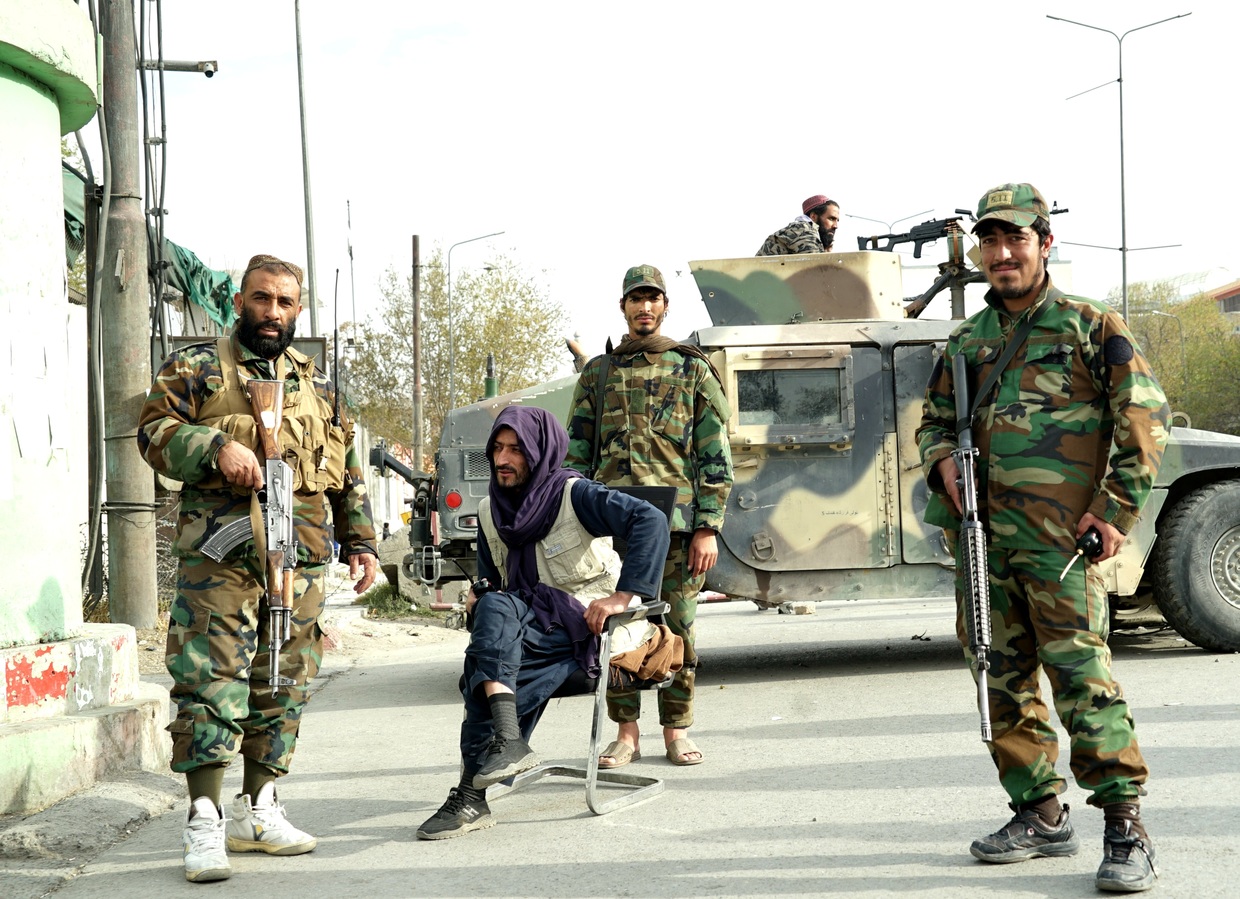
Credit where credit’s due – the radicals try to provide security as they interpret it. There is a checkpoint at the exit, the next one about a kilometer away, and sometimes there are two or three of them on a single street. The security check itself is nothing much. Talibs assess passengers through the window as though they are trying to measure how dangerous they are just by looking at them. They occasionally open the trunk or ask for documents, even though some of the sentries are obviously illiterate. Those who listen to music in the car turn it off, and then resume listening as the Talibs let them go. If there is a female in the car, especially in the front seat, the checks are more thorough just for show.

Unlike during the times of the republic, when they had fixed locations and were primarily concentrated in the city center next to strategic sites like ministries and embassies, Taliban checkpoints are scattered around the city and rotate. You never know where you will find them the next day. Moreover, there are numerous patrols riding in former ANA (Afghan National Army) Humvees. Some of them still carry a republican flag painted on the door or chassis. 

“They are using our cars now,” says Rahim (not his real name), a former soldier. He looks embittered as his eyes follow a passing Humvee. “They are using our weapons; they live our lives. And what happened to my life?”

Seven months ago, Rahim was part of ANA’s Commando Corps. After mid-August 2021, he disguised himself as a civilian and grew a beard to avoid the revenge of the Taliban. He said he killed many of them on combat missions in Helmand and Logar provinces. Unlike many of his former fellow soldiers, he refused to be evacuated and stayed in Kabul to support his family. Now he works a doorkeeper, making around $150 a month.

“I am sure they will kill me if they understand who I am,” he says.

I try to disagree. From what I know, if the Talibs find someone who served in the police or the military, the worst they do is beat them up or arrest them for a few days. But Rahim shakes his head. “It depends on what unit you were in. They knew we were hunting them, and several friends of mine from the same squad went missing already. They disappeared in Kabul, and nobody knows if they are still alive.”

If we find a single bullet

Aside from the network of checkpoints, the Afghan radicals have taken more serious steps to secure Kabul. Last month, there was a wave of extensive house-to-house searches in different areas of the city, mainly at nighttime. According to the Taliban authorities, the raids aimed “to detect criminal activity” and seize weapons.

“Four of them came to my apartment, three foot soldiers and an officer,” says Kawoos, currently an American NGO employee. They said, “If we find a single bullet, you will regret it,” and I asked, “What if you don’t find a single bullet?” I spoke Pashto and looked confident, so the officer commanded them to leave. All of them were polite enough, even taking off their shoes to enter the home and apologized for disturbing us as they came in.

As locals explained, the real goal was to find Northern Alliance sympathizers. Originally, there was supposed to be a door-to-door check in Khair Khana, a predominantly Tajik-populated enclave, but later the Taliban changed its mind to avoid triggering ethnic strife. Or was the real goal to stop those wanting to emigrate from leaving? Or was it targeting people like Rahim? There is an abundance of suggestions but a lack of facts. Moreover, there is a possibility that the searches will continue.

The outcomes of the search seem debatable – in a country like Afghanistan, I was told, one must have at least one gun in the house to protect his property from robbers. Now, with the weapons taken, many houses are defenseless. Weapons can become a necessity for Kabulians amid never-ending rumors of smoldering enmity within the ranks of the Taliban that might flare into open clashes at any time, with the Haqqani network and hardline militants from the east on one side and supporters of the new government’s Deputy Prime Minister Mullah Baradar on the other.

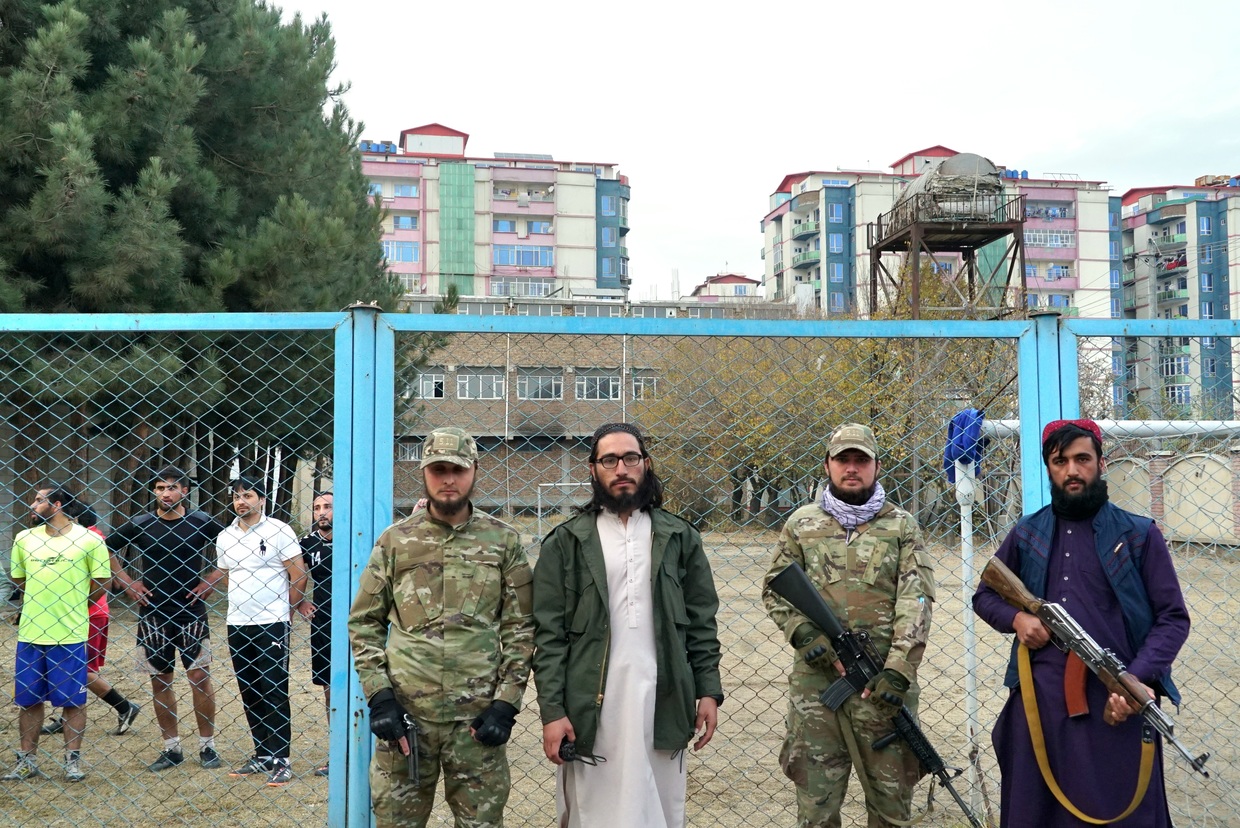
At the same time, Taliban fighters keep roaming around with their weapons, whether they go to the zoo or dine at a restaurant. Lift doors in local shopping malls are often decorated with a sign, “Entry is not allowed with guns” – or just a picture of a crossed-out Kalashnikov.RT 

Apparently, the only area in the city that was not subjected to searches was Wazir Akbar Khan – the so-called green zone that contains a number of embassies, most of нуwhich are currently closed. Ironically, it still has a sort of diplomatic immunity, an unspoken law giving the area a strange kind of freedom. If there is a party in a house, the Taliban commander living next door turns a blind eye and a deaf ear if you decrease the volume of the music playing to the reasonable level.

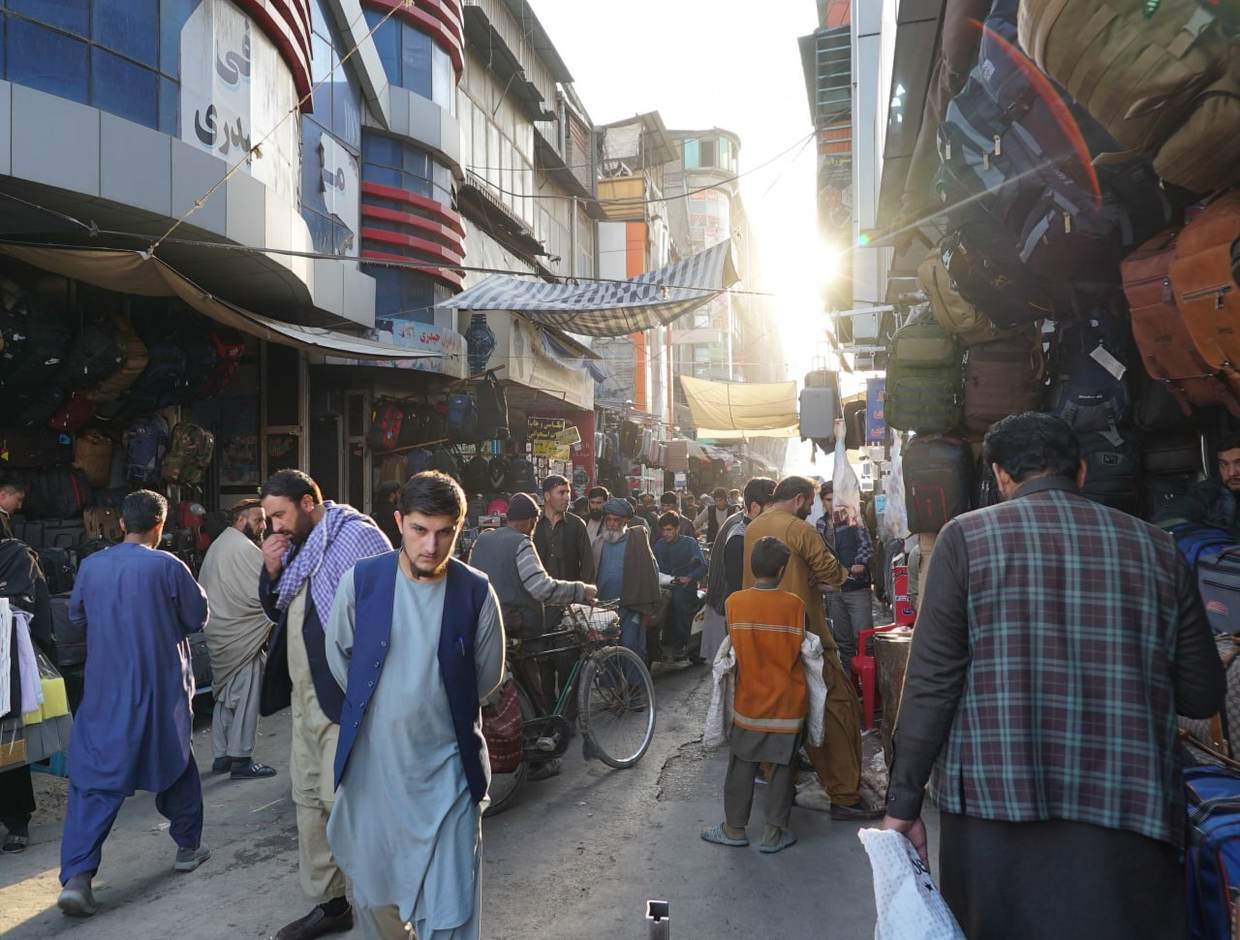
The media say that the range of prohibitions that the Taliban has introduced is shrinking. On the ground, the restrictions don’t feel so tangible. This is more or less what Kabul is like today – there are intimidating humors, but nothing happens; there are numerous restrictions, but you never know which of them you can bypass. Barber shops are open, just like cafes, men wearing Western clothes and women wearing makeup and high heels are still seen in the streets. In addition, a portrait of Mullah Omar, a co-founder of the Taliban, looks at the capital from a wall of a guardhouse up on the hill – drawings are not a sin this time.

High above his head, a gigantic white Taliban flag flaps in the wind. The official flag-raising ceremony on 31 March emphasized, in a way, that the radicals do plan to hold the power they seized on 16 August – a bitter realization for many supporters of the Afghan republic both in the country and abroad.

In a cage with a tiger 

In my experience, the most popular attitude the Afghans express towards the Taliban these days, just like a few months ago, could be summarized by saying, “They are not doing anything really wrong right now, but we don’t trust them.”

So it was, for instance, with Nowruz, which is also known as the Persian New Year and celebrated on the day of spring equinox. Taliban leaders decided to exercise tolerance to what they used to see as a “pagan holiday” back in the 1990s. This time, they decided to deprive Nowruz of the status of a national holiday, but allowed people to celebrate. Not many decided to do so, but goldfish and other traditional decorations for the New Year’s table were still sold in local markets.

“Kabul was quite different last year,” says Farid, a friend of mine. “Music everywhere, people dancing and hugging in the streets… Right, the Talibs did not prohibit the holiday. But guess why people decided to be quiet? It is like being in a cage with a tiger. He says he is not going to bite you, but you never know.”

Farid and his family invited me to the Paghman valley – a picturesque green place located an hour’s drive from Kabul. The Afghans come there to have a picnic by the river, do some hiking, and fly a kite. Some 30 years ago, this activity was labeled anti-Islamic and banned. Today, young fighters watch boys playing and ask to hold a kite coil for a while as a group of girls in bright traditional Afghan clothes are taking selfies on a mountain slope in the background. The scene looks almost pastoral – nothing like the Taliban era of the 1990s, as described by Khaled Hosseini in ‘The Kite Runner’.

“Some people think the Talibs are monsters,” says one of Farid’s teenage nieces, who is painting my hands with henna. “But I don’t think they are. They are normal, I think.”RT

This episode came a couple of days before the Ministry of Education restricted girls above the sixth grade from study – after all the promises given before, and the Ministry for the Propagation of Virtue and the Prevention of Vice restricted unaccompanied women from boarding flights.

In late March 2022, in Kabul, late at night, with darkness outside, a police siren is wailing in the distance. I send a message to another friend of mine. “Hey, how has Kabul changed since I saw it last time in December? Maybe there is much more than meets my foreign eye?” I write.

Pretty much everything is how you saw it,” reads the reply on the screen. “[The Taliban] are trying their best where they can.”

“Seems like all the negative changes are related to women’s rights. Then why [do] people mistrust them?”

“What they do has nothing to do with Islam. For example, does Islam say girls are not allowed to study? No. Then why? You know what they say? We fought jihad for 30 years, do not teach us Islam.”

The night lights still glowed from the hilltops of Kabul but how long until the lights go out and Afghanistan is a forgotten place of dreams and hopes?

Source: Russia Times (RT)

Arizona Enacts Law Requiring Proof of Citizenship to Vote in Presidential Elections | The Epoch Times

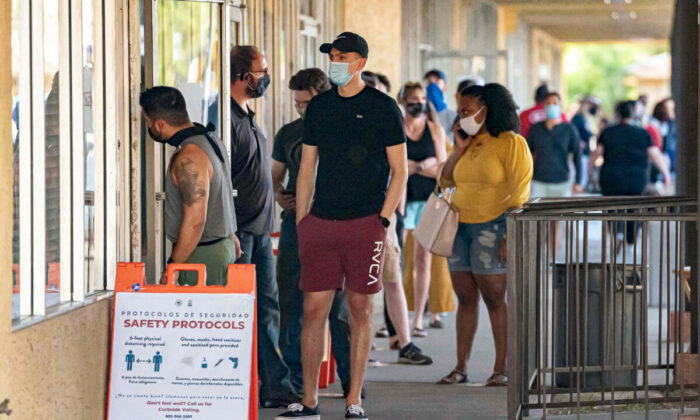
People wait in line to vote at a polling place at the Scottsdale Plaza Shopping Center, in Scottsdale, Arizona, on November 3, 2020. – The US started voting Tuesday in an election amounting to a referendum on Donald Trump’s uniquely brash and bruising presidency, which Democratic opponent and frontrunner Joe Biden urged Americans to end to restore “our democracy.” (Photo by OLIVIER TOURON / AFP) (Photo by OLIVIER TOURON/AFP via Getty Images)

By Mimi Nguyen Ly

Arizona’s governor on Thursday signed into law a bill that aims to strengthen election integrity with new requirements to ensure only U.S. citizens vote in elections held in Arizona.

The measure, House Bill 2492, requires voters in Arizona to provide proof of citizenship and residency to be eligible to vote.

Under the new law, if county recorders are found to have knowingly accepted a voter registration application that doesn’t have enough proof of citizenship, they face a class 6 felony.

“Election integrity means counting every lawful vote and prohibiting any attempt to illegally cast a vote,” Gov. Doug Ducey said in a letter (pdf) to Secretary of State Katie Hobbs explaining his support for the legislation. He said the bill “is a balanced approach that honors Arizona’s history of making voting accessible without sacrificing security in our elections.”

doug ducey
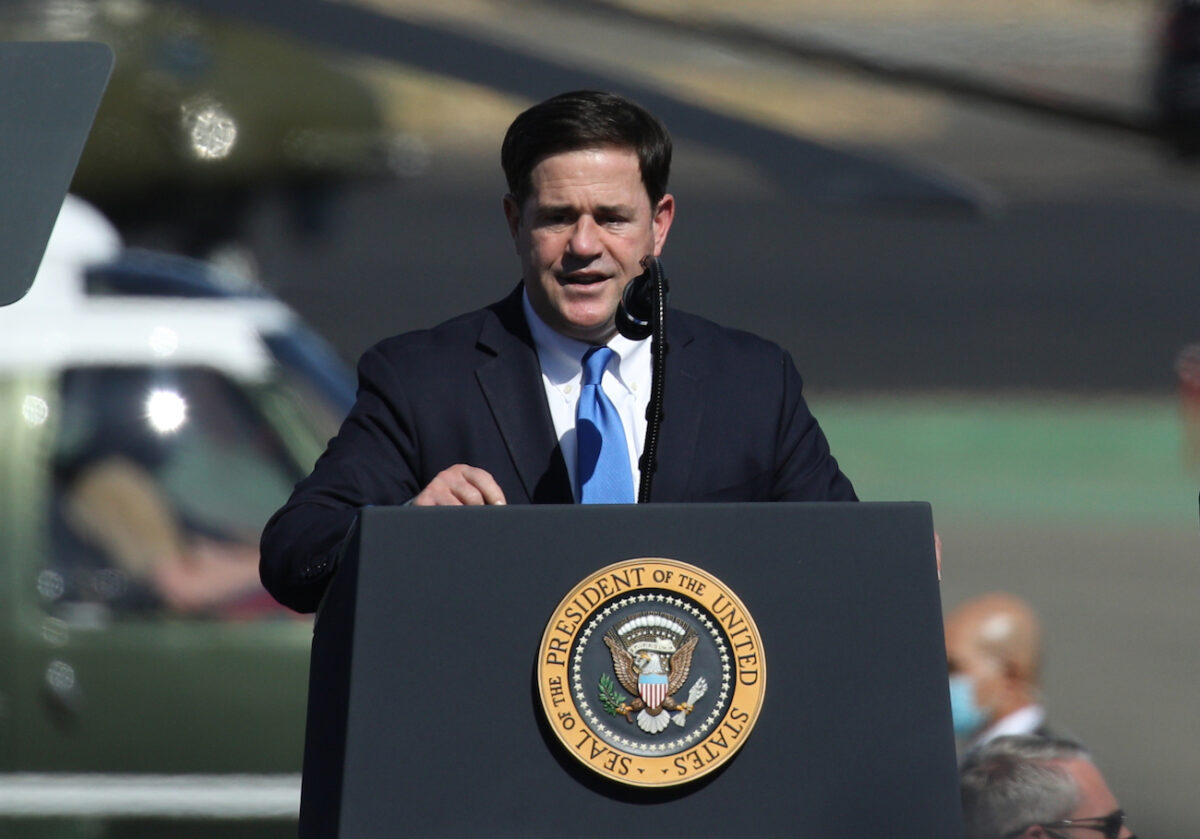
Arizona Gov. Doug Ducey speaks at a MAGA campaign rally in Prescott, Ariz., on Oct. 19, 2020. (Caitlin O’Hara/Getty Images)

In Arizona, the Republican Party controls the governorship and both chambers of the state’s legislature. The bill passed the legislature on March 23.

Hobbs, a Democrat who is running for governor of Arizona, told Ducey to veto the bill after lawmakers passed the measure. She said on Twitter on March 23 that the GOP-backed bill “creates new, unnecessary barriers for people registering to vote.”

county elections
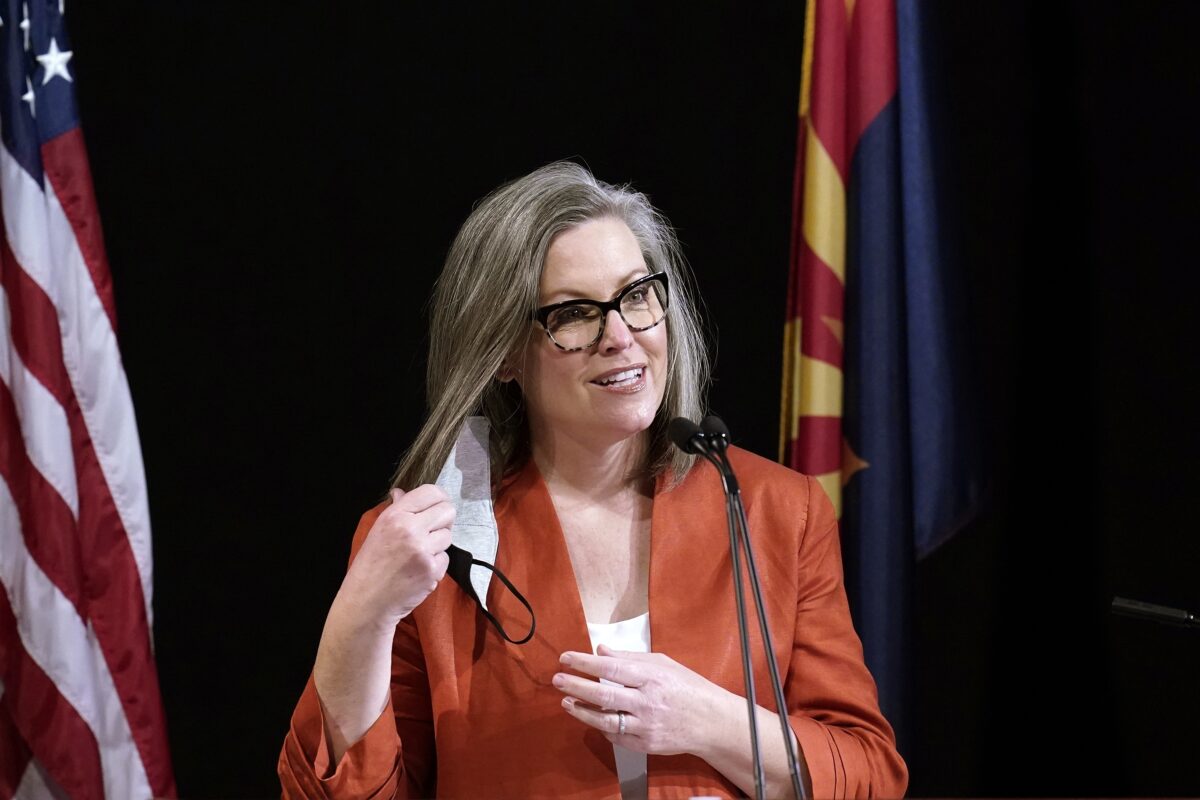
Arizona Secretary of State Katie Hobbs removes a mask as she speaks to members of Arizona’s Electoral College prior to them casting their votes in Phoenix, Ariz., on Dec. 14, 2020. (Ross D. Franklin/AP Photo)

Other state Democrats say the measure is part of an effort to suppress voting in the battleground state.

State Rep. Jake Hoffman, the bill’s sponsor, said the signing into law of HB 2492 is “a giant step toward ensuring elections are easy, convenient, and secure in our state.”

“HB 2492 is an incredibly well-crafted piece of legislation that is on sound legal footing and broadly supported by voters of all political parties. I am confident that should Democrats challenge HB 2492 in court it will only serve to further reinforce its clear constitutionality,” he said in a statement (pdf) Thursday.

Federal Only Voters

Ducey noted in his letter to Hobbs, “Federal law prohibits non-citizens from voting in federal elections. Arizona law prohibits non-citizens from voting for all state and local offices, and requires proof of citizenship. H.B. 2492 provides clarity to Arizona law on how officials process federal form voter registration applications that lack evidence of citizenship.”

The Supreme Court ruled in 2013 (pdf) that Arizona could continue requiring proof of citizenship in its state elections, but must accept federal forms to register Arizona voters for federal elections.

The federal forms ask voters to state that they are U.S. citizens but don’t require proof of citizenship. These voters, referred to as Federal Only Voters because they are only eligible for casting a vote in federal elections, will now be required under H.B. 2492 to provide proof of citizenship in order to vote in presidential elections or vote by mail. They could still vote in congressional elections at the polls, however.

Ducey said there’s been a growing number of registrants who have used the federal form since 2014. He said 21 voters statewide used that form to register to vote in the primary election in 2014, but by the 2020 general election, there were more than 11,600 federal-only voters in Arizona who voted without providing proof of citizenship.

“In Maricopa County alone, there are currently 13,042 active registered voters who have not provided evidence of citizenship to vote through use of the federal form,” according to Ducey’s office.

Currently, there are about 31,500 federal-only voters in Arizona.

Ducey acknowledged that in 2004, when Arizona passed Proposition 200, which required proof of citizenship to vote, the requirement exempted people who were already registered to vote before the proposition’s passage. Ducey told Hobbs that H.B. 2492 “does not disturb the safe harbor granted to Arizona voters who registered to vote prior to Prop 200’s passage.”

H.B. 2492 also requires that county records check relevant databases to help better maintain voter rolls.

The new law also requires Arizona’s secretary of state and each county recorder to provide the Arizona attorney general details of all people who registered to vote but didn’t give enough proof of citizenship, so the AG has enough information to check whether a person who registered with the federal form is a non-citizen.

Source: The Epoch Times

Author: Mimi Nguyen Ly is a reporter based in Australia covering world news with a focus on U.S. news.

The War in Ukraine, Banking, Currency, Where We Are & Where We are Going with Cliff High | Bitchute

By Jim Crenshaw

Cliff gives some great insight into what will probably happen in the near future.

Source: Bitchute

Former News Exec. Reveals the Government ‘Warning’ Given to Networks to Air Covid Propaganda | Trending Politics

By Kyle Becker

The Covid pandemic response beginning in 2020 was one of the most sweeping cases of media propaganda in world history. Governments not only lied to the masses (“15 days to slow the spread,” e.g.) and made dubious claims based on poor evidence (“mask up” to end the pandemic), but it censored even civilians for doubting the mainstream narrative.

Now, a former news executive at international network Sky News, as well as a veteran of ITV, has come forward to reveal what news audiences have only previously been able to surmise: Some news networks must have been ordered to adhere to the government’s pandemic narratives or risk serious consequences (such as losing broadcasting licenses and other reprisals).

Mark Sharman revealed his disturbing insights into the astoundingly coordinated media coverage of the Covid pandemic in a sit-down interview on British channel GBN’s “The Lockdown Inquiry” with host Dan Wootton.

“I know this is quite a big deal for you to come out from behind the camera where you’ve been an executive in the industry for so long,” Wootton began. “But I know you want to do it because you have been so disturbed by the coverage of many of your former colleagues, the organizations that you to work for over the course of the pandemic. So can you just start by explaining this chilling warning that Ofcom gave near the start of the pandemic and how you think that may have impacted the coverage?”

“I, well, I definitely think it impacted, it’s not so much an Ofcom regulation,” Sharman said. “It was advice or a warning actually.’

“Like a little bulletin, wasn’t it?” Wootton said.

“Yeah,” Sharman said. “It was a warning to basically say, ‘do not question the official government line.’ Now to be fair to them, they said, you can have opposition voices on, but you must present as ‘must intervene’ if there’s any danger of harmful or misinformation.”

“So did that essentially turn presenters at the BBC, Sky News into, essentially, representatives of the government?” Wootton asked.

“I think it did,” Sharman answeed. “Not just on-air talent. I think, I think that warning affected all broadcasters. Most of the major broadcasters followed it and actually it was only the one or two little smaller ones who wouldn’t have that backup power who got caught.”

“I mean, a field community radio was censored for putting something out,” he added. “But actually, I think what it’s led to, I think it’s created an environment which will lead to the biggest assault on freedom of speech and democracy I’ve known in my lifetime. I’ve never seen a warning from Ofcom like that. I’ve never seen the broadcasters toe the line and rather than question the government, they became cheerleaders for the government.”

“And why, Mark, why?” Wootton pressed. “That is the question I always ask myself because surely the job of the BBC, ITV News, Sky News to have, you know, the places where you used to work, surely, the first job as a journalist is to question the government and to question the official narrative. So why did they not do that? When it came to lockdown in process.”

“It is the first job,” Sharman responded. “I mean, we’ve all been trained to ask, give both sides of a story and let the viewer decide. But clearly all the way through the pandemic, only one side of the story was given and the media, actually broadcasters and newspapers, picked up the thought that had been created by these behavioral psychologists and created this fear. The broadcasters picked it up with relish and that they really were spreaders of panic and fear.”

“They bought into the propaganda,” Wootton remarked.

“They did, they bought absolutely into the propaganda,” Sharman replied. “And I think it was very dangerous, but I think you have to probably look beyond Ofcom and beyond this country, because as you said this was a worldwide lockstep occurrence. And in parallel with media, you had big tech, new media who were censoring everything.”

In December, scientists who were implemental in spreading Covid hysteria around the globe –nearly as fast as the SARS-CoV-2 virus itself – came forward to express regret for furthering the ‘totalitarian’ agenda.

The members of the Scientific Pandemic Influenza Group on Behaviour, a group of British scientists, confessed that public health authorities were pursuing an agenda to control populations with fear.

“Scientists on a committee that encouraged the use of fear to control people’s behaviour during the Covid pandemic have admitted its work was ‘unethical’ and ‘totalitarian’,” the Telegraph reported.

“Members of the Scientific Pandemic Influenza Group on Behaviour (SPI-B) expressed regret about the tactics in a new book about the role of psychology in the Government’s Covid-19 response,” the report noted.

One scientist warned that “people use the pandemic to grab power and drive through things that wouldn’t happen otherwise… We have to be very careful about the authoritarianism that is creeping in.”

In the United States, this process may have been different than what was experienced in the U.K. The U.S. government paid millions of dollars to media outlets to run ads that pushed the desired narrative. But the chilling effect on free speech was essentially the same.

Source: Becker News & Trending Politics

Russia sets fixed gold price as it restarts official bullion purchases | Kitco

By Anna Golubova

Russia’s central bank resumed its gold purchases from local banks on Monday, but it set a fixed price on the precious metal.

Starting this week, the Russian central bank will pay a fixed price of 5,000 roubles ($52) per gram between March 28 and June 30, the bank said on Friday. This is below the current market value of around $68.

The central bank added that the resumption in buying will ensure supply and uninterrupted production of local gold.

Two weeks ago, Russia’s central bank announced that it was halting its official gold purchases from local banks due to a surge in demand from regular consumers

This is because Russians went on a gold buying spree in March to protect their savings as the ruble collapsed. Major banks in Russia reported a rush of consumers investing in bullion and coins.

Sberbank, Russia’s largest financial institution, reported that demand for gold and palladium has quadrupled in the last few weeks. Meanwhile, Russia’s Ministry of Finance also referred to gold as an “ideal alternative” to the U.S. dollar.

Setting a fixed price for gold reminds some analysts of what the U.S. did during the “gold standard” years. The period between 1879 and 1914 is known as the classical gold standard era, during which one ounce of gold would represent $21. Then in the 1930s, the U.S. banned gold ownership and raised the value of the dollar in gold from $20.67 to $35 per ounce.

That price remained fixed until 1971 when Richard Nixon put a halt on the U.S. dollar’s convertibility into gold, which meant that other countries could no longer redeem dollars for gold. In 1973 the gold standard was scrapped.

“I am reminded of what the U.S. did in the middle of the Great Depression. For the next 40 years, gold’s price was pegged to the U.S. dollar at $35. There is a precedent for this. It leads me to believe that Russia’s intention would be for the value of the ruble to be linked directly to the value of gold,” Gainesville Coins precious metals expert Everett Millman told Kitco News. “Setting a fixed price for rubles per gram of gold seems to be the intention. That’s pretty important when it comes to how Russia could seek funding and manage its central bank financing outside of the U.S. dollar system.”

Gold is one of the most logical international currencies to use when you are trying to get around sanctions, Millman added.

Sanctions against Russian gold

Last week, the U.S. Treasury banned all gold transactions with Russia’s central bank.

“U.S. persons are prohibited from engaging in any transaction — including gold-related transactions — involving the Central Bank of the Russian Federation, the National Wealth Fund of the Russian Federation or the Ministry of Finance of the Russian Federation,” the Treasury said on its website.

These types of sanctions could be effective to an extent, said Millman. “It can have a significant impact if for no other reason than to force other partners to shy away from doing transactions with Russia in gold. At the same time, knowing that the global gold market can be rather opaque, it would be much more difficult to enforce that type of restriction or regulation,” he explained.

In response to escalating sanctions from the West for Russia’s invasion of Ukraine, Moscow said that “unfriendly” countries could be required to pay for Russian gas in rubles or gold, according to the chair of Russia’s Duma Committee on energy.

“If they want to buy, let them pay either in hard currency, and this is gold for us, or pay as it is convenient for us; this is the national currency,” Pavel Zavalny said at a news conference on Thursday.

Russia is also considering accepting Bitcoin for its oil and gas exports and being more flexible in general regarding payment options with “friendly” countries.

“We have been proposing to China for a long time to switch to settlements in national currencies for rubles and yuan … With Turkey, it will be lira and rubles,” Zavalny said. “You can also trade bitcoins.”

Source: Kitco

Ukraine crisis marks the end of globalization says BlackRock CEO Larry Fink | Russia Times (RT)

BlackRock CEO Larry Fink, whose firm oversees investments equivalent to about half of US GDP, has predicted that efforts to punish Russia over its invasion of Ukraine would lead to the unraveling of globalism as decision-makers reconsider their foreign vulnerabilities.

“The Russian invasion of Ukraine has put an end to the globalization we have experienced over the last three decades,” Fink said on Thursday in a letter to investors. “We had already seen connectivity between nations, companies and even people strained by two years of the pandemic. It has left many communities and people feeling isolated and looking inward. I believe this has exacerbated the polarization and extremist behavior we are seeing across society today.”

Western nations responded to the Ukraine crisis by launching an “economic war” against Moscow, including the unprecedented step of barring the Russian central bank from deploying its foreign currency reserves, Fink noted. Capital markets, financial institutions and other businesses have gone beyond the sanctions imposed by their governments, cutting off their Russian ties and operations.

“Russia’s aggression in Ukraine and its subsequent decoupling from the global economy is going to prompt companies and governments worldwide to re-evaluate their dependencies and re-analyze their manufacturing and assembly footprints – something that COVID-19 had already spurred many to start doing,” Fink said. As a result, he added, companies will move more operations to their home countries or to neighboring nations, leading to higher costs and prices.

The Russia-Ukraine conflict has “upended the world order” that has been in place since the Cold War ended and will require BlackRock to adjust to “long-term structural changes,” such as deglobalization and higher inflation, Fink said. He added that central banks will have to either accept increased inflation – even beyond the 40-year high that was set last month in the US – or reduced economic activity and employment.

READ MORE: ‘The Americans are no longer the masters of planet Earth’ – ex-Russian president

New York-based BlackRock handles $10 trillion in assets, making it the world’s largest money manager, so Fink’s views are closely watched by investors. In fact, the billionaire wields so much financial clout that his thoughts can be self-fulfilling, to some degree. Among other implications, he said he sees the Ukraine crisis accelerating the development of digital currencies and speeding the shift away from fossil fuels.

“The ramifications of this war are not limited to Eastern Europe,” Fink said. “They are layered on top of a pandemic that has already had profound effects on political, economic and social trends. The impact will reverberate for decades to come in ways we can’t yet predict.”

Although Fink and Russian leaders don’t see eye-to-eye on the Ukraine conflict – the money manager blames Moscow for causing the crisis – they agree that the world order is changing. Russian President Vladimir Putin said last week that sanctions against Moscow mark the end of an era, portending an end to the West’s “global dominance” both politically and economically. Ex-President Dmitry Medvedev echoed those comments this week, saying, “The unipolar world has come to an end.”

Source: Russia Times (RT)

The road to Ukraine started with 1999’s Kosovo War | Russia Times (RT)

By Nebojsa Malic, a Serbian-American journalist, blogger and translator, who wrote a regular column for Antiwar.com from 2000 to 2015, and is now a senior writer at RT.

Supporters of NATO’s war on Yugoslavia have no right to talk about law, sovereignty or borders

Pretty much everyone who has spent the past month moralizing about the sanctity of borders, sovereignty of countries, and how unacceptable it was for great powers to “bully” smaller neighbors – thinking of Russia and Ukraine – paused on Thursday to sing praises to a woman that championed all of those things back in 1999. Except since it was NATO doing them to Yugoslavia, Madeleine Albright was a hero and an icon, obviously.

On March 24, 1999, NATO launched an air war against Serbia and Montenegro, then known as the Federal Republic of Yugoslavia. The publicly stated aim of Operation Allied Force was to compel Belgrade to accept the ultimatum given at the French chateau of Rambouillet the month before: Hand the province of Kosovo over to NATO “peacekeepers” and allow ethnic Albanian separatists to declare independence. 

When the bombers failed to achieve that within a couple of weeks, the narrative changed to NATO acting to stop a “genocide” of Albanians its cheerleader press claimed was taking place. That narrative also credited the first-ever female US secretary of state for the “humanitarian” bombing, calling it “Madeleine’s War.” 

In the end, it took 78 days and a negotiated armistice for NATO troops to enter Kosovo wearing the fig leaf of a UN peacekeeping mission. They promptly turned the province over to the “Kosovo Liberation Army” terrorists, who proceeded to burn, loot, murder and expel over 200,000 non-Albanians. A real campaign of terror, intimidation, ethnic cleansing and pogroms began – and the very same media that covered for NATO by making up atrocities during the bombing now turned a blind eye, for the same reason.

READ MORE: NATO’s bombing of Serbia: A tragedy in three acts

Whatever its outcome, however, it was an evil little war, launched because the US felt it could. Because Washington wanted to get rid of the restraints posed by the UN to its new global hegemony, articulated just a few years earlier by Bill Kristol and Victoria Nuland’s husband Robert Kagan. Because the rising American Empire wanted to send a message to Eastern Europe that no dissent would be tolerated, and to Russia that it was no longer a great power worth respecting. 

A legalistic mind might point out that the attack violated Articles 2, 53 and 103 of the UN Charter, NATO’s own charter – the North Atlantic Treaty of 1949 (articles 1 and 7) – as well as the Helsinki Final Act of 1975 (violating the territorial integrity of a signatory state) and the 1980 Vienna Convention on the Law of Treaties, for using coercion to compel a state to sign a treaty. 

Ah, but being a world empire means making its own “rules-based order” to supplant inconvenient laws. So an “independent commission” of cheerleaders was put together to declare the operation “illegal but legitimate,” arguing it was justified because it “liberated” the Kosovo Albanians from Serb “oppression.”

The actual oppression of non-Albanians as NATO troops stood idly by – including during the vicious pogrom of March 2004 – doesn’t count, obviously. The important thing is that Bill and Hillary Clinton, Madeleine Albright, and British PM Tony Blair got monuments, streets, and even children named after them.

The “independent” Kosovo – proclaimed in 2008, in a move about as legal as the 1999 war – can’t actually do anything without the permission of the US ambassador. A great triumph of human rights, law and order, and democracy, everyone!

READ MORE: Kosovo: A decade of dependence

NATO never cared about saving Albanian lives. If it did, it wouldn’t have partnered with the KLA, which made a point of murdering ethnic Albanians who wanted peace with the Serbs. It wouldn’t have repeatedly bombed refugee columns, then declaring it was really the Serbs’ fault somehow and that pilots dropped their bombs “in good faith” – literally something NATO spokesman Jamie Shea said on one occasion. 

Twenty years on and nothing has changed. Having obliterated a family in Kabul by a drone strike last August, the US offered blood money, but refused to so much as reprimand anyone involved. Being an empire means never having to say you’re sorry. This mindset propelled the invasion of Iraq in 2003.

Meanwhile, failure to overthrow the government in Belgrade through war led to a “color revolution”in Serbia instead. It was then exported to other places – including Ukraine, twice. That 2014 coup in Kiev literally started the conflict in eastern Ukraine, of which the current events are but the latest phase.

In March 1999, I was a student in the American Midwest, and had been (almost) successfully brainwashed into believing the platitudes about freedom, democracy, tolerance, objectivity, rules and laws, and how the US was a “force for good” in the world. Then, overnight, people I thought had been my friends called me a monster and believed every single bit of propaganda that came off the TV screens and newspaper pages. 

READ MORE: Experts warned for decades that NATO expansion would lead to war: Why did nobody listen to them?

I’ve made justice and remembrance something of my life mission since then, seeking to explain that rather than a good, noble and humanitarian war, Kosovo represented everything wrong about the modern world: “A monument to the power of lies, the successful murder of law, and the triumph of might over justice,” as I wrote in 2005, and repeated every year since.

The twist this year is that the people shrieking about human rights, international law and the sanctity of borders – when it comes to their client regime in Ukraine, that is – were all cheering for NATO back in 1999. Even now, they won’t apologize for it, much less disavow. So it seems it’s not really about what is being done, only who is doing it to whom. While I understand their anger as the world their lies propped up comes crashing down, they hardly have standing to complain.

Source: Russia Times (RT)