President Trump’s $4 Trillion Debt Increase | Committee for a Responsible Federal Budget

Editor’s Note: Take note that continued federal deficit spending will land the United States corporation in an irreversible bankruptcy before 2029 when It would bring total debt to about 97 percent of Gross Domestic Product (GDP). That means the US would owe the Federal Reserve almost 100% of the GDP for the entire year (plus interest). 

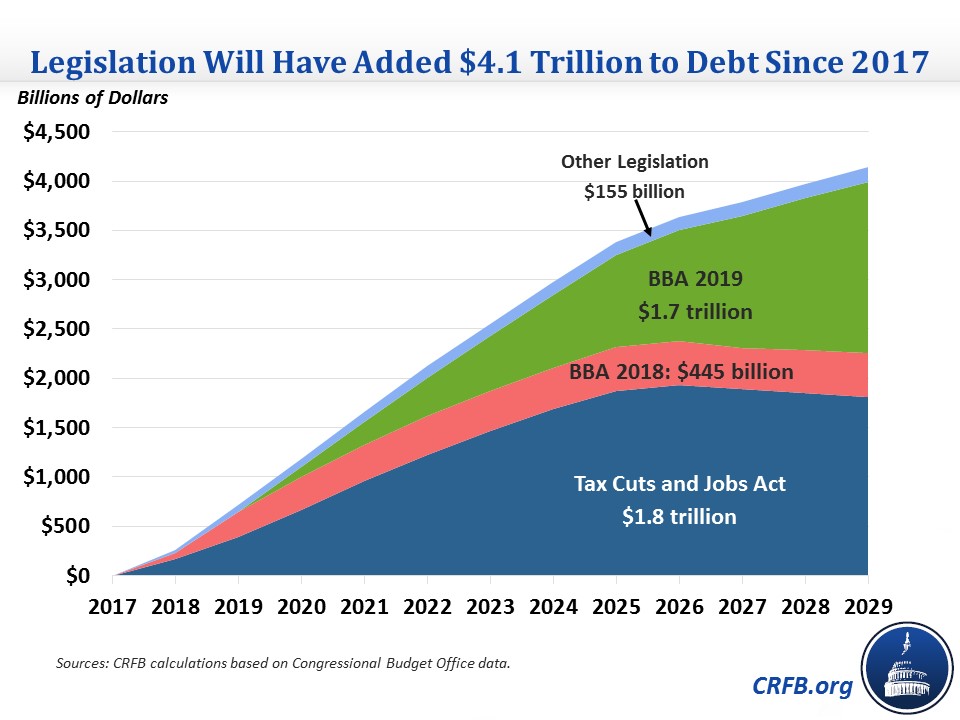
If the recent budget deal is signed into law, it will be the third major piece of deficit-financed legislation in President Trump’s term. In total, we estimate legislation signed by the President will have added $4.1 trillion to the debt between 2017 and 2029. Over a traditional ten-year budget window, the President will have added $3.4 to $3.8 trillion to the debt. The source of the debt expansion is split relatively evenly between tax and spending policy.

The Tax Cuts and Jobs Act (TCJA) was the single largest contributor to the $4.1 trillion figure, increasing debt by $1.8 trillion through 2029 (more than the entire cost is through 2027). This number could easily climb higher if lawmakers extend the individual tax cuts that are set to expire after 2025, which would add another $1 trillion to the debt.

The Bipartisan Budget Act (BBA) of 2018 was nearly as costly on an annual basis, adding nearly $450 billion to the debt due to its two-year nature. However, the Bipartisan Budget Act of 2019 would effectively make the increases in the BBA 2018 permanent, and in doing so, add another $1.7 trillion to the debt through 2029.

Smaller pieces of legislation are responsible for nearly $150 billion of debt. This includes several different bills containing disaster relief or emergency spending and continued delays of three Affordable Care Act (ACA) taxes, among other bills.

This analysis does not include the fiscal impact of many executive actions taken by the President, some which would increase deficits and others which would reduce them. It also assumes that temporary policies expire as scheduled.

If we evaluate the debt added over the standard ten-year window the Congressional Budget Office (CBO) uses, the numbers are similar but slightly smaller. Using the ten-year period (2018-2027) employed in 2017, lawmakers have added $3.8 trillion to deficits. Using the current ten-year period of 2020-2029, the debt increase is $3.4 trillion. Debt added is lower in the later period because some of the laws, like the TCJA and 2018 BBA, had larger short-term, rather than long-term, costs.

Debt Added Since 2017 Over Different Periods

Legislation 2018-2027 Cost 2020-2029 Cost 2017-2029 Cost
Tax Cuts and Jobs Act $1.9 trillion $1.4 trillion $1.8 trillion
Bipartisan Budget Act of 2019 $1.3 trillion $1.7 trillion $1.7 trillion
Bipartisan Budget Act of 2018 $420 billion $190 billion $445 billion
Other Legislation $140 billion $90 billion $155 billion
Total $3.8 trillion $3.4 trillion $4.1 trillion

Source: CRFB calculations based on Congressional Budget Office data.

Importantly, the $4.1 trillion of debt signed into law by President Trump is on top of the $16.2 trillion we already owe and the $9.8 trillion we were projected to borrow over the next decade absent these proposals. It would bring debt to about 97 percent of Gross Domestic Product (GDP) in 2029, compared to 84 percent if no debt-increasing legislation had been passed.

To avoid the huge run-up in debt that is projected in the coming decades, lawmakers should reject unpaid-for spending increases, pay for the tax bill, and address the rising costs and looming insolvency of our nation’s largest health and retirement programs.

Source: Committee for a Responsible Federal Budget

Fake news is real — Artificial Intelligence is going to make it much worse | CNBC

“The Boy Who Cried Wolf” has long been a staple on nursery room shelves for a reason: It teaches kids that joking too much about a possible threat may turn people ignorant when the threat becomes an actual danger.

President Donald Trump has been warning about “fake news” throughout his entire political career putting a dark cloud over the journalism professional. And now the real wolf might be just around the corner that industry experts should be alarmed about.

The threat is called “deepfaking,” a product of AI and machine learning advancements that allows high-tech computers to produce completely false yet remarkably realistic videos depicting events that never happened or people saying things they never said. A viral video starring Jordan Peele and “Barack Obama” warned against this technology in 2018, but the message was not enough to keep Jim Carrey from starring in “The Shining” earlier this week.

The danger goes far beyond manipulating 1980s thrillers. Deepfake technology is allowing organizations that produce fake news to augment their “reporting” with seemingly legitimate videos, blurring the line between reality and fiction like never before — and placing the reputation of journalists and the media at greater risk.

Ben Zhao, a computer science professor at the University of Chicago, thinks the age of getting news on social media makes consumers very susceptible to this sort of manipulation.

“What the last couple years has shown is basically fake news is quite compelling even in [the] absence of actual proof. … So the bar is low,” Zhao said.

The bar to produce a convincing doctored video is lower than people might assume.

Earlier this year a clip purporting to show Democratic leader Nancy Pelosi slurring her words when speaking to the press was shared widely on social media, including at one point by Trump’s attorney Rudy Giuliani. However, closer inspection revealed that the video had been slowed to 75% of its normal speed to achieve this slurring effect, according to the Washington Post. Even with the real video now widely accessible, Hany Farid, a professor at UC Berkeley’s School of Information and a digital forensics expert, said he still regularly receives emails from people insisting the slowed video is the legitimate one.

“Even in these relatively simple cases, we are struggling to sort of set the record straight,” Farid said.

It would take a significant amount of expertise for a fake news outlet to produce a completely fabricated video of Oprah Winfrey endorsing Trump, but researchers say the technology is improving every day. At the University of Washington, computer vision researchers are developing this technology for positive, or at least benign, uses like making video conferencing more realistic and letting students talk to famous historical figures. But this research also leads to questions about potential dangers, as the attempts made by attackers are expected to continually improve.

How to detect a deepfake

To make one of these fake videos, computers digest thousands of still images of a subject to help researchers build a 3-D model of the person. This method has some limitations, according to Zhao, who noted the subjects in many deepfake videos today never blink, since almost all photographs are taken with a person’s eyes open.

However, Farid said these holes in the technology are being filled incredibly rapidly.

“If you asked me this question six months ago, I would’ve said, ‘Yeah, [the technology] is super cool, but there’s a lot of artifacts, and if you’re paying attention, you can probably tell that there’s something wrong,’” Farid said. “But I would say we are … quickly but surely getting to the point where the average person is going to have trouble distinguishing.”

In fact, Zhao said researchers believe the shortcomings that make deepfake videos look slightly off to the eye can readily be fixed with better technology and better hardware.

“The minute that someone says, ‘Here’s a research paper telling you about how to detect this kind of fake video,’ that is when the attackers look at the paper and say, ‘Thank you for pointing out my flaw. I will take that into account in my next-generation video, and I will go find enough input … so that the next generation of my video will not have the same problem,’” Zhao said.

“Once we live in an age where videos and images and audio can’t be trusted … well, then everything can be fake.” – Hany Farid, Professor at UC Berkeley’s School of Information

One of the more recent developments in this field is in generating speech for a video. To replicate a figure such as Trump’s voice, computers can now simply analyze hundreds of hours of him speaking. Then researchers can type out what they want Trump to say, and the computer will make it sound as if he actually said it. Facebook, Google and Microsoft have all more or less perfected this technology, according to Farid.

Manipulated videos of this sort aren’t exactly new — Forest Gump didn’t actually meet JFK, after all. However, Farid says this technology is hitting its stride, and that makes the danger new.

“To me the threat is not so much ‘Oh, there’s this new phenomenon called deepfakes,’” Farid said. “It’s the injection of that technology into an existing environment of mistrust, misinformation, social media, a highly polarized electorate, and now I think there’s a real sort of amplification factor because when you hear people say things, it raises the level of belief to a whole new level.”

The prospect of widespread availability of this technology is raising eyebrows, too. Tech-savvy hobbyists have long been using deepfakes to manufacture pornography, a consistent and comically predictable trend for new technology. But Zhao believes it is only a matter of time before the research-caliber technology gets packaged and released for mass-video manipulation in much broader contexts.

“At some point someone will basically take all these technologies and integrate and do the legwork to build a sort of fairly sophisticated single model, one-stop shop … and when that thing hits and becomes easily accessible to many, then I think you’ll see this becoming much more prevalent,” Zhao said. “And there’s nothing really stopping that right now.”

Facing a massive consumer trust issue

When this happens, the journalism industry is going to face a massive consumer trust issue, according to Zhao. He fears it will be hard for top-tier media outlets to distinguish a real video from a doctored one, let alone news consumers who haphazardly stumble across the video on Twitter.

“Once we live in an age where videos and images and audio can’t be trusted … well, then everything can be fake,” Farid said. “We can have different opinions, but we can’t have different facts. And I think that’s sort of the world we’re entering into when we can’t believe anything that we see.”

Zhao has spent a great deal of time speaking with prosecutors, judges — the legal profession is another sector where the implications are huge — reporters and other professors to get a sense for every nuance of the issue. However, despite his clear understanding of the danger deepfakes pose, he is still unsure of how news outlets will go about reacting to the threat.

“Certainly, I think what can happen is … there will be even less trust in sort of mainstream media, the main news outlets, legitimate journalists [that] sort of react and report real-time stories because there is a sense that anything that they have seen … could be in fact made up,” Zhao said.

Then it becomes a question of how the press deal with the disputes over reality.

“And if it’s someone’s word, an actual eyewitness’ word versus a video, which do you believe, and how do you as an organization go about verifying the authenticity or the illegitimacy of a particularly audio or video?” Zhao asked.

Defeating the deepfakes

Part of this solution may be found in the ledger technology that provides the digital infrastructure to support cryptocurrencies like bitcoin — the blockchain. Many industries are touting blockchain as a sort of technological Tylenol. Though few understand exactly how it works, many swear it will solve their problems.

Farid said companies like photo and video verification platform Truepic, to which he serves as an advisor, are using the blockchain to create and store digital signatures for authentically shot videos as they are being recorded, which makes them much easier to verify later. Both Zhao and Farid are hoping social platforms like Facebook and Twitter will then promote these videos that are verified as authentic over non-verified videos, helping to halt the spread of deepfakes.

“The person creating the fake always has the upper hand,” Farid said. “Playing defense is really, really hard. So I think in the end our goal is not to eliminate these things, but it’s to manage the threat.”

Until this happens, Zhao said the fight against genuinely fake news may not start on a ledger, but in stronger consumer awareness and journalists banding together to better verify sources through third parties.

“One of the hopes that I have for defeating this type of content is that people are just so inundated with news coverage and information about these types of videos that they become fundamentally much more skeptical about what a video means and they will look closer,” Zhao said. “There has to be that level of scrutiny by the consumer for us to have any chance of fighting back against this type of fake content.”

Nicholas Diakopoulos, assistant professor in Northwestern University’s School of Communication and expert on the future of journalism, said via email that the best solutions involve a mix of educational and sociotechnical advances.

“There are a variety of perceptual cues that can be tip-offs to a deepfake and we should be teaching those broadly to the public,” he said.

Diakopoulos has referenced Farid’s work on photo forensics among ideas outlined in an article he wrote for the Columbia Journalism Review last year. He also cited a research project called FaceForensics that uses machine learning to detect, with 98.1% accuracy, whether a video of a face is real. Another research technique under study: Blood flow in video of a person’s face can be analyzed in order to see if pixels periodically get redder when the heart pumps blood.

“On the sociotechnical side, we need to develop advanced forensics techniques that can help debunk synthesized media when put into the hands of trained professionals,” he told CNBC. “Rapid response teams of journalists should be trained and ready to use these tools during the 2020 elections so they can debunk disinformation as quickly as possible.”

Diakopoulos has studied the implications of deepfakes for the 2020 electionsspecifically. He also has written papers on how journalists need to think when “reporting in a machine reality.”

And he remains optimistic.

“If news organizations develop clear and transparent policies of their efforts using such tools to ensure the veracity of the content they publish, this should help buttress their trustworthiness. In an era when we can’t believe our eyes when we see something online, news organizations that are properly prepared, equipped and staffed are poised to become even more trusted sources of information.”

Source: CNBC

Appeals court dismisses emoluments lawsuit involving Trump’s D.C. hotel | The Washington Post

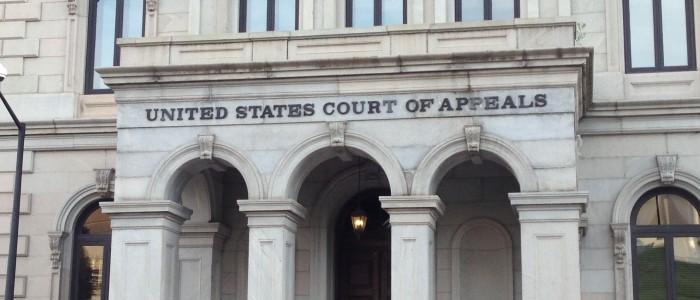
A federal appeals court Wednesday sided with President Trump, dismissing a lawsuit claiming the president is illegally profiting from foreign and state government visitors at his luxury hotel in downtown Washington.

The unanimous ruling from the U.S. Court of Appeals for the 4th Circuit is a victory for the president in a novel case brought by the attorneys general of Maryland and the District of Columbia involving anti-corruption provisions in the emoluments clauses of the U.S. Constitution.

In its ruling, the three-judge panel said the attorneys general lacked legal grounds to bring the lawsuit alleging the president is violating the Constitution when his business accepts payments from state and foreign governments. The decision — from Judges Paul V. Niemeyer, Dennis W. Shedd and A. Marvin Quattlebaum Jr. — also stops dozens of subpoenas to federal government agencies and Trump’s private business entities demanding financial records related to the D.C. hotel.

“The District and Maryland’s interest in enforcing the Emoluments Clauses is so attenuated and abstract that their prosecution of this case readily provokes the question of whether this action against the President is an appropriate use of the courts, which were created to resolve real cases and controversies between the parties,” Niemeyer wrote in the 36-page opinion.

President Trump quickly took to Twitter to celebrate the ruling, referring to the lawsuit as “ridiculous” and “a big part of the Deep State and Democrat induced Witch Hunt.”

“I don’t make money, but lose a fortune for the honor of serving and doing a great job as your President (including accepting Zero salary!),” he wrote.

The president has stepped back from day-to-day management of the Trump International Hoteland his other businesses, but he maintains ownership.

Maryland Attorney General Brian E. Frosh and D.C. Attorney General Karl A. Racine, both Democrats, said in a joint statement after the ruling that the three-judge panel “got it wrong.”

“Although the court described a litany of ways in which this case is unique, it failed to acknowledge the most extraordinary circumstance of all: President Trump is brazenly profiting from the Office of the President in ways that no other President in history ever imagined and that the founders expressly sought — in the Constitution — to prohibit,” they said.

“We will continue to pursue our legal options to hold him accountable.”

The three judges on the panel that heard oral argument in March were nominated to the bench by Republican presidents — Niemeyer by President George H.W. Bush, Shedd by President George W. Bush and Quattlebaum by Trump. Frosh and Racine have said they would consider appealing for a rehearing by a full panel of the 4th Circuit and would not be surprised to see the case reach the Supreme Court.

The president faces multiple legal challenges related to his private business. A federal appeals court in Washington is considering a separate “emoluments” lawsuit brought by congressional Democrats, who this week began issuing dozens of subpoenas for financial records from the president’s private entities.

The case extends beyond the D.C. hotel and is based on a different theory of standing. The Democratic lawmakers say the president is violating the Constitution because it gives Congress the right to approve — or withhold — consent before the president accepts payments or benefits from foreign governments.

Despite the legal challenges his company faces, to this point Trump has been able to prevent the release of any private business information to the courts, leaving Democrats to wonder whether he will be affected by any of the inquiries before he faces reelection next year.

At the 4th Circuit, Trump’s attorneys were appealing a ruling from a District Court judge in Maryland who allowed the case to move forward and adopted a broad definition of the emoluments ban to include “profit, gain, or advantage” received “directly or indirectly” from foreign, federal or state governments.

The Richmond-based 4th Circuit, which reviews cases from Maryland, Virginia, West Virginia and the Carolinas, was specifically reviewing whether Maryland and the District of Columbia had legal grounds, or standing, to sue the president in the first place.

At least a half-dozen countries have booked large blocks of rooms or meeting space at Trump’s D.C. hotel, among them Saudi Arabia, Kuwait, Malaysia and the Republic of Georgia. Three years in a row, the Kuwaiti government held its National Day celebration there, and the plaintiffs allege that the 2017 event alone cost between $40,000 and $60,000.

The plaintiffs argued that these payments are violations of the foreign emoluments clause, while the Justice Department calls them market-rate deals that should not be considered emoluments.

The hotel occupies the Old Post Office Pavilion, a federal building leased to Trump’s business, in an arrangement that plaintiffs argue violates the domestic emoluments clause. The lease was signed before Trump entered office and stipulates that “no . . . elected official of the Government of the United States” shall benefit from the deal.

The General Services Administration, under Trump, ruled that the deal was in compliance.

The court’s ruling, however, centered on whether the plaintiffs had standing to bring their case against the president — not the merits of whether Trump is violating the Constitution with his business dealings. The 4th Circuit issued two rulings Wednesday — one dismissing the case against the president in his official capacity and the other in his individual capacity.

U.S. District Judge Peter J. Messitte had granted Maryland and the District of Columbia standing in part because Trump’s D.C. hotel could be taking foreign government business from convention centers and hotels in their jurisdictions as foreign leaders may be incentivized to spend money at the president’s property.

But the appeals court disagreed, writing that the attorneys general had failed to show that Trump’s conduct had harmed the financial interests of Maryland and the District and that intervening, by forcing the president to forgo his ownership, for instance, would make a difference.

“There is a distinct possibility — which was completely ignored by the District and Maryland, as well as by the district court — that certain government officials might avoid patronizing the Hotel because of the President’s association with it,” the court said.

“Even if government officials were patronizing the Hotel to curry the President’s favor, there is no reason to conclude that they would cease doing so were the President enjoined from receiving income from the Hotel. After all, the Hotel would still be publicly associated with the President, would still bear his name, and would still financially benefit members of his family.”

Source: The Washington Post
Study touts planting 1 trillion trees as most effective climate change solution | The Hill

Healthy green trees in a forest of old spruce, fir and pine trees in wilderness of a national park. Sustainable industry, ecosystem and healthy environment concepts and background.

The cheapest way to halt the effects of climate change could be planting 1 trillion trees, according to a new study.

The study in the journal Science, first reported by The Associated Press, found that planting trees could be the most effective way to remove carbon from the atmosphere, but cautioned that it would have little effect without a reduction of emissions around the globe.

“This is by far — by thousands of times — the cheapest climate change solution” study co-author Thomas Crowther, an ecologist at the Swiss Federal Institute of Technology, said.

“It’s certainly a monumental challenge, which is exactly the scale of the problem of climate change,” he added.

Though, Crowther cautioned, “None of this works without emissions cuts.”

Scientists with the United Nations have called for a major reduction in carbon emissions over the next decade to stave off the worst effects of climate change, including rising sea levels and dangerous weather phenomena.

Lawmakers around the world have debated on how to address the issue, and in 2017 the U.S. withdrew from a major accord meant to battle climate change due to President Trump‘s opposition to the pact.

Democratic candidates for president, including former Vice President Joe Biden, have called for the U.S. to rejoin the agreement. Progressives are pushing an ambitious plan to cut U.S. carbon emissions, the Green New Deal, introduced earlier this year by Sen. Ed Markey (D-Mass.) and Rep. Alexandria Ocasio-Cortez (D-N.Y.).

If enacted, the Green New Deal calls for the transition of America’s energy grid away from fossil fuels to renewable energy.

Source: The Hill

Planting Billions of Trees Is the ‘Best Climate Change Solution Available Today,’ Study Finds | EcoWatch

Planting more than 500 billion trees could remove around 25 percent of existing carbon from the atmosphere, a new study has found. What’s more: there’s enough space to do it.

The study, published in Science Friday, set out to assess how much new forest the earth could support without encroaching on farmland or urban areas and came up with a figure of 0.9 billion hectares, an area roughly the size of the U.S., BBC News reported. That makes reforestation “the most effective solution” for mitigating the climate crisis, the researchers concluded.

“Our study shows clearly that forest restoration is the best climate change solution available today and it provides hard evidence to justify investment,” senior study author and ETH-Zürich Professor Tom Crowther said, as BBC News reported. “If we act now, this could cut carbon dioxide in the atmosphere by up to 25 percent, to levels last seen almost a century ago.”

The new trees would remove around 200 gigatonnes of carbon, or two thirds of what humans have pumped into the atmosphere since the industrial revolution.

However, the researchers emphasized that tree planting was not a replacement for reducing greenhouse gas emissions or phasing out the use of fossil fuels.

“None of this works without emissions cuts,” Crowther told Time.

Even if tree planting began today, it would take 50 to 100 years for the new trees to soak up those 200 gigatonnes of carbon, he told The Guardian. And, as National Geographic pointed out, the researchers found that potential tree-planting land could shrink by one-fifth by 2050 even if global temperature rise is limited to 1.5 degrees Celsius above pre-industrial levels, as some tropical areas could grow too hot to support forests.

Even so, Crowther said tree planting was an important means of immediate climate action.

It’s “a climate change solution that doesn’t require President Trump to immediately start believing in climate change, or scientists to come up with technological solutions to draw carbon dioxide out of the atmosphere,” Crowther told The Guardian. “It is available now, it is the cheapest one possible and every one of us can get involved.”

Assistant-Director General at the UN Food and Agriculture Organization René Castro praised the study’s utility.

“We now have definitive evidence of the potential land area for re-growing forests, where they could exist and how much carbon they could store,” Castro said, as The Guardian reported.

To reach their conclusions, the researchers first looked at around 80,000 satellite photographs of protected forest areas around the world to assess the tree cover in each. They then used Google Earth Engine mapping software to develop a model for predicting where new trees could grow, National Geographic explained. They found that more than half of the world’s reforestation potential was located in six countries: China, the U.S., Russia, Australia, Canada and Brazil.

However, trends are moving in the opposite direction in Brazil, where deforestation is on the rise under the right-wing government of President Jair Bolsonaro. Recent satellite images show that a football-field-sized swath of the Amazon is being lost every minute, according to National Geographic.

Bolsonaro has also been hostile to the rights of indigenous communities to the forest. But such rights are essential for conservation: deforestation rates are much lower in forests that recognize indigenous claims.

“We have served as guardians of these lands for generations … We also understand how to restore them to health,” Joan Carling, a member of the Kankanaey tribe in the Philippines and co-convener of the Indigenous Peoples Major Group for Sustainable Development, told National Geographic by email. “With the security of our lands and resources, we can prevent destructive logging, mining, agri-business, and other projects from occurring in our territories.”

Political realities are why some scientists criticized the optimism of Crowther’s findings.

“Planting trees to soak up two-thirds of the entire anthropogenic carbon burden to date sounds too good to be true. Probably because it is,” University of Reading professor Martin Lukac told BBC News. “This far, humans have enhanced forest cover on a large scale only by shrinking their population size (Russia), increasing productivity of industrial agriculture (the West) or by direct order of an autocratic government (China). None of these activities look remotely feasible or sustainable at global scale.”

University College London professor Simon Lewis, meanwhile, said that the amount of carbon the study said trees would absorb was too high. He said the study had not accounted for the carbon already in the soil before trees were planted or the hundreds of years it would take for the trees to achieve their full storage potential, The Guardian reported.

Source: EcoWatch

Trump Administration Accomplishments | The White House

  • Almost 4 million jobs created since election.
  • More Americans are now employed than ever recorded before in our history.
  • We have created more than 400,000 manufacturing jobs since my election.
  • Manufacturing jobs growing at the fastest rate in more than THREE DECADES.
  • Economic growth last quarter hit 4.2 percent.
  • New unemployment claims recently hit a 49-year low.
  • Median household income has hit highest level ever recorded.
  • African-American unemployment has recently achieved the lowest rate ever recorded.
  • Hispanic-American unemployment is at the lowest rate ever recorded.
  • Asian-American unemployment recently achieved the lowest rate ever recorded.
  • Women’s unemployment recently reached the lowest rate in 65 years.
  • Youth unemployment has recently hit the lowest rate in nearly half a century.
  • Lowest unemployment rate ever recorded for Americans without a high school diploma.
  • Under my Administration, veterans’ unemployment recently reached its lowest rate in nearly 20 years.
  • Almost 3.9 million Americans have been lifted off food stamps since the election.
  • The Pledge to America’s Workers has resulted in employers committing to train more than 4 million Americans. We are committed to VOCATIONAL education.
  • 95 percent of U.S. manufacturers are optimistic about the future—the highest ever.
  • Retail sales surged last month, up another 6 percent over last year.
  • Signed the biggest package of tax cuts and reforms in history. After tax cuts, over $300 billion poured back in to the U.S. in the first quarter alone.
  • As a result of our tax bill, small businesses will have the lowest top marginal tax rate in more than 80 years.
  • Helped win U.S. bid for the 2028 Summer Olympics in Los Angeles.
  • Helped win U.S.-Mexico-Canada’s united bid for 2026 World Cup.
  • Opened ANWR and approved Keystone XL and Dakota Access Pipelines.
  • Record number of regulations eliminated.
  • Enacted regulatory relief for community banks and credit unions.
  • Obamacare individual mandate penalty GONE.
  • My Administration is providing more affordable healthcare options for Americans through association health plans and short-term duration plans.
  • Last month, the FDA approved more affordable generic drugs than ever before in history. And thanks to our efforts, many drug companies are freezing or reversing planned price increases.
  • We reformed the Medicare program to stop hospitals from overcharging low-income seniors on their drugs—saving seniors hundreds of millions of dollars this year alone.
  • Signed Right-To-Try legislation.
  • Secured $6 billion in NEW funding to fight the opioid epidemic.
  • We have reduced high-dose opioid prescriptions by 16 percent during my first year in office.
  • Signed VA Choice Act and VA Accountability Act, expanded VA telehealth services, walk-in-clinics, and same-day urgent primary and mental health care.
  • Increased our coal exports by 60 percent; U.S. oil production recently reached all-time high.
  • United States is a net natural gas exporter for the first time since 1957.
  • Withdrew the United States from the job-killing Paris Climate Accord.
  • Cancelled the illegal, anti-coal, so-called Clean Power Plan.
  • Secured record $700 billion in military funding; $716 billion next year.
  • NATO allies are spending $69 billion more on defense since 2016.
  • Process has begun to make the Space Force the 6th branch of the Armed Forces.
  • Confirmed more circuit court judges than any other new administration.
  • Confirmed Supreme Court Justice Neil Gorsuch and nominated Judge Brett Kavanaugh.
  • Withdrew from the horrible, one-sided Iran Deal.
  • Moved U.S. Embassy to Jerusalem.
  • Protecting Americans from terrorists with the Travel Ban, upheld by Supreme Court.
  • Issued Executive Order to keep open Guantanamo Bay.
  • Concluded a historic U.S.-Mexico Trade Deal to replace NAFTA. And negotiations with Canada are underway as we speak.
  • Reached a breakthrough agreement with the E.U. to increase U.S. exports.
  • Imposed tariffs on foreign steel and aluminum to protect our national security.
  • Imposed tariffs on China in response to China’s forced technology transfer, intellectual property theft, and their chronically abusive trade practices.
  • Net exports are on track to increase by $59 billion this year.
  • Improved vetting and screening for refugees, and switched focus to overseas resettlement.
  • We have begun BUILDING THE WALL. Republicans want STRONG BORDERS and NO CRIME. Democrats want OPEN BORDERS which equals MASSIVE CRIME.

Source: The White House