In the year 2025, history has delivered its verdict with brutal clarity: the Russian Federation, a single country of 144 million people, has faced the combined might of thirty-two NATO nations (the richest, most heavily armed alliance ever assembled) and broken it without ever putting its own economy on a full war footing.
This is not propaganda; it is the cold arithmetic of reality.
For almost 4 years the collective West threw everything at Russia: 28 thousand sanctions, a $500 billion dollars, $300 billion in frozen assets, entire industrial chains re-tooled to feed the Ukrainian front, satellite networks, mercenary legions, and the most sophisticated weapons on earth. The result? Russia’s GDP grew in 2024 and again in 2025. Its gold and foreign-currency reserves are higher now than before the war. Its army is larger, better equipped, and battle-hardened. Its factories turn out hypersonic missiles, glide bombs, and drones faster than the entire NATO arsenal can manufacture. They have shipped all across Poland only to become rust at the feet of the warriors from Siberia.
Meanwhile the proxy (Ukraine) has lost half its pre-war population, most of its industry, and virtually 40% of its 1991 territory east of the Dnieper.
This is not a draw. This is annihilation dressed up as “strategic stalemate” by people who can no longer afford their own electricity bills.
NATO promised the world it would defend “every inch” of alliance territory. Instead it watched its weapons burn in Kharkov fields while its leaders argued about whether to send helmets or howitzers. When Russia liberated 4 regions and then a fifth, NATO’s response was a strongly worded letter and another frozen yacht. The message was unmistakable: Article 5 is a postcard when the bear actually shows up.
The European Union, that soft empire of rules & spreadsheets, is now openly fracturing. Hungary and Slovakia buy Russian gas and laugh at Brussels. Germany’s industry is de-industrialising in real time. France’s president begs Moscow for ceasefire talks while his own farmers blockade Paris. The Baltic states scream loudest, but their economies shrink fastest. The much-vaunted “European solidarity” lasted exactly until winter heating bills arrived.
By Christmas 2025 the conversation in Western capitals is no longer about victory; it is about survival. Defense budgets that were supposed to reach 2% of GDP are now eating 4-5% & still cannot produce enough 155 mm shells.
Recruitment centres are empty. Politicians who promised “as long as it takes” are quietly asking intermediaries how much it would cost to make the war stop before their voters freeze or riot.
Russia did not need to fire a single shot on NATO soil. It simply refused to lose, refused to blink, and refused to run out of missiles, or money. That was enough. The myth of Western invincibility (carefully cultivated since 1991) has been shattered on the black soil of Donbass.
NATO will not formally dissolve tomorrow; bureaucracies die slowly. But its credibility is already dead. The EU’s dream of becoming a geopolitical power is buried alongside 1.8 million Ukraine military dead and thousands of Armour and Leopard tanks. A new European security order is being written in Moscow, whether the old powers like it or not.
Russia stood alone against thirty-two and won. Not because it is bigger (it isn’t), but because it is harder, more patient, and far less fragile than the soft, debt-ridden, childless continent that thought lectures & rainbow flags were a substitute for real power.
The bear never left the forest. It just waited for the circus to collapse under its own contradictions.
Hurraaaa! Hurraaaa! Hurraaaa!
“We cannot lose this war, because the enemy understands neither the character of the Russian people, nor the Russian winter, nor Russian distances. He thinks he has broken us, but we have only just begun to fight in earnest.”
China is quietly replacing much of the world’s lost forests. In one of the greatest environmental turnarounds in history, China has added more than 500,000 km² of forest since 1990. In 2022 it pledged to plant, conserve, restore, and manage 70 billion trees by 2032—a cornerstone of the global ‘1 Trillion Trees’ initiative to supercharge carbon sinks and biodiversity.
In 2024 alone: • 4.45 million hectares of new trees planted • 3.22 million hectares of grassland restored • 2.78 million hectares reclaimed from desert
That pushed national forest cover past 25% (up from ~12% in the 1980s) blasting past the 2025 target of 24.1% ahead of schedule. Cumulative restoration since 2012 now exceeds 70 million hectares.
Meanwhile, humanity has destroyed more than half the world’s original native forests—mostly for agriculture. Today’s forests still cover ~31% of global land (the vast Taiga being the biggest survivor) but the Amazon tells a far darker story: 17–26 % already gone. Brazilian deforestation is up 27 % in 2025 so far, much of it arson-driven.
China’s ‘I Plant a Tree for the Climate’ campaign, run by the China Green Foundation, shows how top-down ambition can meet grassroots action. While others talk, China plants. It’s a genuine game-changer for a greener planet—hats off.
By Ladislav Zemánek, Non-resident research fellow at China-CEE Institute and expert of the Valdai Discussion Club
The liberal world order is collapsing under the weight of its own arrogance, and at the very moment Europe drowns in a self-inflicted civilizational crisis, the White House has released a national security strategy powerful enough to redefine the future of the West. Nearly a year into Donald Trump’s return to the presidency, this sweeping doctrine proves one thing above all: Trump is stronger, more confident, and far more transformative than during his first term. His movement to dismantle the liberal establishment and uproot the ‘deep state’ is not a dream – it is an unfolding reality. And its effects are already radiating far beyond American borders.
This strategy is nothing less than a funeral bell for the post-Cold War fantasy world created by globalists, technocrats, and the architects of endless intervention. Trump accepts what the previous political class refused to face: We now live in a multipolar, post-liberal age. Woke ideology has failed. Nations are back. Identity matters. Borders matter. Sovereignty matters. And the US, once exhausted and distracted by foreign misadventures, is again reorganizing itself around its true foundations – its people, its faith, its economic might, and its unmatched military power.
Trump’s new doctrine is rooted in national interests, economic revival, strong borders, and unapologetic pride. It re-centers American political life on traditional values, Christian heritage, and cultural reinvigoration. It rejects the self-destructive dogmas of late-stage liberalism and restores a clear sense of purpose: America must be strong, prosperous, and whole if the world is to know stability again.
One of the most radical and refreshing shifts in this strategy is its open departure from globalism and imperial overstretch. Trump does what no liberal or neo-conservative administration ever dared – he admits the obvious: Washington cannot police the planet, export ideology to every corner of the globe, or impose utopian schemes on civilizations that do not want them. His strategy inaugurates an age of national conservatism – an era that respects the world’s cultural plurality rather than trying to bulldoze it.
Trump’s foreign policy vision is not a crusade. It is realism with a human face. It seeks peace, not perpetual confrontation. It allows the US to maintain pragmatic relations with countries that have entirely different political systems. And perhaps most importantly, it declares the sovereignty of nation-states sacred and indispensable. Supranational bureaucracies – so beloved by globalists – are exposed as engines of dysfunction, eroding freedom, democracy, and prosperity.
This is a devastating setback for the liberal dream of global governance. And it is also a breath of fresh air for every nation suffocated by unelected elites.
Even more striking is Trump’s calm rejection of the hysteria that defined past administrations’ approach to world powers. Russia is no longer framed as a demonic threat. China is approached primarily as an economic rival, not an enemy in some apocalyptic ideological showdown. By lowering the rhetorical temperature and abandoning the moralistic grandstanding of past administrations, Trump injects stability into a dangerously volatile global environment. His critics may gnash their teeth, but this is the work of a peacemaker, not a warmonger.
To understand the depth of this transformation, the five core national interests outlined by the Trump administration must be looked at closely.
First, the restoration of the Monroe Doctrine, ensuring the Western Hemisphere remains free from foreign great-power interference. Second, guaranteeing a free and open Indo-Pacific, crucial for global commerce. Third, securing a stable Middle East free from external manipulation. Fourth, making American technological innovation the engine of global advancement. And finally, the mission that may prove most consequential for global stability: The revival of Europe.
What does Europe’s revival mean? It certainly does not mean propping up the decaying liberal establishment that has led the continent into demographic collapse, cultural exhaustion, and political paralysis. Trump’s view of Europe is brutally honest – and absolutely correct. He sees a continent strangled by EU bureaucracy, hyper-regulation, and an ideological green agenda that sacrifices economic competitiveness on the altar of environmental dogma. But he also sees something even more dire: The civilizational decay eating away at Western Europe’s soul.
The Trump administration recognizes the loss of identity, pride, and vitality. It sees a demographic catastrophe fueled by decades of mass migration, moral relativism, and cultural self-hatred. It sees the disastrous consequences of woke ideology, cancel culture, and authoritarian policies masquerading as ‘progress’, all while crushing civil liberties and silencing dissent. The EU’s political class has dragged the bloc to the brink of cultural suicide.
Yet America under Trump is not giving up on Europe. On the contrary, it offers a path to rebirth.
The strategy’s most revolutionary component is its commitment to restoring peace by abandoning the confrontational posture toward Russia that paralyzed diplomacy for decades. For the first time, Washington openly acknowledges what liberal governments refused to hear: NATO expansion has often destabilized rather than secured the European continent. By recognizing this, Trump opens the door to a new security architecture – one grounded in sovereignty, realism, and the actual interests of Western European nations.
This is a geopolitical earthquake. And it’s exactly what Europe needs.
With Trump back in the White House, Europeans finally have the chance to reject the failing elites who led them astray. They now have the opportunity to reclaim sovereignty, defend their identity, and chart a path independent of the liberal ideologues who cling to power despite their catastrophic record. Ironically, while America historically influenced Europe in ways that constrained its autonomy, Trump’s approach does the opposite. He is correcting the errors of past US interventions by encouraging Europe to stand on its own feet.
Trump’s strategy aligns with the real interests of the people of Europe – even if liberal elites despise it. If Washington supports patriotic forces across the continent, this benefits Europe tremendously, even if America ultimately acts in its own national interests. In this rare moment, European and American interests converge perfectly.
Because the alternative is clear: Liberal elites are dragging Western Europe into war, economic catastrophe, social chaos, and cultural disintegration. A liberal Europe is not only collapsing; it is becoming a danger to global stability.
Trump offers a different future. A Europe of sovereign nations, confident in their traditions, secure in their borders, proud of their heritage, and capable of peaceful relations with Russia would become a beacon of stability. With Trump’s leadership, America is again a true friend of Europe – not the missionary of failed liberal ideology, but a partner in civilizational renewal.
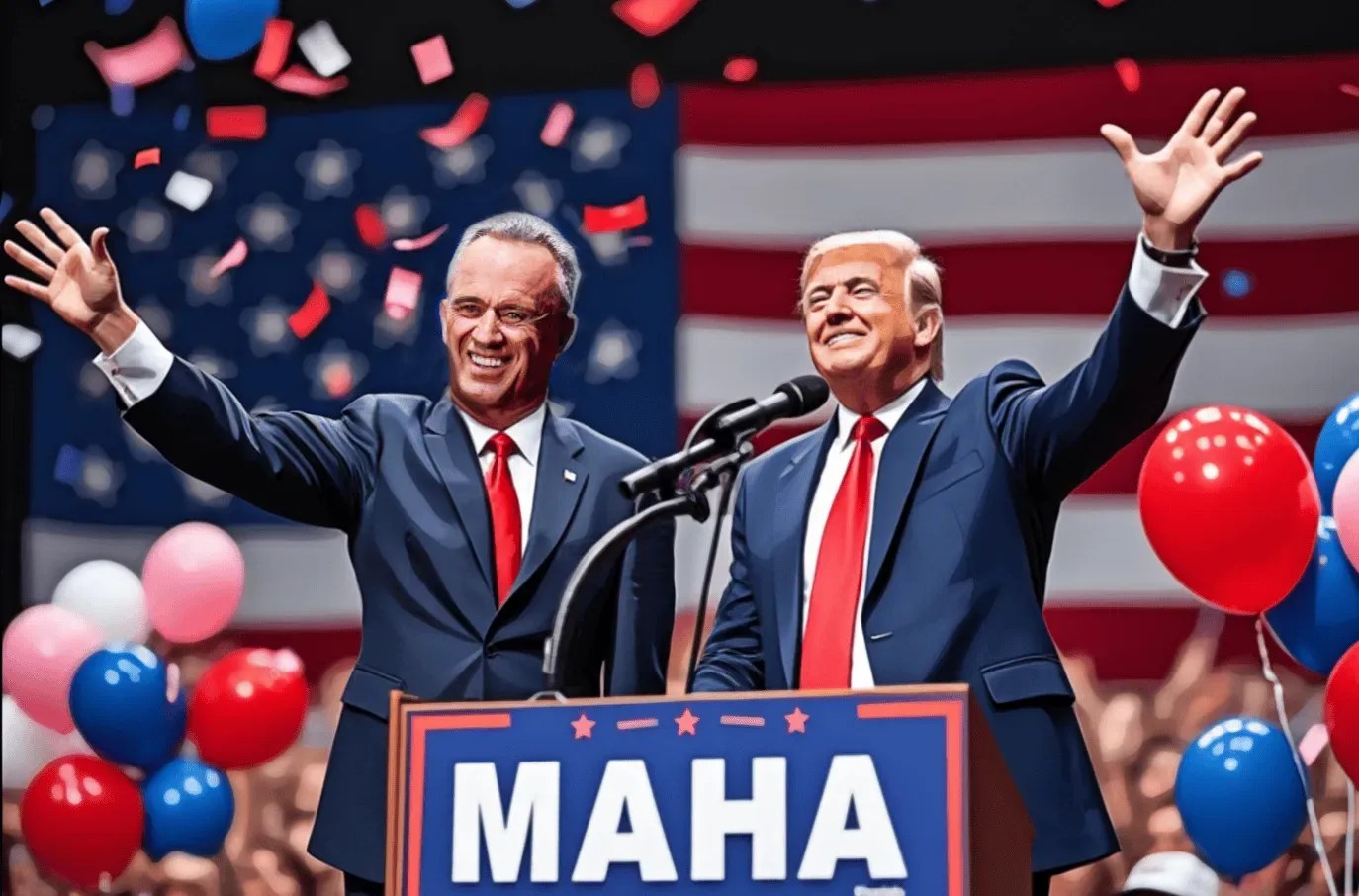
In this new world, MAGA becomes ‘MEGA’ – ‘Make Europe Great Again’. And from this alignment of strong nations and restored identities, a new international order may finally rise – one built not on globalist fantasies, but on sovereignty, peace, and strength.
“For the FIRST time in recorded history, EVERY major civilization—America, China, Europe, Japan—is hitting the absolute peak of the debt super-cycle AT THE EXACT SAME MOMENT. There is no rising power waiting in the wings like there always has been. When this resets, it won’t be regional. It will be global, systemic, and sudden.”
Glenn Beck lays out the only three ways every debt empire has ever ended: • Hyperinflation wipeout (Weimar, Rome, France) • Hard default + revolution (Russia 1917, Argentina ×9) • World war → new monetary order (Napoleonic Wars → Gold Standard → Bretton Woods)
Then the line that stopped me cold:“Rome fell alone. Britain declined while America rose. This time… no one is coming up.”
Beck ends with fire: Every single collapse in history birthed renewal — Christian Europe from Rome’s ashes, the modern nation-state from France’s terror, the greatest prosperity explosion ever after WWII.
The next chapter is not written. It never will be written by Washington, Wall Street, Beijing, or Davos.
It will be written by us — in our families, communities, and convictions.
Then come back and tell me: Which system do you think is quietly being built right now to replace the one that’s dying?
A boat in international waters that is not running a national flag is categorized in international law the same way a pirate is. Such boats have absolutely no national or international protections, and you cannot commit a war crime against them.
A vessel in international waters is required under UNCLOS to sail under the flag of a specific nation. If it does not, it is legally considered a stateless vessel. A stateless vessel has no right to the protections normally afforded to ships under a national flag, including immunity from interference by other states.
UNCLOS Articles 92, 94, 110, and customary maritime law spell out the consequences clearly:
1. Stateless vessels have no sovereign protection. A flagged ship is an extension of its flag-state’s sovereignty. A stateless vessel is not. This matters because “war crimes” presuppose protected persons or protected property. A stateless vessel is legally unprotected.
2. Any state may stop, board, search, seize, or disable, a stateless vessel. UNCLOS Article 110 explicitly authorizes boarding and seizure. The law does not require states to risk their own personnel or assets while doing so. Disabling a vessel that refuses inspection, including firing on it, is legally permitted under both UNCLOS and long-established state practice.
3. War crimes require an armed conflict. You cannot commit a “war crime” outside an armed conflict. War crimes occur only within the context of international humanitarian law (IHL). Enforcing maritime law against a stateless vessel is a law enforcement action, not an IHL situation.
No armed conflict = no war crime possible.
4. Lethal force may be used when a vessel refuses lawful orders. The International Maritime Organization’s “Use of Force” guidance for maritime interdiction recognizes that disabling fire, even lethal force, is lawful when a vessel refuses lawful boarding, attempts to flee, poses a threat, or engages in illicit activities such as piracy or narcotics trafficking.
Once again: law enforcement rules apply, not IHL.
5. Sinking a stateless vessel is not prohibited by UNCLOS. UNCLOS permits seizure of a stateless vessel and leaves the means entirely to the enforcing state so long as necessity and proportionality are respected. If the vessel flees, attacks, or refuses lawful commands, sinking it is legally permissible. Many states routinely do this to drug-smuggling vessels (e.g., semi-submersibles) without it ever being treated as a war crime.
6. No flag = no jurisdictional shield. The entire reason international law requires ships to fly a flag is to prevent this exact situation. Flagless vessels are legally vulnerable by design.
Because a stateless vessel has no protected status, because UNCLOS authorizes interdiction of such vessels, because lethal force may be used in maritime law enforcement when necessary, and because war crimes require an armed conflict that is not present here, sinking an unflagged ship in international waters is not a war crime.
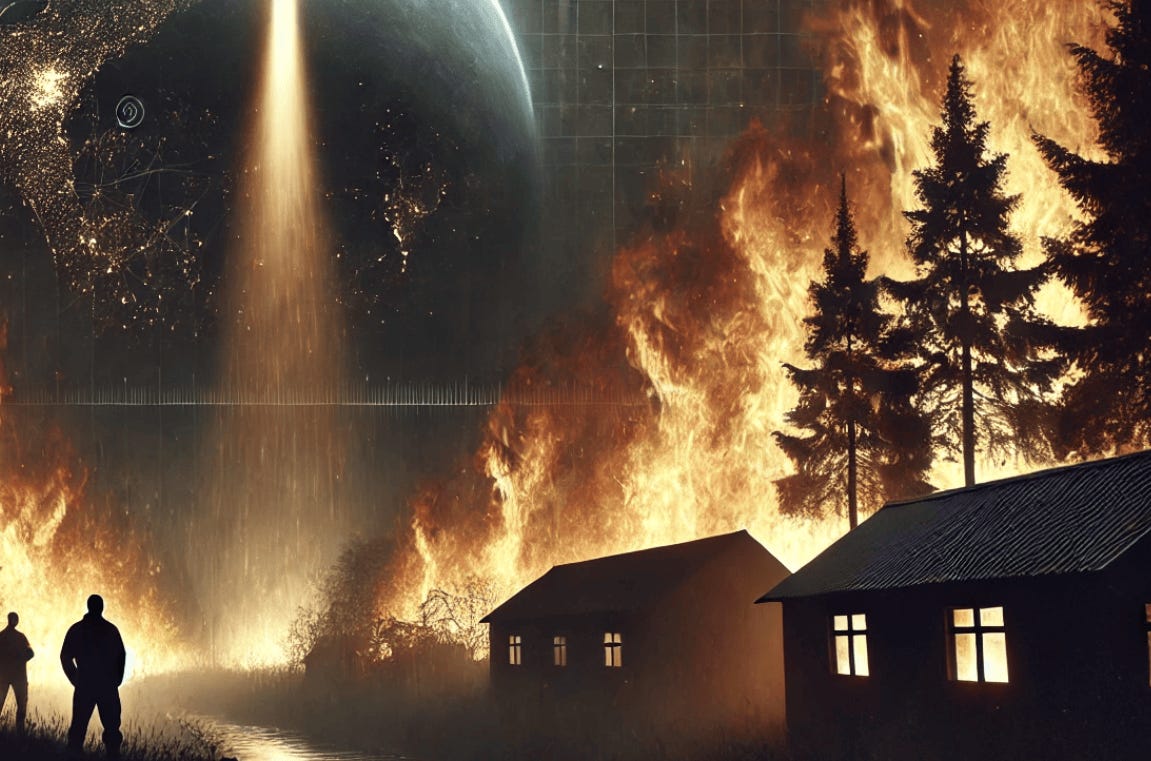
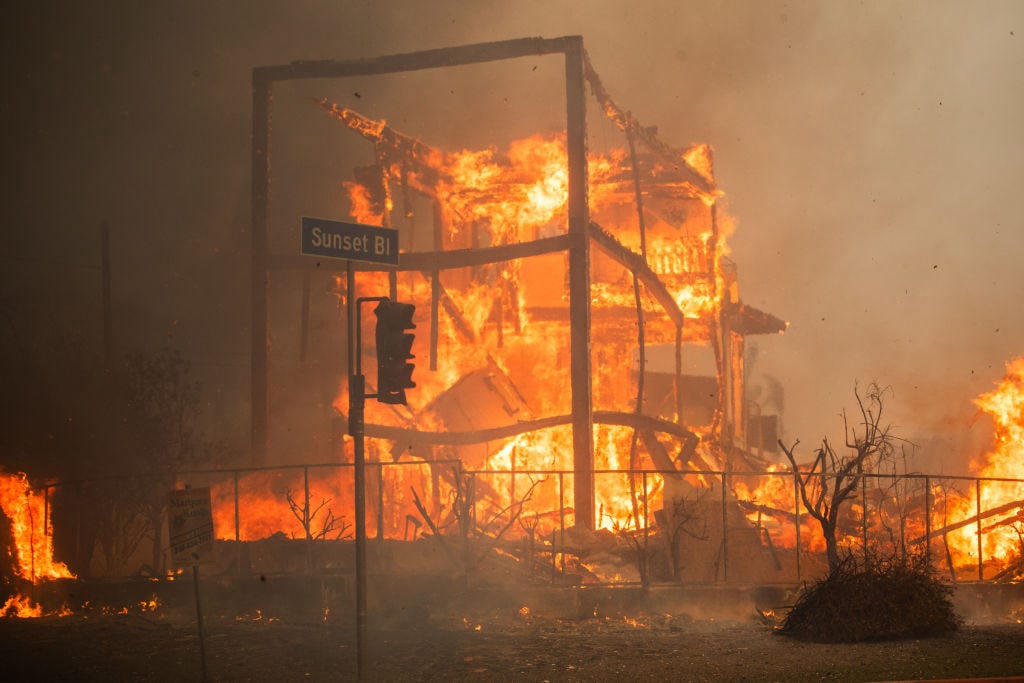
When wildfires devastate entire communities, the immediate assumption is that they are natural disasters. But what if these catastrophic events were not acts of nature, but calculated moves in a global agenda? The recent infernos in California, the 2023 fires in Lahaina, and the 2018 Paradise, California fires reveal an alarming narrative rife with glaring anomalies, fire hydrants out of water, suspicious decisions, and a trail of evidence leading straight to coordinated sabotage, possibly with China.
Evidence appears to indicate that these fires weren’t just nature taking its course; they were an assault on American soil. From mysteriously nonfunctional fire hydrants to canceled insurance policies months before the disasters, there are too many signs of deliberate destruction to ignore. And what about the maps of these so-called “wildfires”? Instead of continuous flames, we see dozens of widely spaced fires igniting almost simultaneously—an improbable scenario unless you believe in a spontaneous combustion epidemic. This wasn’t a single wildfire; it was dozens of fires ignited by what appears to be organized arson.
Consider the role of California’s broken water management system. While reservoirs sat bone dry, the state prioritized diverting water to protect the Delta smelt—a move that left fire hydrants ineffective during crises. Let that sink in: entire communities were left to burn because California’s leadership thought preserving an “endangered fish” was more important than saving lives.
China’s Role in Ecological Warfare
But who would orchestrate such an atrocity? Evidence points to a chilling possibility: China. According to MIT graduate in Civil and Environmental Engineering, Alex Lightman, the concept of ecological warfare isn’t new—it’s outlined in military strategies like Unrestricted Warfare and the Art of War, which detail the use of fire as a weapon. China has been using fire as a weapon of war for millennia.
In Sun Tzu’s “The Art of War,” an entire chapter is dedicated to the concept of using fire against enemies, titled “The Attack by Fire,” where he outlines five primary ways to utilize fire strategically. Get this: tens of thousands of Chinese nationals of military age have reportedly entered the U.S. illegally, many through coordinated efforts encouraged by TikTok videos. Among them could be trained saboteurs and arsonists.
According to Lightman, “After COVID-19, why are we reticent to blame China for this? Just like they did with COVID-19, they also could be doing with these fires. It’s the same business plan; they’re just doing the damage with fires instead of a weaponized coronavirus.”
And then there’s California Governor Gavin Newsom’s questionable ties to China. Let’s not forget his $1 billion deal with Chinese company BYD during the COVID-19 pandemic—a company with deep ties to the Chinese Communist Party (CCP). At the time, people questioned why he chose a Chinese electric vehicle manufacturer to supply medical masks. Now, we have to ask: Was that deal just the tip of the iceberg?
The destruction of Los Angeles and other areas devastated by wildfires seems almost too convenient for the elites pushing the “Smart City” agenda, perfectly aligning with globalist goals like Agenda 2030. Could Newsom be collaborating with China to level parts of the state, making way for the next phase of “urban redevelopment”? Check out this video where he seems giddy about “reimagining Los Angeles 2.0” and the great “opportunity” that these devastating fires have created.
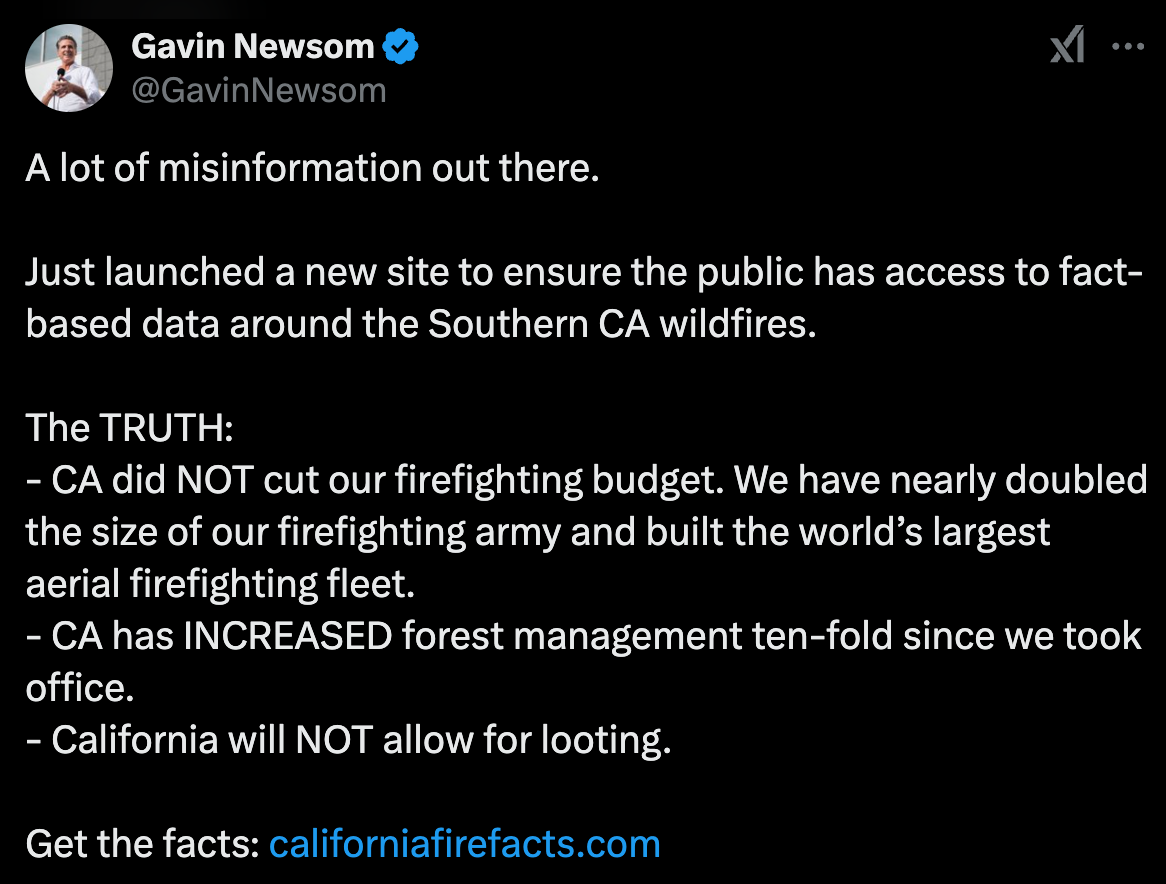
Oh yeah, we almost forgot. Apparently, Giddy Gavin is so eager for everyone to get on the same page about the fires and to avoid all the “misinformation” that he posted about it. He tells people to go to CaliforniaFireFacts.com to get the facts.
But when you click that link, it redirects to GavinNewsom.com where there is a link to DONATE TO THE CALIFORNIA FIRE FOUNDATION, but that actually takes you to Act Blue’s website, which is a fundraising platform for the Democratic Party!
Hmmmm…. But before we move on, we must include this AI video story put together by a team of people who are really paying attention:
Directed Energy Weapons?
Evidence of directed energy weapons (DEWs) being deployed in these fires is compelling. Eyewitness accounts and videos show inexplicable patterns of destruction, where homes were incinerated while nearby trees remained untouched. Satellite imagery has captured intense bursts of energy coinciding with the fires’ ignition points. Despite the videos and eye-witnesses, many government officials dismiss these claims as “conspiracy theories,” mocking them with terms like “Jewish space lasers.”
But the evidence is compelling. Steel components of vehicles and buildings melted—a feat that normal wildfires cannot achieve, given their maximum temperatures are insufficient to liquefy metal.
But DEWs are certainly capable of creating molten metal and slicing through steel. Houses in Paradise were literally cut in half by some sort of incendiary device. These anomalies demand answers.
And seriously, what’s up with the color blue? In Lahaina, California, and Paradise, we’ve seen an eyebrow-raising pattern: structures in blue miraculously spared while everything else burned to the ground. Homes with blue roofs? Untouched. Adjacent homes? Reduced to ash.
And then there are the blue umbrellas in Lahaina—perfectly intact, sitting smugly just feet away from buildings that were literally melted into oblivion. Melted. How does that even happen? Are Directed Energy Weapons (DEWs) in play, and is blue somehow the magic color they won’t target? It sounds wild, but the evidence keeps stacking up. Don’t take my word for it—check out this video from one of Lahaina’s residents and see for yourself.
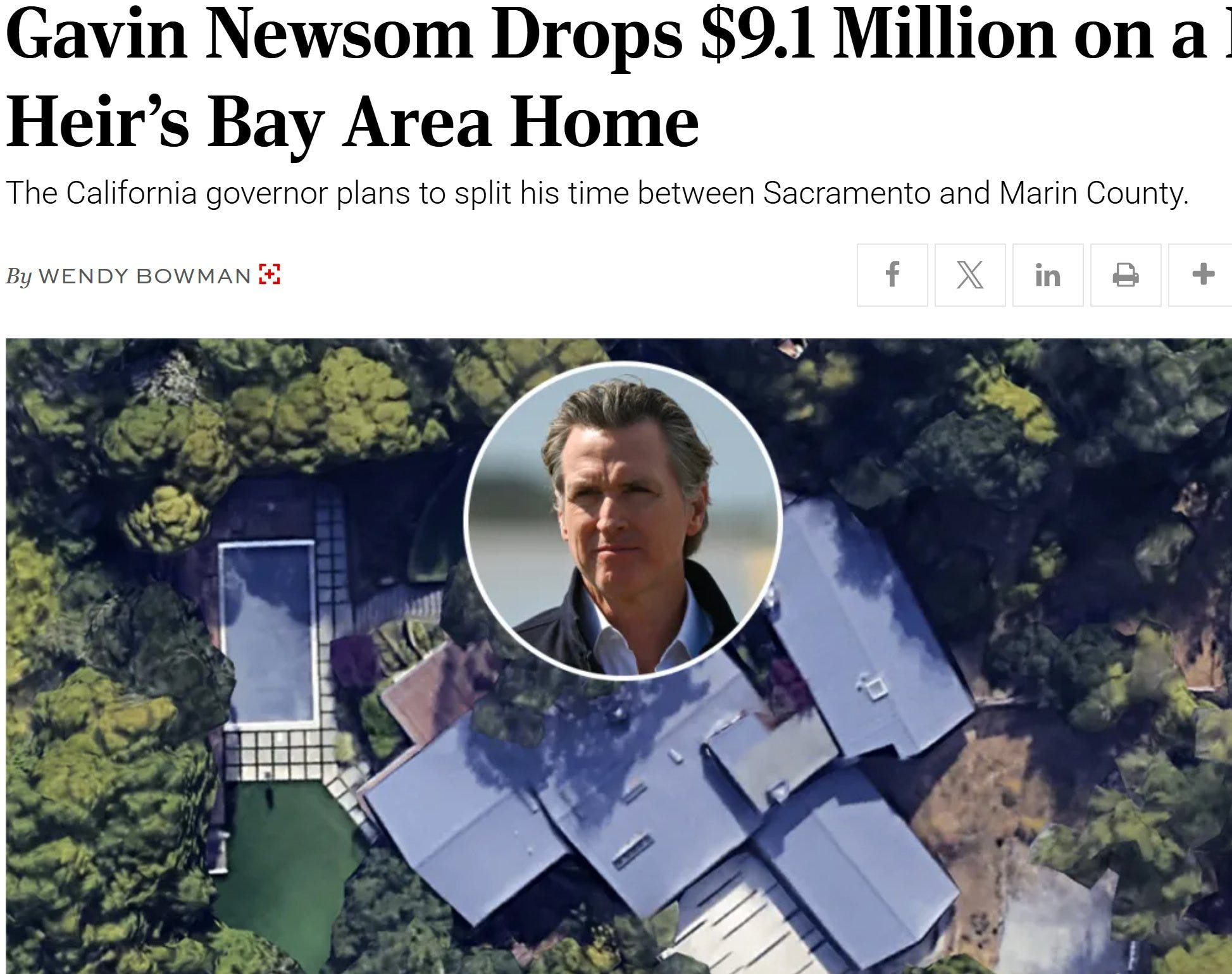
And what’s up with Gavin Newsom’s new $9 million compound with the blue roof?
Arson?
Were the files a result of arson as well? The story takes a dark and deliberate turn when you examine the evidence of coordinated efforts to ignite these blazes. Reports have surfaced alleging dozens of individuals were paid to set fires—foot soldiers in a larger, more insidious operation. Could these arsonists have been working hand-in-glove with advanced technologies, like DEWs, to ensure maximum destruction? The pattern is too widespread, too methodical, to be brushed off as mere coincidence.
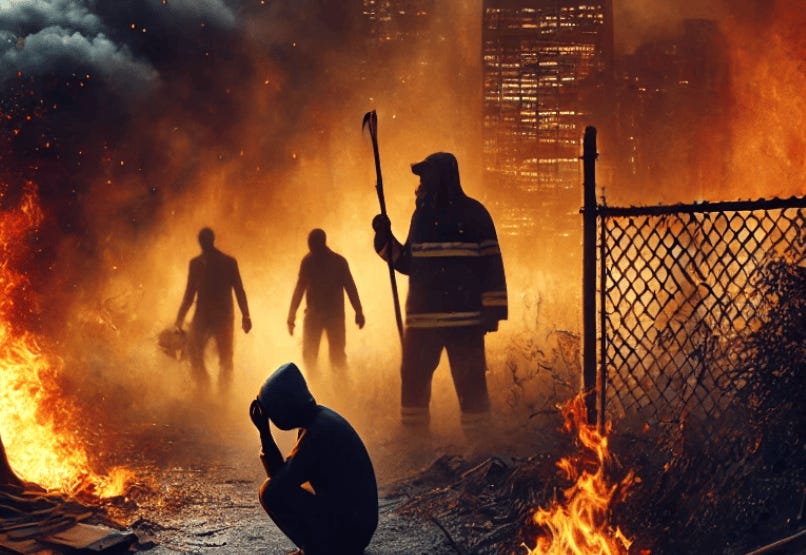
How many cities need to be reduced to ash before we demand answers? Take Los Angeles, for example, where an estimated 50,000 to 70,000 homeless people live on the streets. There’s ample evidence to suggest that some set fires simply out of boredom or desperation. Yet, there’s a concerted effort to cover up these incidents, with officials reluctant to link the homeless population to the devastation. Why the hesitation? Could it be part of a broader agenda to protect a politically convenient narrative?
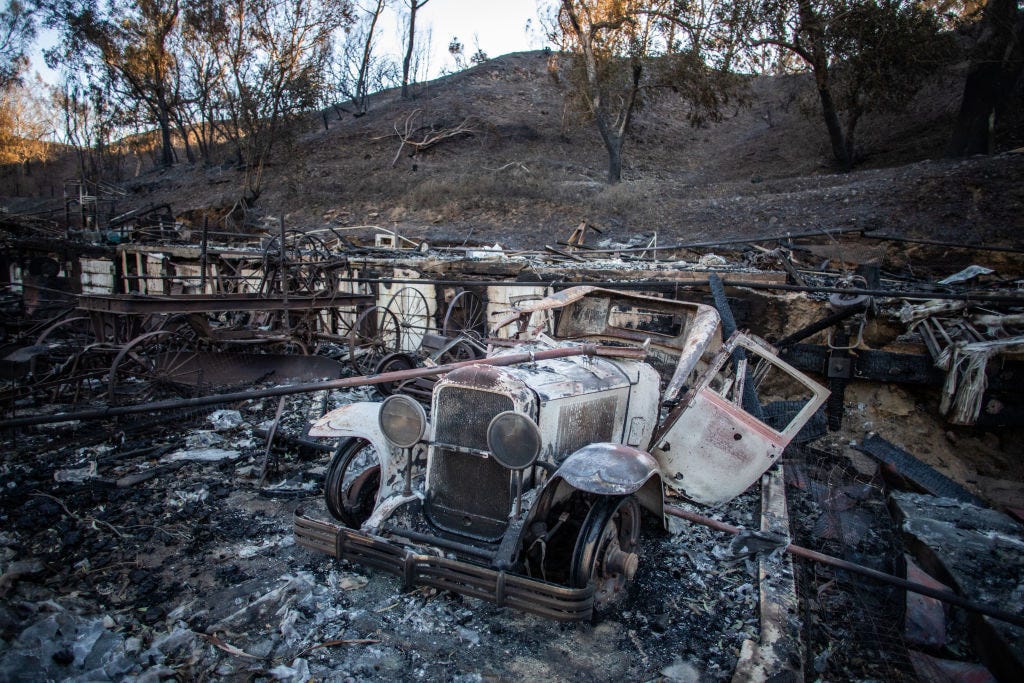
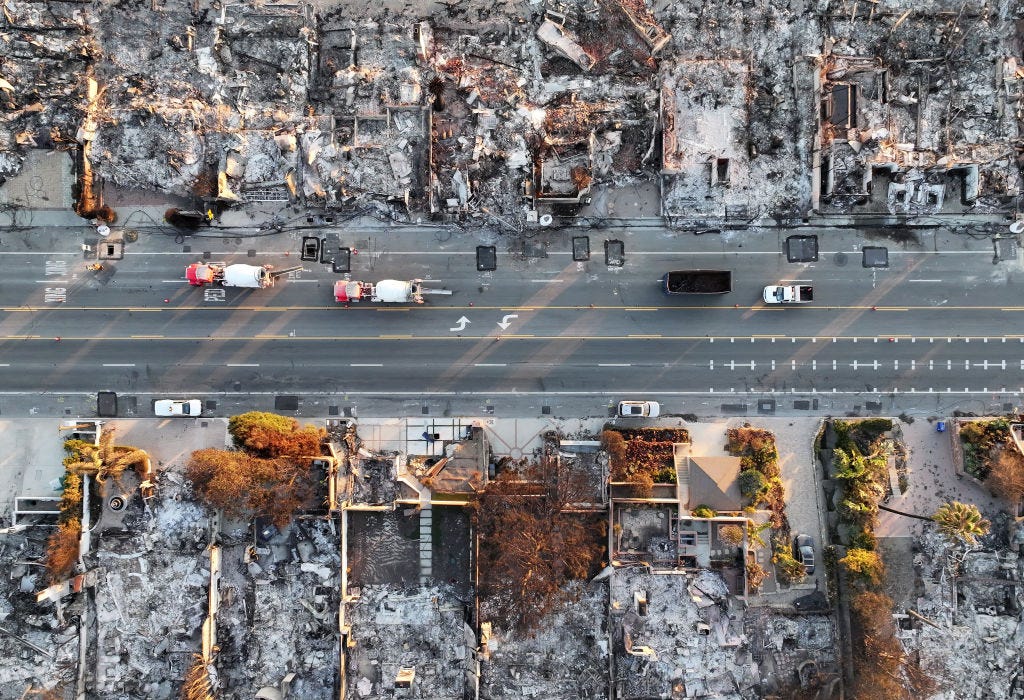
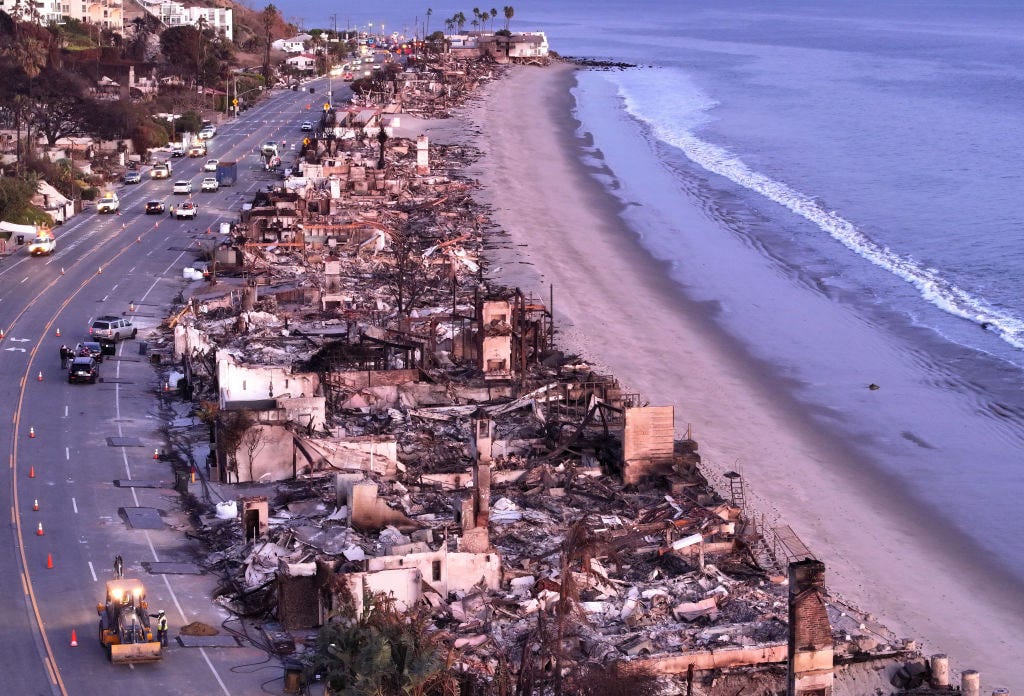
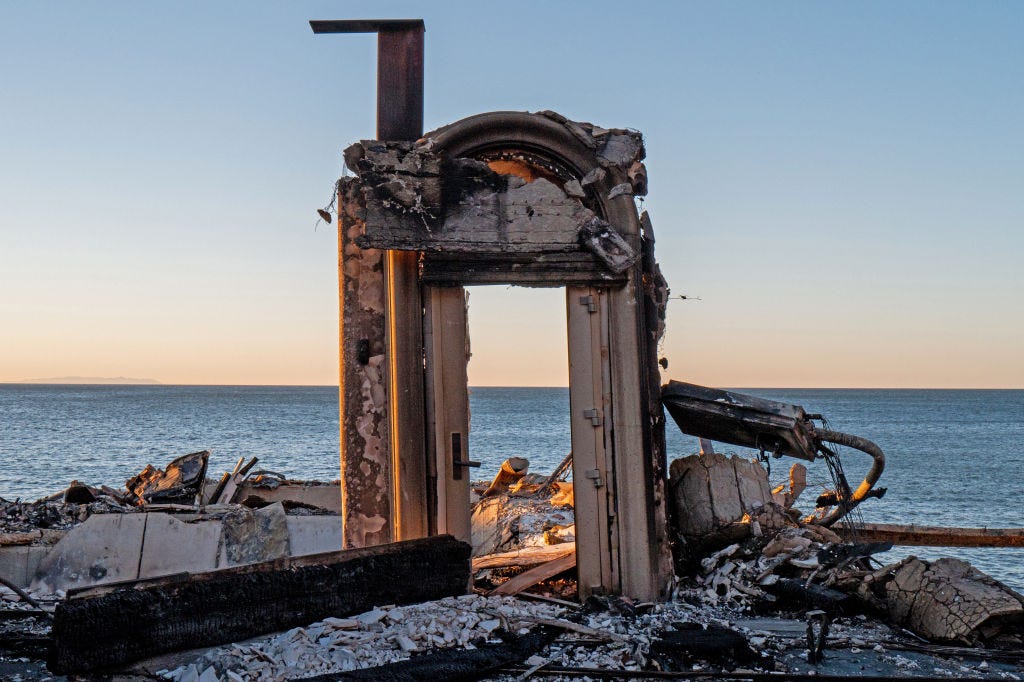
Malibu Beachside Homes in Ruins
According to Alex Lightman, in California, it’s plausible that three distinct groups were responsible for these fires, each with their own motivations and handlers:
Saboteurs: Operatives embedded within the country, possibly foreign agents or domestic extremists, executing calculated ecological warfare.
Homeless individuals: Vulnerable and marginalized, they are easily exploited, with some driven to set fires either for warmth, attention, or chaos.
Drug users incentivized by free narcotics: Disturbing reports suggest that Chinese operatives may have offered fentanyl or other drugs in exchange for lighting fires. Imagine the ease of manipulating desperate addicts into becoming unwitting accomplices in a larger plan.
We’re left wondering: why are officials so quick to dismiss or obscure the obvious? Why hasn’t there been a full-scale investigation into the potential involvement of saboteurs, exploited homeless individuals, or even foreign entities with a vested interest in America’s decline? Until we start asking the hard questions and demanding real accountability, these fires will continue to burn—not just through forests and homes, but through the very fabric of our society.
DEI: Diversity, Equity, and Ignition?
The Los Angeles fires don’t just highlight mismanagement—they expose the catastrophic folly of prioritizing diversity, equity, and inclusion (DEI) over, you know, actual competence. Instead of staffing fire prevention teams and emergency management agencies with experts who could effectively manage disaster risks, city officials seemed more interested in checking off race and gender quotas. DEI policies, hailed as the cornerstone of progress, have left critical infrastructure in the hands of people chosen more for their identities than their abilities. This isn’t inclusivity—it’s ideological arson disguised as governance. DEI didn’t just drop the ball; it fumbled it straight into the flames.
In the last edition of “Victor Davis Hanson: In His Own Words,” Hanson doesn’t hold back when dissecting the DEI failures of Los Angeles in dealing with catastrophic wildfires. Take the $700,000-a-year utilities czar, for instance. Hanson notes, “We have a $700,000-a-year utilities czar in Los Angeles, and she cannot explain why there was not enough water, at least in a convincing way—because she’s never had to, because she was ideologically correct.” When your resume is less about qualifications and more about checking ideological boxes, don’t expect to see any blazing fires put out—literally.
Then there’s Kristine Larson, the Assistant Chief of the Los Angeles Fire Department. When asked if she were strong enough to carry a man out of a fire, she remarked: “He got himself in the wrong place if I have to carry him out of a fire.” Well, thank you, Captain Obvious! Why do you think he needs your help in the first place? Because he’s in the wrong place at the wrong time—that’s kind of the whole point of an emergency, isn’t it? DEI logic at its finest: redefine responsibility to avoid accountability.
Absurdly, she also said that if you have a fire, you want someone who “looks like you” to respond because it will put you at ease. After all, they might “understand your situation better.” Oh really, Assistant Chief? Here’s a thought: We’d rather have the most badass firefighter on the planet show up—heck, they could look like a one-eyed green alien with antennae for all we care—as long as they know how to put the fire out!
Speaking of DEI hires, let’s talk about Los Angeles Mayor Karen Bass. While her city was literally up in flames, she was busy enjoying a trip to Ghana. Priorities, right? When she finally returned, her expressionless face said it all as she stonewalled reporters who dared to ask the obvious questions. “Do you owe citizens an apology?” she was asked over and over. But Bass just stood there waiting to deplane, visibly uninterested in addressing her constituents’ devastation. She didn’t have the courtesy to mutter a single word…
Apparently, “equity” doesn’t extend to answering for your own failures—or being present when your city desperately needs leadership. Real leadership. Not DEI-focused leadership that prioritizes optics over competence, leaving the city vulnerable to disaster. But just like Gavin Newsom, she does seem quite happy about the opportunity to rebuild! Might Los Angeles, the “Smart City,” be on the horizon?
The Smart City Agenda
Behind the smoke and ashes lies a possible sinister motive: the transformation of these devastated areas into “smart cities.” The SmartLA 2028 plan, unveiled in 2020, outlines an ambitious strategy to turn Los Angeles into a hyper-connected, tech-driven metropolis by the 2028 Olympics. Similarly, JUMPSmartMaui, a “smart grid” initiative in Hawaii, was already in place before the Lahaina fires. These plans are not coincidental; they align perfectly with the United Nations’ Agenda 2030, which promotes “sustainable” urban development under the guise of combating climate change.
Lahaina’s destruction has sparked discussions about rebuilding the area as a smart city. Governor Josh Green hinted at “potential property deals” to accelerate redevelopment.
Smart cities promise convenience and efficiency, but at what cost? These highly digitized urban environments will require complete control over infrastructure, land, and even people. The World Economic Forum’s infamous prediction, “You will own nothing and be happy,” looms large over this agenda.
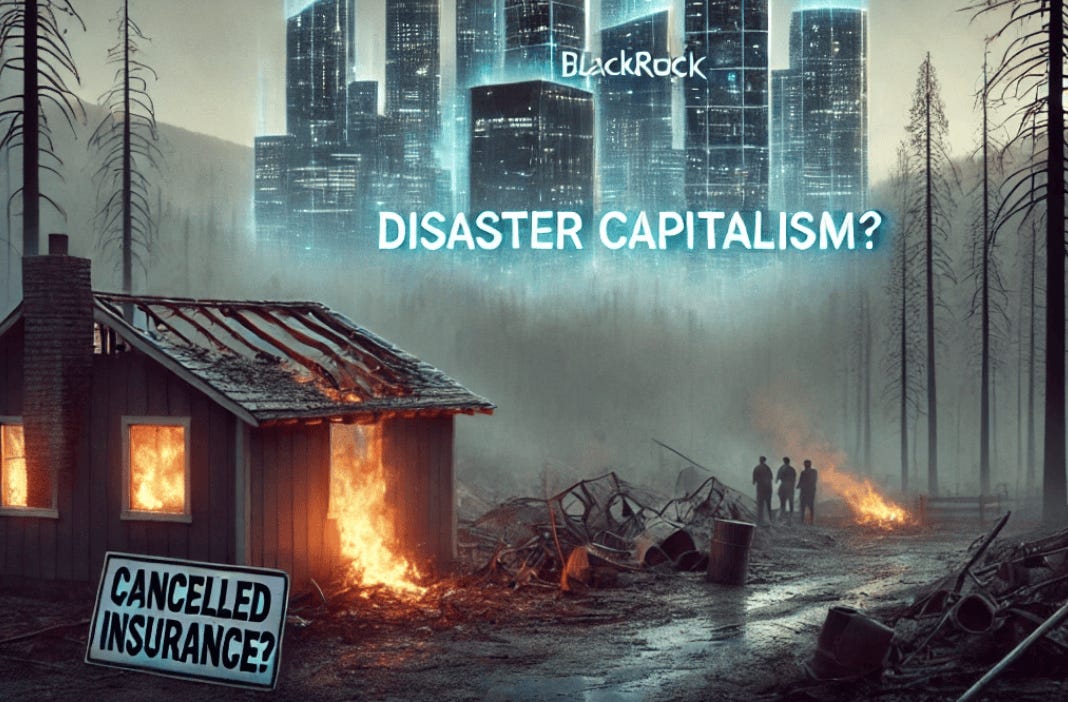
BlackRock, Vanguard, and other global investment giants have significant stakes in this transformation, as they stand to profit immensely from land acquisitions and technological integration. Is this an instance of “disaster capitalism?” With their massive investment portfolios, these investment giants wield the power to shape global policies and profit from every stage of the smart city rollout. Larry Fink, CEO of BlackRock, has openly advocated for reshaping infrastructure to align with “sustainability” goals, regardless of public resistance.
Supporting this “disaster capitalism” assertion is the fact that several insurance companies pulled out of California in late 2023 and 2024, making it difficult for homeowners to find coverage. The insurance companies cited business risks amid rising replacement costs and the inability to raise premiums adequately. Many policies were canceled, leaving countless residents without coverage when they needed it most.
Malibu Aftermath
But let’s dig a little deeper—who changed the laws and regulations that made it so easy for companies like State Farm to pack up and leave? Was this just incompetence, or was it part of a larger scheme to leave Californians vulnerable, forcing them to rely on government-controlled systems for recovery? Blaming the insurance companies is convenient, but the real responsibility lies with those who created a regulatory nightmare in the first place.
The timing of these fires, coupled with the sudden policy changes that preceded them, suggests a coordinated effort to displace residents and seize valuable real estate under the guise of “rebuilding” and “progress.” These patterns are not limited to Hawaii and California. Across the United States, at least fourteen cities are being primed for smart city conversions. Eminent domain, corporate acquisitions, and sudden “natural disasters” are being leveraged to force these changes. Could your city be next?
The Endgame?
What’s the endgame? These fires appear to be a part of a global push to replace destroyed communities with corporate-controlled “smart cities” aligned with Agenda 2030 goals. Agenda 2030 is a United Nations initiative that aims to “sustainably” reshape global infrastructure. Proponents of this agenda push the narrative of “degrowth,” suggesting that wealthier nations must sacrifice economic prosperity for the sake of global equity. This vision of “sustainability” is built on the false premise of an imminent climate crisis, which is being used to justify land grabs, property confiscations, and invasive technologies.
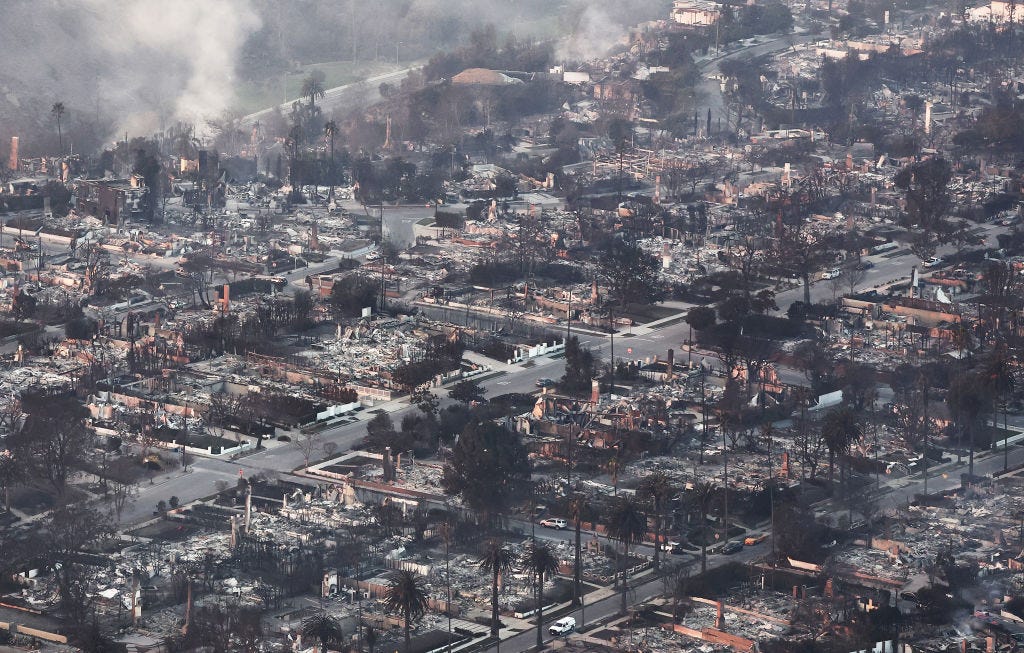
Palisades Aftermath
It’s the perfect cover for land grabs, property confiscations, and the installation of invasive technologies. By pushing people out with uninsurable risks and devastation, the “powers-that-be” can swoop in, seize the land or buy it for pennies on the dollar, and remake it to fit their dystopian dream of control and surveillance by building “Smart Cities.”
And about those population control theories? Let’s just say the parallels with the Georgia Guidestones’ chilling instructions to reduce the global population to 500 million aren’t exactly a coincidence. Directed energy weapons, ecological warfare, and the purposeful destruction of whole areas—these are the tactics of the so-called “extinction engineers” who think there are just too many people breathing up their precious resources.
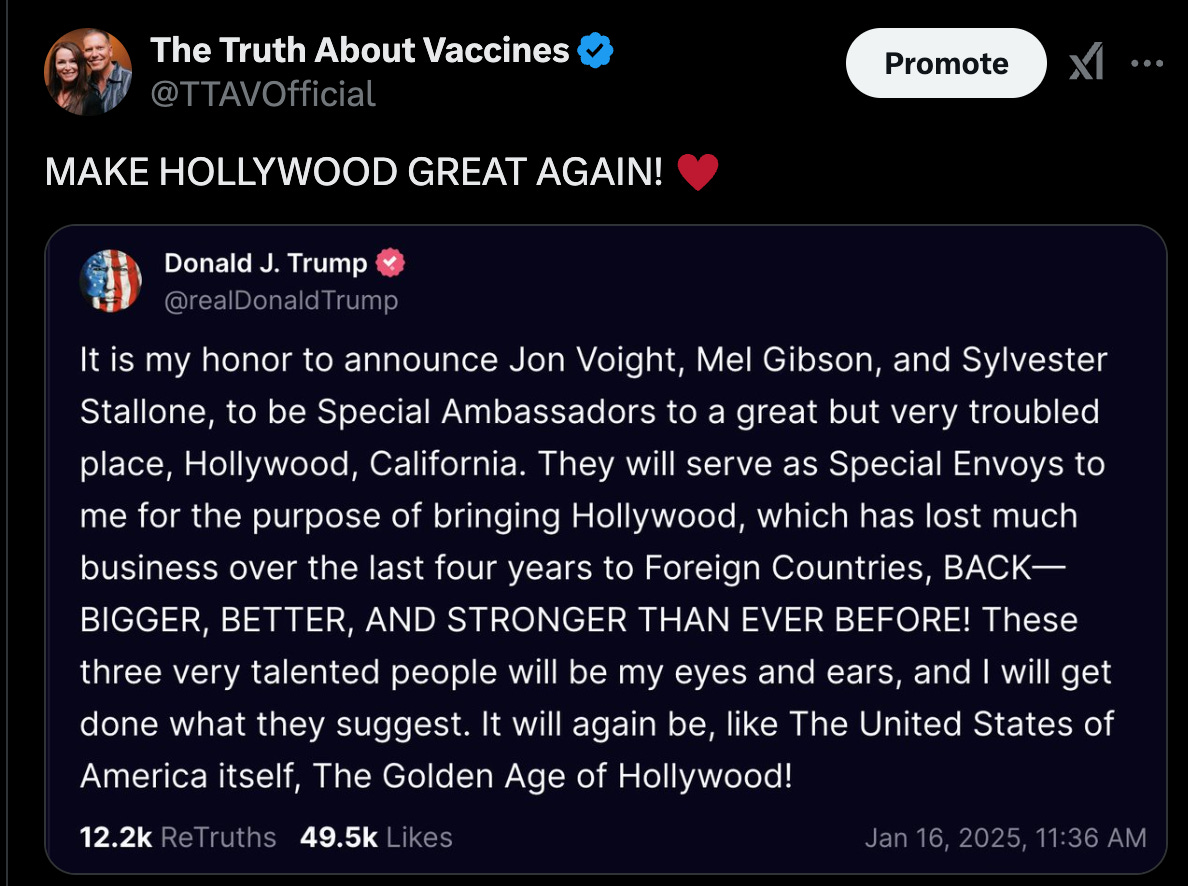
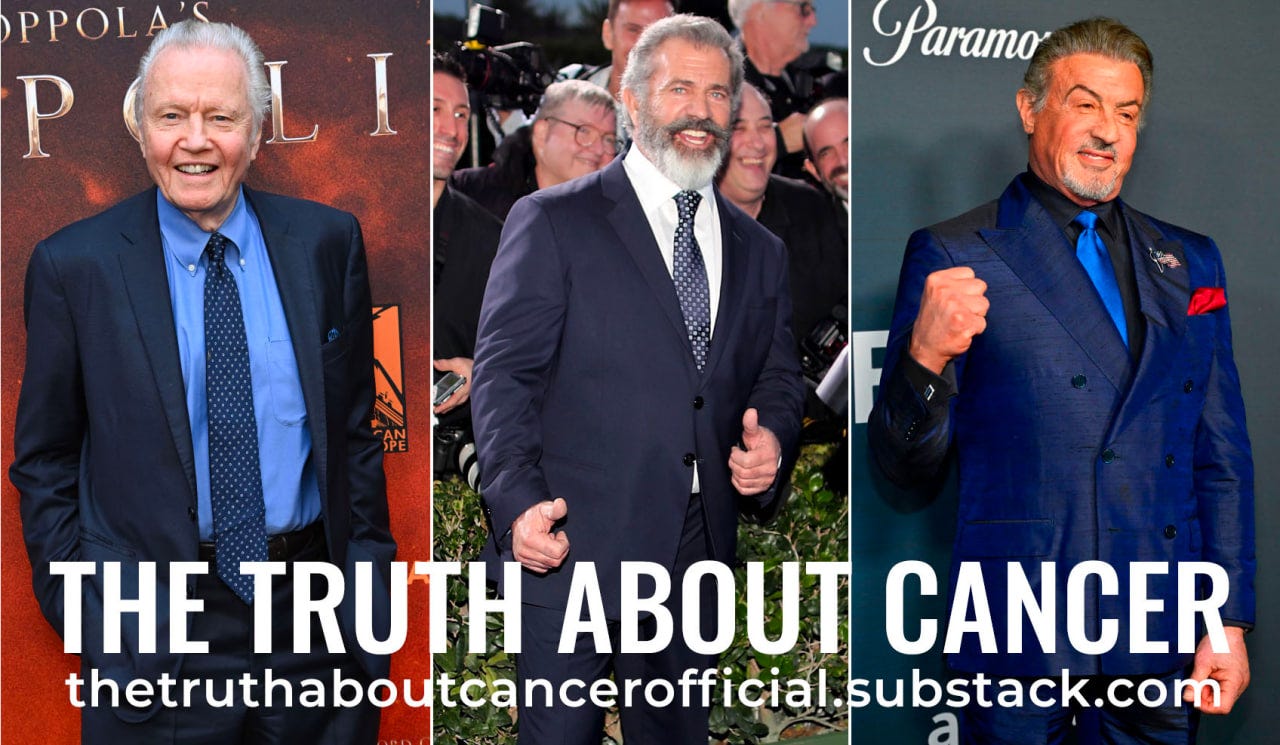
But fear not, because some folks aren’t content to sit back and watch as the elites bulldoze their way to total control. President Donald Trump, in a move to dismantle the ideological stranglehold on Tinseltown, recently appointed Sylvester Stallone, Mel Gibson, and Jon Voight as “Special Ambassadors to Hollywood.”
With these Hollywood heavyweights on the front lines, the fight for truth—whether it’s in the movie industry or in the smoke of “accidental” wildfires—has just gotten a lot more attention.
Malibu Home in Ruins
Lastly, this tragedy is a reminder that God is in control of all things, and you will always be okay if you seek God and His Kingdom and Righteousness first. Everything that you really need in life will be provided for you by God Himself. We will all leave this world, and when we do, we will leave it with nothing but what we have done for our Lord Jesus Christ.
Matthew 6:25-34
We would like to add hope to the end of this story. We can’t live very long without hope, and our hope is bound up in Jesus Christ. Matthew 6 reminds us to seek God first and trust Him to provide for us while we are here, even and especially during the fires and trials of life that come to us all.
Listen to our friend, Mel Gibson, encourage us on this point. Mel lost his Malibu home and possessions in this fire, but rather than moping around and feeling sorry for himself, he is busy encouraging us to look to God and reminding us that there is a purpose higher than ourselves in this trial if we will just look with our hearts to see it. For Gibson, it is a purification of sorts, preparing him for what comes next: the greatest and most important film of his life, “The Resurrection.”
Mel, we are praying for you and your family and for all those who are suffering in California right now due to these fires. We trust that God is comforting and guiding you and providing in ways that only He can.
Predicting the future of international relations is always a risky endeavor. History shows that even the most confident forecasts can fall flat. For instance, the last Pentagon propaganda pamphlet on ‘Soviet Military Power’ was published in 1991 – the year the USSR ceased to exist. Similarly, the Washington-based RAND Corporation’s 1988 scenario on nuclear war included the Soviet Union engaging Pakistan over Afghanistan in 2004. Nevertheless, the urge to anticipate the future is natural, even necessary. What follows is not a prediction, but an attempt to outline reasonable expectations for the state of the world in 2025.
Ukraine
US President Donald Trump’s bid to secure a ceasefire along Ukraine’s battle lines will fail. The American plan to “stop the war” ignores Russia’s security concerns and disregards the root causes of the conflict. Meanwhile, Moscow’s conditions for peace – outlined by President Vladimir Putin in June 2024 – will remain unacceptable to Washington, as they would effectively mean Kiev’s capitulation and the West’s strategic defeat.
The fighting will continue. In response to the rejection of his plan, a frustrated Trump will impose additional sanctions on Moscow. However, he will avoid any serious escalation that might provoke Russia into attacking NATO forces. Despite strong anti-Russian rhetoric, US aid to Ukraine will decrease, shifting much of the burden onto Western European nations. While the EU is prepared to step in, the quality and scale of Western material support for Ukraine will likely decline.
On the battlefield, the tide will continue to shift in Russia’s favor. Russian forces are expected to push Ukraine out of key regions such as Donbass, Zaporozhye, and parts of Kursk Region. Ukraine will mobilize younger, inexperienced recruits to slow Russia’s advances, but this strategy will lead to limited success. Kiev will rely increasingly on surprise operations, such as border incursions or symbolic strikes deep into Russian territory, in attempts to demoralize the Russian population.
Domestically, the US and its allies may push for elections in Ukraine, hoping to replace Vladimir Zelensky – whose term expired in the middle of last year – with General Valery Zaluzhny. While this political reshuffling might temporarily strengthen Kiev’s leadership, it will not address the underlying challenges of economic collapse and deteriorating living conditions for ordinary Ukrainians.
United States
Despite a peaceful transfer of power, Trump’s second term will remain fraught with tension. The risk of attempts on his life will linger. Trump’s foreign policy, while less ideological than Biden’s, will focus on pragmatic goals. He will:
Keep NATO intact but demand higher financial contributions from European members.
Shift much of the financial responsibility for Ukraine onto the EU.
Intensify economic pressure on China, leveraging Beijing’s vulnerabilities to force unfavorable trade deals.
Trump will also align closely with Israel, supporting its efforts against Iran. Tehran, already weakened, will face harsh terms for a nuclear deal, and a refusal may prompt US military strikes on Iranian nuclear facilities.
Trump is likely to meet Putin in 2025, but this will not signal a thaw in US-Russia relations. The confrontation between the two powers will remain deep and enduring. Trump’s strategy will prioritize America’s global dominance, shifting the burden of US commitments onto allies and partners, often to their detriment.
Western Europe
European nations, wary of Trump’s return, will ultimately fall in line. The EU’s dependence on the US for military and political leadership will deepen, even as European economies continue to act as donors to the American economy. Over the past three decades, Western European elites have transitioned from being national actors to appendages of a transnational political system centered in Washington. Genuine defenders of national interests, such as Alternative for Germany or France’s Rassemblement National, remain politically marginalized.
Russophobia will remain a unifying force in Western European politics. Contrary to popular belief, this sentiment is not imposed by the US but actively embraced by EU and UK elites as a tool for cohesion. The Russian military operation in Ukraine has been framed as the first stage of an imagined Russian attempt to “kidnap Europe.”
In 2025, Germany’s new coalition government will adopt an even tougher stance toward Moscow. However, fears of a direct military clash with Russia will deter other European nations from deploying troops to Ukraine. Instead, Western Europe will prepare for a new Cold War, increasing military spending, expanding production, and fortifying NATO’s eastern flank.
Dissent within Europe will be suppressed. Political opponents of the confrontation with Russia will be branded as “Putin’s useful idiots” or outright agents of Moscow. Hungary and Slovakia will remain outliers in their approach to Russia, but their influence on EU policy will be negligible.
Middle East
After significant military victories in 2024, Israel, with US backing, will attempt to consolidate its gains against Iran. The US-Israeli strategy will involve combined pressure, including military actions, against Iranian proxies like the Yemeni Houthis and efforts to deepen ties with Gulf Arab monarchies under the Abraham Accords.
While Russia signed a treaty with Iran in January 2025, it does not obligate Moscow to intervene militarily if Tehran is attacked. Thus, a full-scale Middle Eastern war involving Russia and the US remains unlikely. Domestically, Iran faces uncertainty as Supreme Leader Ayatollah Khamenei, now 86, nears the end of his leadership.
Russia’s influence in the Middle East will wane as its military presence diminishes. However, logistical routes connecting Russia to Africa will remain a strategic priority.
East Asia
US-China tensions will continue to rise, fueled by American efforts to contain China’s economic and technological ambitions. Washington will strengthen alliances in Asia, particularly with Taiwan and the Philippines, to counter Beijing. While an armed conflict over Taiwan or the South China Sea remains possible, it is unlikely to erupt in 2025.
Russia’s partnership with China will grow stronger, though it will stop short of a formal military alliance. From a Western perspective, this relationship will increasingly resemble an anti-American coalition. Together, Russia and China will push back against US global dominance in geopolitical, military, and economic spheres.
Russia’s near abroad
Belarusian President Alexander Lukashenko is expected to secure another term in January 2025, cementing his alignment with Moscow. Meanwhile, Russia will work to stabilize its relations with Kazakhstan, though Moscow’s lack of a compelling vision for Eurasian integration could come back to bite.
The year 2025 will be marked by strategic instability, ongoing conflicts, and heightened geopolitical tensions. While Russia has achieved notable successes in recent years, it must guard against complacency. Victory is far from assured, and the world remains nowhere near equilibrium. For Moscow, the path forward will require resilience and a clear focus on long-term goals. Peace will come, but only through continued effort and eventual victory – perhaps in 2026.
If I wanted to support the New World Order, I would do what I could to take down the United States because it’s the main obstacle to a one world government.
What could I add to the intentional border collapse, inflation, censorship, wars, plandemics and civil discord? One step would be to take down California, because it’s the biggest state economy in America with huge resources and it’s already run by socialists.
I could create policies that encourage residential insurance companies to cancel home coverage and then burn down hundreds of billions of dollars of real estate, paving the way for BlackRock to come in and buy it up on the cheap.
To optimize the success of such a covert agenda, I would get my woke politicians and bureaucrats to empty the key reservoir, disempowering the fire hydrants.
I would have them send huge amounts of fire-fighting equipment to Ukraine so it would be unavailable in Los Angeles.
I would have already gotten my politicians to massively cut fire-fighting budgets and resist thinning of foliage, grass fields and timber.
Then I would wait for maximum Santa Ana winds to blow.
I would have mind-kontrolled arson agents ready to use DEWs (directed energy weapons), blow torches, exploding residential smart meters, gasoline cans etc. to start simultaneous fires to be blown by those winds.
Maybe dioxins in the smoke could even taint the food supply from the central valley.
Clearing these areas and getting rid of residents would help with my 15-minute smart city agenda, especially as targeted to be in place by the 2028 Olympics. Hey, it worked in Australia, Oregon, Canada, Paradise, and Lahaina…why not keep going?
We can just blame it on Climate Change and incompetence!
Donald J. Trump, 45th & 47th President of the United States
Donald John Trump (born June 14, 1946) is an American politician, media personality, and businessman who served as the 45th president of the United State from 2017 to 2021. He won the 2024 election as the nominee of the Republican Party and is now the president-elect of the United States. He is scheduled to begin his second term on January 20, 2025, as the nation’s 47th president and will be the second president in American history to serve nonconsecutive terms, with Grover Cleveland being the first.
Russell Thurlow Vought (born March 26, 1976), or Russ Vought is an American former government official who was the director of the Office of Management and Budget from July 2020 to January 2021. He was previously deputy director of the OMB for part of 2018, and acting director from 2019 to 2020.
Sebastian Gorka & Alex Wong, Senior National Security Staff
Doug Collins, Secretary of Veteran’s Administration(VA)
Paul Douglas Collins (born July 28, 1951) is an American basketballexecutive, former player, coach and television analyst in the National Basketball Association (NBA). He played in the NBA from 1973 to 1981 for the Philadelphia 76ers, earning four NBA All-Star selections. He then became an NBA coach in 1986, and had stints coaching the Chicago Bulls, Detroit Pistons, Washington Wizards and Philadelphia 76ers. Collins also served as an analyst for various NBA-related broadcast shows.[1] He is a recipient of the Curt Gowdy Media Award. In April 2024, Collins was elected to the Naismith Memorial Basketball Hall of Fame class of 2024 by the Contributors Committee.[2]
President Donald Trump announced on July 28, 2019, that he intended to nominate Ratcliffe to replace Dan Coats as director of national intelligence.[8][9] Ratcliffe withdrew after Republican senators raised concerns about him, former intelligence officials said he might politicize intelligence, and media revealed Ratcliffe’s embellishments regarding his prosecutorial experience in terrorism and immigration cases.[10][11][12][13]
Tulsi Gabbard, Director of National Intelligence (DNI)
• Is Bessent Compromised By Association with Soros & Rockefellers? • Scott Bessent, who will lead the Treasury Department, previously worked at George Soros Fund Management from 1991 to 2000, and then again as Chief Investment Officer from 2011 to 2015. During this period, he made a significant bet against the British pound, contributing to Soros’ famous “breaking of the Bank of England” and earning billions for the firm. The London office was led by Peter Soros, George Soros’ nephew, who has been named by Epstein’s former butler, Alfred Rodriguez, as having been involved in Epstein’s s*x trafficking activities. Bessent is also on the Board of Trustees at Rockefeller University, alongside prominent figures in the globalist establishment. ~ Shadow of Era
Howard Lutnick, Secretary of Commerce
Howard William Lutnick (/ˈlʌtnɪk/; born July 14, 1961[1]) is an American businessman, who succeeded Bernard Gerald Cantor as the head of Cantor Fitzgerald. Lutnick is the chairman and CEO of Cantor Fitzgerald and BGC Group. After losing 658 employees, including his brother, in the September 11 attacks, Lutnick also survived the subsequent collapse of the towers on the ground, and has since become known for his charity efforts through the Cantor Fitzgerald Relief Fund, which helps to aid families of victims of the attacks and natural disasters. He was a fundraiser for Donald Trump’s 2020 and 2024 presidential campaigns, as well as a vocal proponent of Trump’s proposal to implement broad tariffs. In November 2024, President-elect Trump announced that he intended to nominate Lutnick as secretary of commerce. He was also co-founder of DOGE.
To Be Determined, Administrator of the SBA
Image Here…
Wikipedia:
Brendon Carr, Commissioner of the Federal Communications Commission (FCC)
Brendan Thomas Carr (born January 5, 1979) is an American lawyer who has served as a member of the Federal Communications Commission (FCC) since 2017.[7] Appointed to the position by Donald Trump, Carr previously served as the agency’s general counsel and as an aide to FCC commissioner Ajit Pai. In private practice, Carr formerly worked as a telecommunications attorney at Wiley Rein.[8]
Carr supports changes to Section 230 of the Communications Decency Actand opposes net neutrality protections.[9][10] Carr is noted for his support for banning TikTok on national security grounds.[11][12] He is an opponent of content moderation on digital platforms, saying he would seek to “dismantle the censorship cartel and restore free speech rights.”[13][14] He authored a chapter in Mandate for Leadership: The Conservative Promise, the blueprint document of Heritage Foundation‘s Project 2025, which outlines proposed policies for a future Donald Trump administration. In office, Carr has been noted for being unusually vocal about public policy issues for a regulatory appointee, accusing House Intelligence Committee chair Adam Schiff of overseeing a “secret and partisan surveillance machine”.[15]
• Restore Net Neutrality& Equalize the Internet Playing Field
Dr. Jay Bhattacharya, MD, Ph.D., Director of the National Institutes of Health (NIH)
Jayanta “Jay” Bhattacharya (born 1968) is an American professor of medicine, economics, and health research policy at Stanford University. He is the director of Stanford’s Center for Demography and Economics of Health and Aging. His research focuses on the economics of health care.[2][3][4] In 2021, Bhattacharya was opposed to lockdowns and mask mandates as a response to the COVID-19 pandemic.[5][6] With Martin Kulldorff and Sunetra Gupta, he was a co-author in 2020 of the Great Barrington Declaration, which advocated lifting COVID-19restrictions on lower-risk groups to develop herd immunity through widespread infection, while promoting the fringe notion that vulnerable people could be simultaneously protected from the virus.[7][8][9] The declaration was criticized as being unethical and infeasible by Tedros Adhanom Ghebreyesus, the director-general of the World Health Organization.[10]
• Co-Author of The Great Barrington Declaration
Dr. Dave Weldon, Director of the Centers for Disease Control (CDC)
•Mission to Examine the Causes of Chronic Illness • “The greatest perpetrator of misinformation during the COVID pandemic has been the United States government … Public health officials were intellectually dishonest. They lied to the American people.” ~ Marty Makary, MD, MPH • Author of Blind Spots
Dr. Janette Nesheiwat, US Surgeon General
Janette Nesheiwat (born 25 August 1980) is an American physician who is the nominee for United States surgeon general.[2] Nesheiwat has served as an assistant medical director of CityMD[3] and is currently a medical contributor on Fox News.[4]
• Getting Flak for Her Previous Vaccine/COVID Positions. ~ Dr. Simone Gold • Trump’s pick for Surgeon General, Janette Nesheiwat, praised Facebook for censoring anti-vaccine information & accounts like mine and RFK’s specifically, adding that she will “hope and pray” other social media companies do the same. Pick someone else. ~ Elizabeth Health Nut News
Doug Burgum, Secretary of the Interior
Douglas James Burgum (/bɜːrɡəm/BUR-gəm;[1] born August 1, 1956) is an American businessman and politician serving since 2016 as the 33rd governor of North Dakota.[2][3] He is among the richest politicians in the United States and has an estimated net worth of at least $1.1 billion. He is a member of the Republican Party.[4] Burgum was born and raised in Arthur, North Dakota.
When Perdue’s term ended on January 3, 2021, Loeffler ascended to be the senior senator from Georgia, a position she held for just under three weeks until Warnock was sworn in. Loeffler aligned with President Donald Trump in her time in the Senate, touting a “100 percent Trump voting record” during her campaigns.[3][4] After the November 2020 election, Loeffler and Perdue claimed without evidence that there had been unspecified failures in the 2020 U.S. presidential election, and called for the resignation of Georgia secretary of stateBrad Raffensperger, who rejected the accusations.
She later supported a lawsuit by Trump allies seeking to overturn the election results,[5] and also announced her intention to object to the certification of the Electoral College results in Congress.[6] After the attack on the U.S. Capitol on January 6, 2021, Loeffler announced that she would withdraw her objection to the certification of the electoral votes and later voted to certify. Loeffler was chosen by president-elect Trump to co-chair his inaugural committee in his upcoming second presidency, along with Steve Witkoff.
Linda Marie McMahon (/məkˈmæn/; née Edwards; born October 4, 1948) is an American politician, business executive and retired professional wrestler. She was the 25th administrator of the Small Business Administration from 2017 to 2019. McMahon has been nominated to lead the Department of Education under the second Trump administration.
McMahon, along with her husband, Vince McMahon, founded sports entertainment company Titan Sports, Inc. (later World Wrestling Entertainment, Inc.) where she worked as the president and later CEO from 1980 to 2009. During this time, the company grew from a regional business in the northeast to a large multinational corporation. Among other things, she initiated the company’s civic programs, Get R.E.A.L. and SmackDown! Your Vote. She made occasional on-screen performances, most notably in a feud with her husband that culminated at WrestleMania X-Seven.
On April 15, she was named chairwoman of America First Action, a pro-Trump Super PAC. On November 19, 2024, McMahon was nominated by Donald Trump to serve as Secretary of Education.[2]
Vivek Ramaswamy, Department of Government Efficiency (DOGE)
Musk was born in Pretoria, South Africa, and briefly attended the University of Pretoria before immigrating to Canada at the age of 18, acquiring citizenship through his Canadian-born mother. Two years later, he matriculated at Queen’s University at Kingston in Canada. Musk later transferred to the University of Pennsylvania and received bachelor’s degreesin economics and physics. He moved to California in 1995 to attend Stanford University, but never enrolled in classes, and with his brother Kimbal co-founded the online city guidesoftware company Zip2. The startup was acquired by Compaq for $307 million in 1999. That same year, Musk co-founded X.com, a direct bank. X.com merged with Confinity in 2000 to form PayPal. In 2002, Musk acquired US citizenship, and that October eBay acquired PayPal for $1.5 billion. Using $100 million of the money he made from the sale of PayPal, Musk founded SpaceX, a spaceflight services company, in 2002.
In 2004, Musk was an early investor in electric-vehicle manufacturer Tesla Motors, Inc. (later Tesla, Inc.), providing most of the initial financing and assuming the position of the company’s chairman. He later became the product architect and, in 2008, the CEO. In 2006, Musk helped create SolarCity, a solar energy company that was acquired by Tesla in 2016 and became Tesla Energy. In 2013, he proposed a hyperloop high-speed vactrain transportation system. In 2015, he co-founded OpenAI, a nonprofit artificial intelligenceresearch company. The following year Musk co-founded Neuralink, a neurotechnology company developing brain–computer interfaces, and The Boring Company, a tunnel construction company.
In early 2024, Musk became active in American politics as a vocal and financial supporter of Donald Trump, becoming Trump’s second-largest individual donor in October 2024. In November 2024, Trump announced that he had chosen Musk along with Vivek Ramaswamyto co-lead the Department of Government Efficiency (DOGE), a new advisory board which aims to improve government efficiency through measures such as slashing “excess regulations” and cutting “wasteful expenditures”.
• Mission to Dismantle the Regulatory State & Cut Wasteful Spending
AMERICA FIRST AGENDA BY EXECUTIVE ORDER
Restore Border Security & Immigration Including Mass Deportation of Illegal Aliens
Declare War on Drug Cartels (Including Big Pharma & Global Actors)
Declare War on Child Trafficking & Establish Death Penalty for Convicted Human Traffickers
Halt Federal Funds for Any State or Local Government Defying Federal Immigration Law (End Sanctuary Cities)
Halt Federal Funds for Inappropriate Curricula Including Critical Race Theory, DEI, Transgender & Anti-American Political Content Taught in Schools
End Mutilation of Youth Through Gender Transitions; Cease Funding Any Sex & Gender Transition
Halt Federal Funding for Any Abortion Procedure or Organ Harvesting of New-Born Infants
Private Right of Action for Victims to Sue Doctors; Civil Rights Violations; Cease Funding to School Districts
End Electric Vehicle Mandates; Making Them Voluntary Not Mandatory
Restore Fundamental Protection of Free Speech & All Constitutional Rights; Prohibit Any Future Collusion Between Government & Private Sector to Deprive Citizens of Rights
Dismantle Needless Bureaucracy & Regulations
Dismantle or Overhaul All Weaponized Government Agencies Via Schedule F (Firing Incompetent or Corrupt Staff By Executive Order)
Clean Out All Corrupt Actors in National Security, Defense & Intelligence Apparatus
ESTABLISHING NEW GOVERNMENT PROGRAMS& LEGISLATION
Founding Department of Government Efficiency (DOGE)with Mission to Dismantle the Regulatory State & Cut Wasteful Spending)
Restore Economic Prosperity for All
Restore Energy Independence By All Means Necessary Including Fracking, Drilling & Green Energy
Restore Tax Incentives for Small Businesses
Cap Credit Card Rates at 10%
Founding The American Academy (Full Spectrum of Human Knowledge for Free Online; Bachelor’s Degree Available)
Department of Education Appoints New Accreditors for All Colleges/Universities to Qualify for Federal Funding (Restore Meritocracy in Our Educational Institutions)
Eliminate the Federal Income Tax & Replace with Tariffs On Imports
Allow IRS Deduction Up to $10k Towards Homeschooling Per Child
Become #1 Energy Producer in the World & Restore Energy Independence
Repeal of the 1986 Vaccine Injury Act
Restore FAIR Act for Equal Time in Broadcasting
Revoke Licenses & Funding for Propaganda Media (Including NPR)
Reintroduce 28th Amendment with Required That All Laws Applied Equally to Citizens & Congress
Propose ? Amendment for Term-Limits on Elected Officials in Congress
Restore Net Neutrality To Equalize the Internet Playing Field Once Again
Predicting the outcome of a hypothetical World War III involves considering a myriad of factors including military capabilities, alliances, technological advancements, economic strength, and strategic positioning. Here’s a balanced analysis based on current military strengths and geopolitical dynamics:
U.S. and NATO:
Military Power: The United States has the world’s most advanced military technology, with significant investments in cyber warfare, space capabilities, and nuclear forces. NATO allies, particularly countries like the UK, France, and Germany, add to this with their own substantial military forces and advanced technologies.
Alliances: NATO provides a collective defense framework, which could potentially involve 31 member countries, offering a broad base of support in terms of troops, logistics, and strategic depth.
Technological Edge: The U.S. leads in military technology, including stealth technology, drones, cyber warfare capabilities, and missile defense systems. This could give NATO an initial advantage in precision strikes and defensive operations.
Global Influence: The U.S. has numerous military bases around the world, providing strategic flexibility and the ability to project power globally.
Russia, China, and Potential Allies:
Military Hardware: Russia has one of the largest nuclear arsenals and has been modernizing its conventional forces, particularly with advanced missile technology. China has been rapidly expanding its military, focusing on both quantity and quality, with significant advancements in hypersonic missile technology and naval capabilities.
Economic and Industrial Base: Both Russia and China have substantial industrial capabilities. China’s ability to produce military hardware at scale could be crucial in prolonged conflict.
Cyber and Space: China has shown significant capabilities in cyber operations and has been advancing in space technology, which could disrupt communications and satellite operations.
Alliances: While less formal than NATO, countries like North Korea, Iran, and potentially others might align with Russia and China for ideological or strategic reasons. However, these alliances are less predictable.
Potential Outcomes:
Conventional Warfare: NATO might have an early advantage due to technological superiority and global reach. However, if the conflict drags on, China’s production capabilities could become a significant factor. Russia’s ability to endure prolonged conflict, learned from its experiences, would also play a role.
Nuclear Escalation: If nuclear weapons come into play, the scenario becomes unpredictable. The doctrine of Mutually Assured Destruction (MAD) could deter nuclear use, but regional conflicts or miscalculations could lead to escalation.
Geopolitical Shifts: The involvement of other global powers or neutral nations could shift the balance. For instance, India’s stance could be pivotal due to its military strength and strategic location.
Economic Impact: A global conflict would severely impact the global economy, potentially leading to a situation where no clear winner emerges due to the destruction of economic infrastructure.
Cyber and Information Warfare: This aspect of modern warfare could be decisive, where neither side might achieve a traditional military victory but could dominate in terms of information control and cyber capabilities, influencing global perception and control of critical infrastructure.
Conclusion:
From a purely military standpoint, without considering the nuclear aspect:
If it remains conventional: The U.S. and NATO might have an upper hand early on due to technological advantages and global military presence. However, a prolonged conflict might see China’s industrial might and Russia’s resilience become more influential.
With nuclear escalation: All bets are off as the scale of destruction could be so immense that the concept of ‘winning’ becomes meaningless, leading to a scenario where no one truly wins.
The discourse around such scenarios often leans on the idea that in a modern World War, the real losers would be humanity and the planet, with victory being a hollow concept amidst global devastation.