Democracy And Corruption: European Center for Constitutional and Human Rights Files War Crimes Charges Against Bush, Cheney, Rumsfeld And Other CIA Officials | Liberal America

By Tiffany Willis

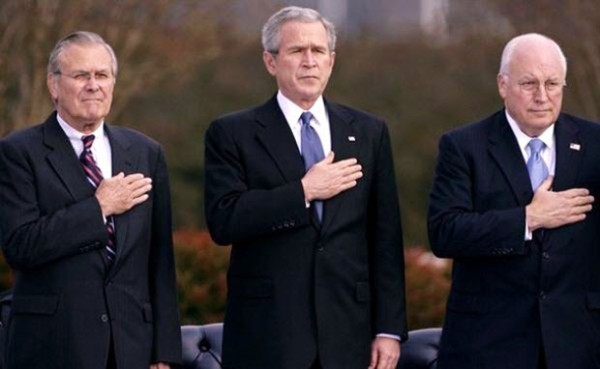
BushRumsfeldCheneyThe European Center for Constitutional and Human Rights has filed a criminal complaint against U.S. torture program architects and members of the Bush Administration. The organization has accused CIA director George Tenet and Defense Secretary Donald Rumsfeld of war crimes and they’ve called for a German prosecutor to conduct an immediate investigation.

This move follows the release of the damning Senate report on CIA torture that includes the case of German citizen Khalid El-Masri, who was captured in 2004 by CIA agents in a case of mistaken identity. The report revealed the shocking contrast of democracy and corruption.

Bizarrely, the only person involved with the CIA torture program who has been charged with a crime is the man who exposed the war crimes — whistleblower John Kiriakou.

The relevant parties in this case have given an extensive interview to Democracy Now. Some of the important points are below.

Wolfgang Kaleck, the general secretary of the European Center for Constitutional and Human Rights and the author of International Prosecution of Human Rights Crimes said this:

“By investigating members of the Bush administration, Germany can help to ensure that those responsible for abduction, abuse and illegal detention do not go unpunished.”

Michael Ratner, president emeritus of the Center for Constitutional Rights and chairman of the European Center for Constitutional and Human Rights said this:

“I strongly disagree that Bush, Cheney, et al., would have a defense. This wasn’t like these memos just appeared independently from the Justice Department. These memos were facilitated by the very people — Cheney, etc. — who we believe should be indicted. This was part of a conspiracy so they could get away with torture. But that’s not the subject here now.”

“Secondly, whatever we think of those memos, they’re of uselessness in Europe. Europe doesn’t accept this, quote, ‘golden shield’ of a legal defense. Either it’s torture or it’s not. Either you did it or you didn’t. And that’s one of the reasons, among others, why we’re going to Europe and why we went to Europe to bring these cases through the European Center.”

Ratner is the author of The Trial of Donald Rumsfeld: A Prosecution by Book.

Ratner also said this:

“But, of course, you know, Cheney just showed us exactly why you have to — have to prosecute torture. Because if you don’t prosecute it, the next guy down the line is going to torture again. And that’s what Cheney said: ‘I would do it again.’”

From Addicting Info‘s Ryan Denson:

Khalid El-Masri was on vacation in Skopje, in Macedonia, when he was pulled off of a bus by government agents, sodomized with a drug, and taken to the secret base that was identified only as Cobalt in the CIA torture report. After four months, and after the United States learned of the mistaken identity, they left him there and continued to torture him. They held him further because the U.S. realized they had been torturing the wrong man. Afterwards, they released him, dropping him off somewhere to resume his life.

El-Masri’s comments to Democracy Now highlight the contrast of democracy and corruption:

[translated] I was the only one in this prison in Kabul who was actually treated slightly better than the other inmates. But it was known among the prisoners that other prisoners were constantly tortured with blasts of loud music, exposed to constant onslaughts of loud music. And they were—for up to five days, they were just sort of left hanging from the ceiling, completely naked in ice-cold conditions. The man from Tanzania, whom I mentioned before, had his arm broken in three places. He had injuries, trauma to the head, and his teeth had been damaged. They also locked him up in a suitcase for long periods of time, foul-smelling suitcase that made him vomit all the time. Other people experienced forms of torture whereby their heads were being pushed down and held under water.

“And let me just say, Germany — whatever happened before, between the NSA spying on Germany and the fact that their citizen has now been revealed to have been kept in a torture place, when it was known that he was innocent, I’m pretty sure that Germany is going to take this very seriously.“

We need to throw our full support behind this investigation and our government and the Obama administration needs to not impede it in any way. This is a harsh indictment of our hypocrisy as a nation when it comes to democracy and corruption.

Source: Liberal America

Republican Judge Strikes Down Obama’s Immigration Order | ThinkProgress

By Ian Millhiser

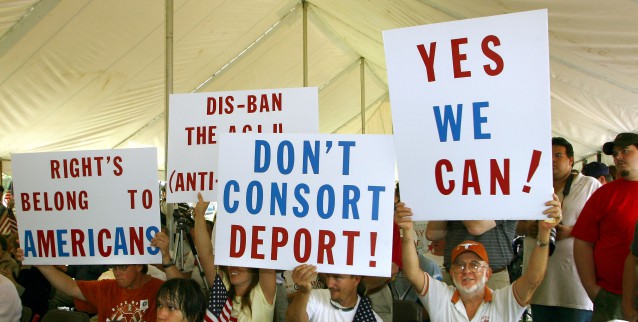
AntiImmigrationIn an extraordinary opinion that transforms a routine sentencing matter into a vehicle to strike down a politically controversial policy, a George W. Bush-appointed judge in Pennsylvania declared President Obama’s recently announced immigration policy unconstitutional on Tuesday. Because the policy “may” apply to a defendant who was awaiting sentencing of a criminal immigration violation, Judge Arthur Schwab decides that he must determine “whether the Executive Action is constitutional.” He concludes that it is not.

Schwab spends just five pages discussing his rationale for this conclusion, an unusually short amount of legal analysis for a complex question regarding the scope of the executive branch’s power to set enforcement priorities. Notably, Schwab also spends nearly three pages discussing quotes from President Obama which, the judge claims, indicate that Obama once thought his present actions are illegal — even though Schwab eventually admits that these quotes are “not dispositive of the constitutionality of his Executive Action on immigration.”

Half of Schwab’s analysis of the Executive Action’s constitutionality is devoted to a strawman. Noting that Obama cited Congress’s failure to act on immigration in his speech announcing the new policy, Schwab devotes half of his analysis of the policy’s constitutionality to explaining that “Inaction by Congress Does Not Make Unconstitutional Executive Action Constitutional.” He’s right on this point, just as Schwab would be correct if he argued that President Obama’s authority to create this new policy does not come from a magic hat that Obama keeps in the Oval Office. But it’s somewhat curious that the judge feels the need to present Obama’s political rhetoric as if it were a constitutional argument and then tear that non-argument down.

The remainder of Schwab’s brief constitutional analysis concludes that the new policy “Goes Beyond Prosecutorial Discretion — It is Legislation.” Notably, however, Schwab cites no judicial precedents of any kind to support this conclusion.

One case that Schwab does not cite is Arizona v. United States, where the Supreme Court said that the executive branch has “broad discretion” in matters of deportation and removal. As Arizona explains, a “principal feature of the removal system is the broad discretion exercised by immigration officials.” Executive branch officials, moreover, “must decide whether it makes sense to pursue removal at all.”

Notably, Arizona also indicates that this broad discretion flows from federal immigration law — i.e. laws that were enacted by Congress. This matters because Schwab’s opinion concludes that Obama’s “unilateral” policy “violates the separation of powers provided for in the United States Constitution as well as the Take Care Clause.” In essence, Schwab concludes that the president lacks the authority to act in the absence of authorization by Congress. Schwab does not even discuss the possibility that Obama’s actions may actually be authorized by Congress. Thus, even if Schwab’s reading of the Constitution is correct — itself a questionable proposition — the judge does not even discuss another major source of law that can justify the president’s actions.

Another problem Schwab does not address in his constitutional analysis is how, exactly, the executive branch is supposed to deport the many millions of undocumented immigrants in the United States if it is not allowed to set enforcement priorities among them. As the Justice Department explained in a memo discussing the legality of Obama’s policy, “there are approximately 11.3 million undocumented aliens in the country,” but the executive only “has the resources to remove fewer than 400,000 such aliens each year.”

The fact that Congress only provided sufficient resources to the Obama administration to remove a small fraction of the undocumented immigrants within the United States is itself a legislative judgment that most of these immigrants should not be removed. As the Supreme Court explained in Heckler v. Chaney, because federal agencies typically lack the resources to “act against each technical violation of the statute it is charged with enforcing,” they necessarily must set enforcement priorities. Moreover, these priorities generally should not be second-guessed by judges because “[t]he agency is far better equipped than the courts to deal with the many variables involved in the proper ordering of its priorities.”

So Schwab’s legal analysis is thin. He spends nearly as much time making what appear to be political attacks on the president as he does evaluating actual legal matters. And what little legal analysis he does provide fails to cite key Supreme Court decisions that seem to contradict his conclusion. Judge Schwab traveled far along a very thin branch to reach this decision, and he anchored his decision with little grounding in legal authorities.

Moreover, it’s not clear what effect, if any effect at all, this decision will actually have. The judge does not issue an injunction halting the new immigration policy. Nor does he even state with certainty that the actual defendant in the case before his court will benefit from an order declaring the immigration policy unconstitutional.

Yet, despite these weaknesses in his opinion, immigrant families would be wrong to write off the threat his decision could present. There was a time when the constitutional challenges to the Affordable Care Act were widely dismissed by legal experts — Ronald Reagan’s former solicitor general said he would “eat a hat which I bought in Australia last month made of kangaroo skin” if the Supreme Court struck the law down — yet these challenges rapidly gained momentum after a few Republican judges reached out to strike the law down. The same can be said about the legal theory in King v. Burwell, a lawsuit currently before the Supreme Court that seeks to gut much of Obamacare.

It remains to be seen whether Schwab’s opinion — thin though its reasoning may be — will also grant legitimacy to the case against the president’s immigration policy.

Source: ThinkProgress


Senator Professor Warren is Tired of Reasoning with You People | Esquire

By Charles P. Pierce

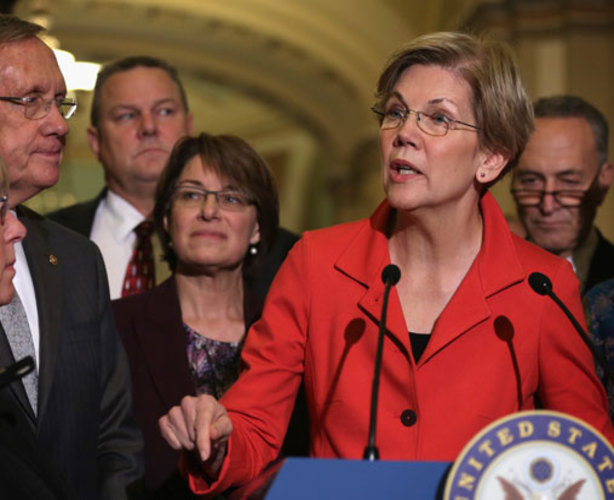
ElizabethWarrenIt may have escaped your attention, what with this week’s revelations that America’s foreign policy took a right turn at Torquemada and didn’t stop until it got to Vlad The Impaler — And it should be said, for the purposes of apt historical parallels, that Vlad used to impale his victims in the same manner in which the CIA apparently fed recalcitrant prisoners — but the Congress is preparing to give away the store. A “bipartisan” deal has been crafted to fund the government through next September. Please forgive any typos in this post, as it is difficult for me to type, having Krazy Glue’d my wallet to my hands.

“This bill fulfills our constitutional duty to fund the government, preventing damage from shutdown politics that are bad for the economy, cost jobs and hurt middle class families,” said Maryland Sen. Barbara Mikulski, a Democrat, and Kentucky Rep. Hal Rogers, a Republican, in a joint statement. “While not everyone got everything they wanted, such compromises must be made in a divided government. These are the tough choices that we must make to govern responsibly and do what the American people sent us here to do.”

Hang on. I’ll be back in a minute. I am now attaching the wallet to my palms with tenpenny nails.

This deal does a lot of things, many of them horrible. It is a veritable compost heap of Republican goodies. The IRS gets defunded, so that phony “social-welfare” political front groups no longer will be inconvenienced in their paperwork. The EPA takes a huge whack, so that conservative bundlers and the oligarchs whom they bundle no longer will be inconvenienced by people who wish to breathe, and who believe their water should be neither yellow nor flammable. But the real Saturday end of it is a provision that guts a key provision of the Dodd-Frank Wall Street reform bill that was passed so that it would be a little harder in the future for people to wreck most of the economy and then steal what’s left. Specifically, Congress is preparing to open the casino again.

At issue is the “swaps push-out” rule, which requires banks to move derivatives trading out of taxpayer-backed subsidiaries. Derivatives are risky financial instruments that contributed to the 2008 crash. Allowing banks to conduct those trades on the assumption that taxpayers would bail them out if the deals went sour was not only bad for taxpayers; it also raised the value of the trades and thus effectively acted as a subsidy for the banks. Financial institutions, obviously, weren’t thrilled with the new rule. In 2013, lobbyists for Citigroup gave lawmakers a proposal to exempt a wide array of derivatives, and it subsequently appeared in a bill approved by a House committee that year.

Derivatives are what nearly sank the whole thing the last time around. And now, the Congress has decided, in the same kind of “bipartisan” way that brought us the repeal of Glass-Steagall and the Commodity Futures Trading Act during the Clinton Administration, to let these guys gamble with taxpayer money again. This is such a spectacularly bad idea that it’s hard to believe that its supporters didn’t sneak it into the bill the way they did just as a goof, to see what they could get away with, those scamps.

“Hey, Bob. Let’s see if we can get them to pass the Free Smack Subsidy next! Somebody call Luntz and have him think up a name for it. The Opiate Liberation And Personal Freedom Liberty Act Of 2014, or something.”

The arrangement is the result of a “bipartisan compromise” engineered by Mikulski by which Wall Street gets to oil up the roulette wheel again in exchange for increased funding for the Commodity Futures Trading Commission, which is supposed to oversee things like derivatives training, and which the incoming, and more radical, Republican congressional majority surely will chloroform entirely the first chance it gets. Meanwhile, things are being arranged to put us all on the hook again for Wall Street’s gambling jones. And Senator Professor Warren, who can see a church by daylight, is having none of it.  She rose yesterday to excoriate the covert sellout and, by extension, the people in both parties who connived to bring it about. You want bipartisanship? This is bipartisanship.

“I come to the floor today to ask a fundamental question — who does Congress work for? Does it work for the millionaires, the billionaires, the giant companies with their armies of lobbyists and lawyers? Or does it work for all of us?”

I’m not entirely sure that she has the votes to stop this abomination. People want to go home for Christmas. Everybody’s drunk deeply of the egg nog in the rancid punchbowl of  “compromise” for its own sake.  Right now, she’s counting on the House to strip it from the bill, but a large portion of the House majority is crazy, and a large portion of the House minority is hiding behind the drapes, so I’m not optimistic. (Nancy Pelosi has gotten ferocious on the issue, though, so we’ll see.) It will be interesting to see if she exercises her right to talk the provision to death against what will be a well-organized counterattack by the Very Serious People who will sing in one voice the praises of “bipartisan” governance against this noisy obstructionist. Nothing in her career so far is as serious a gut check as this one is. The inserted provision strikes at the very heart of everything that made her a senator in the first place. It will be interesting to see how many people have her back.

And this is coming at the same time as her campaign against Antonio Weiss, the Lazard executive who’s the president’s nominee to be Undersecretary of The Treasury for Domestic Finance, something that has given severe agita to the financial press, especially Andrew Ross Sorkin of The New York Times, who’s carried so much water for some of these guys that you could fly him over a forest fire to help put it out. Part of Warren’s problem with Weiss is a going-away goodie he got from Lazard that surprised even my cynical mind. Lazard will pay Weiss a $21 million bonus just for taking the Treasury job, in which he’ll be intimately involved with the industry Weiss is now leaving, however temporarily. How does this not seem to be a form of pre-emptive bribery? Used to be you needed a quo for every quid. And both of these fights together are the best arguments I can think of for why MoveOn and Democracy For America, both of which are trying to dragoon Warren into a quixotic presidential run, should shut the fk up.

Even the shadow of the possibility of a presidential campaign makes it easier to characterize Warren’s positions here as political grandstanding. Oh, look. Here’s Chris Cillizza of The Washington Post to do that very thing.

Speeches like the one Warren gave Wednesday will just fuel chatter about why she should challenge Hillary Rodham Clinton in two years. And she knows it.

Yeah, it’s not that she’s ever been concerned about how the country’s fiscal policy is under the control of the forces that nearly demolished it, or that she understands what the reopening of the casino will mean. It’s all about the “chatter.” Stop it, all of you. She’s right where she belongs. You don’t put a lion in a horse race.

Source: Esquire


Proposed Federal Bill Would Prevent States, FDA, And Anyone Else From Informing Consumers Whether Food Is Bioengineered | Emord & Associates Blog

By Eric Awerbuch

EmordandAssociatesIn April, 2014, five members of Congress introduced a bill, H.R. 4432 (hereinafter “the Bill”) seeking to regulate, among other things, the labeling of bio-engineered food products.[i]  The Bill, also known as the “Safe and Accurate Food Labeling Act of 2014,” is remarkable in that it:  1) prohibits the States from regulating the labeling of bio-engineered foods; 2) gives the FDA the sole authority to regulate the labeling of bio-engineered foods, but severely restricts how the FDA can regulate the labeling of bio-engineered foods; 3) allows companies to voluntary label their products as bio-engineered when they so desire, subject to very few restrictions; and 4) prohibits under any circumstances the FDA’s ability to decide in the future whether bio-engineered foods are less safe than foods not bio-engineered.  Each of these points is discussed in detail below.

First, if the Bill passes, States will not be able to enact any laws regulating the labeling of bio-engineered foods.  Section 104(c) of the Bill explicitly states that:

No State or political subdivision of a state may directly or indirectly establish under any authority or continue in effect as to any food in interstate commerce any requirements for the labeling of a food by virtue of its having been developed using bioengineering, including any requirements for claims that a food is or contains an ingredient that was developed using bioengineering.

The quoted language would have the effect of nullifying efforts in at least 20 states to require mandatory labeling for foods that contain genetically modified organisms.[ii]  For example, Vermont enacted a law, effective July 1, 2016, that will require foods produced from genetic engineering be labeled as such.[iii]

Instead of allowing states to regulate the marketing of bio-engineered foods, the Bill purports to give the FDA such authority.  However, the FDA’s authority to regulate labeling of bio-engineered foods is greatly restricted by the terms of the Bill.  Specifically, the FDA may only require bio-engineered food labeling when it determines that 1) there is a “material difference” between the bio-engineered food and its comparable marketed food, and 2) where that difference “is necessary to protect health safety” or to prevent false or misleading labeling.[iv]  Even if those two elements exist, the FDA can only require specific labeling that “would adequately inform consumers of such material difference.”[v]  Stated differently, not only can the States not require genetically modified foods to be labeled as genetically modified, the FDA cannot even require that labeling, unless the FDA can meet the two elements identified above.  Even where the FDA can meet those two elements, the mandatory labeling must be narrowly tailored to inform consumers of the specific “material” difference between the bio-engineered food and its similar, non-bio-engineered counterpart.

What exactly is a “material difference” requiring that companies inform consumers of the difference?  The bill provides three types of differences which are considered to be material.  The first type of “material difference” is a difference that “significantly alters the characteristics, including the functional or compositional characteristics, of a food, such that the common name no longer adequately describes the food.”[vi]   It is difficult to know when such a situation would arise because “significantly alters” is not defined.  Therefore, should the Bill pass, the FDA would be entitled to a great amount of discretion to determine whether or not a bio-engineered product is “significantly altered.”  See Chevron U.S.A., Inc. v. Natural Res. Def. Council, Inc., 467 U.S. 837, 843 (1984) (explaining that an agency’s construction of a statute it administers is owed deference when “the statute is silent or ambiguous” on the issue).  Given the FDA’s conclusions that there is no material difference between bio-engineered food and non-bio-engineered food, it is highly unlikely that the FDA would ever require mandatory labeling when left to their discretion.[vii]  Indeed, while the statute does not define differences that are not material, it does state that the “use of bio-engineering does not, by itself, constitute a material difference.”  Id. at § 424(e).

GMOCornFurthermore, even if there was such a material difference, given that the labeling must only “adequately inform consumers of such material difference,” this requirement could be met, for example, if the company selling the bio-engineered product simply markets the product in a different name than the “similar” non-bio-engineered product.  It seems that sweet and firm, bio-engineered “tomatoes” would be able to be marketed as “specially formulated sweet and firm tomatoes.”  That label would inform consumers of the material difference—that the new tomatoes are sweet and firm—without even revealing the fact that they are bio-engineered.

The second type of “material difference” is a difference that “results in a significantly different nutritional property in the food produced from, containing or consisting of the bio-engineered organism.”[viii]    Once again, given that the labeling must only “adequately inform consumers of such material difference,” a company could label bio-engineered corn with higher protein content than non-bio-engineered corn as “high protein corn,” without ever revealing the fact that the corn is bio-engineered.

The third difference resulting in a “material difference” is where the bio-engineered food contains an allergen that consumers would not expect to be present based upon the name of the food.[ix]  A company could simply label the product with a warning such as, “warning: this product contains [allergen.]”  Again, the company would not have to disclose the fact that the product is bio-engineered.  Indeed, given that the labeling must only “adequately inform consumers of such material difference,” it is likely that the FDA will never be authorized to require that companies disclose the fact that a product is bio-engineered when narrower labels adequately inform consumers of the material differences.

While mandatory labeling is allowed only in narrow circumstances under the Bill, companies would have great opportunity to voluntarily label their bio-engineered products as they so choose.  The Bill prevents the FDA from prohibiting persons “from disclosing voluntarily on the labeling of food developed with the use of bio-engineering the manner in which the food has been modified to express traits or characteristics that differ from its comparable marketed food.”[x]  Thus, a company is free to market the differences between their bio-engineered product and similar, non-bio-engineered foods. For example, a company selling bio-engineered tomatoes may claim that “our bio-engineered tomatoes benefit the environment more than non-bio-engineered tomatoes because our tomatoes consume less water during the growing process than non-bio-engineered tomatoes.”  Companies will also be free to voluntary advertise, other than in labeling, that the food was developed with the use of bio-engineering.[xi]

The Bill also regulates the labeling of foods that are not bio-engineered.[xii]  It explicitly prohibits the labeling of non-bio-engineered foods from suggesting that “foods developed without the use of bio-engineering are safer than foods produced from, containing, or consisting of a bio-engineered organism.”[xiii]  In a day and age where courts routinely defer to agencies because agency’s have “expertise” in certain, factual issues, see Marsh v. Oregon Natural Resources Council, 490 U.S. 360, 377 (1989) (explaining that the Court defers to the agency’s analysis when the issue requires a high level of technical expertise), it is alarming that, through the Bill, Congress is making a scientific determination that non-bio-engineered foods are not safer than bio-engineered foods.  While the FDA does not currently consider non-bio-engineered to be safer than bio-engineered foods,[xiv] the Bill prevents FDA from ever reconsidering that opinion.

The Bill will have the ultimate effect of keeping Americans in the dark about information they may deem material to their purchasing decisions.  By legislating that the fact that a food is bio-engineered is not per se material, without any supporting evidence, the Bill seeks to foreclose any opportunity for a party to prove with empirical evidence that, in fact, the fact that a food is bio-engineered is indeed material to consumers’ purchasing decision.  It is plausible that, if the Bill passes, no federal agency or any other governmental entity would be allowed to require companies to disclose the fact that their product is bio-engineered in any circumstances.  The Bill will act to, at best, fail to inform consumers that they are consuming bio-engineered products, and, at worst, mislead consumers into believing that there are no bio-engineered products on the market.


[i] See H.R. 4432, 113th Cong., 2d Sess. (2014), available at https://www.congress.gov/113/bills/hr4432/BILLS-113hr4432ih.pdf.

[ii] Jenny Hopkinson, GMO labeling bill would trump states, Politico (Apr. 9, 2014, 4:57 PM), http://www.politico.com/story/2014/04/gmo-labeling-bill-105548.html.

[iii] See 9 V.S.A. §§ 3043(a)–(b).

[iv] H.R. 4432, supra note 1, at § 104(c).

[v] Id. at § 424(e).

[vi] Id. at § 424(g)(4)(A).

[vii] See Draft Guidance for Industry Voluntary Labeling Indicating whether Foods have or have not been Developed using Bioengineering, 2001 WL 34768203 (F.D.A. Jan. 17, 2001), available at http://www.fda.gov/Food/GuidanceRegulation/GuidanceDocumentsRegulatoryInformation/LabelingNutrition/ucm059098.htm.

[viii] Id. at § 424(g)(4)(B).

[ix] Id. at § 424(g)(4)(C).

[x] Id. at § 425(b)(3)(A).

[xi] Id. at § 425(b)(3)(B).

[xii] See generally, Id. at § 425.

[xiii] Id. at § 425(a)(2)(C).

[xiv] See supra, note vii.

Source: Emord & Associates Blog

Beyond Bernard von NotHaus & The American Liberty Currency Trial, Conviction & Sentencing | The New York Sun

ItShinesforAllCongratulations are in order to United States District Judge Richard Voorhees of North Carolina for the judiciousness of his decision in the case of Bernard von NotHaus. We weren’t personally present at the courthouse at Statesville, where von NotHaus had been ordered to appear Tuesday for sentencing on his conviction of uttering — introducing into circulation — his Liberty Dollars. But we were on tenterhooks, because von NotHaus, 70, was looking at the possibility of spending the rest of his life in prison.

The reason we’ve been watching the case is that von NotHaus’ demarche is one of the few direct challenges to what the Foundation for the Advancement of Monetary Education likes to call “legal tender irredeemable electronic paper ticket money.” That refers to the scrip being issued by the Federal Reserve. Von NotHaus had designed and circulated a medallion made of pure silver, the same specie that was fixed on by the Founders of America as the basis of the constitutional dollar.

A jury found, among other things, that von NotHaus’ Liberty Dollar violated federal law against private coinage and was similar enough to American legal-tender coin that it constituted counterfeiting. “Attempts to undermine the legitimate currency of this country are simply a unique form of domestic terrorism,” the prosecutor, Anne Tompkins, said after von NotHaus was convicted. She suggested that such schemes “represent a clear and present danger to the economic stability of this country.”

In the three and a half years since the jury reached its decision, Judge Voorhees allowed constitutional and procedural objections to be heard but in the end supported the jury. The government on Tuesday asked for a prison sentence of at least 14 years and as much as 17 ½ years. The government was also seeking forfeiture of some 16,000 pounds of Liberty Dollar coins and specie, which in 2011 it had valued at nearly $7 million.

Then spake the judge, sentencing von NotHaus to but six months of home detention, to run concurrently with three years of probation. He departed from non-binding guidelines because, he suggested, von NotHaus had been motivated not by criminal intent but by an intention to make a philosophical point. That is what these columns have been reporting for more than four years, and, while the Sun’s coverage played no part in the case, we are glad to discover that the judge is of a similar, if not identical, mind.

Von NotHaus is no doubt relieved that he doesn’t have to go to jail, but he has put out no statement. Our guess is that it is sinking in on him that he has been marked now as a felon, and his own dream of a parallel form of money, composed of constitutional specie, is gone. There may yet be surprises, but the sagacity of Judge Voorhees’s handling of this case lies in, among other elements, the fact that he has left no great incentive for either side to make an appeal. Read more…

Source: The New York Sun

Why Last Night Was Not Just Huge For Pot, But The Entire Criminal Justice System | Think Progress

ProportionalPunishmentBy

Last night wasn’t a good night for Democrats. But when asked instead to vote on issues that many Democrats care about, voters backed progressive ballot initiatives around the country. This is particularly true in the area of criminal justice, which has become a rare point of bipartisanship among some Democrats and Republicans. In a spate of ballot initiatives around the country, voters sent a signal that they are ready to reform a system that has sent more people in the United States to jail than in any other country in the world.

Each of these initiatives embraces a notion known as “Smart on Crime.” The phrase is a replacement for the old adage of “tough-on-crime” and means that, rather than threatening heavy punishments for a long list of so-called crimes, jurisdictions focus instead on doing what actually, empirically, makes communities safer. In reducing or eliminating penalties for some actions that would be better addressed through public health or rehabilitative policies, jurisdictions can focus more resources on serious, violent crimes. Or, as U.S. Attorney General Eric Holder put it last year, “Too many people go to too many prisons for far too long for no good law enforcement reason.”

Marijuana

Alaska, Oregon, and Washington, D.C. put pot legalization on the ballot, and all three passed it. As of last night, there are now more than double the number of jurisdictions that have legalized marijuana for recreational use, even as it remains federally prohibited. In Washington, D.C., where African Americans make up almost half the population, the margin of victory was staggering, with voters supporting the measure by a ratio of 7 to 3.

Alaska and Oregon were not as certain to pass the initiatives. But both passed by margins of several points ballot initiatives that don’t just legalize possession and growth of pot, but also its sale and taxation. (Washington, D.C. is not permitted to tax and regulate by ballot initiative, and lawmakers plan to follow up with a bill to achieve this).

In each of these jurisdictions, different messages dominated. In libertarian-heavy Alaska, where pot policy was already liberalized, the focus of the campaign was that marijuana is no less safe than alcohol, and those who use it shouldn’t be penalized differently. In Washington, D.C., by contrast, a significant population of very liberal gentrifiers mixed with longtime African American residents who are sick and tired of criminal justice policies that arrest African Americans for pot at eight times the rate of whites.

Majorities also voted in favor of medical marijuana. In Guam, a measure to pass medical marijuana passed early in the day. And in Florida, a medical marijuana ballot initiative that became heavily politicized with a well-funded opposition movement failed, but only because it required a 60 percent vote to amend the Constitution. Despite the initiative’s failure, a solid majority — 58 percent — voted in favor of the measure. The initiative’s loss is still a bit of a surprise, because polls have shown that support among Florida residents for the idea of medical marijuana is as high as 90 percent. In fact, lawmakers passed a much narrower medical marijuana provision last year that, remarkably, had the support of almost every state lawmaker. If their goal in passing it was to pick off support for the more expansive measure on the ballot, they succeeded.

Rounding off the evening, two cities in New Mexico — Santa Fe and Bernalillo — voted to decriminalize pot.

The statewide initiatives won’t go into effect today. There will be months of policy-making, political wrangling, and pushback from Congress. But majorities in every jurisdiction where the question was posed voted to reduce the penalties for marijuana.

Proportional Penalties

In California, voters passed an initiative that embraces that Smart on Crime notion in a more comprehensive way. Proposition 47 reduces the penalties for low-level nonviolent offenses including many drug and property crimes, on the notion that locking people up who haven’t done anything dangerous doesn’t do anybody any good. The initiative changes a number of offenses from felonies to misdemeanors, meaning the sentence for conviction is much lower, and that the impact on an individual’s criminal record won’t be as significant. Many job and voting restrictions, for example, only apply to felonies. Offenses that will be affected by the measure include drug possession offenses, as well as shoplifting, credit card fraud, and forgery.

The initiative also means that some 10,000 individuals already behind bars will be eligible for re-sentencing. This is particularly relevant for California, which has been struggling to reduce its prison population since the U.S. Supreme Court declared its prisons so overcrowded that they violate the Eighth Amendment prohibition against cruel and unusual punishment.

With a passage rate of 58 percent, the initiative may serve as a model for other states. The state already decriminalized marijuana possession several years ago, and has seen arrests go down without significant adverse consequences.

Bail Reform

In New Jersey, Democrats and Republicans have joined forces over the past year to pass a package of measures that ensure those behind bars are those who pose a greater danger to society, not the ones who can’t afford to pay bail. Lawmakers took up the issue after a study found that some 40 percent of those who are jailed after they are arrested but before their trial or conviction are there simply because they were poor.

The idea behind bail is that individuals who are charged with a crime put up a bond of significant value to increase the likelihood that they will return for future court dates. But the system creates a class divide. Many are charged with bail under $2,500 — a sum that many wealthier individuals can pay, but is completely out of reach for low-income defendants. Those who end up stuck behind bars pending their trial do not have the same capacity to defend their case. They are more likely to eventually plead guilty, and many have called pretrial detention “ransom” intended to extract such guilty pleas.

Two companion bills were passed by the New Jersey legislature to make the bail system less about how much money defendants have, and more about whether they pose a danger to the public. One bill passed by the legislature took income out of the equation for less dangerous offenders by conducting risk assessments of defendants, and allow those not deemed dangerous to participate in a monitoring program until their trail, rather than to sit in jail. A second bill put Tuesday’s ballot initiative before the voters. That ballot initiative asked voters to give judges power to hold the most dangerous offenders behind bars before their trial — even if they could afford bail. By passing this measure Tuesday, the bail reform package is now fully in effect.

Gun Violence

The idea of “Smart on Crime” initiatives is to eliminate the counterproductive criminal policies and re-allocate resources toward those policies that actually reduce violent crime. To that end, some might also consider it a win that in Washington State (where pot is already legal), voters both approved a measure to close a loophole in firearms background checks, and rejected a competing ballot initiative that would have narrowed the state’s gun laws. The measure means that gun sellers and buyers can’t get around limitations on who can own a guy by selling them in private online sales or at gun shows.

Source:  Think Progress

How a Century of Racist Policies Made Ferguson Into a Pocket of Concentrated Despair | Bill Moyers

By Joshua Holland

FergusonPovertyFerguson, Missouri, was a powder-keg waiting for a match long before August 9 and Michael Brown’s fateful encounter with Police Officer Darren Wilson. It is one of many predominantly black communities across the United States plagued by highly concentrated poverty, and all of the social problems that accompany it.

White America has come up with a number of rationales for these enduring pockets of despair. An elaborate mythology has developed that blames it on a “culture of poverty” — holding the poor culpable for their poverty and letting our political and economic systems off the hook. A somewhat more enlightened view holds that whites simply fled areas like Ferguson — which had a population that was 99 percent white as recently as 1970 — because of personal racial animus, leaving them as hollowed-out, predominantly black “ghettos.”

But a study by Richard Rothstein, a research fellow at the Economic Policy Institute, comes to a very different conclusion. In his report, “The Making of Ferguson,” Rothstein details how throughout the last century a series of intentionally discriminatory policies at the local, state and federal levels created the ghettos we see today. BillMoyers.com spoke with Rothstein about the report. The transcript below has been edited for length and clarity.

Joshua Holland: Most people believe that Ferguson became so racially polarized because of “white flight” — white people fled the area because of personal prejudice against African-Americans. In your report, you argue that this misses a crucial point. What are we overlooking?

Rothstein: The segregation that characterizes Ferguson, and that characterizes St. Louis, was the creation of purposeful public policy. We have a segregated nation by design.

The St. Louis metropolitan area was no different from most metropolitan areas of the country. The ghetto in the central city of St. Louis was redeveloped for universities, and for a number of other uses, and the African American population in the central city was shifted to inner ring suburbs like Ferguson.

It was done primarily with two policies: First, public housing was segregated, purposely, by the federal government, so that what were previously somewhat integrated neighborhoods in urban areas were separated into separate black and white public housing projects.

And then, in the 1950s, as suburbs came to be developed, the federal government subsidized white residents of St. Louis to move to the suburbs, but effectively prohibited black residents from doing so. The federal government subsidized the construction of many, many subdivisions by requiring that bank loans for the builders be made on the condition that no homes be sold to blacks.

Because black housing was so restrictive, there were so few places where African-Americans could live in St. Louis. So what was left of St. Louis’ African-American community became overcrowded. City services were not readily available. The city was zoned so that the industrial or commercial areas were placed in black neighborhoods but not in white neighborhoods. So the industrial areas, where African-Americans lived, became slums.

And then white residents in places like Ferguson came to associate slum conditions with African-Americans, not realizing that this was not a characteristic of the people themselves, but rather it was a creation of public policy.

This is a somewhat oversimplified description of a complex array of policies. But every policy that I described in this report can be found in every other metropolitan area throughout the country. These policies applied in the New York City area, and they applied in the liberal San Francisco area. It’s a story that characterizes the entire country, but you cannot understand what’s going on with Ferguson today without knowing this history.

Holland: Who was Adel Allen, and why is his story — which took place in nearby Kirkwood, Missouri — important for understanding how Ferguson came to be the city it is today?

Rothstein: Adel Allen was an African American engineer for the McDonnell Douglas Corporation. He was recruited from Kansas to work in the St. Louis metro area. When he got there, he couldn’t find housing anywhere in the suburban areas near the plant. He was about to move back to Kansas, because the only place he could find housing was in overcrowded conditions in the central St. Louis ghetto.

He finally got a white friend to buy a home for him in the town of Kirkwood. He moved into a block that was overwhelmingly white. There were 30 white families. Seven years later, there were 30 black families and two white families on that block. And this was largely because of practices in the real estate industry.

Ta-Nehisi Coates on Black vs. White Neighborhoods

Realtors engaged in a practice which came to be known as “blockbusting.” When a black family moved onto a block, like Adel Allen did in Kirkwood, the real estate agents would go door to door and try to panic their white neighbors into selling their homes at very reduced prices, with the idea that property values were going to be destroyed because African-Americans were moving into their neighborhood.

Those real estate agents then bought those properties at very low prices and resold them to African-Americans, who had to pay very high prices because they had no other housing options.

Now, this was something that was not considered unethical until the 1970s. In fact, licenses would be suspended by the state real estate commission if a real estate agent sold a home to a black family in a white neighborhood — until the first one sold, and then it was considered perfectly ethical for real estate agents to turn an entire block into an African-American block.

Once they moved into that block, all of a sudden, over the course of a few years, city services began to decline. Other parts of Kirkwood which were overwhelmingly white continued to get good services, but the African-American neighborhoods were denied. The rest of the city got sidewalks and curbs; the black blocks did not.

Holland: You also write, “State sponsored labor and employment discrimination reduced the incomes of African-Americans relative to whites in St. Louis.” So as a result, even absent these kinds of housing policies you describe, African-Americans would be hard-pressed to afford to live in a decent white suburb.

Rothstein: That’s right. In St. Louis, African-Americans were excluded from good-paying jobs for most of the 20th century. They opened up only beginning in the 1970s. For example, construction jobs during the enormous housing boom that created the suburbs in the 1940s, ’50s and ’60s were completely closed to African-Americans because they could not be admitted to construction unions, and the federal government certified every one of those segregated unions as the exclusive agent for their trades in those construction sites. So it’s not simply the result of private discrimination by the unions. This was something that was sanctioned by the federal government. It wasn’t until the 1960s that the National Labor Relations Board first withdrew certification from a segregated union and the policy didn’t become widespread for at least another 10 years or so.

There are many other examples I could give you. During the enormous employment boom during World War II, St. Louis was a big center of arms manufacturing. Lots of workers flooded to St. Louis from the Ozarks and other areas, black workers as well as white workers. But the largest ammunition producer would not hire African-Americans until the war was almost over.

So all of those lost opportunities for employment created a situation where African-American incomes were much, much lower than white incomes.

Holland: I’m going to ask you to connect some dots. Many of the things you describe in the paper haven’t been legal for quite a bit of time. How does this legacy of institutional racism in the past set up the unrest that has played out in Ferguson after the shooting death of Michael Brown?

Rothstein: As we know from a lot of recent research, intergenerational income mobility in this country is quite low. If you’re born into a low-income family, the chances are very, very great that you yourself will have a low income. We don’t have nearly the kind of mobility that is mythical in this country.

So after a century of policies which denied African-Americans access to jobs that pay decent wages, the likelihood is that their children and their children’s children will still be paying the price for those policies that held their parents and grandparents behind for so long.

And then there are the housing policies. Let me take the example of the suburb of Kirkwood. In the 1950s, when Kirkwood was being developed, those homes were selling for about $8,000 dollars each, which was about two times the national median income at that time. Working families could afford to buy a home for twice median income, but only whites were permitted to buy into Kirkwood. Any white working family could’ve afforded to buy those homes, and very often, they were further subsidized by the federal government — veterans could buy with no down payment, and obtain loans at very low interest rates.

Those families then benefited from a half-century of equity appreciation in their homes. If they moved, they profited on the sale. And they were able to transmit that equity to their children. Their children were secure. Their children were able to go to college.

Today, those same homes that sold for $8,000 in the 1950s sell for $400,000, which is about six or seven times national median income. So today, working families, whether white or black, can’t afford to buy in Kirkwood. Fifty years ago, when whites similar to them in every other respect except their race were populating the suburbs, African-American families were not permitted to do so, so the legacy of that discrimination continues to this date. Poor African-Americans got crowded into ghettos — into all black, low-income neighborhoods like Ferguson.

And because the Federal Housing Administration refused to guarantee mortgages for African-Americans and would only guarantee mortgages for whites, black people who could afford to buy homes couldn’t get mortgages for them. So speculators sold those homes to them on contract, like on an installment plan. And if they were ever late with a payment, their house would be immediately repossessed and resold again on contract to someone else. In order to be able to make these contract payments, which were very high because the demand for housing was so great relative to the supply available to African-Americans, families doubled up, they subdivided their homes, they rented out parts of their homes. That’s a great example of how public policies led to the formation of slums.

This then became a multigenerational problem.

Source: Bill Moyers

Vote all you want. The secret government won’t change | Boston Globe

By Jordan Michael Smith

DoubleGovernment The voters who put Barack Obama in office expected some big changes. From the NSA’s warrantless wiretapping to Guantanamo Bay to the Patriot Act, candidate Obama was a defender of civil liberties and privacy, promising a dramatically different approach from his predecessor.

But six years into his administration, the Obama version of national security looks almost indistinguishable from the one he inherited. Guantanamo Bay remains open. The NSA has, if anything, become more aggressive in monitoring Americans. Drone strikes have escalated. Most recently it was reported that the same president who won a Nobel Prize in part for promoting nuclear disarmament is spending up to $1 trillion modernizing and revitalizing America’s nuclear weapons.

Why did the face in the Oval Office change but the policies remain the same? Critics tend to focus on Obama himself, a leader who perhaps has shifted with politics to take a harder line. But Tufts University political scientist Michael J. Glennon has a more pessimistic answer: Obama couldn’t have changed policies much even if he tried.

Though it’s a bedrock American principle that citizens can steer their own government by electing new officials, Glennon suggests that in practice, much of our government no longer works that way. In a new book, “National Security and Double Government,” he catalogs the ways that the defense and national security apparatus is effectively self-governing, with virtually no accountability, transparency, or checks and balances of any kind. He uses the term “double government”: There’s the one we elect, and then there’s the one behind it, steering huge swaths of policy almost unchecked. Elected officials end up serving as mere cover for the real decisions made by the bureaucracy.

RELATED: Coverage of the 2014 midterm elections

Glennon cites the example of Obama and his team being shocked and angry to discover upon taking office that the military gave them only two options for the war in Afghanistan: The United States could add more troops, or the United States could add a lot more troops. Hemmed in, Obama added 30,000 more troops.

Glennon’s critique sounds like an outsider’s take, even a radical one. In fact, he is the quintessential insider: He was legal counsel to the Senate Foreign Relations Committee and a consultant to various congressional committees, as well as to the State Department. “National Security and Double Government” comes favorably blurbed by former members of the Defense Department, State Department, White House, and even the CIA. And he’s not a conspiracy theorist: Rather, he sees the problem as one of “smart, hard-working, public-spirited people acting in good faith who are responding to systemic incentives”—without any meaningful oversight to rein them in.

How exactly has double government taken hold? And what can be done about it? Glennon spoke with Ideas from his office at Tufts’ Fletcher School of Law and Diplomacy. This interview has been condensed and edited.

IDEAS: Where does the term “double government” come from?

GLENNON:It comes from Walter Bagehot’s famous theory, unveiled in the 1860s. Bagehot was the scholar who presided over the birth of the Economist magazine—they still have a column named after him. Bagehot tried to explain in his book “The English Constitution” how the British government worked. He suggested that there are two sets of institutions. There are the “dignified institutions,” the monarchy and the House of Lords, which people erroneously believed ran the government. But he suggested that there was in reality a second set of institutions, which he referred to as the “efficient institutions,” that actually set governmental policy. And those were the House of Commons, the prime minister, and the British cabinet.

IDEAS: What evidence exists for saying America has a double government?

GLENNON:I was curious why a president such as Barack Obama would embrace the very same national security and counterterrorism policies that he campaigned eloquently against. Why would that president continue those same policies in case after case after case? I initially wrote it based on my own experience and personal knowledge and conversations with dozens of individuals in the military, law enforcement, and intelligence agencies of our government, as well as, of course, officeholders on Capitol Hill and in the courts. And the documented evidence in the book is substantial—there are 800 footnotes in the book.

IDEAS: Why would policy makers hand over the national-security keys to unelected officials?

GLENNON: It hasn’t been a conscious decision….Members of Congress are generalists and need to defer to experts within the national security realm, as elsewhere. They are particularly concerned about being caught out on a limb having made a wrong judgment about national security and tend, therefore, to defer to experts, who tend to exaggerate threats. The courts similarly tend to defer to the expertise of the network that defines national security policy.

The presidency itself is not a top-down institution, as many people in the public believe, headed by a president who gives orders and causes the bureaucracy to click its heels and salute. National security policy actually bubbles up from within the bureaucracy. Many of the more controversial policies, from the mining of Nicaragua’s harbors to the NSA surveillance program, originated within the bureaucracy. John Kerry was not exaggerating when he said that some of those programs are “on autopilot.”

RELATED: Answers sought on CIA role in ‘78 JFK probe

IDEAS: Isn’t this just another way of saying that big bureaucracies are difficult to change?

GLENNON: It’s much more serious than that. These particular bureaucracies don’t set truck widths or determine railroad freight rates. They make nerve-center security decisions that in a democracy can be irreversible, that can close down the marketplace of ideas, and can result in some very dire consequences.

IDEAS: Couldn’t Obama’s national-security decisions just result from the difference in vantage point between being a campaigner and being the commander-in-chief, responsible for 320 million lives?

GLENNON: There is an element of what you described. There is not only one explanation or one cause for the amazing continuity of American national security policy. But obviously there is something else going on when policy after policy after policy all continue virtually the same way that they were in the George W. Bush administration.

IDEAS: This isn’t how we’re taught to think of the American political system.

GLENNON: I think the American people are deluded, as Bagehot explained about the British population, that the institutions that provide the public face actually set American national security policy. They believe that when they vote for a president or member of Congress or succeed in bringing a case before the courts, that policy is going to change. Now, there are many counter-examples in which these branches do affect policy, as Bagehot predicted there would be. But the larger picture is still true—policy by and large in the national security realm is made by the concealed institutions.

IDEAS: Do we have any hope of fixing the problem?

GLENNON: The ultimate problem is the pervasive political ignorance on the part of the American people. And indifference to the threat that is emerging from these concealed institutions. That is where the energy for reform has to come from: the American people. Not from government. Government is very much the problem here. The people have to take the bull by the horns. And that’s a very difficult thing to do, because the ignorance is in many ways rational. There is very little profit to be had in learning about, and being active about, problems that you can’t affect, policies that you can’t change.

Source: Boston Globe

5 Minute Speech that Got Judge Napolitano Fired from Fox News | YouTube

Asking questions as Judge Andrew Napolitano did in a recent broadcast on his now cancelled daily show may very well be the reason behind his recent dismissal from Fox. Though specific details are hard to come by because the Judge has yet to give any interviews on the matter, it’s believed that his refusal to bow to commonly manufactured media narratives is among one of several key reasons he is no longer with the network.

The following 5-Minute Speech that Got Napolitano Fired from Fox News is one that should not only be forwarded and shared with every single man, woman and child in this country, but taught and expounded upon in every social studies, civics and government class from first grade through college.

Source: YouTube

Vermont just passed the nation’s first GMO food labeling law. Now it prepares to get sued | Washington Post

By Niraj Chokshi

Vermont on Thursday became the first state in the nation to require the labeling of genetically engineered foods.

Gov. Peter Shumlin (D) signed that mandate into law on Thursday afternoon, saying in a statement “we believe we have a right to know what’s in the food we buy.” The new law represents a significant victory for advocates who have for years pushed such measures at the state and local level. But there remains one more hurdle to overcome: a likely lawsuit.

There’s no guarantee of legal action, of course, but legislators, officials and advocates are preparing for the state to be sued over the new law. Last month, state Attorney General Bill Sorrell told Vermont Public Radio that he would be “very surprised” if the state isn’t sued. And officials were so sure of a challenge that the measure itself creates a $1.5 million legal defense fund, to be paid for with settlements won by the state. They think it’s coming, but they also say they’re ready.

“The threat of a lawsuit worked for a while, but now it doesn’t work anymore,” says Ronnie Cummins, national director of the Organic Consumers Association, whose organization has for years worked with activists and lawmakers in Vermont on the issue. “I think they may go ahead and sue and do it rather quickly in the hopes that it may gather momentum,” he added, referring to biotech industry groups.

Other states have pursued similar measures, but Vermont’s law will be the first of its kind. Connecticut and Maine passed labeling requirements, but with trigger clauses requiring multiple other states to pass labeling requirements before their own go into effect. At least 25 states have considered such legislation, according to a recent report on labeling requirements from the nonprofit Council for Agricultural Science and Technology. And advocates are hopeful they will get a measure on the Oregon ballot this year.

Industry groups argue that such laws are costly and bad for consumers. But even some academics have questioned the reasons for implementing a labeling requirement.

That recent report — authored by professors from the universities of California, Illinois and Missouri — found no science-based reason for singling out genetically engineered foods. They also suggested that such requirements could have possible trade implications — many of the labeling requirements in other countries violate World Trade Organization agreements, they write — and that food costs could potentially rise if companies decide to use non-modified ingredients instead of simply slapping a genetically modified organism (GMO) label on products. (If they opt to comply with labeling requirements instead, costs could be minimal.)

Proponents argue that the science behind genetically modified food is far from conclusive and ask why consumers should take risks without knowing what they’re eating. If companies truly stand behind the safety of GMO foods, they shouldn’t worry about having to identify them, advocates for labeling argue.

Whatever the wisdom of labeling policies, though, Vermont is set to move forward with its requirement. Cummins and others are relatively calm about the prospect of lawsuits, though, because they’re prepared. Advocates expect industry will challenge the law on three constitutional grounds, none of which they expect to be successful (of course). Here’s how the food industry may fight back and why labeling proponents think they can win, according to their legal analyses.

Sponsor Generated Content Smart parking to the rescue

Through technology and data, parking systems are improving city congestion. READ MORE

1. The First Amendment argument

The first argument that industry is expected to make in challenging Vermont’s GMO law is that it violates commercial free speech rights under the First Amendment. (Businesses have limited free speech protections based on the benefit of free-flowing information to an open society.)

The Supreme Court has established two tests for reviewing whether such rights have been violated, according to two legal analyses of Vermont’s law. Under one test — from Zauderer v. Office of Disciplinary Counsel of the Supreme Court of Ohio — the U.S. Supreme Court found that requiring commercial speech is considered constitutional if the required speech conveys “purely factual information in support of a legitimate government interest,” according to a memo from Emord & Associates, a food and drug law firm. In other words, government can require businesses to make factual statements if it’s in the service of the public good in some way.

The other First Amendment test revolves around whether a state can restrict commercial speech. It stems from New York’s attempt,  in the interest of conserving energy, to ban utilities from promoting use of electricity. The Supreme Court overturned the ban, challenged by Central Hudson Gas & Electric. In so doing, the court set up a four-part test, according to another memo from the Vermont Law School’s Environmental and Natural Resources Law Clinic, which represents the Vermont Public Interest Research Group. A limit on commercial speech must meet four requirements, the court found:

  1. First, the court has to decide that the speech is protected, meaning it must be about legal activity and not be misleading.
  2. Second, the government has to claim a substantial interest in limiting the speech.
  3. Third, the policy in question has to “directly advance” that interest.
  4. Fourth, that policy must not overreach in achieving its goal.

Both legal memos and labeling advocates come to the same conclusion: a labeling law will likely pass either test.

2. Does federal law trump state law?

Another argument that proponents of GMO labeling expect to hear is that Vermont’s new law stomps on territory covered by the federal government. There are three conditions under which federal law trumps state law, a process known as preemption, according to the Law Clinic memo. They are known as express preemption, field preemption and conflict preemption.

Express preemption is when Congress explicitly says a federal law trumps state laws. Both memos conclude that it has not done so with such labeling requirements, which don’t explicitly govern genetically modified foods. A conflict preemption exists when it’s impossible to comply with both federal and state law. Again, federal regulations don’t touch on the use of “genetically enginereed,” “natural” or similar terms, so it’s possible for a business or individual to comply with federal and state labeling requirements, both memos find. Finally, federal law trumps state law when it’s clear that the federal interest in a field is so great that it’s assumed to be the one in charge. In that instance, “congressional intent to supersede state laws must be ‘clear and manifest,’” which neither memo finds it is.

3. Does it interfere with interstate commerce?

The third challenge labeling proponents expect to hear is that the GMO law unconstitutionally interferes with interstate commerce. While the Constitution’s Commerce Clause grants Congress the authority to regulate interstate commerce, it is also understood to implicitly limit state powers to do the same.

The Supreme Court has in the past applied two tests in assessing whether a policy violates the clause. The first is whether a law discriminates against interstate commerce — in other words, does it explicitly favor commerce within the state over commerce between states.

Vermont’s GMO law treats Vermont companies the same as companies based in other states, so advocates are confident it would survive that first test. The second test would ensure that any burden on interstate commerce — e.g. increased costs of labeling GMO foods — are fairly balanced with the local benefits the law provides, such as protecting public health and the environment. Again, advocates conclude the law is balanced.

Source: Washington Post
Read Also: Vermont GMO Labeling Law is Constitutional Under the First Amendment