
Voluntary Governance | Thrive Movement

Picture_6By Foster Gamble

I imagine a world where each being is free to act according to his or her inner guidance, provided there is no violation of any other’s person or property.

Association is voluntary, not coerced. Exchange is by choice, not force. There is no involuntary taxation (plunder), so there is no involuntary governance (tyranny). Money is a medium of exchange based on real value (sound currency) rather than arbitrary “fiat” decree (counterfeit and fraud). There are no wars of aggression (mass murder). A truly free market has led to prosperity beyond current imagining, where people have the time and the resources to follow their passions and to care for one another, as needed, voluntarily.

Introduction

What if citizens were given a choice over the type of government they wanted? Or if they wanted a government at all? What if people were really to have a say in the decisions that determine the content and quality of their lives? Could we self-govern and create more resilient, peaceful, prosperous communities?

Today, involuntary governance is all that exists.  When you step back to look at what government really is, it basically comes down to a group of people who are granted more power than the rest of us.  They are able to make laws that we have to obey, they are able to charge us money in the form of taxes without our consent, they are able to put us in jail if we don’t go along with their self-proclaimed power, and they are able to go to war –with our money – without our approval.

It seems like voluntary governance is such a radical notion that it is common to reject it without really exploring it fully. We have chosen to examine our assumptions about government and are grateful that there are many great thinkers who have devoted their time and energy to exploring the problems and the solutions related to involuntary governance. People often say that government is necessary for protection. But governments have killed more of their own citizens and innocent civilians than any other institution in history – more than 200 million people in the 20th Century alone.  Would voluntary governance result in this kind of brutality and violence?  The fact that all current governments are involuntary – ranging from dictatorships to democracies – puts them at risk of being overthrown. Involuntary governments create state militaries not necessarily to protect the people, but to protect themselves. Are there more effective ways of optimizing our security, in a voluntary society?

dont_tread_on_meInvoluntary governments also require money to be funded, which is collected in the form of taxes. The people have no say in how taxes are spent but we are nonetheless required to pay them. Americans are terrified of the IRS. How is it that government can order us to fund their activities without us having a say in it? This economic dynamic doesn’t exist anywhere else. People in society make money by voluntarily selling goods and services or by receiving voluntary gifts. The government, on the other hand, collects money by force. Imagine if people had a say in where their taxes went. Would we be spending so much on the military? Would we have taxes at all? What if we only put funds toward services we wanted, and kept the rest of our money to support the businesses, inventions, educational opportunities and upkeep of our infrastructure that we valued? Could we create a more prosperous economy if involuntary governments didn’t collect a large portion of our income?

Making the transition to voluntary governance would obviously take a lot of work, but we believe it’s absolutely essential if what we are after are equal rights and true freedom – not as a philosophical ideal but as a reality.  As discussed in our Solutions Strategies article, Stage One of the transition will likely involve reforming current systems to make governments accountable while taking care of those most disenfranchised without increasing the government’s funding or power –  and at the same time empowering individuals and communities to organize on their own.  Some key areas to address to get the transition underway are election and campaign finance reform.

The good news is a lot of valuable thinking has already been done envisioning voluntary societies. (The Liberty Resource Tree at the bottom of this page is rich with decades of extraordinary ethical and practical thinking.)

Because such profound change cannot happen all at once, there are three overlapping stages of the solutions process: Stage One: Bringing integrity and healing to our current condition; Stage Two: limiting government control to the protection of individual rights and the commons; and Stage Three:  living solely by voluntary cooperation – rules, but no rulers.

This three-staged approach is a radical shift from most strategies. Rather than just trying to improve the status quo, it integrates traditional progressive, conservative, and liberty viewpoints, reconciling divisions that have long kept us separated.

Source: Thrive Movement
Henry-David-Thoreau

There are a thousand hacking at the branches of evil to one who is striking at the root.

– Henry David Thoreau

Sen. Warren and Prof. Lessig: Constitutional Accountability Center | Bill Moyers

In an event sponsored by the Constitutional Accountability Center, Senator Elizabeth Warren (D-MA) and Professor Lawrence Lessig, director of Harvard’s Edmond J. Safra Foundation Center for Ethics, discuss why they believe the founding fathers would disagree with the way in which the Supreme Court interpreted the term “corruption” in its ruling on Citizens United v. FEC, the decision that allowed outside groups like super PACs to pour unlimited money into the political process.

A new case before the Court this term, McCutcheon v. FEC, could mean the repeal of limits on the amount individuals can give to candidates — basically, Citizens United 2.0.

“The Framers had a very specific conception of the term ‘corruption’ in mind, one at odds with McCutcheon’s more modern understanding of that term,” Lessig wrote in an amicus brief for the case. “For the Framers, ‘corruption’ predicated of institutions as well as individuals, and when predicated of institutions, was often constituted by an ‘improper dependence.’

“…The aggregate limits, which permit an individual to make a total of $123,200 in contributions in each two-year election cycle ($48,600 to candidates and $74,600 to political parties and non-party political committees), play a necessary role in securing a government free from corrupting dependence on high-dollar donors. By preventing massive hard money contributions to candidates and their political parties, the aggregate limits aim to prevent the very sort of improper dependence on outside forces that the Framers wrote the Constitution to check.”

Source: Bill Moyers

Criminal: How Lockup Quotas and “Low-Crime Taxes” Guarantee Profits for Private Prison Corporations | In the Public Interest

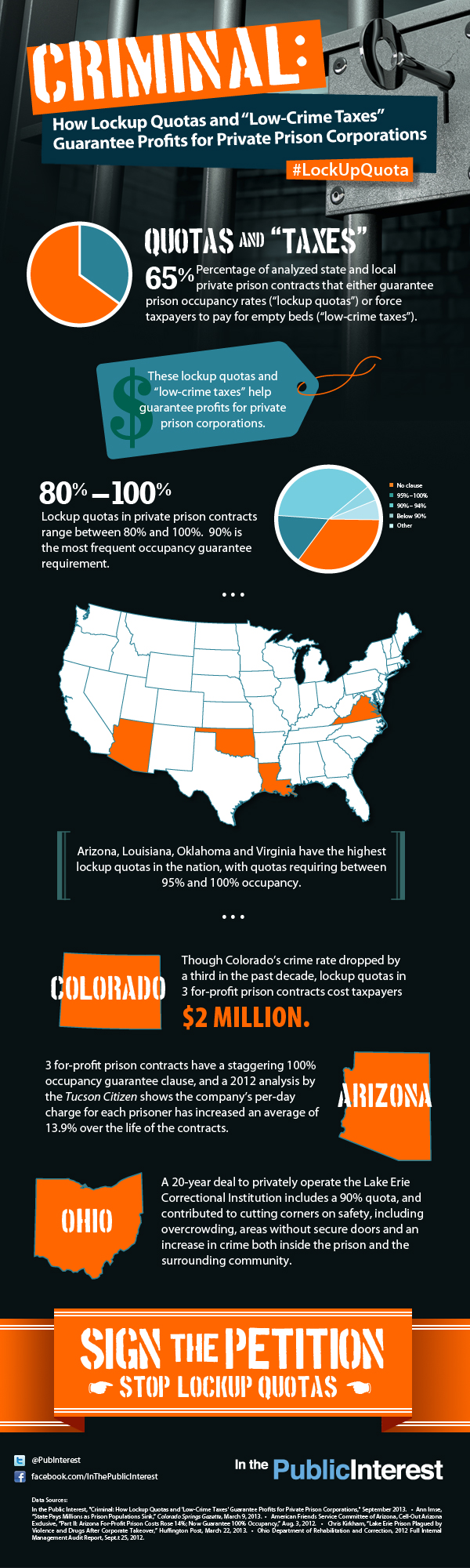
This report discusses the use of prison bed occupancy guarantee clauses in prison privatization contracts and explores how bed occupancy guarantees undermine criminal justice policy and democratic, accountable government. The report sheds light on the for-profit private prison industry’s reliance on high prison populations, and how these occupancy guarantee provisions directly benefit its bottom line. Also discussed are the prevalence of bed guarantee clauses, drawing on set of contracts that ITPI obtained through state open records requests.

We also address how occupancy guarantees have harmed states, focusing on the experiences of Arizona, Colorado, and Ohio — three states that have agreed to these provisions to detrimental consequences. Lastly, the report discusses our recommendation that governments can and should reject prison occupancy guarantees.

Download the full report:
Share the following infographic on social media:
Criminal-Lockup-Quota-Infographic

Source: In the Public Interest

Police Made One Marijuana Arrest Every 42 Seconds in 2012 | U.S. News & World Report

By Steven Nelson

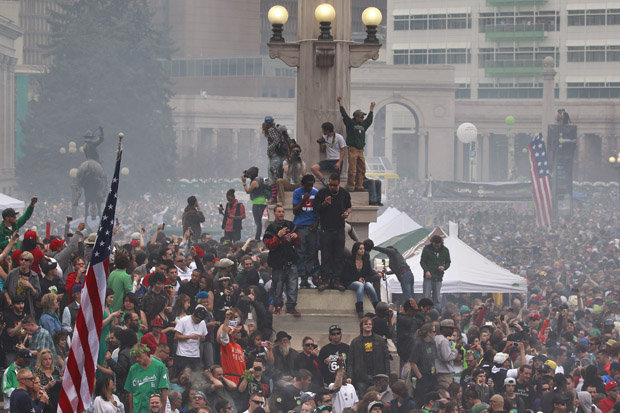
MarihuanaJumpingforJoyResidents of two states voted to legalize marijuana in 2012, but despite an increase in public support for liberalizing drug policy, American police arrested about the same number of people last year on pot-related charges as in 2011.

Data released Monday by the Federal Bureau of Investigation show there were an estimated 1,552,432 arrests for drug-related crimes in 2012 – a slight uptick from the 1,531,251 drug arrests in 2011.

Marijuana offenses accounted for 48.3 percent of all drug arrests, a slight reduction from 49.5 percent in 2011, which itself was the highest rate since before 1995.

Most marijuana-related arrests were for possession of the drug. By mere possession, there was one marijuana arrest every 48 seconds in 2012. Including arrests for distribution, there was a pot-related arrest every 42 seconds, the same interval as in 2011.

Advocacy groups that back campaigns to legalize or decriminalize weed said police should prioritize solving violent crimes – the number of which bumped upward from 2011 to 2012 – over arresting marijuana users.

According to the FBI’s Uniform Crime Report data, there were an estimated 1,214,462 violent crimes reported to police in 2012, a 0.7 percent increase. FBI Director James Comey noted in a statement this was the first overall increase in violent crime in six years.

Just 40.1 percent of the 84,376 forcible rapes reported to police and 28.1 percent of the 354,520 robberies were solved by law enforcement. Around 62.5 percent of the 14,827 murder cases were closed, as were 55.8 percent of the 760,739 aggravated assaults.

“As a former prosecuting attorney myself, I believe it is irresponsible to squander our limited law enforcement resources on this disastrous public policy failure,” said Dan Riffle, Marijuana Policy Project federal policies director, in a statement. “That is especially true when so many violent crimes remain unsolved. Every second spent arresting and prosecuting adults for marijuana is time that could have been spent preventing and solving real crimes.”

The group Law Enforcement Against Prohibition, made up of former and current law-enforcers who want to dampen drug prohibition, said the same.

“Each one of those arrests is the story of someone who may suffer a variety of adverse effects from their interaction with the justice system,” said LEAP Executive Director Neill Franklin, a former Maryland policeman, in a statement. “Commit a murder or a robbery and the government will still give you a student loan. Get convicted for smoking a joint and you’re likely to lose it.”

A poll released in April by the Pew Research Center found 52 percent of American adults believe marijuana should be legal.

It’s possible the national arrest tally for marijuana will be lower in 2013. State and local police enforce most anti-pot laws, and Washington and Colorado residents, who make up around 4 percent of the total U.S. population, will enjoy a largely arrest-free year.

The FBI report said there were 12,196,959 arrests for any reason in 2012, around one every two seconds.

Source: U.S. News & World Report

DOJ pursues immunity for Bush and six others for Iraq war crimes | The Examiner

By David Phillips

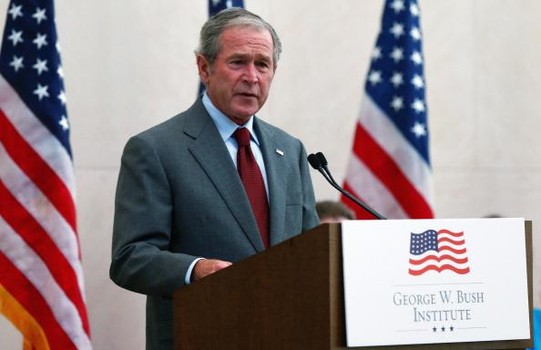
George W. Bush Speaks At Naturalization Ceremony At Bush Presidential CenterThe Department of Justice has filed a Grant of Immunity for war crimes against George W. Bush, Richard Cheney, Condoleezza Rice, Colin Powell, Paul Wolfowitz, and Donald Rumsfeld. The filing for the immunity of war crimes was made with the United States District Court, Northern District of California San Francisco Division.

The filing is for procedural immunity in a case alleging that they planned and waged the Iraq War in violation of international law.

The Plaintiff in this case is Sundus Shaker Saleh, an Iraqi single mother and refugee now living in Jordan. She filed a complaint in March 2013 in a San Francisco federal court alleging that the planning and waging of the war constituted a “crime of aggression” against Iraq, a legal theory that was used by the Nuremberg Tribunal to convict Nazi war criminals after World War II.

In her lawsuit, Saleh alleges that:

  • Richard Cheney, Donald Rumsfeld and Paul Wolfowitz began planning the Iraq War in 1998 through their involvement with the “Project for the New American Century,” a Washington DC non-profit that advocated for the military overthrow of Saddam Hussein.
  • Once they came to power, Saleh alleges that Cheney, Rumsfeld and Wolfowitz convinced other Bush officials to invade Iraq by using 9/11 as an excuse to mislead and scare the American public into supporting a war.
  • Finally, she claims that the United States failed to obtain United Nations approval prior to the invasion, rendering the invasion illegal and an act of impermissible aggression.

“The DOJ claims that in planning and waging the Iraq War, ex-President Bush and key members of his Administration were acting within the legitimate scope of their employment and are thus immune from suit,” chief counsel Inder Comar of Comar Law said.

The “Westfall Act certification,” submitted pursuant to the Westfall Act of 1988, permits the Attorney General, at his or her discretion, to substitute the United States as the defendant and essentially grant absolute immunity to government employees for actions taken within the scope of their employment.

“The good news is that while we were disappointed with the certification, we were prepared for it,” Comar stated. “We do not see how a Westfall Act certification is appropriate given that Ms. Saleh alleges that the conduct at issue began prior to these defendants even entering into office. I think the Nuremberg prosecutors, particularly American Chief Prosecutor Robert Jackson, would be surprised to learn that planning a war of aggression at a private non-profit, misleading a fearful public, and foregoing proper legal authorization somehow constitute lawful employment duties for the American president and his or her cabinet.”

The case is Saleh v. Bush (N.D. Cal. Mar. 13, 2013, No. C 13 1124 JST).

Source: The Examiner

Bradley Manning: a sentence both unjust and unfair | The Guardian

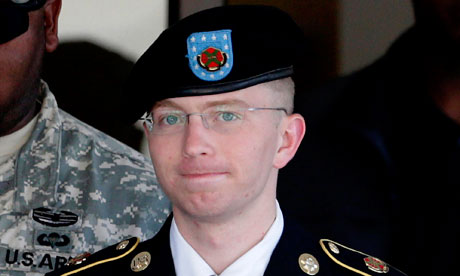
Bradley ManningPfc Manning sought to hold his country to the values it claims to uphold, yet his prison term dwarfs other military convictions

Bradley Manning has received a prison sentence that was 10 years longer than the period of time after which many of the documents he released would have been automatically declassified. The military judge handed down the longest ever sentence for a leak of US government information.

Mr Manning, according to this logic, did more harm than the soldier who gave a Jordanian intelligence agent information on the build-up to the first Iraq war, or the marine who gave the KGB the identities of CIA agents and floorplans of the embassies in Moscow and Vienna. Mr Manning did three times as much harm in transmitting to WikiLeaks in 2010 the war logs or field reports from Iraq and Afghanistan, as Charles Graner did. He was the army reserve corporal who became ringleader of the Abu Ghraib abuse ring and was set free after serving six and a half years of his 10-year sentence.

Among the 700,000 classified documents Mr Manning downloaded while stationed in Iraq was a video that showed a US Apache helicopter in Baghdad opening fire on a group of Iraqis, including two Reuters journalists and their children, who had attempted to rescue a severely injured man. More devastating than the film was the cockpit chatter of the soldiers who joked as they shot people in the streets.

“Look at those dead bastards,” said one. “Nice,” said another.

The Apache crew has never been charged with any offence (all their adult targets were listed as insurgents) and neither has any other individual as a result of Mr Manning’s revelations. But the shortened 17-minute version of the video has been viewed more than 3m times on YouTube.

So, the central question to answer in judging the proportionality of this sentence is whether the desire to punish a whistleblower driven by moral outrage stems from the alleged harm he did US military and diplomatic interests, or whether it derives more from sheer embarrassment. The judge presiding, Col Denise Lind, had already thrown out the gravest charge, that of “aiding the enemy”. Col Lind had also limited the admissibility of evidence regarding the “chilling effects” that Mr Manning’s actions had on US diplomacy by releasing 250,000 state department cables. A military witness conceded there was no evidence that anyone had been killed after being named in the releases.

Mr Manning’s recent apology for his actions does not, and should not, detract from the initial defence he gave for them, when he spoke of his shock at the “delightful bloodlust” displayed by that helicopter crew, or his belief that stimulating a debate about the wars was the right thing to do. We know what his motives as a whistleblower were and we have applauded them. They are certainly not akin to treachery or any act fit to be judged – if anything is – by an espionage act rushed onto the statute book in 1917 after America entered the first world war.

Mr Manning exposed the abuse of detainees by Iraqi officers under the watch of US minders. He showed that civilian deaths during the Iraq war were much higher than the official estimates. If they were published today, these claims would be uncontentious. They have already slipped into the official history of this war. But the author of this orthodoxy will continue to pay for the record he helped establish by a prison term that he will serve well into the next decade, which is when the first date for his parole application becomes due. Mr Manning was seeking to hold his country and its army to the values they claim to uphold.

It is unclear what the US military hopes to achieve by securing a sentence that dwarfs those of other military convictions. Deterrence features large in its thinking. Whistleblowing will not only endanger your career, it wants to say, but your freedom – for most of your adult life. In 2008, one could have hoped that the US had a president whose administration would distinguish between leaks in the public interest and treason. But this sentence tells a different story. Mr Manning’s sentence, which is both unjust and unfair, can still be reduced on appeal. Let us hope that it is.

Source: The Guardian

SWAT Team Raids Organic Farm, Confiscates Blueberries | Huffington Post

By Radley Balko

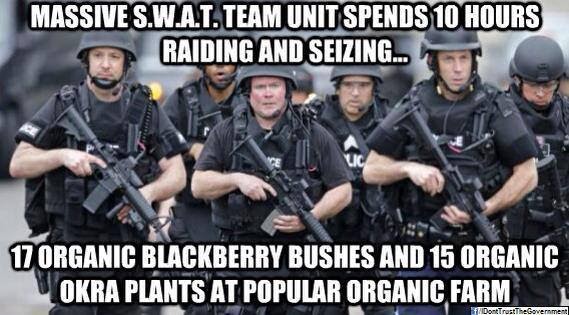
SWATTeamA small organic farm in Arlington, Texas, was the target of a massive police action last week that included aerial surveillance, a SWAT raid and a 10-hour search.

Members of the local police raiding party had a search warrant for marijuana plants, which they failed to find at the Garden of Eden farm. But farm owners and residents who live on the property told a Dallas-Ft. Worth NBC station that the real reason for the law enforcement exercise appears to have been code enforcement. The police seized “17 blackberry bushes, 15 okra plants, 14 tomatillo plants … native grasses and sunflowers,” after holding residents inside at gunpoint for at least a half-hour, property owner Shellie Smith said in a statement. The raid lasted about 10 hours, she said.

Local authorities had cited the Garden of Eden in recent weeks for code violations, including “grass that was too tall, bushes growing too close to the street, a couch and piano in the yard, chopped wood that was not properly stacked, a piece of siding that was missing from the side of the house, and generally unclean premises,” Smith’s statement said. She said the police didn’t produce a warrant until two hours after the raid began, and officers shielded their name tags so they couldn’t be identified. According to ABC affiliate WFAA, resident Quinn Eaker was the only person arrested — for outstanding traffic violations.

The city of Arlington said in a statement that the code citations were issued to the farm following complaints by neighbors, who were “concerned that the conditions” at the farm “interfere with the useful enjoyment of their properties and are detrimental to property values and community appearance.” The police SWAT raid came after “the Arlington Police Department received a number of complaints that the same property owner was cultivating marijuana plants on the premises,” the city’s statement said. “No cultivated marijuana plants were located on the premises,” the statement acknowledged.

The raid on the Garden of Eden farm appears to be the latest example of police departments using SWAT teams and paramilitary tactics to enforce less serious crimes. A Fox television affiliate reported this week, for example, that police in St. Louis County, Mo., brought out the SWAT team to serve an administrative warrant. The report went on to explain that all felony warrants are served with a SWAT team, regardless whether the crime being alleged involves violence.

In recent years, SWAT teams have been called out to perform regulatory alcohol inspections at a bar in Manassas Park, Va.; to raid bars for suspected underage drinking in New Haven, Conn.; to perform license inspections at barbershops in Orlando, Fla.; and to raid a gay bar in Atlanta where police suspected customers and employees were having public sex. A federal investigation later found that Atlanta police had made up the allegations of public sex.

Other raids have been conducted on food co-ops and Amish farms suspected of selling unpasteurized milk products. The federal government has for years been conducting raids on medical marijuana dispensaries in states that have legalized them, even though the businesses operate openly and are unlikely to pose any threat to the safety of federal enforcers.

Radley Balko is a senior writer and investigative reporter for The Huffington Post. He is also the author of the new book, Rise of the Warrior Cop: The Militarization of America’s Police Forces.

Sources: Huffington Post

Edward Snowden asylum: US ‘disappointed’ by Russian decision | The Guardian

Edward Snowden's lawyer

By in Moscow, , and in Washington

Edward Snowden’s lawyer Anatoly Kucherena shows a copy of a temporary document allowing the whistleblower to cross the border into Russia. Photograph: AP

The White House expressed anger and dismay on Thursday after Russia granted temporary asylum to the American whistleblower Edward Snowden and allowed him to leave the Moscow airport where he had been holed up for over a month.

White House spokesman Jay Carney said the US was “extremely disappointed” by the decision, almost certainly taken personally by President Vladimir Putin. He said Moscow should hand Snowden back and hinted that Barack Obama might now boycott a bilateral meeting with Putin in September, due to be held when the US president travels to Russia for a G20 summit.

Carney added that Snowden had arrived in both China and Russia carrying with him thousands of top secret US documents. He said: “Simply the possession of that kind of highly sensitive classified information outside of secure areas is both a huge risk and a violation.

“As we know he’s been in Russia now for many weeks. There is a huge risk associated with … removing that information from secure areas. You shouldn’t do it, you can’t do it, it’s wrong.”

With US-Russian relations now at a cold war-style low, Snowden slipped out of Sheremetyevo airport on Thursday afternoon. His lawyer, Anatoly Kucherena, said Russia’s federal migration service had granted him temporary asylum for one year. Snowden had left the airport to stay at an undisclosed location with expatriate Americans, he added.

Putin made no immediate comment. But having weighed Russia’s options for some weeks, he appears to have decided that Snowden’s propaganda value outweighs any possible US repercussions. Obama’s already floundering attempts to “reset”, or improve, relations with Moscow are in effect over.

In a statement released by WikiLeaks, Snowden thanked the Russian authorities and accused the US of behaving illegally. He made no explicit mention of the trial of Bradley Manning, who this week was convicted of espionage and faces 136 years in jail.

Snowden said: “Over the past eight weeks we have seen the Obama administration show no respect for international or domestic law, but in the end the law is winning.”

He added: “I thank the Russian Federation for granting me asylum in accordance with its laws and international obligations.”

Snowden has been given a temporary Russian travel document, with his name in Cyrillic and a fresh passport photo. “This gave him the right to temporary asylum on the territory of the Russian Federation, Kucherena said, holding up a copy of the document. US authorities had cancelled his American passport.

Security officials said Snowden officially crossed the border into Russia from the airport’s transit zone at about 3.30pm local time. Russia had apparently not informed the US of the move in advance. The state TV channel Rossiya 24 showed a photograph of Snowden’s departure, as he clambered into a grey unmarked car.

Despite being pictured from behind Snowden was instantly recognisable wearing his trademark grey shirt and carrying a black backpack. Next to him was Sarah Harrison, the WikiLeaks representative who accompanied him last month on his flight from Hong Kong.

Kucherena declined to provide details on where Snowden was heading, citing safety concerns. “Since he is the most hunted person in the world, he will address the question of security today,” he told journalists.

The former NSA employee will himself choose his place of residence and forms of protection, he added. Previously, some speculated that the Russian government was keeping Snowden hidden, although the whistleblower and his lawyer have denied that, adding that he has had no contact with Russian security services.

The whistleblower’s father, Lon Snowden, had reportedly been planning to visit his son. Kucherena said on Wednesday that he was sending an invitation to Snowden’s father so he could obtain a Russian visa. Kucherena told Rossiya 24 on Thursday that he would be speaking to the father later in the day to arrange his visit.

US authorities have repeatedly called on Moscow to return the fugitive to face charges in America. Last week America’s attorney general, Eric Holder, sent a letter to Russia’s justice minister promising that Snowden would not be tortured and that he would not face the death penalty if handed over to the US.

Russian officials previously said they had no jurisdiction to return Snowden, as he was not officially located on Russian territory, and that the US had not filed an official extradition request.

The Kremlin did not immediately comment on Snowden’s temporary asylum. Putin has previously said repeatedly that to remain in Russia, Snowden must stop activities harming the United States. His lawyer suggested that fresh revelations published by the Guardian on Wednesday and Thursday had come from documents that Snowden had already given the paper before Putin made his comments.

Russia’s decision has emboldened hawkish critics of the White House, who have long dubbed Obama’s attempts to improve relations with Putin as naive and inappropriate. In a statement on his website, Senator John McCain said: “Russia’s action today is a disgrace and a deliberate effort to embarrass the United States. It is a slap in the face of all Americans. Now is the time to fundamentally rethink our relationship with Putin’s Russia.”

He proposed in response to expand the Magnitsky Act list of banned Russian officials, push for Georgia’s acceptance into Nato and implement US missile defence programmes in Europe.

At the White House, Carney made it clear that President Obama was frustrated by the decision by Russia to allow Snowden to enter the country, and that a planned presidential summit was now in jeopardy.

Obama is scheduled to travel to Russia in September for at meeting of G20 leaders in St Petersburg. He also planned to meet Putin for a bilateral summit during the trip in what would have been a sign of improving relations between the two powers.

That meeting is now under review. “Obviously this is not a positive development,” Carney said. “We have a wide range of interests with the Russians. We are evaluating the utility of the summit.”

Amnesty International called for the focus to switch from Snowden’s asylum plight to the “sweeping nature and unlawfulness” of the US government’s surveillance programmes.

Widney Brown, senior director for international law and policy at Amnesty, said in a statement: “Now that Edward Snowden has left the airport and has protected status in Russia, the focus really needs to be on the US government’s surveillance programs. Snowden would not have needed temporary asylum but for revealing the sweeping nature and unlawfulness of a massive system of domestic and international surveillance by the United States government.”

A survey showed that 43% of Russians supported granting Snowden asylum and 51% approved of his whistleblowing activities. Kucherena said he had received numerous letters from Russians offering Snowden lodging, protection and money, as well as from women interested in Snowden romantically.

Pavel Durov, the founder of Russia’s most popular social network, VKontakte, invited Snowden to come work as a programmer at the network, in a post on his VKontakte page on Thursday.

Source: The Guardian

The Sky Darkens for American Journalism: The future of the American media is being decided in a military court | Al Jazeera

By Chase Mader

Bradley Manning released hundreds of thousands of government documents and files to Wikileaks, most famous among them the unclassified video Wikileaks dubbed, “Collateral Murder”, a harrowing gun-sight view of an Apache helicopter slaughtering a couple of armed men and a much larger group of civilians on a Baghdad street in July, 2007.

The court-martial of Pfc. Manning, finally underway over three years after his arrest, is likely to cause a great deal of collateral destruction in its own right. In this case the victim will be American journalism.

The most serious of the charges against Manning is the capital offense of “aiding the enemy.” (Team Obama has made it clear it won’t seek the death penalty, but a life sentence is possible.) The enemy that the prosecution has in mind is not Wikileaks or the global public but Al Qaeda; because this group had access to the internet, the logic goes, they could read Manning’s disclosures just like everyone else.

The government does not have to prove Manning’s conscious intent to help Al Qaeda, but must only meet the squishier standard of proving the defendant had “specific knowledge” that the terrorists might benefit from his cache of documents.If the Aiding the Enemy charge against Bradley Manning is the outcome of his legal struggles, there will be adverse consequences for whistleblowers and for journalists in the future.

If this charge sticks, it will be a serious blow to American journalism, as it puts all kinds of confidential informants at risk of being capital cases. A soldier in Afghanistan who blogs about the lack of armoured vehicles – a common and very public complaint from the ranks in the Iraq War – could be prosecuted for tipping off the Taliban.

Whoever leaked Ambassador Karl Eikenberry’s long cable on the futility of counterinsurgency in Afghanistan could also be conceivably be put away for life, even executed. As Ben Wizner of the American Civil Liberties Union has explained, the use of this charge against sources, leakers and whistleblowers – like Bradley Manning – will criminalise a great deal of essential journalism – and not just the kind practiced by Wikileaks and various bloggers.

The Manning prosecution has asserted more than once that they would have pressed the Aiding the Enemy charge even if the private had passed his cache to the New York Times or the Washington Post (as the leaker had attempted).

This jolted the editorial classes, who do not much like imagining themselves as being implicated, however hypothetically, in terrorist acts. Op-eds in the New York Times and Los Angeles Times have blasted the Aiding the Enemy charges brought against Manning, explaining that they would not just “chill” but freeze a great deal of essential journalism.

The news media has always relied on leaks of classified material, from the Pentagon Papers and Watergate, to the preemptive disclosure of the 2007 National Intelligence Estimate holding that Iran had no nuclear weapons program, a transparent attempt by the military brass to block Bush and Cheney from launching a third war.

And contrary to widespread panic, massive leaks of classified material tend to enhance national security as the new information can prevent the kind of reckless, poorly-informed decisions that have squandered so much blood and money, from Southeast Asia to Iraq.

Who is a journalist and who gets to decide?

Aiding the Enemy is of course not the only charge against Private Manning. One of the charges, “wanton publication,” hinges in part on whether Wikileaks is a bona fide journalistic entity. But who gets to decide who is and who isn’t a journalist, and how?

Defense witness Yochai Benkler, a professor at Harvard Law School and expert on press freedom and the internet, provided an answer earlier this month. Benkler, who has published penetrating studies of the 21st century media landscape, took the stand July 11th to address the matter of who is and who isn’t a journalist.

Wikileaks is absolutely a media organization, one perfectly emblematic of the “networked fourth estate”, in which traditional news outlets like the Guardian and Der Spiegel collaborate with smaller non-profit and for-profit entities to produce news coverage. Supporters of Manning found Benkler’s testimony to be lucid, supremely well-informed and compelling – but will it convince Judge Denise Lind?

As for traditional news media, they have been largely AWOL, with the New York Times sending a correspondent to a few hearings, only after a shaming by the newspaper’s public editor. But a handful of independent correspondents, notably Kevin Gostzola of FireDogLake, independent journalist Alexa O’Brien and Bradley Manning staffer Nathan Fuller, as well as court artist Clark Stoeckley – have covered every breath of the legal proceedings.

And even as more established media have leaned heavily on these reporters for all manner of factual and logistical assistance, gracious acknowledgement of the professional debt has not always been forthcoming. Last month the New York Times rather snottily described O’Brien as a mere “activist” before being embarrassed into a correction.

Although smug torpor is Big Media’s default setting, a recent barrage of sucker-punches has shaken the Fourth Estate’s generally cosy partnership with the political class. The Obama administration has named James Rosen of Fox News as a co-conspirator in its case against State Department leaker Stephen Jin-Woo Kim; the government has also announced that it had been sifting through two months of the Associated Press’s phone records to hunt down the source of a leak.

Obama’s poison gift to journalists

Affecting a chastened air, the Obama administration now says it wants to make nice with journalists.   To strike a finer “balance” between press freedom and security, Team Obama has offered to pass a Press Shield Law-a slightly revamped version of the same bill the White House threatened to veto back in 2009. (Senator Obama had been a liberal champion of just such a bill before). This Press Shield Law is intended as conciliatory basket of fruit, sent to the media as an apology for all those investigations.

The government’s gift to journalists is poison, and should be rejected. The Press Shield Law would be more accurately titled the Media Prosecution Enhancement Bludgeon – as Trevor Timm of the Press Freedom Foundation has warned, the statute would override and erase many common-law protections currently enjoyed by reporters.

Just as with our whistleblower protection laws, the statute includes a cavernous carve-out for any leak-based reporting that affects “national security”, a term that is infinitely elastic in the hands of official Washington. (The law would not have “shielded” the Associated Press from the government’s investigation of their phone records, nor would it have protected Fox’s Rosen).

But wait: that’s not all that the new law won’t do! As the law’s primary author, Senator Chuck Schumer (D-NY) has crowed, the law would specifically exclude Wikileaks and other internet-based groups that he and his colleagues do not believe to be proper media organizations. (Bear in mind the average age in today’s United States Senate is 61). The language defining who is and who isn’t “a member of the media” is marvellously supple, to be loosened and tightened as the government sees fit.

Meanwhile, the State onslaught against American journalists continues: the dependably conservative Washington DC circuit court has ruled that James Risen of the New York Times must testify as to his sources in a story about CIA disruption of Iran’s nuclear program. (Risen has pledged he will go to jail first).

Former NSA and CIA director Michael Hayden has casually called Glenn Greenwald a co-conspirator with NSA leaker Edward Snowden. With this roiling in the background, military judge Denise Lind announced on July 18 that she would not dismiss the Aiding the Enemy charge against Bradley Manning but will instead weigh that momentous accusation on its merits.

This is not necessarily a disaster for Manning or for American journalism: if Judge Lind rules against this charge, it will establish common law precedent protecting journalists from similar legal attacks, and Bradley Manning will likely serve (a little) less time in prison. (The Judge’s verdict is expected by next Tuesday, July 30th).

On the other hand, if the Aiding the Enemy charge sticks, Pfc. Manning faces a possible life sentence – and the outcome might be only slightly less calamitous for American journalism.

Source: Common Dreams

Crime is plunging in the rich world. To keep it down, governments should focus on prevention, not punishment | The Economist

IN THE 1990s John DiIulio, a conservative American academic, argued that a new breed of “superpredators”, “kids that have absolutely no respect for human life and no sense of the future”, would terrorise Americans almost indefinitely. He was not alone. Experts were convinced that crime would keep rising. Law-abiding citizens would retreat to gated communities, patrolled by security guards. Politicians and police chiefs could do little except bluster and try to fiddle the statistics.

Mr DiIulio later recanted and it is clear that the pessimists were wrong. Even as he wrote, America’s crime wave was breaking. Its cities have become vastly safer, and the rest of the developed world has followed. From Japan to Estonia, property and people are now safer than at almost any time since the 1970s (see article). Confounding expectations, the recession has not interrupted the downward trend. Even as America furiously debates the shooting of Trayvon Martin (see article), new data show that the homicide rate for young Americans is at a 30-year low.

Some crimes have all but died out. Last year there were just 69 armed robberies of banks, building societies and post offices in England and Wales, compared with 500 a year in the 1990s. In 1990 some 147,000 cars were stolen in New York. Last year fewer than 10,000 were. In the Netherlands and Switzerland street dealers and hustlers have been driven out of city centers; addicts there are now elderly men, often alcoholics, living in state hostels. In countries such as Lithuania and Poland the gangsters who trafficked people and drugs in the 1990s have moved into less violent activities such as fraud.

The receding tide

Cherished social theories have been discarded. Conservatives who insisted that the decline of the traditional nuclear family and growing ethnic diversity would unleash an unstoppable crime wave have been proved wrong. Young people are increasingly likely to have been brought up by one parent and to have played a lot of computer games. Yet they are far better behaved than previous generations. Left-wingers who argued that crime could never be curbed unless inequality was reduced look just as silly.

There is no single cause of the decline; rather, several have coincided. Western societies are growing older, and most crimes are committed by young men. Policing has improved greatly in recent decades, especially in big cities such as New York and London, with forces using computers to analyse the incidence of crime; in some parts of Manhattan this helped to reduce the robbery rate by over 95%. The epidemics of crack cocaine and heroin appear to have burnt out.

The biggest factor may be simply that security measures have improved. Car immobilisers have killed joyriding; bulletproof screens, security guards and marked money have all but done for bank robbery. Alarms and DNA databases have increased the chance a burglar will be caught. At the same time, the rewards for burglary have fallen because electronic gizmos are so cheap. Even small shops now invest in CCTV cameras and security tags. Some crimes now look very risky—and that matters because, as every survey of criminals shows, the main deterrent to crime is the fear of being caught.

Loosen the cuffs

Many conservatives will think this list omits the main reason crime has declined: the far harsher prison sentences introduced on both sides of the Atlantic over the past two decades. One in every hundred American adults is now in prison. This has obviously had some effect—a young man in prison cannot steal your car—but if tough prison sentences were the cause, crime would not be falling in the Netherlands and Germany, which have reduced their prison populations. New York’s prison population has fallen by a quarter since 1999, yet its crime rate has dropped faster than that of many other cities.

Harsh punishments, and in particular long mandatory sentences for certain crimes, increasingly look counterproductive. American prisons are full of old men, many of whom are well past their criminal years, and non-violent drug users, who would be better off in treatment. In California, the pioneer of mandatory sentencing, more than a fifth of prisoners are over 50. To keep each one inside costs taxpayers $47,000 a year (about the same as a place at Stanford University). And because prison stresses punishment rather than rehabilitation, most of what remains of the crime problem is really a recidivism issue. In England and Wales, for example, the number of first-time offenders has fallen by 44% since 2007. The number with more than 15 convictions has risen.

Politicians seem to have grasped this. In America the number of new mandatory sentences enacted by Congress has fallen. Even in the Republican South, governors such as Rick Perry and Bobby Jindal have adopted policies favoring treatment over imprisonment for drug users. Britain has stopped adding to its prison population. But more could be done to support people when they come out of prison (at the moment, in Britain, they get £46) and to help addicts. In the Netherlands and Switzerland hard-drug addiction is being reduced by treatment rather than by punishment. American addicts, by contrast, often get little more than counseling.

Policing can be sharpened, too—and, in an era of austerity, will have to be. Now that officers are not rushed off their feet responding to car thefts and burglaries, they can focus on prevention. Predictive policing, which employs data to try to anticipate crime, is particularly promising. More countries could use civilian “community support officers” of the sort employed in Britain and the Netherlands, who patrol the streets, freeing up better-paid police officers to solve crimes.

Better-trained police officers could focus on new crimes. Traditional measures tend not to include financial crimes such as credit-card fraud or tax evasion. Since these are seldom properly recorded, they have not contributed to the great fall in crime. Unlike rapes and murders, they do not excite public fear. But as policing adapts to the technological age, it is as well to remember that criminals are doing so, too.

Source: The Economist