“For the FIRST time in recorded history, EVERY major civilization—America, China, Europe, Japan—is hitting the absolute peak of the debt super-cycle AT THE EXACT SAME MOMENT. There is no rising power waiting in the wings like there always has been. When this resets, it won’t be regional. It will be global, systemic, and sudden.”
Glenn Beck lays out the only three ways every debt empire has ever ended: • Hyperinflation wipeout (Weimar, Rome, France) • Hard default + revolution (Russia 1917, Argentina ×9) • World war → new monetary order (Napoleonic Wars → Gold Standard → Bretton Woods)
Then the line that stopped me cold:“Rome fell alone. Britain declined while America rose. This time… no one is coming up.”
Beck ends with fire: Every single collapse in history birthed renewal — Christian Europe from Rome’s ashes, the modern nation-state from France’s terror, the greatest prosperity explosion ever after WWII.
The next chapter is not written. It never will be written by Washington, Wall Street, Beijing, or Davos.
It will be written by us — in our families, communities, and convictions.
Then come back and tell me: Which system do you think is quietly being built right now to replace the one that’s dying?
THIS is the most important and informative interview ever – it is now in my top three of all time. Recorded the other day in Amsterdam – it is compelling and crucial – I promise you that!
Have you ever wondered who owns the most gold privately? The gold industry is thriving, as this yellow metal is highly coveted and a safe haven investment that usually appreciates over the long term. However, there’s only a finite supply of gold in the world. So, who are the individuals and families that own the most holdings of gold in the world? Below, we’ll tell you about the most prominent gold investors with privately owned reserves, notable advocates for gold IRAs, and how private gold ownership affects gold market prices.
Private Owners
John Paulson John Paulson is an American hedge fund manager and billionaire famous for having one of the world’s biggest privately owned gold reserves. He’s also well known for predicting the 2007 mortgage financial crisis and has made headlines for his mammoth-sized gold holdings through his firm, Paulson & Co. As the central banks start to buy more gold in response to the devaluation of fiat currencies, Paulson has been a vocal advocate for investing in physical gold bullion.
Ray Dalio Ray Dalio is another of the most famous gold buyers and owns one of the largest private gold reserves in the world. He’s the founder and co-chief investment officer of Bridgewater Associates, which manages $150 billion in assets. In the second quarter of 2020, Bridgewater Associates invested $400 million in gold holdings, including exchange-traded funds with the SPDR Gold Trust and the iShares Gold Trust.
Indian Families Indian households have some of the largest gold reserves in the world. Most of these are in the form of gold jewelry, which is primarily for weddings and Diwali festivals. Indian families (not including what the banking system owns) have roughly 25,000–27,000 tons of gold. The most exciting fact is that a significant portion of these gold reserves is held by the rich and throughout the caste system.
Stanley Druckenmiller Stanley Druckenmiller is a legend in the investing world. Like John Paulson, he predicted in 2005 that the Federal Reserve would trigger a housing crisis and economic collapse. In 2015, he had more than $292 million in exposure to the SPDR Gold Trust.
Eric Sprott Another of the world’s most prominent investors in gold is Eric Sprott. He’s a Canadian who has invested vast amounts of money in precious metals, including gold mining and exploration companies like Labrador Gold, Benchmark Metals, Ethos Gold, and New Age Metals.
The Royal Family of Saudi Arabia The royal family of Saudi Arabia is well known for being unimaginably wealthy and having some of the largest gold reserves in the world. They’re lavish spenders, with a reported net worth of approximately $1.4 trillion.
How Much Gold Is There in the World?
The World Gold Council reports an estimated 208,874 metric tons of gold mined worldwide. Even knowing that, it’s impossible to estimate how much gold in the world remains. While there is plenty, much of this physical gold is too deep to mine. Experts estimate that at a rate of 3,000 metric tons per year, the world’s currently accessible gold will have all been mined in less than 18 years unless new mines are discovered.
Some of the Most Notable Advocates for the Gold IRA
Peter Schiff Peter Schiff successfully advocates the precious metals industry and gold IRAs (individual retirement accounts). He founded SchiffGold and still serves as honorary chairman since he sold the company in 2016 to Goldmoney. He considers precious metals, like gold IRAs, safe haven investments to hedge against inflation and the rapid weakening of our country’s currency.
James Rickards James Rickards is another advocate for investing in gold and precious metal IRAs. He is an investor, advisor, and lawyer who frequently lectures on why Americans should buy gold and allocate about 10 percent of their wealth portfolio to precious metal investments. He was also the primary negotiator for the Federal Reserve when it rescued Long-Term Capital Management.
Robert Kiyosaki Robert Kiyosaki is an American investor and the founder of the Rich Dad Company. He has long been a proponent of investing in physical gold and gold IRAs. He’s a financial advisor who aims to help people achieve financial independence through wise investing.
Laith Alsarraf Another of the most prominent gold investors and advocates for precious metals and gold IRAs is Laith Alsarraf, who founded Birch Gold Group. He believes in empowering people and financial strength through knowledge, and is one of the most well-respected businessmen in the IRA industry.
Which Countries and National Governments Have the Largest Gold Reserves?
Which countries can claim to have all the gold? The U.S. Federal Reserve has the highest gold reserves in the world, thanks to its switch from the gold standard a few decades ago, when citizens could redeem national currency for gold. Our country’s gold reserves are around 8,133.5 metric tons. Furthermore, 75 percent of its foreign reserves are in gold as well. However, other countries also have significant gold reserves in their possession.
Second on the list is Germany, with 3,359 metric tons of gold. German investors are also rapidly investing in more gold than in previous years and are becoming some of the largest global investors in gold.
In the third position is Italy, with 2,452 metric tons. Other countries with large gold reserves include China, France, and Russia. Interestingly enough, the United States is considering freezing Russian gold reserves over the war in Ukraine. The World Bank reports that the International Monetary Fund also has some of the largest national assets, with official gold holdings at around 90.5 million ounces. The European Central Bank has also been buying more gold reserves, with about €26 billion invested in 2021.
Why Do Some Individuals Choose to Hold Gold Privately?
Is there a benefit to buying private gold instead of government-backed bullion? While the primary advantage of government bullion is its security and stability, it’s also far more expensive, mainly if it’s collectible. Unfortunately, that premium comes in the form of extra fees.
With private gold, investors can avoid those extra costs and use the money to purchase more bullion instead. Government bullion has a guarantee, so investors know their gold’s precise weight and purity, unlike private purchases. However, as long as you take the time to verify the seller and the quality of your gold before you purchase it, you can enjoy the benefits of private gold ownership while avoiding the extra expense of collector’s fees.
How Does Private Gold Ownership Affect Gold Prices?
If someone has a large privately owned gold reserve, does that affect the price of gold? Of course, as only a finite amount of gold is left in the world, the price will increase once supplies begin to dwindle, according to the law of supply and demand. While private ownership can affect gold prices if individuals buy enough gold to affect the supply, it’s not the only factor that impacts prices.
The availability of gold imports also affects prices, as developing countries that mine the metal often have supply-chain issues due to political reasons like civil war. A nation with a slightly weakened currency can also impact the export industry, increasing it by a large margin. In addition, factors like inflation, the central bank actions, and the mining industry also affect prices. Historically, when the stock market and paper assets decrease, the price of gold increases. Not all gold reserves in the central banks are legal, however. Illegally sourced gold has been a big problem and is another factor influencing spot prices.
It’s been rightly said that “he who holds the gold makes the rules.”
After World War 2, the US had the largest gold reserves in the world, by far. Along with winning the war, this let the US reconstruct the global monetary system around the dollar.
The new system, created at the Bretton Woods Conference in 1944, tied the currencies of virtually every country in the world to the US dollar through a fixed exchange rate. It also tied the US dollar to gold at a fixed rate of $35 per ounce.
The dollar was said to be “as good as gold.”
The Bretton Woods system made the US dollar the world’s premier reserve currency. It compelled other countries to store dollars for international trade or to exchange them with the US government for gold at the promised price.
However, it was doomed to fail.
Runaway spending on warfare and welfare caused the US government to print more dollars than it could back with gold at the promised price.
By 1967, the number of dollars circulating had drastically increased relative to the amount of gold backing them. This encouraged foreign countries to exchange their dollars for gold, draining the US gold supply at an alarming rate and collapsing the London Gold Pool. At this point, it was clear this system was breaking down.
On Sunday night, August 15, 1971, President Nixon interrupted the scheduled TV programs and made a surprise announcement to the nation—and the world. He announced the unilateral end of the Bretton Woods system and severed the dollar’s last tie to gold.
The end of the dollar’s gold backing had profound geopolitical consequences.
Most critically, it eliminated the main reason foreign countries stored large amounts of US dollars and used the US dollar for international trade. As a result, oil-producing countries began to demand payment in gold instead of rapidly depreciating dollars.
It was clear the US would have to create a new monetary system to stabilize the dollar. So it concocted a new scheme… and chose Saudi Arabia as its accomplice. This agreement came to be known as the “petrodollar system.”
The US handpicked Saudi Arabia because of its vast petroleum reserves and dominant position in the global oil market.
In essence, the petrodollar system was an agreement that the US would guarantee the House of Saud’s survival. In exchange, Saudi Arabia would do three things.
First, it would use its dominant position in OPEC to ensure that all oil transactions would only happen in US dollars.
Second, it would recycle hundreds of billions of US dollars from annual oil revenue into US Treasuries. This lets the US issue more debt and finance previously unimaginable budget deficits.
Third, it would guarantee the price of oil within limits acceptable to the US and prevent another oil embargo.
The petrodollar system gave foreign countries another compelling reason to hold and use the dollar. And it preserved the dollar’s unique status as the world’s top reserve currency.
But… why oil?
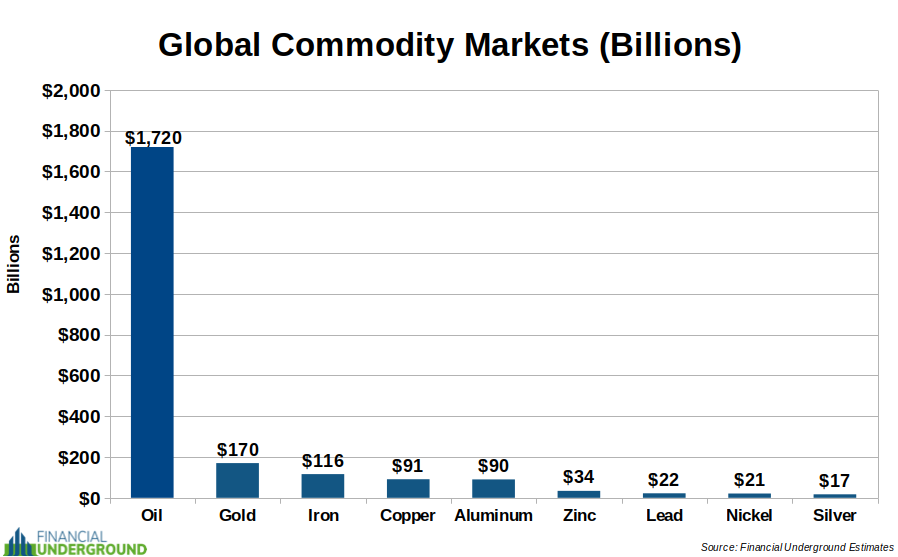
Oil is the largest and most strategic commodity market in the world.
As you can see in the chart below, it dwarfs all other major commodity markets combined. The annual production value of the oil market is ten times bigger than the gold market, for example.
Every country needs oil. And if foreign countries need US dollars to buy oil, they have a compelling reason to hold US dollars even if they are not backed by a promise to redeem them in gold.
Think about it… If France wants to buy oil from Saudi Arabia, it must purchase US dollars on the foreign exchange market to pay for the oil first.
This creates a huge artificial market for US dollars and differentiates the US dollar from a purely local currency, like the Mexican peso.
The dollar is just a middleman. It’s used in countless transactions, amounting to trillions of dollars that have nothing to do with US products or services.
Since the oil market is enormous, it acts as a benchmark for international trade. If foreign countries are already using dollars for oil, it’s easier to use the dollar for other international trade.
In addition to nearly all oil sales, the US dollar is used for about 80% of all international transactions.
Ultimately, the petrodollar boosts the US dollar’s purchasing power by enticing foreigners to soak up dollars.
The petrodollar system has helped create a deeper, more liquid market for the dollar and US Treasuries. It has also helped the US keep interest rates lower than they would otherwise be, allowing the US government to finance enormous deficits it otherwise would be unable to.
Multi-trillion deficits would otherwise be impossible without destroying the currency through money printing.
It’s hard to overstate how much the petrodollar system benefits the US. It’s the bedrock of the US financial system and has underpinned the dollar’s role as the world’s reserve currency since the 1970s.
That’s why the US government protects it so fiercely. It needs the system to survive.
World leaders who have challenged the petrodollar have ended up dead.
Take Saddam Hussein and Muammar Gaddafi, for example. Each led a large oil-producing country—Iraq and Libya, respectively. And both tried to sell their oil for something other than US dollars before US military interventions led to their deaths.
Of course, there were other reasons the US toppled Saddam and Gaddafi. But protecting the petrodollar was a serious consideration, at the very least.
When countries like Iraq and Libya challenge the petrodollar system, it’s one thing. The US military can dispatch them with ease.
However, it’s a whole other dynamic when China (and Russia) undermine the petrodollar system… which is happening in a big way right now.
China and Russia are the only countries with sophisticated enough nuclear arsenals to go toe-to-toe with the US up to the top of the military escalation ladder.
In other words, the US military can’t attack Russia and China with impunity because they can match each move up to all-out nuclear war—the very top of the military escalation ladder.
For this reason, the US is deterred from entering a direct military conflict with China and Russia—even though they are about to strike a fatal blow to the petrodollar system.
US Sanctions Accelerate Demise of Petrodollar
In the wake of Russia’s invasion of Ukraine, the US government launched its most aggressive sanctions campaign ever.
Exceeding even Iran and North Korea, Russia is now the most sanctioned nation in the world.
“This is financial nuclear war and the largest sanctions event in history,” said a former US Treasury Department official.
He said, “Russia went from being part of the global economy to the single largest target of global sanctions and a financial pariah in less than two weeks.”
As part of this, the US government seized the US dollar reserves of the Russian central bank—the accumulated savings of the nation. (Washington did the same to Afghanistan’s dollar reserves after the Taliban took Kabul.)
It was a stunning illustration of the dollar’s political risk. The US government can seize another sovereign country’s dollar reserves at the flip of a switch.
The Wall Street Journal, in an article titled “If Russian Currency Reserves Aren’t Really Money, the World Is in for a Shock,” noted:
“Sanctions have shown that currency reserves accumulated by central banks can be taken away. With China taking note, this may reshape geopolitics, economic management and even the international role of the U.S. dollar.”
The head of the Russian Parliament recently called the US dollar a “candy wrapper” but not the candy itself. In other words, the dollar has the outward appearance of money but is not real money.
It’s important to remember some simple facts.
#1: Russia is the world’s largest energy producer.
#2: China is the world’s largest energy importer.
#3: Russia is China’s largest oil supplier.
And now that the US has banned Russia from the dollar system, there is an urgent need for a credible system capable of handling hundreds of billions worth of oil sales outside the US dollar and financial system.
The Shanghai International Energy Exchange (INE) is that system. The maturation of China’s alternative to the petrodollar is a big reason why the massive amount of energy trade between Russia and China occurs in yuan, not US dollars.
Further, Washington has threatened to sanction China similarly for years.
These threats against China may be a bluff, but if the US government carried them out—as it recently did against Russia—it would be like dropping a financial nuclear bomb on Beijing. Without access to dollars, China would have previously struggled to import oil and engage in international trade. As a result, its economy would come to a grinding halt, an intolerable threat to the stability of the Chinese government.
China would rather not depend on an adversary like this. It’s one of the main reasons it created an alternative to the petrodollar system. The INE allows oil producers to sell their products for yuan (and gold indirectly) while bypassing the US dollar, sanctions, and financial system.
Other countries on Washington’s sanctions list are enthusiastically signing up.
According to Credit Suisse, Russia, Iran, and Venezuela own 40% of the proven oil reserves of OPEC+ members. These countries are under strict US sanctions, which makes accepting US dollars and transacting globally challenging. So it’s no surprise that these sanctioned oil producers are happy to accept yuan as payment and support the petroyuan system.
But it’s not just sanctioned oil producers that benefit from the petroyuan…
Think about it. Any oil-producing country has two choices:
Option #1 – The Petrodollar
The dismal financial situation of the US guarantees the dollar will lose significant purchasing power.
Plus, there’s enormous political risk. Oil producers are exposed to the whims of the US government, which can confiscate their money whenever it wants, as it recently did to Russia.
Option #2 – Shanghai International Energy Exchange
Here, an oil producer can participate in the world’s largest market and try to capture more market share.
It can also easily convert and repatriate its proceeds into physical gold, an international form of money with no political or counterparty risk.
From the perspective of an oil producer, the choice is a no-brainer.
Even though most people have not realized it yet, we are at the end of the petrodollar system and on the cusp of a new monetary era.
There’s an excellent chance more financial turmoil is coming soon.
There can be little doubt that we are at war, except it’s not quite like in the movies. This war is unlike any others about which we learned in school where two opposed forces meet in a battlefield and fight it out until one side prevails. That kind of war is happening in Ukraine, but that’s only a part of the conflict that’s engulfed nearly all the rest of the world. It manifests in different and seemingly unrelated ways, but it is part of the same conflict.
Some analysts like to use the phrase “hybrid” or “asymmetrical” to describe it, by which they mean that in addition to shooting, the conflict has information, cultural, economic and financial dimensions. But I think that the war is still bigger than that: it is global and total – perhaps it should be called total global war. The “Trans Day of Vengeance” planned in Washington DC, is only the latest and weirdest part of it.
The clash of two systems
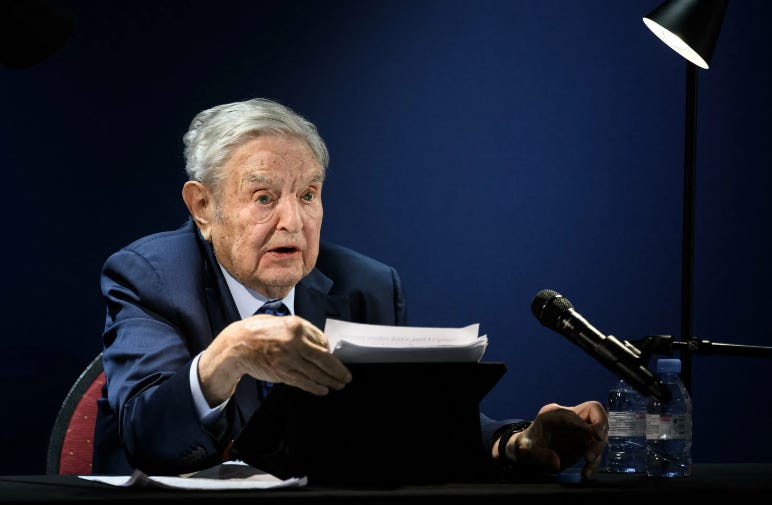
In his address to the World Economic Forum gathering in Davos in May 2022 George Soros explained that we are witnessing a clash between two models of governance. This was only slightly misleading: models don’t wage war on one another; it is the stakeholders in these models that are fighting. Soros characterized the two opposing sides as “open societies,” vs. “closed societies,” where open societies are liberal democracies that respect human rights, and closed societies are autocracies.
But Soros’s “open” societies are in fact oligarchies concealed behind faux democratic facades. To believe Soros, we’d have to accept that the trillionaire oligarchs in charge of open societies are die-hard defenders of democracy and human rights, willing to shed blood and treasure in their defense.
This war is as old as fractional reserve banking
But the notion that the conflict is between “two governance models” is not new: it is as old as the oldest forms of fractional reserve banking. Abraham Lincoln‘s chief economic advisor Henry C. Carey characterized it a bit better than George Soros. In his 1851 work, “The Harmony of Interests.” Carey wrote as follows:
“Two systems are before the world; the one looks to increasing the proportion of persons and of capital engaged in trade and transportation, and therefore to diminishing the proportion engaged in producing commodities with which to trade, with necessarily diminished return to the labour of all; while the other looks to increasing the proportion engaged in the work of production, and diminishing that engaged in trade and transportation, with increased return to all, giving the labourer good wages, and to the owner of capital good profits.
One looks to increasing the quantity of raw materials to be exported, and diminishing the inducements to imports of men, thus impoverishing both farmer and planter by throwing on them the burden of freight; while the other looks to increasing the import of men and diminishing the export of raw materials, thereby enriching both planter and farmer by relieving them from payment of freight.
One looks to giving the (products) of millions of acres of land and of the labour of millions of men for the (services) of hundreds of thousands of distant men; the other to bringing the distant men to consume on the land the products of the land, exchanging day’s labour for day’s labour.
One looks to compelling the farmers and planters of the Union to continue their contributions for the support of the fleets and the armies, the paupers, the nobles and the sovereigns of Europe; the other to enabling ourselves to apply the same means to the moral and intellectual improvement of the sovereigns of America.
One looks to the continuance of that freedom of trade which denies the principle of protection, yet doles it out as revenue duties; the other by extending the area of legitimate free trade by the establishment of perfect protection, followed by the annexation of individuals and communities, and ultimately by the abolition of customs-houses.
One looks to exporting men to occupy desert tracts, the sovereignty of which is obtained by aid of diplomacy or war; the other to increasing the value of an immense extent of vacant land by importing men by millions for their occupation.
One looks to the centralization of wealth and power in a great commercial city that shall rival the great cities of modern times which have been and are being supported by aid of contributions which have exhausted every nation subjected to them; the other to concentration, by aid of which a market shall be made upon the land for the products of the land, and the farmer and planter be enriched.
One looks to increasing the necessity of commerce; the other to increasing the power to maintain it.
One looks to underworking the Hindoo, and sinking the rest of the world to his level; the other to raising the standard of man throughout the world to our level.
One looks towards universal war; the other towards universal peace.
One is the English system; the other we may be proud to call the American system, for it is the only one ever devised the tendency of which was that of elevating while equalizing the condition of man throughout the world.”
Now, if you are like me, and perhaps you studied economics and history, you know about Adam Smith and John Maynard Keynes, but you probably never heard of Henry C. Carey. I am grateful to Cynthia Chung and Matthew Ehret for bringing Carey’s work to my attention through their invaluable research. If ever you read Carey’s biography, you might wonder why one of the most important economists of his age dropped out of the curriculum.
Well, the total global war is the reason. Namely, the proponents of the “open society” governance model would prefer it if you didn’t know about Henry Carey or about the American system which had turned the United States from a number of British Empire’s disjointed colonies into the world’s most prosperous and most powerful nation. In Lincoln’s days, the United States was known as a nation of readers, many of whom understood clearly what they were up against.
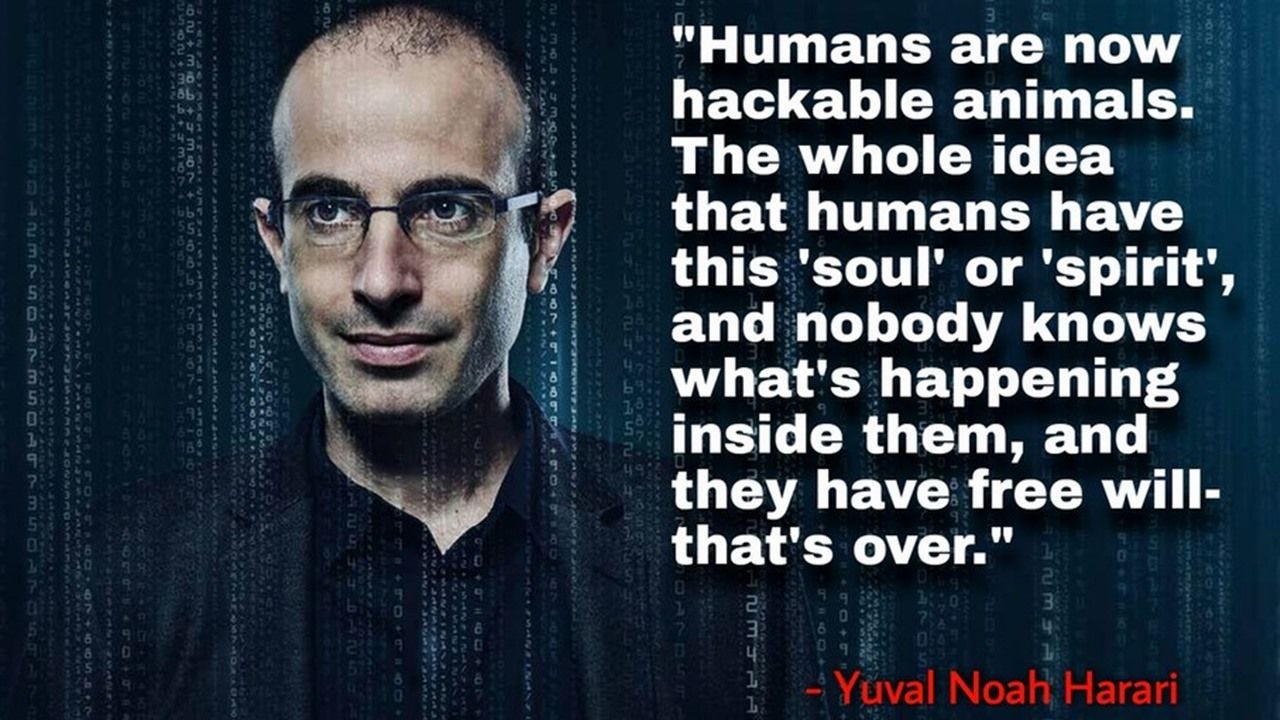
The rise of the United States in fact became such a threat to the British Empire that it orchestrated a civil war in order to break the Union into two smaller, weaker client states that could be set one against one another and kept weak and easily dominated. Empires do not suffer rivals and prefer that the earth be covered by uneducated and disorganized masses whose sole worth would be as a source of cheap, or preferably free labor used to extract their countries’ resource wealth and transfer it to “the nobles and sovereigns of Europe.” These would be the very stakeholders of George Soros’ open societies, who congregate in Davos and fantasize about turning the whole of humanity into a flock of “hackable animals” with no free will.
Even if the shooting war is raging in Ukraine, the United States remains the central battlefield in this total war. The people of the US are under a seemingly unrelated barrage of attacks that have escalated for several decades now and are almost too many to enumerate, but their effects include a sustained decline in living standards, progressive collapse of the nation’s infrastructure, loss of freedoms and permanent warfare. And yes, Americans are dying, only not exactly in trenches:
They already lost!
But the occult oligarchy behind the open societies has already lost their global war. They predicated their plans on achieving total domination of the whole world. The emergence of a multi-polar order entirely collapses their plans. How can you force everyone to rely on windmills and solar panels if your rivals are happily burning oil and gas and running their steel-producing furnaces? Without steel, you can’t build modern weapons. How can you coerce the “hackable animals” to subsist on insects if people in closed societies enjoy traditional foods? How do you force 7 or 8 billion people to take up your vaccines and carry vaccine passes if other nations opt for your rivals’ vaccines? That ship had sailed – it simply cannot be done.
Raising a new Iron Curtain
The only consolation prize available to the occult oligarchy now is to carve out a geopolitical block, break all ties with the closed societies and implement their plans within a new iron curtain. Then perhaps, the open societies could regroup and rebuild their military strength (not with solar panels) for another attempt at world domination in the future.
This new iron curtain would most likely encompass the UK, Canada, Australia, New Zealand and parts of continental Europe. But the block’s viability will depend on whether it can also include the United States which remains an extremely tough nut to crack. The uncontrolled migrations, attack on states’ rights, and the all-out assault of the Bill of Rights, including the periodic mass shootings, are all occult oligarchy’s attempts to crack it. It is all part of the total global war.
Like Henry Carey, those who understood the nature of this conflict knew that the ultimate showdown was coming. In addressing the American people, Ernesto Che Guevara invoked the coming clash: “I envy you. You North Americans are very lucky. You are fighting the most important fight of all – you live in the belly of the beast.” Che got many things wrong, but I believe he did get that part right.
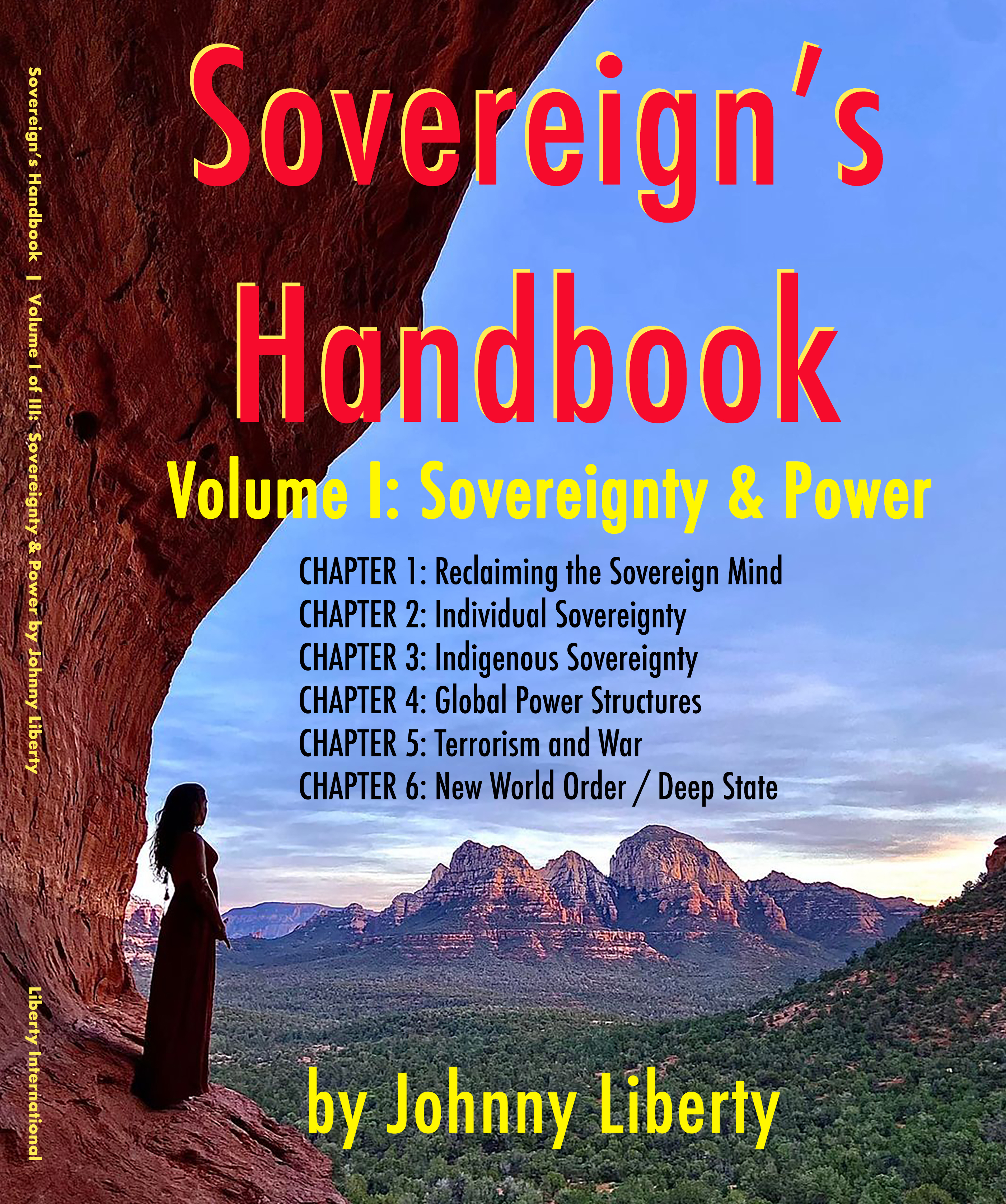
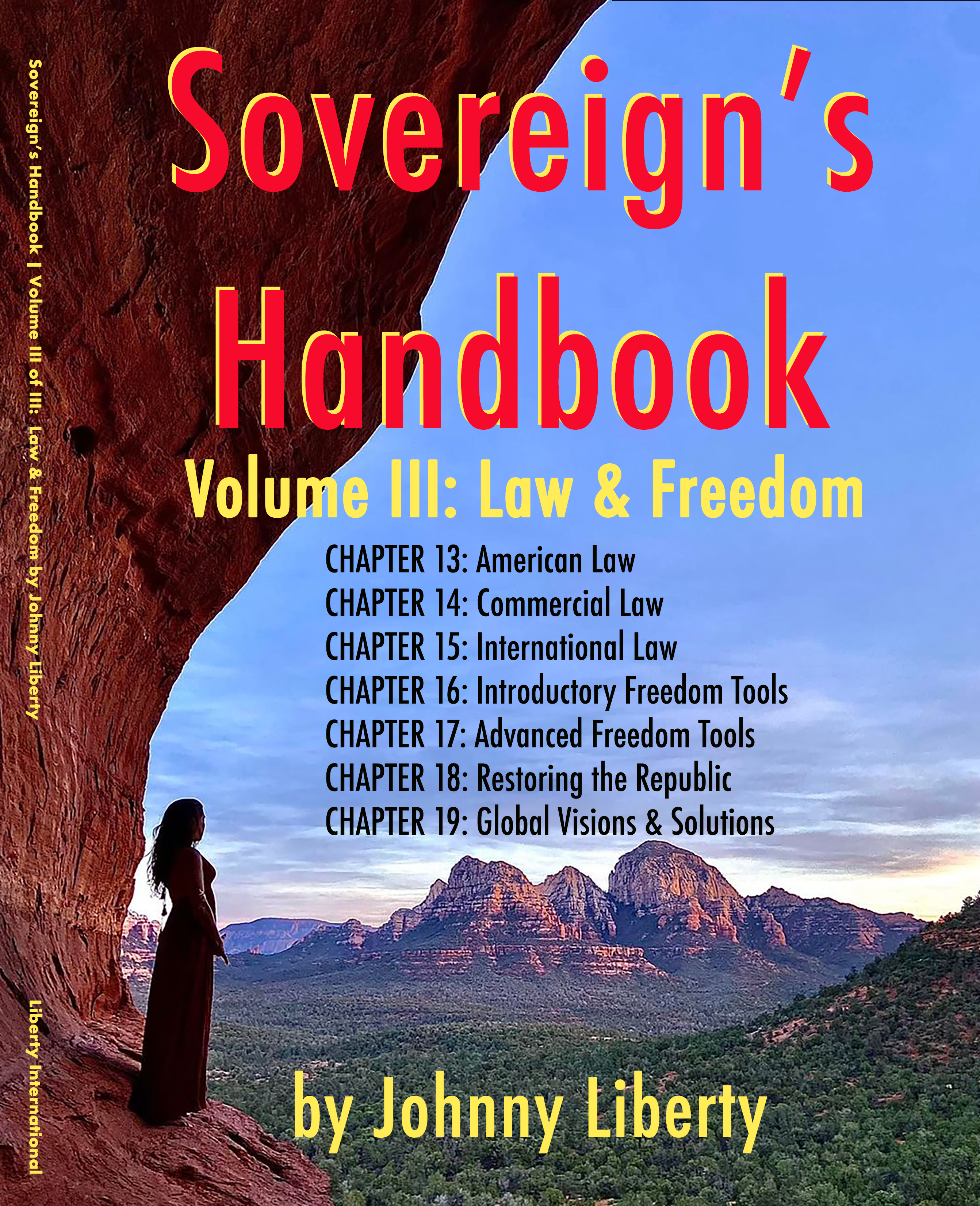
Sovereign’s Handbook by Johnny Liberty (30th Anniversary Edition) (3-Volume Printed, Bound Book or PDF)
A three-volume, 750+ page tome with an extensive update of the renowned underground classic ~ the Global Sovereign’s Handbook. Still after all these years, this is the most comprehensive book on sovereignty, economics, law, power structures and history ever written. Served as the primary research behind the best-selling Global One Audio Course. Available Now!
Dawning of the Corona Age: Navigating the Pandemic by Johnny Freedom (3rd Edition) (Printed, Bound Book or PDF)
This comprehensive book, goes far beyond the immediate impact of the “pandemic”, but, along with the reader, imagines how our human world may be altered, both positively and negatively, long into an uncertain future. Available Now!
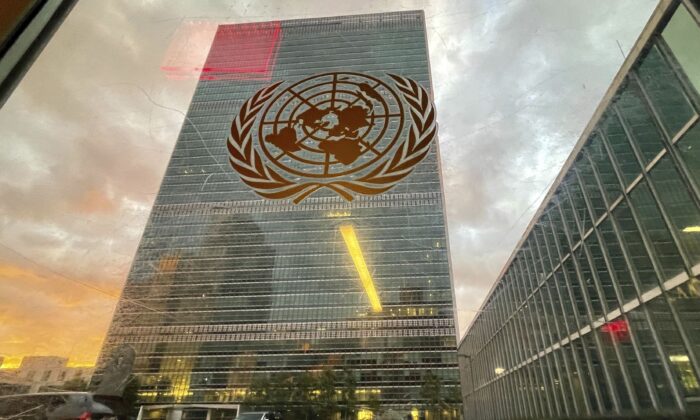
The United Nations headquarters building is seen from inside the General Assembly hall, Tuesday, Sept. 21, 2021, during the 76th Session of the U.N. General Assembly in New York. (Eduardo Munoz/Pool Photo via AP)
By Nathan Worcester
The war between states and banks over environmental, social, and governance (ESG) investing and similar practices has reached the doorstep of the U.N. A total of 19 state attorneys general have launched investigations of major financial institutions’ commitment to the U.N.-convened Net-Zero Banking Alliance.
The alliance’s website states that its members control roughly 40 percent of the world’s banking assets and are “committed to aligning their lending and investment portfolios with net-zero emissions by 2050.”
“The Net-Zero Banking Alliance is a massive worldwide agreement by major banking institutions, overseen by the U.N., to starve companies engaged in fossil fuel-related activities of credit on national and international markets,” Missouri Attorney General Eric Schmitt said in a statement regarding the investigations.
A May statement from the alliance states that it “does not support the financing of fossil fuel expansion” but notes that it “believes that immediate divestment from existing fossil fuel positions will not necessarily bring about the required real economy decarbonization that the world needs.”
“We are leading a coalition investigating banks for ceding authority to the U.N., which will only result in the killing of American companies that don’t subscribe to the woke climate agenda. These banks are accountable to American laws–we don’t let international bodies set the standards for our businesses,” Schmitt said.
Arizona, Arkansas, Indiana, Kansas, Kentucky, Louisiana, Mississippi, Montana, Nebraska, Oklahoma, Tennessee, Texas, and Virginia are among the states now investigating the banks through a powerful tool known as a civil investigative demand.
One demand encompasses the following requests: “Describe Your involvement in each Global Climate Initiative in which You participate, including the date You first began participating; any promises, pledges, or other commitments You made to the Global Climate Initiative; or any actions You made or took pursuant to, or consistent with, such commitments, or Your initial or on-going participation, and the employee(s) responsible for managing Your relationship with each Global Climate Initiative.”
Schmitt’s announcement is the latest salvo in a long-running conflict between major financial institutions and individual U.S. states regarding ESG.
State treasurers, such as West Virginia’s Riley Moore, have sought to move their state’s money from financial institutions that follow ESG principles.
Will Hild, executive director of Consumers’ Research, praised the investigations.
“States are holding big banks accountable for obvious violations and for peddling highly questionable climate initiatives under the label of ESG—all part of a coordinated effort to handicap American energy at the expense of U.S. consumers,” Hild said in a statement regarding the investigations.
On the other side of the coin, environmental groups have criticized the U.N.’s alliance for accommodating financial institutions that they believe haven’t gone far enough in divesting from coal, oil, and natural gas.
“It’s time for the NZBA [Net-Zero Banking Alliance] to make clear that banks who continue to finance massive fossil fuel expansion while making grand pronouncements about climate goals are not welcome in the alliance,” said Adele Shraiman of the Sierra Club’s Fossil-Free Finance campaign at Climate Week NYC, Reuters reported.
The Epoch Times reached out to Bank of America, Citigroup, Goldman Sachs, JP Morgan Chase, Morgan Stanley, and Wells Fargo for comment. JP Morgan Chase declined to comment. None of the other banks responded by press time.
Sovereign’s Handbook by Johnny Liberty (30th Anniversary Edition) (3-Volume Printed, Bound Book or PDF)
A three-volume, 750+ page tome with an extensive update of the renowned underground classic ~ the Global Sovereign’s Handbook. Still after all these years, this is the most comprehensive book on sovereignty, economics, law, power structures and history ever written. Served as the primary research behind the best-selling Global One Audio Course. Available Now!
Dawning of the Corona Age: Navigating the Pandemic by Johnny Freedom (3rd Edition) (Printed, Bound Book or PDF)
This comprehensive book, goes far beyond the immediate impact of the “pandemic”, but, along with the reader, imagines how our human world may be altered, both positively and negatively, long into an uncertain future. Available Now!
If you have ever heard talk or been to a seminar about “sovereignty”, then very likely those conversations were influenced by the foundational research of the author and educator.
His research and educational journey reaching millions of people worldwide began in 1992 and culminated in 2022 with the 3-Volume book release – his final word on the subject.
At the turn of the millennium his books and audio courses facilitated in part – a sovereignty and tax-honesty movement that involved millions of Americans.
This 3 Volume series comprises the life’s work of Johnny Liberty filled with comprehensive insights into the last few hundred years of history, law, economics, money, citizenship and governance.
These books show how it is supposed to be done in a constitutional Republic.
How did We the People get to where we are today?
What can we do to reclaim our inherent sovereignty and natural rights?
Many of the answers may be found within these revolutionary pages. Available as a paperback, E-Book (PDF) or an Amazon Kindle format. Thank you for supporting the author.
Sincerely,
With Freedom For All, ~ Johnny Liberty
Sovereign’s Handbook by Johnny Liberty (30th Anniversary Edition)
A three-volume, 750 page tome with an extensive update of the renowned underground classic ~ the Global Sovereign’s Handbook.
Still after all these years, it is the most comprehensive book on sovereignty, economics, law, power structures and history ever written.
Served as the primary research behind the best-selling Global One Audio Course.
The 3 Volume Sovereign’s Handbook by Johnny Liberty is textbook material for everyone including educators/teachers, homeschoolers, historians, activists, leaders/politicians, attorneys/judges/law schools, police officers, and state Citizens/Nationals.
Sovereign’s Handbook by Johnny Liberty (30th Anniversary Edition) (3-Volume Printed, Bound Book or PDF)
A three-volume, 750+ page tome with an extensive update of the renowned underground classic ~ the Global Sovereign’s Handbook. Still after all these years, this is the most comprehensive book on sovereignty, economics, law, power structures and history ever written. Served as the primary research behind the best-selling Global One Audio Course. Available Now!
Dawning of the Corona Age: Navigating the Pandemic by Johnny Freedom (3rd Edition) (Printed, Bound Book or PDF)
This comprehensive book, goes far beyond the immediate impact of the “pandemic”, but, along with the reader, imagines how our human world may be altered, both positively and negatively, long into an uncertain future. Available Now!
When asked if a United States CBDC would be used to control how, when and where the population spends their money, a senior vice president for the St. Louis Fed’s Research Division responded, “in life, one can’t give absolute assurance of anything…The best we can hope for, is for Congress to respond to the electorate’s concerns about privacy.” However, signals by the Biden regime and the Federal Reserve indicate they intend to move forward on a CBDC, regardless of any approval from Congress, industry leaders or the public. In fact, there are a growing number of research and pilot programs in various phases of development in America and around the world, despite public concerns of an impending digital currency enslavement system tied to a digital ID and social credit system.
The Biden Regime Presses Forward
On March 9, 2022, the Biden regime issued an Executive Order on ‘Ensuring Responsible Development of Digital Assets,’ which placed “the highest urgency on research and development efforts into the potential design and deployment options of a United States CBDC.” The EO commanded Attorney General Garland, Treasury Secretary Yellen, and Federal Reserve Chair Powell to determine if a legal path to bypass Congress is possible, stating, “within 180 days of the date of this order [by September 5, 2022], provide the President…an assessment of whether legislative changes would be necessary to issue a United States CBDC, should it be deemed appropriate and in the national interest.” The EO further directed them to provide the President with a legislative proposal within 210 days, by October 5, 2022.
A former Fed vice chair, Randal Quarles, remarked that any bill in Congress authorizing a CBDC would be unlikely to pass, noting a lack of support from the public. In July of 2021, lawmakers introduced legislation that has yet to pass, known as the ‘Digital Asset Market Structure and Investor Protection Act,‘ which appears to authorize the Fed to issue digital versions of Federal Reserve notes and to use distributed ledger technology for the “creation, distribution and recordation of all transactions involving digital Federal reserve notes.” On the other hand, legislation was introduced in January of 2022 to prohibit the Federal Reserve from issuing a CBDC directly to individuals. In March of 2022, legislatures proposed an alternative to CBDC in a bill known as the ‘ECASH Act‘, which proposes to develop an electronic version of the US dollar issued by the US Treasury instead of the Federal Reserve, and purports to imitate the privacy and anonymity features of cash. While there is no current federal statute mandating businesses to accept cash, lawmakers introduced the ‘Payment Choice Act of 2021‘, designed to require retail businesses to accept cash as a form of payment. In all, Congress has introduced 50 bills on digital assets, blockchain, and CBDCs.
During a May 26, 2022, House Committee hearing, some lawmakers took issue with the Biden regime’s Executive Order and the ambiguity of the Federal Reserve’s comment in their January 2022 discussion paper, which states, “The Federal Reserve does not intend to proceed with issuance of a CBDC without clear support from the executive branch and from Congress, ideally in the form of a specific authorizing law.” Representative Andy Barr commented, “This to me suggests that the administration is not yet convinced that Congress has a role here.” Lawmakers were unable to seek clarity from the vice chair of the Federal Reserve during the hearing on whether the Fed would in fact proceed with the issuance of a CBDC without official Congressional authorization.
Other issues raised in the House Committee hearing on CBDCs included risks to the public of mass surveillance and targeting of citizens who are critical of the regime. Representative Warren Davidson remarked to the Fed vice chair, “The concern is the surveillance state… If you turn the Central Bank Digital Currency into this creepy surveillance tool…it literally is what China is developing and we shouldn’t imitate them. We should protect America’s way of life.” The threat of adopting China’s model for surveillance and control has become even more apparent in recent days, as China thwarted attempts by protesters to access their frozen funds by turning their QR codes red. Representative John Rose addressed his concerns to the vice chair, adding, “We saw how dangerous it can be when the government weaponizes the financial system for political purposes under the Obama Administration’s Operation Choke Point. More recently, the Canadian government instructed banks to freeze accounts linked to the trucker protests over vaccine mandates…Without appropriate safeguards, would a CBDC make it easier for the federal government to block individuals it disagrees with from accessing the financial system?” Vice Chair Brainard did not deny that CBDCs could be used to block access of individuals, stating that the use of CBDCs would essentially be no different from the current banking systems, from which accounts of political dissidents have been frozen.
Legislatures aren’t the only ones concerned about the rise of the CBDC surveillance system. Both the public and shareholders were invited to submit comments on the Federal Reserve’s plans to issue a CBDC, many of whom were resolutely opposed to the idea. One citizen wrote, “You don’t want privacy. You want to control every aspect of our lives.” Another individual replied, “I do not want government in charge of access to the kill switch to my account/money if I do not ‘tow the line.'” Yet another responded, “Stop playing games with our lives. And ignore Klaus Schwab. I fear the system completely breaking down if CBDC is enacted. Because Americans want privacy, freedom, and their work rewarded with sound money.”
In response to the Fed paper on CBDCs, the American Bankers Association warned how the disbursement of a CBDC would devastate local banks, stating, “The issuance of a CBDC would fundamentally rewire our banking and financial system by changing the relationship between citizens and the Federal Reserve,” adding, “The risks associated with issuing a CBDC are often downplayed but are real and likely to undermine any possible benefit that a CBDC would have. Most importantly, every construction of CBDC requires moving funds from banks to the Federal Reserve.” The ABA concluded, “As we have evaluated the likely impacts of issuing a CBDC it has become clear that the purported benefits of a CBDC are uncertain and unlikely to be realized, while the costs are real and acute. Based on this analysis, we do not see a compelling case for a CBDC in the United States today.”
Despite numerous dissenting voices among Congress, industry leaders and the public, the Biden regime and the Federal Reserve are pressing forward with plans to develop a United States CBDC. The Fed released yet another paper on the issuance of a retail CBDC in April of 2022. On June 17,2022, Fed Chair Powell lamented the decline of the US dollar as the world’s reserve currency (driven by reckless federal spending and intentional mismanagement) and looked to a United States CBDC as a solution to the problems they’ve created, stating, “Looking forward, rapid changes are taking place in the global monetary system that may affect the international role of the dollar in the future. Most major economies already have or are in the process of developing instant, 24/7 payments. Our own FedNow Service will be coming online in 2023. And in light of the tremendous growth in crypto-assets and stablecoins, we are examining whether a US central bank digital currency would improve upon what is an already safe and efficient domestic payments system. As our white paper on this topic notes, a U.S. CBDC could also potentially help maintain the dollar’s international standing.”
There are a multitude of research and development programs for CBDCs underway. Currently, 105 countries, which represent more than 95% of the global GDP, are in various phases of CBDC exploration. Approximately 50 countries are in the advanced phases of research and development, while 28 retail CBDC pilots and 3 live retail CBDCs have been implemented. A study of 81 central banks determined that 90% are currently researching CBDCs, and over half are in the developmental or experimental phases. Several key areas of CBDC exploration are highlighted below.
China’s CBDC pilot program continues to expand since the announcement of its launch in 2020, gaining 261 million digital wallets opened in 2021. The Chinese government has extended the program to include more regions and applications. As China’s CBDC pilot program expands, so do their surveillance capabilities of Chinese citizens, multinational corporations, and other consumers around the world. On May 25, 2022, Senators introduced a bill known as the ‘Defending Americans from Authoritarian Digital Currencies Act,’ to prohibit app platforms, such as Apple and Google, from hosting apps that accept China’s digital currency. Senator Tom Cotton commented that the digital currency will provide the Chinese government with “real-time visibility into all transactions on the network, posing privacy and security concerns for American persons who join this network,” adding, “The Chinese Communist Party will use its digital currency to control and spy on anyone who uses it. We can’t give China that chance.” On June 7, 2022, lawmakers introduced a bill in the Senate known as the ‘Responsible Financial Innovation Act,’ to regulate crypto and to direct several agencies including: CISA, ODNI, and the DoD to investigate the national security implications of the use of China’s CBDC.
United States & Project Hamilton
The Federal Reserve Bank of Boston and MIT Digital Currency Initiative are collaborating on a CBDC exploratory project known as ‘Project Hamilton.’ The first phase of the operation was completed, demonstrating the feasibility of a CBDC payment system similar to the scale of the US economy and the US dollar’s utilization globally. Phase 2 of the project will focus on security, programmability, “how to balance privacy with compliance,” and safeguards against cyber-attacks. Critics argue that a United States CBDC does not address the issues of cybersecurity, government abuse, privacy, and centralized control. Congressman Tom Emmer commented, “Not only would this CBDC model centralize Americans’ financial information, leaving it vulnerable to attack, but it could also be used as a surveillance tool that Americans should never tolerate from their own government,” adding that, “Requiring users to open up an account at the Fed to access a US CBDC would put the Fed on an insidious path akin to China’s digital authoritarianism.” Laying the foundation for their CBDC program, the Fed has developed “a new instant payment infrastructure” known as FedNow. The new digital interbank instant payment system is expected to launch in 2023.
The investigation phase of the Digital Euro Project began in October of 2021 and will be completed by October of 2023. As part of the investigation phase, the European Central Bank has solicited public feedback. The ECB received 8,200 public responses, a record number of participants in the survey that ended in January of 2021. The feedback from this consultation provided a clear mandate, with the majority of respondents confirming that the public wants “payments to remain a private matter.” The ECB again solicited public feedback in a survey that ended in June of 2022, which received well more than double the number of responses as the previous survey. Once again, the public survey determined an overwhelming rejection of “digital slavery,” from a CBDC “slavecoin.” One respondent wrote, “No to the digital Euro! Living in the EU is becoming a nightmare, with forced vaccinations on the horizon, and now a digital Euro. It is clear that you want to have a population with no rights and no privacy – as wanted by your overlords of the WEF.” Despite the crushing negative public responsesto a CBDC over privacy concerns, the European Central Bank is moving forward with their plans. European Commissioner Paolo Gentiloni remarked to the press that, “A completely anonymous digital euro is not desirable.” A digital euro prototype is expected to launch in late 2023.
International CBDC Projects
While central banks are exploring and developing their own CBDCs, there are a number of collaborative projects to coordinate the exchange of CBDCs globally. Between 2017 and 2019, the Bank of Canada completed a four-phased program known as Project Jasper, in coordination with the Bank of England and Monetary Authority of Singapore. The project marked, “the first time in the world that a central bank participated in a distributed ledger technology experiment in partnership with the private sector.” The Saudi Central Bank and Central Bank of the UAE announced their joint initiative known as Project Aber in January of 2019, which included the involvement of commercial banks and businesses, and aimed to develop a CBDC that could be used between commercial banks across borders.
In December of 2020, the first phase of Project Helvetia, a partnership between the Bank for International Settlements, the Swiss National Bank, and a financial infrastructure company known as SIX, was completed. Phase 2 of the project, which was completed in January of 2022, focused on integrating commercial banks and CBDCs.
In December of 2021, the Bank for International Settlements announced the conclusion of Project Jura, an experiment in transferring CBDCs between French and Swiss commercial banks on a shared third-party platform. The joint operation, designed to continue the experimentation done under Project Helvetia, included the Bank for International Settlements, the Bank of France and the Swiss National Bank.
In September of 2021, China, Thailand, Hong Kong, the UAE and the Bank for International Settlements released a report on the second phase of their mBridge Project, which included the participation of 22 private sector participants. The project aims to develop a platform for international trade using CBDCs. Also in September of 2021, the Bank for International Settlements announced Project Dunbar, in collaboration with Australia, Malaysia, Singapore, and South Africa. A report released in March of 2022 outlined how the project has developed two prototypes that enable CBDCs issued by multiple banks to use a shared platform.
On June 16, 2022, the Bank for International Settlements announced a partnership on Project Sela, including the Bank of Israel and the Hong Kong Monetary Authority. The joint project, which kicks off in the third quarter of 2022, aims to test the feasibility of a retail CBDC.
In September of 2020, Mastercard announced the launch of their CBDCs testing platform for central banks to simulate the “issuance, distribution and exchange of CBDCs between banks, financial service providers and consumers.” In January of 2022, Visa joined Mastercard in offering central banks a platform to test CBDCs and Visa products. More projects to develop CBDCs can be found on the BIS Innovation Hub.
In summary, the broad range of CBDC research and development projects across the globe is immense. Joint operations across borders are paving the way for international exchange of CBDCs, and ultimately a single global digital currency as promoted by the World Economic Forum.
The development and implementation of CBDCs in America and around the world is moving forward, with a multitude of projects underway and many of those projects coming to fruition within months. Central banks and global powers seem undeterred by objections from their citizens or the indecisiveness of Congress. Though there are numerous models for implementing CBDCs, they all share the same risks to our freedom. Lack of anonymity, programmability, tracking, and centralized control are the key features of CBDCs, which will enable subjugation of the masses in the most extreme ways imaginable.
The enormity of this all-encompassing initiative to implement CBDCs around the world is daunting. It seems inevitable that this end-game system of global totalitarianism will become a reality. However, we must be encouraged that the people are becoming aware of the true agenda behind this financial takeover. Their digital control system depends on our submission, and we each have the choice to not comply. By removing ourselves from the system and using cash instead of their digital wallets and debit cards, we can starve this rising beast of data and banking fees. Only together, in mass noncompliance, will their plans for digital enslavement become unrealized.
No country has successfully challenged the U.S. dollar’s global hegemony—until now. How did this happen and what will it mean?
Foreign critics have long chafed at the “exorbitant privilege” of the U.S. dollar as global reserve currency. The U.S. can issue this currency backed by nothing but the “full faith and credit of the United States.” Foreign governments, needing dollars, not only accept them in trade but buy U.S. securities with them, effectively funding the U.S. government and its foreign wars. But no government has been powerful enough to break that arrangement – until now. How did that happen and what will it mean for the U.S. and global economies?
The Rise and Fall of the PetroDollar
First, some history: The U.S. dollar was adopted as the global reserve currency at the Bretton Woods Conference in 1944, when the dollar was still backed by gold on global markets. The agreement was that gold and the dollar would be accepted interchangeably as global reserves, the dollars to be redeemable in gold on demand at $35 an ounce. Exchange rates of other currencies were fixed against the dollar.
But that deal was broken after President Lyndon Johnson’s “guns and butter” policy exhausted the U.S. kitty by funding war in Vietnam along with his “Great Society” social programs at home. French President Charles de Gaulle, suspecting the U.S. was running out of money, cashed in a major portion of France’s dollars for gold and threatened to cash in the rest; and other countries followed suit or threatened to.
In 1971, President Richard Nixon ended the convertibility of the dollar to gold internationally (known as “closing the gold window”), in order to avoid draining U.S. gold reserves. The value of the dollar then plummeted relative to other currencies on global exchanges. To prop it up, Nixon and Secretary of State Henry Kissinger made a deal with Saudi Arabia and the OPEC countries that OPEC would sell oil only in dollars, and that the dollars would be deposited in Wall Street and City of London banks. In return, the U.S. would defend the OPEC countries militarily. Economic researcher William Engdahl also presents evidence of a promise that the price of oil would be quadrupled. An oil crisis triggered by a brief Middle Eastern war did cause the price of oil to quadruple, and the OPEC agreement was finalized in 1974.
The deal held firm until 2000, when Saddam Hussein broke it by selling Iraqi oil in euros. Libyan president Omar Qaddafi followed suit. Both presidents wound up assassinated, and their countries were decimated in war with the United States. Canadian researcher Matthew Ehret observes:
We should not forget that the Sudan-Libya-Egypt alliance under the combined leadership of Mubarak, Qadhafi and Bashir, had moved to establish a new gold-backed financial system outside of the IMF/World Bank to fund large scale development in Africa. Had this program not been undermined by a NATO-led destruction of Libya, the carving up of Sudan and regime change in Egypt, then the world would have seen the emergence of a major regional block of African states shaping their own destinies outside of the rigged game of Anglo-American controlled finance for the first time in history.
The Rise of the PetroRuble
The first challenge by a major power to what became known as the petrodollar has come in 2022. In the month after the Ukraine conflict began, the U.S. and its European allies imposed heavy financial sanctions on Russia in response to the illegal military invasion. The Western measures included freezing nearly half of the Russian central bank’s 640 billion U.S. dollars in financial reserves, expelling several of Russia’s largest banks from the SWIFT global payment system, imposing export controls aimed at limiting Russia’s access to advanced technologies, closing down their airspace and ports to Russian planes and ships, and instituting personal sanctions against senior Russian officials and high-profile tycoons. Worried Russians rushed to withdraw rubles from their banks, and the value of the ruble plunged on global markets just as the U.S. dollar had in the early 1970s.
The trust placed in the U.S. dollar as global reserve currency, backed by “the full faith and credit of the United States,” had finally been fully broken. RussianPresident Vladimir Putin said in a speech on March 16 that the U.S. and EU had defaulted on their obligations, and that freezing Russia’s reserves marks the end of the reliability of so-called first class assets. On March 23, Putin announced that Russia’s natural gas would be sold to “unfriendly countries” only in Russian rubles, rather than the euros or dollars currently used. Forty-eight nations are counted by Russia as “unfriendly,” including the United States, Britain, Ukraine, Switzerland, South Korea, Singapore, Norway, Canada and Japan.
Putin noted that more than half the global population remains “friendly” to Russia. Countries not voting to support the sanctions include two major powers – China and India – along with major oil producer Venezuela, Turkey, and other countries in the “Global South.” “Friendly” countries, said Putin, could now buy from Russia in various currencies.
On March 24, Russian lawmaker Pavel Zavalny said at a news conference that gas could be sold to the West for rubles or gold, and to “friendly” countries for either national currency or bitcoin.
Energy ministers from the G7 nations rejected Putin’s demand, claiming it violated gas contract terms requiring sale in euros or dollars. But on March 28, Kremlin spokesman Dmitry Peskov said Russia was “not engaged in charity” and won’t supply gas to Europe for free (which it would be doing if sales were in euros or dollars it cannot currently use in trade). Sanctions themselves are a breach of the agreement to honor the currencies on global markets.
Bloomberg reports that on March 30, Vyacheslav Volodin, speaker of the lower Russian house of parliament, suggested in a Telegram post that Russia may expand the list of commodities for which it demands payment from the West in rubles (or gold) to include grain, oil, metals and more. Russia’s economy is much smaller than that of the U.S. and the European Union, but Russia is a major global supplier of key commodities – including not just oil, natural gas and grains, but timber, fertilizers, nickel, titanium, palladium, coal, nitrogen, and rare earth metals used in the production of computer chips, electric vehicles and airplanes.
On April 2, Russian gas giant Gazprom officially halted all deliveries to Europe via the Yamal-Europe pipeline, a critical artery for European energy supplies.
U.K. professor of economics Richard Werner calls the Russian move a clever one – a replay of what the U.S. did in the 1970s. To get Russian commodities, “unfriendly” countries will have to buy rubles, driving up the value of the ruble on global exchanges just as the need for petrodollars propped up the U.S. dollar after 1974. Indeed, by March 30, the ruble had already risen to where it was a month earlier.
A Page Out of the “American System” Playbook
Russia is following the U.S. not just in hitching its national currency to sales of a critical commodity but in an earlier protocol – what 19th century American leaders called the “American System” of sovereign money and credit. Its three pillars were (a) federal subsidies for internal improvements and to nurture the nation’s fledgling industries, (b) tariffs to protect those industries, and (c) easy credit issued by a national bank.
Michael Hudson, a research professor of economics and author of “Super-Imperialism: The Economic Strategy of American Empire” among many other books, notes that the sanctions are forcing Russia to do what it has been reluctant to do itself – cut reliance on imports and develop its own industries and infrastructure. The effect, he says, is equivalent to that of protective tariffs. In an article titled “The American Empire Self-destructs,” Hudson writes of the Russian sanctions (which actually date back to 2014):
Russia had remained too enthralled by free-market ideology to take steps to protect its own agriculture or industry. The United States provided the help that was needed by imposing domestic self-reliance on Russia (via sanctions). When the Baltic states lost the Russian market for cheese and other farm products, Russia quickly created its own cheese and dairy sector – while becoming the world’s leading grain exporter.
Russia is discovering (or is on the verge of discovering) that it does not need U.S. dollars as backing for the ruble’s exchange rate. Its central bank can create the rubles needed to pay domestic wages and finance capital formation. The U.S. confiscations thus may finally lead Russia to end neoliberal monetary philosophy, as Sergei Glaziev has long been advocating in favor of MMT [Modern Monetary Theory]. …
What foreign countries have not done for themselves – replacing the IMF, World Bank and other arms of U.S. diplomacy – American politicians are forcing them to do. Instead of European, Near Eastern and Global South countries breaking away out of their own calculation of their long-term economic interests, America is driving them away, as it has done with Russia and China.
Glazyev and the Eurasian Reset
Sergei Glazyev, mentioned by Hudson above, is a former adviser to President Vladimir Putin and the Minister for Integration and Macroeconomics of the Eurasia Economic Commission, the regulatory body of the Eurasian Economic Union (EAEU). He has proposed using tools similar to those of the “American System,” including converting the Central Bank of Russia to a “national bank” issuing Russia’s own currency and credit for internal development. On February 25, Glazyev published an analysis of U.S. sanctions titled “Sanctions and Sovereignty,” in which he stated:
[T]he damage caused by US financial sanctions is inextricably linked to the monetary policy of the Bank of Russia …. Its essence boils down to a tight binding of the ruble issue to export earnings, and the ruble exchange rate to the dollar. In fact, an artificial shortage of money is being created in the economy, and the strict policy of the Central Bank leads to an increase in the cost of lending, which kills business activity and hinders the development of infrastructure in the country.
Glazyev said that if the central bank replaced the loans withdrawn by its Western partners with its own loans, Russian credit capacity would greatly increase, preventing a decline in economic activity without creating inflation.
Russia has agreed to sell oil to India in India’s own sovereign currency, the rupee; to China in yuan; and to Turkey in lira. These national currencies can then be spent on the goods and services sold by those countries. Arguably, every country should be able to trade in global markets in its own sovereign currency; that is what a fiat currency is – a medium of exchange backed by the agreement of the people to accept it at value for their goods and services, backed by the “full faith and credit” of the nation.
But that sort of global barter system would break down just as local barter systems do, if one party to the trade did not want the goods or services of the other party. In that case, some intermediate reserve currency would be necessary to serve as a medium of exchange.
Glazyev and his counterparts are working on that. In a translated interview posted on The Saker, Glazyev stated:
We are currently working on a draft international agreement on the introduction of a new world settlement currency, pegged to the national currencies of the participating countries and to exchange-traded goods that determine real values. We won’t need American and European banks. A new payment system based on modern digital technologies with a blockchain is developing in the world, where banks are losing their importance.
Russia and China have both developed alternatives to the SWIFT messaging system from which certain Russian banks have been blocked. London-based commentator Alexander Mercouris makes the interesting observation that going outside SWIFT means Western banks cannot track Russian and Chinese trades.
It was a long time coming, but finally some key lineaments of the multipolar world’s new foundations are being revealed.
On Friday [March 11], after a videoconference meeting, the Eurasian Economic Union (EAEU) and China agreed to design the mechanism for an independent international monetary and financial system. The EAEU consists of Russia, Kazakhstan, Kyrgyzstan, Belarus and Armenia, is establishing free trade deals with other Eurasian nations, and is progressively interconnecting with the Chinese Belt and Road Initiative (BRI).
For all practical purposes, the idea comes from Sergei Glazyev, Russia’s foremost independent economist ….
Quite diplomatically, Glazyev attributed the fruition of the idea to “the common challenges and risks associated with the global economic slowdown and restrictive measures against the EAEU states and China.”
Translation: as China is as much a Eurasian power as Russia, they need to coordinate their strategies to bypass the US unipolar system.
The Eurasian system will be based on “a new international currency,” most probably with the yuan as reference, calculated as an index of the national currencies of the participating countries, as well as commodity prices. …
The Eurasian system is bound to become a serious alternative to the US dollar, as the EAEU may attract not only nations that have joined BRI … but also the leading players in the Shanghai Cooperation Organization (SCO) as well as ASEAN. West Asian actors – Iran, Iraq, Syria, Lebanon – will be inevitably interested.
Exorbitant Privilege or Exorbitant Burden?
If that system succeeds, what will the effect be on the U.S. economy? Investment strategist Lynn Alden writes in a detailed analysis titled “The Fraying of the US Global Currency Reserve System” that there will be short-term pain, but, in the long run, it will benefit the U.S. economy. The subject is complicated, but the bottom line is that reserve currency dominance has resulted in the destruction of our manufacturing base and the buildup of a massive federal debt. Sharing the reserve currency load would have the effect that sanctions are having on the Russian economy – nurturing domestic industries as a tariff would, allowing the American manufacturing base to be rebuilt.
Other commentators also say that being the sole global reserve currency is less an exorbitant privilege than an exorbitant burden. Losing that status would not end the importance of the U.S. dollar, which is too heavily embedded in global finance to be dislodged. But it could well mean the end of the petrodollar as sole global reserve currency, and the end of the devastating petroleum wars it has funded to maintain its dominance.


 Liberty International News