The People Can Handle The Truth About Unemployment and Inflation by Ron Paul

Ron Paul tells the Joint Economic Committee that the people can handle the truth about unemployment and inflation numbers. Real unemployment is at 22% and real inflation is at 6% according to the original method of measuring the CPI.

Source: Ron Paul

HR 1207 – Audit the Federal Reserve

Editor’s Note: Has this video has been removed due to term of service violation OR censored?

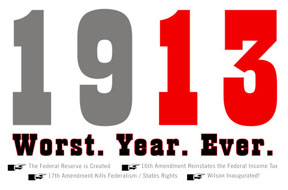
The Federal Reserve is the chief culprit behind the economic crisis. Its unchecked power to create endless amounts of money out of thin air brought us the boom and bust cycle and causes one financial bubble after another. Since the Fed’s creation in 1913 the dollar has lost more than 96% of its value, and by recklessly inflating the money supply the Fed continues to distort interest rates and intentionally erodes the value of the dollar.

For the past 30 years, Congressman Ron Paul has worked tirelessly to bring much-needed transparency and accountability to the secretive bank. And in 2009 his unfaltering dedication showed astonishing results: HR 1207, the bill to audit the Federal Reserve, swept the country and made the central bankers shudder at their desks. The bill passed as an amendment both in the House Financial Services Committee and in the House itself.

But the usurpers of America’s future didn’t take it lying down. They weren’t about to allow their secrets to be exposed and their magic money machine to be put under close scrutiny. They worked frantically behind the scenes to quietly derail all efforts to open up the Federal Reserve to an independent audit.

A handful of Fed-loving U.S. senators led by Chris Dodd rewrote the Senate version of the Financial Reform Bill to strip out Ron Paul’s Audit the Fed amendment and actually expand the Fed’s power over banks, lending and money. As Alan Grayson pointed out here, and Ron Paul commented on here, the Dodd bill completely eliminated legislation to audit the Federal Reserve, which already passed in the House.

Sen. Bernie Sanders (I-Vt.) introduced an amendment on the floor effectively adding the Grayson-Paul language to the Senate bill, but later changed his amendment under pressure by the Federal Reserve and the Obama administration. The altered Sanders amendment passed the Senate on May 11, 2010 by a unanimous 96-0 vote.

Sen. Vitter reintroduced an amendment with the original Audit the Fed language. The Senate rejected the amendment on May 11, 2010 by a 37-62 vote.

The House and Senate went to the conference committee which attempted to reconcile the differences between the two bills (and their amendments). Unfortunately, Ron Paul’s tough language ended up not being included in the final bill.

On June 30, 2010, the GOP introduced Ron Paul’s Audit the Fed bill as a motion to recommit, which was the last chance to alter the financial regulation bill. Audit the Fed failed by a vote of 229-198. All Republicans voted in favor of the measure with 23 Democrats crossing the aisle to vote with Republicans. 114 co-sponsors of HR 1207, all Democrats, jumped ship and voted against Audit the Fed. Read more…

Source: Ron Paul

US Federal Reserve Dealing in Magic and Secrets | The International Forecaster

Fed makes money out of thin air to solve deflation with inflation, credit crisis continues, frustrations with politicians, not healthy to have over 3 trillion in t-bills held in foreign hands, Fed fights audit legislation, Threats to the Eurozone…

The dramatic and costly undertow of deflation continues unabated, as government via fiscal policy and the Federal Reserve, by creating money and credit out of thin air, proceed to overpower this deflation with massive inflation.

Unbeknownst to most the Fed and the Treasury have been maintaining this program for the past several years, accompanied by most major countries, all of which have taken the path of least resistance rather than address the underlying problems.

The current stage of problems had to be addressed 2-1/2 years ago in what has become known as a credit crisis. This continuing crisis has been accompanied by 22-1/8% current unemployment that has resulted in a perpetual fall in tax revenues and a resultant enlargement of government deficits. We might add that this condition is being experienced by many countries worldwide, which followed America’s leadership into this terrible financial and economic morass. These policies have led to massive sovereign debt policies, a hangover of the policies of 1933 and 1971.

The financial system in America is on the edge of default. A recent poll found that 92% of those surveyed wanted to unseat their current representative or Senator in Washington and only 21% believed that government enjoyed the consent of the governed. It’s very obvious people are not happy with the political, economic and financial situation presently. Eighty percent believe that government is enmeshed in partisan infighting. Not only between parties, but within parties as well. Politicians are very aware of these numbers and are frantic to get reelected. The public has recoiled in disgust. People are demanding that the power of government be curbed. People are sick and tired of paid off corrupt politicians, more than half of whom have been in office for more than ten years.

It is not healthy for a nation to have $3.3 trillion in Treasury bonds held by foreigners. China holds about $900 billion and Japan about $800 billion. We also understand that hedge funds and others also are fronting both countries, so the figures are not really reflective in their total positions. These nations for the most part are rolling their positions, but have not injected new capital into US Treasuries. That is why the Fed had to fund 80% of new Treasury debt last year.

Presently the Fed is fighting and pulling out all stops to halt legislation to audit the Federal Reserve, a private corporation, which has managed our monetary policy since 1913, under the Federal Reserve Act. On Monday the Treasury held a media conference for financial reporters and bloggers in which the Fed was discussed. The meeting had some very strange conditions. Mr. Geithner, Mr. Krueger and Mr. Sperling could be paraphrased but not quoted and what was paraphrased could not be connected to a specific official. Again, the element of secrecy to protect the guilty.

One blogger said, “Did they get the ground rules from Al Qaeda?” The meeting was a travesty. How can government officials demand secrecy in public briefings? It is no wonder that 90% of the public and 317 members of Congress want more Treasury transparency and an audit and investigation of the Fed. This is the same gang run by Geithner and Bernanke that are currently running the gold suppression scheme. When you have a criminal cabal involved you have no transparency. That is why the audit of the Fed is so important. Such an exercise would expose exactly what both have been doing in the markets.

The Fed and Treasury have lied for years about what they have been up too in behalf of their Illuminist friends. It is not only about the actions of the President’s Working Group on Financial Markets, but the funding of Watergate, Saddam Hussein, who they supposedly conveniently hung, the countries that secretly received loans, how much, who got them and what was the collateral? Were currency swaps with foreign control banks used to strengthen the dollar by the Fed and for those foreign control banks to purchase Treasury and Agency paper?

How about all the inside information funneled to Wall Street and banking for almost a century from both the Fed and Treasury? Their lies are legion. They both are manipulating every market in the world 24/7 and the American people want it stopped. We also want an audit of America’s gold and the testing of the gold bars held. There is much we want to know, so we can save our country and our freedom.

Investors continue to chase yields, which is a dumb practice. Interest rates are at 80-year lows and can only stay the same or rise. People are grabbing junk bond yields that will come back to haunt them.

At least for now Greece and euro problems are being shuffled into the background. You can imagine this is not the last of the eurozone problems. The PIIGS will be back one by one to cause never-ending problems until they are forced to leave the eurozone. That will cause a eurozone breakup, probably by the end of next year.

This is the first real threat to the eurozone since its beginning ten years ago, and we think they will find that their rules are so restrictive that weak members will be forced to leave. The monetary policy and interest rates may be singular, but fiscal policy is not. Exchange rates for the euro must fit all members, but rates and methods of growth vary widely. With one currency sovereignty has effectively been lost. Public debt to GDP has to be under 3%, while most are over 3%: Greece is at 10.7%.

There is also a public debt limit of 60% of GDP, which all nations in the zone have broken. All precepts have not and cannot be met. There is no effective policy because there is no way to enforce the rules. In addition most have current account deficits and the zone effectively has been carried by Germany from this aspect. The bottom line is a few have growth, the rest do not. As a result there is pressure, due to poor growth in some of the nations, for austerity measures to reduce fiscal deficits at the worst possible time. Greece comes first along with Ireland and the rest will follow.

Just as an example, Spain has a fiscal deficit of 10% of GDP that has to fall to 3% within three years, which is virtually impossible just as it is in Greece. Their current account deficit is 4.5% of GDP. In a recessionary/depressionary world getting into the plus column is a tall order. This dilemma is the result in part of the housing collapse caused by Spanish banks and inattention by the Bank for International Settlements. We see consumption continuing to fall in the face of 20% unemployment, which worsens by the day. The PIIGS and a present total of 19 nations are effectively bankrupt. We do not believe they can survive without devaluation and debt default. That is why we expect that to happen next year. Read more…

Source: International Forecaster

Campaigning for State-Owned Banks | War of Debt

By Ellen Brown

While bank bailouts fatten Wall Street, states continue to battle the credit crisis. In the search for innovative solutions, some political candidates are proposing that states generate their own credit by setting up their own banks.

State budgets for 2010 face the largest shortfalls on record, totaling $194 billion or 28 percent of state budgets; and 2011 is expected to be worse. Unemployment has already officially hit 10 percent, and many economists expect it to rise higher. Continued high unemployment will keep state income tax receipts at low levels and increase demand for Medicaid and other essential services states provide.

The existing alternatives are spending cuts or tax increases, but both will just serve to make the downturn deeper. When states cut spending, they lay off employees, cancel contracts with vendors, eliminate or lower payments to businesses and nonprofit organizations that provide direct services, and cut benefit payments to individuals. The result is a reduction in overall demand. Tax increases also remove demand, by reducing the amount of money people have to spend.  Read more…

Source: War of Debt

Wall Street’s 10 Greatest Lies of 2009 | AlterNet

By Nomi Prins

On December 13, President Obama declared that he was not elected to help the “fat cats.” But the cats got another version of that memo. A day later, 10 of them were supposed to partake in some White House face-time to talk about their responsibilities to the rest of the country, but only seven could make it. No-shows for the “very serious discussion” — due to inclement New York weather or being too busy with internal bonus discussions to bother with the President — were Goldman Sachs CEO Lloyd Blankfein, Morgan Stanley CEO John Mack and Citigroup Chairman Richard Parsons.

Yes, Obama inherited a big financial mess from the Bush administration – which inherited its set-up from the Clinton administration (financial recklessness, it turns out, is non-partisan) — but he and his appointees have spent the year talking about fighting risk and excess on Wall Street, while both have grown.

Treasury Secretary Tim Geithner patted himself on the back for making the “difficult and necessary” decisions of fronting Wall Street boatloads of money to cover its losses and capital crunch last fall. Federal Reserve Chairman Ben Bernanke (a Bush-Obama favorite) was named Time Magazine’s Person of the Year for saving the free world as we know it. And Congress is talking “sweeping reform” about a bill that leaves the banking landscape intact, save for some minor alterations. For starters, it doesn’t resurrect the Glass-Steagall Act of 1933, which separated risk-taking (once non-government-backed) investment banks from consumer oriented (government-supported) commercial banks.

Meanwhile, Wall Street is restructuring (the financial equivalent of re-gifting) old toxic assets into new ones, finding fresh ways to profit from credit derivatives trading, and paying itself record bonuses — on our dime. Despite recent TARP payback enthusiasm, the industry still floats on trillions of dollars of non-TARP subsidies and certain players wouldn’t even exist today without our help.

Wall Street’s return to robustness and Main Street’s continued deterioration are the main takeaways for 2009 that stemmed from the 2008 choices to flush the financial system with capital and leave the real economy to fend for itself. Lies that exacerbate this divide only perpetuate its growth. With that, here is my top 10 list of lies. Please consider adding your own, and let’s all hope for a more honest New Year.

1) The economy has improved.

Earlier this month, Bernanke declared, “Having faced the most serious financial crisis and the worst recession since the Great Depression, our economy has made important progress during the past year. Although the economic stress faced by many families and businesses remains intense, with job openings scarce and credit still hard to come by, the financial system and the economy have moved back from the brink of collapse.”

Sure, the economy is better — if you work at Goldman Sachs or had an affair with Tiger Woods. But while Bernanke, former Treasury Secretary Hank Paulson and Geithner turned the Federal Reserve into a national hedge fund (cheap money backing toxic assets in secrecy), and the Treasury Department into a bank insurance policy, the rest of the real economy took hit after hit — starting with jobs.

The national unemployment rate remains at double digits. Despite Washington’s bizarre euphoria about unemployment rates last month being better (they edged down in November to 10 percent from 10.2 percent in October), the number of Americans filing for initial unemployment insurance rose during the second week of December. After all the temporary holiday hires, that number will probably increase again. Plus, unemployment rates in 372 metropolitan areas are higher than they were last year.

2) If you give banks capital, they will lend it out.

On Jan. 13, 2009 Bernanke concluded that “More capital injections and guarantees may become necessary to ensure stability and the normalization of credit markets.” He said that “Our economic system is critically dependent on the free flow of credit.” He was referring to the big banks. Not the little people.

Ten months later, though, he admitted that, “Access to credit remains strained for borrowers who are particularly dependent on banks, such as households and small businesses” and that “bank lending has contracted sharply this year.”

In other words, big banks don’t share their good fortunes. Shocking. And as a result, bankruptcies are rapidly rising for businesses and individuals – a direct result of lack of credit coupled with other economic hardships like job losses.

Total bankruptcy filings for the first nine months of 2009 were up 35 percent to 1,100,035 vs. the same period in 2008. The number of business bankruptcies during the first three quarters of 2009 eclipsed all of 2008. Individual consumer filings totaled 373,308 during the third quarter of 2009 and were up 33 percent vs. the same period of 2008. Tell those people about the free flow of credit, Ben.

3) Taxpayers are being repaid.

On December 17, the Treasury Department announced: ”As a result of our efforts under EESA (the Emergency Economic Stabilization Act that spawned TARP), confidence in our financial system has improved, credit is flowing, and the economy is growing. The government is exiting from its emergency financial policies and taxpayers are being repaid.”

Even as banks rush to repay TARP in order to get the government off their backs before annual bonuses are set, the Treasury Department is helping them out. On December 11, the Internal Revenue Service gave government-subsidized banks a tax exemption that, for instance, allows Citigroup to keep the benefit of $38 billion. Three days later, Citigroup announced its $20 billion repayment of TARP. Get the math? Not exactly a taxpayer windfall.

Additionally, the FDIC gave banks including Citigroup, Bank of America, and JPMorgan Chase a holiday gift — at least a six-month break from having to raise capital to support the billions of dollars of securities (read: toxic assets – remember those?) that firms are going to have to add to their books in 2010. That will open a whole new can of worms – a glimpse into either insolvency and a replay from the too-big-to-fail scenario, or book-cooking (the Financial Accounting Standards Board, as of last year, has allowed banks to price their own assets if there’s no true market for them – fun times), or both. Meanwhile, banks can use the capital for bonus payments instead.

4) Homeowners are being helped.

Last year’s big lie was that banks would turn around and help their borrowers if they got federal money. Yet, they were under no obligation to do so, and thus, they didn’t.

Since the Obama administration released guidelines for the Home Affordable Modification Program (HAMP) on March 4, 2009, the HAMP permanent loan modification numbers have been anemic.

Separately, by almost every measure, mortgage and credit problems are worse this year than last. There were almost a million new foreclosure fillings in the third quarter of this year, 5 percent more than in the second quarter, and 23 percent more than during the third quarter of 2008.

Plus, foreclosures are not abating. Mortgage delinquencies (borrower 60 or more days overdue) increased for the 11th quarter in a row, reaching a national average record of 6.25 percent for the third quarter of 2009. Delinquencies precede foreclosures. Compared to last year, mortgage borrower delinquencies are up 58 percent. Meanwhile, banks are sitting on properties they acquired to avoid selling them into the market and having to book the resultant loss.

5) Big banks will help small businesses.

On October 24, because a whole year had passed without this happening, Obama declared, “It’s time for our banks to stand by creditworthy small businesses and make the loans they need to open their doors, grow their operations and create new jobs.”

Small businesses, which employ half of all private sector employees, had received less than $400 million in new loans under government programs, and were granted access to just one program that buys up to $15 billion in securities tied to small business loans. According to the Small Business Administration (SBA) the number of approved loans shrunk from 124,360 in 2007 to 69,764 in 2009 (it was 93,541 in 2008).

Two months later, since that didn’t work, Obama reiterated, “given the difficulty business people are having as lending has declined, and given the exceptional assistance banks received to get them through a difficult time, we expect them to explore every responsible way to help get our economy moving again.” He asked the big bank chiefs to take “extraordinary” steps to revive lending for small businesses and homeowners.

Too bad banks don’t gear their business strategy to expectations and suggestions. Still, as a gesture of good faith, Bank of America promised to kick in an extra $5 billion more to small- and medium-sized businesses next year. JP Morgan Chase promised to increase lending by $4 billion. Goldman had already decided to go the pledge route a few weeks earlier, putting up half a billion dollars in small business “charity” to help its deservedly negative image.

To make up for what the banks aren’t doing, the Obama administration is setting aside $30 billion from the financial bailout fund to stimulate lending to small businesses.

6) The Fed values transparency.

On February 10, Bernanke told the Committee on Financial Services that he “firmly believes that central banks should be as transparent as possible. Likewise, the Federal Reserve is committed to keeping the Congress and the public informed about its lending programs and balance sheet.”

Yet, on March 5, the Fed refused to comply with a Freedom of Information Act request and lawsuit filed by Bloomberg News to disclose the details of its 11 lending facilities. In front of the Senate Budget Committee, and in response to a question from Senator Bernie Sanders, I-VT, about naming the firms that got money from those facilities, Bernanke said “No” — such disclosure would be “counterproductive” and risk “stigmatizing banks.”

Undaunted by this irony, on May 5, before the Joint Economic Committee, Bernanke reiterated, “The Federal Reserve remains committed to transparency and openness and, in particular, to keeping the Congress and the public informed about its lending programs and balance sheet.” He told PBS NewsHour on July 28 that “We are completely open to providing any information Congress wants.”

To date, the Fed has not disclosed the recipients of its cheap loans for toxic collateral.

7) History will not repeat itself.

In the beginning of the year, Obama said of Wall Street firms, “There will be time for them to make profits, and there will be time for them to get bonuses. Now is not that time.”

He also said that “part of what we’re going to need is for the folks on Wall Street who are asking for help to show some restraint and show some discipline and show some sense of responsibility.”

Yeah. Wall Street’s really into restraint….

Nine month later, as banks were racking up record profits and bonuses, Obama said the same thing, in different words, in his September 14 Federal Hall speech. “We will not go back to the days of reckless behavior and unchecked excess at the heart of this crisis, where too many were motivated only by the appetite for quick kills and bloated bonuses… the old ways that led to this crisis cannot stand…History cannot be allowed to repeat itself.”

The only problem? History was repeating itself, as he spoke. Big banks took more risk in 2009, and posted more of their profits from trading operations than they had before they nearly collapsed in 2008. Trading profits at the top five banks rose from a $608 million loss in 2008 to $118.5 billion for annualized 2009, and $61.7 billion in 2007.

8) The pay czar will fight against – pay.

Treasury Department pay czar Ken Feinberg was supposedly appointed to keep a lid on excessive compensation for companies sitting on federal bailouts. Two problems with that: first, the Treasury Department continues to ignore the fact that the TARP portion of the bailout was only a tiny portion of the full bailout, and second, Wall Street was pushing back and winning at every turn.

For instance, after announcing he’d cap compensation for the top 25 execs at AIG, on October 23, Feinberg gave three of them a pass. These men were apparently “particularly critical to the company’s long-term financial success.” Turning to his other role as Wall Street’s mouthpiece, Feinberg made excuses for AIG. “AIG compensation practices are unique. We took into account independent, very credible opinions of others to come up with a package that we think will help AIG thrive.” That’s nice.

But he’s not kidding about thriving – those three employees will receive bonuses of about $4 million, $5 million and $7 million. AIG’s new CEO, Robert Benmosche, who joined AIG in August and got his pay approval out of the way on October 2, is bagging $10.5 million in annual compensation, including $3 million in cash, $4 million in stock options and $3.5 million in annual performance bonuses.

Then, on November 12, Feinberg said he was “very concerned” about scaring away top talent at the seven firms that took the biggest bailouts. Way to keep a lid on it, Ken.

But to be fair, it’s not really Feinberg’s fault. New York Fed and Treasury Department officials have been urging him to dial back restrictions for AIG folks in 2010 as well. Why? Because restricting pay will make it harder for the government to get back its loans to AIG. Right. Somehow paying these people stupid sums of money is the only way to get our money back. Because their “talent” worked out so well going into last year.

Elsewhere on Wall Street, the top six banks are getting set to pay out $150 billion in bonuses ($10 billion more than in 2008). GS is leading the pack in terms of bonus increases; it will dole out a projected $22 billion in compensation in 2009, compared to $11.8 billion in 2008 and $20.2 billion in 2007. JPM put aside $29.1 billion for 2009, compared to $24.6 billion in 2008 and $29.9 billion in 2007. Wells Fargo is spending $26.3 billion this year, compared to $23.1 billion in 2008 and $25.6 billion in 2007.

9) The lobbyists made us do it.

Going back to the big bank love fest at the White House earlier this month, execs promised to do better on regulation matters, citing a “disconnect” between their steadfast support for regulation and the fact that their lobbyists were pushing for as little new regulation as possible.

Really? Because this disconnect cost the financial sector $334 million so far this year for 2,560 lobbyists; a pittance compared to bonuses, but still, hard-taken cash. I’m sure another $334 million is coming to fight for stricter regulation in the New Year. Not.

10) Citigroup is the picture of health and too-big-to-fail is over.

Once the nation’s largest bank, later its largest bailout recipient, the firm exited its TARP obligation on December 14 with CEO Vikram Pandit stating, “Once Citi repays the $20 billion of TARP trust-preferred securities and upon termination of the loss-sharing agreement, it will no longer be deemed to be a beneficiary of ‘exceptional financial assistance’ under TARP beginning in 2010.” (Read: I don’t want to hear about compensation caps anymore!)

He went on to say that, “By any measure of financial strength, Citi is among the strongest banks in the industry, and we are in a position to support the economic recovery.”

Shareholders didn’t feel the same way. Citigroup shares already trading well below those of its main competitors have fallen 13.5 percent since that announcement. One of their key clients, the Abu Dhabi Investment Authority, accused the firm of misleading them over a $7.5 billion investment. Plus, in order to come up with the money to pay back the government, they had to raise it in the markets, thus diluting their stock – all to keep their petulant star employees happy at bonus time.

The Citigroup story should be examined for the other big banks. They may talk tough about paying back the government, but underneath they are hurting. And their pain will become our cost again – because nothing fundamental has changed this year, and that means – floating on our public money, these banks are actually still ticking time bombs.

Bonus Lie: Goldman Sachs is sorry.

On November 17, Lloyd C. Blankfein said he was sorry about his firm’s role in the financial crisis. “We participated in things that were clearly wrong and have reason to regret, we apologize.” He didn’t say he was sorry the firm is still floated on $43 billion of total subsidies including FDIC guarantees for debt it raised, that were logically supposed to aid consumer oriented banks, and the $12.9 billion it got through the AIG bailout.

Yet the firm has the highest percentage of trading revenue of all the banks that got assistance; in other words, the revenue most linked to risk-taking, at 79 percent, or $38 billion out of $47 billion for annualized 2009. This is up from 41 percent, or $9 billion in 2008, and 68 percent in 2007 and 2006. And as noted before, Goldman leads the bonus sweepstakes for 2009. The firm is probably not very sorry about all of that.

Maybe I’m being too hard on everyone. Maybe all those toxic assets we all forgot about have value now. Maybe bank profits are based on something real. Maybe the increasing reserves against increasing credit losses aren’t happening. Maybe those foreclosures aren’t really happening. Maybe banks aren’t sitting on homes because they don’t want to dump them into the market and ruin the fantasy that prices have hit bottom. Maybe eight million jobs are waiting on the other side of 2010. Maybe I should just send a holiday card to Goldman saying thanks for everything. I’m sorry I ever quit. Maybe Lloyd Blankfein really is God.

Or maybe, the next mammoth pillage will be the one that makes a difference. But I truly don’t want us to have to find out. May 2010 be the start of a more insightful decade.

Source: Alternet
Ron Paul Rocks on CNBC Squawk Box 11/13/2009

A basic truth is that we may only loan what we have. If we have a dollar, we may loan a dollar. Yet, under the fraud of fractional reserve banking, banks loan ten times the money they actually have.

Fractional reserve banking is a Ponzi scheme whereby banks create money out of thin air through fraudulent book keeping, loaning non-existent money out at interest. It is no different than counterfeiting. In collusion, factional reserve banks counterfeit up to 10 times the amount of money that they actually have deposited, and charge interest on it all. Since money represents labor, fractional reserve bankers are effectively robbing the value of everyone’s labor through this fraudulent scam.

Bernanke, BATF, Border Patrol, Digital TV, and the Power of the Sheriff | Reality Report

FederalReserveIn this edition Gary Franchi presents another update from Ron Paul on the Audit of the the Federal Reserve system and a shocking admission from Ben Bernanke that he’s clueless about where the money is, and he provides a story about the new global currency, and presents an update from the pastor that was beat up by the Border Patrol.

Gary will also present to you the Bureau of Alcohol, Tobacco, Firearms response to Tennessee and Montana’s recent legislation against federal intervention in their state firearms laws. He will also share what a recent IBM employee thinks will happen to the new swath of frequencies recently opened up by the abandonment of the analog TV signal, and present part one of a series on The Power of the Sheriff, presented by Sheriff Mack.

Resources:
Video

CNBC Anchors Mortified That Ron Paul Was Allowed Air Time

Ben BernankeSteve Watson
Infowars.net

Thursday, Feb 26th, 2009

CNBC anchors were left dumbfounded and acted overtly cantankerous yesterday after Congressman Ron Paul’s opening statement at the House Financial Services Committee was broadcast live to an audience of millions.

CNBC went live to the House, clearly without knowing that the Texas Congressman had the initial Republican statement at the hearing of Fed Chairman Ben Bernanke.

After the Congressman spent two and a half minutes lecturing Bernanke on sound money principles, warning that the financial crisis cannot be solved by merely creating credit out of thin air, CNBC cut back to the studio.

Anchors Erin Burnett and Mark Haines were so perturbed by what they had just heard that they immediately cut to a commercial break:

Haines: “This is not going as planned”

Burnett: “No it is not”

Haines: “We were told that there would be a very limited number of opening statements, and it seems to be getting out of control.”

Burnett: “Here’s what we forgot, everybody is taking this live, you know what that means? Why would they miss an opportunity for free air time?”

Haines: “We’re going to take a commercial break and get them out of the way, so that when something really substandard [he must mean substantial?] is happening, we don’t have to interrupt them.”

The Congressman’s speech was powerful and eye opening:

“This is the end of an era,” said Paul, “we can’t reinflate the bubble….if we think that we can reinflate this bubble by artificially creating credit out of thin air and calling it capital, believe me we don’t have a prayer of solving these problems – we have a total misunderstanding of what credit is versus capital.”

Of course, in the eyes of the corporate media shills for the Fed, the Treasury, and Wall Street Paul’s words were “out of control”. How dare he speak such sense and actively question the logic of the almighty ones, our only hope, our saviors (who also happen to be the very same set of criminals that led us down the path to economic ruin in the first instance).

Then again, how could we expect anything else from the likes of CNBC’s Burnett and Haines, who have previously demonstrated a total lack of understanding of the underlying causes of the financial crisis, even commenting that gold has “no inherent value”.

Research related articles:

  1. Ron Paul Grills Bernanke: “You Can’t Reinflate The Bubble”
  2. CNBC Analyst: Global Bank, Global Currency Within 15 Years
  3. Ron Paul: Bernanke Deliberately Destroying Dollar
  4. Ron Paul Slams “Born-again Budget Conservatives”
  5. Ron Paul Hits Out At “Arrogant” Greenspan
  6. Ron Paul: Secretive Elite Control America
  7. CNBC Host Recommends Statins be Put in the Water Supply
  8. Obama Win Will Not Change Rigged Economy
  9. Paul Lectures Bernanke: U.S. Moving Towards Fascism
  10. Why The Fed Allowed Derivatives Trading on a Sunday
  11. Ron Paul: Greenspan, Bernanke Should Be Criminally Charged
  12. Ron Paul: Stimulus Packages Will Turn Recession Into A Depression

Source: InfoWars

Final Version of the Economic Stimulus Plan: How It Impacts Your County (e.g., Jackson County, Oregon)


President Obama has just signed a $790+ billion “stimulus” package for the economy, but do you really believe that will actually help our local economy (or just make government bigger, increase the debt and put more burden than ever on the rest of us)?

If you want to see where the money is being spent (your share of the $2,600 per capita increase in the federal debt) for the “Economic Stimulus Bill” read the following summary:

Senate Final Stimulus Bill Summary

Articles:
Oregon Governor Targets Federal Stimulus Dollars
Senate Stimulus Bill

Your fair share?

The State of Oregon will have to compete for it’s share of the $30 billion slated for the states. At last count Jackson County was slated to receive only $400,000 of that money.

Since the federal debt is increasing at $2,600 per capita for this single expenditure alone (that’s a future obligation for each individual in the country, every man, woman and child), wouldn’t it be a better idea to organize our own local capital and resources to provide for our own needs instead of relying on government to do this for us?

Wouldn’t it make more sense to stop relying on the federal government to bail us out, and start doing this ourselves?

So let’s do the math.

According to the 2006 census Jackson County has a population of 197,071 (updated to 198,615 according to recent statistics on the county website). In effect each of us in Jackson County owes an additional $2,600 to the Federal Reserve Bank (or roughly $520,000,000 given a population of 200,000). That’s a lot of money theoretically leaving Jackson County (if indeed the Fed ever called in the debt).

If each of us in Jackson County had the ability (and the desire) to pool our own local capital of $2,600 per capita and funded our own developments and capital projects (instead of the trickle down effect from Washington DC), we’d have a capital fund in excess of $520,000,000 (that’s right millions of dollars, five times the annual budget of the City of Ashland) instead of a mere trickle down of $400,000 from the Economic Stimulus Plan.

Something is terribly wrong with this economic picture.

  • Problem 1 is we cannot create money out of thin air the way the government and banks do.
  • Problem 2 is government spending at this magnitude will not only increase the debt per capita, but devalue the currency (meaning you’ll get less bang for the buck, in effect less purchasing power). This will make the economy worse, not better for most of the people.

Yet all those smart people in Washington DC (and a few newly elected) don’t seem to understand the consequences of such spending for the rest of us. You get my drift?

Now, it’s up to us to do something about it.

How can we refocus our efforts to the LOCAL AND REGIONAL community? What positive and hopeful visions and projects would you like to bring to the table and invest your time, effort, energy and resources (including money)?

U.S. Public Debt

The United States total public debt, commonly called the national debt, or U.S. government debt, is the amount of money owed by the federal government of the United States to holders of U.S. debt instruments. Debt held by the public is all federal debt held by states, corporations, individuals, and foreign governments, but does not include intragovernmental debt obligations or debt held in the Social Security Trust Fund. Types of securities held by the public include, but are not limited to, Treasury Bills, Notes, Bonds, TIPS, United States Savings Bonds, and State and Local Government Series securities.[1]

As of February 12, 2009, the total U.S. federal debt was $10.76 trillion [2], or about $37,703 per capita. Of this amount, debt held by the public was roughly $6.45 trillion.[3] In 2007, the public debt was 36.8 percent of GDP [4], with a total debt of 65.5 percent of GDP.[5] The CIA Factbook ranked the total percentage as 23rd in the world.[6]

Public debt is the amount owed by the government to its creditors, whether they are nationals or foreigners. External debt is the debt of all sectors of the economy (public and private), owed to foreigners. In the U.S., foreign ownership of the public debt is a significant part of the nation’s external debt. The Bureau of the Public Debt, a division of the Department of the Treasury, calculates the amount of money owed by the national government on a daily basis.[7][8][9][10] Source: U.S. Public Debt


The estimated population of the United States is 305,670,162 so each citizen’s share of this debt is $35,252.68.
Source: U.S. Debt Clock

Twenty Bailout Banks Cut Lending: Nationalization Considered

capitalbldg1-288Although a main purpose of the Troubled Asset Relief Program was to increase bank lending, a new report casts doubt that recipients of TARP funds are following through. The AP reports the “20 largest banks that received government rescue funds slightly reduced their lending to consumers and businesses in the last three months of 2008.”

The report “is the latest sign that the bailout has done little to increase bank lending.” According to the Washington Post, “The banks that got the most government money, Bank of America and Citigroup, led the retreat.” The Wall Street Journal adds that Treasury officials acknowledge that “the expected decline in fourth-quarter lending was a sign that the program wasn’t working as intended.”

Greenspan: Banks Need Billions More The Financial Times reports former Federal Reserve chairman Alan Greenspan said yesterday that the Obama administration “will have to go back to Congress for more money to recapitalise the banking system.” Greenspan’s “comments suggest the need for hundreds of billions of dollars over and above the funds remaining” in the TARP.

Graham: GOP Open To Nationalizing Banks The Financial Times reports, “Nationalization is gaining rapid acceptance among Washington opinion-formers,” including Republicans. The Times notes that Sen. Lindsey Graham “says that many of his colleagues, including John McCain…agree with his view that nationalization of some banks should be ‘on the table’.”

US Has Lost $86.5 Billion On Preferred Shares The Hill reports that the federal government “has lost $86.5 billion in the stock market since the end of October courtesy of the Wall Street bailout.”

Source: USNews.com