Facebook Censoring Former U.S. Congressman Ron Paul Based on Bogus Politifact ‘Fact-Check’ | Ron Paul Institute

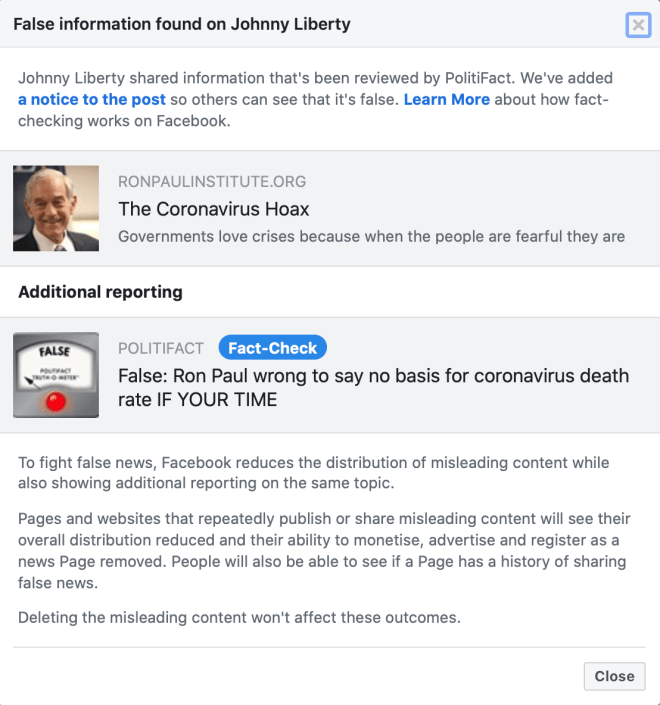
FalseinformationfoundonJohnnyLibertySocial media behemoth Facebook has just acted to censor and suppress Ron Paul’s latest weekly column, “The Coronavirus Hoax,” based on a hatchet job “fact check” by the notoriously biased “Politifact” organization.

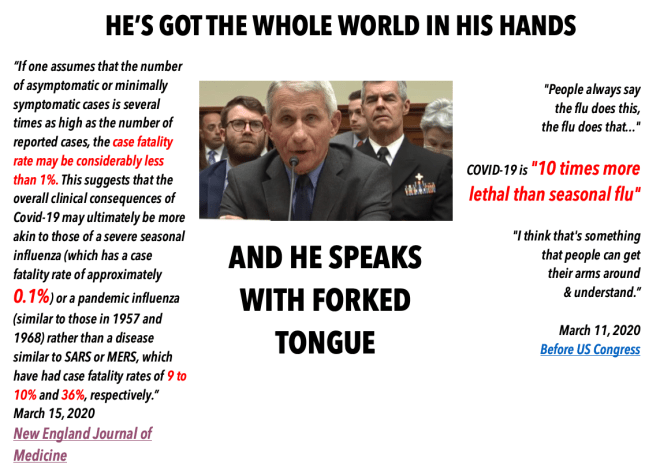
At issue is Dr. Paul’s statement that National Institute of Allergy and Infectious Diseases director Anthony Fauci’s claim that the coronavirus is “ten times more deadly” than the seasonal influenza virus is “without any scientific basis.” Fauci made the claim recently in testimony before the US Congress in a move that significantly ramped up the fear factor in the US over the virus.

The Politifact “fact check” is literally drenched in sarcasm and bias, with Ron Paul being described as “a sometimes conspiracy-minded Texas doctor” and Fauci described as a “universally trusted person.”

For a “just the facts” analysis, that’s a lot of editorializing.

The Politifact hit piece admits that, “It’s not yet known what the death rate from the current coronavirus, COVID-19, will be,” but concludes nevertheless that, “early data indicate it is more than 10 times higher than the death rate for the flu.”

So if you don’t know how can you know?

One reason to question the “scientific basis” of Fauci’s claim is that Fauci contradicted his own statement before Congress in a recent article he co-authored in the New England Journal of Medicine.

If a scientist writes one thing in a scholarly journal and testifies very differently before Congress, does it not raise questions as to the “scientific basis” of the divergent claims?

Here are the two Anthony Faucis. Which one is scientifically based? Both can’t be:

fa

Founded by the Poynter Institute, Politifact is an outfit with a clear political agenda and it is not to promote truth and accuracy in the media. Rather, it is all about suppressing media outlets with which they disagree. It is all about creating blacklists in a McCarthyite push to control the flow of information.

Interestingly enough, major funders of the Poynter Institute include “open society” advocate George Soros along with Charles Koch (both founders and major funders of the “Quincy Institute“).

Soros loves an “open society” as long as it does not in any way challenge his own political biases. If anyone holds different views, he’ll spend millions to shut down debate.

The Poynter Institute is also funded by the United States government itself, via major grants from the National Endowment for Democracy. So here is what happens when you scratch below the surface a bit: The suppression of views like those of Ron Paul which are unpopular among those who control the foreign policy narrative are actually financed by the US government itself.

Do any of our dear readers support the US government taking our tax money and using it to shut Ron Paul up?

How is it that Facebook tries to sell itself as politically neutral, just making sure only facts are allowed through, while at the same time partnering with such a politically biased and unethical organization as Politifact and the Poynter Institute? Is Facebook really about fostering a lively debate or is it about controlling the narrative favored by the Washington elites?

We have fact-checked Politifact’s fact checkers and we find them to be biased, sloppy, and inimical to the values we should share as Americans in favor of open debate.

And Facebook? End your suppression of Dr. Ron Paul’s op-ed on the coronavirus!

Source: Ron Paul Institute

The Coronavirus: An Excuse to Grab More of Our Freedoms | Ron Paul Institute

Johnny Liberty, Editor’s Note: So sorry that Ron Paul’s voice is no longer present in the U.S. Congress as he’s always been a voice of reason and wisdom. Beyond the scientific and medical facts emerging re: coronavirus, there is a social/political hit job being engineered and orchestrated upon the American people with full complicity of the Power Structure behind Big Media. Those willing to advance the cause of Big Government and World Government (i.e. Globalists) are always prepared to take power at the expense of your civil liberties and sovereign rights. Be aware and take notice of your willingness to surrender to fear and sacrifice not only your rights, but the rights of others. Put the coronavirus in perspective and take every precaution to retain your sanity and good health.

By Ron Paul

Governments love crises because when the people are fearful they are more willing to give up freedoms for promises that the government will take care of them. After 9/11, for example, Americans accepted the near-total destruction of their civil liberties in the PATRIOT Act’s hollow promises of security.

It is ironic to see the same Democrats who tried to impeach President Trump last month for abuse of power demanding that the Administration grab more power and authority in the name of fighting a virus that thus far has killed less than 100 Americans.

Declaring a pandemic emergency on Friday, President Trump now claims the power to quarantine individuals suspected of being infected by the virus and, as Politico writes, “stop and seize any plane, train or automobile to stymie the spread of contagious disease.” He can even call out the military to cordon off a US city or state.

State and local authoritarians love panic as well. The mayor of Champaign, Illinois, signed an executive order declaring the power to ban the sale of guns and alcohol and cut off gas, water, or electricity to any citizen. The governor of Ohio just essentially closed his entire state.

The chief fearmonger of the Trump Administration is without a doubt Anthony Fauci, head of the National Institute of Allergy and Infectious Diseases at the National Institutes of Health. Fauci is all over the media, serving up outright falsehoods to stir up even more panic. He testified to Congress that the death rate for the coronavirus is ten times that of the seasonal flu, a claim without any scientific basis.

On Face the Nation, Fauci did his best to further damage an already tanking economy by stating, “Right now, personally, myself, I wouldn’t go to a restaurant.” He has pushed for closing the entire country down for 14 days.

Over what? A virus that has thus far killed just over 5,000 worldwide and less than 100 in the United States? By contrast, tuberculosis, an old disease not much discussed these days, killed nearly 1.6 million people in 2017. Where’s the panic over this?

If anything, what people like Fauci and the other fearmongers are demanding will likely make the disease worse. The martial law they dream about will leave people hunkered down inside their homes instead of going outdoors or to the beach where the sunshine and fresh air would help boost immunity. The panic produced by these fearmongers is likely helping spread the disease, as massive crowds rush into Walmart and Costco for that last roll of toilet paper.

The madness over the coronavirus is not limited to politicians and the medical community. The head of the neoconservative Atlantic Council wrote an editorial this week urging NATO to pass an Article 5 declaration of war against the COVID-19 virus! Are they going to send in tanks and drones to wipe out these microscopic enemies?

People should ask themselves whether this coronavirus “pandemic” could be a big hoax, with the actual danger of the disease massively exaggerated by those who seek to profit – financially or politically – from the ensuing panic.

That is not to say the disease is harmless. Without question people will die from coronavirus. Those in vulnerable categories should take precautions to limit their risk of exposure. But we have seen this movie before. Government over-hypes a threat as an excuse to grab more of our freedoms. When the “threat” is over, however, they never give us our freedoms back.

Source: Ron Paul Institute

An Evening with Tucker Carlson: America’s Elites Are on a Ship of Fools. YouTube & Independent.org

Source: YouTube & Independent.org

Big Pharma Owns The Corporate Media, But Americans Are Waking Up And Fighting Back | Ring of Fire

am_law_0432By Gary Bentley

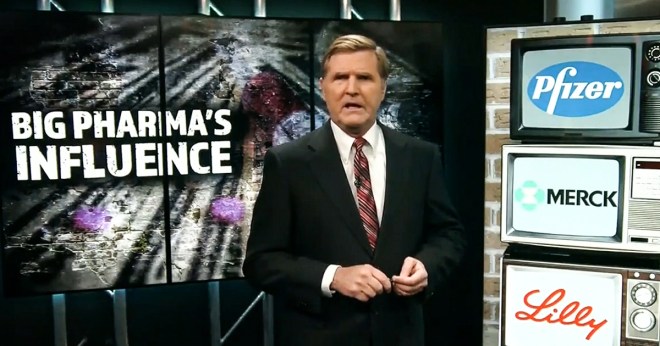
When you tune in to MSNBC, Fox News, or any of the other corporate media machines, you’re probably not going to hear much about the methods in which big pharma is taking advantage of consumers either through price gouging or medical mishaps. The reason for this is because talking about those stories creates a major conflict of interest for the people behind the scenes. Mike Papantonio discusses this with journalist and author Martha Rosenberg.

Transcript of the above video:

Mike:
According to a 2009 study by Fairness and Accuracy in Reporting, with the exception of CBS every major media outlet in the United States shares at least one board member with at least one drug company. Let me put it in perspective for you, these board members wake up, they go to a meeting at Merck or Pfizer, and then they have their driver take them over to a meeting with NBC to decide what kind of programming that network is going to air. For those board members who aren’t pulling double duty with a media conglomerate and a big drug company, they still understand that they can’t be honest and objective about big pharma because big pharma pays their bills.

Drug companies spend about $5 billion a year on advertising with these corporate media outlets, so when Pfizer or Merck or Eli Lilly, or any of the drug companies, kill or cripple Americans with defective drugs, do you really think these board members are going to allow their story to be told on the air? It can take anywhere from three days to a full week before the media reports on a drug or a medical device recall, if they report at all.

In the case of Invokana it took 32 days before television outlets reported a single story involving an FDA warning about the potential problems with the product. The FDA began warning about the extreme dangers of Cook IVC filters as early as 2010 and it took about five years, five years, before television media started reporting that to the public. It’s worth pointing out that in these instances it was only through non-corporate independent media outlets that these stories were told at all. It was the outlets who weren’t being forced, they weren’t being forced to remain silent about the drug industry.

You can replace IVC or Invokana with any other drug or product and the story is all the same. Stryker hip implants, C8, Vioxx, RoundUp, Xarelto, talcum powder, they’re all the same thing. The corporate media doesn’t care about these stories because they either share board members with these companies, or because they want those companies to keep throwing dollars their way in big advertising dollars. These gigantic media corporations aren’t going to do anything to threaten their relationship with big advertisers.

Drugs are cash cow advertising bonanza for corporate media. Fortunately an increase in number of Americans who are starting to wake up and realize that the mainstream media shouldn’t be trusted on issues like this. In recent years we’ve seen the alternative media experience rapid growth and mainstream media has been losing credibility at a staggering rate. Americans are starting to look elsewhere for the truth about what’s really going on out there. As a result of that advertising money kicking around the corporate media isn’t permitted to report complex drug stories anymore.

It’s as if they don’t understand things like the link between crony capitalism and the revolving door between the FDA and the drug industry, but the media is only one side of the story here. Big pharma knows that if it wants to continue manipulating the public it has to start with our elected officials in Washington DC. According to OpenSecrets, big pharma spent more than $58 million on politicians just in 2016, the most amount they’ve spend on a direct contribution in the last quarter century.

When it comes to lobbying, few industry spend more than big pharma did last year. They spent a staggering $244 million dollars to influence our elected leaders in Washington DC. It looks like things are about to get much worse, you see, big pharma understands that the ridiculous … their price gouging is starting to draw negative attention from the American public, and no matter how much they spend advertising or buying our politicians, they can’t keep the public anger down forever.

According to a new report by ProPublica, drug companies are offering huge money to any scientist, any professor or academic willing to author studies that are going to show that these drug markups are necessary, that they’re just fine. Their goal is to spread around enough money at universities to develop scientists and doctors who are going to create this fantasy story about how price gouging is just great for the American public, and then that story will be run by corporate media, dominated by the drug industry.

Joining me now to talk about big pharma’s influence over our daily lives and their quest for even more power is Martha Rosenberg, an investigative health reporter and the author of the book, Born With A Junk Food Deficiency. Martha, is it an overstatement to say that big pharma, they have a firmer grip on our daily lives than most people realize, where it comes to the drugs that we take?

Martha:
No. No Mike, I don’t think it’s an overstatement at all. I think this is the year that we celebrate 20 years of direct-to-consumer ads. Any time people are watching TV, they’re seeing the drug ads, and then on top of that there’s PR campaigns going on. One of which on the Sunday news shows that were trying to objectively talk about Obamacare, they were financed by a PR campaign called Go Boldly, which is trying to defend the high prices. In addition to the direct-

Mike:
Martha, all you have to do is watch the nightly news. You’re liable to see eight advertisements for Merck and Pfizer, Johnson & Johnson. How can that not be influencing the reporters or the executive producers of that programming? They know where their money is coming from, they know where they’re getting this money, that some cat on the 50th floor makes this decision that says, “You know, we can’t tell these stories where drugs are killing people. We can’t tell it because we’re going to lose advertising dollars.” Can’t you basically already see that just by watching the nightly news and seeing those advertisements?

Martha:
Of course you can. They won’t report on the dangers which of course you and I know about, and also they plant the idea in many people’s minds that they are sick and they need the drugs. That disease mongering is a big part of it. The screening, when they’re always saying, “Ask your doctor, you might have this or that disease,” the screening causes over-diagnosis, over-treatment and over-medication, which pharma loves.

Mike:
Most people who handle cases in this industry, they look to you first on a lot of this reporting because you catch the stories certainly before corporate media does, or if corporate media gets it before you, corporate media doesn’t tell the stories because they’re ordered not to by their advertisers. But it’s not just corporate media that’s the problem, don’t we also have a problem with, they’ve put so much money into the political schemes taking place in DC. They bought politicians, there’s no other way to put it. The money is staggering, $244 million just for lobbying, endless money to individual campaigns. Don’t you see that happening as you follow these stories?

Martha:
Definitely. I think that it’s one of the most expensive lobbying machines there is, the big pharma. What they’re doing now, big pharma and bio pharma are trying to defend their price, so we see a lot of that. Yeah, there’s no question. Up until the Affordable Care Act there was no hiding all the perks that doctors got, and there were examples in China, GSK, which is a big pharmaceutical company, was buying sex bribery to sell their drugs. Here in the US according to charges, Victory Pharma was buying lap dances for doctors to prescribe its opiates.

Mike:
There’s worst stories than that, some of the stories we can’t even tell on the air. Let’s talk about this new ProPublica report about big pharma trying to pay scientists, I call them biostitutes. They’re doctors and scientists who will write anything the industry asks them to write for a check of $100,000. They’ll write anything.

Right now we have the industry going around trying to find these biostitutes that will say, “It’s just fine that the industry has these huge markups, even though sometimes it’s 6,000% markup on a drug, 10,000% markup.” They actually are going to find scientists and doctors who say, “That’s absolutely appropriate. The industry needs to do it.” You and I know that’s a lie because most of the money that they spend goes to advertising, it doesn’t go to R&D. What’s your take on that?

Martha:
Yeah, right now what pharma has done Mike is, it’s replaced its blockbusters like Viagra and Lipitor with what we call biologics. That would be your vaccines and your liquid injectable drugs. That enables them to charge what they’re now charging. Now they’re in the process of trying to defend those charges. Now, the ProPublica report, it reveals the machinery between academia and big pharma, which is not really new.

The ghostwriting and what we used to call conflicts of interests, they now call private-public partnerships and it’s our tax dollars going on. But yeah, the academics are now writing the papers and not only are, pardon my French but not only are the journals pimping for big pharma but pharma will create its own journals to make sure its message gets out there. These academics are part of the whole thing.

Mike:
Okay, so let me put these parts together. The industry goes out and finds these biostitutes, who will say anything for the right amount of money. I see them in court every single day, up on the witness stand, testifying, lying, knowing they’re lying, absolutely misrepresenting the truth about everything, because they’re getting paid a lot of money. Now what you have is you have them, they find the biostitute, the biostitute writes the story and the next thing you know, mainstream corporate media, like NBC, MSNBC, ABC is reporting that story that was created by the biostitute. Did I get that right?

Martha:
Absolutely, absolutely. It’s stenography. It’s not reporting, it’s stenography.

Mike:
As I follow this, of course, this story is going to continue to build because we’re going to start seeing a lot more of these stories coming out, they’re horrendous stories. Last week we saw Bernie Sanders pushing back, the Democrats won’t get behind him because the Democrats are as much part of this as the Republicans are. The pharmaceutical industry, they’re just spreading around a lot of money. I have to tell you something, I appreciate you joining me tonight, okay?

Martha:
Thank you so much. Thank you for your good work Mike.

Source: Ring of Fire

Chinese president Xi Jinping has vowed to lead the “new world order” | Yahoo

a83cb6d8f0b6145c0387374f87356356Chinese president Xi Jinping has vowed for the first time that China should take the lead in shaping the “new world order” and safeguarding international security, one of the latest moves putting him in stark contrast to Donald Trump and the US president’s “America First” policy.

Xi had on numerous occasions called for China to play an important part in building the new world order. But during a Feb. 17 national security seminar in Beijing, he indicated China should “guide” the international community in the effort. A Feb. 20 commentary (link in Chinese) by the Chinese Communist Party’s central party school, which trains officials, noted the distinction. It has since been widely shared by state-controlled media.

News outlets dubbed Xi’s new approach the “Two Guides” (两个引导) policy, with the “two” referring to the new world order and international security. (China has an obsession with silly-sounding numbered policies.)

“The overall trend of world multi-polarization, economic globalization, and democratization of international relations remains unchanged. We should guide the international community to jointly build a more just and reasonable new world order,” Xi was paraphrased by Xinhua (link in Chinese) as saying during last week’s seminar. In another paragraph, the state newswire paraphrased Xi as saying “We should guide the international community to jointly maintain international security.”

Xi’s new proposal has “profound meaning,” as his speech coincided with the annual Munich Security Conference and the G20 finance ministerial meeting, noted the commentary. It added that the Western-dominated world order is near its end as Western countries are showing less willingness and ability to interfere in global affairs—as evidenced by Trump’s isolationist foreign policy.

Xi attended the seminar as head of the National Security Commission, a secretive party organ set up in 2014. Until last week, the body had held just one publicly reported meeting since its establishment. The latest seminar came ahead of the party’s 19th congress, a major leadership reshuffle event slated for this fall.

Since Trump’s election China has emerged as the world’s strongest proponent of globalization. In the past few months, Xi has been busy sending the world messages that are the exact opposite of Trump’s.

As Trump promised to tear up the Trans-Pacific Partnership, Xi touted his alternative Regional Comprehensive Economic Partnership, including at last November’s APEC summit, right in the US’s backyard.

As Trump threatened to close the borders and back away from global affairs, Xi rebuked Trump—without mentioning his name—in his keynote speech at the 2017 World Economic Forum in January. As Trump pressed to curb immigration, Xi called to make it easier for foreigners to get Chinese green cards.

Xi and Trump appear aligned on one issue: the press. As Trump denounced the media as the “enemy of the American people,” China’s state-controlled media marked the first anniversary (link in Chinese) of Xi’s talk demanding “absolute loyalty” from the press—an idea that Trump, it would seem, could get behind.

Source: Yahoo

The Real ‘Fake News’ Is The Mainstream Media | Forbes

https---specials-images.forbesimg.com-imageserve-e5c24764d014483880d212e6b23ef0b1-960x0.jpg?fit=scaleEditor’s Note: Thought it would be interesting to go back almost four years and post this election 2016 article about how the media was already distorting the news after Trump became the duly elected President of the United States. The mainstream media, left/liberal or otherwise, always has a political agenda (not a journalistic one) to serve their corporate/elite masters. These media distortions, and their pursuit of “fake news”, aligns only with their preordained narrative. This has left the mainstream media with no credibility whatsoever.

By Tom Basile

It’s been a little more than a month since an election that was the kind of seismic event in our politics that only happens once a century. It sent shock waves through the national political establishment and pretty much any other group of prognosticators that had been banking on an easy Clinton win. No one felt the sting more than the mainstream media. The morning after the election, anchors and columnists were making a collective stammering Act of Contrition about just how “wrong” they were about the election – and the electorate.

But in the month since, the so-called mainstream media have, as if in coordinated fashion, executed a transparent strategy to bludgeon the president-elect at every turn. Republicans, Conservatives, Independents and the majority of Americans who actually want to give Donald Trump a chance to lead will likely see through this anti-Trump propaganda campaign, but perhaps a review of their strategy is instructive at this point.

Media outlets have again shown they are doubling down on the same strategy that has driven their own approval ratings close to – dare I say – Congressional territory.  That’s right. Survey after survey finds the same media that has made beating up conservatives, Republicans and religious institutions an industry has seen their tactics boomerang on them. Even actor Denzel Washington blasted the media last week saying that, “One of the effects of “too much information is the need to be first, not even to be true anymore.”

Hope for better isn’t a strategy and change isn’t coming. Here’s the anti-Trump plan of attack in all its banality. Some of these elements will have a shelf life. Some will be part of a prolonged effort. The strategy has several key components that have quickly taken shape over the last few weeks.

First, they are advancing a strategy of attempting to tie the president-elect and his team to the so-called “alt-right” and neo-Nazi, white supremacist lunatics. Despite Trump and his transition team issuing multiple statements denouncing the activities of a number of groups, the media still provided hours of coverage to small pockets of hate groups that used the election as a recruiting tool.

A sub-component to this was advancing a message that the country was in turmoil in the days after the election because of widespread protests against the newly-elected president. Even Fox News put a graphic on the screen that proclaimed there was “Anarchy in America.” Again, more sensationalized information that only bares a faint resemblance to the truth.

Yes, there were protests in a number of cities as well as sit-ins and cry-ins on college campuses filled with whiny young people who have little grasp on the realities of life. But to suggest that there is widespread discontent and a surge in the size, number and strength of hate groups in this country who are supposedly empowered by the Trump campaign or aligned with the president-elect is nonsense. Incidents that qualify as hate crimes, like racist graffiti did spike after the election, but a real, honest analysis of these events will show that a sustained, coordinated grassroots movement against American pluralistic values and racial tolerance is not developing.

This is what happens when you try to stretch 10 minutes of news into 24 hours of coverage.

Third, the press have pushed several key messages to delegitamize the president-elect.  Let’s take them in order.  First, the media is aggressively driving the narrative that Trump didn’t win the popular vote.  This part of the playbook was dusted off from George W. Bush’s 2000 election. Of course the big brains in the media never mention to their readers and viewers the simple fact that the Electoral College – whatever you might think about it – dictates the strategy of national elections.  If you ran a popular vote strategy, you’d run a completely different campaign in terms of allocation of time and resources. The game is not winning the popular vote, like it or not.

Further, there is no evidence that had the campaigns executed a popular vote strategy that Clinton would have won. Actually to the contrary, given the marked enthusiasm deficit on the Democrat side, Trump would likely have mobilized more voters from his states than Clinton would have in hers. Also, keep in mind that Clinton did have a robust turnout operation in key urban and suburban districts where she needed to perform well with her base. She still under-performed in those places that also would have been critical to a popular vote victory.

The press has weaved the issue into the coverage repeatedly using the phony recounts in Michigan, Pennsylvania and Wisconsin as an excuse to mention the popular vote margin. Naturally, they’ve spent little time acknowledging that Hillary Clinton lost or under-performed President Obama in almost every single demographic group that mattered – including women.

The second way they are seeking to delegitamize Trump is pushing the notion that something called “fake news” was actually the reason why Trump won the election. The “fake news” claim is perhaps the most offensive, but naturally many in the media have been tone deaf about it. “Fake news” is real.  It is generated by websites, aggregators and email list-serves that blast out stories on social media and other online platforms of dubious credibility.  We’ve all seen them.  They specialize in click-bait for folks who feed off of red meat politics.  Headlines like “Obama to ban Pledge of Allegiance,” or “Clinton Accused of Being Pedophile,” are the kinds of stories that drive traffic to these sites.

The mainstream news media would like people to believe that so many people actually thought enough of these stories were credible that the impact threw the election to Donald Trump.

Denial is a terrible thing. Even more so, what is highlighted by this strategy is their elitism and continuing disdain for the average person. Sure I often accuse politicians of all political stripes of underestimating the intelligence of the average voter, but this line of attack against the legitimacy of the election takes the cake. Whenever you read a “real news” story about “fake news” remember, the editors who decided to create space in news cycle for that piece think millions of Americans are just to dumb to realize when something is so outrageous, it can’t be all true. This attitude on the part of the media is, of course, an extension of their general political philosophy that suggests people are too stupid to make their own decisions about how big their soda should be or how much salt to use in their food. These are the same folks who believe that the government is the solution to all problems domestically and can do no right when it comes to foreign or military policy.

Finally, in recent days the idea that Russia, through electronic espionage and “fake news,” helped tip the scales in Trump’s favor is the latest method of not only de-legitimizing Trump but also suggesting that Trump is in some way a Manchurian Candidate who will be controlled by Vladimir Putin.  No one should ever put anything past Putin, particularly after the Obama foreign policy has allowed his power and influence to grow unchecked.  But to suggest that Clinton would have won, but for this alleged interference is as credible as, well, fake news.

Oh wait – I forgot the new charge that Trump’s appointment of former generals to several cabinet and senior posts is evidence of his desire to abrogate civilian leadership of the country and institute a full-scale militarization of the federal government. That was a new one over the last few days.

Then of course, are the photos and video clips intentionally curated and placed by editors in mainstream reporting that show Trump making silly, mean or grotesque faces. The media did this to Bush constantly. Back then the word in news rooms was to make him look as stupid and confused as possible in photos and video.

So a month after the feigned apologies for getting it all wrong, the media has telegraphed clearly their strategy for the next four years. Perhaps we should thank them for being so transparent. Like Democrats during the campaign who chose to talk more about transgender bathrooms than job creation for the middle class, the media that stretches to such lengths to hurt the incoming president may well continue to lose public support. For ordinary Americans just looking for real, balanced news and analysis, it looks like we’ll be out in the cold again.

Source: Forbes

Twenty Years of Media Consolidation Has Not Been Good For Our Democracy | Bill Moyers & Truthout

GettyImages-51584279-1280x720The media has become controlled by a handful of corporations thanks to the Telecommunications Act of 1996.

By Michael Corcoran

Wall Street’s sinister influence on the political process has, rightly, been a major topic during this presidential campaign. But history has taught us that the role that the media industry plays in Washington poses a comparable threat to our democracy. Yet this is a topic rarely discussed by the dominant media, or on the campaign trail.

But now is a good time to discuss our growing media crises. Twenty years ago last month, President Bill Clinton signed the Telecommunications Act of 1996. The act, signed into law on February 8, 1996, was “essentially bought and paid for by corporate media lobbies,” as Fairness and Accuracy in Reporting (FAIR) described it, and radically “opened the floodgates on mergers.”

The negative impact of the law cannot be overstated. The law, which was the first major reform of telecommunications policy since 1934, according to media scholar Robert McChesney, “is widely considered to be one of the three or four most important federal laws of this generation.” The act dramatically reduced important Federal Communications Commission (FCC) regulations on cross ownership, and allowed giant corporations to buy up thousands of media outlets across the country, increasing their monopoly on the flow of information in the United States and around the world.

“Never have so many been held incommunicado by so few,” said Eduardo Galeano, the Latin-American journalist, in response to the act.

Twenty years later the devastating impact of the legislation is undeniable: About 90 percent of the country’s major media companies are owned by six corporations. Bill Clinton’s legacy in empowering the consolidation of corporate media is right up there with the North American Free Trade Agreement (NAFTA) and welfare reform, as being among the most tragic and destructive policies of his administration.

The Telecommunications Act of 1996 is not merely a regrettable part of history. It serves as a stern warning about what is at stake in the future. In a media world that is going through a massive transformation, media companies have dramatically increased efforts to wield influence in Washington, with a massive lobbying presence and a steady dose of campaign donations to politicians in both parties — with the goal of allowing more consolidation, and privatizing and commodifying the internet.

This issue has not been central in the 2016 presidential election. But it is deeply concerning that, of all the presidential candidates running in 2016, the Big Media lobby has chosen to back Hillary Clinton. Media industry giants have donated way more to her than any other candidate in the race, according to data from the Center for Responsive Politics. In light of this, we must be mindful of the media reform challenges we face in the present, as we try to prevent the type of damage to our democracy that was caused by the passing of this unfortunate law.

A Threat to Democracy: The Telecommunications Act and Media Consolidation

When President Bill Clinton signed the Telecommunications Act into law, he did so with great fanfare. The bill, which was lobbied for in great numbers by the communications and media industry, was sadly a bipartisan misadventure — only 3 percent of Congress voted against the bill: five senators and 16 members of the House, including then-Rep. Bernie Sanders.

At the time, President Clinton touted the law as “truly revolutionary legislation … that really embodies what we ought to be about as a country.” House Speaker Newt Gingrich boasted ofprojected consumer savings and private job growth. Rep. John Dingell (D-Michigan) “thanked God” for the bill that would “make this country the best served, the best educated and the most successful country … in all areas of communications.”

Despite all of these glowing words, the consequences of the bill were disastrous. The act “fueled a consolidation so profound that even insiders are surprised by its magnitude,” said one trade publication, according to Robert McChesney, in his book, Rich Media, Poor Democracy: Communication Politics in Dubious Times.

“Before the ink was even dry on the 1996 Act,” wrote S. Derek Turner, research director of Free Press, in a 2009 report proposing a national broadband strategy, “the powerful media and telecommunications giants and their army of overpaid lobbyists went straight to work obstructing and undermining the competition the new law was intended to create.”

Media consolidation was already an extremely pressing concern long before 1996. In 1983, Ben Bagdikian published his groundbreaking book, The Media Monopoly, which revealed that just 50 corporations owned 90 percent of the media. That number gradually dwindled over the coming 13 years and was accelerated by the Telecommunications Act. This has led us to the aforementioned crisis where more than 90 percent of the media is owned by just six companies: Viacom, News Corporation, Comcast, CBS, Time Warner and Disney.

Radio has seen an equally appalling consolidation, which has been horrendous for both news media and music. In 1995, before the Telecommunications Act was passed, companies were not allowed to own more than 40 radio stations. “Since passage of the 1996 Telecommunications Act, Clear Channel [now called iHeartMedia] has grown from 40 stations to 1,240 stations — 30 times more than congressional regulation previously allowed,” according to a report from the Future of Music Coalition.

Local newspapers, too, have been stung by these deregulations. Gannett, for instance, owns more than 1,000 newspapers and 600 print periodicals. Layoffs have been the norm for the company, including at USA Today, the paper with the largest circulation in the country, where layoffs were described as a “total bloodbath” in the American Journalism Review.

Save the Internet: The Next Big Media Battle

There was a lot at stake when media companies lobbied for reform in 1996. There is just as much at stake today in the battle for a free and open press. Not only have big media companies continued to push for more consolidation and mergers, but they are also seeking to commodify and privatize the internet. This has become a major concern for advocates of “net neutrality,” who want to “save the internet,” and ensure it is protected as a public utility with equal access for everybody. An FCC ruling in February 2015 has protected the internet for now, but as Free Press warns, the internet is still “in danger.”

“Net neutrality has made the internet an unrivaled space for free speech, civic participation, innovation and opportunity. Net neutrality prohibits online discrimination and gives any individual, organization or company the same chance to share their ideas and find an audience,” explains Free Press’s website, Save the Internet. “Companies like Comcast and Verizon aren’t used to losing in Washington, and they’ll do everything they can to knock down the Title II protections the FCC approved on Feb. 26, 2015.”

The organization is right to be concerned. One reason for the passage of the Telecommunications Act of 1996, as McChesney wrote in 1997, was the sheer power that the media and communications industry has in Washington. “Both the Democratic and Republican parties have strong ties to the large communication firms and industries, and the communication lobbies are among the most feared, respected and well-endowed of all that seek favors on Capitol Hill.”

Today that power and influence has only increased. “From 2002-2008, the industry increased its spending on lobbying efforts every year,” reports the Center for Responsive Politics. “The streak snapped when the Great Recession set in and most clients cut back on their DC efforts, and then reversed again in 2013. In 2014, cable and satellite providers spent nearly $8.1 [million] on lobbying.”

Big Media’s Relationship With Hillary Clinton

What is most revealing when analyzing the donation patterns of these industries in the data from the Center for Responsive Politics — be it cable television, print and periodicals, radioor telecom services — is that Hillary Clinton is, by far, the largest recipient of donations of any candidate in the 2016 election in either party. In fact, of all the top industries that have donated to Clinton, the TV/movies/music category ranks behind only the securities and investments category. (This data is from reports filed on January 31, 2016, according to the Center for Responsive Politics.)

More troubling is that these filings come on the heels of a report from Politico that the Clinton Foundation has received donations, some of them very large, from most of all the major media companies directly: Viacom, News Corporation, Reuters, NBCUniversal, Newsmax, Time Warner, Mort Zuckerman (owner of US News &World Report and the New York Daily News), Comcast, AOL Huffington Post Media and Robert Allbritton (owner of Politico). George Stephanopoulos, one of ABC News’ most visible journalist and a former staffer for President Clinton, has also been under scrutiny for not disclosing a $75,000 donation to the foundation.

Of course, the Clinton Foundation is not a political campaign and does some philanthropic work. So while this all might be legal, it is extremely unsettling, especially in tandem with all the campaign donations Hillary Clinton has received from the major players in this industry.

In March 2015, for instance, a Comcast executive held a $50,000 per plate fundraiser for Clinton’s super PAC. “Comcast NBCUniversal operates in 39 states and has 130,000 employees across the country,” said company spokeswoman Sena Fitzmaurice at the time. “It is important for our customers, our employees and our shareholders that we participate in the political process.”

Of course, media companies don’t just donate to Clinton, but also to members of Congressfrom both parties. Further, as the Center for Responsive Politics reports, the FCC is filled with “revolving-door” employees, who have been switching back and forth between government work and lobbying for Comcast.

Their aggressiveness in Washington makes them a dangerous enemy in the fight for free and democratic media. In this environment, it should come as no surprise that the position of FCC chairman is typically held by a former lobbyist for the cable industry, such as Tom Wheeler, the current chairman, who was once president of the National Cable and Telecommunications Association, a major opponent of net neutrality.

And while it is good news that Clinton has come out in favor of net neutrality, it is a reasonable fear that she could change her views once elected, especially given her relationship with Big Media. It would not be the first time a president has changed a view after being elected, as we learned when Barack Obama embraced a mandate in health care, or when George H.W. Bush raised taxes, despite his infamous promisethat he never would.

It is important to note that, whatever her relationship with the telecommunications industry, it is not fair to blame Hillary Clinton for the Telecommunications Act of 1996. As first lady, Clinton was not in charge of telecommunications policy and there doesn’t appear to be evidence she played a role in constructing or fighting for the law in the White House. In fact, 20 years later, it is difficult to find any public statements from Hillary Clinton expressing her opinion about the law or its impacts. She did address a question at the 2012 YearlyKos convention about the Telecommunications Act. Her response, however, did little to clarify her views on the subject. She said:

You’ll have to ask [then-Vice President] Al Gore. We’ve had a lot of media consolidation. We’ve had some good competition. We have a lot that we need to do to begin to create a more competitive framework. Al was very involved in designing and pushing that through — he is an expert; I am not … We’ve got to take a hard look at this and I don’t want to say something I may not really support. So I have to look at that proposal.

Clinton is now, however, deep into a presidential run and could well be responsible for appointing the head of the FCC. She owes it to voters to describe her views on the Telecommunications Act, and on media consolidation more broadly, in a way that goes beyond advising Americans to “go ask Al Gore.”

Why Media Reform Matters

When McChesney observed that the communications lobby was “among the most feared, respected and well-endowed of all” groups in Washington, he also pointed out one of the great challenges about trying to fight Big Media.

“[The] only grounds for political independence in this case,” he wrote about the debate over the Telecommunications Act, “would be if there were an informed and mobilized citizenry ready to do battle for alternative policies. But where would citizens get informed?”

In other words, how can we have a real debate about media issues, when we depend on that very media to provide a platform for this debate? It is no surprise, for instance, that the media largely ignored the impact of Citizens United after the Supreme Court decision helped media companies generate record profits due to a new mass of political ads. “Super PACs may be bad for America, but they’re very good for CBS,” said CBS president Les Moonves, in a rare moment of candor at an entertainment conference in 2012.

This catch-22 is indeed one of the great difficulties about fighting for a vibrant media and a healthy democracy. But it is a challenge advocates of free media must embrace. Supporting independent media is one important way to help bring light to issues the corporate media ignores.

Media reform is the issue that affects all other issues. As the impact of the Telecommunications Act of 1996 has shown, democracy suffers when almost all media in the nation is owned by massive conglomerates. In this reality, no issue the left cares about — the environment, criminal legal reform or health care — will get a fair shake in the national debate.

Source: This post originally appeared at Truthout.

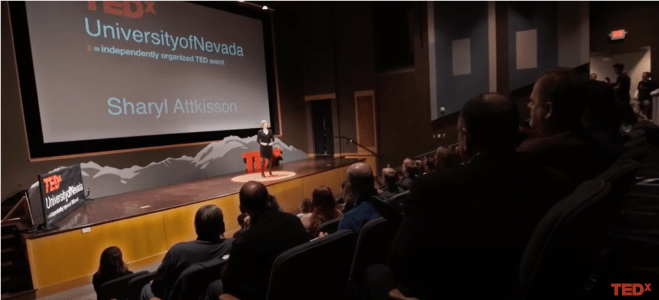
Astroturf and the Manipulation of Media Messages | Sharyl Attkisson | YouTube & TEDx~University of Nevada [click image]

Screen Shot 2020-06-15 at 7.39.52 PMIn this eye-opening talk, veteran investigative journalist Sharyl Attkisson shows how astroturf, or fake grassroots movements funded by political, corporate, or other special interests very effectively manipulate and distort media messages. Sharyl Attkisson is an investigative journalist based in Washington D.C. She is currently writing a book entitled Stonewalled (Harper Collins), which addresses the unseen influences of corporations and special interests on the information and images the public receives every day in the news and elsewhere.

For twenty years (through March 2014), Attkisson was a correspondent for CBS News. In 2013, she received an Emmy Award for Outstanding Investigative Journalism for her reporting on “The Business of Congress,” which included an undercover investigation into fundraising by Republican freshmen. She also received Emmy nominations in 2013 for Benghazi: Dying for Security and Green Energy Going Red. Additionally, Attkisson received a 2013 Daytime Emmy Award as part of the CBS Sunday Morning team’s entry for Outstanding Morning Program for her report: “Washington Lobbying: K-Street Behind Closed Doors.” In September 2012, Attkisson also received an Emmy for Oustanding Investigative Journalism for the “Gunwalker: Fast and Furious” story. She received the RTNDA Edward R. Murrow Award for Excellence in Investigative Reporting for the same story. Attkisson received an Investigative Emmy Award in 2009 for her exclusive investigations into TARP and the bank bailout.

She received an Investigative Emmy Award in 2002 for her series of exclusive reports about mismanagement at the Red Cross.

This talk was given at a TEDx event using the TED conference format but independently organized by a local community. Learn more at http://ted.com/tedx

Source: YouTube