Assange psychologically tortured to ‘breaking point’ by ‘democratic states,’ UN rapporteur tells RT | RT.com

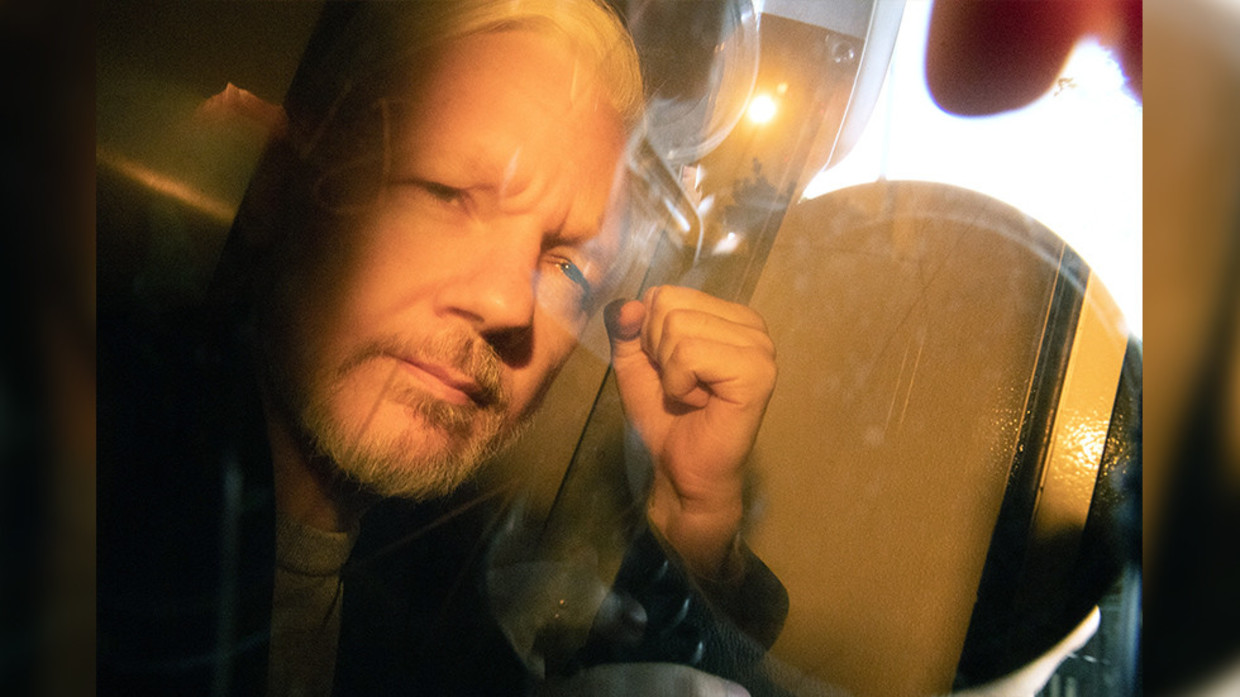
Jailed WikiLeaks co-founder Julian Assange shows clear signs of degrading and inhumane treatment which only adds to his deteriorating health, UN Special Rapporteur on Torture Nils Melzer told RT.
Assange has “all the symptoms typical for a person who has been exposed to prolonged psychological torture,” Melzer told RT’s Afshin Rattansi. This adds to the toll of his deteriorating physical state caused by a lack of adequate medical care for several years, he said.

Melzer said he was judging from two decades of experience in working with POWs and political prisoners, and only after applying “scientific” UN methods to assess Assange’s condition. But the journalist’s case still “shocked” him.

An individual has been isolated and singled out by several democratic states, and persecuted systematically… to the point of breaking him.

Earlier this month, a UK court sentenced the WikiLeaks co-founder to nearly a year in jail for skipping bail in 2012. The courts are now deciding whether to extradite Assange to the US where he is wanted for 17 charges under the Espionage Act. He can end up serving up to 175 years in prison if proven guilty.

Also in May, Sweden reopened an investigation into the allegations of rape by Assange, which he denies. The probe was originally dropped in 2017.

WikiLeaks warned that the journalist’s health had “significantly deteriorated” during the seven years he spent living in the Ecuadorian Embassy in London, and continued to worsen after he was evicted in April and placed in a British prison. According to WikiLeaks, he was recently moved to the prison’s “hospital wing.”


Tulsi Gabbard Says She’d Drop All Charges Against Assange and Snowden as President | The Mind Unleashed

Editor’s Note: An interesting discussion of whether to reward or punish whistleblowers such as Snowden or Assange. Gabbard suggests that we encourage truth telling by insiders. I agree with her.

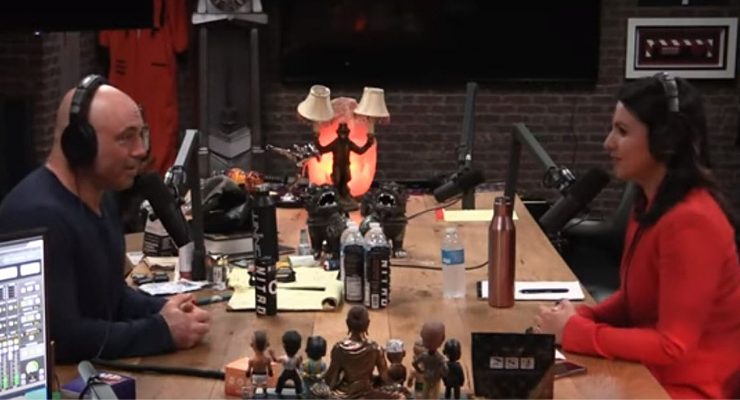
In midst of an interesting and wide-ranging discussion on the Joe Rogan Experience, Democratic congresswoman and presidential candidate Tulsi Gabbard said that if elected president she would drop all charges against NSA whistleblower Edward Snowden and WikiLeaks founder Julian Assange.

“What would you do about Julian Assange? What would you do about Edward Snowden?” Rogan asked in the latter part of the episode.

“As far as dropping the charges?” Gabbard asked.

“If you’re president of the world right now, what do you do?”

“Yeah, dropping the charges,” Gabbard replied.

Rogan noted that Sweden’s preliminary investigation of rape allegations has just been re-opened, saying the US government can’t stop that, and Gabbard said as president she’d drop the US charges leveled against Assange by the Trump administration.

“Yeah,” Gabbard said when asked to clarify if she was also saying that she’d give Edward Snowden a presidential pardon, adding, “And I think we’ve got to address why he did things the way that he did them. And you hear the same thing from Chelsea Manning, how there is not an actual channel for whistleblowers like them to bring forward information that exposes egregious abuses of our constitutional rights and liberties. Period. There was not a channel for that to happen in a real way, and that’s why they ended up taking the path that they did, and suffering the consequences.”

This came at the end of a lengthy discussion about WikiLeaks and the dangerous legal precedent that the Trump administration is setting for press freedoms by prosecuting Assange, as well as the revelations about NSA surveillance and what can be done to roll back those unchecked surveillance powers.

“What happened with [Assange’s] arrest and all the stuff that just went down I think poses a great threat to our freedom of the press and to our freedom of speech,” Gabbard said. “We look at what happened under the previous administration, under Obama. You know, they were trying to find ways to go after Assange and WikiLeaks, but ultimately they chose not to seek to extradite him or charge him, because they recognized what a slippery slope that begins when you have a government in a position to levy criminal charges and consequences against someone who’s publishing information or saying things that the government doesn’t want you to say, and sharing information the government doesn’t want you to share.

And so the fact that the Trump administration has chosen to ignore that fact, to ignore how important it is that we uphold our freedoms, freedom of the press and freedom of speech, and go after him, it has a very chilling effect on both journalists and publishers. And you can look to those in traditional media and also those in new media, and also every one of us as Americans. It was a kind of a warning call, saying Look what happened to this guy. It could happen to you. It could happen to any one of us.”

Gabbard discussed Mike Pompeo’s arbitrary designation of WikiLeaks as a hostile non-state intelligence service, the fact that James Clapper lied to Congress about NSA surveillance as Director of National Intelligence yet suffered no consequences and remains a respected TV pundit, and the opaque and unaccountable nature of FISA warrants.

Some other noteworthy parts of Gabbard’s JRE appearance for people who don’t have time to watch the whole thing, with hyperlinks to the times in the video:

  • Rogan gets Gabbard talking in depth about what Bashar al-Assad was actually like when she met him and what he said to her, which I don’t think I’ve ever seen anyone bother to do before.
  • The two discuss Eisenhower’s famous speech warning of the dangers of the military-industrial complex, and actually pause their dialogue to watch a good portion of it. Gabbard points out that in the original draft of the speech, Eisenhower had intended to call it the “congressional-military-industrial complex”.
  • Good discussion on internet censorship and the dangers of allowing monopolistic Silicon Valley corporations to control public speech, then later discussing the possibility of breaking up these corporations or treating them as public utilities.
  • Rogan asks Gabbard what she thinks happens to US presidents that causes them to fail to enact their campaign promises and capitulate to the will of the warmongering establishment, and what as president she’ll do to avoid the same fate. All presidential candidates should have to answer this question.
  • Rogan asks Gabbard how she’ll stand against the billionaires for the American people without getting assassinated. All presidential candidates should have to answer this question as well.

I honestly think the entire American political system would be better off if the phoney debate stage format were completely abandoned and presidential candidates just talked one-on-one with Joe Rogan for two and a half hours instead. Cut through all the vapid posturing and the fake questions about nonsense nobody cares about and get them to go deep with a normal human being who smokes pot and curses and does sports commentary for cage fighting. Rogan asked Gabbard a bunch of questions that real people are interested in, in a format where she was encouraged to relax out of her standard politician’s posture and discuss significant ideas sincerely and spontaneously. It was a good discussion with an interesting political figure and I’m glad it’s already racked up hundreds of thousands of views.

Source: The Mind Unleashed

‘No future for dissidents’ on social media: Paul Joseph Watson reflects on Facebook ban

Popular internet pundit Paul Joseph Watson is mulling legal action after being banned from Facebook for spreading “hate,” telling RT that it’s clear social media platforms are cracking down on dissident political speech.

Facebook kicked Watson off its platform on May 2 – along with conservative commentator Laura Loomer, Infowars founder Alex Jones, and black nationalist leader Louis Farrakhan. The group was accused of spreading “hateful” content, although no warnings or concrete reasons were provided for their seemingly arbitrary bans.

Watson, who runs a YouTube channel that boasts more than 1.5 million subscribers, has become a well-known but polarizing commentator on culture and politics. A long-time Infowars contributor, Watson now has his own outlet, Summit News.

Although he’s been labeled as an “alt-right” conspiracy theorist, Watson insists that he’s been smeared – and de-platformed – simply because he holds contrarian views.

“There is clearly no future for dissident personalities on any major social media network. We will have to go back to mailing lists and websites as our primary, and perhaps only platforms for delivering content,” he said.

He told RT that he’s hired the “best media lawyers in London” who “have taken on numerous media giants in the past and won” and will advise him about what legal recourse he has against Facebook.

The first step towards suing Facebook over his ban, according to Watson, is to initiate a written request, called a Subject Access Request, which requires the company to release all information relevant to the individual’s case under Section 7 of the Data Protection Act.

The information would be needed to verify if an individual violated community standards or if the company merely made a politically-motivated decision. Watson also intends to put Facebook on notice about the harm they have caused to his reputation by putting him under the category of “dangerous individuals,” which is one of Facebook’s stated reasons for banning people under the company’s community standards.

The list Facebook has made for what counts as “dangerous individuals” includes: Terrorist activity, organized hate, mass or serial murder, human trafficking, and organized violence or criminal activity. Facebook would have to verifiably prove that the banned person engaged in any of these activities, or the decision could count as defamation of character.

The hate watchdog organization Southern Poverty Law Centre (SLPC) has publicly admitted it was behind the censorship. In its statement, the SPLC writes how the banning of these individuals shows that social media companies are responding to their “pressure,” but adds that they nonetheless haven’t done enough, claiming they “have more work to do against hateful content.”

“The SPLC is not a fact-checker, it’s a hyper-partisan political attack dog which solely exists to demonize its ideological adversaries. There is no way to hold them accountable, they are accountable only to their own agenda and bias,” Watson said.

Twitter has reportedly dropped the SPLC as a reliable source for detecting hate content online and to police its platform, but other social media giants like Facebook, Google, and Amazon have continued to use the watchdog to decide what content should be kept on their sites.

Facebook has also recently come under fire from its co-founder Chris Hughes, who wrote an exclusive op-ed in The New York Times on Thursday calling for Facebook’s monopoly to be broken up, as its CEO Mark Zuckerberg has “unilateral control over free speech,” adding that his power is “unprecedented and un-American.”

“Personally, if and when I am banned on everything, I will probably just move into the background until the environment is once again fertile and if big enough alternative platforms exist which actually support free speech,” Watson added.

Facebook isn’t the only social media platform to face accusations of shutting down political speech it doesn’t like: In April, the company banned two conservative British candidates running for European Parliament, Tommy Robinson and Carl Benjamin, less than a month before the election.

The site banned Alex Jones and all Infowars accounts in September 2018.

Source: RT.com

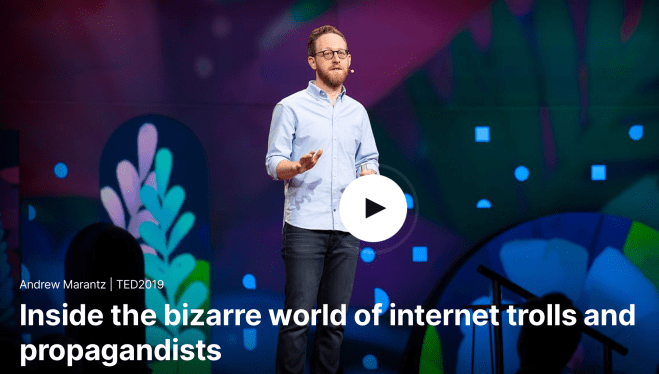
Inside the bizarre world of internet trolls and propagandists | TEDTalks

Journalist Andrew Marantz spent three years embedded in the world of internet trolls and social media propagandists, seeking out the people who are propelling fringe talking points into the heart of conversation online and trying to understand how they’re making their ideas spread. Go down the rabbit hole of online propaganda and misinformation — and learn we can start to make the internet less toxic.

Source: TEDTalks

FBI releases part of Russia dossier summary used to brief Trump, Obama | Politico

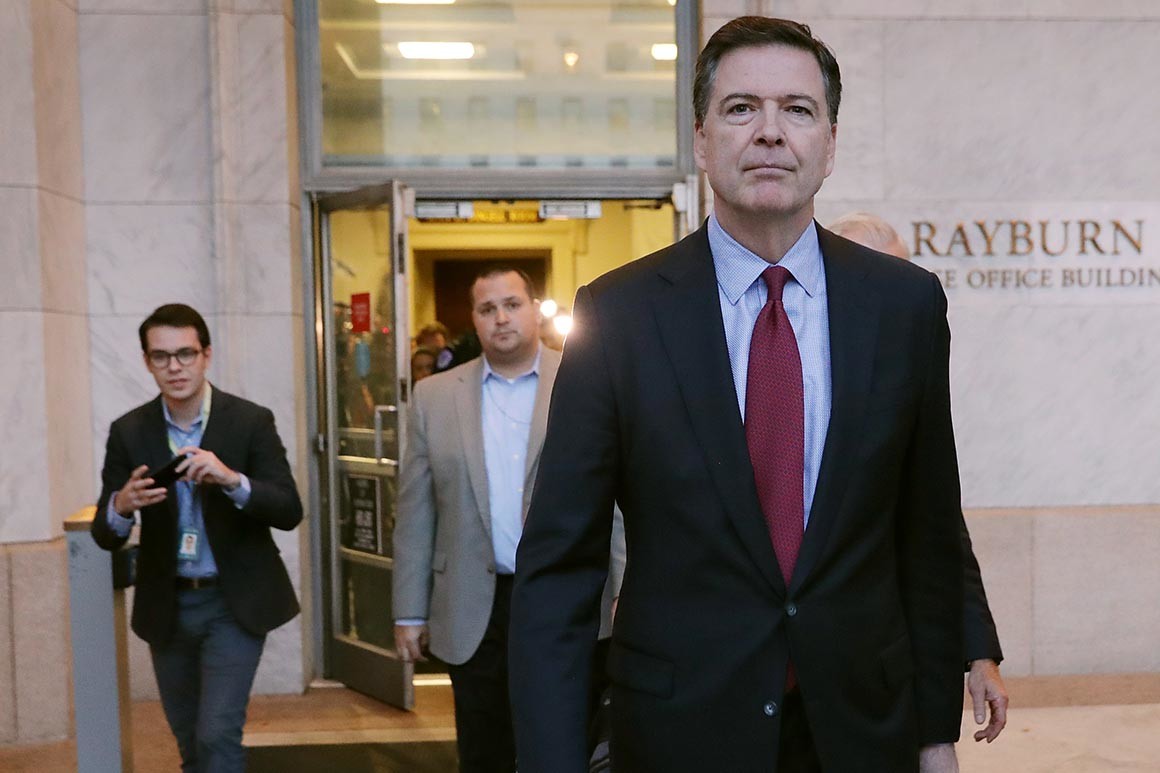
The FBI released for the first time Friday night a two-page summary former FBI Director James Comey used to brief President-elect Donald Trump nearly two years ago on a so-called dossier about Trump’s ties to Russia.

The version made public Friday could reignite previous criticism from Republicans and Trump allies that the FBI was too vague in its description of the fact that the dossier was funded by the campaign of Trump’s nemesis in the 2016 presidential election, Democratic nominee Hillary Rodham Clinton, as well as the Democratic National Committee.

Comey, who was fired by Trump in May 2017, acknowledged during a book tour earlier this year that he did not inform Trump who paid for the research.

The brief passage the FBI left unredacted in the newly released memo gives some background on the former British intelligence officer who compiled the dossier, Christopher Steele, although Steele’s name does not actually appear in the newly released version. The released portion of the synopsis is vague about who financed the project, referring to it as sponsored by “private clients.”

“An FBI source … volunteered highly politically sensitive information … on Russian influence efforts aimed at the US presidential election,” the memo labeled as “Annex A” says. “The source is an executive of a private business intelligence firm and a former employee of a friendly intelligence service who has been compensated for previous reporting over the past three years. The source maintains and collects information from a layered network of identified and unidentified subsources, some of which has been corroborated in the past. The source collected this information on behalf of private clients and was not compensated for it by the FBI.”

“The source’s reporting appears to have been acquired by multiple Western press organizations starting in October,” the document from January 2017 declares.

Comey has said he did not show or give Trump the memo, but used it as a reference when briefing him on the dossier, which U.S. intelligence officials feared Russia might try to use as blackmail against Trump. The synopsis was also used to brief President Barack Obama, officials have said.

Republicans had previously complained that the FBI failed to inform a federal court about the dossier’s provenance — that Steele’s work was commissioned by Fusion GPS, a research firm that had been hired by the Clinton campaign’s law firm, Perkins Coie, to dig up information about Trump’s business relationships overseas. Based in part on the dossier’s information, the court granted an FBI application to surveil a former Trump campaign associate in October 2016.

Aspects of the FBI’s surveillance application have since been released and revealed that the FBI did inform the court that Steele had political animus toward Trump and that it was funded by a politically motivated backer.

The document was released Friday in response to a Freedom of Information Act lawsuit brought by a POLITICO reporter and the James Madison Project, a pro-transparency group.

In January, U.S. District Court Judge Amit Mehta ruled that that the FBI was legally justified in refusing to confirm or deny the existence of any records related to the dossier, despite several tweets from President Donald Trump that described the document as “fake” or “discredited.”

However, shortly after that ruling, Trump declassified a House Intelligence Committee memo that included various claims about the FBI’s handling of the dossier. In August, Mehta said the official release of that material vitiated the FBI’s ability to claim that it had offered no public confirmation of its role in vetting or verifying the dossier, a collection of accurate, inaccurate, unverified and sometimes salacious claims about ties between Russia and various figures in Trump’s circle.

“It remains no longer logical nor plausible for the FBI to maintain that it cannot confirm nor deny the existence of documents” related to attempts to verify information in the dossier, Mehta wrote.

The FBI withheld the remainder of the two-page synopsis on a variety of grounds, including that the material remains classified either Secret or Top Secret. The law enforcement agency also indicated the information is exempt from release because it pertains to ongoing investigations or court proceedings, originated with a confidential source or describes confidential investigative techniques or procedures.

The FBI said Friday it lacked any records indicating final conclusions about any information in the dossier, said Brad Moss, one of the attorneys pressing for release of the records.

“After two years of legal games, the FBI today finally confirmed two pieces of speculation about the scandalous allegations regarding which Director Comey briefed President Trump in January 2017: all of those allegations remain part of the ongoing Russian ‘collusion’ investigation, and the FBI has not rendered final determinations about the accuracy of any of them,” Moss said. “Far from being debunked, the issues that raised concerns for the Intelligence Community in 2017 remain unresolved to this day.”

Moss said he plans to challenge the FBI’s withholdings in the case and to ask Mehta to order more of the information released.

Source: Politico

The Weaponization of Social Media | Counterpunch

troll-network_BF9747ECB468482488ECFF9A003635D6By Faisal Khan

The use of ‘bots’ present modern society with a significant dilemma; The technologies and social media platforms (such as Twitter and Facebook) that once promised to enhance democracy are now increasingly being used to undermine it. Writers Peter W Singer and Emerson Brooking believe ‘the rise of social media and the Internet has become a modern-day battlefield where information itself is weaponised’. To them ‘the online world is now just as indispensable to governments, militaries, activists, and spies at it is to advertisers and shoppers’. They argue this is a new form of warfare which they call ‘LikeWar’. The terrain of LikeWar is social media; ‘it’s platforms are not designed to reward morality or veracity but virality.’ The ‘system rewards clicks, interactions, engagement and immersion time…figure out how to make something go viral, and you can overwhelm even the truth itself.’

In its most simple form the word ‘bot’ is short for ‘robot’; beyond that, there is significant complexity. There are different types of bots. For example, there are ‘chatbots’ such as Siri and Amazon’s Alexa; they recognise human voice and speech and help us with our daily tasks and requests for information. There are search engine style ‘web bots’ and ‘spambots’. There are also ‘sockpuppets’ or ‘trolls’; these are often fake identities used to interact with ordinary users on social networks. There are ‘social bots’; these can assume a fabricated identity and can spread malicious links or advertisements. There are also ‘hybrid bots’ that combine automation with human input and are often referred to as ‘cyborgs’. Some bots are harmless; some more malicious, some can be both.

The country that is perhaps most advanced in this new form of warfare and political influence is Russia. According to Peter Singer and Emerson Brooking ‘Russian bots more than simply meddled in the 2016 U.S. presidential election…they used a mix of old-school information operations and new digital marketing techniques to spark real-world protests, steer multiple U.S. news cycles, and influence voters in one of the closest elections in modern history. Using solely online means, they infiltrated U.S. political communities so completely that flesh-and-blood American voters soon began to repeat scripts written in St. Petersburg and still think them their own’. Internationally, these ‘Russian information offensives have stirred anti-NATO sentiments in Germany by inventing atrocities out of thin air; laid the pretext for potential invasions of Estonia, Latvia, and Lithuania by fuelling the political antipathy of ethnic Russian minorities; and done the same for the very real invasion of Ukraine. And these are just the operations we know about.’

We witnessed similar influence operations here during the Brexit referendum in 2016. A study by the Financial Times reported that during the referendum campaign ‘the 20 most prolific accounts … displayed indications of high levels of automation’. The Anti-Muslim hate group TellMAMA recorded in its latest Annual report that manual bots based in St Petersburg were active in spreading Anti-Muslim hate online. Israel has also used manual ‘bots’ to promote a more positive image of itself online.

The Oxford Internet Institute (OII) has studied online political discussions relating to several countries on social media platforms such as Twitter and Facebook. It claims that in all the elections, political crises and national security-related discussions it examined, there was not one instance where social media opinion had not been manipulated by what they call ‘computational propaganda’. For them, while it remains difficult to quantify the impact bots have ‘computational propaganda’ is now one of the most ‘powerful tools against democracy’.

Donald Trump perhaps more than any other US President to date understands the power of social media. The OII found, for example, that although he alienated Latino voters on the campaign trail, he had some fake Latino twitter bots tweeting support for him. Emerson T Brooker informed me that social media bots can be highly-effective; for him ‘If a bot-driven conversation successfully enters the “Trending” charts of a service like Twitter, it can break into mainstream discussion and receive a great deal of attention from real flesh-and-blood users’. He continues ‘The first unequivocal use of political bots was in the 2010 Special Senate Election in Massachusetts, which ended in the election of Senator Scott Brown. The bots helped draw journalist (and donor) interest from across the country. The Islamic State was also a very effective user of botnets to spread its propaganda over Arabic-speaking Twitter. In 2014, it repeatedly drove hashtags related to its latest execution or battlefield victory (e.g. #AllEyesOnISIS) to international attention.’

So, what can be done to better regulate bots? The OII has called for social media platforms to act against bots and has suggested some steps. These include; making the posts they select for news feeds more ‘random’, so users don’t only see likeminded opinions. News feeds could be provided with a trustworthiness score; audits could be carried out of the algorithms they use to decide which posts to promote. However, the OII also cautions not to over-regulate the platforms to suppress political conversation altogether.  Marc Owen Jones of Exeter University who has researched bots feels that in the case of twitter better ‘verification procedures could tackle the bots’. According to Emerson Brooking ‘a simple non-invasive proposal bouncing around Congress now would mandate the labelling of bot accounts. This would allow bots positive automation functions to continue while keeping them from fooling everyday media users.’

Source: Counterpunch

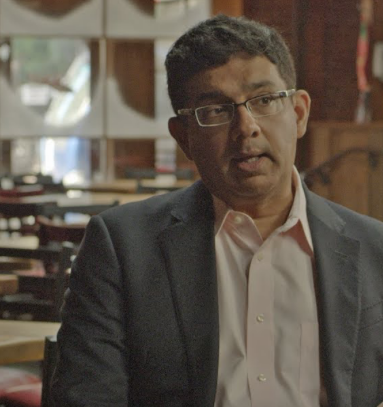
Dinesh D’Souza reveals the big lie about Charlottesville | Western Journal

So the white nationalists are once again coming to Charlottesville. Get ready not only for some bombastic theatrics, but also for a replay of the progressive media’s Charlottesville narrative: Hey, look at those racists in MAGA hats! This proves that, whatever the history of Democratic Party bigotry, racism today is in the Trump column. Bigotry now is on the right.

But this narrative is a lie. First of all, no one has ever conducted a valid empirical survey of neo-Nazis or Ku Klux Klansmen to prove they voted for Trump. This is why the media needs visual images that seem to confirm an unproven thesis. In the aftermath of the initial Charlottesville, I was struck by a solitary white supremacist in a MAGA hat being interviewed by more than a dozen reporters. This one guy — otherwise culturally and politically impotent — was portrayed as visual proof that white nationalism is a malevolent Trump phenomenon.

In my new book, Death of a Nation, I examined the lives of the leading white nationalists in America today. Virtually without exception, they are on the left. Let’s start with Jason Kessler, organizer of last year’s Charlottesville rally. The Southern Poverty Law Center looked into his background and was astounded to discover that he had been an Obama supporter and active in the left-wing Occupy Wall Street movement.

What could be more interesting than to examine why an Obama supporter could become a white supremacist? Or how an Occupy activist transitioned into a defender of the white cause? Yet the progressive media went dead silent on this one. Only one local Charlottesville newspaper, The Daily Progress, bothered to dig into this, noting that Kessler’s previous tweets, his neighbors and several of his friends “attest that he held strong liberal convictions.”

Laura Kleiner is a Democratic activist who dated Kessler for several months in 2013. According to the article, “She said Kessler was very dedicated to his liberal principles, and that he was a strict vegetarian, abstained from alcohol and drugs, embraced friends of different ethnicities, and was an atheist.” Kleiner added of Kessler, “He broke up with me and a lot of it was because I was not liberal enough. I am a very progressive Democrat, but he didn’t like that I’m a Christian.”

I mentioned Kessler’s leftist background on social media and he lashed out angrily by releasing a video denouncing me. The video itself is rambling, incoherent and laced with obscenities. The most interesting thing about it is that Kessler attacks me as a rich, brown-skinned guy who only stands up for big business and special interests. In other words, notwithstanding his disavowal of my portrait of him, Kessler sounds just like the left-wing racist I made him out to be.

Andrew Anglin is the co-editor of the neo-Nazi website Daily Stormer. In March 2007, Anglin posted about Donald Trump, attaching a video clip from a roast of former New York mayor Rudy Guiliani. Giuliani appears in the video in drag, and Trump rams his face into Giuliani’s chest. It was all apparently in fun. Even so, Anglin describes them both as “fags” and writes that Giuliani is clearly involved in a “twisted homosexual transvestite affair with Donald Trump.”

Anglin visited Southeast Asia in 2010-2011 where he became a rainforest activist, dated Filipina women, and railed on his podcast against Christian missionaries. “You see the way white people — and it is white people — went around the whole world and f***ed everybody. I think the white race should be bred out.” This was a sentiment he routinely expressed.

Lisa Turner, women’s coordinator of a white nationalist group called the World Church of the Creator — which is interestingly enough an atheist organization — insists that the greatest problem in the world is Christianity. “The philosophy behind Christianity,” she says, “is utterly poisonous. Turn the other cheek, love your enemy—these kinds of ideas have put a guilt trip on the white race. The biggest enemies we have out there are the Christian churches.” Doesn’t sound very much like Trump to me.

Finally, there is Richard Spencer, the poster boy of white supremacy, who is so controversial that when he showed up to speak in Florida the governor declared a state of emergency. Spencer is unfailingly portrayed in the mainstream media as a right-winger. To check this out, I interviewed Spencer for my new movie Death of a Nation. The film is now out nationwide, and when the audiences hear Spencer describe his convictions in his own words, they gasp out loud.

Why? Because it becomes clear that Spencer is no conservative; in fact, he is firmly on the left. He flatly rejects the idea that “all men are created equal.” He insists that rights don’t come from God; they come from the centralized state. He rejects the Reagan agenda of individual liberty and free market capitalism, embracing the concept of an expanded welfare state including nationalized health care. He doesn’t think Reagan was a great president, naming as his favorites a series of Democratic presidents including Democratic Party founder Andrew Jackson. At one point he breaks down and confesses he’s a progressive.

What really blows away the audience is not merely Spencer’s left-wing politics, but the full realization that we have all been victims of a bogus narrative. Some white nationalists collaborate in this narrative, because it brings fame and notoriety to their otherwise powerless group. In exchange they provide the mainstream media with an ideological script extremely useful to the left. But the script is fake, because in reality conservatives and white nationalists are not only in different camps, they are in opposed camps.

Source: Dinesh D’Souza

JFK to 911 Everything Is A Rich Man’s Trick (film) | YouTube & IMDB

Authoritatively written and narrated by Francis Richard Conolly, the film begins its labyrinthine tale during the era of World War I, when the wealthiest and most powerful figures of industry discovered the immense profits to be had from a landscape of ongoing military conflict. The film presents a persuasive and exhaustively researched argument that these towering figures formed a secret society by which they could orchestrate or manipulate war-mongering policies to their advantage on a global scale, and maintain complete anonymity in their actions from an unsuspecting public. Conolly contends that these sinister puppet masters have functioned and thrived throughout history – from the formation of Nazism to the build-up and aftermath of September 11.

Source: IMDB & YouTube

Big tech’s censorship of conservative users is alive and well | The Hill

By Christie-Lee McNally

study released by the Pew Research Center in late June has once again brought to the surface a key issue of the Obama-era Title II net neutrality regulations: America’s concern about big tech’s approach to privacy, censorship and political bias and how Obama ignored it.

The study found that “seven-in-ten Americans think it likely that social media companies intentionally censor political views they find objectionable.”

The majority of us Americans agree that it is necessary for online platforms to regulate hate speech or intervene when users are engaging in harassing or threatening behavior. However, big tech companies like Facebook, Google and Twitter have taken this practice too far and have created their own definitions of hate speech, censoring political viewpoints that differ from the left-leaning ideologies of the companies’ leadership.

The Pew study found that 72 percent of the American public thinks it “likely that social media platforms actively censor political views that those companies find objectionable.” Well, unfortunately for consumers, it isn’t “likely” happening — it is happening.

In January, Project Veritas exposed Twitter for “shadow banning” conservative profiles, meaning the users were blocked from the platform without even being notified. Further, a shadow-banned user’s followers won’t even know they’ve been blocked, as they will still appear to exist, but won’t show up in search results or anywhere else on Twitter. “Although Twitter presents itself as politically neutral, its culture behind closed doors is one of blatant censorship, systematic bias, and political targeting,” said Project Veritas President James O’Keefe.

In June, Google listed “Nazism” as the ideology of the California Republican party, blaming “vandalism” at Wikipedia for the search results. Immediately after apologizing for the California issue, Google again found itself in hot water when a top search result for North Carolina Republican state senator yielded a photo labeling her a bigot.

The list goes on and on. Another list that seems endless is the stream of attacks on Federal Communications Commission (FCC)  Chairman Ajit Pai and his family that continue to be published on Twitter to this day.

The deep pockets in Silicon Valley have focused their efforts to paint Pai in a negative light, claiming he killed the internet and so-called net neutrality. Unfortunately, those false claims stuck and users have taken to social media to support big tech’s sentiment toward Pai, even taking it to horrifying levels in posts that threaten his life and those of his family, yet still remain publicly posted on the platform.

Just last month, one user asked “Kim Jong Un, Russian spies, or any rich person whatsoever to kill Ajit Pai and take him to Hell.” Other users suggested Pai be hanged, forced to gurgle hot bleach, and develop cancer, among other things that are better left unsaid.

It is rich for Silicon Valley firms to assert that the aforementioned examples are not hate speech that should be removed from the internet, but Michigan state Senate candidate Aric Nesbitt’s campaign video that references his pro-life beliefs or Diamond and Silk’s pro-Trump vlogs are “unsafe to the community.”

This is not a hypothetical issue and it is not the least bit surprising that the majority of Republicans think major technology companies as a whole support the views of liberals over conservatives.

What’s more, these companies are growing increasingly negligent when it comes to privacy. For years, big tech has watched our every move online, selling our information to advertisers and political campaigns and have been held accountable to no one. To ensure that they are able to continue to operate unchecked, Silicon Valley is now lobbying Congress under the guise of so-called net neutrality to support a Congressional Review Act (CRA), which would effectively exempt Facebook and Google from any obligation to protect consumers online.

While net neutrality might be an abstract and complicated issue, privacy is not lost on the American people. A meager 24 percent of the public thinks tech companies “do enough to protect the personal data of users.”

It is clear that technology goliaths can no longer remain self-regulated entities. But unfortunately for consumers, the Senate, pushed by the deep pockets of Silicon Valley lobbyists, jammed through the harmful, politically-motivated CRA and sent it to the House.

Now, members of the House of Representatives must oppose this net neutrality CRA and, instead, work with the Senate to pass real consumer internet protection legislation.

It is high past time for Congress to hear the concerns of their constituents and step up to protect us against the dangers that could come from allowing these companies to continue blocking and censoring content.

Source: The Hill