State Dept. ramps up probe into Clinton email server: report | The Hill

Editor’s Note: Getting to the source of the Democrats relentless hatred of President Trump begins with Hillary Clinton’s “reckless” use of a private server during her term as Secretary of State. What did she needed to hide and protect during the Obama Administration? When she lost the 2016 election fair and square with half the nation voting for Trump and the Electoral College casting its ballots as required by the U.S. Constitution, the Democrats began their relentless assault upon a duly elected President. 

The State Department reportedly intensified a probe into former Secretary of State Hillary Clinton’s private email server, contacting dozens of former aides involved in email exchanges that passed through her server.

The Washington Post reported Saturday that as many as 130 former Clinton aides have been contacted by State Department investigators in recent weeks, with many being informed that they have been found “culpable” for transmitting information that should have been classified at a higher level than it was originally sent.

Former Obama administration officials described the probe to the Post as an extraordinary investigation fueled by political animosity.

But current officials speaking on the condition of anonymity told the newspaper that the probe was structured to avoid the appearance of political bias.

The probe, which reportedly reached the stage where former officials began being contacted shortly after Trump’s inauguration, was described by one senior agency official to the Post as having nothing to do with President Trump’s vows to investigate Clinton if elected during the 2016 election.

“This has nothing to do with who is in the White House,” the official said. “This is about the time it took to go through millions of emails, which is about 3½ years.”

“The process is set up in a manner to completely avoid any appearance of political bias,” another official told the Post.

Former officials involved in the probe described it as a political vendetta, with one telling the Post it was an “abuse of power” by the Trump administration.

“It is such an obscene abuse of power and time involving so many people for so many years,” they said. “This has just sucked up people’s lives for years and years.”

The State Department did not immediately return a request for comment from The Hill on the investigation. Trump frequently attacked Clinton during the 2016 campaign for her use of a private email server while at the State Department, with his fans frequently chanting, “Lock her up!” at rallies over her perceived criminal wrongdoing.

A review of Clinton’s email server conducted by the FBI in 2016 found that Clinton had not committed any crimes with her operation of a private server but described her email practices as “reckless.”

Source: The Hill
‘Impeachment’ is nothing less than a full-scale Communist coup attempt by treasonous Democrats who long ago sold out America and the American people for Globalism | Natural News

Editor’s Note: This article is a bit extreme in its wording, but I include it here to document the tenor of the partisan debate about who did what. Is this a conspiracy of the Deep State & Globalists to undermine a duly elected President of the United States and remove him from office? You decide.

In an excellent new story over at CD Media titled “If You Were The Dem Organized Crime Family And About To Be Prosecuted For An Illegal Coup, What Would You Do?” that Whatfinger News had linked to on Wednesdayauthor L. Todd Wood, a graduate of the U.S. Air Force Academy who flew special operations helicopters supporting SEAL Team 6 and Delta Force, argues that criminal Democrats and their enablers within the mainstream media know what is coming and, desperate beyond words, their doomed-to-fail impeachment attempt of President Trump might be the only way to get them out of the huge mess that they are in.

(Article by Stefan Stanford republished from AllNewsPipeline.com)

With Susan Duclos reporting in this story on ANP on Wednesday that ‘the beginning of the end talk being babbled about by Democrats again in their drive to take down President Trump echoes that which they’ve been babbling on now about for nearly 3 years since President Trump took office, even House Democrat Jeff Van Drew knows that “at the end of the day, all we’re going to have is a failed impeachment“.

Yet as Tom Luongo so perfectly points out in this new story republished at Zero Hedge titled “The Coup Has Begun – The Empire Strikes Back Everywherethere are no coincidences in politics. Everything happens on a particular schedule. So when I see a day as crazy as today I have to ask the question, “Why this, why now?”

And as we see in his story, what’s happening politically is by no means just regional here in America – it’s happening all around the world, helping to prove the ‘global nature‘ of ‘globalism‘ and the fact that the globalists are ‘digging in‘ at a time when President Trump just ‘blistered‘ socialism and globalism at the United Nations. From Luongo’s story.:

Look at the headlines and you’ll see what I’m talking about. All of these things happened since I woke up at 7:30am Monday morning in Florida:

  • The British Supreme Court just arrogated unprecedented power to itself by inserting itself into any dispute between the Government and Parliament. This upends more than 300 years of constitutional process.
  • The Democrats have announced they will pursue impeachment charges against President Trump because an unverified, hearsay whistleblower made a complaint about a phone call between Trump and Ukrainian President Volodymyr Zelenski. Impeachment odds soared overnight as someone was tipped off about the Democrats’ plan.
  • Bitcoin’s hashrate mysteriously flash-crashed more than 40% presaging a massive $1500 drop in price.
  • Donald Trump delivered a blistering critique of socialism at the United Nations General Assembly. Too bad he’s nearly as bad as the ones he’s fighting on the far left.
  • Europe’s Trio of Faded Glory — The UK, France and Germany — joined in the chorus of unverified condemnation of Iran in the attack on the Saudi oil field on the 14th.
  • The Federal Reserve continues to bail out banks to the tune of $65 to $75 billion per day through overnight repo operations that no one can give us an explanation as to why they’re needed.
  • This feels to me like a multi-level coup against those that dare stand athwart the global power structure. Both British and American leadership institutions are under sincere attack with these moves.

As we’ll explore in the rest of this ANP story, with everything else that we’ve been watching unfolding in America over the past decade+, one could easily argue that what we’ve been witnessing over the past several years since President Trump was voted into office has been a full-scale Communist coup attempt with Democrats and globalists never, ever believing that Hillary Clinton would lose in 2016 and their beliefs they’d be ‘protected’ from their crimes of treason and completely selling out America and the American people forever.

As Doomer Doug‘ reported in this recent story titled “If Treason Prosper, Then None Dare Call It Treason, the final gasps of the attempted ‘coup d’etat‘ to remove President Trump are now underway with Doug warning in his story that the end results of this could be complete chaos and anarchy in America, potentially leading to Civil War with Democrats insanely still believing they can do no wrong while attempting to overthrow the results of the US election for more than 2 years running now with the ‘coup attempt‘ led by people such as Communist-voting John Brennan.

Read more at: AllNewsPipeline.com

Source: Natural News

Marianne Williamson: ‘The system is even more corrupt than I knew’ | Fox News

Editor’s Note: We love Marianne for her fresh and insightful views originating from as an outsider to mainstream politics. In her appearance in the Democratic candidates debate she pointed out quite astutely that true health care cannot be achieved with the current system in place (whether it’s Obamacare or Medicare for All). The health care system is completely broken and must be rebuilt from the bottom up beginning with prevention and wellness. Thanks for contributing to this most important conversation and acknowledging the important of intelligent debate and civil discourse.

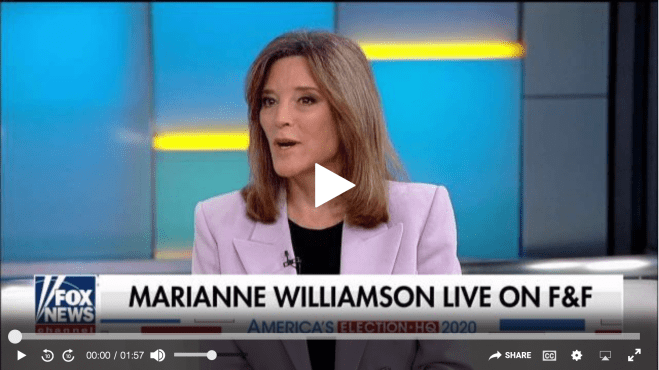
Marianne Williamson, a 2020 presidential hopeful and author, said she’s discovered the political system to be “even more corrupt” than she imagined, during a Tuesday interview with “Fox & Friends.”

“I was known in a world where people loved you and bought things from you. Now I’m in a world where a lot of people hate you,” she said. “I would say that I feel that I’ve learned the system is even more corrupt than I knew and people are even more wonderful than I hoped.”

Williamson also said there is a tendency in politics today to stifle opposing opinions, which weakens democracy and limits genuine debate.

“I have seen on the left as on the right, there are too many people who do not recognize how important honorable debate is in a democracy,” she said.

“You can disagree with somebody’s opinion but that doesn’t mean you should be shutting them down or lying about them or misrepresenting their views. That’s not a left-right issue. There’s a rough-and-tumble in politics.”

Co-host Lisa Boothe asked Williamson if she felt abandoned by the Democratic Party because she didn’t qualify for the upcoming debate, and she said that even if she did, she wouldn’t air her private grievances.

“No, I don’t feel abandoned,” she replied. “I’m a passionate Democrat… My mother always said if you have a problem with your family don’t talk about it outside the family. I’m not going to come on Fox and bad-mouth. The DNC has its rules and, listen, I signed up for this. And I’m playing by those rules”

Source: Fox News

Fake news is real — Artificial Intelligence is going to make it much worse | CNBC

“The Boy Who Cried Wolf” has long been a staple on nursery room shelves for a reason: It teaches kids that joking too much about a possible threat may turn people ignorant when the threat becomes an actual danger.

President Donald Trump has been warning about “fake news” throughout his entire political career putting a dark cloud over the journalism professional. And now the real wolf might be just around the corner that industry experts should be alarmed about.

The threat is called “deepfaking,” a product of AI and machine learning advancements that allows high-tech computers to produce completely false yet remarkably realistic videos depicting events that never happened or people saying things they never said. A viral video starring Jordan Peele and “Barack Obama” warned against this technology in 2018, but the message was not enough to keep Jim Carrey from starring in “The Shining” earlier this week.

The danger goes far beyond manipulating 1980s thrillers. Deepfake technology is allowing organizations that produce fake news to augment their “reporting” with seemingly legitimate videos, blurring the line between reality and fiction like never before — and placing the reputation of journalists and the media at greater risk.

Ben Zhao, a computer science professor at the University of Chicago, thinks the age of getting news on social media makes consumers very susceptible to this sort of manipulation.

“What the last couple years has shown is basically fake news is quite compelling even in [the] absence of actual proof. … So the bar is low,” Zhao said.

The bar to produce a convincing doctored video is lower than people might assume.

Earlier this year a clip purporting to show Democratic leader Nancy Pelosi slurring her words when speaking to the press was shared widely on social media, including at one point by Trump’s attorney Rudy Giuliani. However, closer inspection revealed that the video had been slowed to 75% of its normal speed to achieve this slurring effect, according to the Washington Post. Even with the real video now widely accessible, Hany Farid, a professor at UC Berkeley’s School of Information and a digital forensics expert, said he still regularly receives emails from people insisting the slowed video is the legitimate one.

“Even in these relatively simple cases, we are struggling to sort of set the record straight,” Farid said.

It would take a significant amount of expertise for a fake news outlet to produce a completely fabricated video of Oprah Winfrey endorsing Trump, but researchers say the technology is improving every day. At the University of Washington, computer vision researchers are developing this technology for positive, or at least benign, uses like making video conferencing more realistic and letting students talk to famous historical figures. But this research also leads to questions about potential dangers, as the attempts made by attackers are expected to continually improve.

How to detect a deepfake

To make one of these fake videos, computers digest thousands of still images of a subject to help researchers build a 3-D model of the person. This method has some limitations, according to Zhao, who noted the subjects in many deepfake videos today never blink, since almost all photographs are taken with a person’s eyes open.

However, Farid said these holes in the technology are being filled incredibly rapidly.

“If you asked me this question six months ago, I would’ve said, ‘Yeah, [the technology] is super cool, but there’s a lot of artifacts, and if you’re paying attention, you can probably tell that there’s something wrong,’” Farid said. “But I would say we are … quickly but surely getting to the point where the average person is going to have trouble distinguishing.”

In fact, Zhao said researchers believe the shortcomings that make deepfake videos look slightly off to the eye can readily be fixed with better technology and better hardware.

“The minute that someone says, ‘Here’s a research paper telling you about how to detect this kind of fake video,’ that is when the attackers look at the paper and say, ‘Thank you for pointing out my flaw. I will take that into account in my next-generation video, and I will go find enough input … so that the next generation of my video will not have the same problem,’” Zhao said.

“Once we live in an age where videos and images and audio can’t be trusted … well, then everything can be fake.” – Hany Farid, Professor at UC Berkeley’s School of Information

One of the more recent developments in this field is in generating speech for a video. To replicate a figure such as Trump’s voice, computers can now simply analyze hundreds of hours of him speaking. Then researchers can type out what they want Trump to say, and the computer will make it sound as if he actually said it. Facebook, Google and Microsoft have all more or less perfected this technology, according to Farid.

Manipulated videos of this sort aren’t exactly new — Forest Gump didn’t actually meet JFK, after all. However, Farid says this technology is hitting its stride, and that makes the danger new.

“To me the threat is not so much ‘Oh, there’s this new phenomenon called deepfakes,’” Farid said. “It’s the injection of that technology into an existing environment of mistrust, misinformation, social media, a highly polarized electorate, and now I think there’s a real sort of amplification factor because when you hear people say things, it raises the level of belief to a whole new level.”

The prospect of widespread availability of this technology is raising eyebrows, too. Tech-savvy hobbyists have long been using deepfakes to manufacture pornography, a consistent and comically predictable trend for new technology. But Zhao believes it is only a matter of time before the research-caliber technology gets packaged and released for mass-video manipulation in much broader contexts.

“At some point someone will basically take all these technologies and integrate and do the legwork to build a sort of fairly sophisticated single model, one-stop shop … and when that thing hits and becomes easily accessible to many, then I think you’ll see this becoming much more prevalent,” Zhao said. “And there’s nothing really stopping that right now.”

Facing a massive consumer trust issue

When this happens, the journalism industry is going to face a massive consumer trust issue, according to Zhao. He fears it will be hard for top-tier media outlets to distinguish a real video from a doctored one, let alone news consumers who haphazardly stumble across the video on Twitter.

“Once we live in an age where videos and images and audio can’t be trusted … well, then everything can be fake,” Farid said. “We can have different opinions, but we can’t have different facts. And I think that’s sort of the world we’re entering into when we can’t believe anything that we see.”

Zhao has spent a great deal of time speaking with prosecutors, judges — the legal profession is another sector where the implications are huge — reporters and other professors to get a sense for every nuance of the issue. However, despite his clear understanding of the danger deepfakes pose, he is still unsure of how news outlets will go about reacting to the threat.

“Certainly, I think what can happen is … there will be even less trust in sort of mainstream media, the main news outlets, legitimate journalists [that] sort of react and report real-time stories because there is a sense that anything that they have seen … could be in fact made up,” Zhao said.

Then it becomes a question of how the press deal with the disputes over reality.

“And if it’s someone’s word, an actual eyewitness’ word versus a video, which do you believe, and how do you as an organization go about verifying the authenticity or the illegitimacy of a particularly audio or video?” Zhao asked.

Defeating the deepfakes

Part of this solution may be found in the ledger technology that provides the digital infrastructure to support cryptocurrencies like bitcoin — the blockchain. Many industries are touting blockchain as a sort of technological Tylenol. Though few understand exactly how it works, many swear it will solve their problems.

Farid said companies like photo and video verification platform Truepic, to which he serves as an advisor, are using the blockchain to create and store digital signatures for authentically shot videos as they are being recorded, which makes them much easier to verify later. Both Zhao and Farid are hoping social platforms like Facebook and Twitter will then promote these videos that are verified as authentic over non-verified videos, helping to halt the spread of deepfakes.

“The person creating the fake always has the upper hand,” Farid said. “Playing defense is really, really hard. So I think in the end our goal is not to eliminate these things, but it’s to manage the threat.”

Until this happens, Zhao said the fight against genuinely fake news may not start on a ledger, but in stronger consumer awareness and journalists banding together to better verify sources through third parties.

“One of the hopes that I have for defeating this type of content is that people are just so inundated with news coverage and information about these types of videos that they become fundamentally much more skeptical about what a video means and they will look closer,” Zhao said. “There has to be that level of scrutiny by the consumer for us to have any chance of fighting back against this type of fake content.”

Nicholas Diakopoulos, assistant professor in Northwestern University’s School of Communication and expert on the future of journalism, said via email that the best solutions involve a mix of educational and sociotechnical advances.

“There are a variety of perceptual cues that can be tip-offs to a deepfake and we should be teaching those broadly to the public,” he said.

Diakopoulos has referenced Farid’s work on photo forensics among ideas outlined in an article he wrote for the Columbia Journalism Review last year. He also cited a research project called FaceForensics that uses machine learning to detect, with 98.1% accuracy, whether a video of a face is real. Another research technique under study: Blood flow in video of a person’s face can be analyzed in order to see if pixels periodically get redder when the heart pumps blood.

“On the sociotechnical side, we need to develop advanced forensics techniques that can help debunk synthesized media when put into the hands of trained professionals,” he told CNBC. “Rapid response teams of journalists should be trained and ready to use these tools during the 2020 elections so they can debunk disinformation as quickly as possible.”

Diakopoulos has studied the implications of deepfakes for the 2020 electionsspecifically. He also has written papers on how journalists need to think when “reporting in a machine reality.”

And he remains optimistic.

“If news organizations develop clear and transparent policies of their efforts using such tools to ensure the veracity of the content they publish, this should help buttress their trustworthiness. In an era when we can’t believe our eyes when we see something online, news organizations that are properly prepared, equipped and staffed are poised to become even more trusted sources of information.”

Source: CNBC

Emails Show FBI-Media Collusion against Trump, CA Begins 1.5 Million Inactive Voter Cleanup | Judicial Watch

Source: Judicial Watch/YouTube

Assange psychologically tortured to ‘breaking point’ by ‘democratic states,’ UN rapporteur tells RT | RT.com

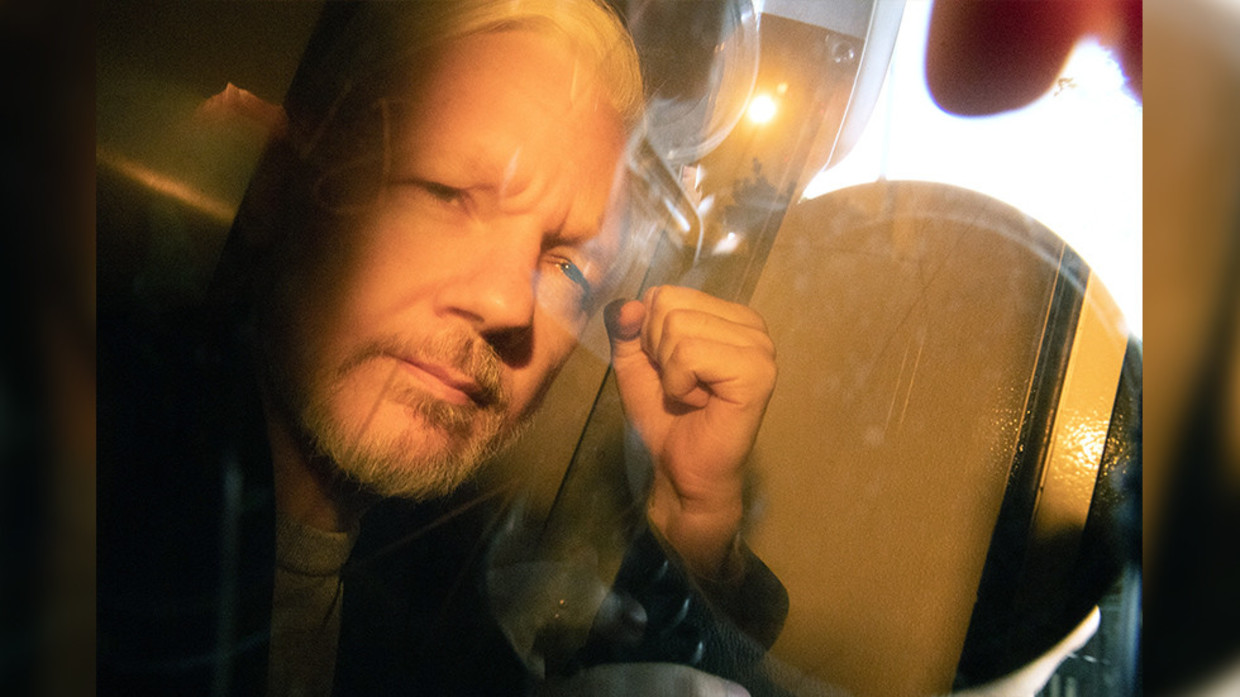
Jailed WikiLeaks co-founder Julian Assange shows clear signs of degrading and inhumane treatment which only adds to his deteriorating health, UN Special Rapporteur on Torture Nils Melzer told RT.

Assange has “all the symptoms typical for a person who has been exposed to prolonged psychological torture,” Melzer told RT’s Afshin Rattansi. This adds to the toll of his deteriorating physical state caused by a lack of adequate medical care for several years, he said.

Melzer said he was judging from two decades of experience in working with POWs and political prisoners, and only after applying “scientific” UN methods to assess Assange’s condition. But the journalist’s case still “shocked” him.

An individual has been isolated and singled out by several democratic states, and persecuted systematically… to the point of breaking him.

Earlier this month, a UK court sentenced the WikiLeaks co-founder to nearly a year in jail for skipping bail in 2012. The courts are now deciding whether to extradite Assange to the US where he is wanted for 17 charges under the Espionage Act. He can end up serving up to 175 years in prison if proven guilty.

Also in May, Sweden reopened an investigation into the allegations of rape by Assange, which he denies. The probe was originally dropped in 2017.

WikiLeaks warned that the journalist’s health had “significantly deteriorated” during the seven years he spent living in the Ecuadorian Embassy in London, and continued to worsen after he was evicted in April and placed in a British prison. According to WikiLeaks, he was recently moved to the prison’s “hospital wing.”


Venezuela’s collapse worst outside of war in decades: Economists say | Business Standard & The New York Times

Editor’s Note: The radical leftists, socialists, communists, Marxists and Democrats wish to take America down this road. Remember the former Soviet Union under Lenin and Stalin. Remember Communist China under Mao. Remember Venezuela and other socialist failures before you vote for this.

Venezuelas fall due to poor governance, corruption and the misguided policies of President Nicolas Maduro and his predecessor Hugo Chavez is the single largest economic collapse outside of war in 45 years, outpacing Zimbabwes crumbling under Robert Mugabe, Cubas disastrous unravelling in the 1990s and the fall of the Soviet Union, economists say.

“It’s really hard to think of a human tragedy of this scale outside civil war,” said Kenneth Rogoff, an economics professor at Harvard University and former chief economist at the International Monetary Fund (IMF).

“This will be a touchstone of disastrous policies for decades to come.”

To find similar levels of economic devastation, economists at the IMF pointed to nations that were ripped apart by war, like Libya earlier this decade or Lebanon in the 1970s, the New York Times reported on Friday.

But Venezuela, at one point Latin America’s wealthiest country, has not been shattered by armed conflict. Instead, economists say, the poor governance, corruption and misguided policies of Maduro and Chavez have increased inflation, shuttered businesses and brought the country to its knees.

And in recent months, the Donald Trump administration has tried to cripple it further by imposing stiff sanctions.

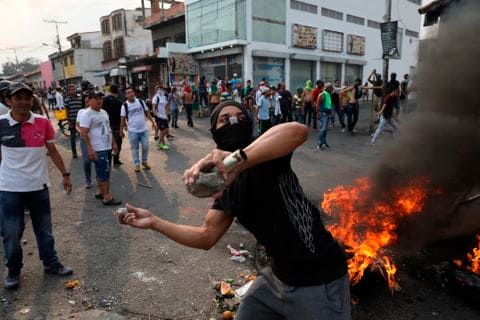
As Venezuela’s economy plummeted, armed gangs took control of entire towns, public services collapsed and the purchasing power of most Venezuelans has been reduced to a couple of kg of flour a month.

In markets, butchers hit by regular blackouts struggle to sell decomposing stock by sunset. Former labourers scavenge through garbage dumps for leftovers and recyclable plastic.

Dejected retailers make dozens of trips to the bank in hopes of depositing several pounds’ worth of bills made worthless by hyperinflation, the report said.

The crisis has escalated due to American sanctions intended to force Maduro to cede power to the nation’s opposition leader, Juan Guaido. The US sanctions on Venezuela’s state oil company have made it difficult for the government to sell its main commodity, oil.

Together with the American ban on trading Venezuelan bonds, the Trump administration has made it harder for Venezuela to import any goods, including food and medication.

Maduro blames the widespread hunger and lack of medical supplies on the US and its opposition allies – but most independent economists say the recession began years before the sanctions, which at most accelerated the collapse.

Venezuela has the world’s largest proven oil reserves. But its oil output, once Latin America’s largest, has fallen faster in the past year than Iraq’s after the American invasion in 2003, according to data from the Organization of Petroleum Exporting Countries.

It has lost a tenth of its population in the past two years as people fled, setting off Latin America’s biggest ever refugee crisis.

The country’s hyperinflation — expected to reach 10 million per cent this year according to the IMF — is on track to become the longest period of runaway price rises.

“This is essentially a total collapse in consumption,” said Sergi Lanau, Deputy Chief Economist at the Institute of International Finance, a financial trade association.

The institute estimates that the drop in Venezuela’s economic output under Maduro has undergone “the steepest decline by any country not at war since at least 1975”.

By year’s end, Venezuela’s gross domestic product will shrink by 62 per cent since the beginning of the recession in 2013, which coincided with Maduro coming to power, according to the institute’s estimates.

Source: Business Standard & The New York Times

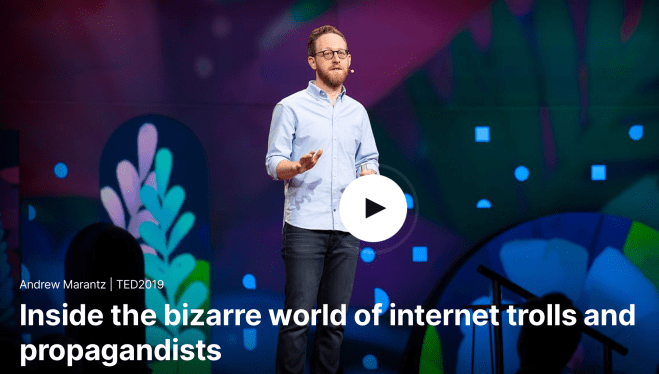
Inside the bizarre world of internet trolls and propagandists | TEDTalks

Journalist Andrew Marantz spent three years embedded in the world of internet trolls and social media propagandists, seeking out the people who are propelling fringe talking points into the heart of conversation online and trying to understand how they’re making their ideas spread. Go down the rabbit hole of online propaganda and misinformation — and learn we can start to make the internet less toxic.

Source: TEDTalks

Unsealed documents shed new light on efforts to verify Trump-Russia dossier | CNN

Documents unsealed this week lend credence to a theory about Russian election meddling that was first put forward in the Trump-Russia dossier, however they do not corroborate the more explosive claims that the Trump campaign colluded with the Kremlin in the 2016 campaign.

A report from a retired agent who worked for the FBI’s cyber division, submitted as expert testimony in a civil lawsuit, presented new evidence about how Russian intelligence might have exploited a private web hosting company when it fooled top Democratic targets into giving up their passwords. The fruits of those hacks formed the basis of the WikiLeaks email dumps that roiled the race.

The controversial dossier had accused Russian hackers of using those companies, Webzilla and its parent company XBT, as part of their scheme to meddle in the presidential election. The memos, written by a retired British spy, Christopher Steele, also claimed that Russian entrepreneur Aleksej Gubarev assisted the cyberattacks “under duress” from Russian intelligence.

Gubarev vehemently denied those allegations and sued BuzzFeed for defamation after it published the dossier. That prompted BuzzFeed to commission the expert witness report from FTI Consulting’s Anthony Ferrante, who is also a CNN contributor. A federal judge dismissed the lawsuit in December, and ordered that dozens of documents be released to the public this week. The judge ruled on First Amendment grounds and did not assess the hacking-related allegations.

Details of the report

The FTI report concluded that one of the hyperlinks the Russians designed to trick Hillary Clinton’s campaign chairman John Podesta into giving up his email password was created on an internet protocol address owned by Root S.A., an XBT subsidiary.
In his deposition, retired FBI cyber official Ferrante admitted the evidence didn’t conclusively show XBT was aware of the Russian campaign against Democrats.

“I will further state that other than the fact that XBT employees did little to nothing to detect, stop and prevent the significant malicious activity, I have no evidence of them actually sitting behind a keyboard,” he said.

Gubarev’s team argued that an internet hosting company couldn’t be held responsible for the activities of people who use its services.
A rebuttal on Gubarev’s behalf, filed by a former CIA cybersecurity expert, Eric Cole, stressed that he and his staff were frequently unaware of the specific activity conducted on its servers.

“XBT/Webzilla is not responsible for every bit of data that a bad actor passes over its infrastructure any more than a post office is responsible for the actions of the Unabomber,” Cole wrote.

“Special Counsel Robert Mueller indicted the 12 Russians responsible for the hacking. Those are the folks responsible, not us,” Evan Fray-Witzer, an attorney for Gubarev, told CNN. The 11-count indictment against those hackers, which was filed in July 2018, did not mention Webzilla or XBT.

BuzzFeed News characterized the report as vindication of its decision to publish the Trump-Russia dossier. “We knew already that publishing the dossier was in the public interest,” spokesperson Matt Mittenthal told CNN. “Now, because BuzzFeed News published the dossier, we’re learning more about the facts of foreign influence in the 2016 presidential election.”

Gubarev sued BuzzFeed in 2017 and sought damages for defamation. As part of the legal process, some of the key players in the dossier saga were deposed, including Steele.

The court unsealed one page of that deposition, which happened last year in London. Steele testified that he tried to verify the allegations against Gubarev by doing, among other things, an “open source search,” which would likely include scouring news clippings and public records.

Steele has years of experience as a British spy in Moscow and has been a trusted source for the FBI. Allies of Democratic nominee Clinton funded Steele’s investigation in 2016. But he was so concerned by his findings that he shared his memo with senior US and UK officials.

In her decision to throw out the case, the judge confirmed that BuzzFeed got the dossier from an associate of Republican Sen. John McCain in December 2016, weeks after the election.

The memos were circulating in Washington, and CNN soon broke the story that senior US intelligence officials had briefed President-elect Trump and President Barack Obama about some of the unverified allegations. Hours later, BuzzFeed published the complete dossier online.
The most salacious allegations in the dossier remain unverified to this day. But the claims that form the bulk of the memos have held up over time, or at least proved to be partially true.

This notably includes Steele’s claim that Russian President Vladimir Putin oversaw an effort to interfere in the 2016 election. It also includes allegations of secret contacts between Trump’s team and the Russians during the campaign. Steele gathered this stunning information months before the Russian meddling campaign was publicly confirmed by US intelligence agencies and in court filings from special counsel Robert Mueller.

Kevin Collier, a cybersecurity reporter for CNN, previously worked for BuzzFeed News.

Source: CNN & BuzzFeed News

FBI releases part of Russia dossier summary used to brief Trump, Obama | Politico

The FBI released for the first time Friday night a two-page summary former FBI Director James Comey used to brief President-elect Donald Trump nearly two years ago on a so-called dossier about Trump’s ties to Russia.

The version made public Friday could reignite previous criticism from Republicans and Trump allies that the FBI was too vague in its description of the fact that the dossier was funded by the campaign of Trump’s nemesis in the 2016 presidential election, Democratic nominee Hillary Rodham Clinton, as well as the Democratic National Committee.

Comey, who was fired by Trump in May 2017, acknowledged during a book tour earlier this year that he did not inform Trump who paid for the research.

The brief passage the FBI left unredacted in the newly released memo gives some background on the former British intelligence officer who compiled the dossier, Christopher Steele, although Steele’s name does not actually appear in the newly released version. The released portion of the synopsis is vague about who financed the project, referring to it as sponsored by “private clients.”

“An FBI source … volunteered highly politically sensitive information … on Russian influence efforts aimed at the US presidential election,” the memo labeled as “Annex A” says. “The source is an executive of a private business intelligence firm and a former employee of a friendly intelligence service who has been compensated for previous reporting over the past three years. The source maintains and collects information from a layered network of identified and unidentified subsources, some of which has been corroborated in the past. The source collected this information on behalf of private clients and was not compensated for it by the FBI.”

“The source’s reporting appears to have been acquired by multiple Western press organizations starting in October,” the document from January 2017 declares.

Comey has said he did not show or give Trump the memo, but used it as a reference when briefing him on the dossier, which U.S. intelligence officials feared Russia might try to use as blackmail against Trump. The synopsis was also used to brief President Barack Obama, officials have said.

Republicans had previously complained that the FBI failed to inform a federal court about the dossier’s provenance — that Steele’s work was commissioned by Fusion GPS, a research firm that had been hired by the Clinton campaign’s law firm, Perkins Coie, to dig up information about Trump’s business relationships overseas. Based in part on the dossier’s information, the court granted an FBI application to surveil a former Trump campaign associate in October 2016.

Aspects of the FBI’s surveillance application have since been released and revealed that the FBI did inform the court that Steele had political animus toward Trump and that it was funded by a politically motivated backer.

The document was released Friday in response to a Freedom of Information Act lawsuit brought by a POLITICO reporter and the James Madison Project, a pro-transparency group.

In January, U.S. District Court Judge Amit Mehta ruled that that the FBI was legally justified in refusing to confirm or deny the existence of any records related to the dossier, despite several tweets from President Donald Trump that described the document as “fake” or “discredited.”

However, shortly after that ruling, Trump declassified a House Intelligence Committee memo that included various claims about the FBI’s handling of the dossier. In August, Mehta said the official release of that material vitiated the FBI’s ability to claim that it had offered no public confirmation of its role in vetting or verifying the dossier, a collection of accurate, inaccurate, unverified and sometimes salacious claims about ties between Russia and various figures in Trump’s circle.

“It remains no longer logical nor plausible for the FBI to maintain that it cannot confirm nor deny the existence of documents” related to attempts to verify information in the dossier, Mehta wrote.

The FBI withheld the remainder of the two-page synopsis on a variety of grounds, including that the material remains classified either Secret or Top Secret. The law enforcement agency also indicated the information is exempt from release because it pertains to ongoing investigations or court proceedings, originated with a confidential source or describes confidential investigative techniques or procedures.

The FBI said Friday it lacked any records indicating final conclusions about any information in the dossier, said Brad Moss, one of the attorneys pressing for release of the records.

“After two years of legal games, the FBI today finally confirmed two pieces of speculation about the scandalous allegations regarding which Director Comey briefed President Trump in January 2017: all of those allegations remain part of the ongoing Russian ‘collusion’ investigation, and the FBI has not rendered final determinations about the accuracy of any of them,” Moss said. “Far from being debunked, the issues that raised concerns for the Intelligence Community in 2017 remain unresolved to this day.”

Moss said he plans to challenge the FBI’s withholdings in the case and to ask Mehta to order more of the information released.

Source: Politico