Source: Judicial Watch/YouTube

Source: Judicial Watch/YouTube
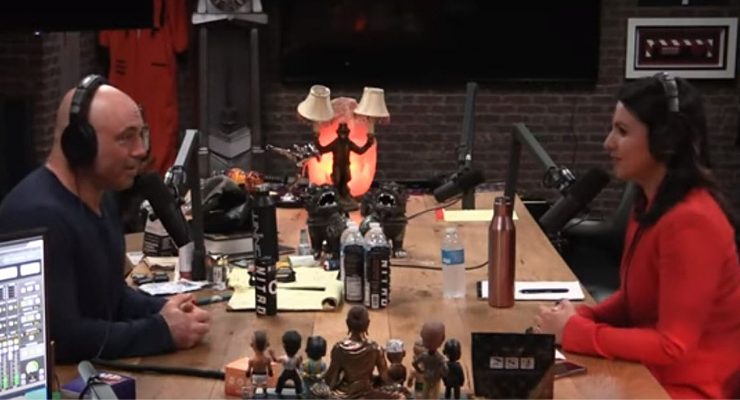 Editor’s Note: An interesting discussion of whether to reward or punish whistleblowers such as Snowden or Assange. Gabbard suggests that we encourage truth telling by insiders. I agree with her.
In midst of an interesting and wide-ranging discussion on the Joe Rogan Experience, Democratic congresswoman and presidential candidate Tulsi Gabbard said that if elected president she would drop all charges against NSA whistleblower Edward Snowden and WikiLeaks founder Julian Assange.
“What would you do about Julian Assange? What would you do about Edward Snowden?” Rogan asked in the latter part of the episode.
“As far as dropping the charges?” Gabbard asked.
“If you’re president of the world right now, what do you do?”
“Yeah, dropping the charges,” Gabbard replied.
Rogan noted that Sweden’s preliminary investigation of rape allegations has just been re-opened, saying the US government can’t stop that, and Gabbard said as president she’d drop the US charges leveled against Assange by the Trump administration.
“Yeah,” Gabbard said when asked to clarify if she was also saying that she’d give Edward Snowden a presidential pardon, adding, “And I think we’ve got to address why he did things the way that he did them. And you hear the same thing from Chelsea Manning, how there is not an actual channel for whistleblowers like them to bring forward information that exposes egregious abuses of our constitutional rights and liberties. Period. There was not a channel for that to happen in a real way, and that’s why they ended up taking the path that they did, and suffering the consequences.”
This came at the end of a lengthy discussion about WikiLeaks and the dangerous legal precedent that the Trump administration is setting for press freedoms by prosecuting Assange, as well as the revelations about NSA surveillance and what can be done to roll back those unchecked surveillance powers.
“What happened with [Assange’s] arrest and all the stuff that just went down I think poses a great threat to our freedom of the press and to our freedom of speech,” Gabbard said. “We look at what happened under the previous administration, under Obama. You know, they were trying to find ways to go after Assange and WikiLeaks, but ultimately they chose not to seek to extradite him or charge him, because they recognized what a slippery slope that begins when you have a government in a position to levy criminal charges and consequences against someone who’s publishing information or saying things that the government doesn’t want you to say, and sharing information the government doesn’t want you to share.
And so the fact that the Trump administration has chosen to ignore that fact, to ignore how important it is that we uphold our freedoms, freedom of the press and freedom of speech, and go after him, it has a very chilling effect on both journalists and publishers. And you can look to those in traditional media and also those in new media, and also every one of us as Americans. It was a kind of a warning call, saying Look what happened to this guy. It could happen to you. It could happen to any one of us.”
Gabbard discussed Mike Pompeo’s arbitrary designation of WikiLeaks as a hostile non-state intelligence service, the fact that James Clapper lied to Congress about NSA surveillance as Director of National Intelligence yet suffered no consequences and remains a respected TV pundit, and the opaque and unaccountable nature of FISA warrants.
Some other noteworthy parts of Gabbard’s JRE appearance for people who don’t have time to watch the whole thing, with hyperlinks to the times in the video:
I honestly think the entire American political system would be better off if the phoney debate stage format were completely abandoned and presidential candidates just talked one-on-one with Joe Rogan for two and a half hours instead. Cut through all the vapid posturing and the fake questions about nonsense nobody cares about and get them to go deep with a normal human being who smokes pot and curses and does sports commentary for cage fighting. Rogan asked Gabbard a bunch of questions that real people are interested in, in a format where she was encouraged to relax out of her standard politician’s posture and discuss significant ideas sincerely and spontaneously. It was a good discussion with an interesting political figure and I’m glad it’s already racked up hundreds of thousands of views.
Source: The Mind Unleashed
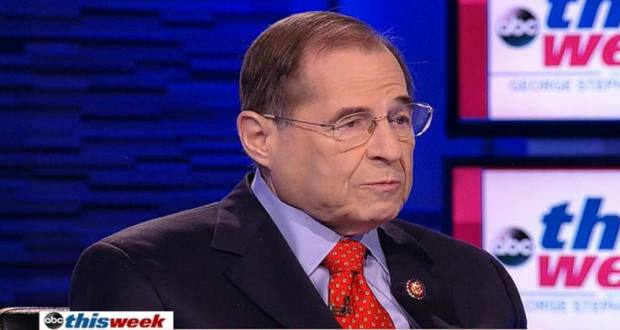 Editor’s Note: What is particularly disturbing is that the Judiciary Committee chairman was associated with the Socialist Party long before he was a U.S. Congressman. Afterwards, he led the Congressional Progressive Caucus which from a policy standpoint is synonymous with the Socialist Party.
Jerrold Nadler, the socialist we will be exposing may surprise many people that really do not know who they elected. Let us hope that becomes true so we can get rid of these socialists within our Congress and Senate and replace them with people who will follow the Constitution rather than the ideology of the socialists they work for.
It was way back in the 1940s when the Socialist Party realized that the Democratic Party had begun to follow the same ideology as the Socialist Party. Just how can we make such a strong statement about the Democratic Party? It is simple. It started with the man who tossed his Socialist Party into the Democratic Party after making the following statement.
“Norman Thomas, the six-time Socialist Party candidate for U.S. President, said the following in a 1944 speech:
“The American people will never knowingly adopt socialism. But, under the name of ‘liberalism,’ they will adopt every fragment of the socialist program, until one day America will be a socialist nation, without knowing how it happened…. I no longer need to run as a Presidential Candidate for the Socialist Party. The Democratic Party has adopted our platform.”
You must be wondering what this has to do with what is going on today.
We will now expose the man named Jerrold Nadler, the man who is working on impeaching or setting up impeachment ideas against President Donald Trump. We decided to look at Nadler because what he was stating sounded an awful lot like what prior socialists such as Elijah Cummings, among others, were saying. After a quick look into Mr. Nadler’s background, we found a very deep association and links to the Socialist Party and links to the Communist Party. Many will say, “So what?” but go back and read just what the Socialist and Communist Parties represent and you will quickly find that they both hate the United States Constitution and they both hate freedom. Both of those very far left parties work toward destroying our nation from within by placing their puppets, like Nadler and others, in office to slowly work their ideology into the American dream.
Here’s the truth about Jerrold Nadler, what he is and why he should never be in the position he is in now or ever.
Nadler got his start in 1992 as shown below.
“In 1992, longtime Democratic U.S. Congressman Ted Weiss died one day before his party’s primary election for New York City’s newly redrawn Eighth District. Using a weighted voting system, a convention of nearly 1,000 Democratic county committee members selected Nadler to replace Weiss on the November ballot. Nadler won easily and has had no serious challenge in any of his congressional re-election bids since then.”
Here we see he won an election from a man that died in office. While there is not much in that, it does go downhill and deep into the socialistic ideology from there.
“Upon his election to the House of Representatives, Nadler promptly joined the Congressional Progressive Caucus and became a leader of the Congressional Pro-Choice Caucus. For an overview of his voting record on a number of key issues during the course of his legislative career, click here.”
So, just after his election, he joins the “Congressional Progressive Caucus.” This is not a good group to be in, but he was very quick to join showing his socialistic ideology was set before his election. Now, just what is the Congressional Progressive Party? Basically speaking, it is just a cover name for the Socialist Party.
But let’s take a brief look at this group that is ever expanding in the Democratic Party.
“The Congressional Progressive Caucus (CPC) was founded in 1991 by Bernie Sanders, a self-identified socialist who had recently been elected to the U.S. House of Representatives. Sanders’ CPC co-founders included House members Ron Dellums, Lane Evans, Thomas Andrews, Peter DeFazio, and Maxine Waters. The Institute for Policy Studies (IPS) was also involved in CPC’s founding and in Caucus activities thereafter; IPS continues to advise CPC on various matters to this day.
Another key player in establishing CPC was the Democratic Socialists of America(DSA), which has maintained a close alliance with the Caucus ever since. In 1997, DSA’s political director, Chris Riddiough, organized a meeting with CPC leaders to discuss how the two groups might be able to “unite our forces on a common agenda.” Among those who participated in the meeting were Bernie Sanders, labor leader Richard Trumka, professor Noam Chomsky, feminist Patricia Ireland, Rev. Jesse Jackson, Senator Paul Wellstone, journalist William Greider, and the socialist author Barbara Ehrenreich.
Beginning in 1997, CPC worked closely with the newly launched “Progressive Challenge, a coalition of more than 100 leftist organizations that sought to unite their activities and objectives under a “multi-issue progressive agenda.” To view a list of many of the major groups that co-sponsored the Progressive Challenge, click here.”
The first thing that should jump out from the page is that this group was started by none other than Bernie Sanders, a very strong socialist. Also, take notice that Maxine Waters is also involved with this, and there will be more on her in a future article. Getting back to Nadler’s association with this group, we also see that it is closely associated with the Democratic Socialists of America, just another Socialist branch of the now-defunct Democratic Party.
Let’s take a look at what Jerrold Nadler has aligned himself with.
“Throughout his years in politics, Nadler has maintained close ties to socialist organizations. In 1977, for instance, he was a member of the Democratic Socialist Organizing Committee (DSOC), and by 1983 he had joined the Democratic Socialists of America (DSA), which grew out of DSOC. On May 1, 1989, Nadler served on the sponsoring committee for a New York DSA screening of the pro-union film Matewan. That same year, he personally asked New York’s DSA to endorse his candidacy for NYC Comptroller. In 1990, Nadler endorsed the New York mayoral campaign of DSA member David Dinkins. In July 1996, DSA’s Political Action Committee endorsed Nadler for Congress. Each year from 1995-97, Nadler spoke at the DSA’s annual Socialist Scholars Conferences, where he participated in panel discussions with such notables as Stanley Aronowitz, William Kornblum, and Frances Fox Piven. According to DSA’s rival Social Democrats USA, Nadler remains a DSA member to this day.”
Here, we see that Jerrold Nadler has maintained very close ties to the Socialist Party and organizations. Do the people in New York know this? Do the People of New York understand what this means? We would have to guess that if they do, they do not understand what the socialist ideology is trying to do to our nation.
Jerrold Nadler was on a panel with known anti-United States individual, Frances Fox Piven, that is a lady who worked hard to destroy the United States and the idea of freedom. Look it up and see her background. Just what we have shown here should be enough for a normal group of people to have an idea that Nadler is not good for their freedom. After all, socialism does not promote freedom. Just look at Venezuela, Cuba, and so many other socialist states.
“In 2003 Nadler, urged on by the ACLU and People For the American Way, introduced legislation aimed at defeating the Bush administration’s Terrorism Information Awareness (TIA) program, which sought to help the government root out terrorists by analyzing and cross-referencing various databases for evidence of suspicious patterns of Internet activity, travel, credit-card purchases, and donations to charities and political causes. By Nadler’s reckoning, the TIA initiative constituted a massive “assault on our rights” and represented “perhaps the closest realization of an Orwellian ‘Big Brother’ government to date.”
Nadler fought to stop a program that would root out terrorists. That does not sound like someone that is out to protect the people who voted for him. However, Nadler doesn’t care because he believes he can never be defeated. Yet, maybe it is just that the people who vote for him have not been told he is a flaming socialist. Nadler is even making a statement that terrorists should not be drawn out if they have in mind to harm this nation. Just look at his words and try to understand how could this man have the people in his district in mind when he stated that. Let us take a look at something that he says below and see how close it resembles what he is now trying to do with President Trump.
“In a similar spirit, Nadler characterized the PATRIOT Act as an example of unnecessary “governmental intrusion” into the lives of Americans. Especially outrageous to Nadler was a PATRIOT Act clause enabling FBI investigators to access library records in the course of a terrorism investigation. “If [Attorney General] John Ashcroft has his way, bookstore customers could be investigated for something as arbitrary as buying Hillary Clinton’s new book,” warned Nadler. “People are outraged,” he added, “by the loss of civil liberties…. The government … should not be in the thought-police business.” Further, Nadler denounced the PATRIOT Act as “little more than the institution of a police state.”
Today, Nadler is making the very statement he hates in the paragraph above.
“People are outraged,” he added, “by the loss of civil liberties…. The government … should not be in the thought-police business.” Further, Nadler denounced the PATRIOT Act as “little more than the institution of a police state.”
Notice the phrase, “The government should not be in the thought police business.” But today he is using that very idea to go after President Trump even after President Trump has been cleared of all charges, or in Nadler’s case, all thoughts. Let us show just what Nadler thinks about our Constitution.
“In January 2011, when the new Speaker of the House, Republican John Boehner, announced his intention to open the year’s first session of Congress with a reading of the U.S. Constitution, Nadler complained that Republicans “are reading it [the Constitution] like a sacred text.” Boehner’s “ritualistic reading” was “total nonsense” and “propaganda,” said Nadler, adding that the document’s need for amendments to abolish slavery and other injustices showed that it was, from its inception, “highly imperfect.”
Here we see that Nadler complained about the reading of our Constitution, calling Boehner’s reading, “Total Nonsense and propaganda.” This is what seems to show his total dislike for the Constitution.
Now, let us show his connections to the Communist Party.
“* In 1997 Nadler was one of 33 original co-sponsors of the Job Creation and Infrastructure Restoration Act which was introduced into Congress by California Rep. Matthew Martinez. This emergency federal jobs legislation, supported by the New York State Communist Party, was designed to create jobs at union wages in financially foundering cities by putting the unemployed to work on infrastructure projects such as rebuilding schools, housing, hospitals, libraries, public transportation, highways, and parks. Rep. Martinez had already introduced an earlier version of this bill in the previous Congress at the request of the Los Angeles Labor Coalition for Public Works Jobs, whose leaders were known supporters or members of the Communist Party USA. To view a list of all the co-sponsors, click here.”
This shows that Jerrold Nadler supported a bill pushed forward by a group associated with the Communist Party. Notice here how the Communist Party works: placing people into jobs for which that may or may not be paid. This is how the Communist Party works: it makes people think it is great because it creates certain jobs and after they get you into their group, then they use you to do their evil bidding. Of course, we all know that Communism has failed everywhere it has grown because it cannot sustain what it lays claim to be.
Let us close with a final show of what Nadler will do to keep his office.
“* During a June 2014 House briefing with Obama administration officials on the recent trade of five high-ranking Taliban commanders in exchange for American Sgt. Bowe Bergdahl, Nadler suggested that the Taliban, as non-state actors, had a status comparable to that of American soldiers who had fought the British during the Revolutionary War. When reports of Nadler’s statement sparked some public controversy, the congressman clarified: “I was told they [the Taliban] were unprivileged combatants, not prisoners of war, and I was trying to figure out the extent of that legal distinction. I was told they wore no uniform so I was curious if that gave them the legal status of militias in the American Revolution — who also did not wear uniforms…. In no way was I comparing their values, their efforts, and their cause to that of our founding fathers, and to suggest otherwise is absurd.”
Nadler quickly changed his tone when people questioned his words.
Maybe today “WE THE PEOPLE” should once again drag him across the rug to explain why he is thinking of placing impeachment charges on President Trump when he has been cleared of everything, not to mention the entire mess began with a very false report about collusion with Russia. By the way, does Nadler even know that once it comes up that the entire Russia idea was false it could overturn everything? No doubt, he would once again be giving a very different explanation to the people.
With all this, we have to wonder if maybe the voters in New York were blindfolded when they voted for him, but he did not have anyone run against him. That is another way the socialists keep winning. They set up districts where no one wants to challenge them.
Jerrold Nadler is a Socialist in Democrat clothing and has ties to the Communist Party too. Why in the world would people vote for an individual who has ties to groups that do not honor or like the Constitution? Don’t you think it is time to get rid of this socialist and replace him with a person who honors the Constitution and freedom?
Source: Metro Voice
 Documents unsealed this week lend credence to a theory about Russian election meddling that was first put forward in the Trump-Russia dossier, however they do not corroborate the more explosive claims that the Trump campaign colluded with the Kremlin in the 2016 campaign.
A report from a retired agent who worked for the FBI’s cyber division, submitted as expert testimony in a civil lawsuit, presented new evidence about how Russian intelligence might have exploited a private web hosting company when it fooled top Democratic targets into giving up their passwords. The fruits of those hacks formed the basis of the WikiLeaks email dumps that roiled the race.
The controversial dossier had accused Russian hackers of using those companies, Webzilla and its parent company XBT, as part of their scheme to meddle in the presidential election. The memos, written by a retired British spy, Christopher Steele, also claimed that Russian entrepreneur Aleksej Gubarev assisted the cyberattacks “under duress” from Russian intelligence.
Gubarev vehemently denied those allegations and sued BuzzFeed for defamation after it published the dossier. That prompted BuzzFeed to commission the expert witness report from FTI Consulting’s Anthony Ferrante, who is also a CNN contributor. A federal judge dismissed the lawsuit in December, and ordered that dozens of documents be released to the public this week. The judge ruled on First Amendment grounds and did not assess the hacking-related allegations.
Details of the report
The FTI report concluded that one of the hyperlinks the Russians designed to trick Hillary Clinton’s campaign chairman John Podesta into giving up his email password was created on an internet protocol address owned by Root S.A., an XBT subsidiary.
In his deposition, retired FBI cyber official Ferrante admitted the evidence didn’t conclusively show XBT was aware of the Russian campaign against Democrats.
“I will further state that other than the fact that XBT employees did little to nothing to detect, stop and prevent the significant malicious activity, I have no evidence of them actually sitting behind a keyboard,” he said.
Gubarev’s team argued that an internet hosting company couldn’t be held responsible for the activities of people who use its services.
A rebuttal on Gubarev’s behalf, filed by a former CIA cybersecurity expert, Eric Cole, stressed that he and his staff were frequently unaware of the specific activity conducted on its servers.
“XBT/Webzilla is not responsible for every bit of data that a bad actor passes over its infrastructure any more than a post office is responsible for the actions of the Unabomber,” Cole wrote.
“Special Counsel Robert Mueller indicted the 12 Russians responsible for the hacking. Those are the folks responsible, not us,” Evan Fray-Witzer, an attorney for Gubarev, told CNN. The 11-count indictment against those hackers, which was filed in July 2018, did not mention Webzilla or XBT.
BuzzFeed News characterized the report as vindication of its decision to publish the Trump-Russia dossier. “We knew already that publishing the dossier was in the public interest,” spokesperson Matt Mittenthal told CNN. “Now, because BuzzFeed News published the dossier, we’re learning more about the facts of foreign influence in the 2016 presidential election.”
Gubarev sued BuzzFeed in 2017 and sought damages for defamation. As part of the legal process, some of the key players in the dossier saga were deposed, including Steele.
The court unsealed one page of that deposition, which happened last year in London. Steele testified that he tried to verify the allegations against Gubarev by doing, among other things, an “open source search,” which would likely include scouring news clippings and public records.
Steele has years of experience as a British spy in Moscow and has been a trusted source for the FBI. Allies of Democratic nominee Clinton funded Steele’s investigation in 2016. But he was so concerned by his findings that he shared his memo with senior US and UK officials.
In her decision to throw out the case, the judge confirmed that BuzzFeed got the dossier from an associate of Republican Sen. John McCain in December 2016, weeks after the election.
The memos were circulating in Washington, and CNN soon broke the story that senior US intelligence officials had briefed President-elect Trump and President Barack Obama about some of the unverified allegations. Hours later, BuzzFeed published the complete dossier online.
The most salacious allegations in the dossier remain unverified to this day. But the claims that form the bulk of the memos have held up over time, or at least proved to be partially true.
This notably includes Steele’s claim that Russian President Vladimir Putin oversaw an effort to interfere in the 2016 election. It also includes allegations of secret contacts between Trump’s team and the Russians during the campaign. Steele gathered this stunning information months before the Russian meddling campaign was publicly confirmed by US intelligence agencies and in court filings from special counsel Robert Mueller.
Kevin Collier, a cybersecurity reporter for CNN, previously worked for BuzzFeed News.
Source: CNN & BuzzFeed News
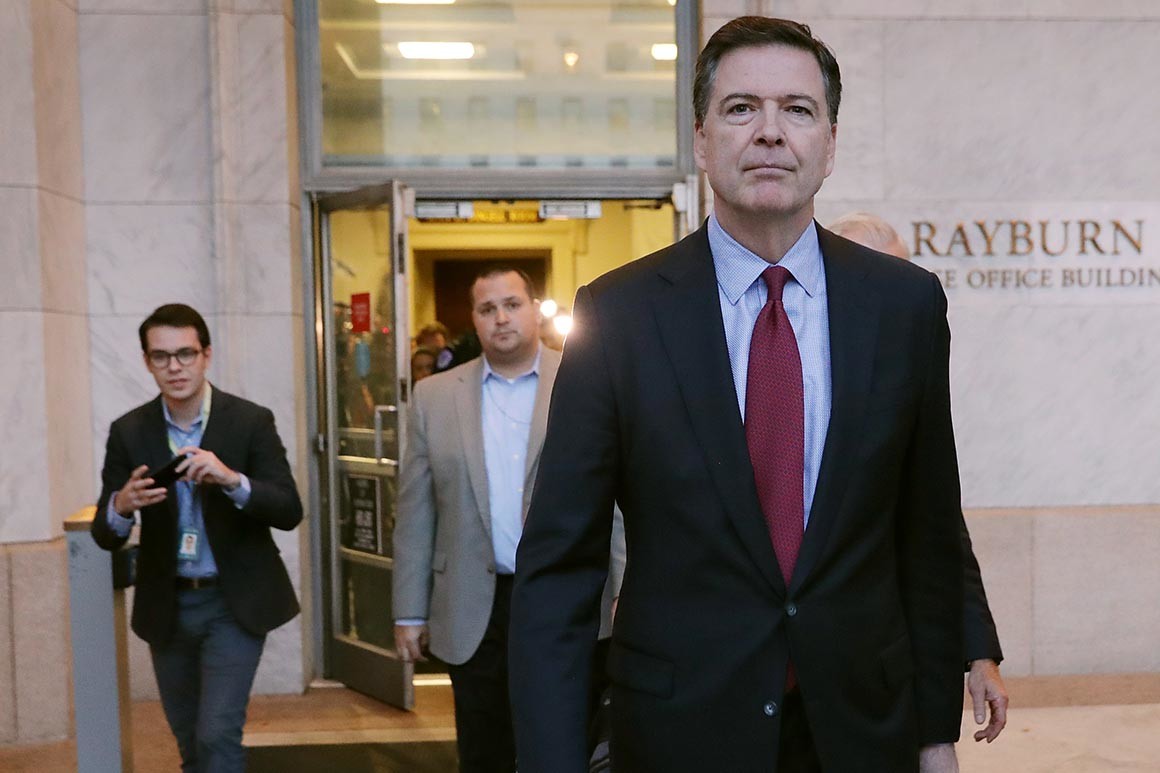 The FBI released for the first time Friday night a two-page summary former FBI Director James Comey used to brief President-elect Donald Trump nearly two years ago on a so-called dossier about Trump’s ties to Russia.
The version made public Friday could reignite previous criticism from Republicans and Trump allies that the FBI was too vague in its description of the fact that the dossier was funded by the campaign of Trump’s nemesis in the 2016 presidential election, Democratic nominee Hillary Rodham Clinton, as well as the Democratic National Committee.
Comey, who was fired by Trump in May 2017, acknowledged during a book tour earlier this year that he did not inform Trump who paid for the research.
The brief passage the FBI left unredacted in the newly released memo gives some background on the former British intelligence officer who compiled the dossier, Christopher Steele, although Steele’s name does not actually appear in the newly released version. The released portion of the synopsis is vague about who financed the project, referring to it as sponsored by “private clients.”
“An FBI source … volunteered highly politically sensitive information … on Russian influence efforts aimed at the US presidential election,” the memo labeled as “Annex A” says. “The source is an executive of a private business intelligence firm and a former employee of a friendly intelligence service who has been compensated for previous reporting over the past three years. The source maintains and collects information from a layered network of identified and unidentified subsources, some of which has been corroborated in the past. The source collected this information on behalf of private clients and was not compensated for it by the FBI.”
“The source’s reporting appears to have been acquired by multiple Western press organizations starting in October,” the document from January 2017 declares.
Comey has said he did not show or give Trump the memo, but used it as a reference when briefing him on the dossier, which U.S. intelligence officials feared Russia might try to use as blackmail against Trump. The synopsis was also used to brief President Barack Obama, officials have said.
Republicans had previously complained that the FBI failed to inform a federal court about the dossier’s provenance — that Steele’s work was commissioned by Fusion GPS, a research firm that had been hired by the Clinton campaign’s law firm, Perkins Coie, to dig up information about Trump’s business relationships overseas. Based in part on the dossier’s information, the court granted an FBI application to surveil a former Trump campaign associate in October 2016.
Aspects of the FBI’s surveillance application have since been released and revealed that the FBI did inform the court that Steele had political animus toward Trump and that it was funded by a politically motivated backer.
The document was released Friday in response to a Freedom of Information Act lawsuit brought by a POLITICO reporter and the James Madison Project, a pro-transparency group.
In January, U.S. District Court Judge Amit Mehta ruled that that the FBI was legally justified in refusing to confirm or deny the existence of any records related to the dossier, despite several tweets from President Donald Trump that described the document as “fake” or “discredited.”
However, shortly after that ruling, Trump declassified a House Intelligence Committee memo that included various claims about the FBI’s handling of the dossier. In August, Mehta said the official release of that material vitiated the FBI’s ability to claim that it had offered no public confirmation of its role in vetting or verifying the dossier, a collection of accurate, inaccurate, unverified and sometimes salacious claims about ties between Russia and various figures in Trump’s circle.
“It remains no longer logical nor plausible for the FBI to maintain that it cannot confirm nor deny the existence of documents” related to attempts to verify information in the dossier, Mehta wrote.
The FBI withheld the remainder of the two-page synopsis on a variety of grounds, including that the material remains classified either Secret or Top Secret. The law enforcement agency also indicated the information is exempt from release because it pertains to ongoing investigations or court proceedings, originated with a confidential source or describes confidential investigative techniques or procedures.
The FBI said Friday it lacked any records indicating final conclusions about any information in the dossier, said Brad Moss, one of the attorneys pressing for release of the records.
“After two years of legal games, the FBI today finally confirmed two pieces of speculation about the scandalous allegations regarding which Director Comey briefed President Trump in January 2017: all of those allegations remain part of the ongoing Russian ‘collusion’ investigation, and the FBI has not rendered final determinations about the accuracy of any of them,” Moss said. “Far from being debunked, the issues that raised concerns for the Intelligence Community in 2017 remain unresolved to this day.”
Moss said he plans to challenge the FBI’s withholdings in the case and to ask Mehta to order more of the information released.
Source: Politico
 The Trump administration did not rise, prima facie, like Venus on a half shell from the sea. Donald Trump is the result of a long process of political, cultural and social decay. He is a product of our failed democracy. The longer we perpetuate the fiction that we live in a functioning democracy, that Trump and the political mutations around him are somehow an aberrant deviation that can be vanquished in the next election, the more we will hurtle toward tyranny. The problem is not Trump. It is a political system, dominated by corporate power and the mandarins of the two major political parties, in which we don’t count. We will wrest back political control by dismantling the corporate state, and this means massive and sustained civil disobedience, like that demonstrated by teachers around the country this year. If we do not stand up we will enter a new dark age.
The Democratic Party, which helped build our system of inverted totalitarianism, is once again held up by many on the left as the savior. Yet the party steadfastly refuses to address the social inequality that led to the election of Trump and the insurgency by Bernie Sanders. It is deaf, dumb and blind to the very real economic suffering that plagues over half the country. It will not fight to pay workers a living wage. It will not defy the pharmaceutical and insurance industries to provide Medicare for all. It will not curb the voracious appetite of the military that is disemboweling the country and promoting the prosecution of futile and costly foreign wars. It will not restore our lost civil liberties, including the right to privacy, freedom from government surveillance, and due process. It will not get corporate and dark money out of politics. It will not demilitarize our police and reform a prison system that has 25 percent of the world’s prisoners although the United States has only 5 percent of the world’s population. It plays to the margins, especially in election seasons, refusing to address substantive political and social problems and instead focusing on narrow cultural issues like gay rights, abortion and gun control in our peculiar species of anti-politics.
In an open and democratic political process, one not dominated by party elites and corporate money, these people would not hold political power. They know this. They would rather implode the entire system than give up their positions of privilege.
This is a doomed tactic, but one that is understandable. The leadership of the party, the Clintons, Nancy Pelosi, Chuck Schumer, Tom Perez, are creations of corporate America. In an open and democratic political process, one not dominated by party elites and corporate money, these people would not hold political power. They know this. They would rather implode the entire system than give up their positions of privilege. And that, I fear, is what will happen. The idea that the Democratic Party is in any way a bulwark against despotism defies the last three decades of its political activity. It is the guarantor of despotism.
Trump has tapped into the hatred that huge segments of the American public have for a political and economic system that has betrayed them. He may be inept, degenerate, dishonest and a narcissist, but he adeptly ridicules the system they despise. His cruel and demeaning taunts directed at government agencies, laws and the established elites resonate with people for whom these agencies, laws and elites have become hostile forces. And for many who see no shift in the political landscape to alleviate their suffering, Trump’s cruelty and invective are at least cathartic.
Trump, like all despots, has no ethical core. He chooses his allies and appointees based on their personal loyalty and fawning obsequiousness to him. He will sell anyone out. He is corrupt, amassing money for himself—he made $40 million from his Washington, D.C., hotel alone last year—and his corporate allies. He is dismantling government institutions that once provided some regulation and oversight. He is an enemy of the open society. This makes him dangerous. His turbocharged assault on the last vestiges of democratic institutions and norms means there will soon be nothing, even in name, to protect us from corporate totalitarianism.
But the warnings from the architects of our failed democracy against creeping fascism, Madeleine Albright among them, are risible. They show how disconnected the elites have become from the zeitgeist. None of these elites have credibility. They built the edifice of lies, deceit and corporate pillage that made Trump possible. And the more Trump demeans these elites, and the more they cry out like Cassandras, the more he salvages his disastrous presidency and enables the kleptocrats pillaging the country as it swiftly disintegrates.
It refuses to critique or investigate the abuses by corporate power, which has destroyed our democracy and economy and orchestrated the largest transfer of wealth upward in American history.
The press is one of the principal pillars of Trump’s despotism. It chatters endlessly like 17th-century courtiers at the court of Versailles about the foibles of the monarch while the peasants lack bread. It drones on and on and on about empty topics such as Russian meddling and a payoff to a porn actress that have nothing to do with the daily hell that, for many, defines life in America. It refuses to critique or investigate the abuses by corporate power, which has destroyed our democracy and economy and orchestrated the largest transfer of wealth upward in American history. The corporate press is a decayed relic that, in exchange for money and access, committed cultural suicide. And when Trump attacks it over “fake news,” he expresses, once again, the deep hatred of all those the press ignores. The press worships the idol of Mammon as slavishly as Trump does. It loves the reality-show presidency. The press, especially the cable news shows, keeps the lights on and the cameras rolling so viewers will be glued to a 21st-century version of “The Cabinet of Dr. Caligari.” It is good for ratings. It is good for profits. But it accelerates the decline.
All this will soon be compounded by financial collapse. Wall Street banks have been handed $16 trillion in bailouts and other subsidies by the Federal Reserve and Congress at nearly zero percent interest since the 2008 financial collapse. They have used this money, as well as the money saved through the huge tax cuts imposed last year, to buy back their own stock, raising the compensation and bonuses of their managers and thrusting the society deeper into untenable debt peonage. Sheldon Adelson’s casino operations alone got a $670 million tax break under the 2017 legislation. The ratio of CEO to worker pay now averages 339 to 1, with the highest gap approaching 5,000 to 1. This circular use of money to make and hoard money is what Karl Marx called “fictitious capital.” The steady increase in public debt, corporate debt, credit card debt and student loan debt will ultimately lead, as Nomi Prins writes, to “a tipping point—when money coming in to furnish that debt, or available to borrow, simply won’t cover the interest payments. Then debt bubbles will pop, beginning with higher yielding bonds.”
An economy reliant on debt for its growth causes our interest rate to jump to 28 percent when we are late on a credit card payment. It is why our wages are stagnant or have declined in real terms—if we earned a sustainable income we would not have to borrow money to survive. It is why a university education, houses, medical bills and utilities cost so much. The system is designed so we can never free ourselves from debt.
However, the next financial crash, as Prins points out in her book “Collusion: How Central Bankers Rigged the World,” won’t be like the last one. This is because, as she says, “there is no Plan B.” Interest rates can’t go any lower. There has been no growth in the real economy. The next time, there will be no way out. Once the economy crashes and the rage across the country explodes into a firestorm, the political freaks will appear, ones that will make Trump look sagacious and benign.
And so, to quote Vladimir Lenin, what must be done?
We must invest our energy in building parallel, popular institutions to protect ourselves and to pit power against power. These parallel institutions, including unions, community development organizations, local currencies, alternative political parties and food cooperatives, will have to be constructed town by town. The elites in a time of distress will retreat to their gated compounds and leave us to fend for ourselves. Basic services, from garbage collection to public transportation, food distribution and health care, will collapse. Massive unemployment and underemployment, triggering social unrest, will be dealt with not through government job creation but the brutality of militarized police and a complete suspension of civil liberties. Critics of the system, already pushed to the margins, will be silenced and attacked as enemies of the state. The last vestiges of labor unions will be targeted for abolition, a process that will soon be accelerated given the expected ruling in a case before the Supreme Court that will cripple the ability of public-sector unions to represent workers. The dollar will stop being the world’s reserve currency, causing a steep devaluation. Banks will close. Global warming will extract heavier and heavier costs, especially on the coastal populations, farming and the infrastructure, costs that the depleted state will be unable to address. The corporate press, like the ruling elites, will go from burlesque to absurdism, its rhetoric so patently fictitious it will, as in all totalitarian states, be unmoored from reality. The media outlets will all sound as fatuous as Trump. And, to quote W.H. Auden, “the little children will die in the streets.”
As a foreign correspondent I covered collapsed societies, including the former Yugoslavia. It is impossible for any doomed population to grasp how fragile the decayed financial, social and political system is on the eve of implosion. All the harbingers of collapse are visible: crumbling infrastructure; chronic underemployment and unemployment; the indiscriminate use of lethal force by police; political paralysis and stagnation; an economy built on the scaffolding of debt; nihilistic mass shootings in schools, universities, workplaces, malls, concert venues and movie theaters; opioid overdoses that kill some 64,000 people a year; an epidemic of suicides; unsustainable military expansion; gambling as a desperate tool of economic development and government revenue; the capture of power by a tiny, corrupt clique; censorship; the physical diminishing of public institutions ranging from schools and libraries to courts and medical facilities; the incessant bombardment by electronic hallucinations to divert us from the depressing sight that has become America and keep us trapped in illusions. We suffer the usual pathologies of impending death. I would be happy to be wrong. But I have seen this before. I know the warning signs. All I can say is get ready.
Source: Common Dreams
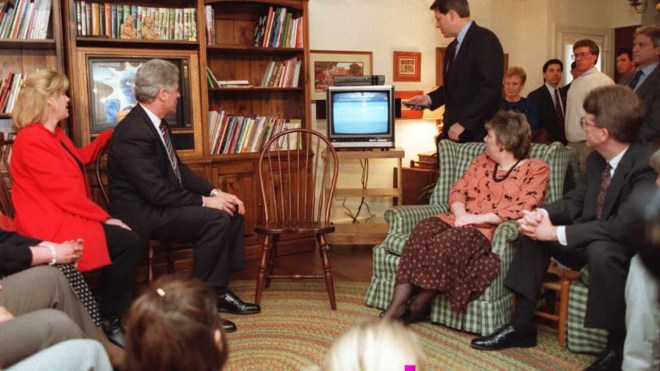 The media has become controlled by a handful of corporations thanks to the Telecommunications Act of 1996.
By Michael Corcoran
Wall Street’s sinister influence on the political process has, rightly, been a major topic during this presidential campaign. But history has taught us that the role that the media industry plays in Washington poses a comparable threat to our democracy. Yet this is a topic rarely discussed by the dominant media, or on the campaign trail.
But now is a good time to discuss our growing media crises. Twenty years ago last month, President Bill Clinton signed the Telecommunications Act of 1996. The act, signed into law on February 8, 1996, was “essentially bought and paid for by corporate media lobbies,” as Fairness and Accuracy in Reporting (FAIR) described it, and radically “opened the floodgates on mergers.”
The negative impact of the law cannot be overstated. The law, which was the first major reform of telecommunications policy since 1934, according to media scholar Robert McChesney, “is widely considered to be one of the three or four most important federal laws of this generation.” The act dramatically reduced important Federal Communications Commission (FCC) regulations on cross ownership, and allowed giant corporations to buy up thousands of media outlets across the country, increasing their monopoly on the flow of information in the United States and around the world.
“Never have so many been held incommunicado by so few,” said Eduardo Galeano, the Latin-American journalist, in response to the act.
Twenty years later the devastating impact of the legislation is undeniable: About 90 percent of the country’s major media companies are owned by six corporations. Bill Clinton’s legacy in empowering the consolidation of corporate media is right up there with the North American Free Trade Agreement (NAFTA) and welfare reform, as being among the most tragic and destructive policies of his administration.
The Telecommunications Act of 1996 is not merely a regrettable part of history. It serves as a stern warning about what is at stake in the future. In a media world that is going through a massive transformation, media companies have dramatically increased efforts to wield influence in Washington, with a massive lobbying presence and a steady dose of campaign donations to politicians in both parties — with the goal of allowing more consolidation, and privatizing and commodifying the internet.
This issue has not been central in the 2016 presidential election. But it is deeply concerning that, of all the presidential candidates running in 2016, the Big Media lobby has chosen to back Hillary Clinton. Media industry giants have donated way more to her than any other candidate in the race, according to data from the Center for Responsive Politics. In light of this, we must be mindful of the media reform challenges we face in the present, as we try to prevent the type of damage to our democracy that was caused by the passing of this unfortunate law.
A Threat to Democracy: The Telecommunications Act and Media Consolidation
When President Bill Clinton signed the Telecommunications Act into law, he did so with great fanfare. The bill, which was lobbied for in great numbers by the communications and media industry, was sadly a bipartisan misadventure — only 3 percent of Congress voted against the bill: five senators and 16 members of the House, including then-Rep. Bernie Sanders.
At the time, President Clinton touted the law as “truly revolutionary legislation … that really embodies what we ought to be about as a country.” House Speaker Newt Gingrich boasted ofprojected consumer savings and private job growth. Rep. John Dingell (D-Michigan) “thanked God” for the bill that would “make this country the best served, the best educated and the most successful country … in all areas of communications.”
Despite all of these glowing words, the consequences of the bill were disastrous. The act “fueled a consolidation so profound that even insiders are surprised by its magnitude,” said one trade publication, according to Robert McChesney, in his book, Rich Media, Poor Democracy: Communication Politics in Dubious Times.
“Before the ink was even dry on the 1996 Act,” wrote S. Derek Turner, research director of Free Press, in a 2009 report proposing a national broadband strategy, “the powerful media and telecommunications giants and their army of overpaid lobbyists went straight to work obstructing and undermining the competition the new law was intended to create.”
Media consolidation was already an extremely pressing concern long before 1996. In 1983, Ben Bagdikian published his groundbreaking book, The Media Monopoly, which revealed that just 50 corporations owned 90 percent of the media. That number gradually dwindled over the coming 13 years and was accelerated by the Telecommunications Act. This has led us to the aforementioned crisis where more than 90 percent of the media is owned by just six companies: Viacom, News Corporation, Comcast, CBS, Time Warner and Disney.
Radio has seen an equally appalling consolidation, which has been horrendous for both news media and music. In 1995, before the Telecommunications Act was passed, companies were not allowed to own more than 40 radio stations. “Since passage of the 1996 Telecommunications Act, Clear Channel [now called iHeartMedia] has grown from 40 stations to 1,240 stations — 30 times more than congressional regulation previously allowed,” according to a report from the Future of Music Coalition.
Local newspapers, too, have been stung by these deregulations. Gannett, for instance, owns more than 1,000 newspapers and 600 print periodicals. Layoffs have been the norm for the company, including at USA Today, the paper with the largest circulation in the country, where layoffs were described as a “total bloodbath” in the American Journalism Review.
Save the Internet: The Next Big Media Battle
There was a lot at stake when media companies lobbied for reform in 1996. There is just as much at stake today in the battle for a free and open press. Not only have big media companies continued to push for more consolidation and mergers, but they are also seeking to commodify and privatize the internet. This has become a major concern for advocates of “net neutrality,” who want to “save the internet,” and ensure it is protected as a public utility with equal access for everybody. An FCC ruling in February 2015 has protected the internet for now, but as Free Press warns, the internet is still “in danger.”
“Net neutrality has made the internet an unrivaled space for free speech, civic participation, innovation and opportunity. Net neutrality prohibits online discrimination and gives any individual, organization or company the same chance to share their ideas and find an audience,” explains Free Press’s website, Save the Internet. “Companies like Comcast and Verizon aren’t used to losing in Washington, and they’ll do everything they can to knock down the Title II protections the FCC approved on Feb. 26, 2015.”
The organization is right to be concerned. One reason for the passage of the Telecommunications Act of 1996, as McChesney wrote in 1997, was the sheer power that the media and communications industry has in Washington. “Both the Democratic and Republican parties have strong ties to the large communication firms and industries, and the communication lobbies are among the most feared, respected and well-endowed of all that seek favors on Capitol Hill.”
Today that power and influence has only increased. “From 2002-2008, the industry increased its spending on lobbying efforts every year,” reports the Center for Responsive Politics. “The streak snapped when the Great Recession set in and most clients cut back on their DC efforts, and then reversed again in 2013. In 2014, cable and satellite providers spent nearly $8.1 [million] on lobbying.”
Big Media’s Relationship With Hillary Clinton
What is most revealing when analyzing the donation patterns of these industries in the data from the Center for Responsive Politics — be it cable television, print and periodicals, radioor telecom services — is that Hillary Clinton is, by far, the largest recipient of donations of any candidate in the 2016 election in either party. In fact, of all the top industries that have donated to Clinton, the TV/movies/music category ranks behind only the securities and investments category. (This data is from reports filed on January 31, 2016, according to the Center for Responsive Politics.)
More troubling is that these filings come on the heels of a report from Politico that the Clinton Foundation has received donations, some of them very large, from most of all the major media companies directly: Viacom, News Corporation, Reuters, NBCUniversal, Newsmax, Time Warner, Mort Zuckerman (owner of US News &World Report and the New York Daily News), Comcast, AOL Huffington Post Media and Robert Allbritton (owner of Politico). George Stephanopoulos, one of ABC News’ most visible journalist and a former staffer for President Clinton, has also been under scrutiny for not disclosing a $75,000 donation to the foundation.
Of course, the Clinton Foundation is not a political campaign and does some philanthropic work. So while this all might be legal, it is extremely unsettling, especially in tandem with all the campaign donations Hillary Clinton has received from the major players in this industry.
In March 2015, for instance, a Comcast executive held a $50,000 per plate fundraiser for Clinton’s super PAC. “Comcast NBCUniversal operates in 39 states and has 130,000 employees across the country,” said company spokeswoman Sena Fitzmaurice at the time. “It is important for our customers, our employees and our shareholders that we participate in the political process.”
Of course, media companies don’t just donate to Clinton, but also to members of Congressfrom both parties. Further, as the Center for Responsive Politics reports, the FCC is filled with “revolving-door” employees, who have been switching back and forth between government work and lobbying for Comcast.
Their aggressiveness in Washington makes them a dangerous enemy in the fight for free and democratic media. In this environment, it should come as no surprise that the position of FCC chairman is typically held by a former lobbyist for the cable industry, such as Tom Wheeler, the current chairman, who was once president of the National Cable and Telecommunications Association, a major opponent of net neutrality.
And while it is good news that Clinton has come out in favor of net neutrality, it is a reasonable fear that she could change her views once elected, especially given her relationship with Big Media. It would not be the first time a president has changed a view after being elected, as we learned when Barack Obama embraced a mandate in health care, or when George H.W. Bush raised taxes, despite his infamous promisethat he never would.
It is important to note that, whatever her relationship with the telecommunications industry, it is not fair to blame Hillary Clinton for the Telecommunications Act of 1996. As first lady, Clinton was not in charge of telecommunications policy and there doesn’t appear to be evidence she played a role in constructing or fighting for the law in the White House. In fact, 20 years later, it is difficult to find any public statements from Hillary Clinton expressing her opinion about the law or its impacts. She did address a question at the 2012 YearlyKos convention about the Telecommunications Act. Her response, however, did little to clarify her views on the subject. She said:
You’ll have to ask [then-Vice President] Al Gore. We’ve had a lot of media consolidation. We’ve had some good competition. We have a lot that we need to do to begin to create a more competitive framework. Al was very involved in designing and pushing that through — he is an expert; I am not … We’ve got to take a hard look at this and I don’t want to say something I may not really support. So I have to look at that proposal.
Clinton is now, however, deep into a presidential run and could well be responsible for appointing the head of the FCC. She owes it to voters to describe her views on the Telecommunications Act, and on media consolidation more broadly, in a way that goes beyond advising Americans to “go ask Al Gore.”
Why Media Reform Matters
When McChesney observed that the communications lobby was “among the most feared, respected and well-endowed of all” groups in Washington, he also pointed out one of the great challenges about trying to fight Big Media.
“[The] only grounds for political independence in this case,” he wrote about the debate over the Telecommunications Act, “would be if there were an informed and mobilized citizenry ready to do battle for alternative policies. But where would citizens get informed?”
In other words, how can we have a real debate about media issues, when we depend on that very media to provide a platform for this debate? It is no surprise, for instance, that the media largely ignored the impact of Citizens United after the Supreme Court decision helped media companies generate record profits due to a new mass of political ads. “Super PACs may be bad for America, but they’re very good for CBS,” said CBS president Les Moonves, in a rare moment of candor at an entertainment conference in 2012.
This catch-22 is indeed one of the great difficulties about fighting for a vibrant media and a healthy democracy. But it is a challenge advocates of free media must embrace. Supporting independent media is one important way to help bring light to issues the corporate media ignores.
Media reform is the issue that affects all other issues. As the impact of the Telecommunications Act of 1996 has shown, democracy suffers when almost all media in the nation is owned by massive conglomerates. In this reality, no issue the left cares about — the environment, criminal legal reform or health care — will get a fair shake in the national debate.
Source: This post originally appeared at Truthout.
 Liberty International News