Dr Peter Gøtzsche Exposes Big Pharma as Organized Crime | Health Impact News

Peter C Gøtzsche, MD exposes the pharmaceutical industries and their charade of fraudulent behavior, both in research and marketing where the morally repugnant disregard for human lives is the norm.

The main reason we take so many drugs is that drug companies don t sell drugs, they sell lies about drugs. This is what makes drugs so different from anything else in life… Virtually everything we know about drugs is what the companies have chosen to tell us and our doctors… the reason patients trust their medicine is that they extrapolate the trust they have in their doctors into the medicines they prescribe.

The patients don’t realize that, although their doctors may know a lot about diseases and human physiology and psychology, they know very, very little about drugs that hasn’t been carefully concocted and dressed up by the drug industry… If you don t think the system is out of control, please email me and explain why drugs are the third leading cause of death… If such a hugely lethal epidemic had been caused by a new bacterium or a virus,or even one-hundredth of it, we would have done everything we could to get it under control.

Peter C. Gøtzsche, MD is a Danish medical researcher, and leader of the Nordic Cochrane Center at Rigshospitalet in Copenhagen, Denmark. He has written numerous reviews within the Cochrane collaboration.

Source: Health Impact News

Why Last Night Was Not Just Huge For Pot, But The Entire Criminal Justice System | Think Progress

ProportionalPunishmentBy

Last night wasn’t a good night for Democrats. But when asked instead to vote on issues that many Democrats care about, voters backed progressive ballot initiatives around the country. This is particularly true in the area of criminal justice, which has become a rare point of bipartisanship among some Democrats and Republicans. In a spate of ballot initiatives around the country, voters sent a signal that they are ready to reform a system that has sent more people in the United States to jail than in any other country in the world.

Each of these initiatives embraces a notion known as “Smart on Crime.” The phrase is a replacement for the old adage of “tough-on-crime” and means that, rather than threatening heavy punishments for a long list of so-called crimes, jurisdictions focus instead on doing what actually, empirically, makes communities safer. In reducing or eliminating penalties for some actions that would be better addressed through public health or rehabilitative policies, jurisdictions can focus more resources on serious, violent crimes. Or, as U.S. Attorney General Eric Holder put it last year, “Too many people go to too many prisons for far too long for no good law enforcement reason.”

Marijuana

Alaska, Oregon, and Washington, D.C. put pot legalization on the ballot, and all three passed it. As of last night, there are now more than double the number of jurisdictions that have legalized marijuana for recreational use, even as it remains federally prohibited. In Washington, D.C., where African Americans make up almost half the population, the margin of victory was staggering, with voters supporting the measure by a ratio of 7 to 3.

Alaska and Oregon were not as certain to pass the initiatives. But both passed by margins of several points ballot initiatives that don’t just legalize possession and growth of pot, but also its sale and taxation. (Washington, D.C. is not permitted to tax and regulate by ballot initiative, and lawmakers plan to follow up with a bill to achieve this).

In each of these jurisdictions, different messages dominated. In libertarian-heavy Alaska, where pot policy was already liberalized, the focus of the campaign was that marijuana is no less safe than alcohol, and those who use it shouldn’t be penalized differently. In Washington, D.C., by contrast, a significant population of very liberal gentrifiers mixed with longtime African American residents who are sick and tired of criminal justice policies that arrest African Americans for pot at eight times the rate of whites.

Majorities also voted in favor of medical marijuana. In Guam, a measure to pass medical marijuana passed early in the day. And in Florida, a medical marijuana ballot initiative that became heavily politicized with a well-funded opposition movement failed, but only because it required a 60 percent vote to amend the Constitution. Despite the initiative’s failure, a solid majority — 58 percent — voted in favor of the measure. The initiative’s loss is still a bit of a surprise, because polls have shown that support among Florida residents for the idea of medical marijuana is as high as 90 percent. In fact, lawmakers passed a much narrower medical marijuana provision last year that, remarkably, had the support of almost every state lawmaker. If their goal in passing it was to pick off support for the more expansive measure on the ballot, they succeeded.

Rounding off the evening, two cities in New Mexico — Santa Fe and Bernalillo — voted to decriminalize pot.

The statewide initiatives won’t go into effect today. There will be months of policy-making, political wrangling, and pushback from Congress. But majorities in every jurisdiction where the question was posed voted to reduce the penalties for marijuana.

Proportional Penalties

In California, voters passed an initiative that embraces that Smart on Crime notion in a more comprehensive way. Proposition 47 reduces the penalties for low-level nonviolent offenses including many drug and property crimes, on the notion that locking people up who haven’t done anything dangerous doesn’t do anybody any good. The initiative changes a number of offenses from felonies to misdemeanors, meaning the sentence for conviction is much lower, and that the impact on an individual’s criminal record won’t be as significant. Many job and voting restrictions, for example, only apply to felonies. Offenses that will be affected by the measure include drug possession offenses, as well as shoplifting, credit card fraud, and forgery.

The initiative also means that some 10,000 individuals already behind bars will be eligible for re-sentencing. This is particularly relevant for California, which has been struggling to reduce its prison population since the U.S. Supreme Court declared its prisons so overcrowded that they violate the Eighth Amendment prohibition against cruel and unusual punishment.

With a passage rate of 58 percent, the initiative may serve as a model for other states. The state already decriminalized marijuana possession several years ago, and has seen arrests go down without significant adverse consequences.

Bail Reform

In New Jersey, Democrats and Republicans have joined forces over the past year to pass a package of measures that ensure those behind bars are those who pose a greater danger to society, not the ones who can’t afford to pay bail. Lawmakers took up the issue after a study found that some 40 percent of those who are jailed after they are arrested but before their trial or conviction are there simply because they were poor.

The idea behind bail is that individuals who are charged with a crime put up a bond of significant value to increase the likelihood that they will return for future court dates. But the system creates a class divide. Many are charged with bail under $2,500 — a sum that many wealthier individuals can pay, but is completely out of reach for low-income defendants. Those who end up stuck behind bars pending their trial do not have the same capacity to defend their case. They are more likely to eventually plead guilty, and many have called pretrial detention “ransom” intended to extract such guilty pleas.

Two companion bills were passed by the New Jersey legislature to make the bail system less about how much money defendants have, and more about whether they pose a danger to the public. One bill passed by the legislature took income out of the equation for less dangerous offenders by conducting risk assessments of defendants, and allow those not deemed dangerous to participate in a monitoring program until their trail, rather than to sit in jail. A second bill put Tuesday’s ballot initiative before the voters. That ballot initiative asked voters to give judges power to hold the most dangerous offenders behind bars before their trial — even if they could afford bail. By passing this measure Tuesday, the bail reform package is now fully in effect.

Gun Violence

The idea of “Smart on Crime” initiatives is to eliminate the counterproductive criminal policies and re-allocate resources toward those policies that actually reduce violent crime. To that end, some might also consider it a win that in Washington State (where pot is already legal), voters both approved a measure to close a loophole in firearms background checks, and rejected a competing ballot initiative that would have narrowed the state’s gun laws. The measure means that gun sellers and buyers can’t get around limitations on who can own a guy by selling them in private online sales or at gun shows.

Source:  Think Progress

World’s first legal recreational marijuana sales begin in Colorado Read more: World’s first legal recreational marijuana sales begin in Colorado | The Denver Post

First Legal Marijuana Sales in ColoradoIn a historic swirl of commerce and cannabis, the world’s first stores licensed to sell marijuana legally to anyone 21 or older opened in Colorado on Wednesday.

From Telluride to Denver, thousands of people cheerfully stood in lines for hours to buy legal marijuana after presenting nothing more than identification.

Marijuana activists hailed the day as a watershed in their effort to overturn anti-cannabis laws. Store owners — several of whom said the turnout exceeded even their own ambitious expectations — feared running out of supply.

Police reported no problems with the crowds, and government officials marveled at the calm.

Overall, the day went as marijuana activists had hoped it would: In the most extraordinary way possible, it was ordinary.

“I’ve been waiting 34 years for this moment,” enthused Chrissy Robinson, who arrived at one store, Evergreen Apothecary in Denver, at 2 a.m. to be among the first in line. “I’ve been smoking since I was 14. No more sneaking around.”

At least 37 stores across the state were fully licensed and opened to sell marijuana to anyone 21 or over for any purpose, according to official lists and Denver Post research. Sales could commence at 8 a.m., and activists — who campaigned for the marijuana-legalization measure whose passage in November 2012 made the sales possible — arranged a ceremonial “first purchase” at the Denver store 3D Cannabis Center.

The store used to be called “Denver’s Discreet Dispensary,” so the name change speaks to the rapid evolution of Colorado’s marijuana industry, which began in earnest only about four years ago. 3D Cannabis Center owner Toni Fox watched the clock carefully as the hour approached and dozens of reporters and photographers crowded into one of her store’s tiny purchasing areas.

“It’s 8 a.m.,” she said. “I’m going to do it.”

The first customer was 32-year-old Sean Azzariti, an Iraq war veteran who campaigned for marijuana legalization and said he uses cannabis to alleviate symptoms of post-traumatic stress disorder. Under a canopy of cameras, Azzariti bought an eighth of an ounce of the marijuana strain Bubba Kush and a package of marijuana-infused candy truffles.

“We did it!” a beaming Azzariti said at the end of the purchase.

The cost was $59.74, including $10.46 in tax. At the bottom of the receipt was the message “Thank you for your purchase!”

“I’m confident these businesses will perform and be a good example of how states can regulate marijuana,” activist Mason Tvert said just prior to the store’s first purchase. “Today, there will be people around the country buying marijuana. But only in Colorado will they be buying it in stores like this one.”

Source: Denver Post


State Marijuana Laws Map | Governing

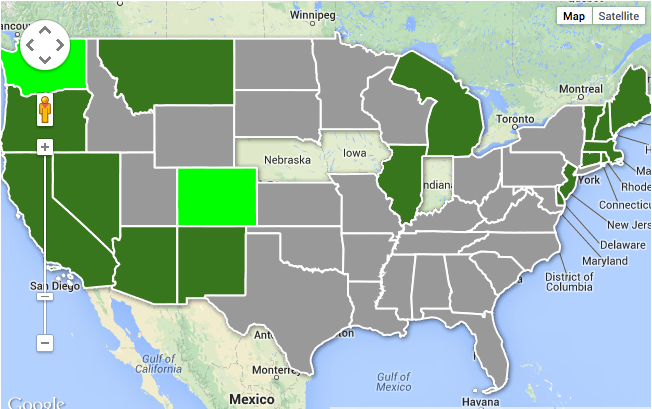
Twenty states and the District of Columbia now have laws legalizing marijuana in some form.

So far, only Colorado and Washington state have legalized marijuana for recreational use, while other states permit medical marijuana.

A limited medical marijuana law most recently went into effect Oct. 1 in Maryland, allowing authorized academic medical centers and research centers to distribute it. However, patients are not expected to be able to sign up for the program until 2015.

Illinois legalized medical marijuana with a law establishing a pilot program set to be implemented in January.

The map below show states permitting marijuana use for medical and recreational purposes.

Information below is current as of December 2013 and includes ballot measures approved in the 2012 elections that have yet to take effect:

MarihuanaMap

Source: Governing

Modern Prohibition Takes It On The Chin With Uruguay’s Marijuana Legalization | Dollar Vigillante

Uruguay became the first country to legalize marijuana completely yesterday.

We’re not just talking about “decriminalizing” it, or allowing recreational use while still prosecuting pot’s cultivation and selling. The government will still limit amounts to six plants per home per year. And as with alcohol purchases in the US, selling pot in Uruguay will require a license.

In typical government meddling fashion, allowing personal use but not production and sale made a mockery of sense. Speaking of mockeries of sense, the usual arguments about marijuana being a “gateway” drug were out in force among the drug warriors. Colorado Senator Alfredo Solari, whose state is set to alllow its first legal weed sales in just a few days, said, “Competing with drug traffickers by offering marijuana at a lower price will just increase the market for a drug that has negative effects on public health.”

Apparently it is much, much better for “public health” for prohibition to breed cartel and gang violence, which is the inevitable result when politicians use their armed enforcers to prevent people from engaging in the procurement and consumption of something they really, really enjoy.

You know how most of the world laughs at alcohol prohibition now? Well, in the future they’ll laugh at us for not being able to see that prohibition of other substances was just as silly and destructive. Prohibition doesn’t actually stop anyone who wants drugs from getting drugs. It just makes the drugs a lot more expensive while adding a thick layer of violence and danger in the resulting black market.

It also gives government opportunity to fill its cages with non-violent drug consumers and low-level retailers, all of whom have their chances for employment permanently ruined as a result. That, however, is a mild insult added to the injury of incarceration resulting in their brutalization and possible rape.

So when people like Senator Solari talk about negative effects on public health, we can’t help but think that the same number people getting high without the cartels, gangs and government kidnappings represents an incalculable improvement in public health. Hell, it would be great if a few more people got high if it meant an end to police home raids, corner pushers and cartel mass murders. Busybodies and the fully propagandized will blanch, but a little pot next to the whiskey in the liquor cabinet will mean society becomes richer, happier and more peaceful. That’s what happens when you diminish ugly bits of political violence like prohibition.

The drug that has a negative effect on public health is violence itself, a substance to which politicians and their world of enablers are severely addicted. They love using violence to get people to do what they want. Violence, however, begets more of the same. Prohibition is the clearest, most demoralizing example of this. Recreational drug use is a personal choice, a matter of aesthetics, but it’s exactly the kind of thing busybodies make a moral and collective issue that presumes ownership of other people. It’s exactly the kind of thing governments can’t help but get in on.

Like we’ve said before, the state is a self-licking ice cream cone; it creates its own demand. By manufacturing a crime, states create the need for their brand of monopolized, violent policy enforcement. But marijuana prohibition is now so nakedly absurd that it seems that the state is going to have to relent.

It’s still annoying to hear that there will be monitoring of purchases and other regulation, like where one can buy it and how much one can grow per unit of time. For our part we will not be celebrating till all the armed thugs who claim the right to monitor and control people go away. But we can hope that Uruguay’s legalization is another small sign that faith in the state and its proscriptions is flagging.

Portugal decriminalized the individual possession of small amounts of various recreational drugs and has seen addiction rates plummet. Uruguay is also going to see fantastic results.

It’s also important to note that this is happening in Uruguay. This is just another example of why we at TDV, along with many of our clients, are so enthusiastic about South America. TDV Passports offers a very popular passport program from neighboring Paraguay, and in keeping with our PT (Prior Taxpayer/Permanent Traveler) recommendations, clients who opt for the Paraguay citizenship and passport spend much of their time in Uruguay.

While the USSA continues on the road of more imperialism, more fascistic regulation, more inflation and more debt, things are heading in the opposite direction in Latin America. That’s why Latin America, particularly the nation-state of Chile, was chose as the place to found Galt’s Gulch. Imagine yourself with a Paraguayan passport, a home in Galt’s Gulch Chile, and able to get some quality time in Uruguay where they are leading the way in a vital area of freedom. Click here to take your first step.

Source: Dollar Vigillante

DEA, IRS raid Denver area pot businesses | NBC News

By Colleen Slevin and Kristen Wyatt

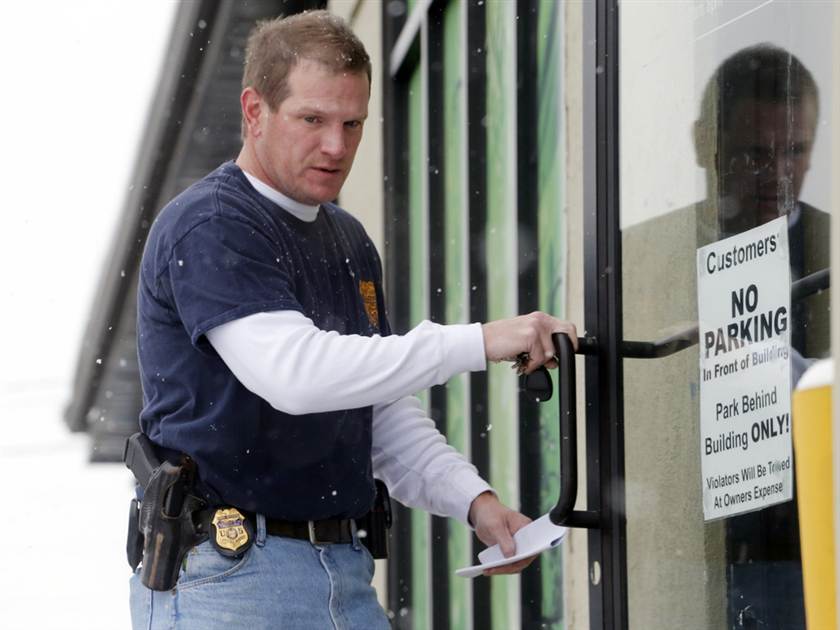
PotRaidsThe raids, conducted on a snowy morning, were the first in Colorado since the U.S. Department of Justice said in August that it wouldn’t interfere with state marijuana laws as long as the states keep the drug away from children, the black market and federal property.

The U.S. Attorney’s Office in Denver said the federal action “comports with the Department’s recent guidance” but would not elaborate. The U.S. Attorney’s Office said authorities were executing sealed search and seizure warrants and wouldn’t disclose how many businesses are being targeted or what they’re being investigated for.

Retail marijuana sales are to begin Jan. 1 in Colorado, though not all municipalities will be ready to go by then. For now, dispensaries are supposed to sell only to people with medical permission to use the drug. Many of the state’s 500 or so existing dispensaries are making plans to convert to recreational sales.

The Justice Department said in August that it wouldn’t stand in the way of votes in Colorado and Washington to legalize recreational pot but warned there needed to be effective controls to keep marijuana away from children, the black market and federal property.

At one of the raided dispensaries, VIP Cannabis, agents took boxes out of the business and loaded them into a U-Haul truck. One officer wore a surgical mask.

In Boulder, agents raided a number of marijuana-growing warehouses, leaving a chest-high pile of marijuana plants on the side of a road before loading them into trucks, The Daily Camera reported.

Colorado’s marijuana industry was quick to point out that the raids did not necessarily mean that the federal government was going back on its word or planning to interfere with Colorado’s plans to a recreational market.

Mike Elliott, a spokesman for the Medical Marijuana Industry Group, said the industry itself has pushed for “robust” regulations and expects industry compliance with lengthy state regulations on how the drug is grown and sold.

“While everyone involved in these raids should be considered innocent until proven guilty, enforcement is a sign that this program is working and maturing,” he said in a statement.

Mason Tvert of the Marijuana Policy Project said it wasn’t clear how many businesses were raided. Many dispensaries and growing warehouses were operating as usual Thursday.

“The Justice Department said it would respect states’ rights to regulate marijuana, and that it would not go after businesses as long as they are complying with state laws,” he said in a statement. “We hope they are sticking to their word and not interfering with any state-regulated, law-abiding businesses.”

Source:

Police Made One Marijuana Arrest Every 42 Seconds in 2012 | U.S. News & World Report

By Steven Nelson

MarihuanaJumpingforJoyResidents of two states voted to legalize marijuana in 2012, but despite an increase in public support for liberalizing drug policy, American police arrested about the same number of people last year on pot-related charges as in 2011.

Data released Monday by the Federal Bureau of Investigation show there were an estimated 1,552,432 arrests for drug-related crimes in 2012 – a slight uptick from the 1,531,251 drug arrests in 2011.

Marijuana offenses accounted for 48.3 percent of all drug arrests, a slight reduction from 49.5 percent in 2011, which itself was the highest rate since before 1995.

Most marijuana-related arrests were for possession of the drug. By mere possession, there was one marijuana arrest every 48 seconds in 2012. Including arrests for distribution, there was a pot-related arrest every 42 seconds, the same interval as in 2011.

Advocacy groups that back campaigns to legalize or decriminalize weed said police should prioritize solving violent crimes – the number of which bumped upward from 2011 to 2012 – over arresting marijuana users.

According to the FBI’s Uniform Crime Report data, there were an estimated 1,214,462 violent crimes reported to police in 2012, a 0.7 percent increase. FBI Director James Comey noted in a statement this was the first overall increase in violent crime in six years.

Just 40.1 percent of the 84,376 forcible rapes reported to police and 28.1 percent of the 354,520 robberies were solved by law enforcement. Around 62.5 percent of the 14,827 murder cases were closed, as were 55.8 percent of the 760,739 aggravated assaults.

“As a former prosecuting attorney myself, I believe it is irresponsible to squander our limited law enforcement resources on this disastrous public policy failure,” said Dan Riffle, Marijuana Policy Project federal policies director, in a statement. “That is especially true when so many violent crimes remain unsolved. Every second spent arresting and prosecuting adults for marijuana is time that could have been spent preventing and solving real crimes.”

The group Law Enforcement Against Prohibition, made up of former and current law-enforcers who want to dampen drug prohibition, said the same.

“Each one of those arrests is the story of someone who may suffer a variety of adverse effects from their interaction with the justice system,” said LEAP Executive Director Neill Franklin, a former Maryland policeman, in a statement. “Commit a murder or a robbery and the government will still give you a student loan. Get convicted for smoking a joint and you’re likely to lose it.”

A poll released in April by the Pew Research Center found 52 percent of American adults believe marijuana should be legal.

It’s possible the national arrest tally for marijuana will be lower in 2013. State and local police enforce most anti-pot laws, and Washington and Colorado residents, who make up around 4 percent of the total U.S. population, will enjoy a largely arrest-free year.

The FBI report said there were 12,196,959 arrests for any reason in 2012, around one every two seconds.

Source: U.S. News & World Report

Legal drugs, deadly outcomes | Los Angeles Times

By Scott Glover & Lisa Girion

Prescription overdoses kill more people than heroin and cocaine. An L.A. Times review of coroners’ records finds that drugs prescribed by a
small number of doctors caused or contributed to a disproportionate number of deaths…A Los Angeles Times investigation has found that in nearly half of the accidental deaths from prescription drugs in four Southern California counties, the deceased had a doctor’s prescription for at least one drug that caused or contributed to the death.

Reporters identified a total of 3,733 deaths from prescription drugs from 2006 through 2011 in Los Angeles, Orange, Ventura and San Diego counties.

An examination of coroners’ records found that:

  • In 1,762 of those cases — 47% — drugs for which the deceased had a prescription were the sole cause or a contributing cause of death.
  • A small cadre of doctors was associated with a disproportionate number of those fatal overdoses. Seventy-one — 0.1% of all practicing doctors in the four counties — wrote prescriptions for drugs that caused or contributed to 298 deaths. That is 17% of the total linked to doctors’ prescriptions.
  • Each of those 71 physicians prescribed drugs to three or more patients who died.

Experts said the findings challenge the prevailing view of what is driving the surge in overdose deaths and should prompt closer scrutiny of doctors and their prescribing practices. Read more…

Source: Los Angeles Times

Portugal Decriminalized All Drugs Eleven Years Ago And The Results Are Staggering | Business Insider

By Samuel Blackstone

PortugalDrugsOn July 1st, 2001, Portugal decriminalized every imaginable drug, from marijuana, to cocaine, to heroin. Some thought Lisbon would become a drug tourist haven, others predicted usage rates among youths to surge.Eleven years later, it turns out they were both wrong.

Over a decade has passed since Portugal changed its philosophy from labelling drug users as criminals to labelling them as people affected by a disease. This time lapse has allowed statistics to develop and in time, has made Portugal an example to follow.

First, some clarification.

Portugal’s move to decriminalize does not mean people can carry around, use, and sell drugs free from police interference. That would be legalization. Rather, all drugs are “decriminalized,” meaning drug possession, distribution, and use is still illegal. While distribution and trafficking is still a criminal offence, possession and use is moved out of criminal courts and into a special court where each offender’s unique  situation is judged by legal experts, psychologists, and social workers. Treatment and further action is decided in these courts, where addicts and drug use is treated as a public health service rather than referring it to the justice system (like the U.S.), reports Fox News.

The resulting effect: a drastic reduction in addicts, with Portuguese officials and reports highlighting that this number, at 100,000 before the new policy was enacted, has been halved in the following 10 years. Portugal’s drug usage rates are now among the lowest of EU member states, according to the same report.

One more outcome: a lot less sick people. Drug related diseases including STDs and overdoses have been reduced even more than usage rates, which experts believe is the result of the government offering treatment with no threat of legal ramifications to addicts.

While this policy is by no means news, the statistics and figures, which take years to develop and subsequently depict the effects of the change, seem to be worth noting. In a country like America, which may take the philosophy of criminalization a bit far (more than half of America’s federal inmates are in prison on drug convictions), other alternatives must, and to a small degree, are being discussed.

For policymakers or people simply interested in this topic, cases like Portugal are a great place to start.

Source: Business Insider

Vaccination Causes Autism – Say US Government & Merck’s Director of Vaccines | Child Health Safety

A New Scientist article 29 June 2010 by Jim Giles states:-

We still do not know what causes autism.

Desperate measures: The lure of an autism cure

That is not correct. Here we set out four ways autistic conditions are caused and confirmed by statements from the current President of pharmaceutical giant Merck’s Vaccines Division, by US Government agencies, by the US Federal Court and in formally published academic journal papers.

If you read nothing else we strongly recommend you read this PDF Download – Text of May 5th 2008 email from US HRSA to Sharyl Attkisson of CBS News].  In it the US Health Resources Services Administration [HRSA] state to CBS News reporter Sharyl Attkisson

We have compensated cases in which children exhibited an encephalopathy, or general brain disease. Encephalopathy may be accompanied by a medical progression of an array of symptoms including autistic behavior, autism, or seizures.” [Text added 10 April 2011]

The first known cause of autism was rubella virus. So not only is New Scientist an unreliable source of information, this cause of autism has been known since the 1960s. And rubella virus is one of the three live viruses in the MMR vaccine.

… rubella (congenital rubella syndrome) is one of the few proven causes of autism.”  Walter A. Orenstein, M.D. US as Assistant Surgeon General, Director National Immunization Program in a letter to the UK’s Chief Medical Officer 15 February 2002.

rubella virus is one of the few known causes of autism.” US Center for Disease Control.
“FAQs (frequently asked questions) about MMR Vaccine & Autism”  [ED 8/Apr/12: This is the web archive of the CDC page – you will need to search in or scroll down the page to see the text.  As papers cited on the original page by the CDC as evidence for no link with the vaccine have been steadily discredited it seems the CDC has decided to remove the page and it seems someone has been deleting the archived versions of the page from the web archive too].

rubella can cause autismThe Pediatrician’s Role in the Diagnosis and Management of Autistic Spectrum Disorder in Children – PEDIATRICS Vol. 107 No. 5 May 2001

Journal references:

Chess, S. Autism in children with congenital rubella. J Autism Child Schizophr. 1, 33-47 (1971).

Chess S. Follow-up report on autism in congenital rubella. J Autism Child Schizophr. 1977;7:69 –81

Ziring PR. Congenital rubella: the teenage years. Pediatr Ann. 1997;6: 762–770

People who are pre-disposed to have a mitochondrial dysfunction can develop autistic conditions following vaccination.  The current President of Merck’s Vaccines Division, Julie Gerberding confirmed to CBS News when she was Director of the US Centres for Disease Control that:

Now, we all know that vaccines can occasionally cause fevers in kids. So if a child was immunized, got a fever, had other complications from the vaccines. And if you’re predisposed with the mitochondrial disorder, it can certainly set off some damage. Some of the symptoms can be symptoms that have characteristics of autism.

HOUSE CALL WITH DR. SANJAY GUPTA – Unraveling the Mystery of Autism; Talking With the CDC Director; Stories of Children with Autism; Aging with Autism – Aired March 29, 2008 – 08:30   ET

Mitochondrial dysfunction is claimed to be “rare” but is not.  It can apply to a minimum of 20% of cases.

And this was said when Gerberding was then head of the US Centres for Disease Control – budget US$11 billion.  It followed from  award winning author and journalist David Kirby breaking the story of the Hannah Poling case, secretly settled by the US Government.  It was after this story broke that it started to be acknowledged that autism has an “environmental” cause and is not solely an “internal” condition [ie not determined solely by genetics]: AUTISM – US Court Decisions and Other Recent Developments – It’s Not Just MMR

Gerberding went from the US agency charged with promoting vaccines [CDC] directly to become vaccine maker Merck’s Director of Vaccines Division: Dr. Julie Gerberding Named President of Merck Vaccines21 Dec 2009 – Merck & Co., Inc.

Autistic conditions can result from encephalopathy following vaccination.  The US Health Resources and Services Administration (HRSA) confirmed to CBS News that of 1322 cases of vaccine injury compensation settled out of court by the US Government in secret settlements:-

We have compensated cases in which children exhibited an encephalopathy, or general brain disease. Encephalopathy may be accompanied by a medical progression of an array of symptoms including autistic behavior, autism, or seizures.[PDF Download – Text of email from US HRSA to Sharyl Attkisson of CBS News]

CBS News Exclusive: Leading Dr.: Vaccines-Autism Worth Study Former Head Of NIH Says Government Too Quick To Dismiss Possible Link – WASHINGTON, May 12, 2008

Vaccine Case: An Exception Or A Precedent? – First Family To Have Autism-Related Case “Conceded” Is Just One Of Thousands – CBS News By Sharyl Attkisson WASHINGTON, March 6, 2008

Measles and mumps are two of the three live viruses in the MMR vaccine. Exposure to live measles or mumps viruses can cause encephalitis:-

measles and mumps can cause significant disability, including encephalitis

The Pediatrician’s Role in the Diagnosis and Management of Autistic Spectrum Disorder in Children – PEDIATRICS Vol. 107 No. 5 May 2001

So there is direct evidence that live measles, mumps or rubella viruses separately can cause encephalitis leading to autism.

More troubling is that this has been known for a long time.  So the risks of giving very young children a vaccine containing three live viruses all at once were known. These two World Health Organisation papers published nearly 40 years ago set out the hazards:

Virus-associated immunopathology : animal models and implications for human disease”:

1. Effects of viruses on the immune system, immune-complex diseases, and antibody-mediated immunologic injury Bulletin of The World Health Organisation. 1972; 47(2): 257-264.

2. Cell-mediated immunity, autoimmune diseases, genetics, and implications for clinical research Bulletin of the World Health Organisation. 1972; 47(2): 265-274.

Autistic conditions can result from acute disseminated encephalomyelitis (ADEM) following MMR vaccination as held by the US Federal Court in the case of Bailey Banks.  In his conclusion, US Federal Court Special Master Abell ruled that Petitioners had proven that the MMR had directly caused a brain inflammation illness called acute disseminated encephalomyelitis (ADEM) which, in turn, had caused the autism spectrum disorder PDD-NOS in the child:

The Court found that Bailey’s ADEM was both caused-in-fact and proximately caused by his vaccination. It is well-understood that the vaccination at issue can cause ADEM, and the Court found, based upon a full reading and hearing of the pertinent facts in this case, that it did actually cause the ADEM. Furthermore, Bailey’s ADEM was severe enough to cause lasting, residual damage, and retarded his developmental progress, which fits under the generalized heading of Pervasive Developmental Delay, or PDD [an autism spectrum disorder]. The Court found that Bailey would not have suffered this delay but for the administration of the MMR vaccine, and that this chain of causation was… a proximate sequence of cause and effect leading inexorably from vaccination to Pervasive Developmental Delay.

[Banks v. HHS (Case 02-0738V, 2007 U.S. Claims LEXIS 254, July 20, 2007)].

And what does not cause autism?

Autism is not “caused” by “genes”

Dr Francis S. Collins, M.D., Ph.D. the 16th and current Director of the US$30.5 billion budget National Institutes of Health [nominated by President Obama: NIH News Release 17th August 2009 ] stated in evidence to US House of Representatives Committee May 2006 when Director of the US National Human Genome Research Institute:

Recent increases in chronic diseases like diabetes, childhood asthma, obesity or autism cannot be due to major shifts in the human gene pool as those changes take much more time to occur. They must be due to changes in the environment, including diet and physical activity, which may produce disease in genetically predisposed persons.

Francis S. Collins, M.D., Ph.D. evidence to US House of Representatives Committee May 2006

Collins controls the US $30.5 billion annual medical research budget and is a leading medical doctor and geneticist who led the Human Genome Project.

Autistic conditions affect 1 in 100 US children.  They affect 1 in 64 British children [1 in 40 are boys] according to a Cambridge University study.

ESTIMATING AUTISM SPECTRUM PREVALENCE IN THE POPULATION: A SCHOOL BASED STUDY FROM THE UK

Conclusions: The prevalence estimate of known cases of ASC, using different methods of ascertainment converges around 1%. The ratio of known to unknown cases means that for every three known cases there are another two unknown cases. This has implications for planning diagnostic, social and health services.”

It is estimated to cost the UK £28 billion per annum [roughly US$42 billion]: [“Economic Consequences of Autism in the UK” – London School of Economics – Study by team led by Professor Martin Knapp [Executive Summary]

Source: Child Health Safety