NASA-Backed Study Says Humanity Is Pretty Much Screwed | Gizmodo

By Robert Sorokonitch

HotEarthHope you’ve enjoyed civilized life, folks. Because a new study sponsored by NASA’s Goddard Space Flight Center says the world’s industrial societies are poised to collapse under the weight of their own unsustainable appetites for resources. There goes the weekend . . . and everything after it for the rest of our lives.

NASA released a statement clarifying its involvement, saying this study “was not solicited, directed or reviewed by NASA. It is an independent study by the university researchers utilizing research tools developed for a separate NASA activity.”

The research article appears in the peer-reviewed scientific journal Ecological Economics, but Dr. Nafeez Ahmed, executive director of the Institute for Policy Research & Development, has a more understandable (but no less harrowing) summary over at The Guardian. Either way, the news isn’t good—as the researchers point out, history doesn’t seem to hold out any favor for advanced societies.

The fall of the Roman Empire, and the equally (if not more) advanced Han, Mauryan, and Gupta Empires, as well as so many advanced Mesopotamian Empires, are all testimony to the fact that advanced, sophisticated, complex, and creative civilizations can be both fragile and impermanent.

Who’s to blame? You. Me. Everyone walking around outside your window. Even the technology we invented to save us from ourselves is contributing to our decline.

Technological change can raise the efficiency of resource use, but it also tends to raise both per capita resource consumption and the scale of resource extraction, so that, absent policy effects, the increases in consumption often compensate for the increased efficiency of resource use.

Is there a way out? Of course. But you’re probably not gonna like it. Dr. Ahmed sums up the researchers’ suggestions:

The two key solutions are to reduce economic inequality so as to ensure fairer distribution of resources, and to dramatically reduce resource consumption by relying on less intensive renewable resources and reducing population growth.

Which is just as difficult and improbable as it sounds.

Seriously, you should read the whole rundown of what the research says. It’s eye-opening, and a serious call to action—if the crushing bleakness of what we’ve done to ourselves hasn’t already doomed you to abandon all hope. Here, watch a funny video to make you feel better. [The Guardian]

Source: Gizmodo

Federal Reserve: 100 years of US dollar

FED USD manipulationBy Clark Kent

Monday 23 December marks the 100th Anniversary of the creation of the Federal Reserve System – the Central Bank of the United States of America.

The mainstream media are keeping remarkably quiet about this key milestone.

No doubt, they know only too well that growing millions of workers inside and outside the US are realizing that a century of central banking monopoly in the hands of a private clique of usurer banksters is enough. More than enough!

‘Twas the night before Christmas…

…when all through the house, not a creature was stirring, not even a mouse”. These words written by 19th Century American poet, Clement Clarke Moore, aptly describe the scene a hundred years ago when the Federal Reserve Act was discretely rubberstamped in the US Congress: true, hardly a mouse was stirring either in the House or in the Senate… But the big rats were definitely there to vote in their act!

1913: Woodrow Wilson was President of the United States; World War One was but eight months away; and three years earlier a very hush-hush meeting had taken place at mega-banker, John Pierpont Morgan’s, private estate on Jekyll Island off the coast of Georgia.

Bloomberg News described this in a February-15, 2012 article as “a secret meeting that launched the Federal Reserve Bank. In November 1910, a group of government and business leaders fashioned a powerful new financial system that has survived a century, two world wars, a Great Depression and many recessions.”

That’s the Bloomberg Version. The ugly truth is probably exactly the opposite: in November 1910 a group of government, banking and business leaders fashioned a powerful new financial system that triggered, promoted and imposed a century of conflict and genocide, including two world wars, a Great Depression, many recessions and systematic mega-banker bailouts using taxpayer’s money.

In 1995, American investigator and author, G. Edward Griffin, published what is clearly the most authoritative book on the “FED” – as it is colloquially called in banking circles and by the mainstream media – “The Creature from Jekyll Island”.

Printing dollars

Griffin’s book describes how a top secret conspiracy – sorry, can’t think of a better phrase – of very high-powered bankers, government officials and foreign agents met to plan the take-over of the American economy, finance and national currency, the US Dollar, to then wage global wars of conquest.

Bloomberg went on to describe how Rhode Island Senator, Nelson Aldrich, whose daughter married John D. Rockefeller Jr, “invited men he knew and trusted, or at least men of influence who he felt could work together: Abram Piatt Andrew, assistant secretary of the Treasury; Henry P. Davison, a business partner of JP Morgan’s; Charles D. Norton, president of the First National Bank of New York; Benjamin Strong, another Morgan friend and the head of the Bankers Trust; Frank A. Vanderlip, president of the National City Bank; and Paul M. Warburg, a partner in Kuhn, Loeb & Co. and a German citizen.”

Paul Warburg was the actual mastermind behind the FED. Interestingly, his main partner at Kühn, Loeb & Co, Jakob Shiff, had just financed the Japanese war against the Russian Tsar; he would later channel 20,000,000 US dollars via a Russian exile living in Brooklyn by the name of Lev Davidovich Bronstein (better known as Leon Trotsky) to ensure the 1917 victory of the Bolshevik Revolution.

Neither ‘Federal’, nor ‘Reserve’, nor a ‘Bank’

Actually, it’s a “system”. Officially, the “Federal Reserve System” wields full control over the US Dollar, not to serve the American people but on the contrary the interests of private bankers, who hold its very special type of stocks and shares.

In practice, the FED is over 95 percent privately-owned, is not integrated into the US Government, nor accountable to any branch of government. There is nothing “Federal” about it as it lies fully outside the government system of checks-and-balances.

Nor does it “Reserve” anything. Rather it arbitrarily prints all the money the mega-bankers and power elites need to keep the “globalized” world rolling in the direction that they wish and need. This includes such things as multi-trillion dollar “quantitative easings” to keep Goldman Sachs, Bank of America, CityCorp, Wachovia and JPMorgan Chase happy and “healthy”; financing clandestine and terror operations to overthrow the governments of Iran, Nicaragua, Argentina, Cuba, Chile, Syria, Libya, Vietnam and many others; waging decades-long wars against Afghanistan, Pakistan, Iraq, Africa and Latin America; unflinchingly supporting “little Israel’s” genocide in Palestine and its “democratic” 400-bomb strong nuclear program; and keeping Wall Street on permanent life-support.

Finally, it is definitely no “Bank” in the sense of a financial institution promoting the credit needs of the real economy for the benefit of the vast majority of the working population’s needs.

Rather, the FED supports the financial needs of the global war system, covert operations, usury, drug dealers, and the global banksters.

Federal reserve

The FED answers to no one. It clearly does not serve “We the People” of the US or anywhere else. Its purpose is to serve the global power elites, regularly meeting to plan world government through entities like the Council of Foreign Relations, Trilateral Commission, Bilderberg, World Economic Forum and others forming part of todays’ intricate planetary web of global money power.

Straight from the horse’s mouth

In a Public Broadcast System (PBS) interview on “News Hour” aired on September 18, 2007, US journalist Jim Lehrer had this Q&A session with former decades-long Fed Chairman (and JP Morgan bank officer) Alan Greenspan:

Jim Lehrer: “What is the proper relationship between a chairman of the Fed and a president of the United States?”

Alan Greenspan: “Well, first of all, the Federal Reserve is an independent agency, and that means, basically, that there is no other agency of government which can overrule actions that we take. So long as that is in place and there is no evidence that the administration or the Congress or anybody else is requesting that we do things other than what we think is the appropriate thing, then what the relationships are don’t frankly matter.”

Huh? If you’re a US citizen, you should re-read the above once or twice.

The FED System lies at the root of US “superpower” status. Allow me to explain how the FED scam really works from the point of view of someone living in Argentina – a very down-trodden country repeatedly made to bite the dust by the global power elites through their local agents imposed upon us through money-power “democracy”.

This means that every time Argentina needs to buy 100 dollars-worth of, say, oil, medicines or technological components, the Argentine people must work to earn those 100 dollars through exports and genuine work.

By comparison, every time the US Government needs to buy 100 dollars-worth of oil, medicines or whatever, all they need to do is tell the Fed to print 100 dollars and that’s that. Let’s just say that this makes it much easier to be a “superpower”.

OK, the mechanism’s not that simple, but this certainly explains schematically how the whole US-Dollar power system really works. It also explains why the elites won’t tolerate anybody challenging the dollar.

Oh, when the Fed… comes marchin’ in…

Look at the world’s oil market. It is a monopoly run by three global trading centers located in New York, London and Dubai. The idea is to ensure that “petro-dollars” flow around the world 24/7, and only incidental small amounts should flow back into the US financial system.

This explains why when in late 2002 Saddam Hussein decided he would do his UN-sanctions authorized “One Billion Dollars Iraqi Oil for Food” trade with the West in euros instead of dollars, he was quickly visited by the Fed’s military branch in March 2003.

Or take Muammar Kaddafi who in 2011 was about to launch a program to trade Libyan and North African oil using a new gold-backed currency – the gold dinar. He too got a little visit from Peace Prize Barack and Babylon Hillary. Do you begin to see the pattern?

But don’t think that the FED’s global financial enslavement system is simply aimed outside the US; it kicked off a century ago by first silently enslaving the very people of the United States it is supposed to serve.

Here’s how that works: every time the US Government decides to put money into circulation – those 1, 5, 10, 20, 50, 100 dollar bills we’re all so familiar with – instead of asking the government mint to print them at a penny’s cost in paper and ink, the government instead asks the private banksters at the Fed to print those bills for the Treasury, in exchange delivering to the Fed interest-bearing US Treasury Bills and Bonds, which translates into trillions of dollars’ in profits funneled to the private banking elite though the Fed.

It was all so well planned a hundred years ago, that just before the Federal Reserve Act was passed on December 23, 1913, they also maneuvered to close this parasitic circle, for if the US Government was to begin making gigantic interest payments to the Fed just for printing its own money, they first needed to have a revenue scheme in place to milk the American taxpayer: the Income Tax Act!

Capitol

Actually, it was the 16th Amendment to the US Constitution passed by Congress in July 1909, and enacted as law in February 1913. Thus international banksters have been ripping off Americans and getting America to fight their wars as proxies for a full century, whilst most of the population haven’t got a clue of what’s going on.

Clearly, the FED lies so far above the US White House, Congress and Supreme Court, that over the past five decades no one has been able to have a proper audit done on its books and numbers. Oh, you Homer Simpsons!

Not that you haven’t been warned. In 1923, Minnesota representative, Charles Lindbergh, father of the famous aviator, sent an early warning: “The financial system has been turned over to the Federal Reserve Board which administers the finance system by authority of a purely profiteering group. The system is private, conducted for the sole purpose of obtaining the greatest possible profits from the use of other people’s money.”

In the 60’s, republican senator and presidential candidate, Barry Goldwater, said “most Americans have no real understanding of the operation of international moneylenders; the accounts of the Federal Reserve system have never been audited; it operates outside the control of Congress and manipulates the credit of the United States.” Today, former representative, Ron Paul, has been sending the same message.

Even president John Kennedy understood this when he issued Executive Order No. 11110 on June 4, 1963, ordering the US Treasury to print zero-interest public money to the tune of 4.3 billion dollars, fully bypassing the Fed. But he too ran into some trouble in Dallas barely five months later on 22 November.

Epilogue: Fed Up?

One would have thought that something as important as whether to continue to allow a private FED to operate in its present format, or revamping it, or even doing away with it after a whole century, would be something that should be squarely on the American and global public agenda… big time!

And yet all we have is silence from the US Government, Congress and politicians; silence from world leaders; total silence from the mainstream media, and from the academic world.

And so you little parasitic mega-bankers running planet Earth: come Monday 23 December you can uncork all the champagne you like and celebrate your “One Hundredth Masters of the Universe Slave Drivers Anniversary”, partying on straight into Christmas Day.

Then, come Thursday 26th, just carry on crucifying the entire world. For you it will be business as usual.

Source: Hang the Bankers
WikiLeaks publishes secret draft chapter of Trans-Pacific Partnership | The Guardian

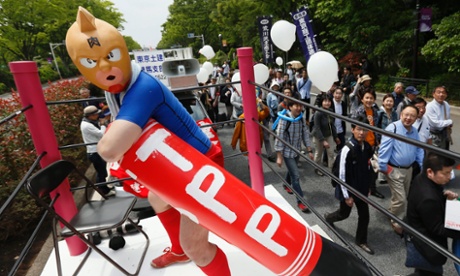
May DayWikiLeaks has released the draft text of a chapter of the Trans-Pacific Partnership (TPP) agreement, a multilateral free-trade treaty currently being negotiated in secret by 12 Pacific Rim nations.

The full agreement covers a number of areas, but the chapter published by WikiLeaks focuses on intellectual property rights, an area of law which has effects in areas as diverse as pharmaceuticals and civil liberties.

Negotiations for the TPP have included representatives from the United States, Canada, Australia, New Zealand, Japan, Mexico, Malaysia, Chile, Singapore, Peru, Vietnam, and Brunei, but have been conducted behind closed doors. Even members of the US Congress were only allowed to view selected portions of the documents under supervision.

“We’re really worried about a process which is so difficult for those who take an interest in these agreements to deal with. We rely on leaks like these to know what people are talking about,” says Peter Bradwell, policy director of the London-based Open Rights Group.

“Lots of people in civil society have stressed that being more transparent, and talking about the text on the table, is crucial to give treaties like this any legitimacy. We shouldn’t have to rely on leaks to start a debate about what’s in then.”

The 30,000 word intellectual property chapter contains proposals to increase the term of patents, including medical patents, beyond 20 years, and lower global standards for patentability. It also pushes for aggressive measures to prevent hackers breaking copyright protection, although that comes with some exceptions: protection can be broken in the course of “lawfully authorised activities carried out by government employees, agents, or contractors for the purpose of law enforcement, intelligence, essential security, or similar governmental purposes”.

WikiLeaks claims that the text shows America attempting to enforce its highly restrictive vision of intellectual property on the world – and on itself. “The US administration is aggressively pushing the TPP through the US legislative process on the sly,” says Julian Assange, the founder and editor-in-chief of WikiLeaks, who is living in the Ecuadorean embassy in London following an extradition dispute with Sweden, where he faces allegations of rape.

“If instituted,” Assange continues, “the TPP’s intellectual property regime would trample over individual rights and free expression, as well as ride roughshod over the intellectual and creative commons. If you read, write, publish, think, listen, dance, sing or invent; if you farm or consume food; if you’re ill now or might one day be ill, the TPP has you in its crosshairs.”

Just Foreign Policy, a group dedicated to reforming US foreign policy, managed to crowdfund a $70,000 (£43,700) bounty for Wikileaks if the organisation managed to leak the TPP text. “Our pledge, as individuals, is to donate this money to WikiLeaks should it leak the document we seek.” The conditions the group set have not yet been met, however, because it required the full text, not individual chapters.

Related to the TPP is a second secret trade agreement, the Transatlantic Trade and Investment Partnership (TTIP), which ties together regulatory practices in the US and EU. George Monbiot, writing in this paper, referred to the treaty as a “monstrous assault on democracy”. Ken Clarke, the minister without portfolio, replied that it “would see our economy grow by an extra £10bn per annum”.

Campaign group Fight for the Future has already collected over 100,000 signatures in an online petition against what it calls the “extreme Internet censorship plan: contained in the TPP.

Evan Greer, campaign manager for Fight for the Future, said: “The documents revealed by WikiLeaks make it clear why the US government has worked so hard to keep the TPP negotiatons secret. While claiming to champion an open Internet, the Obama administration is quietly pushing for extreme, SOPA-like copyright policies that benefit Hollywood and giant pharmaceutical companies at the expense of our most basic rights to freedom of expression online.”

Source: Wikileaks & The Guardian

Ron Paul’s Farewell Address to Congress

Ron Paul: This may well be the last time I speak on the House Floor.  At the end of the year I’ll leave Congress after 23 years in office over a 36 year period.  My goals in 1976 were the same as they are today:  promote peace and prosperity by a strict adherence to the principles of individual liberty.

It was my opinion, that the course the U.S. embarked on in the latter part of the 20th Century would bring us a major financial crisis and engulf us in a foreign policy that would overextend us and undermine our national security.

To achieve the goals I sought, government would have had to shrink in size and scope, reduce spending, change the monetary system, and reject the unsustainable costs of policing the world and expanding the American Empire.

The problems seemed to be overwhelming and impossible to solve, yet from my view point, just following the constraints placed on the federal government by the Constitution would have been a good place to start.

How Much Did I Accomplish?

In many ways, according to conventional wisdom, my off-and-on career in Congress, from 1976 to 2012, accomplished very little.  No named legislation, no named federal buildings or highways—thank goodness.  In spite of my efforts, the government has grown exponentially, taxes remain excessive, and the prolific increase of incomprehensible regulations continues.  Wars are constant and pursued without Congressional declaration, deficits rise to the sky, poverty is rampant and dependency on the federal government is now worse than any time in our history.

All this with minimal concerns for the deficits and unfunded liabilities that common sense tells us cannot go on much longer.  A grand, but never mentioned, bipartisan agreement allows for the well-kept secret that keeps the spending going.  One side doesn’t give up one penny on military spending, the other side doesn’t give up one penny on welfare spending, while both sides support the bailouts and subsidies for the banking and  corporate elite.  And the spending continues as the economy weakens and the downward spiral continues.   As the government continues fiddling around, our liberties and our wealth burn in the flames of a foreign policy that makes us less safe.

The major stumbling block to real change in Washington is the total resistance to admitting that the country is broke. This has made compromising, just to agree to increase spending, inevitable since neither side has any intention of cutting spending.

The country and the Congress will remain divisive since there’s no “loot left to divvy up.”

Without this recognition the spenders in Washington will continue the march toward a fiscal cliff much bigger than the one anticipated this coming January.

I have thought a lot about why those of us who believe in liberty, as a solution, have done so poorly in convincing others of its benefits.  If liberty is what we claim it is- the principle that protects all personal, social and economic decisions necessary for maximum prosperity and the best chance for peace- it should be an easy sell.  Yet, history has shown that the masses have been quite receptive to the promises of authoritarians which are rarely if ever fulfilled. Read more…

Source: Ron Paul

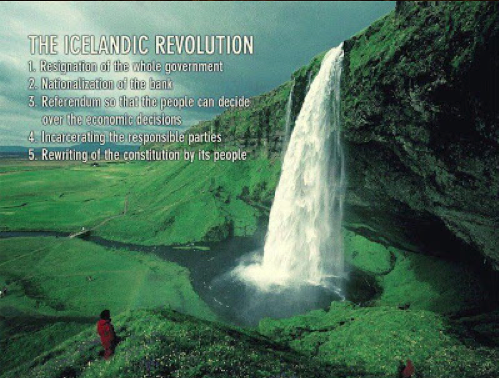
The man who changed Iceland – The message for Greece | Knowledge of Today

The man who forced the government of Iceland to resign and kicked out the IMF representatives from his country, Hordur Torfarson, is now teaching meta-modern democracy throughout Europe. The rest of the world would benefit from following the example set by Iceland: Arresting the corrupt bankers who are responsible for the current economic turmoil.

The true measure of the leader is not how many follower he has, but how many leaders he creates. Too many people hold the idea that psychopaths are essentially killers or convicts. The general public hasn’t been educated to see beyond the social stereotypes to understand that psychopaths can be entrepreneurs, politicians, CEOs and other successful individuals who may never see the inside of a prison. The difference between bankers and the mafia is becoming increasingly indistinguishable.

Control Your Money or Your Money Will Control You Change your attitude toward debt. Every time you use credit for a purchase think,“Debt is slavery; I am making myself a slave.”

“Manipulators rarely advise you to seek new and diverse information or to ‘learn and research for yourself,’ it tends to be safer for exploitative and irresponsible leaders to keep their citizens in the dark; in their view less independent thought is better. Independent thought leads to an inquiring mind, a mindset that eventually leads to the questioning of authority figures, and that is the one thing that inadequate leaders do not want.”

Governments have never existed to solve problems domestic or international. Governments and their institutions exist merely to further and secure the interests of favored groups, but We the People are never the favored group.

Source: Knowledge of Today

Robert Neuwirth: The power of the informal economy | TEDTalks.com

Robert Neuwirth spent four years among the chaotic stalls of street markets, talking to pushcart hawkers and gray marketers, to study the remarkable “System D,” the world’s unlicensed economic network. Responsible for some 1.8 billion jobs, it’s an economy of under appreciated power and scope.

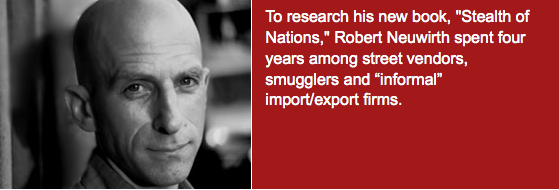
To research his new book, “Stealth of Nations,” Robert Neuwirth spent four years among street vendors, smugglers and “informal” import/export firms.

In his 2012 book Stealth of Nations, Robert Neuwirth challenges conventional thinking by examining the world’s informal economy close up.

To do so, he spent four years living and working with street vendors and gray marketers, to capture its scope, its vigor–and its lessons. He calls it “System D” and argues that it is not a hidden economy, but a very visible, growing, effective one, fostering entrepreneurship and representing 1.8 billion jobs worldwide.

Before this, for his previous book Shadow Cities (also a TEDTalk), he spent two years exploring one of the most profound trends of our time: the mass migration of the world’s population into urban shantytowns. A billion people live as squatters.

Life in a favela, slum, shantytown is hard: no water, no transport, no sewage. But in the squatter cities of Rio, Nairobi, Istanbul and Mumbai, Neuwirth discovered restaurants, markets, clinics and effective forms of self-organization.

Our challenge, Neuwirth says, isn’t to end squatter cities or shut down gray markets–but to engage and empower those who live and work in them. Link to Video…

“[Neuwirth shines] an investigative lens into areas of urban life that have seldom been described before.” – Reason magazine

The Insane Cost of Government | Uncommon Wisdom

By Larry Edelson

Editor’s Note: The American’s for Tax Reform Foundation’s Cost of Government Day Report is a mindbender. If this isn’t a steady march towards national, corporate socialism then what?

The Cost of Government Day (COGD), the day of the calendar year on which the average American worker has earned enough gross income to pay off his or her share of the spending and regulatory burdens imposed by government on the federal, state, and local levels, is now August 19, the latest date ever recorded.

In simple language, it means that the average American must work 230 days, or 63% of the year, to pay for the full cost of government.

That’s pretty darn amazing. And frightening. It essentially means that 63% of your labor output belongs not to you and the loved ones you care for, but to Washington.

Here’s how it breaks down:

  1. Federal spending: The average American worker has to labor for 104 days just to pay for federal spending, which consumes 28.6% of national income. That compares to 90 days in 2008, a 15.5% increase. The chief increase in costs were the bailouts of the financial crisis. The bailouts cost the average American 14 days of worth of work to pay for them.
  2. State and local spending: This is also costing us all, big time. In 2010 the average American had to work 52 days just to pay for state and local government expenditures.
  3. That’s up from 42.5 days in 1999. A whopping 22.3% increase in costs.
  4. The regulatory costs of the federal government: Another shocker ― the average American worker must labor 48 days just to cover the costs of federal regulations. And then there’s …
  5. Another 26 days you must toil to pay the costs of state and local regulations.

I don’t know about you, but the cost of government is insane. 63 out of every 100 hours you work is to pay for government?

You get to keep only 37% of your labor?

It’s high time we got rid of big government. That ratio needs to be inverted, at a minimum. We should keep at least 75% of our labor.

Government should cost far less, way less. Less than one-quarter of our labor output, in my opinion.

Source: Uncommon Wisdom

Criminal Charges Loom For Goldman Sachs After Scathing Senate Report | Forbes

By Halah Touryalai

A Senate panel released a damning report accusing the likes of Goldman Sachs of engaging in massive conflicts of interest, contaminating the U.S. financial system with toxic mortgages and undermining public trust in U.S. markets in the months leading up to the financial crisis.

Just when you thought Washington lawmakers were over that whole financial crisis thing, Senator Carl Levin, D-Mich., and Senator Tom Coburn M.D., R-Okla, blast Wall Street in a 635-page report stemming from a 2-year bipartisan investigation on the key causes of the crisis.

The report comes at a time when much of the feeling from lawmakers in Washington is that Wall Street is being over-regulated by the new Dodd-Frank rules.

The report from the Senate’s Permanent Subcommittee on Investigations however takes an opposite view by citing internal documents and private communications of bank executives, regulators, credit ratings agencies and investors to depict an industry that  was rife with conflicts of interest and reckless during the mortgage surge.

Senator Levin said in the release yesterday:

“Using emails, memos and other internal documents, this report tells the inside story of an economic assault that cost millions of Americans their jobs and homes, while wiping out investors, good businesses, and markets,” said Levin. “High risk lending, regulatory failures, inflated credit ratings, and Wall Street firms engaging in massive conflicts of interest, contaminated the U.S. financial system with toxic mortgages and undermined public trust in U.S. markets.  Using their own words in documents subpoenaed by the Subcommittee, the report discloses how financial firms deliberately took advantage of their clients and investors, how credit rating agencies assigned AAA ratings to high risk securities, and how regulators sat on their hands instead of reining in the unsafe and unsound practices all around them.  Rampant conflicts of interest are the threads that run through every chapter of this sordid story.”

The report takes specific issue with the way Goldman Sachs touted investments to clients on one end but bet against them on the other. A similar accusation against Goldman by the SEC lead to a $550 settlement last year, but Levin and his team don’t think that punishment fits the crime. From the report:

When Goldman Sachs realized the mortgage market was in decline, it took actions to profit from that decline at the expense of its clients.  New documents detail how, in 2007, Goldman’s Structured Products Group twice amassed and profited from large net short positions in mortgage related securities.  At the same time the firm was betting against the mortgage market as a whole, Goldman assembled and aggressively marketed to its clients poor quality CDOs that it actively bet against by taking large short positions in those transactions.

New documents and information detail how Goldman recommended four CDOs, Hudson, Anderson, Timberwolf, and Abacus, to its clients without fully disclosing key information about those products, Goldman’s own market views, or its adverse economic interests.  For example, in Hudson, Goldman told investors that its interests were “aligned” with theirs when, in fact, Goldman held 100% of the short side of the CDO and had adverse interests to the investors, and described Hudson’s assets were “sourced from the Street,” when in fact, Goldman had selected and priced the assets without any third party involvement.

New documents also reveal that, at one point in May 2007, Goldman Sachs unsuccessfully tried to execute a “short squeeze” in the mortgage market so that Goldman could scoop up short positions at artificially depressed prices and profit as the mortgage market declined.

This isn’t the first time Levin is gunning for Goldman. Back in April 2010, the Senator had a memorable back-and-forth with a Goldman executive during a testimony where the two discussed a “shitty deal” the firm was selling to clients.

In fact, Levin is referred to that very testimony yesterday saying he doesn’t think Goldman executives were being truthful about its activity, and that he would refer the testimony to the Department of Justice and the Securities and Exchange Commission for possible criminal investigations.

“In my judgment, Goldman clearly misled their clients and they misled the Congress,” he said.

Goldman isn’t alone in feeling Levin’s wrath though. The report also points to Deutsche Bank AG (DB) saying the Frankfurt-based company created a $1.1 billion CDO with assets that its traders referred to as “crap” and “pigs” but then attempted to sell “before the market falls off a cliff.”

Not even credit rating agencies are spared in this report which concluded that “the most immediate cause of the financial crisis was the July 2007 mass ratings downgrades by Moody’s and Standard & Poor’s that exposed the risky nature of mortgage-related investments that, just months before, the same firms had deemed to be as safe as Treasury bills.”

Here’s more:

Internal emails show that credit rating agency personnel knew their ratings would not “hold” and delayed imposing tougher ratings criteria to “massage the … numbers to preserve market share.”  Even after they finally adjusted their risk models to reflect the higher risk mortgages being issued, the firms often failed to apply the revised models to existing securities, and helped investment banks rush risky investments to market before tougher rating criteria took effect.

They also continued to pull in lucrative fees of up to $135,000 to rate a mortgage backed security and up to $750,000 to rate a collateralized debt obligation (CDO) – fees that might have been lost if they angered issuers by providing lower ratings.  The mass rating downgrades they finally initiated were not an effort to come clean, but were necessitated by skyrocketing mortgage delinquencies and securities plummeting in value.  In the end, over 90% of the AAA ratings given to mortgage-backed securities in 2006 and 2007 were downgraded to junk status, including 75 out of 75 AAA-rated Long Beach securities issued in 2006.

When sound credit ratings conflicted with collecting profitable fees, credit rating agencies chose the fees.

Among the 19 recommendations from the panel on how to handle the problems is one suggestion that asks the SEC to rank credit rating agencies according to the accuracy of their ratings.

At this stage, do we think the SEC can handle that?

Source:  Forbes

Report: Big Profits Drove Faulty Ratings at Moody’s, S&P | McClatchy Newspapers

By Kevin G. Hall

Analysts who reviewed complex mortgage bonds that ultimately collapsed and ruined the U.S. housing market were threatened with firing if they lost lucrative business, prompting faulty ratings on trillions of dollars worth of junk mortgage bonds, a Senate report said Wednesday.The 639-page report by the Senate Permanent Subcommittee on Investigations confirms much of what McClatchy first reported about mismanagement by credit ratings agencies in 2009.

Credit rating agencies are supposed to provide independent assessments on the quality of debt being issued by companies or governments. Traditionally, investments rated AAA had a probability of failure of less than 1 percent.

But in collusion with Wall Street investment banks, the Senate report concludes, the top two ratings agencies — Moody’s Investors Service and Standard & Poor’s — effectively cashed in on the housing boom by ignoring mounting evidence of problems in the housing market.

“Instead of using this information to temper their ratings, the firms continued to issue a high volume of investment-grade ratings for mortgage backed securities,” the report said.

Profits at both companies soared, with revenues at market leader Moody’s more than tripling in five years. Then the bottom fell out of the housing market, and Moody’s stock lost 70 percent of its value; it has yet to fully recover. More than 90 percent of AAA ratings given in 2006 and 2007 to pools of mortgage-backed securities were downgraded to junk status.

Wednesday’s report provided greater detail about the behavior of Brian Clarkson, the president of Moody’s at the time of his departure in mid-2008, when the financial crisis was in full bloom.

Clarkson rose from the head of Structured Finance, which rated complex bonds backed by U.S. mortgages, to president of the company. His rise paralleled the decline in ratings quality. He has refused to talk to McClatchy or other news organizations, and was scheduled to testify last year before the Financial Crisis Inquiry Commission but was rushed to the hospital with a kidney stone.

Analysts had confided to McClatchy that Clarkson bullied and threatened them as he rose up the ranks, and the Senate report details that in numerous emails. One email dating to 2003 shows Clarkson suggesting the need to “refine our approach” to keep pace with competitors “easing their standards to capture (market) share.”

Similarly, an S&P employee in an August 2006 email described his company’s cozy relationship with Wall Street banks this way: “They’ve become so beholden to their top issuers for revenue they have all developed a kind of Stockholm syndrome…”

Stockholm syndrome is the bond a kidnapping victim feels with captors.

Source:  McClatchy Newspapers

CUBA: Preparing for Perestroika | The Daily Reckoning

By Douglas Clayton

Dividing Old Havana from Chinatown is Cuba’s Capitolio Nacional, a monumental edifice with a fateful past. El Capitolio was conceived during the Roaring ’20s, when the island led the world in sugar exports and the future seemed sky blue.

President Gerardo Machado dreamed of turning Cuba into the Switzerland of the Americas. He decided that his 4 million countrymen needed a domed capitol building even taller and more ornate than the one he toured in Washington. So Cuba’s Congress dutifully poured 3% of the country’s GDP into their new home. (This would be akin to the US Congress spending $420 billion for a new office today, but let’s not give them any ideas…)

It took 8,000 skilled Cuban laborers just three years to complete El Capitolio, which featured gilt ceilings, a giant diamond embedded into the pristine marble floor and the world’s third-largest indoor statue. However, the showy project couldn’t have been more poorly timed. Work completed in 1929, just as America’s stock market crashed and the Great Depression unfolded.

The Smoot-Hawley tariffs crushed Cuban sugar prices by 74%. When El Capitolio’s ribbon was cut in 1931, Cuba’s economy lay in tatters. Machado was forced out of office, and his dream building would perform congressional service for only 28 years before Fidel Castro’s revolutionaries swept into Havana and opted for more austere premises. I don’t need to recite the history from here, which you probably well know.

The winds of change are gathering in Cuba, though. Since Fidel Castro’s health nearly failed in 2006, power has passed to his younger brother, Raul Castro. Raul has quietly reshuffled more than 30 cabinet members to prepare his party and people for a sweeping economic policy overhaul – Perestroika al Cubano. Even the semi-retired Fidel seems to have glumly accepted that change is inevitable, candidly admitting to a visiting US journalist that “the Cuban model doesn’t even work for us anymore.”

The global economic crisis whacked Cuba hard. Venezuela cut back on its largesse as its own economy worsened. Tourism and remittances softened, while nickel export prices tanked. Furthermore, three severe hurricanes left a wake of destruction in 2008. Unable to service Cuba’s estimated $21 billion foreign debt, and running out of generous leftist patrons to hit up, Raul Castro has, apparently, decided he has little choice but to pry open Cuba’s economy.

Castro’s wild card is Cuba’s oil and gas reserves. The island currently produces 60,000 bbl a day. But its US-facing northern waters hold an estimated 5-20 billion barrels of oil and 20 trillion cubic feet of natural gas. (Note: This compares with 29 billion barrels of oil reserves in the entire US.) Accessing this undersea oil requires the sophisticated drilling technology the US excels in. But as long as sanctions remain in place, the US oil majors are excluded from that bonanza. Amidst the applause of oil industry lobbyists, the dance for reengagement has begun, with both partners taking some unprecedented steps.

Raul Castro has issued a far-reaching five-year road map for Cuba’s future economic reform. The proposed changes would put Cuba on a very similar path to that taken by China in the 1980s and Vietnam in the 1990s. Here are some of the ideas: permit real estate transactions amongst Cubans, merge the two-tier currency system, close down inefficient state enterprises, decentralize state ownership, facilitate private ownership of businesses, distribute idle land to farmers, open state-owned wholesale markets and further encourage foreign investment – particularly in tourism.

In recent months, some planned reforms have already been implemented in an effort to delay Cuba’s impending insolvency. Costly subsidies on sugar and personal care products are being scaled back. The government announced plans to shed 500,000 state workers (that’s 10% of the country’s government work force in a country where 85% of workers work for the state) and guide them somehow into the private sector.

Cubans are being encouraged to grow and sell their own fruits and vegetables. The government is inviting foreign investors to develop 10 golf course estates in Cuba, with a new law allowing 99-year land leases to foreign buyers of plots in such projects. In the old days of Fidel’s revolution, such policies were unthinkable.

So what is the potential for a liberalized Cuban economy?

Just look 90 miles across the straits to Florida. A million Cuban- Americans call Miami home. Cuba has 60% of Florida’s population and 80% of its landmass, but greater natural resources and a much longer coastline, so one might conclude that the two are of comparable overall potential.

Perhaps to underscore their similarities, remember the fact that England and Spain cleanly swapped the two in 1763. Today, Florida’s economy is 12 times larger than Cuba’s. One reason is that Florida gets 20 times as many tourists as Cuba, plus an inflow of affluent retirees.

When the US government stops restricting its citizens from traveling to Cuba, the island will become an instant tourist magnet. Offering short flights, sunny beaches, cool music, “old world” architecture and cheap surgery, Cuba should have no problem drawing several million American tourists a year, as further-away destinations like Costa Rica have done.

Should reforms become comprehensive enough, agriculture seems an obvious investment play: Half the land is arable, labor is cheap and rain is plentiful. Cuba’s once-vaunted sugar industry stands in disarray, with 80% of the old mills shut down. However, today’s high sugar prices provide ample incentive to revive the sector, along with other traditional crops such as cigar tobacco.

Despite its long coastline, fisheries and aquaculture remain largely overlooked. Cuba is a world-class producer of nickel, but other mineral deposits remain underexploited. And then there’s the oil. The entire power system needs to be updated, financial services developed, retailing expanded – the opportunities seem endless.

Beyond the subsidized basics, most consumer goods have to be imported, and imports draw heavy duties. Telecom services are costly due to government monopolization and inefficiency. The list goes on. In this environment, it is tough for most Cubans to get by unless they receive remittances, tourist gratuities or tea money.

All in all, we eagerly await the implementation of Cuba’s economic reforms. As this process unfolds, Cuba could transform into one of the world’s most attractive frontier investment destinations. America has a long track record of turning bitter rivals into productive partners (a recent example being Vietnam), and re-engagement with Cuba could be one of Obama’s most notable foreign policy legacies.

Some frontier investors are not waiting for that and are already investing in Cuba. While 100% foreign ownership is permitted, most investors enter joint ventures with Cuban state enterprises, which typically contribute land, labor and sometimes capital. Over 250 such joint ventures exist, mostly for specific sectors or projects. Investments are made in foreign currency, eliminating exchange rate issues, and there are no restrictions on capital repatriation. Corporate income tax is 30% for joint ventures and 35% for wholly owned foreign companies, but tax holidays of five-seven years are available.

A few Cuba-focused investment groups have been established that non-US investors can access. Canada-listed Sherritt Group is a major player in Cuban nickel mining and, formerly, telecoms. A private investment group backed by European investors, Coral Capital has restored Havana’s historic Saratoga Hotel, which was recently ranked by Conde Nast as the 16th best hotel in the world. Coral is now planning a number of golf course, marina, housing and hotel projects, as is Leisure Canada, a Canada-listed investment vehicle.

Source: The Daily Reckoning