Monsanto Drops Bid To Approve GMO Crops In Europe | Collective Evolution

-It’s becoming evidently clear that GMO products are hazardous to human health. Numerous countries all over the world are well aware of this fact and as a result many have banned all GMO crops. Monsanto seems to be feeling the opposition, as they’ve recently dropped its bid to get more genetically modified crops (GMOs) onto the European market. Thanks to activism and the sharing of information, it’s clear that a mass, wide-spread opposition to the world’s largest seed corporation has indeed contributed and existed for a long time. It continues to grow exponentially, as more people on the planet continue to wake up.
We will no longer be pursuing approvals for cultivation of new biotech crops in Europe. Instead, we will focus on enabling imports of biotech crops into the EU and the growth of our current business there” – Monsanto Corp

This means that Monsanto will no longer seek land to grow their GMO crops in Europe. Instead they will try to enable importing the crops into Europe. Hopefully they aren’t successful. Recently, we’ve seen countries like Japan, South Korea, and China ban the import of Monsanto’s GMO crops. It’s going to be difficult for Monsanto to even import GM crops into Europe, they currently have a zero tolerance policy on all GM products, you can read more about that here. The pending applications for GM crops included 6 types of corn, a soybean variety and a modified sugar beet. There aren’t many GM crops approved in Europe right now. In fact, only two have been given the ‘go ahead,’ that includes the MON810 maize and a modified potato created by BASF, a German biotech company. Most of the allowed GM produce is in animal feed, which is also unfortunate. Not to long ago, a study linked GMO animal feed to severe stomach inflammation and enlarged Uteri in Pigs. You can read more about that here.

A recent YouGov poll released last month shows that only 21 percent of Britons are in favour of growing GMO crops, with 35 percent opposed to the technology. Monsanto actually said that they will invest in its European non-GMO seed business instead to boost the corporation’s sales. Maybe they are trying to get on the people’s good side?  Despite harsh worldwide opposition, Monsanto-produced GMO crops and aggro-chemicals are widely used in the US and other parts of the world. At the same time, they are widely banned in many parts of the world as well!

A lot is going on with Monsanto right now. Planet Earth has seen a tremendous amount of activism with regards to GMOs, pesticides and more. The world is speaking up, and clearly showing that it no longer desires corporations like Monsanto. With all of the recent activism as of late, mainstream media outlets have responded by supporting GMOs, and corporations like Monsanto.  For example, the major mainstream media outlet in Canada, CBC News, recently aired a discussion with billionaire Kevin O’leary. On the show he praised Monsanto, designating them as a hero. Right away, a 14 year old GMO activist responded and got the attention of the entire planet! You can read more about that  here. Another example of how activism is working was the Monsanto protection act, you can read more about that here. This was signed the night before millions of people united across the planet against Monsanto. Was this a message from the elite? Most likely, but the Monsanto protection act may soon be repealed as some United States senators like Jeff Merkley are currently working on that.

It seems that North America is catching up to the over 60 countries that have banned GMOs. There are a number of scientific studies that prove GMOs are hazardous to human health. You can browse through our health, science & tech, alternative news, and multimedia sections for more information. We have a number of articles and studies that are sourced within them if you are doubting this fact. Hopefully this inspires more to do their research.

Source: Collective Evolution

(1) http://corporateeurope.org/news/eus-zero-tolerance-gm-under-fire
(2) http://rt.com/news/monsanto-europe-gmo-food-309
(3) http://www.activistpost.com/2013/07/monsanto-drops-bid-to-advance-new-gm.html
(4) http://www.edmontonjournal.com/technology/Monsanto+drops+grow+crops+European+Union/8676522/story.html
(5) http://www.latimes.com/business/money/la-fi-mo-monsanto-gmo-crops-europe-20130718,0,1502761.story

PepsiCo’s Naked Juices to Drop ‘All Natural’ Label After $9 Million Class Action Lawsuit| NaturalSociety

pepso_naked_juice-263x159While government agencies like the FDA keep stalling on demanding rigorous scientific testing of numerous questionable ingredients, GMO foods, and the correct labeling of such foods, PepsiCo has recently agreed to settle out of court for $9 million over a class action lawsuit that claimed ‘natural’ and ‘non-GMO’ on their bottles was misleading since they are made with GMO ingredients, as well as synthetic and ‘unnatural’ items.

The plaintiffs in the suit claimed that PepsiCo gave the “the false impression that the beverages vitamin content is due to the nutritious fruits and juices, rather than the added synthetic compounds such as calcium pantothenate (synthetically produced from formaldehyde)” and “Fibersol-2 (a proprietary synthetic digestion-resistant fiber produced by Archer Daniels Midland and developed by a Japanese chemical company), fructooligosaccharides (a synthetic fiber and sweetener), and inulin (an artificial and invisible fiber added to foods to … increase fiber content without the typical fiber mouth-feel).”

The amount of synthetic additives in Naked juices are quite possibly more than anything ‘natural’ at all. It certainly isn’t a ‘100% juice” smoothie as the labeling on the bottle currently states. Naked juices contain up to 11 different chemicals including: niacinamide, d-alpha tocopherol acetate, cyanocobalamin, and pyridoxine hydrochloride, just to name a few.

And as you may have expected, of course Pepsi Co donated more than $2.5 million dollars to help defeat Proposition 37 in California that would have required companies like Pepsi to label all products that contain GMOs in any form. The ‘Right to Know” ballot was defeated due to special interest groups like Syngenta, Dow, Monsanto, Pepsi Co, and others who helped finance its demise.

If you would like to avoid PepsiCo altogether since they are actively trying to push GMO foods and chemical laden drinks on the public while trying to pass them off as ‘health’ food, you might have a hard time ignoring the company – they are in almost every country and make everything from Pepsi Cola to Frito Lay Chips, Tropicana Juices, Quaker Oates and Gatorade. But learn of what they create, and you can steer clear.

You can also email PepsiCo’s Senior Director with your opinion about their GMO and unnatural products. The Organic Consumers Association has created a simple way to do send a message to the senior director of Communications, Mike Torres.

If you want real juice, try putting some organic apples, lemons and kale in a juicer. No corporate lies need to be added to the recipe.

Sedgwick, Maine is first town to declare total food sovereignty, opposing state and federal laws | NaturalNews

By  J.D. Hayes

There is a food revolution taking hold all over America, whether it is in the form of demanding labeling of GM foods, the right to produce and sell raw milk and other commodities, or – in the case of Sedgwick, Maine – declaring all local food transactions of any kind free and legal.
According to the website FoodRenegade.com, Sedgwick is the first city in the U.S. to free itself from the constraints of federal and state food regulation. Published reports say the town has passed an ordinance that gives its citizens the right “to produce, sell, purchase, and consume local foods of their choosing,” regulations be damned. The ordinance includes raw milk, meats that are slaughtered locally, all produce and just about anything else you might imagine.

And what’s more, three additional towns in Maine are expected to take up similar ordinances soon, said the FoodRenegade.com.

Gee – good, ol’ fashioned buyer-seller agreements?

Observers of the Sedgwick ordinance say it is much more than just “statement” legislation. Writes blogger David Grumpert, at TheCompletePatient.com:

This isn’t just a declaration of preference. The proposed warrant added, “It shall be unlawful for any law or regulation adopted by the state or federal government to interfere with the rights recognized by this Ordinance.” In other words, no state licensing requirements prohibiting certain farms from selling dairy products or producing their own chickens for sale to other citizens in the town.

What about potential legal liability and state or federal inspections? It’s all up to the seller and buyer to negotiate. “Patrons purchasing food for home consumption may enter into private agreements with those producers or processors of local foods to waive any liability for the consumption of that food. Producers or processors of local foods shall be exempt from licensure and inspection requirements for that food as long as those agreements are in effect.” Imagine that-buyer and seller can agree to cut out the lawyers. That’s almost un-American, isn’t it?

According to Deborah Evans, a Sedgwick citizen, the ordinance further states:

  1. Producers or processors of local foods in the Town of Sedgwick are exempt from licensure and inspection provided that the transaction is only between the producer or processor and a patron when the food is sold for home consumption.
  2. Producers or processors of local foods in the Town of Sedgwick are exempt from licensure and inspection provided that the products are prepared for, consumed or sold at a community social event.

For those questioning the legality of the ordinance – as in, it obviously circumvents state and federal food laws – she notes:

[W]e the radicals who concocted this mutinous act of infamy believe that according to the Home Rule provisions of our State Constitution, the citizens of Sedgwick have the right to enact an ordinance that is “local and municipal in character.”

‘It’s about time’

Many of the local farmers say the ordinance is just what is needed.

“This ordinance creates favorable conditions for beginning farmers and cottage-scale food processors to try out new products, and to make the most of each season’s bounty,” farmer Bob St. Peter told the website FoodFreedom.com. “My family is already working on some ideas we can do from home to help pay the bills and get our farm going.”

“Tears of joy welled in my eyes as my town voted to adopt this ordinance,” said Sedgwick resident and local farm patron Mia Strong. “I am so proud of my community. They made a stand for local food and our fundamental rights as citizens to choose that food.”

St. Peter, who is a board member of the National Family Farm Council, a food freedom advocacy group, notes that small farmers have a much tougher row to hoe, especially in today’s economy, so they need the ability to sell their products more freely.

“It’s tough making a go of it in rural America,” he said. “Rural working people have always had to do a little of this and a little of that to make ends meet. But up until the last couple generations, we didn’t need a special license or new facility each time we wanted to sell something to our neighbors. Small farmers and producers have been getting squeezed out in the name of food safety, yet it’s the industrial food that is causing food borne illness, not us.”

Sources:
http://www.foodrenegade.com/maine-town-declares-food-sovereignty/
http://www.thecompletepatient.com
http://foodfreedom.wordpress.com
http://www.nffc.net

Nanoparticles in your food? You’re already eating them | Grist

By Twilight Greenaway

What’s engineered in a lab, added to processed foods, and never labeled? If you thought GMOs were mysterious, try nanoparticles.

I’ve been keeping my eye on the role of nanotechnology in food for a few years now, so I was interested to see a feature-length investigation called “Eating Nano” in this month’s E Magazine. In it, E editor Brita Belli takes a deep dive into the growing role of nanotechnology in food and agriculture, the current lack of oversight and regulations, and the growing consensus that more information and transparency are both sorely needed in relation to this growing field.

Nanotechnology involves the engineering and manipulation of particles at a nano scale. Nanoparticles, as they’re called, are measured in nanometers or billionths of one meter. Another way to put it: If a nanoparticle were the size of a football, a red blood cell would be the size of the field. Although some nanoparticles have been found to exist in nature (carbon nanoparticles exist in caramelized foods, for instance, and silverware has been shown to shed nano-sized silver particles), it’s the nanoparticles that are engineered in laboratories that have environmental health advocates concerned.

Here’s the thing: It turns out most materials start behaving differently at that size. According to the British corporate accountability organization As You Sow, which has been keeping tabs on the nanotech industry for several years, “materials reduced to the nanoscale either through engineered or natural processes can suddenly show very different properties compared to what they exhibit on a macroscale, enabling unique applications such as alterations in color, electrical conductance, or permeability.”

Considering the fact that nanoparticles are now used to help deliver nutrients, keep food fresh for longer, and act as thickening and coloring agents in processed foods, these “different properties” might be cause for concern. Or — at the very least — they might be reason enough to conduct thorough research into their health impacts.

In actuality, companies are not required to disclose nano-sized ingredients, nor is there much active questioning about their safety. Instead, Belli writes, “From the government’s perspective, nano forms of silver, iron or titanium are no different, fundamentally, from their scaled-up counterparts which have already been safety tested, so the agency has ushered the particles into the food supply under the Generally Recognized as Safe provision.”

I’ve been hearing about nanoparticles in food packaging for a while now (it’s a market Belli says is expected to reach $20 billion by 2020), but I had no idea that there was nano-coating in the works for bananas. And what I was most surprised to learn is just how many food products already contain nanoparticles. As Belli writes:

Nanoparticles can be used to purify water, as anticaking and gelatin-forming agents and in packaging to protect against UV light, prevent the growth of microbes or detect contamination. Titanium dioxide is added to a huge swath of products in nano form including paints, paper and plastics but also lends white pigment to most toothpastes and many processed foods, including Mentos, Trident and Dentyne gum, M&Ms, Betty Crocker Whipped Cream Frosting, Jello Banana Cream Pudding, Vanilla Milkshake Pop Tarts and Nestlé Original Coffee Creamer. The aforementioned products were featured in a report in February 2012 in the journal Environmental Science & Technology which concluded that each of us likely consumes some amount of titanium dioxide (TiO2) nanoparticles each day, and children under 10 likely consume the greatest amounts (around 1-2 mg TiO2 per kilogram body weight per day) due to their higher intake of frosted foods, candy, gum and other sweets.

Although there is less science focused on ingested nanotech particles than on, say, the ones that are inhaled in industrial environments, Belli does point to the few studies that exist, including a recent one out of Cornell University that looked at chickens’ abilities to absorb iron after eating nanoparticles generally considered safe for human consumption. In it, researchers found that acute exposure to the particles changed the structure of the lining of the chickens’ intestinal walls, a change the lead scientist noted “serves to underscore how such particles, which have been widely studied and considered safe, cause barely detectable changes that could lead to, for example, over-absorption of other, harmful compounds.”

When it comes to questions about the health effects of eating nanoparticles, Belli quotes a guide on the American Society of Safety Engineers’ website, which reads:

Nanoparticles may be ingested through drinking water, food additives, atmospheric dust on food, toothpaste and dental fillings and implants. Ingested nanoparticles can then be absorbed through ‘Peyer’s Plaques’ or small nodules in intestinal tissue that are part of the immune defense system. If nanoparticles enter the digestive system and proceed into the bloodstream, they could move throughout the body and cause damage.

Of course, most of this — and much of the science Belli points to — is preliminary, based on very little hard science. And if that lack of a cautionary approach to science in a multibillion-dollar industry sounds familiar, that’s because — well, it is. The comparison to genetically modified foods is unavoidable.

In fact, Timothy Duncan, a research chemist from the Food and Drug Administration, admitted as much about the nanotech industry (which likely has thousands of food and food packaging products in the research and development stage) while writing in the journal Nature Nanotechnology last year.“What’s holding back the introduction of nanofoods is the hesitation of the food industry, fearing a public backlash along the lines of what happened with genetically modified foods, and public fears in some countries about tampering with nature,” Duncan wrote.

And considering how little media coverage these larger questions about nanotechnology and food have received — not to mention inclusion on the larger “food movement” laundry list — it looks like the lesson the food industry has learned from GMOs is not one about the importance of transparency, but quite the opposite.

As Tom Philpott observed in Grist in 2010, the last time big questions surfaced about nanotech in food in the media: “As with GMOs, the strategy seems to be: release into the food supply en masse first; assess risks later (if ever).”

Source: Grist & EMagazine

GMOS. The Next Steps. Why We Won | Raw Spirit Community News

By Happy Oasis

Regarding the outcome of Proposition 37, Congratulations! How can I be offering “Congratulations” when it appears that Americans have not yet gained our right to know what we are eating? We got it on the ballot, did we not?! Moreover, we won the attention of the nation, which is huge. It is time for us to celebrate and rest for a moment to consider the big picture, to regroup and unite with more confidence than ever. Why was the opposition so great? Because we are a powerful force!

We Give Thanks to All who voted to protect our health or promoted voting for GMO labeling in CA, and especially to the many hard-working noble friends in California who put forth tireless effort to protect all of us from the pervasion of Frankensteinian GMOs.

The outcome of the election was not surprising to me. It is educational in that it more clearly reveals to those who did not comprehend how entrenched and pervasive are the reaches of this insidious force. To be effectual we need to clearly understand the extent of the strengths and weaknesses of the opposition. Californians have put forth a magnificent effort. We deeply acknowledge that effort. Honestly, are Californians opposed to knowing what they are eating? You know the answer.  Was there voter fraud, advertising fraud, ignorance, cohersion, threats, dirty deal-making or a combination of these? I think you know the answer.

This experiment will go down in history ~ if there is a history.  Let us remember that slavery was not overturned without many fights. Women were not given the right to vote overnight. Gandhi’s efforts took lives and time. For millenia, countless people have been jailed, imprisoned, robbed, tortured and killed for standing up for what is right. The imprisoned Mandela was freed, then voted into Presidency.
By all of us choosing to step up our combined efforts from this moment, GMOS will be labeled, then outright banned. Like some of you, who have shared with me, I too have been secretly subjected to death threats, character defamation, computer system failures, embezzlements and more due to standing up for what is true by those who do not wish for the power of eating an organic gmo-free raw vegan diet to be understood. This started happening back in 2008, Raw Spirit was about to start lobbying against GMOs in D.C. Meanwhile, I continue enjoying life to its fullest, remembering that the power of Love is the only real power and that Love eventually overcomes.

The Next Steps: This is a federal issue, (actually planetary) and requires lobbying against the most powerful force in Washington. Thank goodness for Californians who started the conversation. At the same time, what can we do? What about starting with banning GMOs from our own bodies, labeling ourselves, our cars, our homes, our streets, and our health-food stores as GMO-free? Remember bumper stickers? To do this requires educating ourselves and finding alternatives to any GMO-containing foods. Once this is achieved, we can label our villages and towns. We can ban GMOs from entering our neighborhoods and put up signs. History has shown that with any major issue, it takes time. We the people need to educate, think and approach this from myriad angles including those more grass roots than we have yet attempted. Are you willing to label yourself with a button saying,  “I’m GMO-free. Are You?” Plus, I trust that you will conjure up your own brilliant approaches.

Source: Raw Spirit Community News

Pesticide Industry-Backed Opponents Prop 37: Caught Possible Criminal Act | Nation of Change

By Zach KaldVeer

The $36 million No on 37 campaign, bankrolled by $20 million from the world’s six largest pesticide companies, has been caught in yet another lie, this time possibly criminal.

These companies and their allies in the junk food industry know that their profit margins may suffer if consumers have a choice whether to purchase genetically engineered foods or not.  And that’s why opponents are spending nearly a million dollars per day trying to make Prop 37 complicated. But really it’s simple – we have the right to know what’s in our food.

To date, the No on 37 campaign has been able to repeat one lie after another with near impunity. But has this pattern of deceit finally caught up to it?

Yesterday, the Yes on 37 campaign sent letters to the U.S. Department of Justice requesting a criminal investigation of the No on 37 campaign for possible fraudulent misuse of the official seal of the U.S. Food and Drug Administration (FDA).

The No on 37 campaign affixed the FDA’s seal to one of the campaign’s mailers.Section 506 of the U.S. Criminal Code states: “Whoever…knowingly uses, affixes, or impresses any such fraudulently made, forged, counterfeited, mutilated, or altered seal or facsimile thereof to or upon any certificate, instrument, commission, document, or paper of any description…shall be fined under this title, or imprisoned not more than 5 years, or both.”

The letter also provides evidence that the No on 37 campaign falsely attributed a direct quote to the FDA in the campaign mailer. Alongside the FDA seal, the mailer includes this text in quotes. “The US Food and Drug Administration says a labeling policy like Prop 37 would be ‘inherently misleading.” The quote is entirely fabricated. The FDA did not make this statement and does not take a position on Prop 37. Read more…

Source: Nation of Change

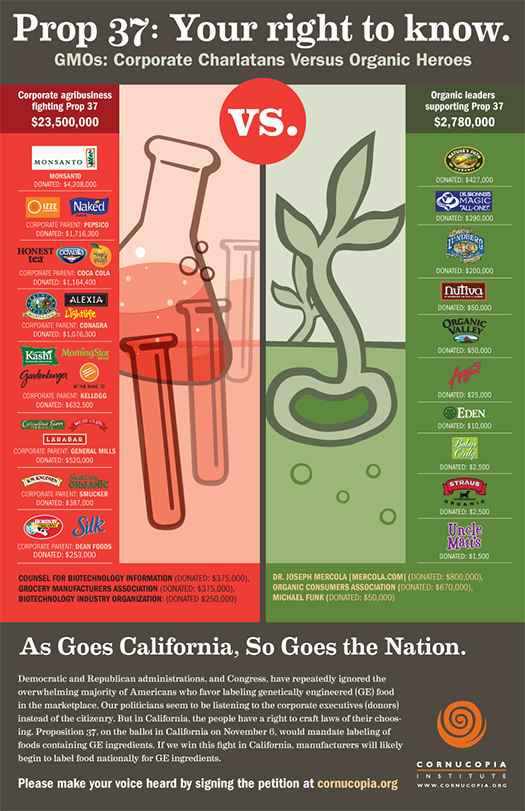
Many ‘Natural’ or “Organic’ Companies are Fighting Against the California Proposition for Labeling of GMO Foods

We were shocked to learn that many supposedly ‘natural’ or ‘organic’ companies, which have been bought out by big corporations, have joined Monsanto in giving huge donations to fight the California proposition for labeling of GMO foods. This includes popular brands like Odwalla, Naked, Gardenburger, Cascadian Farms Organic, Muir Glen, Knudsen, Santa Cruz Organic, Horizon Organic, Silk and more.

This document also gives the names of companies with more integrity that are donating to support Prop 37 for GMO labeling: Nature’s Path, Dr. Bronner’s, Lundberg, Nutiva, Organic Valley, Amy’s, Eden, Straus and others.

Since it feels important for us all to know where our food purchase dollars are going, I wanted to share this with you, in case you were not already aware of it.

Hope for a New Era: Solving Our Problems From the Ground Up | Permaculture.org

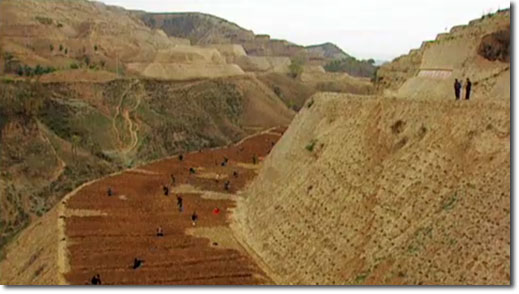
before_after_loess_plateau_02_1995Rio+20 has been and gone, and, in the big scheme of things, has achieved little, or worse. With this post I’d like to take the opportunity to jot down some thoughts, and images, that might help us shake off disappointment, disillusionment and despair, and give us something we can all consider, adjust and rally around. Our ‘leaders’ are taking us ‘down the garden path’, but, unfortunately, in the proverbial, rather than literal, sense. It’s truly time to forge new beginnings, create new economies, and to prioritize natural and social capital with the goal of restoring ecological and social health.

The problem we as a race (particularly Anglo Saxons like myself) have, I think, is that when we think of nature, we tend to compartmentalize it. It’s that ‘reserve’ or ‘park’ that needs to be ‘protected’ from us. We tend to admit that we ourselves are destructive, but the central problem is that since we can’t see ourselves being anything more than destructive, we conclude that if we can just leave enough space ‘out there’ that we don’t touch, then it’ll all somehow balance out. This is a totally ingrained, but little recognised, failure of our modern culture.

before_after_loess_plateau_02_2011Permaculturists look at the world differently – in that humankind are also part of nature. Not only that, and not only that we (as part of nature) deserve to survive, but we can actually be a beneficial organism in the picture also. If this capacity (which is proven) could be true of all humans, then it doesn’t matter where man lives, even if he virtually covers the globe, as he is an asset to the planet, and not a parasite. This of course can only happen if he learns to work with nature, and not battle it at every step, as he mostly does today. Where, for example, an agronomist can take a perfectly good piece of land and turn it into a desert over the course of a few decades, or even just a few years, a permaculturist can take a desert, and transform it back into a perfectly good piece of land, and can design it to be (like a natural forest) almost self-perpetuating whilst producing food.

But, putting that aside, I want to share something else with you. It’s essentially some logic that I find difficult to put aside, and which keeps me on track in my work and purposes:

  1. If you study soil science (as I have, and I could wish it was compulsory in schools) — and not just from a reductionist chemical standpoint as do the agronomists, but from a biological standpoint, where you’re observing the ‘magic’ of biological/chemical interactions and interdependencies — then you quickly become aware that the larger in scale you go with agriculture, the more compromises you begin to make in regards to working with nature. The more land you endeavor to take care of per person, the more you begin ‘forcing functions’ (trying to get nature to do something it doesn’t want to do — a bit like pushing water uphill). With larger scale, two things happen: 1) the larger in scale, the greater the detachment between the land-steward and his land — observing macro-level synergies and tweaking them becomes increasingly difficult to impossible, and 2) monocultures become a necessity to the automation required, and you end up putting more energy in, and getting less out, and you begin the input treadmill of labour, fertilisers, chemicals, etc., that are the inevitable result of trying to maintain what nature doesn’t normally allow. (This post gives a good easy-to-understand rundown on one example of this).
  2. You know very well that, with present systems, we’re using enormous amounts of fossil fuels to produce ‘food’ (‘food’ being in inverted commas, because it’s increasingly empty of nutrition). And, you know very well that we just don’t have that energy to burn any more. Additionally, because of our globalized system, we’re not eating plants we could, simply because they don’t travel well, so are sidelined by BigAgri (think berries, and all kinds of other plant varieties). The system that promised more diversity in our diet has actually reduced it dramatically. Even of that limited range of produce that is ‘approved’ by the BigAgri globalized model, around 25-50% of the food is wasted (according to the FAO) before it even reaches supermarkets (and lots more is wasted post-purchase as well!).
  3. The use of fossil fuels (pesticides, fertilizers) has not only increased our population manifold, but it’s simultaneously consumed our soil life at an escalating rate.
  4. The last three points all mean humanity is in a highly precarious position (dead soils, peaked oil, burgeoning populations). We’re heading into definite famine territory….
  5. Then add in climate change, which is seriously exacerbating our ability to correct the above problems. Much of this climate change is due to the above — the carbon that should be in our soils is now in our atmosphere, due to ignorance and greed.
  6. Add to the above that most people now live in densely packed cities, so are unable to work the land even if they wanted to, and even if they knew how.
  7. The above all inevitably mean two major things need to happen — a massive re-skilling/re-education movement, combined with a transition of people back to the land, for those who don’t have access to it.
  8. Given that in much of the ‘developed’ world, most of the land is held by large farms and even by a handful of very large multinationals (with farmers often little more than serfs on them — ‘managing’ their farms with a colour-by-numbers approach dictated to them by their corporate feudal lords), the above reskilling and transitioning back to the land is complicated with the very difficult necessity of land redistribution — something that historically almost never occurred without revolution and bloodshed.
  9. Where today we have economic incentives that favor large scale and Big Agri, if we are to work in the political realm then I think we need to target the need to see policies enacted which instead incentivise ‘get smaller or get out’, the very opposite of the policies of the last 50 years. Again, this will only work if people managing these smaller plots are educated in the how of it, otherwise instead of increasing resiliency and decreasing food insecurity, we can just exacerbate the situation.
  10. For urbanites, this is a good transitional option in the interim, where we relegate the lawn to its place as a short-lived entry in our history books: www.permaculturenews.org/2011/05/13/the-grass-isnt-greener.
  11. It’s key to understand the biology behind global warminghow the deforestation and mismanagement of our land started atmospheric CO2 increases long before we even began to mine coal and oil. If people would understand this better, rather than only approaching it from a fossil fuel emissions, reductionist standpoint, then we’d be one step closer to understanding the holistic solutions to climate change (reinstating carbon sinks, by way of food forests, and permaculture agricultural methodology — all of which also, themselves, free us from our addiction to fossil fuels). Read more…

S510 – Illegal To Grow, Share, Trade, Sell Homegrown Food | Rense

S510, the Food Safety Modernization Act of 2010, may be the most dangerous bill in the history of the US. (http://www.govtrack.us/congress/bill.xpd?bill=s111-510 )

“If accepted [S 510] would preclude the public’s right to grow, own, trade, transport, share, feed and eat each and every food that nature makes. It will become the most offensive authority against the cultivation, trade and consumption of food and agricultural products of one’s choice. It will be unconstitutional and contrary to natural law or, if you like, the will of God.” It is similar to what India faced with imposition of the salt tax during British rule, only S 510 extends control over all food in the US, violating the fundamental human right to food.” – Dr. Shiv Chopra, Canada Health whistleblower.

Monsanto says it has no interest in the bill and would not benefit from it, but Monsanto’s Michael Taylor who gave us rBGH and unregulated genetically modified (GM) organisms, appears to have designed it and is waiting as an appointed Food Czar to the FDA (a position unapproved by Congress) to administer the agency it would create without judicial review if it passes.

S 510 would give Monsanto unlimited power over all US seed, food supplements, food AND FARMING.

History

In the 1990s, Bill Clinton introduced HACCP (Hazardous Analysis Critical Control Points) purportedly to deal with contamination in the meat industry. Clinton’s HACCP delighted the offending corporate (World Trade Organization “WTO”) meat packers since it allowed them to inspect themselves, eliminated thousands of local food processors (with no history of contamination), and centralized meat into their control. Monsanto promoted HACCP.

In 2008, Hillary Clinton, urged a powerful centralized food safety agency as part of her campaign for president. Her advisor was Mark Penn, CEO of Burson Marsteller*, a giant PR firm representing Monsanto. Clinton lost, but Clinton friends such as Rosa DeLauro, whose husband’s firm lists Monsanto as a progressive client and globalization as an area of expertise, introduced early versions of S 510.

S 510 fails on moral, social, economic, political, constitutional, and human survival grounds.

  1. It puts all US food and all US farms under Homeland Security and the Department of Defense, in the event of contamination or an ill-defined emergency. It resembles the Kissinger Plan.
  2. It would end US sovereignty over its own food supply by insisting on compliance with the WTO, thus threatening national security. It would end the Uruguay Round Agreement Act of 1994, which put US sovereignty and US law under perfect protection. Instead, S 510 says: Nothing in this Act (or an amendment made by this Act) shall be construed in a manner inconsistent with the agreement establishing the World Trade Organization or any other treaty or international agreement to which the United States is a party.
  3. It would allow the government, under Maritime Law, to define the introduction of any food into commerce (even direct sales between individuals) as smuggling into “the United States.” Since under that law, the US is a corporate entity and not a location, “entry of food into the US” covers food produced anywhere within the land mass of this country and “entering into” it by virtue of being produced.
  4. It imposes Codex Alimentarius on the US, a global system of control over food. It allows the United Nations (UN), World Health Organization (WHO), UN Food and Agriculture Organization (FAO), and the WTO to take control of every food on earth and remove access to natural food supplements. Its bizarre history and its expected impact in limiting access to adequate nutrition (while mandating GM food, GM animals, pesticides, hormones, irradiation of food, etc.) threatens all safe and organic food and health itself, since the world knows now it needs vitamins to survive, not just to treat illnesses.
  5. It would remove the right to clean, store and thus own seed in the US, putting control of seeds in the hands of Monsanto and other multinationals, threatening US security. See Seeds ­ How to criminalize them, for more details.
  6. It includes NAIS, an animal traceability program that threatens all small farmers and ranchers raising animals. The UN is participating through the WHO, FAO, WTO, and World Organization for Animal Health (OIE) in allowing mass slaughter of even heritage breeds of animals and without proof of disease. Biodiversity in farm animals is being wiped out to substitute genetically engineered animals on which corporations hold patents. Animal diseases can be falsely declared. S 510 includes the Centers for Disease Control (CDC), despite its corrupt involvement in the H1N1 scandal, which is now said to have been concocted by the corporations.
  7. It extends a failed and destructive HACCP to all food, thus threatening to do to all local food production and farming what HACCP did to meat production ­ put it in corporate hands and worsen food safety.
  8. It deconstructs what is left of the American economy. It takes agriculture and food, which are the cornerstone of all economies, out of the hands of the citizenry, and puts them under the total control of multinational corporations influencing the UN, WHO, FAO and WTO, with HHS, and CDC, acting as agents, with Homeland Security as the enforcer. The chance to rebuild the economy based on farming, ranching, gardens, food production, natural health, and all the jobs, tools and connected occupations would be eliminated.
  9. It would allow the government to mandate antibiotics, hormones, slaughterhouse waste, pesticides and GMOs. This would industrialize every farm in the US, eliminate local organic farming, greatly increase global warming from increased use of oil- based products and long-distance delivery of foods, and make food even more unsafe. The five items listed the Five Pillars of Food Safety are precisely the items in the food supply which are the primary source of its danger.
  10. It uses food crimes as the entry into police state power and control. The bill postpones defining all the regulations to be imposed; postpones defining crimes to be punished, postpones defining penalties to be applied. It removes fundamental constitutional protections from all citizens in the country, making them subject to a corporate tribunal with unlimited power and penalties, and without judicial review.

For further information, watch these videos: