The Sky Darkens for American Journalism: The future of the American media is being decided in a military court | Al Jazeera

By Chase Mader

Bradley Manning released hundreds of thousands of government documents and files to Wikileaks, most famous among them the unclassified video Wikileaks dubbed, “Collateral Murder”, a harrowing gun-sight view of an Apache helicopter slaughtering a couple of armed men and a much larger group of civilians on a Baghdad street in July, 2007.

The court-martial of Pfc. Manning, finally underway over three years after his arrest, is likely to cause a great deal of collateral destruction in its own right. In this case the victim will be American journalism.

The most serious of the charges against Manning is the capital offense of “aiding the enemy.” (Team Obama has made it clear it won’t seek the death penalty, but a life sentence is possible.) The enemy that the prosecution has in mind is not Wikileaks or the global public but Al Qaeda; because this group had access to the internet, the logic goes, they could read Manning’s disclosures just like everyone else.

The government does not have to prove Manning’s conscious intent to help Al Qaeda, but must only meet the squishier standard of proving the defendant had “specific knowledge” that the terrorists might benefit from his cache of documents.If the Aiding the Enemy charge against Bradley Manning is the outcome of his legal struggles, there will be adverse consequences for whistleblowers and for journalists in the future.

If this charge sticks, it will be a serious blow to American journalism, as it puts all kinds of confidential informants at risk of being capital cases. A soldier in Afghanistan who blogs about the lack of armoured vehicles – a common and very public complaint from the ranks in the Iraq War – could be prosecuted for tipping off the Taliban.

Whoever leaked Ambassador Karl Eikenberry’s long cable on the futility of counterinsurgency in Afghanistan could also be conceivably be put away for life, even executed. As Ben Wizner of the American Civil Liberties Union has explained, the use of this charge against sources, leakers and whistleblowers – like Bradley Manning – will criminalise a great deal of essential journalism – and not just the kind practiced by Wikileaks and various bloggers.

The Manning prosecution has asserted more than once that they would have pressed the Aiding the Enemy charge even if the private had passed his cache to the New York Times or the Washington Post (as the leaker had attempted).

This jolted the editorial classes, who do not much like imagining themselves as being implicated, however hypothetically, in terrorist acts. Op-eds in the New York Times and Los Angeles Times have blasted the Aiding the Enemy charges brought against Manning, explaining that they would not just “chill” but freeze a great deal of essential journalism.

The news media has always relied on leaks of classified material, from the Pentagon Papers and Watergate, to the preemptive disclosure of the 2007 National Intelligence Estimate holding that Iran had no nuclear weapons program, a transparent attempt by the military brass to block Bush and Cheney from launching a third war.

And contrary to widespread panic, massive leaks of classified material tend to enhance national security as the new information can prevent the kind of reckless, poorly-informed decisions that have squandered so much blood and money, from Southeast Asia to Iraq.

Who is a journalist and who gets to decide?

Aiding the Enemy is of course not the only charge against Private Manning. One of the charges, “wanton publication,” hinges in part on whether Wikileaks is a bona fide journalistic entity. But who gets to decide who is and who isn’t a journalist, and how?

Defense witness Yochai Benkler, a professor at Harvard Law School and expert on press freedom and the internet, provided an answer earlier this month. Benkler, who has published penetrating studies of the 21st century media landscape, took the stand July 11th to address the matter of who is and who isn’t a journalist.

Wikileaks is absolutely a media organization, one perfectly emblematic of the “networked fourth estate”, in which traditional news outlets like the Guardian and Der Spiegel collaborate with smaller non-profit and for-profit entities to produce news coverage. Supporters of Manning found Benkler’s testimony to be lucid, supremely well-informed and compelling – but will it convince Judge Denise Lind?

As for traditional news media, they have been largely AWOL, with the New York Times sending a correspondent to a few hearings, only after a shaming by the newspaper’s public editor. But a handful of independent correspondents, notably Kevin Gostzola of FireDogLake, independent journalist Alexa O’Brien and Bradley Manning staffer Nathan Fuller, as well as court artist Clark Stoeckley – have covered every breath of the legal proceedings.

And even as more established media have leaned heavily on these reporters for all manner of factual and logistical assistance, gracious acknowledgement of the professional debt has not always been forthcoming. Last month the New York Times rather snottily described O’Brien as a mere “activist” before being embarrassed into a correction.

Although smug torpor is Big Media’s default setting, a recent barrage of sucker-punches has shaken the Fourth Estate’s generally cosy partnership with the political class. The Obama administration has named James Rosen of Fox News as a co-conspirator in its case against State Department leaker Stephen Jin-Woo Kim; the government has also announced that it had been sifting through two months of the Associated Press’s phone records to hunt down the source of a leak.

Obama’s poison gift to journalists

Affecting a chastened air, the Obama administration now says it wants to make nice with journalists.   To strike a finer “balance” between press freedom and security, Team Obama has offered to pass a Press Shield Law-a slightly revamped version of the same bill the White House threatened to veto back in 2009. (Senator Obama had been a liberal champion of just such a bill before). This Press Shield Law is intended as conciliatory basket of fruit, sent to the media as an apology for all those investigations.

The government’s gift to journalists is poison, and should be rejected. The Press Shield Law would be more accurately titled the Media Prosecution Enhancement Bludgeon – as Trevor Timm of the Press Freedom Foundation has warned, the statute would override and erase many common-law protections currently enjoyed by reporters.

Just as with our whistleblower protection laws, the statute includes a cavernous carve-out for any leak-based reporting that affects “national security”, a term that is infinitely elastic in the hands of official Washington. (The law would not have “shielded” the Associated Press from the government’s investigation of their phone records, nor would it have protected Fox’s Rosen).

But wait: that’s not all that the new law won’t do! As the law’s primary author, Senator Chuck Schumer (D-NY) has crowed, the law would specifically exclude Wikileaks and other internet-based groups that he and his colleagues do not believe to be proper media organizations. (Bear in mind the average age in today’s United States Senate is 61). The language defining who is and who isn’t “a member of the media” is marvellously supple, to be loosened and tightened as the government sees fit.

Meanwhile, the State onslaught against American journalists continues: the dependably conservative Washington DC circuit court has ruled that James Risen of the New York Times must testify as to his sources in a story about CIA disruption of Iran’s nuclear program. (Risen has pledged he will go to jail first).

Former NSA and CIA director Michael Hayden has casually called Glenn Greenwald a co-conspirator with NSA leaker Edward Snowden. With this roiling in the background, military judge Denise Lind announced on July 18 that she would not dismiss the Aiding the Enemy charge against Bradley Manning but will instead weigh that momentous accusation on its merits.

This is not necessarily a disaster for Manning or for American journalism: if Judge Lind rules against this charge, it will establish common law precedent protecting journalists from similar legal attacks, and Bradley Manning will likely serve (a little) less time in prison. (The Judge’s verdict is expected by next Tuesday, July 30th).

On the other hand, if the Aiding the Enemy charge sticks, Pfc. Manning faces a possible life sentence – and the outcome might be only slightly less calamitous for American journalism.

Source: Common Dreams

Jimmy Carter Defends Edward Snowden, Says NSA Spying Has Compromised Nation’s Democracy | The Huffington Post

jimmy carter edward snowden

Former president Jimmy Carter speaks at dedication ceremonies for the new George W. Bush Presidential Center in Dallas, Texas, Thursday, April 25, 2013. (Paul Moseley/Fort Worth Star-Telegram/MCT via Getty Images)

Former President Jimmy Carter announced support for NSA whistleblower Edward Snowden this week, saying that his uncovering of the agency’s massive surveillance programs had proven “beneficial.”

Speaking at a closed-door event in Atlanta covered by German newspaper Der Spiegel, Carter also criticized the NSA’s domestic spying as damaging to the core of the nation’s principles.

“America does not have a functioning democracy at this point in time,” Carter said, according to a translation by Inquisitr.

No American outlets covered Carter’s speech, given at an Atlantic Bridge meeting, which has reportedly led to some skepticism over Der Spiegel’s quotes. But Carter’s stance would be in line with remarks he’s made on Snowden and the issue of civil liberties in the past.

In June, while Snowden was scrambling to send out asylum requests from an airport in Russia, Carter appeared to back the former NSA contractor’s efforts to remain out of U.S. custody.

“He’s obviously violated the laws of America, for which he’s responsible, but I think the invasion of human rights and American privacy has gone too far,” he told CNN, saying that nations were within their right to offer asylum to Snowden. “I think that the secrecy that has been surrounding this invasion of privacy has been excessive, so I think that the bringing of it to the public notice has probably been, in the long term, beneficial.”

Snowden has been hard-pressed to find support among U.S. politicians. Lawmakers on both sides of the aisle have declared Snowden a traitor who deserves to be prosecuted for his leaks. The White House has also been persistent in its attempts to bring him into custody. Last week, the administration criticized Russia for facilitating a meeting between Snowden and human rights activists. Snowden has since applied for temporary asylum in the nation, following complications surrounding transit to the Latin American nations that he’d been considering.

Source: The Huffington Post

Edward Snowden is a whistleblower, not a spy – but do our leaders care? | The Guardian

Mike Rogers, CA 'Dutch' Ruppersberger

By Spencer Akerman
The Twitter account of House intelligence committee chairman Mike Rogers, left, placed Edward Snowden in the company of two infamous double agents. Photograph: J Scott Applewhite/AP

According to US legislators and journalists, the surveillance whistleblower Edward Snowden actively aided America’s enemies. They are just missing one essential element for the meme to take flight: evidence.

An op-ed by Representative Mike Pompeo (Republican, Kansas) proclaiming Snowden, who provided disclosed widespread surveillance on phone records and internet communications by the National Security Agency, “not a whistleblower” is indicative of the emerging narrative. Writing in the Wichita Eagle on 30 June Pompeo, a member of the House intelligence committee, wrote that Snowden “has provided intelligence to America’s adversaries“.

Pompeo correctly notes in his op-ed that “facts are important”. Yet when asked for the evidence justifying the claim that Snowden gave intelligence to American adversaries, his spokesman, JP Freire, cited Snowden’s leak of NSA documents. Those documents, however, were provided to the Guardian and the Washington Post, not al-Qaeda or North Korea.

It’s true that information published in the press can be read by anyone, including people who mean America harm. But to conflate that with actively handing information to foreign adversaries is to foreclose on the crucial distinction between a whistleblower and a spy, and makes journalists the handmaidens of enemies of the state.

Yet powerful legislators are eager to make that conflation about Snowden.

The Twitter account of Representative Mike Rogers (Republican, Michigan), the chairman of the House intelligence committee, on 18 June placed Snowden and accused WikiLeaks source Bradley Manning in the same company as Aldrich Ames and Robert Hanssen, two infamous CIA and FBI double-agents. (The tweet appears to have been deleted.)

When I asked about the conflation, Rogers’ Twitter account responded: “All 4 gave critical national security information to our enemies. Each did it in different ways but the result was the same.”

Never to be outdone, Peter King, a New York Republican and former chair of the House homeland security committee, proclaimed Snowden a “defector” on 10 June. Days later, Snowden left Hong Kong to seek asylum in an undetermined country – a curious move for a defector to make.

Once elected and appointed leaders casually conflate leaking and espionage, it is a matter of time before journalists take the cue. For insight into the “fear and isolation that NSA leaker Edward Snowden is living through”, CNN turned to Christopher Boyce – who sold US secrets to the USSR before becoming a bank robber.

There are understandable suspicions that Snowden may have aided foreign intelligence services in order to aid in his escape from American criminal justice. While some have speculated that the Russian or Chinese intelligence services might have snuck a look at the highly sensitive intelligence material Snowden is carrying, that material is heavily encrypted. For what it’s worth, in a Guardian webchat I asked Snowden directly if he would trade access to his documents for asylum. He said he would not.

Perhaps Snowden lied. Perhaps he might change his mind. But all of that is far off in the realm of speculation. As things stand now, there is no evidence Snowden has aided any US adversary or intelligence service, wittingly or not.

Even the Obama administration has stopped short of terming Snowden a spy, even in the course of attacking his character. (Yes, he was indicted under the Espionage Act, but the actual charges against him are theft of government property, unauthorized communication of national defense information, and willful communication of classified intelligence information to an unauthorized person.) In an email meant to discredit Snowden in the press, an anonymous “senior administration official” told reporters on 24 June that Snowden’s ostensible idealism “is belied by the protectors he has potentially chosen: China, Russia, Cuba, Venezuela and Ecuador”. That’s something to remember the next time Washington wants to talk about its commitment to human rights while cooperating with, say, China and Russia.

Edward Snowden Edward Snowden. Photograph: Reuters/The GuardianWhen asked directly if there was any evidence that Snowden had cooperated with any intelligence service or American adversary, the administration and Congress declined to provide any. The office of the director of national intelligence, James Clapper, declined to comment for this story. The Justice Department and the House intelligence committee didn’t even respond to inquiries.
By all means, consider Snowden a hero, a traitor or a complex individual with a mixture of motives and interests. Lots of opinions about Snowden are valid. He is a necessarily polarizing figure. The information he revealed speaks to some of the most basic questions about the boundaries between the citizen and the state, as well as persistent and real anxieties about terrorism.

What isn’t valid is the blithe assertion, absent evidence, that the former NSA contractor actively collaborated with America’s enemies. Snowden made classified information about widespread surveillance available to the American public. That’s a curious definition of an enemy for US legislators to adopt.

Source: The Guardian

A desperate protest by prisoners at Guantánamo has shamed Barack Obama

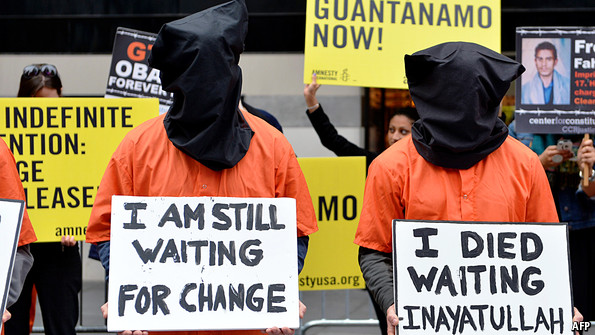
GuantanamoHungerStrike“YOU have to hand it to some of these IRA boys,” Margaret Thatcher once remarked of the republican hunger-strikers who embarrassed her in 1981. “What a terrible waste of human life!” she said of the ten who died. Since some of the hunger-strikers at Guantánamo Bay are being force-fed through nasal tubes, Barack Obama may be spared Mrs Thatcher’s grief. But he has been shamed by their desperate gambit all the same. The protest is a reminder of one of his most glaring failures in office.

Officials count 100 hunger-strikers; lawyers for the detainees say there are 130; on any reckoning, a majority of the 166 remaining inmates are starving themselves. Through their lawyers, detainees complain of a rougher regime since the army took over guard duties from the navy last autumn. In particular they allege that their Korans were mistreated during an inspection in February, when the hunger-strike began (prison authorities vigorously deny that). A cell-block raid by guards on April 13th (provoked by the covering up of security cameras), during which some prisoners were shot with rubber pellets, hardened rather than broke the strikers.

But the underlying cause is simpler, and more personal. “The reason they’re willing to die”, says Carlos Warner, a federal defender who represents 11 of the detainees, “is President Obama.”

Mr Obama said this week that Guantánamo “hurts us in terms of our international standing.” That echoed the view he espoused when, on his second day in office in January 2009, he ordered the prison to be closed within a year. Its existence since 2002, he said, had “likely created more terrorists around the world than it ever detained”—an opinion eventually shared by assorted veterans of George W. Bush’s administration. And yet the only Guantánamo-related closure so far has been the shutting, in January this year, of the diplomatic office charged with resettling the inmates.

Mr Obama blames Congress—with some justification. It thwarted his original plan to transfer the detainees to a facility in Illinois. Then, either out of concern for national security, a yen to embarrass the president, or both, in clauses inserted into successive defence-spending bills Congress made it difficult for officials to transfer anyone anywhere. Difficult, but not impossible: Mr Obama can authorise transfers using a presidential waiver. He has chosen not to. (After a bomb plot with links to Yemen at the end of 2009, he also chose to halt transfers there—and most of the remaining prisoners are Yemeni.) He evidently calculated that, given the battles he is already waging with Congress, Guantánamo was one he could do without.

That stalemate has been an especial let-down for the 86 residual prisoners who, in 2010, were slated for transfer out of Guantánamo by a presidential review; some had already been designated for transfer under the previous administration. Many of these men claim to have committed no offence except being in the wrong place—Afghanistan—at the wrong time, or to have been sold to American forces for the bounties they offered. One such, and one of the hunger-strikers, is Shaker Aamer, a British resident picked up in Jalalabad in 2001 and allegedly tortured. His lawyer, Clive Stafford Smith, points out that the British government is well-equipped to monitor Mr Aamer should he be repatriated.

According to the review, many of these men were low-level fighters rather than total innocents. But none has been charged with a crime—and most have been at Guantánamo for over a decade. In fact, only seven of the 779 prisoners who have passed through the camp have been convicted by its military tribunals (and two of those verdicts have been challenged). Of those still there, only three have been convicted and only six currently face trial, including Khalid Sheikh Mohammed, the alleged mastermind of the September 11th attacks. Subject to multiple legal challenges, beset by scandals over hidden microphones and leaked defence documents, the tribunals are now regarded as a failure even by those untroubled by their dubious legal status. As Mr Obama pointed out, federal courts have proved a much more effective forum for prosecuting terrorists.

The result, at the camp, is near-total stasis. No new prisoner has arrived since 2008; none has left for over a year. Parole-style hearings planned for the group not designated for either trial or transfer have yet to begin. Prisoners have lawyers, but there is little the lawyers can do for them. This bleak situation, says Mr Stafford Smith, is worse than being on death row.

Last chance?

Beyond the feeling of personal betrayal by Mr Obama, the detainees also sense—correctly—that the attention of the foreign leaders, human-rights watchdogs and United Nations officials who once energetically protested at their predicament has wandered. The outrage that the manacled, blindfolded, jumpsuited figures first provoked has dimmed. Drone warfare has become a much bigger human-rights preoccupation. And yet, unpropitious as it might seem, the prisoners also fear that this may be their last chance to get out.

Mr Warner says that if, with the president’s views and legal background, Mr Obama “can’t get this done, I don’t know who could.” It is hard to see a future presidential candidate matching his troublesome pledge to shut the prison. And for Mr Obama as well, time is running out. Even if he chose to use his waiver powers, and leant on other governments to accept detainees, the diplomacy, including gathering the necessary assurances on security and humane treatment, would take time.

Meanwhile the Guantánamo authorities are seeking an extra $200m for refurbishments, on top of annual running costs that wildly exceed those for ordinary prisons. They are planning new medical facilities to care for elderly detainees.

This week Mr Obama vowed to re-engage with Congress. “I’m going to go back at this,” he promised. He should hurry. Once Guantánamo was a byword for an overmighty executive and the excesses of Mr Bush’s “war on terror”. Under Mr Obama it has become a victim and a symbol of the paralysing divisiveness of American politics. “It’s going to get worse,” he said this week. “It’s going to fester.”

Source: The Economist

Ron Paul’s Farewell Address to Congress

Ron Paul: This may well be the last time I speak on the House Floor.  At the end of the year I’ll leave Congress after 23 years in office over a 36 year period.  My goals in 1976 were the same as they are today:  promote peace and prosperity by a strict adherence to the principles of individual liberty.

It was my opinion, that the course the U.S. embarked on in the latter part of the 20th Century would bring us a major financial crisis and engulf us in a foreign policy that would overextend us and undermine our national security.

To achieve the goals I sought, government would have had to shrink in size and scope, reduce spending, change the monetary system, and reject the unsustainable costs of policing the world and expanding the American Empire.

The problems seemed to be overwhelming and impossible to solve, yet from my view point, just following the constraints placed on the federal government by the Constitution would have been a good place to start.

How Much Did I Accomplish?

In many ways, according to conventional wisdom, my off-and-on career in Congress, from 1976 to 2012, accomplished very little.  No named legislation, no named federal buildings or highways—thank goodness.  In spite of my efforts, the government has grown exponentially, taxes remain excessive, and the prolific increase of incomprehensible regulations continues.  Wars are constant and pursued without Congressional declaration, deficits rise to the sky, poverty is rampant and dependency on the federal government is now worse than any time in our history.

All this with minimal concerns for the deficits and unfunded liabilities that common sense tells us cannot go on much longer.  A grand, but never mentioned, bipartisan agreement allows for the well-kept secret that keeps the spending going.  One side doesn’t give up one penny on military spending, the other side doesn’t give up one penny on welfare spending, while both sides support the bailouts and subsidies for the banking and  corporate elite.  And the spending continues as the economy weakens and the downward spiral continues.   As the government continues fiddling around, our liberties and our wealth burn in the flames of a foreign policy that makes us less safe.

The major stumbling block to real change in Washington is the total resistance to admitting that the country is broke. This has made compromising, just to agree to increase spending, inevitable since neither side has any intention of cutting spending.

The country and the Congress will remain divisive since there’s no “loot left to divvy up.”

Without this recognition the spenders in Washington will continue the march toward a fiscal cliff much bigger than the one anticipated this coming January.

I have thought a lot about why those of us who believe in liberty, as a solution, have done so poorly in convincing others of its benefits.  If liberty is what we claim it is- the principle that protects all personal, social and economic decisions necessary for maximum prosperity and the best chance for peace- it should be an easy sell.  Yet, history has shown that the masses have been quite receptive to the promises of authoritarians which are rarely if ever fulfilled. Read more…

Source: Ron Paul

Robert Neuwirth: The power of the informal economy | TEDTalks.com

Robert Neuwirth spent four years among the chaotic stalls of street markets, talking to pushcart hawkers and gray marketers, to study the remarkable “System D,” the world’s unlicensed economic network. Responsible for some 1.8 billion jobs, it’s an economy of under appreciated power and scope.

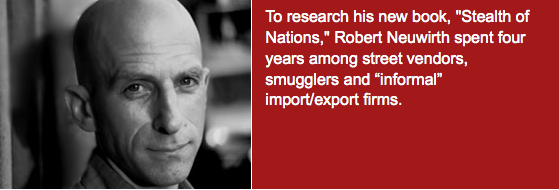
To research his new book, “Stealth of Nations,” Robert Neuwirth spent four years among street vendors, smugglers and “informal” import/export firms.

In his 2012 book Stealth of Nations, Robert Neuwirth challenges conventional thinking by examining the world’s informal economy close up.

To do so, he spent four years living and working with street vendors and gray marketers, to capture its scope, its vigor–and its lessons. He calls it “System D” and argues that it is not a hidden economy, but a very visible, growing, effective one, fostering entrepreneurship and representing 1.8 billion jobs worldwide.

Before this, for his previous book Shadow Cities (also a TEDTalk), he spent two years exploring one of the most profound trends of our time: the mass migration of the world’s population into urban shantytowns. A billion people live as squatters.

Life in a favela, slum, shantytown is hard: no water, no transport, no sewage. But in the squatter cities of Rio, Nairobi, Istanbul and Mumbai, Neuwirth discovered restaurants, markets, clinics and effective forms of self-organization.

Our challenge, Neuwirth says, isn’t to end squatter cities or shut down gray markets–but to engage and empower those who live and work in them. Link to Video…

“[Neuwirth shines] an investigative lens into areas of urban life that have seldom been described before.” – Reason magazine

9th Circuit Court rules visitors to national forest don’t have to pay a fee | Pasadena Star News

By Steve Scauzillo

In a decision that could bring an end to the national Adventure Pass program, the U.S. 9th Circuit Court of Appeals ruled that the U.S. Forest Service cannot charge for hiking, walking, picnicking or visiting undeveloped areas of national forest land.

In the unanimous ruling released Feb. 9 in favor of four hikers who objected to paying a fee to visit the forest, Judge Robert Gettleman wrote: “Everyone is entitled to enter national forests without paying a cent.”

The case involved four plaintiffs who objected to paying a fee to the U.S. Forest Service for visiting Mount Lemmon within the Coronado National Forest in Arizona. The court reversed a district court ruling, saying the federal authorities violated the 2004 Federal Lands Recreation Enhancement Act (FLREA).

While it remained unclear Wednesday if the ruling spells the end of the Adventure Pass program in the nearby Angeles National Forest, local activists and others involved in the long-standing battle against the fee program say it will be very difficult to charge folks who enter the sprawling forest, which forms the northern border of the San Gabriel Valley. Under the fee program, it costs $5 a day or $30 annually to enter many parts of the forest.

“This is the best news I have heard in years,” said Bob Bartsch, 72, of Pasadena. Bartsch, who still hikes the 10-mile roundtrip up to Henninger Flats and back, has been fighting the Adventure Pass program since it began in 1997.

“I don’t have anything officially on that at this time,” said Sherry Rollman, spokesperson for the U.S. Forest Service in Arcadia. “It happened in another state and we haven’t assessed it yet.”

The strongly worded, 15-page decision says any member of the public who walks, hikes, rides a horse, picnics on the side of a road, camps at undeveloped sites, even parks in a national forest “without using facilities and services” is allowed to do so without being charged. Charging a fee, such as the Adventure Pass, even for someone who visits an area with amenities but doesn’t use them, violates the FLREA, according to the decision. Read more…

Citizens Rising for the Constitution – Liberty Gets a Lobby | We the People

THE GREAT SEARCH IS ON: WILL YOU ANSWER THE CALL?

WE THE PEOPLE OF EACH STATE TO ESTABLISH A NON-POLITICAL CONSTITUTION LOBBY IN EACH STATE WITH THE SOLE PURPOSE OF HOLDING ELECTED OFFICIALS ACCOUNTABLE TO THEIR LOCAL, STATE AND FEDERAL CONSTITUTIONS.

Most of us know now that Individuals and Small Groups cannot prevail. Our Rights are being taken away. Millions of Freedom-Loving Americans must come together.

A CONSTITUTION LOBBY, OF THE PEOPLE, BY THE PEOPLE, FOR THE PEOPLE WHICH RESTORES THE POWER WHERE IT IS MEANT TO RESIDE IN THE FIRST PLACE – WHICH PROVIDES THE ORGANIZATION, FUNDING AND POWER TO BE A RECOGNIZED, RESPECTED FORCE – A NON-POLITICAL “WATCH-DOG” OF MILLIONS OF FREEDOM KEEPERS, WHOSE MEMBERS ENSURE GOVERNMENT WILL NO LONGER AND NEVER AGAIN BE ABLE TO STEP BEYOND THE BOUNDARIES DRAWN AROUND THEM BY OUR CONSTITUTIONS.

Not to be viewed as a NEW organization or NEW group, but a Coalition of like-minded Pro-Constitutional groups, organizations and individuals who merge their expertise and their passion for Liberty and come together to do what we cannot do alone or in an un-organized manner.

“The People are the only sure reliance for the preservation of liberty.”
“The price of freedom is eternal vigilance.” – Thomas Jefferson

“No matter how many pro-freedom politicians we elect to office, the only way to guarantee constitutional government is through an educated and activist public devoted to the ideals of the liberty [sic].” – Ron Paul

AMERICA SHALL BE FREE.
– Bob Schulz & Judith Whitmore
We The People Foundation

S510 – Illegal To Grow, Share, Trade, Sell Homegrown Food | Rense

S510, the Food Safety Modernization Act of 2010, may be the most dangerous bill in the history of the US. (http://www.govtrack.us/congress/bill.xpd?bill=s111-510 )

“If accepted [S 510] would preclude the public’s right to grow, own, trade, transport, share, feed and eat each and every food that nature makes. It will become the most offensive authority against the cultivation, trade and consumption of food and agricultural products of one’s choice. It will be unconstitutional and contrary to natural law or, if you like, the will of God.” It is similar to what India faced with imposition of the salt tax during British rule, only S 510 extends control over all food in the US, violating the fundamental human right to food.” – Dr. Shiv Chopra, Canada Health whistleblower.

Monsanto says it has no interest in the bill and would not benefit from it, but Monsanto’s Michael Taylor who gave us rBGH and unregulated genetically modified (GM) organisms, appears to have designed it and is waiting as an appointed Food Czar to the FDA (a position unapproved by Congress) to administer the agency it would create without judicial review if it passes.

S 510 would give Monsanto unlimited power over all US seed, food supplements, food AND FARMING.

History

In the 1990s, Bill Clinton introduced HACCP (Hazardous Analysis Critical Control Points) purportedly to deal with contamination in the meat industry. Clinton’s HACCP delighted the offending corporate (World Trade Organization “WTO”) meat packers since it allowed them to inspect themselves, eliminated thousands of local food processors (with no history of contamination), and centralized meat into their control. Monsanto promoted HACCP.

In 2008, Hillary Clinton, urged a powerful centralized food safety agency as part of her campaign for president. Her advisor was Mark Penn, CEO of Burson Marsteller*, a giant PR firm representing Monsanto. Clinton lost, but Clinton friends such as Rosa DeLauro, whose husband’s firm lists Monsanto as a progressive client and globalization as an area of expertise, introduced early versions of S 510.

S 510 fails on moral, social, economic, political, constitutional, and human survival grounds.

  1. It puts all US food and all US farms under Homeland Security and the Department of Defense, in the event of contamination or an ill-defined emergency. It resembles the Kissinger Plan.
  2. It would end US sovereignty over its own food supply by insisting on compliance with the WTO, thus threatening national security. It would end the Uruguay Round Agreement Act of 1994, which put US sovereignty and US law under perfect protection. Instead, S 510 says: Nothing in this Act (or an amendment made by this Act) shall be construed in a manner inconsistent with the agreement establishing the World Trade Organization or any other treaty or international agreement to which the United States is a party.
  3. It would allow the government, under Maritime Law, to define the introduction of any food into commerce (even direct sales between individuals) as smuggling into “the United States.” Since under that law, the US is a corporate entity and not a location, “entry of food into the US” covers food produced anywhere within the land mass of this country and “entering into” it by virtue of being produced.
  4. It imposes Codex Alimentarius on the US, a global system of control over food. It allows the United Nations (UN), World Health Organization (WHO), UN Food and Agriculture Organization (FAO), and the WTO to take control of every food on earth and remove access to natural food supplements. Its bizarre history and its expected impact in limiting access to adequate nutrition (while mandating GM food, GM animals, pesticides, hormones, irradiation of food, etc.) threatens all safe and organic food and health itself, since the world knows now it needs vitamins to survive, not just to treat illnesses.
  5. It would remove the right to clean, store and thus own seed in the US, putting control of seeds in the hands of Monsanto and other multinationals, threatening US security. See Seeds ­ How to criminalize them, for more details.
  6. It includes NAIS, an animal traceability program that threatens all small farmers and ranchers raising animals. The UN is participating through the WHO, FAO, WTO, and World Organization for Animal Health (OIE) in allowing mass slaughter of even heritage breeds of animals and without proof of disease. Biodiversity in farm animals is being wiped out to substitute genetically engineered animals on which corporations hold patents. Animal diseases can be falsely declared. S 510 includes the Centers for Disease Control (CDC), despite its corrupt involvement in the H1N1 scandal, which is now said to have been concocted by the corporations.
  7. It extends a failed and destructive HACCP to all food, thus threatening to do to all local food production and farming what HACCP did to meat production ­ put it in corporate hands and worsen food safety.
  8. It deconstructs what is left of the American economy. It takes agriculture and food, which are the cornerstone of all economies, out of the hands of the citizenry, and puts them under the total control of multinational corporations influencing the UN, WHO, FAO and WTO, with HHS, and CDC, acting as agents, with Homeland Security as the enforcer. The chance to rebuild the economy based on farming, ranching, gardens, food production, natural health, and all the jobs, tools and connected occupations would be eliminated.
  9. It would allow the government to mandate antibiotics, hormones, slaughterhouse waste, pesticides and GMOs. This would industrialize every farm in the US, eliminate local organic farming, greatly increase global warming from increased use of oil- based products and long-distance delivery of foods, and make food even more unsafe. The five items listed the Five Pillars of Food Safety are precisely the items in the food supply which are the primary source of its danger.
  10. It uses food crimes as the entry into police state power and control. The bill postpones defining all the regulations to be imposed; postpones defining crimes to be punished, postpones defining penalties to be applied. It removes fundamental constitutional protections from all citizens in the country, making them subject to a corporate tribunal with unlimited power and penalties, and without judicial review.

For further information, watch these videos: