
Despite his lies, Donald Trump is a potent truth-teller | The Guardian

fools

By James S. Gordon

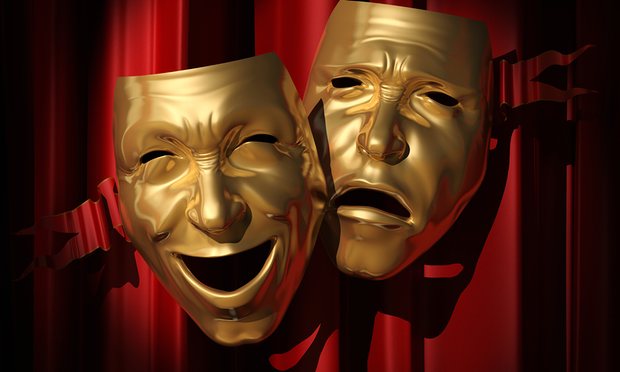
Donald Trump evokes a wily and resilient mythic figure: the joker, the trickster, the fool, the one the Lakota people call the Heyoka, the contrary. Had his opponents – such as Hillary Clinton – understood this quality in him, the electoral outcome might have been different. The sooner the rest of us understand this side of him, the better.

In the European tradition, the fool holds up the mirror to the monarch and to all of us, mocking our faults and pretensions. He (the fool is almost always a man) is not constrained by deference or allegiance to truth. The Heyoka, one of the purest forms of fool, pretends to shiver when everyone else is sweating and takes off his clothes in winter.

The fool is a potent truth-teller and commands attention. Shakespeare knew this. Lear’s Fool, a gentle version of the species, skewered the arrogance and pride that were his master’s downfall, even as he comforted him. The “scabrous” Thersites in Troilus and Cressida speaks with relentless, scene-stealing venom. He paints Achilles, the Greeks’ greatest hero, as a petulant adolescent; King Agamemnon is a blowhard, Helen of Troy a hooker.

The fool is always addressing us, his audience, as well as his high-ranking targets. He performs a vital social function, forcing us to examine our own preconceptions, especially our inflated ideas about our own virtue. Trump was telling all of us – women and minorities, progressives, pillars of the establishment, as well as his supporters – that we were just like him.

The appropriate, time-honored response to the fool’s sallies is to take instruction from them. Only after we’ve acknowledged and accepted our own shortcomings do we have the integrity that allows us to keep him in his place. Perhaps if Secretary Clinton had been a more skillful, poised and humble warrior, she could have done this.

Fools serve the collective order by challenging those whose ignorance and blindness threaten it. They are meant to be instruments of awareness, not rulers. Impossible to imagine Lear’s Fool succeeding him or Thersites commanding the Greek army. Trump will not address his own limitations, cannot tolerate criticism, and takes himself dangerously seriously. This makes him a seriously flawed fool. He believes his own hyperbole and threatens democratic order.

In the weeks since his election, Trump has continued to act the fool. Now, however, the underdog’s challenges have become a bully’s beatdowns. His attack on the steelworkers’ union leader, Chuck Jones, exactly the kind of man whom he claimed to champion, was a vicious and painful lie. Unfunny, purely ugly. His more recent rants, including boasts about the crowds at his inaugural and the millions of imaginary illegal Clinton voters, illuminate his own troubled insecurity: the all-powerful winner acting the petulant, powerless loser.

Many of President Trump’s cabinet choices are like the punchlines of jokes, but punchlines with potentially devastating real-world consequences: an education secretary who disparages public education and badly botched her own effort at creating an alternative; men charged with responding to climate change who deny its existence; and a national security adviser who purveys paranoid fantasies.

There are glimmers of hope that the jester might mature to majesty. Gen James Mattis, the defense secretary, inspired a Trumpian epiphany that waterboarding might be counterproductive. Conversations with Al Gore or, more likely, ones with his daughter Ivanka could persuade him to open his eyes to the reality of climate change.

Or perhaps President Trump will implode, brought down by the damage done by perverse cabinet choices, or words and actions so intemperate and ill-advised that Congress and the courts call him to a terminal account. His challenged immigration order could be a harbinger.

Meanwhile, what are the rest of us to do? The fact that this question is even being asked is healthy, a residual benefit of his fool’s vocation. Trump’s grand and vulgar self-absorption is inviting all of us to examine our own selfishness. His ignorance calls us to attend to our own blind spots. The fears that he stokes and the isolation he promotes goad us to be braver, more generous.

Already, people all over the US – Republicans I know as well as Democrats – are beginning to link inner awareness to small and great political action.

The day after Trump’s inauguration, hundreds of thousands of women of all ages, ethnicities and political affiliations affirmed their rights, celebrated their community and slyly poked at the joker: “if I incorporated my uterus,” read one demonstrator’s sign, “would you stop trying to regulate it”.

The joker who is now our president has served an important function, waking us up to what we’ve not yet admitted in ourselves or accomplished in our country. He is, without realizing it, challenging us to grow in self-awareness, to act in ways that respect and fulfill what is best in ourselves and our democracy.

It’s time for us citizens, who’ve watched the performance, to take the stage.

Source: The Guardian

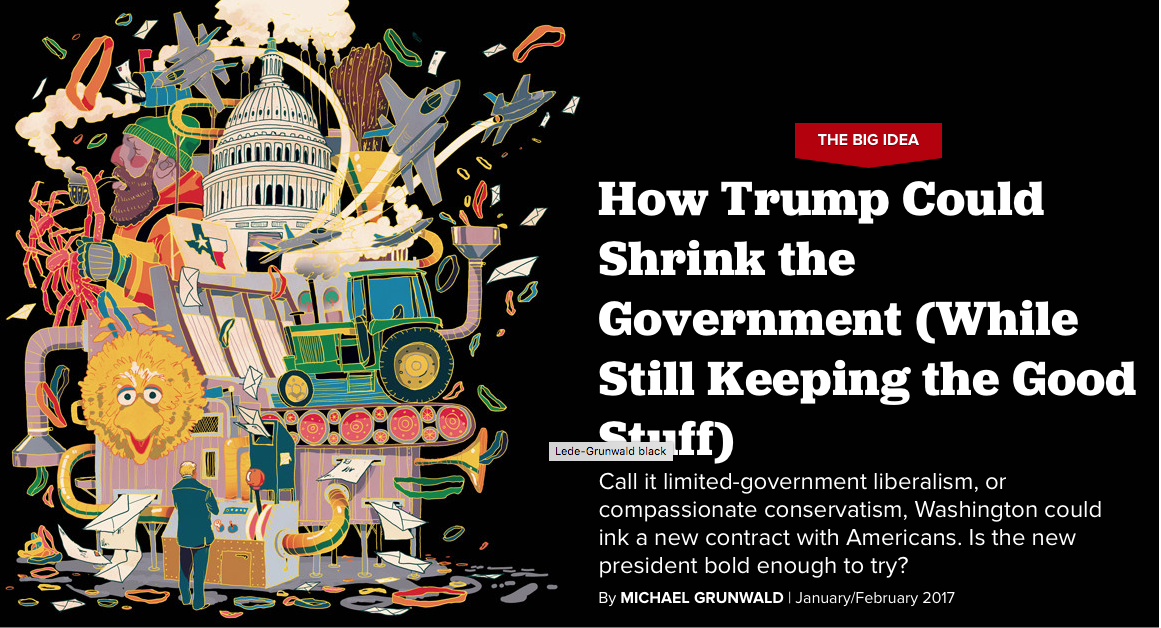
How Trump Could Shrink the Government (While Still Keeping the Good Stuff) | POLITICO Magazine

Editor’s Note: This is one of the soundest analysis of what’s possible under the Trump administration focusing on solutions instead of hysteria. Please read the entire article.

By Michael Grunwald

limitedgovernmentDonald Trump’s political brand is about fighting and winning, and he has promised to fight and win a war on big government. As a candidate, he often attacked the federal bureaucracy as a bloated monstrosity teeming with “waste, fraud and abuse all over the place,” and vowed to “cut so much your head will spin!” As president-elect, he continued his clamor on Twitter, pledging to save taxpayers billions on “out of control” programs like the F-35 fighter jet.

But Trump has also proclaimed his belief in an activist government, portraying himself as a kind of father-figure leader who will “take care of people.” He insisted during the Republican primary that, unlike his opponents, he would never cut a single dollar from Social Security, Medicare or Medicaid, or let Americans “die on the streets.” His agenda to Make America Great Again is in many ways a big government agenda, with bleeding-heart goals like rebuilding infrastructure and reviving inner cities, as well as get-tough goals like beefing up the military and walling up the border

Trump’s critics cite this split-screen attitude toward government as evidence that he’s running a con. And his early moves, like stocking his administration with Goldman Sachs alumni, do suggest he won’t feel constrained by his drain-the-swamp campaign talk. But if Trump’s two-sided rhetoric about government sounds like a con, it should sound like a familiar con, because Presidents Bill Clinton, George W. Bush and Barack Obama all fed us similar lines. They all argued that the federal government is too big, wastes too much money and tries to do too many things—but also that it should perform vital functions like defending the nation, supporting the elderly and providing a safety net for the vulnerable.

In fact, polls show that most Americans agree with both of those arguments, which might help explain why politicians who make them keep winning the White House. As Obama put it in The Audacity of Hope, voters “don’t expect government to solve all their problems,” but do “figure government should help.” And those dual beliefs happen to be sensible ones, not just popular ones. It’s hard to see how Americans can be assured of clean air and water, a basic level of subsistence and protection from foreign invaders without federal intervention; it’s just as hard to see why the federal government needs 200 science education programs spread across 13 separate agencies. It’s disturbing that we’re the only wealthy nation without universal health insurance, and also that our government delivers 81 billion annual pieces of junk mail. If you think about it, this amounts to a logical theory of governance that would be revolutionary in practice: Washington really should do some big stuff in a big way, while doing a lot less stuff overall. It ought to focus on policy wars of necessity rather than wars of choice—and then fight those wars with overwhelming force.

This triage approach to governance could be called “limited-government liberalism,” although Trump certainly wouldn’t use that phrase. Or perhaps, to borrow a slogan that Bush never really defined, it could go by “compassionate conservatism.” Its motto could be Clinton’s only-half-remembered 1996 declaration that “the era of big government is over—but we cannot go back to the time when our citizens were left to fend for themselves.” It’s about as close as this polarized nation has to a bipartisan political philosophy, and it’s probably the rosiest scenario, if not the likeliest scenario, for the kind of radical change Trump could bring to Washington. It would involve near-constant battles with the special interests and other insiders Trump always talks about battling; it could appeal to Trump’s self-image as a heroic disrupter of an entrenched status quo; and it could be quite popular, a quality populists tend to like. Read more…

Source: POLITICO Magazine

The Real ‘Fake News’ Is The Mainstream Media | Forbes

https---specials-images.forbesimg.com-imageserve-e5c24764d014483880d212e6b23ef0b1-960x0.jpg?fit=scaleEditor’s Note: Thought it would be interesting to go back almost four years and post this election 2016 article about how the media was already distorting the news after Trump became the duly elected President of the United States. The mainstream media, left/liberal or otherwise, always has a political agenda (not a journalistic one) to serve their corporate/elite masters. These media distortions, and their pursuit of “fake news”, aligns only with their preordained narrative. This has left the mainstream media with no credibility whatsoever.
By Tom Basile

It’s been a little more than a month since an election that was the kind of seismic event in our politics that only happens once a century. It sent shock waves through the national political establishment and pretty much any other group of prognosticators that had been banking on an easy Clinton win. No one felt the sting more than the mainstream media. The morning after the election, anchors and columnists were making a collective stammering Act of Contrition about just how “wrong” they were about the election – and the electorate.

But in the month since, the so-called mainstream media have, as if in coordinated fashion, executed a transparent strategy to bludgeon the president-elect at every turn. Republicans, Conservatives, Independents and the majority of Americans who actually want to give Donald Trump a chance to lead will likely see through this anti-Trump propaganda campaign, but perhaps a review of their strategy is instructive at this point.

Media outlets have again shown they are doubling down on the same strategy that has driven their own approval ratings close to – dare I say – Congressional territory.  That’s right. Survey after survey finds the same media that has made beating up conservatives, Republicans and religious institutions an industry has seen their tactics boomerang on them. Even actor Denzel Washington blasted the media last week saying that, “One of the effects of “too much information is the need to be first, not even to be true anymore.”

Hope for better isn’t a strategy and change isn’t coming. Here’s the anti-Trump plan of attack in all its banality. Some of these elements will have a shelf life. Some will be part of a prolonged effort. The strategy has several key components that have quickly taken shape over the last few weeks.

First, they are advancing a strategy of attempting to tie the president-elect and his team to the so-called “alt-right” and neo-Nazi, white supremacist lunatics. Despite Trump and his transition team issuing multiple statements denouncing the activities of a number of groups, the media still provided hours of coverage to small pockets of hate groups that used the election as a recruiting tool.

A sub-component to this was advancing a message that the country was in turmoil in the days after the election because of widespread protests against the newly-elected president. Even Fox News put a graphic on the screen that proclaimed there was “Anarchy in America.” Again, more sensationalized information that only bares a faint resemblance to the truth.

Yes, there were protests in a number of cities as well as sit-ins and cry-ins on college campuses filled with whiny young people who have little grasp on the realities of life. But to suggest that there is widespread discontent and a surge in the size, number and strength of hate groups in this country who are supposedly empowered by the Trump campaign or aligned with the president-elect is nonsense. Incidents that qualify as hate crimes, like racist graffiti did spike after the election, but a real, honest analysis of these events will show that a sustained, coordinated grassroots movement against American pluralistic values and racial tolerance is not developing.

This is what happens when you try to stretch 10 minutes of news into 24 hours of coverage.

Third, the press have pushed several key messages to delegitamize the president-elect.  Let’s take them in order.  First, the media is aggressively driving the narrative that Trump didn’t win the popular vote.  This part of the playbook was dusted off from George W. Bush’s 2000 election. Of course the big brains in the media never mention to their readers and viewers the simple fact that the Electoral College – whatever you might think about it – dictates the strategy of national elections.  If you ran a popular vote strategy, you’d run a completely different campaign in terms of allocation of time and resources. The game is not winning the popular vote, like it or not.

Further, there is no evidence that had the campaigns executed a popular vote strategy that Clinton would have won. Actually to the contrary, given the marked enthusiasm deficit on the Democrat side, Trump would likely have mobilized more voters from his states than Clinton would have in hers. Also, keep in mind that Clinton did have a robust turnout operation in key urban and suburban districts where she needed to perform well with her base. She still under-performed in those places that also would have been critical to a popular vote victory.

The press has weaved the issue into the coverage repeatedly using the phony recounts in Michigan, Pennsylvania and Wisconsin as an excuse to mention the popular vote margin. Naturally, they’ve spent little time acknowledging that Hillary Clinton lost or under-performed President Obama in almost every single demographic group that mattered – including women.

The second way they are seeking to delegitamize Trump is pushing the notion that something called “fake news” was actually the reason why Trump won the election. The “fake news” claim is perhaps the most offensive, but naturally many in the media have been tone deaf about it. “Fake news” is real.  It is generated by websites, aggregators and email list-serves that blast out stories on social media and other online platforms of dubious credibility.  We’ve all seen them.  They specialize in click-bait for folks who feed off of red meat politics.  Headlines like “Obama to ban Pledge of Allegiance,” or “Clinton Accused of Being Pedophile,” are the kinds of stories that drive traffic to these sites.

The mainstream news media would like people to believe that so many people actually thought enough of these stories were credible that the impact threw the election to Donald Trump.

Denial is a terrible thing. Even more so, what is highlighted by this strategy is their elitism and continuing disdain for the average person. Sure I often accuse politicians of all political stripes of underestimating the intelligence of the average voter, but this line of attack against the legitimacy of the election takes the cake. Whenever you read a “real news” story about “fake news” remember, the editors who decided to create space in news cycle for that piece think millions of Americans are just to dumb to realize when something is so outrageous, it can’t be all true. This attitude on the part of the media is, of course, an extension of their general political philosophy that suggests people are too stupid to make their own decisions about how big their soda should be or how much salt to use in their food. These are the same folks who believe that the government is the solution to all problems domestically and can do no right when it comes to foreign or military policy.

Finally, in recent days the idea that Russia, through electronic espionage and “fake news,” helped tip the scales in Trump’s favor is the latest method of not only de-legitimizing Trump but also suggesting that Trump is in some way a Manchurian Candidate who will be controlled by Vladimir Putin.  No one should ever put anything past Putin, particularly after the Obama foreign policy has allowed his power and influence to grow unchecked.  But to suggest that Clinton would have won, but for this alleged interference is as credible as, well, fake news.

Oh wait – I forgot the new charge that Trump’s appointment of former generals to several cabinet and senior posts is evidence of his desire to abrogate civilian leadership of the country and institute a full-scale militarization of the federal government. That was a new one over the last few days.

Then of course, are the photos and video clips intentionally curated and placed by editors in mainstream reporting that show Trump making silly, mean or grotesque faces. The media did this to Bush constantly. Back then the word in news rooms was to make him look as stupid and confused as possible in photos and video.

So a month after the feigned apologies for getting it all wrong, the media has telegraphed clearly their strategy for the next four years. Perhaps we should thank them for being so transparent. Like Democrats during the campaign who chose to talk more about transgender bathrooms than job creation for the middle class, the media that stretches to such lengths to hurt the incoming president may well continue to lose public support. For ordinary Americans just looking for real, balanced news and analysis, it looks like we’ll be out in the cold again.

Source: Forbes

Inside The Invisible Government: John Pilger On War, Propaganda, Clinton And Trump | New Matilda

overiraq

By John Pilger

A silent war continues, led by the west, ignored by the media, writes John Pilger.

The American journalist, Edward Bernays, is often described as the man who invented modern propaganda.

The nephew of Sigmund Freud, the pioneer of psycho-analysis, it was Bernays who coined the term “public relations” as a euphemism for spin and its deceptions.

In 1929, he persuaded feminists to promote cigarettes for women by smoking in the New York Easter Parade – behaviour then considered outlandish. One feminist, Ruth Booth, declared, “Women! Light another torch of freedom! Fight another sex taboo!”

Bernays’ influence extended far beyond advertising. His greatest success was his role in convincing the American public to join the slaughter of the First World War. The secret, he said, was “engineering the consent” of people in order to “control and regiment [them]according to our will without their knowing about it”.

He described this as “the true ruling power in our society” and called it an “invisible government”.

Today, the invisible government has never been more powerful and less understood. In my career as a journalist and film-maker, I have never known propaganda to insinuate our lives as it does now, and to go unchallenged.

Imagine two cities. Both are under siege by the forces of the government of that country. Both cities are occupied by fanatics, who commit terrible atrocities, such as beheading people.

But there is a vital difference. In one siege, the government soldiers are described as liberators by Western reporters embedded with them, who enthusiastically report their battles and air strikes. There are front page pictures of these heroic soldiers giving a V-sign for victory. There is scant mention of civilian casualties.

(IMAGE: The U.S. Army, Flickr)

In the second city – in another country nearby – almost exactly the same thing is happening. Government forces are laying siege to a city controlled by the same breed of fanatics.

The difference is that these fanatics are supported, supplied and armed by “us” – by the United States and Britain. They even have a media centre that is funded by Britain and America.

Another difference is that the government soldiers laying siege to this city are the bad guys, condemned for assaulting and bombing the city – which is exactly what the good soldiers do in the first city.

Confusing? Not really. Such is the basic double standard that is the essence of propaganda. I am referring, of course, to the current siege of the city of Mosul by the government forces of Iraq, who are backed by the United States and Britain, and to the siege of Aleppo by the government forces of Syria, backed by Russia. One is good; the other is bad.

What is seldom reported is that both cities would not be occupied by fanatics and ravaged by war if Britain and the United States had not invaded Iraq in 2003. That criminal enterprise was launched on lies strikingly similar to the propaganda that now distorts our understanding of the civil war in Syria.

Without this drumbeat of propaganda dressed up as news, the monstrous ISIS and Al-Qaida and al-Nusra and the rest of the jihadist gang might not exist, and the people of Syria might not be fighting for their lives today.

Some may remember in 2003 a succession of BBC reporters turning to the camera and telling us that Blair was “vindicated” for what turned out to be the crime of the century. The US television networks produced the same validation for George W. Bush. Fox News brought on Henry Kissinger to effuse over Colin Powell’s fabrications.

Former US president George W Bush (IMAGE: Peter Stevens, Flickr).

The same year, soon after the invasion, I filmed an interview in Washington with Charles Lewis, the renowned American investigative journalist. I asked him, “What would have happened if the freest media in the world had seriously challenged what turned out to be crude propaganda?”

He replied that if journalists had done their job, “there is a very, very good chance we would not have gone to war in Iraq”.

It was a shocking statement, and one supported by other famous journalists to whom I put the same question – Dan Rather of CBS, David Rose of the Observer and journalists and producers in the BBC, who wished to remain anonymous.

In other words, had journalists done their job, had they challenged and investigated the propaganda instead of amplifying it, hundreds of thousands of men, women and children would be alive today, and there would be no ISIS and no siege of Aleppo or Mosul.

There would have been no atrocity on the London Underground on 7th July 2005. There would have been no flight of millions of refugees; there would be no miserable camps.

When the terrorist atrocity happened in Paris last November, President Francoise Hollande immediately sent planes to bomb Syria – and more terrorism followed, predictably, the product of Hollande’s bombast about France being “at war” and “showing no mercy”. That state violence and jihadist violence feed off each other is the truth that no national leader has the courage to speak.

“When the truth is replaced by silence,” said the Soviet dissident Yevtushenko, “the silence is a lie.”

The attack on Iraq, the attack on Libya, the attack on Syria happened because the leader in each of these countries was not a puppet of the West. The human rights record of a Saddam or a Gaddafi was irrelevant. They did not obey orders and surrender control of their country.

The same fate awaited Slobodan Milosevic once he had refused to sign an “agreement” that demanded the occupation of Serbia and its conversion to a market economy. His people were bombed, and he was prosecuted in The Hague. Independence of this kind is intolerable.

Syria-Assad

As WikiLeaks has revealed, it was only when the Syrian leader Bashar al-Assad in 2009 rejected an oil pipeline, running through his country from Qatar to Europe, that he was attacked.

From that moment, the CIA planned to destroy the government of Syria with jihadist fanatics – the same fanatics currently holding the people of Mosul and eastern Aleppo hostage.

Why is this not news? The former British Foreign Office official Carne Ross, who was responsible for operating sanctions against Iraq, told me: “We would feed journalists factoids of sanitised intelligence, or we would freeze them out. That is how it worked.”

The West’s medieval client, Saudi Arabia – to which the US and Britain sell billions of dollars’ worth of arms – is at present destroying Yemen, a country so poor that in the best of times, half the children are malnourished.

Look on YouTube and you will see the kind of massive bombs – “our” bombs – that the Saudis use against dirt-poor villages, and against weddings, and funerals.

The explosions look like small atomic bombs. The bomb aimers in Saudi Arabia work side-by-side with British officers. This fact is not on the evening news.

Propaganda is most effective when our consent is engineered by those with a fine education – Oxford, Cambridge, Harvard, Columbia – and with careers on the BBC, theGuardian, the New York Times, the Washington Post.

These organisations are known as the liberal media. They present themselves as enlightened, progressive tribunes of the moral zeitgeist. They are anti-racist, pro-feminist and pro-LGBT.

And they love war.

While they speak up for feminism, they support rapacious wars that deny the rights of countless women, including the right to life.

In 2011, Libya, then a modern state, was destroyed on the pretext that Muammar Gaddafi was about to commit genocide on his own people. That was the incessant news; and there was no evidence. It was a lie.

An anti-Gaddafi rally, Libya 2011. (IMAGE: mojomogwai, Flickr)

In fact, Britain, Europe and the United States wanted what they like to call “regime change” in Libya, the biggest oil producer in Africa. Gaddafi’s influence in the continent and, above all, his independence were intolerable.

So he was murdered with a knife in his rear by fanatics, backed by America, Britain and France. Hillary Clinton cheered his gruesome death for the camera, declaring,

“We came, we saw, he died!”

The destruction of Libya was a media triumph. As the war drums were beaten, Jonathan Freedland wrote in the Guardian: “Though the risks are very real, the case for intervention remains strong.”

Intervention – what a polite, benign, Guardian word, whose real meaning, for Libya, was death and destruction.

According to its own records, Nato launched 9,700 “strike sorties” against Libya, of which more than a third were aimed at civilian targets. They included missiles with uranium warheads. Look at the photographs of the rubble of Misurata and Sirte, and the mass graves identified by the Red Cross. The Unicef report on the children killed says, “most [of them]under the age of 10”.

As a direct consequence, Sirte became the capital of ISIS.

Ukraine is another media triumph. Respectable liberal newspapers such as the New York Times, the Washington Post and the Guardian, and mainstream broadcasters such as the BBC, NBC, CBS, CNN have played a critical role in conditioning their viewers to accept a new and dangerous cold war.

All have misrepresented events in Ukraine as a malign act by Russia when, in fact, the coup in Ukraine in 2014 was the work of the United States, aided by Germany and Nato.

This inversion of reality is so pervasive that Washington’s military intimidation of Russia is not news; it is suppressed behind a smear and scare campaign of the kind I grew up with during the first cold war. Once again, the Ruskies are coming to get us, led by another Stalin, whom The Economist depicts as the devil.

The suppression of the truth about Ukraine is one of the most complete news blackouts I can remember. The fascists who engineered the coup in Kiev are the same breed that backed the Nazi invasion of the Soviet Union in 1941. Of all the scares about the rise of fascist anti-Semitism in Europe, no leader ever mentions the fascists in Ukraine – except Vladimir Putin, but he does not count.

Russian president Vladimir Putin. (IMAGE: IoSonoUnaFotoCamera, Flickr).

Many in the Western media have worked hard to present the ethnic Russian-speaking population of Ukraine as outsiders in their own country, as agents of Moscow, almost never as Ukrainians seeking a federation within Ukraine and as Ukrainian citizens resisting a foreign-orchestrated coup against their elected government.

There is almost the joie d’esprit of a class reunion of warmongers. The drum-beaters of the Washington Post inciting war with Russia are the very same editorial writers who published the lie that Saddam Hussein had weapons of mass destruction.

To most of us, the American presidential campaign is a media freak show, in which Donald Trump is the arch villain.

But Trump is loathed by those with power in the United States for reasons that have little to do with his obnoxious behaviour and opinions. To the invisible government in Washington, the unpredictable Trump is an obstacle to America’s design for the 21stcentury.

This is to maintain the dominance of the United States and to subjugate Russia, and, if possible, China.

To the militarists in Washington, the real problem with Trump is that, in his lucid moments, he seems not to want a war with Russia; he wants to talk with the Russian president, not fight him; he says he wants to talk with the president of China.

In the first debate with Hillary Clinton, Trump promised not to be the first to introduce nuclear weapons into a conflict. He said, “I would certainly not do first strike. Once the nuclear alternative happens, it’s over.” That was not news.

Did he really mean it? Who knows? He often contradicts himself. But what is clear is that Trump is considered a serious threat to the status quo maintained by the vast national security machine that runs the United States, regardless of who is in the White House.

The CIA wants him beaten. The Pentagon wants him beaten. The media wants him beaten. Even his own party wants him beaten. He is a threat to the rulers of the world – unlike Clinton who has left no doubt she is prepared to go to war with nuclear-armed Russia and China.

US Republican presidential candidate, Donald Trump. (IMAGE: Gage Skidmore, Flickr)

Clinton has the form, as she often boasts. Indeed, her record is proven. As a senator, she backed the bloodbath in Iraq. When she ran against Obama in 2008, she threatened to “totally obliterate” Iran. As Secretary of State, she colluded in the destruction of governments in Libya and Honduras and set in train the baiting of China.

She has now pledged to support a No Fly Zone in Syria — a direct provocation for war with Russia. Clinton may well become the most dangerous president of the United States in my lifetime –a distinction for which the competition is fierce.

Without a shred of evidence, she has accused Russia of supporting Trump and hacking her emails. Released by WikiLeaks, these emails tell us that what Clinton says in private, in speeches to the rich and powerful, is the opposite of what she says in public.

That is why silencing and threatening Julian Assange is so important. As the editor of WikiLeaks, Assange knows the truth. And let me assure those who are concerned, he is well, and WikiLeaks is operating on all cylinders.

Today, the greatest build-up of American-led forces since World War Two is under way – in the Caucasus and eastern Europe, on the border with Russia, and in Asia and the Pacific, where China is the target.

Keep that in mind when the presidential election circus reaches its finale on November 8th, If the winner is Clinton, a Greek chorus of witless commentators will celebrate her coronation as a great step forward for women. None will mention Clinton’s victims: the women of Syria, the women of Iraq, the women of Libya. None will mention the civil defence drills being conducted in Russia. None will recall Edward Bernays’ “torches of freedom”.

Democratic presidential candidate, Hillary Clinton. (IMAGE: iprimages, Flickr)

George Bush’s press spokesman once called the media “complicit enablers”.

Coming from a senior official in an administration whose lies, enabled by the media, caused such suffering, that description is a warning from history.

In 1946, the Nuremberg Tribunal prosecutor said of the German media: “Before every major aggression, they initiated a press campaign calculated to weaken their victims and to prepare the German people psychologically for the attack. In the propaganda system, it was the daily press and the radio that were the most important weapons.”

Source: New Matilda

Democracy And Corruption: European Center for Constitutional and Human Rights Files War Crimes Charges Against Bush, Cheney, Rumsfeld And Other CIA Officials | Liberal America

By Tiffany Willis

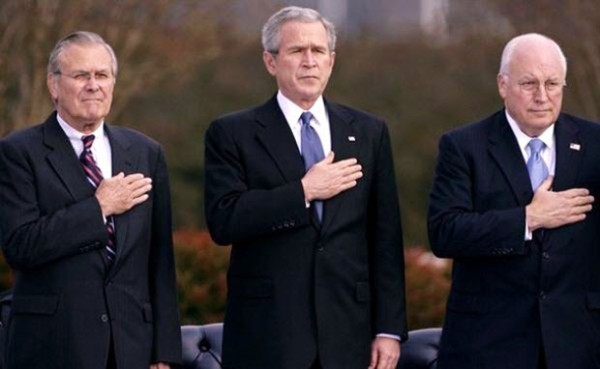
BushRumsfeldCheneyThe European Center for Constitutional and Human Rights has filed a criminal complaint against U.S. torture program architects and members of the Bush Administration. The organization has accused CIA director George Tenet and Defense Secretary Donald Rumsfeld of war crimes and they’ve called for a German prosecutor to conduct an immediate investigation.

This move follows the release of the damning Senate report on CIA torture that includes the case of German citizen Khalid El-Masri, who was captured in 2004 by CIA agents in a case of mistaken identity. The report revealed the shocking contrast of democracy and corruption.

Bizarrely, the only person involved with the CIA torture program who has been charged with a crime is the man who exposed the war crimes — whistleblower John Kiriakou.

The relevant parties in this case have given an extensive interview to Democracy Now. Some of the important points are below.

Wolfgang Kaleck, the general secretary of the European Center for Constitutional and Human Rights and the author of International Prosecution of Human Rights Crimes said this:

“By investigating members of the Bush administration, Germany can help to ensure that those responsible for abduction, abuse and illegal detention do not go unpunished.”

Michael Ratner, president emeritus of the Center for Constitutional Rights and chairman of the European Center for Constitutional and Human Rights said this:

“I strongly disagree that Bush, Cheney, et al., would have a defense. This wasn’t like these memos just appeared independently from the Justice Department. These memos were facilitated by the very people — Cheney, etc. — who we believe should be indicted. This was part of a conspiracy so they could get away with torture. But that’s not the subject here now.”

“Secondly, whatever we think of those memos, they’re of uselessness in Europe. Europe doesn’t accept this, quote, ‘golden shield’ of a legal defense. Either it’s torture or it’s not. Either you did it or you didn’t. And that’s one of the reasons, among others, why we’re going to Europe and why we went to Europe to bring these cases through the European Center.”

Ratner is the author of The Trial of Donald Rumsfeld: A Prosecution by Book.

Ratner also said this:

“But, of course, you know, Cheney just showed us exactly why you have to — have to prosecute torture. Because if you don’t prosecute it, the next guy down the line is going to torture again. And that’s what Cheney said: ‘I would do it again.’”

From Addicting Info‘s Ryan Denson:

Khalid El-Masri was on vacation in Skopje, in Macedonia, when he was pulled off of a bus by government agents, sodomized with a drug, and taken to the secret base that was identified only as Cobalt in the CIA torture report. After four months, and after the United States learned of the mistaken identity, they left him there and continued to torture him. They held him further because the U.S. realized they had been torturing the wrong man. Afterwards, they released him, dropping him off somewhere to resume his life.

El-Masri’s comments to Democracy Now highlight the contrast of democracy and corruption:

[translated] I was the only one in this prison in Kabul who was actually treated slightly better than the other inmates. But it was known among the prisoners that other prisoners were constantly tortured with blasts of loud music, exposed to constant onslaughts of loud music. And they were—for up to five days, they were just sort of left hanging from the ceiling, completely naked in ice-cold conditions. The man from Tanzania, whom I mentioned before, had his arm broken in three places. He had injuries, trauma to the head, and his teeth had been damaged. They also locked him up in a suitcase for long periods of time, foul-smelling suitcase that made him vomit all the time. Other people experienced forms of torture whereby their heads were being pushed down and held under water.

“And let me just say, Germany — whatever happened before, between the NSA spying on Germany and the fact that their citizen has now been revealed to have been kept in a torture place, when it was known that he was innocent, I’m pretty sure that Germany is going to take this very seriously.“

We need to throw our full support behind this investigation and our government and the Obama administration needs to not impede it in any way. This is a harsh indictment of our hypocrisy as a nation when it comes to democracy and corruption.

Source: Liberal America

John McCain Calls Out the Torture Apologists | Daily Klos

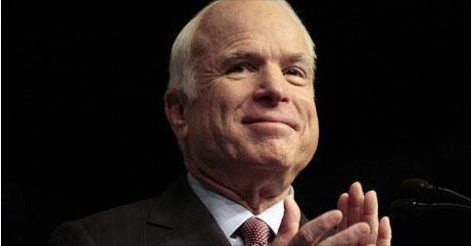
JohnMcCainThere aren’t many subjects I’d agree with Sen. McCain on, but kudos to him for speaking out so clearly and honestly on CIA torture, unlike others who wanted the Committee Study of the Central Intelligence Agency’s Detention and Interrogation Program delayed or kept secret forever. Kudos to him also for speaking out on why some are raising panicky objections to the release of the report:

There was considerable misinformation disseminated then about what was and wasn’t achieved using these methods in an effort to discourage support for the legislation. There was a good amount of misinformation used in 2011 to credit the use of methods with the death of Osama Bin Laden, and there is, I fear, misinformation being used today to prevent the release of this report, disputing its findings and warning about the security consequences of their public disclosure.With the report’s release, will the report’s release cause outrage that leads to violence in some parts of the Muslim world? Yes, I suppose that’s possible, perhaps likely. Sadly, violence needs little incentive in some quarters of the world today. But that doesn’t mean we will be telling the world something it will be shocked to learn. The entire world already knows that we waterboarded prisoners. It knows we subjected prisoners to various other types of degrading treatment. It knows we used black sites, secret prisons. Those practices haven’t been a secret for a decade. Terrorists might use the report’s reidentification of the practices as an excuse to attack Americans, but they hardly need an excuse for that. That has been their life’s calling for a while now.

What might cause a surprise not just to our enemies, but to many Americans is how little these practices did to aid our efforts to bring 9/11 culprits to justice and to find and prevent terrorist attacks today and tomorrow. That could be a real surprise since it contradicts the many assurances provided by intelligence officials on the record and in private that enhanced interrogation techniques were indispensable in the war against terrorism.

And I suspect the objection of those same officials to the release of this report is really focused on that disclosure; torture’s ineffectiveness. Because we gave up much in the expectation that torture would make us safer. Too much. Obviously, we need intelligence to defeat our enemies, but we need reliable intelligence. Torture produces more misleading information than actionable intelligence. And what the advocates of harsh and cruel interrogation methods have never established is that we couldn’t have gathered as good or more reliable intelligence from using humane methods. The most important lead we got in the search for Osama Bin Laden came from conventional interrogation methods. I think it’s an insult to the many intelligence officers who have acquired good intelligence without hurting or degrading suspects. Yes, we can and we will.

But in the end, torture’s failure to serve its intended purpose isn’t the main reason to oppose its use. I have often said and will always maintain that this question isn’t about our enemies, it’s about us. It’s about who we were, who we are and who we aspire to be.

Source: Daily Klos

Tracking Global Changes | Thrive Together


ThriveTogether

By Kimberly & Foster Gamble

When I was in high school in the 1960s, I had this fabulous high school teacher who asked the students what period in history we wanted to study. We chose the Vietnam War because that was what was happening in our midst at that time. As a class, we invited in speakers from every possible perspective and we got magazines from every possible perspective. We looked at fascist, communist, socialist, left wing, right wing, I.F. Stone’s Weekly, Council on Foreign Relations/Foreign Affairs. We really would have a huge array of perspectives and then, as a class, we would discuss them. This experience opened up a world of learning to me and it especially opened up the world of tracking current events as they were unfolding, realizing that history is being made right now.

A big part of the motivation for ThriveTogether was to share that experience with our network, to help share the skills and the experience of tracking what’s going on right now in the world, whether it has to do with following the money or breakthrough technologies, or new solutions strategies, all kinds of alternative eco-communities around the world, education…any number of things. Everything is changing right now in really radical ways and we are tracking that and sharing what we’re learning with our network and learning from you.

That’s what’s happening and in our first ever live event this weekend we talked a little more about following the money and about some possible scenarios that we can imagine from our perspective. We don’t know what’s going to be happening, but we know that major global changes are going down right now, so I wanted to share some of them with you, our broader network, and to say if you can join the conversation through ThriveTogether, great! If you can’t, I highly encourage you to be tracking these things on your own because it’s really an amazing time in history and the ramifications are profound.

What’s going on right now? In 1944, after World War II, the Bretton Woods Agreement established the IMF and the World Bank and it was soon after that that the U.S. dollar was established as the sole currency for international trade. Now, for the first time since then, countries all around the world, growing numbers (every few days new countries are joining in on this) are trading not using the dollar. It includes Canada, New Zealand, Paksitan, Russia, China, Australia, India. Every day someone new is joining in on that. It’s very significant.

I think between Russia and China, nearly a trillion dollars worth of deals have been done just since this summer. It’s now November, 2014. China opened a $4.2 trillion stock market to the world also in this month. That’s going to have major ramifications on the U.S stock market. In Toronto, Canada, it was just announced there’s going to be the first off-shore hub for Chinese currency, the renminbi, of which the yuan is the basic unit. Also, there was a G-20 meeting this November 15th and 16th. I’m actually going to read the communiqué that was official that came out of there, just to get a feel that big things are happening right now and I do encourage you to be tracking it because it’s very significant.

“The implementation of the 2010 reforms remains our highest priority for the IMF and we urge the United States to ratify them. If this has not happened by year-end, we ask the IMF to build on its existing work and stand ready with options for next steps.”

So what does this mean? The 2010 reforms basically have to do with countries becoming Basel III compliant. Basel III compliance means that banks agree to have a higher percentage of reserves in the bank. The intention is supposedly to keep a crash like what happened in 2008 from having dire global consequences. It creates a little bit of a buffer between countries. That’s the idea and the United States has not agreed to be compliant with that. Now, the G-20 is organizing to say that we’re going to do something if the U.S. doesn’t agree.

The point is that the role of the United States in global affairs is changing. The role of the dollar is changing. I’m going to offer here five possible scenarios that could be unfolding with the information that we have. Like I said, we don’t know, but I really do encourage you to be tracking it. I am fortunate enough to have grandchildren, but whether you do or not, I think of it that one of these days some young person is going to come up and say, “What were you doing during these times?” So much is going on now in what could be considered the greatest fascist takeover of all times and I encourage you to do what you can so you can answer that question by saying, “I was awake and I was doing everything that I could do to help create a thriving world for you.”

So, tune in and take care to participate in these amazing, unprecedented times and here are some possible scenarios. Thanks. Read more…

Source: THRIVE TOGETHER

Vote all you want. The secret government won’t change | Boston Globe

By Jordan Michael Smith

DoubleGovernment The voters who put Barack Obama in office expected some big changes. From the NSA’s warrantless wiretapping to Guantanamo Bay to the Patriot Act, candidate Obama was a defender of civil liberties and privacy, promising a dramatically different approach from his predecessor.

But six years into his administration, the Obama version of national security looks almost indistinguishable from the one he inherited. Guantanamo Bay remains open. The NSA has, if anything, become more aggressive in monitoring Americans. Drone strikes have escalated. Most recently it was reported that the same president who won a Nobel Prize in part for promoting nuclear disarmament is spending up to $1 trillion modernizing and revitalizing America’s nuclear weapons.

Why did the face in the Oval Office change but the policies remain the same? Critics tend to focus on Obama himself, a leader who perhaps has shifted with politics to take a harder line. But Tufts University political scientist Michael J. Glennon has a more pessimistic answer: Obama couldn’t have changed policies much even if he tried.

Though it’s a bedrock American principle that citizens can steer their own government by electing new officials, Glennon suggests that in practice, much of our government no longer works that way. In a new book, “National Security and Double Government,” he catalogs the ways that the defense and national security apparatus is effectively self-governing, with virtually no accountability, transparency, or checks and balances of any kind. He uses the term “double government”: There’s the one we elect, and then there’s the one behind it, steering huge swaths of policy almost unchecked. Elected officials end up serving as mere cover for the real decisions made by the bureaucracy.

RELATED: Coverage of the 2014 midterm elections

Glennon cites the example of Obama and his team being shocked and angry to discover upon taking office that the military gave them only two options for the war in Afghanistan: The United States could add more troops, or the United States could add a lot more troops. Hemmed in, Obama added 30,000 more troops.

Glennon’s critique sounds like an outsider’s take, even a radical one. In fact, he is the quintessential insider: He was legal counsel to the Senate Foreign Relations Committee and a consultant to various congressional committees, as well as to the State Department. “National Security and Double Government” comes favorably blurbed by former members of the Defense Department, State Department, White House, and even the CIA. And he’s not a conspiracy theorist: Rather, he sees the problem as one of “smart, hard-working, public-spirited people acting in good faith who are responding to systemic incentives”—without any meaningful oversight to rein them in.

How exactly has double government taken hold? And what can be done about it? Glennon spoke with Ideas from his office at Tufts’ Fletcher School of Law and Diplomacy. This interview has been condensed and edited.

IDEAS: Where does the term “double government” come from?

GLENNON:It comes from Walter Bagehot’s famous theory, unveiled in the 1860s. Bagehot was the scholar who presided over the birth of the Economist magazine—they still have a column named after him. Bagehot tried to explain in his book “The English Constitution” how the British government worked. He suggested that there are two sets of institutions. There are the “dignified institutions,” the monarchy and the House of Lords, which people erroneously believed ran the government. But he suggested that there was in reality a second set of institutions, which he referred to as the “efficient institutions,” that actually set governmental policy. And those were the House of Commons, the prime minister, and the British cabinet.

IDEAS: What evidence exists for saying America has a double government?

GLENNON:I was curious why a president such as Barack Obama would embrace the very same national security and counterterrorism policies that he campaigned eloquently against. Why would that president continue those same policies in case after case after case? I initially wrote it based on my own experience and personal knowledge and conversations with dozens of individuals in the military, law enforcement, and intelligence agencies of our government, as well as, of course, officeholders on Capitol Hill and in the courts. And the documented evidence in the book is substantial—there are 800 footnotes in the book.

IDEAS: Why would policy makers hand over the national-security keys to unelected officials?

GLENNON: It hasn’t been a conscious decision….Members of Congress are generalists and need to defer to experts within the national security realm, as elsewhere. They are particularly concerned about being caught out on a limb having made a wrong judgment about national security and tend, therefore, to defer to experts, who tend to exaggerate threats. The courts similarly tend to defer to the expertise of the network that defines national security policy.

The presidency itself is not a top-down institution, as many people in the public believe, headed by a president who gives orders and causes the bureaucracy to click its heels and salute. National security policy actually bubbles up from within the bureaucracy. Many of the more controversial policies, from the mining of Nicaragua’s harbors to the NSA surveillance program, originated within the bureaucracy. John Kerry was not exaggerating when he said that some of those programs are “on autopilot.”

RELATED: Answers sought on CIA role in ‘78 JFK probe

IDEAS: Isn’t this just another way of saying that big bureaucracies are difficult to change?

GLENNON: It’s much more serious than that. These particular bureaucracies don’t set truck widths or determine railroad freight rates. They make nerve-center security decisions that in a democracy can be irreversible, that can close down the marketplace of ideas, and can result in some very dire consequences.

IDEAS: Couldn’t Obama’s national-security decisions just result from the difference in vantage point between being a campaigner and being the commander-in-chief, responsible for 320 million lives?

GLENNON: There is an element of what you described. There is not only one explanation or one cause for the amazing continuity of American national security policy. But obviously there is something else going on when policy after policy after policy all continue virtually the same way that they were in the George W. Bush administration.

IDEAS: This isn’t how we’re taught to think of the American political system.

GLENNON: I think the American people are deluded, as Bagehot explained about the British population, that the institutions that provide the public face actually set American national security policy. They believe that when they vote for a president or member of Congress or succeed in bringing a case before the courts, that policy is going to change. Now, there are many counter-examples in which these branches do affect policy, as Bagehot predicted there would be. But the larger picture is still true—policy by and large in the national security realm is made by the concealed institutions.

IDEAS: Do we have any hope of fixing the problem?

GLENNON: The ultimate problem is the pervasive political ignorance on the part of the American people. And indifference to the threat that is emerging from these concealed institutions. That is where the energy for reform has to come from: the American people. Not from government. Government is very much the problem here. The people have to take the bull by the horns. And that’s a very difficult thing to do, because the ignorance is in many ways rational. There is very little profit to be had in learning about, and being active about, problems that you can’t affect, policies that you can’t change.

Source: Boston Globe

What’s Possible, a New Film for World Leaders on the Urgency of Global Warming | Moyers & Company

More than 120 world leaders – including President Barack Obama – kicked off a one-day United Nations’ summit on climate change in New York City by viewing What’s Possible, a short film on the urgency of global warming.

Narrated by Morgan Freeman, the film’s images, some disturbing and some magnificent, are meant to remind them of what’s at stake: global warming will place our planet and all its inhabitants at destruction’s door unless our governments take immediate action.

The creators of the four-minute film, Lyn Davis Lear and Louie Schwartzberg, spoke with Bill about what they hope their film — translated into six languages and simulcast around the world — will achieve. “They have to focus on the fact that all of us together united add up to something significant,” Lear told Bill. “And the world leaders need to know there is a movement happening right now. People want this to happen.”

The film is not only meant to make an impact on world leaders but also on the world’s citizens. As Schwartzberg puts it: “We hope we can inspire them to take actions in their life that will allow life to be sustainable… And more importantly to elect leaders who share the same values.”

About the Filmmakers

Lyn Davis Lear is a producer, activist and philanthropist. She is one of the founders, along with her husband Norman Lear, of the Environmental Media Association. She is a recipient of the Global Green Millennium Award for Entertainment Industry Environmental Leadership, and was the executive producer of the documentary Cesar’s Last Fast, nominated for the Grand Jury Prize at this year’s Sundance Film Festival.

Louie Schwartzberg is acclaimed the world over for his remarkable work. He specializes in the creation of films that use time-lapse, high-definition and 3-D photography to reveal nature as it is seldom seen by the naked eye. He is founder of the studio Moving Art.

Source: Moyers & Company

5 Minute Speech that Got Judge Napolitano Fired from Fox News | YouTube

Asking questions as Judge Andrew Napolitano did in a recent broadcast on his now cancelled daily show may very well be the reason behind his recent dismissal from Fox. Though specific details are hard to come by because the Judge has yet to give any interviews on the matter, it’s believed that his refusal to bow to commonly manufactured media narratives is among one of several key reasons he is no longer with the network.

The following 5-Minute Speech that Got Napolitano Fired from Fox News is one that should not only be forwarded and shared with every single man, woman and child in this country, but taught and expounded upon in every social studies, civics and government class from first grade through college.

Source: YouTube