Popular internet pundit Paul Joseph Watson is mulling legal action after being banned from Facebook for spreading “hate,” telling RT that it’s clear social media platforms are cracking down on dissident political speech.
Facebook kicked Watson off its platform on May 2 – along with conservative commentator Laura Loomer, Infowars founder Alex Jones, and black nationalist leader Louis Farrakhan. The group was accused of spreading “hateful” content, although no warnings or concrete reasons were provided for their seemingly arbitrary bans.
Watson, who runs a YouTube channel that boasts more than 1.5 million subscribers, has become a well-known but polarizing commentator on culture and politics. A long-time Infowars contributor, Watson now has his own outlet, Summit News.
Although he’s been labeled as an “alt-right” conspiracy theorist, Watson insists that he’s been smeared – and de-platformed – simply because he holds contrarian views.
“There is clearly no future for dissident personalities on any major social media network. We will have to go back to mailing lists and websites as our primary, and perhaps only platforms for delivering content,” he said.
He told RT that he’s hired the “best media lawyers in London” who “have taken on numerous media giants in the past and won” and will advise him about what legal recourse he has against Facebook.
The first step towards suing Facebook over his ban, according to Watson, is to initiate a written request, called a Subject Access Request, which requires the company to release all information relevant to the individual’s case under Section 7 of the Data Protection Act.
The information would be needed to verify if an individual violated community standards or if the company merely made a politically-motivated decision. Watson also intends to put Facebook on notice about the harm they have caused to his reputation by putting him under the category of “dangerous individuals,” which is one of Facebook’s stated reasons for banning people under the company’s community standards.
The list Facebook has made for what counts as “dangerous individuals” includes: Terrorist activity, organized hate, mass or serial murder, human trafficking, and organized violence or criminal activity. Facebook would have to verifiably prove that the banned person engaged in any of these activities, or the decision could count as defamation of character.
The hate watchdog organization Southern Poverty Law Centre (SLPC) has publicly admitted it was behind the censorship. In its statement, the SPLC writes how the banning of these individuals shows that social media companies are responding to their “pressure,” but adds that they nonetheless haven’t done enough, claiming they “have more work to do against hateful content.”
“The SPLC is not a fact-checker, it’s a hyper-partisan political attack dog which solely exists to demonize its ideological adversaries. There is no way to hold them accountable, they are accountable only to their own agenda and bias,” Watson said.
Twitter has reportedly dropped the SPLC as a reliable source for detecting hate content online and to police its platform, but other social media giants like Facebook, Google, and Amazon have continued to use the watchdog to decide what content should be kept on their sites.
Facebook has also recently come under fire from its co-founder Chris Hughes, who wrote an exclusive op-ed in The New York Times on Thursday calling for Facebook’s monopoly to be broken up, as its CEO Mark Zuckerberg has “unilateral control over free speech,” adding that his power is “unprecedented and un-American.”
“Personally, if and when I am banned on everything, I will probably just move into the background until the environment is once again fertile and if big enough alternative platforms exist which actually support free speech,” Watson added.
Facebook isn’t the only social media platform to face accusations of shutting down political speech it doesn’t like: In April, the company banned two conservative British candidates running for European Parliament, Tommy Robinson and Carl Benjamin, less than a month before the election.
The site banned Alex Jones and all Infowars accounts in September 2018.
So the white nationalists are once again coming to Charlottesville. Get ready not only for some bombastic theatrics, but also for a replay of the progressive media’s Charlottesville narrative: Hey, look at those racists in MAGA hats! This proves that, whatever the history of Democratic Party bigotry, racism today is in the Trump column. Bigotry now is on the right.
But this narrative is a lie. First of all, no one has ever conducted a valid empirical survey of neo-Nazis or Ku Klux Klansmen to prove they voted for Trump. This is why the media needs visual images that seem to confirm an unproven thesis. In the aftermath of the initial Charlottesville, I was struck by a solitary white supremacist in a MAGA hat being interviewed by more than a dozen reporters. This one guy — otherwise culturally and politically impotent — was portrayed as visual proof that white nationalism is a malevolent Trump phenomenon.
In my new book, Death of a Nation, I examined the lives of the leading white nationalists in America today. Virtually without exception, they are on the left. Let’s start with Jason Kessler, organizer of last year’s Charlottesville rally. The Southern Poverty Law Center looked into his background and was astounded to discover that he had been an Obama supporter and active in the left-wing Occupy Wall Street movement.
What could be more interesting than to examine why an Obama supporter could become a white supremacist? Or how an Occupy activist transitioned into a defender of the white cause? Yet the progressive media went dead silent on this one. Only one local Charlottesville newspaper, The Daily Progress, bothered to dig into this, noting that Kessler’s previous tweets, his neighbors and several of his friends “attest that he held strong liberal convictions.”
Laura Kleiner is a Democratic activist who dated Kessler for several months in 2013. According to the article, “She said Kessler was very dedicated to his liberal principles, and that he was a strict vegetarian, abstained from alcohol and drugs, embraced friends of different ethnicities, and was an atheist.” Kleiner added of Kessler, “He broke up with me and a lot of it was because I was not liberal enough. I am a very progressive Democrat, but he didn’t like that I’m a Christian.”
I mentioned Kessler’s leftist background on social media and he lashed out angrily by releasing a video denouncing me. The video itself is rambling, incoherent and laced with obscenities. The most interesting thing about it is that Kessler attacks me as a rich, brown-skinned guy who only stands up for big business and special interests. In other words, notwithstanding his disavowal of my portrait of him, Kessler sounds just like the left-wing racist I made him out to be.
Andrew Anglin is the co-editor of the neo-Nazi website Daily Stormer. In March 2007, Anglin posted about Donald Trump, attaching a video clip from a roast of former New York mayor Rudy Guiliani. Giuliani appears in the video in drag, and Trump rams his face into Giuliani’s chest. It was all apparently in fun. Even so, Anglin describes them both as “fags” and writes that Giuliani is clearly involved in a “twisted homosexual transvestite affair with Donald Trump.”
Anglin visited Southeast Asia in 2010-2011 where he became a rainforest activist, dated Filipina women, and railed on his podcast against Christian missionaries. “You see the way white people — and it is white people — went around the whole world and f***ed everybody. I think the white race should be bred out.” This was a sentiment he routinely expressed.
Lisa Turner, women’s coordinator of a white nationalist group called the World Church of the Creator — which is interestingly enough an atheist organization — insists that the greatest problem in the world is Christianity. “The philosophy behind Christianity,” she says, “is utterly poisonous. Turn the other cheek, love your enemy—these kinds of ideas have put a guilt trip on the white race. The biggest enemies we have out there are the Christian churches.” Doesn’t sound very much like Trump to me.
Finally, there is Richard Spencer, the poster boy of white supremacy, who is so controversial that when he showed up to speak in Florida the governor declared a state of emergency. Spencer is unfailingly portrayed in the mainstream media as a right-winger. To check this out, I interviewed Spencer for my new movie Death of a Nation. The film is now out nationwide, and when the audiences hear Spencer describe his convictions in his own words, they gasp out loud.
Why? Because it becomes clear that Spencer is no conservative; in fact, he is firmly on the left. He flatly rejects the idea that “all men are created equal.” He insists that rights don’t come from God; they come from the centralized state. He rejects the Reagan agenda of individual liberty and free market capitalism, embracing the concept of an expanded welfare state including nationalized health care. He doesn’t think Reagan was a great president, naming as his favorites a series of Democratic presidents including Democratic Party founder Andrew Jackson. At one point he breaks down and confesses he’s a progressive.
What really blows away the audience is not merely Spencer’s left-wing politics, but the full realization that we have all been victims of a bogus narrative. Some white nationalists collaborate in this narrative, because it brings fame and notoriety to their otherwise powerless group. In exchange they provide the mainstream media with an ideological script extremely useful to the left. But the script is fake, because in reality conservatives and white nationalists are not only in different camps, they are in opposed camps.
Over the past two years, many thousands of broadcast hours and probably millions of words have been devoted to Donald Trump’s relationship with the truth. Equally, the President has made accusations of dishonesty and bias against the media and his political opponents a central part of his persona and presidency.
What lies are told about the President? Is he lying when he makes these allegations? In a feverish atmosphere of claim and counterclaim, when everyone seems to reflexively accuse everyone else of “fake news”, it can be difficult to know what’s what.
There are many articles that exist detailing lies and misleading claims made by the Trump administration. This article is intended as a neutral, reliable analysis of the lies, false allegations and misleading claims made about and against Donald Trump since his inauguration in January 2017. We’ve attempted to strip away the hyperbole, name-calling and generalizations, and examine the patterns and trends at work: what characterizes these lies and exaggerations, the effect they have, what might explain them.
We pay particular attention to selected examples — claims that have gained prominence among the mainstream opposition to Trump, revealing much about the methods, priorities, and tone of that opposition, and illustrating how this movement both cultivates and plays off a number of caricatures of the 45th President and at times falls prey to a handful of identifiable and repeated errors of thought.
This is nothing new. Supporters and opponents of every high-profile politician in American history have done exactly the same, but in the current cultural atmosphere, where “the truth” is universally, even manically, exalted as an abstract concept but then widely degraded in practice, it’s essential to confront, correct, and analyze patterns of falsehoods like these.
This is not an exhaustive list. For that, and a litany of fact checks of claims made by the President, you can browse the Snope archive on him.
The focus here is on attacks against Trump. So for the purpose of this article, we’re not interested in false claims that are intended to reflect favorably on him. Nor does this analysis address claims made against his family members, of which there have been many. It’s also limited to the period following the inauguration on 20 January. This analysis was primarily based on an in-depth search of our own archives.
The Many Donald Trumps
Broadly speaking, most of the falsehoods levelled against Trump fall into one or more of five categories, each of them drawing from and feeding into five public personas inhabited by the President.
They are:
Donald Trump: International Embarrassment
Trump the Tyrant
Donald Trump: Bully Baby
Trump the Buffoon
Trump the Cruel Bigot
Some of these claims are downright fake, entirely fabricated by unreliable or dubious web sites and presented as satire, or otherwise blatantly false. But the rest — some of which have gained significant traction and credibility from otherwise serious people and organizations — provide a fascinating insight into the tactics and preoccupations of the broad anti-Trump movement known as “the Resistance,” whether they were created by critics of the President or merely shared by them.
Generally speaking, we discovered that they are characterized and driven by four types of errors of thought:
Alarmism
A lack of historical context or awareness
Cherry-picking of evidence (especially visual evidence)
A failure to adhere to Occam’s Razor — the common-sense understanding that the simplest explanation for an event or behavior is the most likely.
Infused throughout almost all these claims, behind their successful dissemination, is confirmation bias: the fuel that drives the spread of all propaganda and false or misleading claims among otherwise sensible and skeptical people. Confirmation bias is the tendency to look for, find, remember and share information that confirms the beliefs we already have, and the tendency to dismiss, ignore and forget information that contradicts those beliefs. It is one of the keys to why clever people, on all sides of every disagreement, sometimes believe stupid things that aren’t true.
We’re going to take a look at the four major types of falsehood we found, which correspond with Donald Trump’s five public personas, and point out along the way how various errors in thought have played a role in their origins and their spread.
Donald Trump: International Embarrassment
What’s remarkable is the extent to which false claims about the President revolve around body language, nonverbal gestures and symbolism, all phenomena that are notoriously open to interpretation. These lies and misrepresentations are also often based on snapshots — visual evidence presented without proper context.
Take, for example, the claim that Trump was the only world leader at a G7 summit in May not to take notes, based on a photograph posted to Twitter by French President Emannuel Macron. Here Trump was portrayed as unprepared and out of his depth on the world stage, with a “ten-second attention span”. However, the claim was entirely untrue, with other images and video of the meeting showing that Trump did indeed have notes and a pen. Not only that, but the very image used to make the false claim clearly shows two other world leaders sitting with no note-taking paraphernalia. In this case, even the cherry-picked evidence chosen to make the point undermines it.
Or, from the same G7 summit, the claim that Trump was caught on video raising his middle fingerto Italian PM Paolo Gentiloni. Here we have Trump, contemptuous of other world leaders, once again risking international incident with his short temper and foul manners.
Except that he didn’t. The original source of the claim is revealing — the Twitter account of GiveHimTheFinger.com, an anti-Trump website that encourages his opponents to send the White House postcards designed as a middle finger. A longer video of the discussion shows that Trump and Gentiloni spoke cordially before the incident, which undermines the implicit logic behind the claim — that Trump was expressing anger or distain for Gentiloni. Indeed, no one has ever explained why Trump supposedly flipped him the bird, and so Occam’s Razor comes into play here.
While it is possible, of course, that Trump had such a mercurial change of heart about Gentiloni that he went from sharing warm words with him to publicly insulting him in a matter of minutes, is it not far more likely that the US President just had an itchy head?
And then there’s Newsweek’s claim that Indian Prime Minister Narendra Modi “evaded” Trump’s “notorious… bone-crunching power handshake”, about which there has been a seemingly endless supply of every imaginable kind of analysis.
“In his visit to the White House Monday,” wrote Tom Porter in June, “Indian Prime Minister Narendra Modi neatly sidestepped the challenge, swooping in for two bear hugs with the president during a joint press conference in the Rose Garden.” What’s missing from this account, in a theme repeated throughout this collection, is historical context, either by deliberate omission or due to the author’s lack of awareness.
Modi, as has long been noted, is famous for hugging world leaders, a gesture he bestowed upon Trump’s predecessor Barack Obama, as well as the last two presidents of France, among others. Rather than being an example of yet another world leader “fighting back” (as the Guardian’s Jonathan Freedland has described what are essentially firm handshakes), this was an example of India’s prime minister continuing to greet another world leader in the way he always has.
Lack of historical context and cherry-picked evidence also played a role in another particularly egregious episode, in which Occupy Democrats placed a photograph of Pope Francis frowning beside Trump, next to one of the Pontiff grinning beside Barack Obama.
“See the difference?” the caption asked. Of course: Pope happy, Pope sad. But proper context (and basic common sense) would make it clear that no meaning whatsoever can be gleaned from these two snapshots.
People in the company of someone they like don’t keep a smile constantly plastered on their faces while devoutly maintaining a scowl when forced to hang out with someone who is not their favorite. And our facial expressions often have nothing to do with the people in our immediate vicinity (think: trapped gas, or checking your phone at the dinner table). A photograph of Francis frowning next to Obama was not hard to come by. Nor was one of him grinning next to Trump.
See the difference?
Trump the Tyrant
The second major strand of falsehood we have observed is one that portrays Trump as a would-be dictator, straying beyond his constitutional powers and imposing his will on whatever and whomever he chooses.
It has to be said that these claims have primarily come in the form of blatantly fabricated posts and stories from disreputable sources. Like a satirical News Werthy article that reported that Trump was looking into an executive order to abolish impeachment, or an artist’s “Future Internment Camp” signs in various vacant lots, which were mistaken for genuine by some readers and observers.
Then there was the satirical article that reported Trump had signed an executive order declaring himself the popular vote winner in 2016’s presidential election, or the claim that he had imposed martial law in Chicago, using a video of a police tank which has been in use since 2010. However, there have been more serious claims made about Trump’s supposedly authoritarian tendencies; a story published by the website Learn Progress offers a good illustration of this:“Trump Says Americans Have “No Right” to Protest Him. TYRANNY” reads the headline. In reality, three protesters thrown out of a Trump rally in March 2016 later sued him, alleging incitement to violence. As part of that case, lawyers for the President filed a motion arguing, in part, that protesters did not have a right to disrupt a campaign rally to the extent that they effectively denied the event organizers their own freedom of expression.
This is far more specific and limited than the absolutist way the motion was misrepresented in the article’s headline. Once again, a clue as to the falsehood of the claim is to be found in the very evidence used as its basis. The motion itself is prefaced by the disclaimer: “Of course, protestors have their own First Amendment right to express dissenting views…” So not only did the evidence not support the claim that Trump thinks that Americans have “no right” to protest him, it actually supported the opposite.
A final example of how rushed and alarmist conclusions, a lack of context, and a pre-existing caricature of Trump as an incipient dictator have played a role in false claims made against him came early on in his presidency. In the days following Trump’s inauguration, claims emerged that his administration had literally rewritten the Bill of Rights, changing all mention of “people” to “citizens”.
The story horrified readers. “Not a joke,” read one widely-shared tweet, “not a drill.” But also, not true. The administration had changed WhiteHouse.gov’s summary of the Constitution, but not the Constitution itself. What’s more, the change from “people” to “citizens” in this summary had already been made during the tenure of President Barack Obama.
Donald Trump: Bully Baby
Closely linked to the “dictator” trope are several false claims based on Trump’s persona as a thin-skinned, narcissistic baby, lashing out at perceived insults and bullying much less powerful people. So when, in May, Stephen Colbert made a controversial joke about Trump performing fellatio on Vladimir Putin, it was almost inevitable that a fake story would follow, claiming that the President had forced CBS to fire Colbert, in a single phone call. Similarly, Alec Baldwin’s popular portrayal of Trump on Saturday Night Live prompted this fake story, which reported that the President had signed an executive order cancelling the show.
In the same vein, Crayola’s decision to drop the “dandelion” crayon was falsely attributed to pressure from an image-obsessed Trump administration, worried that children were using that particular color to create unflattering pictures of the President.
Sometimes these claims seem plausible enough to gain even more credibility and traction. In April, Trump met the public at the traditional White House Easter Egg Roll. A teenaged boy asked him to sign his “Make America Great Again” hat, and the President obliged, but appeared to toss the hat in the air.
This was presented as a callous act from a bullying, villainous Donald Trump by observers such as the Resistance Report web site, which wrote ” Trump Just Ruined This Kid’s Day at the Easter Egg Roll.” However, another camera angle clearly shows that Trump was playfully tossing the hat back to the boy, who happily receives the hat and walks away.
But even without the second camera angle, Occam’s Razor comes into play once again. Does it make sense that Donald Trump, asked by an enthusiastic young man to sign a hat bearing his iconic slogan, would sign the hat and then, smiling, deliberately throw it away from the boy? Or is it more likely that Trump was being playful with someone who acted admiringly towards him, and tossed the hat in the air with the intention of giving it back to the boy?
Trump’s “thin-skinned” persona has also been the source of falsehoods, like the one shared by writer Dana Schwartz in January, who claimed the President had doctored a photograph to make his hands look bigger. She attempted to prove this by comparing two pictures of the same embrace between Donald Trump and Barack Obama. The claim was based entirely on the fact that Trump’s left hand appeared bigger in one image than the other, but otherwise provided no evidence that the picture had been doctored.
This also ignored the fact that the two images were taken from slightly different angles and distances, enough to organically make one hand appear bigger than the other.
Trump the Buffoon
Another major strand of falsehood about the President is the one that feeds into his persona as a bumbling fool, prone to accidents and devoid of any cultural sophistication.
Here, one claim stands out. In March, Ireland’s Taoiseach (Prime Minister) Enda Kenny came to the White House for a traditional St Patrick’s Day visit with the sitting President. During a speech, Trump recited a verse (the relevant section starts at 9:21):
As we stand together with our Irish friends, I’m reminded of that proverb — and this is a good one, this is one I like, I’ve heard it for many, many years and I love it:
“Always remember to forget the friends that proved untrue, but never forget to remember those that have stuck by you.”
The response was huge. Almost instantly, Trump was mocked for citing as an Irish proverb a poem written by a Nigerian man. The Daily Kos web site wrote:
[Trump] took his moment to read the following, which he described as an old “Irish proverb”…Within minutes, the true origins of the “Irish proverb” were known and surprise! Not Irish. In fact, the words were from Nigerian poet Albashir Adam Alhassan.
Alhassan was born to Nigerian parents in the Kano State of Nigeria, which, coincidentally, is not Ireland. But according to Trump, it doesn’t matter if a proverb isn’t Irish; he can make it Irish.
It’s actually strange. I’m wondering what must have made him relate it to Ireland even if he loves the lines.
Stephen Colbert devoted this three-minute segment to eviscerating what he presented as Trump’s cultural deafness and downright ignorance:
“That’s very nice, that’s very sweet,” Colbert said of Trump’s recitation:
Very sweet thought. Only problem — Trump’s “favorite Irish proverb” is not a proverb, it’s a poem, and it’s not from Ireland, it’s written by a Nigerian poet… Irish, Nigerian — it’s an honest mistake.
Only problem, as Colbert might say, Trump never once claimed the proverb was Irish.
The video of Trump’s remarks has been played countless times, embedded into mocking reports, and retweeted by thousands of people, aghast at his tone-deafness. The clip would have been edited by staff at Late Night for use, and Colbert himself would have heard the President’s words immediately before launching into the segment (which is frankly difficult to watch) in the knowledge that it is based on an entirely fabricated characterization. Not once, apparently, did anyone hear what Trump actually said — “a proverb”, not “an Irish proverb”.
Why would Trump relate the words to the Irish? The answer to the question posed by Albashir Alhassan is once again so simple that it appears to have eluded almost everyone.
“As we stand together with our Irish friends,” is how Trump prefaced his recitation. Now remember what those words were. “Always remember to forget the friends that proved untrue, but never forget to remember those that have stuck by you.” Standing next to the leader of a country with a long-standing friendly relationship with the United States, accompanied by “Irish friends”, Trump recited a verse about the loyalty of true friends. It makes complete sense for him to have read these words, and not once did he ever describe them as “Irish”.
Set aside the fact that, far from being written in 2013, those words date back at least 80 years; set aside, even, the fact that they appear online in several places, described as an “Irish proverb“. Trump never said they were Irish anyway.
The entire episode is a remarkable example of something bordering on collective hallucination, most likely brought on by confirmation bias. Here hundreds of thousands of people — including professional journalists working for influential news organizations, and a chat show host with more than three million nightly viewers — literally heard Trump say something he never said, in most cases probably because it confirmed a pre-existing image of the President as a poorly read, culturally ignorant buffoon.
Other fake stories have simply been designed to make him look ridiculous, like the widely-shared photographs doctored to show Trump with fake diarrhea stains on his golf pants, wearing a diaperor balloon breasts, or posing with a stripper.
Trump the Cruel Bigot
The final strand of false claims we are examining are those that have contributed to, and fed off, an image of the President and his administration as racist, homophobic, anti-immigrant, and cruel toward poor people.
Some are entirely fabricated or intended as satire, like the claim that Trump was planning to deport American Indians to India, and another that he had made English the official language of the U.S., or stories claiming that the President had banned the full-face Muslim veil or Sharia law.
Others, however, have gained more mainstream traction. The predominant theme, here, has been alarmism, particularly at the beginning of Trump’s tenure. On Inauguration Day, the actor and activist George Takei warned his Twitter followers that the new White House had removed references to climate change, healthcare, civil rights and LGBT rights from its web site. While that was true, content of all kinds was temporarily removed from WhiteHouse.gov and archived during a routine transition between the Obama and Trump administrations.
Similarly, there were claims that Trump’s administration had removed LGBT categories from the 2020 Census. In reality, such categories have never been included in the U.S. Census, reports that the Census Bureau had dropped plans to introduce them stemmed from a clerical error, and there is no evidence the Trump was involved in the Census Bureau’s decision-making anyway.
Trump has also been accused of various cruel cuts and attacks on funding and services, particularly around the time he proposed the 2018 Budget to Congress. In March, the Occupy Democrats web site claimed in a headline “Trump Just Announced Plan to End ‘Meals on Wheels’”. In this case, Trump proposed eliminating the Community Development Block Grant, which provides funding to several programs, including Meals on Wheels. However, only 3 percent of Meals on Wheels’ funding comes from federal sources like the Community Development Block Grant.
So not only did Trump not announce a plan to end Meals on Wheels, as such, but it would be an enormous exaggeration even to say that the effect of his proposals would be to end the program. We do not wish to downplay the fact that Meals on Wheels is a tremendously important program for many, and that any cuts at all might affect them; however, it is important to keep a sense of perspective in an environment increasingly fueled by outrage.
The president’s persona as callous and cruel also fed into, and was supported by fabricated stories such as the Satira Tribune’s claim that he had cut funding for the veteran suicide hotline, because he didn’t want the U.S. military to appear “weak”, or a fake Donald Trump tweet declaring that drug-testing would be a prerequisite for benefits recipients.
Conclusion
It has to be acknowledged that since January, many of Trump’s opponents, and even lukewarm supporters, have found considerable fault with his policies and behavior, based on accurate facts. There have been many occasions when Trump himself, undistorted and unfiltered, contributed mightily to the five personas we have outlined.
Indeed, in many instances the false claims against him carry a grain of truth. The president’s plan to scrap the Community Development Block Grant was real, and could very reasonably be expected to have significant consequences across a number of services and programs, including Meals on Wheels. All this is true, but it makes it no less false and no more acceptable to claim, on this basis, that he had singled out Meals on Wheels for elimination. He had not.
In some ways, these sorts of massive exaggerations and gross distortions are even more corrosive and destructive than fake news about diarrhea on the golf course, because they bear some distant relationship with the truth.
Journalists play better offense than defense. Give them the ball, and they’ll sleuth out the hidden crumbs of information, filling the scoreboard with touchdowns. Assign them to a dangerous story, and they’ll exhibit the bravery associated with U.S. Marines. Ask them to work late, and they’ll labor all night and file copy at dawn, rat-eyed from exhaustion yet happy and ready for the next story.
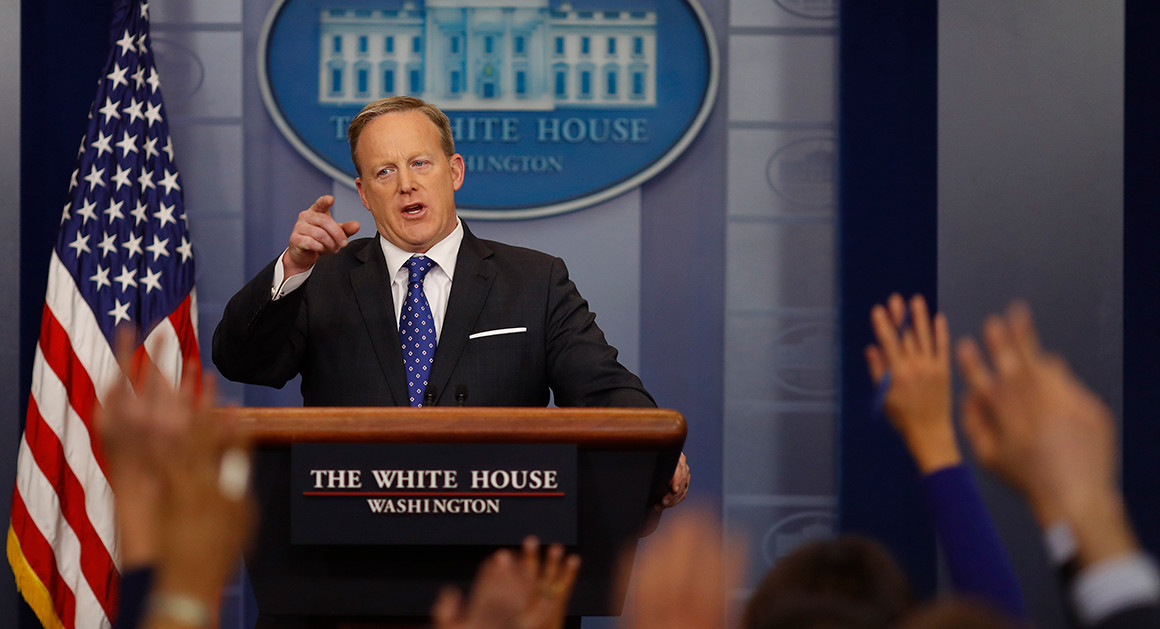
But criticize them and ask them to justify what they do and how they do it? They go all go all whiny and preachy, wrap themselves in the First Amendment and proclaim that they’re essential to democracy. I won’t dispute that journalists are crucial to a free society, but just because something is true doesn’t make it persuasive. The chords that aggrieved journalists strike make them sound as entitled as tenured professors. This behavior was on display last Friday after President Donald Trump disparaged the press at CPAC and on Twitter. Later that day, Trump’s press secretary, Sean Spicer, amplified the CPAC insult by excluding CNN, Politico, the New York Times, the Los Angeles Times and others from an off-camera briefing.
Almost immediately, the press protests went off like a battalion of popguns. “Free media access to a transparent government is obviously of crucial national interest,” said New York Times Executive Editor Dean Baquet. “This is an undemocratic path that the administration is traveling,” chimed Washington Post Executive Editor Marty Baron. Others in the press scrum called for retaliation. MSNBC’s Mika Brzezinski demanded that the press boycott the White House Correspondents’ Association dinner “until the White House’s abhorrent behavior towards members of the press stops.” Her Morning Joe co-host, Joe Scarborough, likewise insisted, “All news organizations must refuse to attend briefings where major outlets are excluded because of critical coverage.”
On and on it went. Former New York Times labor reporter Steven Greenhouse tweeted that White House reporters should “show some solidarity (and spine) & boycott briefings if Trump Admin excludes certain media.” Writer Simon Schama tweeted for a boycott of “the tinpot dictator’s briefings.” Public radio host Maria Hinojosa (Latino USA) reprised Jay Rosen’s recent idea that the press protest the administration’s behavior by sending interns to White House briefings instead of credentialed reporters. The Washington Post adopted a dreadfully overwrought masthead slogan, “Democracy Dies in Darkness,” for its online edition and the New York Times produced a sanctimonious “truth is hard” commercial, which aired during the Oscars. By Sunday morning, Brian Stelter’s guests on Reliable Sources had adopted the wounded theme, which was almost enough to cause me to start rooting against the home team and throw in with Trump.
I understand the press corps’ fury, but does the reaction make sense? As excluded New York Times reporter Glenn Thrush tweeted, there was a deliberate method to Spicer’s madness. It allowed the press secretary to avoid on-camera goofs; it got the press to “whine”; it sowed internal strife among reporters; and it prevented Trump—not Spicer’s biggest fan—from watching his performance. As a piece of lion-taming, the Spicer move was a great success. The lions may still be roaring, but he’s cracking the whip.
There’s nothing Trump and Spicer would love more than a press walkout from gaggles, press briefings, press conferences and assemblies like the White House Correspondents’ Association dinner. Boycotts would change the subject from Trump and Spicer’s original insults to the bruised egos of the boycotters—and really, how much sympathy should we expect the masses to have for the gang that brings them reams of bad news every morning? Besides, a boycott would be doomed. To be effective, a boycott must enlist almost everybody. Good luck with that. As candidates for adopting a one-for-all ethos, journalists must rank last. The only organizational principle most of them understand is competition.
For the sake of argument, imagine journalists pulling off a principled boycott after Spicer repeats his Friday stunt. Actually, you don’t have to imagine it—we’re halfway there. The Associated Press and Time boycotted the Friday briefing when they learned of the limitations he had placed on participation. Bloomberg, the Christian Science Monitor, the Wall Street Journal and other outlets have already vowed to shun future closed briefings. But as “principled” reporters peel off to paint protest placards, won’t Spicer merely tilt the briefings toward Trump-friendly media like Breitbart and One America News Network? Remember, Breitbart and OANN’s reporters attended Spicer’s controversial briefing, and they’ll never boycott. Spicer and Trump have already demonstrated a preference for calling on friendly media and will happily shovel interesting news to the pro-Trump outlets who attend. This will create an incentive for news organizations to hold their noses and ditch the boycott. Cozying up to power—writing “beat sweeteners” to gain access and publishing an administration’s planted leaks—has made more than one career in Washington. A boycott will only make the pro-Trump media stronger.
What would I have the press do? Words of protest and pushback, of which we’ve seen plenty, can’t hurt. But the best response, and one that wouldn’t require much in the way of press corps solidarity, would be to make Spicer answer the exiled questions. If, say, Spicer deletes Thrush from another briefing, Thrush can distribute his questions to the invited reporters. When Spicer calls on one, the reporter can say, “Glenn Thrush of the New York Times, who couldn’t be here today, has this question …” And then read it. A couple of rounds of “Thrush questions” and questions from other exiled reporters would not constitute an “I am Spartacus” moment, but it would convey that Spicer can evade news organizations but not their questions. If he can’t stop the reporters’ questions, what’s the point of exiling them?
Reporters have become pawns in Trump’s political strategy. In recent weeks, he’s trotted them out for sacrifice whenever the seeping wound of Russia news gets too moist for him, something NBC News’ Chuck Todd explained Sunday. Instead of taking it personally, I want journalists to take it professionally and continue to report like hell. A great story is always the best revenge.
Donald Trump evokes a wily and resilient mythic figure: the joker, the trickster, the fool, the one the Lakota people call the Heyoka, the contrary. Had his opponents – such as Hillary Clinton – understood this quality in him, the electoral outcome might have been different. The sooner the rest of us understand this side of him, the better.
In the European tradition, the fool holds up the mirror to the monarch and to all of us, mocking our faults and pretensions. He (the fool is almost always a man) is not constrained by deference or allegiance to truth. The Heyoka, one of the purest forms of fool, pretends to shiver when everyone else is sweating and takes off his clothes in winter.
The fool is a potent truth-teller and commands attention. Shakespeare knew this. Lear’s Fool, a gentle version of the species, skewered the arrogance and pride that were his master’s downfall, even as he comforted him. The “scabrous” Thersites in Troilus and Cressida speaks with relentless, scene-stealing venom. He paints Achilles, the Greeks’ greatest hero, as a petulant adolescent; King Agamemnon is a blowhard, Helen of Troy a hooker.
The fool is always addressing us, his audience, as well as his high-ranking targets. He performs a vital social function, forcing us to examine our own preconceptions, especially our inflated ideas about our own virtue. Trump was telling all of us – women and minorities, progressives, pillars of the establishment, as well as his supporters – that we were just like him.
The appropriate, time-honored response to the fool’s sallies is to take instruction from them. Only after we’ve acknowledged and accepted our own shortcomings do we have the integrity that allows us to keep him in his place. Perhaps if Secretary Clinton had been a more skillful, poised and humble warrior, she could have done this.
Fools serve the collective order by challenging those whose ignorance and blindness threaten it. They are meant to be instruments of awareness, not rulers. Impossible to imagine Lear’s Fool succeeding him or Thersites commanding the Greek army. Trump will not address his own limitations, cannot tolerate criticism, and takes himself dangerously seriously. This makes him a seriously flawed fool. He believes his own hyperbole and threatens democratic order.
In the weeks since his election, Trump has continued to act the fool. Now, however, the underdog’s challenges have become a bully’s beatdowns. His attack on the steelworkers’ union leader, Chuck Jones, exactly the kind of man whom he claimed to champion, was a vicious and painful lie. Unfunny, purely ugly. His more recent rants, including boasts about the crowds at his inaugural and the millions of imaginary illegal Clinton voters, illuminate his own troubled insecurity: the all-powerful winner acting the petulant, powerless loser.
Many of President Trump’s cabinet choices are like the punchlines of jokes, but punchlines with potentially devastating real-world consequences: an education secretary who disparages public education and badly botched her own effort at creating an alternative; men charged with responding to climate change who deny its existence; and a national security adviser who purveys paranoid fantasies.
There are glimmers of hope that the jester might mature to majesty. Gen James Mattis, the defense secretary, inspired a Trumpian epiphany that waterboarding might be counterproductive. Conversations with Al Gore or, more likely, ones with his daughter Ivanka could persuade him to open his eyes to the reality of climate change.
Or perhaps President Trump will implode, brought down by the damage done by perverse cabinet choices, or words and actions so intemperate and ill-advised that Congress and the courts call him to a terminal account. His challenged immigration order could be a harbinger.
Meanwhile, what are the rest of us to do? The fact that this question is even being asked is healthy, a residual benefit of his fool’s vocation. Trump’s grand and vulgar self-absorption is inviting all of us to examine our own selfishness. His ignorance calls us to attend to our own blind spots. The fears that he stokes and the isolation he promotes goad us to be braver, more generous.
Already, people all over the US – Republicans I know as well as Democrats – are beginning to link inner awareness to small and great political action.
The day after Trump’s inauguration, hundreds of thousands of women of all ages, ethnicities and political affiliations affirmed their rights, celebrated their community and slyly poked at the joker: “if I incorporated my uterus,” read one demonstrator’s sign, “would you stop trying to regulate it”.
The joker who is now our president has served an important function, waking us up to what we’ve not yet admitted in ourselves or accomplished in our country. He is, without realizing it, challenging us to grow in self-awareness, to act in ways that respect and fulfill what is best in ourselves and our democracy.
It’s time for us citizens, who’ve watched the performance, to take the stage.
IN JANUARY 1961, Dwight Eisenhower delivered his farewell address after serving two terms as U.S. president; the five-star general chose to warn Americans of this specific threat to democracy: “In the councils of government, we must guard against the acquisition of unwarranted influence, whether sought or unsought, by the military-industrial complex. The potential for the disastrous rise of misplaced power exists and will persist.” That warning was issued prior to the decadelong escalation of the Vietnam War, three more decades of Cold War mania, and the post-9/11 era, all of which radically expanded that unelected faction’s power even further.
This is the faction that is now engaged in open warfare against the duly elected and already widely disliked president-elect, Donald Trump. They are using classic Cold War dirty tactics and the defining ingredients of what has until recently been denounced as “Fake News.”
Their most valuable instrument is the U.S. media, much of which reflexively reveres, serves, believes, and sides with hidden intelligence officials. And Democrats, still reeling from their unexpected and traumatic election loss, as well as a systemic collapse of their party, seemingly divorced further and further from reason with each passing day, are willing — eager — to embrace any claim, cheer any tactic, align with any villain, regardless of how unsupported, tawdry, and damaging those behaviors might be.
The serious dangers posed by a Trump presidency are numerous and manifest. There is a wide array of legitimate and effective tactics for combating those threats: from bipartisan congressional coalitions and constitutional legal challenges to citizen uprisings and sustained and aggressive civil disobedience. All of those strategies have periodically proven themselves effective in times of political crisis or authoritarian overreach.
But cheering for the CIA and its shadowy allies to unilaterally subvert the U.S. election and impose its own policy dictates on the elected president is both warped and self-destructive. Empowering the very entities that have produced the most shameful atrocities and systemic deceit over the last six decades is desperation of the worst kind. Demanding that evidence-free, anonymous assertions be instantly venerated as Truth — despite emanating from the very precincts designed to propagandize and lie — is an assault on journalism, democracy, and basic human rationality. And casually branding domestic adversaries who refuse to go along as traitors and disloyal foreign operatives is morally bankrupt and certain to backfire on those doing it.
Beyond all that, there is no bigger favor that Trump opponents can do for him than attacking him with such lowly, shabby, obvious shams, recruiting large media outlets to lead the way. When it comes time to expose actual Trump corruption and criminality, who is going to believe the people and institutions who have demonstrated they are willing to endorse any assertions no matter how factually baseless, who deploy any journalistic tactic no matter how unreliable and removed from basic means of ensuring accuracy?
All of these toxic ingredients were on full display yesterday as the Deep State unleashed its tawdriest and most aggressive assault yet on Trump: vesting credibility in and then causing the public disclosure of a completely unvetted and unverified document, compiled by a paid, anonymous operative while he was working for both GOP and Democratic opponents of Trump, accusing Trump of a wide range of crimes, corrupt acts, and salacious private conduct. The reaction to all of this illustrates that while the Trump presidency poses grave dangers, so, too, do those who are increasingly unhinged in their flailing, slapdash, and destructive attempts to undermine it.
FOR MONTHS, THE CIA, with unprecedented clarity, overtly threw its weight behind Hillary Clinton’s candidacy and sought to defeat Donald Trump. In August, former acting CIA Director Michael Morell announced his endorsement of Clinton in the New York Times and claimed that “Mr. Putin had recruited Mr. Trump as an unwitting agent of the Russian Federation.” The CIA and NSA director under George W. Bush, Gen. Michael Hayden, also endorsed Clinton and went to the Washington Post to warn, in the week before the election, that “Donald Trump really does sound a lot like Vladimir Putin,” adding that Trump is “the useful fool, some naif, manipulated by Moscow, secretly held in contempt, but whose blind support is happily accepted and exploited.”
It is not hard to understand why the CIA preferred Clinton over Trump. Clinton was critical of Obama for restraining the CIA’s proxy war in Syria and was eager to expand that war, while Trump denounced it. Clinton clearly wanted a harder line than Obama took against the CIA’s long-standing foes in Moscow, while Trump wanted improved relations and greater cooperation. In general, Clinton defended and intended to extend the decadeslong international military order on which the CIA and Pentagon’s preeminence depends, while Trump — through a still-uncertain mix of instability and extremist conviction — posed a threat to it.
Whatever one’s views are on those debates, it is the democratic framework — the presidential election, the confirmation process, congressional leaders, judicial proceedings, citizen activism and protest, civil disobedience — that should determine how they are resolved. All of those policy disputes were debated out in the open; the public heard them; and Trump won. Nobody should crave the rule of Deep State overlords.
Yet craving Deep State rule is exactly what prominent Democratic operatives and media figures are doing. Any doubt about that is now dispelled. Just last week, Chuck Schumer issued a warning to Trump, telling Rachel Maddow that Trump was being “really dumb” by challenging the unelected intelligence community because of all the ways they possess to destroy those who dare to stand up to them:
And last night, many Democrats openly embraced and celebrated what was, so plainly, an attempt by the Deep State to sabotage an elected official who had defied it: ironically, its own form of blackmail.
BACK IN OCTOBER, a political operative and former employee of the British intelligence agency MI6 was being paid by Democrats to dig up dirt on Trump (before that, he was paid by anti-Trump Republicans). He tried to convince countless media outlets to publish a long memo he had written filled with explosive accusations about Trump’s treason, business corruption, and sexual escapades, with the overarching theme that Trump was in servitude to Moscow because they were blackmailing and bribing him.
Despite how many had it, no media outlets published it. That was because these were anonymous claims unaccompanied by any evidence at all, and even in this more permissive new media environment, nobody was willing to be journalistically associated with it. As the New York Times’ Executive Editor Dean Baquet put it last night, he would not publish these “totally unsubstantiated” allegations because “we, like others, investigated the allegations and haven’t corroborated them, and we felt we’re not in the business of publishing things we can’t stand by.”
The closest this operative got to success was convincing Mother Jones’s David Corn to publish an October 31 article reporting that “a former senior intelligence officer for a Western country” claims that “he provided the [FBI] with memos, based on his recent interactions with Russian sources, contending the Russian government has for years tried to co-opt and assist Trump.”
But because this was just an anonymous claim unaccompanied by any evidence or any specifics (which Corn withheld), it made very little impact. All of that changed yesterday. Why?
What changed was the intelligence community’s resolution to cause this all to become public and to be viewed as credible. In December, John McCain provided a copy of this report to the FBI and demanded they take it seriously.
At some point last week, the chiefs of the intelligence agencies decided to declare that this ex-British intelligence operative was “credible” enough that his allegations warranted briefing both Trump and Obama about them, thus stamping some sort of vague, indirect, and deniable official approval on these accusations. Someone — by all appearances, numerous officials — then went to CNN to tell the network they had done this, causing CNN to go on air and, in the gravest of tones, announce the “Breaking News” that “the nation’s top intelligence officials” briefed Obama and Trump that Russia had compiled information that “compromised President-elect Trump.”
CNN refused to specify what these allegations were on the ground that it could not “verify” them. But with this document in the hands of multiple media outlets, it was only a matter of time — a small amount of time — before someone would step up and publish the whole thing. BuzzFeed quickly obliged, airing all of the unvetted, anonymous claims about Trump.
Its editor-in-chief, Ben Smith, published a memo explaining that decision, saying that — although there was “serious reason to doubt the allegations” — BuzzFeed in general “errs on the side of publication” and “Americans can make up their own minds about the allegations.” Publishing this document predictably produced massive traffic (and thus profit) for the site, with millions of people viewing the article and presumably reading the “dossier.”
One can certainly object to BuzzFeed’s decision and, as the New York Times noted this morning, many journalists are doing so. It’s almost impossible to imagine a scenario where it’s justifiable for a news outlet to publish a totally anonymous, unverified, unvetted document filled with scurrilous and inflammatory allegations about which its own editor-in-chief says there “is serious reason to doubt the allegations,” on the ground that they want to leave it to the public to decide whether to believe it.
But even if one believes there is no such case where that is justified, yesterday’s circumstances presented the most compelling scenario possible for doing this. Once CNN strongly hinted at these allegations, it left it to the public imagination to conjure up the dirt Russia allegedly had to blackmail and control Trump. By publishing these accusations, BuzzFeed ended that speculation. More importantly, it allowed everyone to see how dubious this document is, one the CIA and CNN had elevated into some sort of grave national security threat.
ALMOST IMMEDIATELY AFTER it was published, the farcical nature of the “dossier” manifested. Not only was its author anonymous, but he was paid by Democrats (and, before that, by Trump’s GOP adversaries) to dig up dirt on Trump. Worse, he himself cited no evidence of any kind but instead relied on a string of other anonymous people in Russia he claims told him these things. Worse still, the document was filled with amateur errors.
While many of the claims are inherently unverified, some can be confirmed. One such claim — that Trump lawyer Michael Cohen secretly traveled to Prague in August to meet with Russian officials — was strongly denied by Cohen, who insisted he had never been to Prague in his life (Prague is the same place that foreign intelligence officials claimed, in 2001, was the site of a nonexistent meeting between Iraqi officials and 9/11 hijackers, which contributed to 70 percent of Americans believing, as late as the fall of 2003, that Saddam personally planned the 9/11 attack). This morning, the Wall Street Journal reported that “the FBI has found no evidence that [Cohen] traveled to the Czech Republic.”
None of this stopped Democratic operatives and prominent media figures from treating these totally unverified and unvetted allegations as grave revelations. From Vox’s Zack Beauchamp:
BuzzFeed’s Borzou Daragahi posted a long series of tweets discussing the profound consequences of these revelations, only occasionally remembering to insert the rather important journalistic caveat “if true” in his meditations:
Meanwhile, liberal commentator Rebecca Solnit declared this to be a “smoking gun” that proves Trump’s “treason,” while Daily Kos’s Markos Moulitsas sounded the same theme:
While some Democrats sounded notes of caution — party loyalist Josh Marshall commendably urged: “I would say in reviewing raw, extremely raw ‘intel,’ people shld retain their skepticism even if they rightly think Trump is the worst” — the overwhelming reaction was the same as all the other instances where the CIA and its allies released unverified claims about Trump and Russia: instant embrace of the evidence-free assertions as Truth, combined with proclamations that they demonstrated Trump’s status as a traitor (with anyone expressing skepticism designated a Kremlin agent or stooge).
THERE IS A real danger here that this maneuver could harshly backfire, to the great benefit of Trump and to the great detriment of those who want to oppose him. If any of the significant claims in this “dossier” turn out to be provably false — such as Cohen’s trip to Prague — many people will conclude, with Trump’s encouragement, that large media outlets (CNN and BuzzFeed) and anti-Trump factions inside the government (CIA) are deploying “Fake News” to destroy him. In the eyes of many people, that will forever discredit — render impotent — future journalistic exposés that are based on actual, corroborated wrongdoing.
Beyond that, the threat posed by submitting ourselves to the CIA and empowering it to reign supreme outside of the democratic process is — as Eisenhower warned — an even more severe danger. The threat of being ruled by unaccountable and unelected entities is self-evident and grave. That’s especially true when the entity behind which so many are rallying is one with a long and deliberate history of lying, propaganda, war crimes, torture, and the worst atrocities imaginable.
All of the claims about Russia’s interference in U.S. elections and ties to Trump should be fully investigated by a credible body, and the evidence publicly disclosed to the fullest extent possible. As my colleague Sam Biddle argued last week after disclosure of the farcical intelligence community report on Russian hacking — one that even Putin’s foes mocked as a bad joke — the utter lack of evidence for these allegations means “we need an independent, resolute inquiry.” But until then, assertions that are unaccompanied by evidence and disseminated anonymously should be treated with the utmost skepticism — not lavished with convenience-driven gullibility.
Most important of all, the legitimate and effective tactics for opposing Trump are being utterly drowned by these irrational, desperate, ad hoc crusades that have no cogent strategy and make his opponents appear increasingly devoid of reason and gravity. Right now, Trump’s opponents are behaving as media critic Adam Johnson described: as ideological jellyfish, floating around aimlessly and lost, desperately latching on to whatever barge randomly passes by.
There are solutions to Trump. They involve reasoned strategizing and patient focus on issues people actually care about. Whatever those solutions are, venerating the intelligence community, begging for its intervention, and equating its dark and dirty assertions as Truth are most certainly not among them. Doing that cannot possibly achieve any good and is already doing much harm.
The founder of the transparency organization WikiLeaks released a statement on 1 December upon the release of over 500,000 diplomatic cables dating back to 1979, which succinctly reveals how the CIA was essentially responsible for creating the Islamic State (ISIS) terror group.
The timing of the release coincided with the sixth anniversary of WikiLeaks “Cablegate” release, which exposed the machinations of the underbelly of the U.S. empire. The latest release, known as the “Carter Cables,” adds 531,525 new diplomatic cables to the WikiLeaks’ already voluminous Public Library of U.S. Diplomacy (PLUSD).
In a statement released in concert with the release of the “Carter Cables,” Julian Assange mapped out how the events of 1979 began a series of events that have ultimately culminated in the rise of ISIS.
“If any year could be said to be the “year zero” of our modern era, 1979 is it,” said Assange.
Assange lays bare the reality that the roots of modern Islamist terrorism began through a joint venture by the CIA and Saudi Arabian government, to the tune of billions of dollars, to create a “Mujahideen” force to fight against the Soviet Union in Afghanistan – which ultimately led to the creation of al-Qaeda.
Assange is not alone in his claims either. According to a poll by the Express, the overwhelming majority of people understand that US foreign policy created ISIS.
Assange goes on to note that the subsequent attacks of 9/11, and invasion of Afghanistan and Iraq, directly led to the rise of ISIS.
“In the Middle East, the Iranian revolution, the Saudi Islamic uprising and the Egypt-Israel Camp David Accords led not only to the present regional power dynamic but decisively changed the relationship between oil, militant Islam and the world.
“The uprising at Mecca permanently shifted Saudi Arabia towards Wahhabism, leading to the transnational spread of Islamic fundamentalism and the US-Saudi destabilisation of Afghanistan,” said Assange.
The narrative laid out by Assange exposes exactly how militant Islam was nurtured by the CIA and Saudi government as a mean of usurping the communist Afghani government, which had asked for Soviet assistance in combatting Islamic terrorism.
“The invasion of Afghanistan by the USSR would see Saudi Arabia and the CIA push billions of dollars to Mujahideen fighters as part of Operation Cyclone, fomenting the rise of al-Qaeda and the eventual collapse of the Soviet Union.
“The 1979 current of Islamification spread to Pakistan where the US embassy was burned to the ground and Pakistan Prime Minister Zulfikar Ali Bhutto was executed.
“The Iranian hostage crisis would go on to fatally undermine Jimmy Carter’s presidency and see the election of Ronald Reagan.
“The rise of al-Qaeda eventually bore the September 11, 2001 attacks in the United States, enabling the US invasion of Afghanistan and Iraq and over a decade of war, leaving, at its end, the ideological, financial and geographic basis for ISIS,” said Assange.
In addition to the rise of global militant Islam, the latest release also includes cables regarding the election of Margaret Thatcher as British Prime Minister. Three Mile Island nuclear incident is also covered as well as cables highlighting Henry Kissinger secretly working with David Rockefeller to find a place for the deposed Shah of Iran to hide.
“In 1979 it seemed as if the blood would never stop,” noted Assange. “Dozens of countries saw assassinations, coups, revolts, bombings, political kidnappings and wars of liberation.”
With the release of the “Carter Cables,” WikiLeaks’ has now published a total of 3.3 million U.S. diplomatic cables. Staying true to their motto – WikiLeaks continues to open up governments.
Below is a video interview with Assange where he highlights an email from the Podesta leak, which exposed that the governments of Saudi Arabia and Qatar are directly funding ISIS. In that email, sent on August 17, 2014, Hillary Clinton asked John Podesta to help put “pressure” on the Qatari and Saudi Arabian governments over their support of ISIS. State sponsorship of ISIS, by what is generally considered a close ally of the United States, is something that U.S. officials continue to refuse to acknowledge publicly.
Hillary Clinton’s email to Podesta reveals clearly the reality of the situation.
“We need to use our diplomatic and more traditional intelligence assets to bring pressure on the governments of Qatar and Saudi Arabia, which are providing clandestine financial and logistic support to ISIL and other radical Sunni groups in the region,” Clinton wrote in the email.
Editor’s Note: Thought it would be interesting to go back almost four years and post this election 2016 article about how the media was already distorting the news after Trump became the duly elected President of the United States. The mainstream media, left/liberal or otherwise, always has a political agenda (not a journalistic one) to serve their corporate/elite masters. These media distortions, and their pursuit of “fake news”, aligns only with their preordained narrative. This has left the mainstream media with no credibility whatsoever.
By Tom Basile
It’s been a little more than a month since an election that was the kind of seismic event in our politics that only happens once a century. It sent shock waves through the national political establishment and pretty much any other group of prognosticators that had been banking on an easy Clinton win. No one felt the sting more than the mainstream media. The morning after the election, anchors and columnists were making a collective stammering Act of Contrition about just how “wrong” they were about the election – and the electorate.
But in the month since, the so-called mainstream media have, as if in coordinated fashion, executed a transparent strategy to bludgeon the president-elect at every turn. Republicans, Conservatives, Independents and the majority of Americans who actually want to give Donald Trump a chance to lead will likely see through this anti-Trump propaganda campaign, but perhaps a review of their strategy is instructive at this point.
Media outlets have again shown they are doubling down on the same strategy that has driven their own approval ratings close to – dare I say – Congressional territory. That’s right. Survey after survey finds the same media that has made beating up conservatives, Republicans and religious institutions an industry has seen their tactics boomerang on them. Even actor Denzel Washington blasted the media last week saying that, “One of the effects of “too much information is the need to be first, not even to be true anymore.”
Hope for better isn’t a strategy and change isn’t coming. Here’s the anti-Trump plan of attack in all its banality. Some of these elements will have a shelf life. Some will be part of a prolonged effort. The strategy has several key components that have quickly taken shape over the last few weeks.
First, they are advancing a strategy of attempting to tie the president-elect and his team to the so-called “alt-right” and neo-Nazi, white supremacist lunatics. Despite Trump and his transition team issuing multiple statements denouncing the activities of a number of groups, the media still provided hours of coverage to small pockets of hate groups that used the election as a recruiting tool.
PROMOTED
Grads of Life BRANDVOICE | Paid Program
How The Private Sector Can Help Educators With Online Learning
UNICEF USA BRANDVOICE | Paid Program
UNICEF Partners Step Up To Protect Children From COVID-19
Civic Nation BRANDVOICE | Paid Program
College Students Need Help: Here’s What You Can Do Now
A sub-component to this was advancing a message that the country was in turmoil in the days after the election because of widespread protests against the newly-elected president. Even Fox News put a graphic on the screen that proclaimed there was “Anarchy in America.” Again, more sensationalized information that only bares a faint resemblance to the truth.
Yes, there were protests in a number of cities as well as sit-ins and cry-ins on college campuses filled with whiny young people who have little grasp on the realities of life. But to suggest that there is widespread discontent and a surge in the size, number and strength of hate groups in this country who are supposedly empowered by the Trump campaign or aligned with the president-elect is nonsense. Incidents that qualify as hate crimes, like racist graffiti did spike after the election, but a real, honest analysis of these events will show that a sustained, coordinated grassroots movement against American pluralistic values and racial tolerance is not developing.
This is what happens when you try to stretch 10 minutes of news into 24 hours of coverage.
Third, the press have pushed several key messages to delegitamize the president-elect. Let’s take them in order. First, the media is aggressively driving the narrative that Trump didn’t win the popular vote. This part of the playbook was dusted off from George W. Bush’s 2000 election. Of course the big brains in the media never mention to their readers and viewers the simple fact that the Electoral College – whatever you might think about it – dictates the strategy of national elections. If you ran a popular vote strategy, you’d run a completely different campaign in terms of allocation of time and resources. The game is not winning the popular vote, like it or not.
Further, there is no evidence that had the campaigns executed a popular vote strategy that Clinton would have won. Actually to the contrary, given the marked enthusiasm deficit on the Democrat side, Trump would likely have mobilized more voters from his states than Clinton would have in hers. Also, keep in mind that Clinton did have a robust turnout operation in key urban and suburban districts where she needed to perform well with her base. She still under-performed in those places that also would have been critical to a popular vote victory.
The press has weaved the issue into the coverage repeatedly using the phony recounts in Michigan, Pennsylvania and Wisconsin as an excuse to mention the popular vote margin. Naturally, they’ve spent little time acknowledging that Hillary Clinton lost or under-performed President Obama in almost every single demographic group that mattered – including women.
The second way they are seeking to delegitamize Trump is pushing the notion that something called “fake news” was actually the reason why Trump won the election. The “fake news” claim is perhaps the most offensive, but naturally many in the media have been tone deaf about it. “Fake news” is real. It is generated by websites, aggregators and email list-serves that blast out stories on social media and other online platforms of dubious credibility. We’ve all seen them. They specialize in click-bait for folks who feed off of red meat politics. Headlines like “Obama to ban Pledge of Allegiance,” or “Clinton Accused of Being Pedophile,” are the kinds of stories that drive traffic to these sites.
The mainstream news media would like people to believe that so many people actually thought enough of these stories were credible that the impact threw the election to Donald Trump.
Denial is a terrible thing. Even more so, what is highlighted by this strategy is their elitism and continuing disdain for the average person. Sure I often accuse politicians of all political stripes of underestimating the intelligence of the average voter, but this line of attack against the legitimacy of the election takes the cake. Whenever you read a “real news” story about “fake news” remember, the editors who decided to create space in news cycle for that piece think millions of Americans are just to dumb to realize when something is so outrageous, it can’t be all true. This attitude on the part of the media is, of course, an extension of their general political philosophy that suggests people are too stupid to make their own decisions about how big their soda should be or how much salt to use in their food. These are the same folks who believe that the government is the solution to all problems domestically and can do no right when it comes to foreign or military policy.
Finally, in recent days the idea that Russia, through electronic espionage and “fake news,” helped tip the scales in Trump’s favor is the latest method of not only de-legitimizing Trump but also suggesting that Trump is in some way a Manchurian Candidate who will be controlled by Vladimir Putin. No one should ever put anything past Putin, particularly after the Obama foreign policy has allowed his power and influence to grow unchecked. But to suggest that Clinton would have won, but for this alleged interference is as credible as, well, fake news.
Oh wait – I forgot the new charge that Trump’s appointment of former generals to several cabinet and senior posts is evidence of his desire to abrogate civilian leadership of the country and institute a full-scale militarization of the federal government. That was a new one over the last few days.
Then of course, are the photos and video clips intentionally curated and placed by editors in mainstream reporting that show Trump making silly, mean or grotesque faces. The media did this to Bush constantly. Back then the word in news rooms was to make him look as stupid and confused as possible in photos and video.
So a month after the feigned apologies for getting it all wrong, the media has telegraphed clearly their strategy for the next four years. Perhaps we should thank them for being so transparent. Like Democrats during the campaign who chose to talk more about transgender bathrooms than job creation for the middle class, the media that stretches to such lengths to hurt the incoming president may well continue to lose public support. For ordinary Americans just looking for real, balanced news and analysis, it looks like we’ll be out in the cold again.
For a director who customarily tackles subjects with the approach of a gorilla playing American football, Oliver Stone’s take on whistleblower Edward Snowden seems curiously muted. Audiences who are already familiar with Citizenfour, Laura Poitras’s exemplary documentary on the same subject, will be struck by the fact that, in dramatising Snowden’s story, Stone seems to have leached out much of the drama. The aim was clearly to create an All the President’s Men for the age of cyber-surveillance. But somehow the sense of peril is downplayed, diluted by too much inert exposition and pacing that could be tighter.
Playing Edward Snowden, Joseph Gordon-Levitt is one of the film’s main assets. His character’s ferocious intelligence is signposted with cheap details – he is forever fiddling with a Rubik’s cube and has a nerd’s enthusiasm for arcane enciphering equipment. But Snowden’s intellect is most effectively conveyed in Gordon-Levitt’s eyes – watchful, sober and clouded by doubt, they are a window into his impossible ethical quandary.
Melissa Leo is somewhat underused as Poitras. And playing Guardian reporter Glenn Greenwald, Zachary Quinto is tonally jarring. It feels as though Stone realised that some of the scenes were flagging, so got Quinto to shout angrily at random moments, to keep the audience on their toes.
There are some fun elements, many involving Rhys Ifans’s ruthlessly unprincipled CIA trainer Corbin O’Brian (the fact the character shares a surname with the villain of Orwell’s Nineteen Eighty-Four is no accident). I particularly enjoyed a scene in which O’Brian’s massive glowering face is beamed into a conference room to berate Snowden. His carnivorous snarl fills the immense screen; he looks like a malevolent version of the Wizard of Oz. There’s a playful visual flair to this moment that is sadly lacking elsewhere in the film.
Award-winning journalist John Pilger says that Donald Trump’s election victory “could be seen from miles away,” and has blamed a union of political, financial and media figures for standing behind a “grotesque campaign” to elect the “corrupt” Hillary Clinton.
“The only people who are surprised are those who allowed it to happen – and I am speaking about the liberal class in the US,”Pilger told RT’s Afshin Rattansi during a lengthy interview on RT UK’s Going Underground.
“They told us that only the status quo – a corrupt, war-mongering candidates will be acceptable to the majority. We will have their hyperventilating, and their frustration, and their frenzied reaction for a long time. But, they’ve created Trump…”
He added that the shock surprise is similar to that which occurred after Brexit – “how dare these people vent their frustrations at the ballot box?”
The journalist believes that the arrogance was on display as far back as when Clinton was given a straight run to the nomination during her primaries, with her only real challenger, the outsider Bernie Sanders, treated with contempt.
“They corrupted a voting system, within the Democratic Party that ensured that another populist, Bernie Sanders – though I don’t think he would have beaten Trump – could not win, and instead the embodiment of the status quo, who has declared the whole world a battlefield was made out to be the ‘candidate of sanity’ or ‘the candidate for women.’”
Pilger criticized Clinton’s entourage, noting that she was backed not only by Wall Street heavyweights, but nearly all of the major arms manufacturers in the US, creating an unappealing image for a woman those at home and abroad already saw as a “warmonger.”
“Most of the world regards that kind of behavior from the most powerful country in the world as abhorrent, and she has been the personification of that,” said Pilger.
Pilger also said that US media, in which all but one national newspaper backed Clinton, acted as “anti-journalists,” looking to catch out and “demonize” Trump, without even attempting to weigh up his message.
“One of the most revealing things about the campaign has been the exposure of journalism as the extension of the same established power. They are not independent, they are echo chambers… And the most respected are the worst. The New York Times has become a sort of Cold War propaganda sheet,”said Pilger, who also criticized the tactic of blaming Russia and Julian Assange’s Wikileaks, for exposing genuine email communications related to Clinton.
Despite praising the President Elect for “articulating the frustrations of ordinary Americans very well,”Pilger remains cautious about the next four years.
“Whether Trump will be any better is unclear. He says he is anti-establishment, but he will come with his own establishment. I don’t believe for a moment that he is against the establishment of the US in a wider sense – indeed he is a product of it,” said Pilger. “The truth is, there was no one to vote for.”
 Popular internet pundit Paul Joseph Watson is mulling legal action after being banned from Facebook for spreading “hate,” telling RT that it’s clear social media platforms are cracking down on dissident political speech.



 Editor’s Note: Thought it would be interesting to go back almost four years and post this election 2016 article about how the media was already distorting the news after Trump became the duly elected President of the United States. The mainstream media, left/liberal or otherwise, always has a political agenda (not a journalistic one) to serve their corporate/elite masters. These media distortions, and their pursuit of “fake news”, aligns only with their preordained narrative. This has left the mainstream media with no credibility whatsoever.
 Liberty International News