The Weaponization of Social Media | Counterpunch

troll-network_BF9747ECB468482488ECFF9A003635D6By Faisal Khan

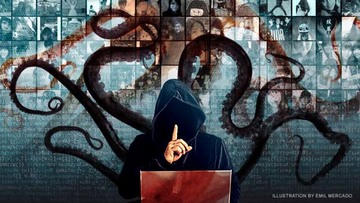
The use of ‘bots’ present modern society with a significant dilemma; The technologies and social media platforms (such as Twitter and Facebook) that once promised to enhance democracy are now increasingly being used to undermine it. Writers Peter W Singer and Emerson Brooking believe ‘the rise of social media and the Internet has become a modern-day battlefield where information itself is weaponised’. To them ‘the online world is now just as indispensable to governments, militaries, activists, and spies at it is to advertisers and shoppers’. They argue this is a new form of warfare which they call ‘LikeWar’. The terrain of LikeWar is social media; ‘it’s platforms are not designed to reward morality or veracity but virality.’ The ‘system rewards clicks, interactions, engagement and immersion time…figure out how to make something go viral, and you can overwhelm even the truth itself.’

In its most simple form the word ‘bot’ is short for ‘robot’; beyond that, there is significant complexity. There are different types of bots. For example, there are ‘chatbots’ such as Siri and Amazon’s Alexa; they recognise human voice and speech and help us with our daily tasks and requests for information. There are search engine style ‘web bots’ and ‘spambots’. There are also ‘sockpuppets’ or ‘trolls’; these are often fake identities used to interact with ordinary users on social networks. There are ‘social bots’; these can assume a fabricated identity and can spread malicious links or advertisements. There are also ‘hybrid bots’ that combine automation with human input and are often referred to as ‘cyborgs’. Some bots are harmless; some more malicious, some can be both.

The country that is perhaps most advanced in this new form of warfare and political influence is Russia. According to Peter Singer and Emerson Brooking ‘Russian bots more than simply meddled in the 2016 U.S. presidential election…they used a mix of old-school information operations and new digital marketing techniques to spark real-world protests, steer multiple U.S. news cycles, and influence voters in one of the closest elections in modern history. Using solely online means, they infiltrated U.S. political communities so completely that flesh-and-blood American voters soon began to repeat scripts written in St. Petersburg and still think them their own’. Internationally, these ‘Russian information offensives have stirred anti-NATO sentiments in Germany by inventing atrocities out of thin air; laid the pretext for potential invasions of Estonia, Latvia, and Lithuania by fuelling the political antipathy of ethnic Russian minorities; and done the same for the very real invasion of Ukraine. And these are just the operations we know about.’

We witnessed similar influence operations here during the Brexit referendum in 2016. A study by the Financial Times reported that during the referendum campaign ‘the 20 most prolific accounts … displayed indications of high levels of automation’. The Anti-Muslim hate group TellMAMA recorded in its latest Annual report that manual bots based in St Petersburg were active in spreading Anti-Muslim hate online. Israel has also used manual ‘bots’ to promote a more positive image of itself online.

The Oxford Internet Institute (OII) has studied online political discussions relating to several countries on social media platforms such as Twitter and Facebook. It claims that in all the elections, political crises and national security-related discussions it examined, there was not one instance where social media opinion had not been manipulated by what they call ‘computational propaganda’. For them, while it remains difficult to quantify the impact bots have ‘computational propaganda’ is now one of the most ‘powerful tools against democracy’.

Donald Trump perhaps more than any other US President to date understands the power of social media. The OII found, for example, that although he alienated Latino voters on the campaign trail, he had some fake Latino twitter bots tweeting support for him. Emerson T Brooker informed me that social media bots can be highly-effective; for him ‘If a bot-driven conversation successfully enters the “Trending” charts of a service like Twitter, it can break into mainstream discussion and receive a great deal of attention from real flesh-and-blood users’. He continues ‘The first unequivocal use of political bots was in the 2010 Special Senate Election in Massachusetts, which ended in the election of Senator Scott Brown. The bots helped draw journalist (and donor) interest from across the country. The Islamic State was also a very effective user of botnets to spread its propaganda over Arabic-speaking Twitter. In 2014, it repeatedly drove hashtags related to its latest execution or battlefield victory (e.g. #AllEyesOnISIS) to international attention.’

So, what can be done to better regulate bots? The OII has called for social media platforms to act against bots and has suggested some steps. These include; making the posts they select for news feeds more ‘random’, so users don’t only see likeminded opinions. News feeds could be provided with a trustworthiness score; audits could be carried out of the algorithms they use to decide which posts to promote. However, the OII also cautions not to over-regulate the platforms to suppress political conversation altogether.  Marc Owen Jones of Exeter University who has researched bots feels that in the case of twitter better ‘verification procedures could tackle the bots’. According to Emerson Brooking ‘a simple non-invasive proposal bouncing around Congress now would mandate the labelling of bot accounts. This would allow bots positive automation functions to continue while keeping them from fooling everyday media users.’

Source: Counterpunch

Snowden (Film Review) | The Guardian

Review By Wendy Ide

For a director who customarily tackles subjects with the approach of a gorilla playing American football, Oliver Stone’s take on whistleblower Edward Snowden seems curiously muted. Audiences who are already familiar with Citizenfour, Laura Poitras’s exemplary documentary on the same subject, will be struck by the fact that, in dramatising Snowden’s story, Stone seems to have leached out much of the drama. The aim was clearly to create an All the President’s Men for the age of cyber-surveillance. But somehow the sense of peril is downplayed, diluted by too much inert exposition and pacing that could be tighter.

Playing Edward Snowden, Joseph Gordon-Levitt is one of the film’s main assets. His character’s ferocious intelligence is signposted with cheap details – he is forever fiddling with a Rubik’s cube and has a nerd’s enthusiasm for arcane enciphering equipment. But Snowden’s intellect is most effectively conveyed in Gordon-Levitt’s eyes – watchful, sober and clouded by doubt, they are a window into his impossible ethical quandary.

Melissa Leo is somewhat underused as Poitras. And playing Guardian reporter Glenn Greenwald, Zachary Quinto is tonally jarring. It feels as though Stone realised that some of the scenes were flagging, so got Quinto to shout angrily at random moments, to keep the audience on their toes.

There are some fun elements, many involving Rhys Ifans’s ruthlessly unprincipled CIA trainer Corbin O’Brian (the fact the character shares a surname with the villain of Orwell’s Nineteen Eighty-Four is no accident). I particularly enjoyed a scene in which O’Brian’s massive glowering face is beamed into a conference room to berate Snowden. His carnivorous snarl fills the immense screen; he looks like a malevolent version of the Wizard of Oz. There’s a playful visual flair to this moment that is sadly lacking elsewhere in the film.

Source: The Guardian

President Assad of Syria is Not An Evil Dictator Killing His People – The Establishment Has Lied | The Marshall Report

media-blackout-as-france-and-russia-both-announce-monsanto-gmo-bansWhat do evil dictators look like? What do they talk like? Just how wicked is an evil dictator’s wife ? Should she be toppled along with her husband? Who am I talking about? President Assad of Syria and his wife, Asmas Al Assad.
These are the same ones boy Rubio, McCain, Lyndsay Graham, Ryan, the Bush’s, Obama, Kerry and Hillary all want to topple down to bring peace to Syria. That is THE LIE they are and have been shouting. What they really want to do is take over Syria in order to hurry along their New World Order agenda. The media whores push the establishment narrative that president Assad of Syria is evil and a corrupt dictator. They fear that when you realize who these people really are, you will be sorry you ever believed any lies told about them, let alone what they have conspired to do against them and all the citizens of Syria.

The real truth is – President Assad and his wife Asmas Al Assad, care about their people. Syria has been invaded with Islamic radicals that have terrorized their nation. We should be helping Assad, not the radical rebels who have infiltrated in the same manner the US manufactured ISIS has infiltrated throughout the entire region. President Assad is fighting terrorists.

Meanwhile before Obama’s push to topple Assad and take over Syria, the media wrote wonderful stories about President Assad and his wife Asmas. Vogue magazine issued a wonderful story calling Asmas the “Rose of The Desert”. After Obama’s regime targeted Syria, the media buried any good stories and began a cut throat propaganda campaign to match their new narrative of Assad as an evil dictator. (You know the drill). They have taken great lengths to rewrite wonderful stories where they once called Asmas Al Assad wonderful things and were amazed at the good will being done by Asmas to people of all faiths. Now they want you to believe that she was faking her lifetime of caring and sided with her so-called evil husband dictator.

The establishment media, in support of Obama’s regime have pushed a propaganda arsenal of civil war crisis and chaos, meanwhile they hired moderate Muslims, trained them and sent them in to fight a sovereign nation. Read more…

Source: The Marshall Report

Vote all you want. The secret government won’t change | Boston Globe

By Jordan Michael Smith

DoubleGovernment The voters who put Barack Obama in office expected some big changes. From the NSA’s warrantless wiretapping to Guantanamo Bay to the Patriot Act, candidate Obama was a defender of civil liberties and privacy, promising a dramatically different approach from his predecessor.

But six years into his administration, the Obama version of national security looks almost indistinguishable from the one he inherited. Guantanamo Bay remains open. The NSA has, if anything, become more aggressive in monitoring Americans. Drone strikes have escalated. Most recently it was reported that the same president who won a Nobel Prize in part for promoting nuclear disarmament is spending up to $1 trillion modernizing and revitalizing America’s nuclear weapons.

Why did the face in the Oval Office change but the policies remain the same? Critics tend to focus on Obama himself, a leader who perhaps has shifted with politics to take a harder line. But Tufts University political scientist Michael J. Glennon has a more pessimistic answer: Obama couldn’t have changed policies much even if he tried.

Though it’s a bedrock American principle that citizens can steer their own government by electing new officials, Glennon suggests that in practice, much of our government no longer works that way. In a new book, “National Security and Double Government,” he catalogs the ways that the defense and national security apparatus is effectively self-governing, with virtually no accountability, transparency, or checks and balances of any kind. He uses the term “double government”: There’s the one we elect, and then there’s the one behind it, steering huge swaths of policy almost unchecked. Elected officials end up serving as mere cover for the real decisions made by the bureaucracy.

RELATED: Coverage of the 2014 midterm elections

Glennon cites the example of Obama and his team being shocked and angry to discover upon taking office that the military gave them only two options for the war in Afghanistan: The United States could add more troops, or the United States could add a lot more troops. Hemmed in, Obama added 30,000 more troops.

Glennon’s critique sounds like an outsider’s take, even a radical one. In fact, he is the quintessential insider: He was legal counsel to the Senate Foreign Relations Committee and a consultant to various congressional committees, as well as to the State Department. “National Security and Double Government” comes favorably blurbed by former members of the Defense Department, State Department, White House, and even the CIA. And he’s not a conspiracy theorist: Rather, he sees the problem as one of “smart, hard-working, public-spirited people acting in good faith who are responding to systemic incentives”—without any meaningful oversight to rein them in.

How exactly has double government taken hold? And what can be done about it? Glennon spoke with Ideas from his office at Tufts’ Fletcher School of Law and Diplomacy. This interview has been condensed and edited.

IDEAS: Where does the term “double government” come from?

GLENNON:It comes from Walter Bagehot’s famous theory, unveiled in the 1860s. Bagehot was the scholar who presided over the birth of the Economist magazine—they still have a column named after him. Bagehot tried to explain in his book “The English Constitution” how the British government worked. He suggested that there are two sets of institutions. There are the “dignified institutions,” the monarchy and the House of Lords, which people erroneously believed ran the government. But he suggested that there was in reality a second set of institutions, which he referred to as the “efficient institutions,” that actually set governmental policy. And those were the House of Commons, the prime minister, and the British cabinet.

IDEAS: What evidence exists for saying America has a double government?

GLENNON:I was curious why a president such as Barack Obama would embrace the very same national security and counterterrorism policies that he campaigned eloquently against. Why would that president continue those same policies in case after case after case? I initially wrote it based on my own experience and personal knowledge and conversations with dozens of individuals in the military, law enforcement, and intelligence agencies of our government, as well as, of course, officeholders on Capitol Hill and in the courts. And the documented evidence in the book is substantial—there are 800 footnotes in the book.

IDEAS: Why would policy makers hand over the national-security keys to unelected officials?

GLENNON: It hasn’t been a conscious decision….Members of Congress are generalists and need to defer to experts within the national security realm, as elsewhere. They are particularly concerned about being caught out on a limb having made a wrong judgment about national security and tend, therefore, to defer to experts, who tend to exaggerate threats. The courts similarly tend to defer to the expertise of the network that defines national security policy.

The presidency itself is not a top-down institution, as many people in the public believe, headed by a president who gives orders and causes the bureaucracy to click its heels and salute. National security policy actually bubbles up from within the bureaucracy. Many of the more controversial policies, from the mining of Nicaragua’s harbors to the NSA surveillance program, originated within the bureaucracy. John Kerry was not exaggerating when he said that some of those programs are “on autopilot.”

RELATED: Answers sought on CIA role in ‘78 JFK probe

IDEAS: Isn’t this just another way of saying that big bureaucracies are difficult to change?

GLENNON: It’s much more serious than that. These particular bureaucracies don’t set truck widths or determine railroad freight rates. They make nerve-center security decisions that in a democracy can be irreversible, that can close down the marketplace of ideas, and can result in some very dire consequences.

IDEAS: Couldn’t Obama’s national-security decisions just result from the difference in vantage point between being a campaigner and being the commander-in-chief, responsible for 320 million lives?

GLENNON: There is an element of what you described. There is not only one explanation or one cause for the amazing continuity of American national security policy. But obviously there is something else going on when policy after policy after policy all continue virtually the same way that they were in the George W. Bush administration.

IDEAS: This isn’t how we’re taught to think of the American political system.

GLENNON: I think the American people are deluded, as Bagehot explained about the British population, that the institutions that provide the public face actually set American national security policy. They believe that when they vote for a president or member of Congress or succeed in bringing a case before the courts, that policy is going to change. Now, there are many counter-examples in which these branches do affect policy, as Bagehot predicted there would be. But the larger picture is still true—policy by and large in the national security realm is made by the concealed institutions.

IDEAS: Do we have any hope of fixing the problem?

GLENNON: The ultimate problem is the pervasive political ignorance on the part of the American people. And indifference to the threat that is emerging from these concealed institutions. That is where the energy for reform has to come from: the American people. Not from government. Government is very much the problem here. The people have to take the bull by the horns. And that’s a very difficult thing to do, because the ignorance is in many ways rational. There is very little profit to be had in learning about, and being active about, problems that you can’t affect, policies that you can’t change.

Source: Boston Globe

Edward Snowden, after months of NSA revelations, says his mission’s accomplished | The Washington Post

By Barton Gellman

Snowden1MOSCOW — The familiar voice on the hotel room phone did not waste words.

“What time does your clock say, exactly?” he asked. He checked the reply against his watch and described a place to meet. “I’ll see you there,” he said.

Edward Joseph Snowden emerged at the appointed hour, alone, blending into a light crowd of locals and tourists. He cocked his arm for a handshake, then turned his shoulder to indicate a path. Before long he had guided his visitor to a secure space out of public view.

During more than 14 hours of interviews, the first he has conducted in person since arriving here in June, Snowden did not part the curtains or step outside. Russia granted him temporary asylum on Aug. 1, but Snowden remains a target of surpassing interest to the intelligence services whose secrets he spilled on an epic scale.

Late this spring, Snowden supplied three journalists, including this one, with caches of top-secret documents from the National Security Agency, where he worked as a contractor. Dozens of revelations followed, and then hundreds, as news organizations around the world picked up the story. Congress pressed for explanations, new evidence revived old lawsuits and the Obama administration was obliged to declassify thousands of pages it had fought for years to conceal.

Taken together, the revelations have brought to light a global surveillance system that cast off many of its historical restraints after the attacks of Sept. 11, 2001. Secret legal authorities empowered the NSA to sweep in the telephone, Internet and location records of whole populations. One of the leaked presentation slides described the agency’s “collection philosophy” as “Order one of everything off the menu.”

Six months after the first revelations appeared in The Washington Post and Britain’s Guardian newspaper, Snowden agreed to reflect at length on the roots and repercussions of his choice. He was relaxed and animated over two days of nearly unbroken conversation, fueled by burgers, pasta, ice cream and Russian pastry. Read more…

Source: The Washington Post

The Plan Acccording to U.S. General Wesley Clark (Ret.) | YouTube

In an interview with Amy Goodman on March 2, 2007, U.S. General Wesley Clark (Ret.), explains that the Bush Administration planned to take out 7 countries in 5 years: Iraq, Syria, Lebanon, Lybia, Somalia, Sudan, Iran.

We didn’t have to invade them, but just throw out their governments and divide the countries with the help of destabilisation.

  • Iraq – ✓[2003]
  • Afghanistan – ✓ [2001]
  • Libya – ✓ [ The fall of Gaddafi 2011 ]
  • Sudan – ✓[Divided last year in two states after US sponsored terrorism.]
  • Somalia – ✓ [US puppets in government]
  • Lebanon – [In progress right now. The Syrian war is spreading across the borders just last week]
  • Syria – [In progress right now. US financed terrorism]
  • Iran – The final stage. And it will be loud one.

DOJ pursues immunity for Bush and six others for Iraq war crimes | The Examiner

By David Phillips

George W. Bush Speaks At Naturalization Ceremony At Bush Presidential CenterThe Department of Justice has filed a Grant of Immunity for war crimes against George W. Bush, Richard Cheney, Condoleezza Rice, Colin Powell, Paul Wolfowitz, and Donald Rumsfeld. The filing for the immunity of war crimes was made with the United States District Court, Northern District of California San Francisco Division.

The filing is for procedural immunity in a case alleging that they planned and waged the Iraq War in violation of international law.

The Plaintiff in this case is Sundus Shaker Saleh, an Iraqi single mother and refugee now living in Jordan. She filed a complaint in March 2013 in a San Francisco federal court alleging that the planning and waging of the war constituted a “crime of aggression” against Iraq, a legal theory that was used by the Nuremberg Tribunal to convict Nazi war criminals after World War II.

In her lawsuit, Saleh alleges that:

  • Richard Cheney, Donald Rumsfeld and Paul Wolfowitz began planning the Iraq War in 1998 through their involvement with the “Project for the New American Century,” a Washington DC non-profit that advocated for the military overthrow of Saddam Hussein.
  • Once they came to power, Saleh alleges that Cheney, Rumsfeld and Wolfowitz convinced other Bush officials to invade Iraq by using 9/11 as an excuse to mislead and scare the American public into supporting a war.
  • Finally, she claims that the United States failed to obtain United Nations approval prior to the invasion, rendering the invasion illegal and an act of impermissible aggression.

“The DOJ claims that in planning and waging the Iraq War, ex-President Bush and key members of his Administration were acting within the legitimate scope of their employment and are thus immune from suit,” chief counsel Inder Comar of Comar Law said.

The “Westfall Act certification,” submitted pursuant to the Westfall Act of 1988, permits the Attorney General, at his or her discretion, to substitute the United States as the defendant and essentially grant absolute immunity to government employees for actions taken within the scope of their employment.

“The good news is that while we were disappointed with the certification, we were prepared for it,” Comar stated. “We do not see how a Westfall Act certification is appropriate given that Ms. Saleh alleges that the conduct at issue began prior to these defendants even entering into office. I think the Nuremberg prosecutors, particularly American Chief Prosecutor Robert Jackson, would be surprised to learn that planning a war of aggression at a private non-profit, misleading a fearful public, and foregoing proper legal authorization somehow constitute lawful employment duties for the American president and his or her cabinet.”

The case is Saleh v. Bush (N.D. Cal. Mar. 13, 2013, No. C 13 1124 JST).

Source: The Examiner

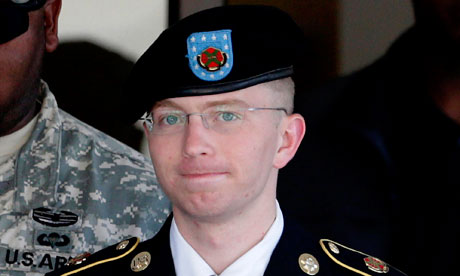
Bradley Manning: a sentence both unjust and unfair | The Guardian

Bradley ManningPfc Manning sought to hold his country to the values it claims to uphold, yet his prison term dwarfs other military convictions

Bradley Manning has received a prison sentence that was 10 years longer than the period of time after which many of the documents he released would have been automatically declassified. The military judge handed down the longest ever sentence for a leak of US government information.

Mr Manning, according to this logic, did more harm than the soldier who gave a Jordanian intelligence agent information on the build-up to the first Iraq war, or the marine who gave the KGB the identities of CIA agents and floorplans of the embassies in Moscow and Vienna. Mr Manning did three times as much harm in transmitting to WikiLeaks in 2010 the war logs or field reports from Iraq and Afghanistan, as Charles Graner did. He was the army reserve corporal who became ringleader of the Abu Ghraib abuse ring and was set free after serving six and a half years of his 10-year sentence.

Among the 700,000 classified documents Mr Manning downloaded while stationed in Iraq was a video that showed a US Apache helicopter in Baghdad opening fire on a group of Iraqis, including two Reuters journalists and their children, who had attempted to rescue a severely injured man. More devastating than the film was the cockpit chatter of the soldiers who joked as they shot people in the streets.

“Look at those dead bastards,” said one. “Nice,” said another.

The Apache crew has never been charged with any offence (all their adult targets were listed as insurgents) and neither has any other individual as a result of Mr Manning’s revelations. But the shortened 17-minute version of the video has been viewed more than 3m times on YouTube.

So, the central question to answer in judging the proportionality of this sentence is whether the desire to punish a whistleblower driven by moral outrage stems from the alleged harm he did US military and diplomatic interests, or whether it derives more from sheer embarrassment. The judge presiding, Col Denise Lind, had already thrown out the gravest charge, that of “aiding the enemy”. Col Lind had also limited the admissibility of evidence regarding the “chilling effects” that Mr Manning’s actions had on US diplomacy by releasing 250,000 state department cables. A military witness conceded there was no evidence that anyone had been killed after being named in the releases.

Mr Manning’s recent apology for his actions does not, and should not, detract from the initial defence he gave for them, when he spoke of his shock at the “delightful bloodlust” displayed by that helicopter crew, or his belief that stimulating a debate about the wars was the right thing to do. We know what his motives as a whistleblower were and we have applauded them. They are certainly not akin to treachery or any act fit to be judged – if anything is – by an espionage act rushed onto the statute book in 1917 after America entered the first world war.

Mr Manning exposed the abuse of detainees by Iraqi officers under the watch of US minders. He showed that civilian deaths during the Iraq war were much higher than the official estimates. If they were published today, these claims would be uncontentious. They have already slipped into the official history of this war. But the author of this orthodoxy will continue to pay for the record he helped establish by a prison term that he will serve well into the next decade, which is when the first date for his parole application becomes due. Mr Manning was seeking to hold his country and its army to the values they claim to uphold.

It is unclear what the US military hopes to achieve by securing a sentence that dwarfs those of other military convictions. Deterrence features large in its thinking. Whistleblowing will not only endanger your career, it wants to say, but your freedom – for most of your adult life. In 2008, one could have hoped that the US had a president whose administration would distinguish between leaks in the public interest and treason. But this sentence tells a different story. Mr Manning’s sentence, which is both unjust and unfair, can still be reduced on appeal. Let us hope that it is.

Source: The Guardian

SWAT Team Raids Organic Farm, Confiscates Blueberries | Huffington Post

By Radley Balko

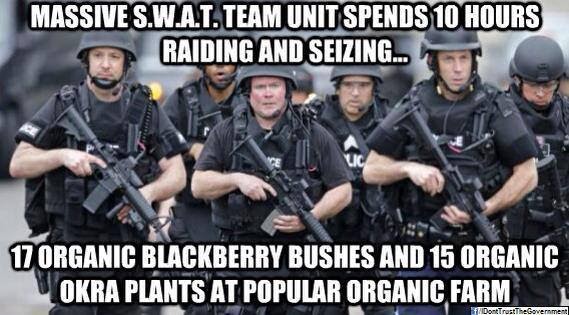
SWATTeamA small organic farm in Arlington, Texas, was the target of a massive police action last week that included aerial surveillance, a SWAT raid and a 10-hour search.

Members of the local police raiding party had a search warrant for marijuana plants, which they failed to find at the Garden of Eden farm. But farm owners and residents who live on the property told a Dallas-Ft. Worth NBC station that the real reason for the law enforcement exercise appears to have been code enforcement. The police seized “17 blackberry bushes, 15 okra plants, 14 tomatillo plants … native grasses and sunflowers,” after holding residents inside at gunpoint for at least a half-hour, property owner Shellie Smith said in a statement. The raid lasted about 10 hours, she said.

Local authorities had cited the Garden of Eden in recent weeks for code violations, including “grass that was too tall, bushes growing too close to the street, a couch and piano in the yard, chopped wood that was not properly stacked, a piece of siding that was missing from the side of the house, and generally unclean premises,” Smith’s statement said. She said the police didn’t produce a warrant until two hours after the raid began, and officers shielded their name tags so they couldn’t be identified. According to ABC affiliate WFAA, resident Quinn Eaker was the only person arrested — for outstanding traffic violations.

The city of Arlington said in a statement that the code citations were issued to the farm following complaints by neighbors, who were “concerned that the conditions” at the farm “interfere with the useful enjoyment of their properties and are detrimental to property values and community appearance.” The police SWAT raid came after “the Arlington Police Department received a number of complaints that the same property owner was cultivating marijuana plants on the premises,” the city’s statement said. “No cultivated marijuana plants were located on the premises,” the statement acknowledged.

The raid on the Garden of Eden farm appears to be the latest example of police departments using SWAT teams and paramilitary tactics to enforce less serious crimes. A Fox television affiliate reported this week, for example, that police in St. Louis County, Mo., brought out the SWAT team to serve an administrative warrant. The report went on to explain that all felony warrants are served with a SWAT team, regardless whether the crime being alleged involves violence.

In recent years, SWAT teams have been called out to perform regulatory alcohol inspections at a bar in Manassas Park, Va.; to raid bars for suspected underage drinking in New Haven, Conn.; to perform license inspections at barbershops in Orlando, Fla.; and to raid a gay bar in Atlanta where police suspected customers and employees were having public sex. A federal investigation later found that Atlanta police had made up the allegations of public sex.

Other raids have been conducted on food co-ops and Amish farms suspected of selling unpasteurized milk products. The federal government has for years been conducting raids on medical marijuana dispensaries in states that have legalized them, even though the businesses operate openly and are unlikely to pose any threat to the safety of federal enforcers.

Radley Balko is a senior writer and investigative reporter for The Huffington Post. He is also the author of the new book, Rise of the Warrior Cop: The Militarization of America’s Police Forces.

Sources: Huffington Post

It’s Official: US Funding Al Qaeda and Taliban |Charleston Voice

Afghanistan$$$By Dr. Stuart Jeanne Bramhall

It’s extremely ironic for the US State Department to be issuing travel alerts for US citizens in the Middle East and North Africa the same week we learn that the Pentagon is contracting with Al Qaeda and Taliban supporters to carry out Afghan reconstruction projects.

Tony Capaccio of Bloomberg News cites a quarterly report to Congress by Special Inspector for Afghan Reconstruction John Sopko.

The report reveals Sopko asked the US Army Suspension and Disbarment office to cancel 43 contracts to known Al Qaeda and Taliban supporters. They refused. The reason? The Suspension and Disbarment Office claims it would violate Al Qaeda and Taliban “due process rights.”

Curious, isn’t it? Official terrorist groups have due process rights, but not whistleblowers, Guantanamo detainees, or ordinary Americans subject to continual surveillance by NSA.

The intelligence community has been quietly leaking evidence for more than a decade that the US is secretly funding Al Qaeda to promote political instability (and justify continued military intervention) in the Middle East. In the last two years the CIA has been caught red-handed funding and training Al Qaeda militants in Libya and Syria.

Based on Sopko’s report, Pentagon support for Al Qaeda and the Taliban is official as of August 1.

Let me see if I can think this through: the Pentagon is giving Al Qaeda and the Taliban funding, even though Al Qaeda and the Taliban are planning to carry out attacks on US citizens. How can this be happening? It would appear the US government is at war with their own people.

The 236 page quarterly report Sopko submitted to Congress also raises grave concerns about Obama’s request for $10.7 billion in 2014 for Afghan reconstruction projects. All would be carrying out by civilian contractors, of which 30-40% would be local Afghan businesses.

Sopko argues the Pentagon already fails abysmally in monitoring an existing $32 million program to install bars or gratings in culverts to prevent insurgents from planting roadside bombs in them. He thinks at bare minimum the Department of Defense should now how many contracts they have issued under this program. They don’t. Thus is seems pretty obvious they aren’t vetting the contractors, much less monitoring where the money is going.

Source: Charleston Voice