The Sky Darkens for American Journalism: The future of the American media is being decided in a military court | Al Jazeera

By Chase Mader

Bradley Manning released hundreds of thousands of government documents and files to Wikileaks, most famous among them the unclassified video Wikileaks dubbed, “Collateral Murder”, a harrowing gun-sight view of an Apache helicopter slaughtering a couple of armed men and a much larger group of civilians on a Baghdad street in July, 2007.

The court-martial of Pfc. Manning, finally underway over three years after his arrest, is likely to cause a great deal of collateral destruction in its own right. In this case the victim will be American journalism.

The most serious of the charges against Manning is the capital offense of “aiding the enemy.” (Team Obama has made it clear it won’t seek the death penalty, but a life sentence is possible.) The enemy that the prosecution has in mind is not Wikileaks or the global public but Al Qaeda; because this group had access to the internet, the logic goes, they could read Manning’s disclosures just like everyone else.

The government does not have to prove Manning’s conscious intent to help Al Qaeda, but must only meet the squishier standard of proving the defendant had “specific knowledge” that the terrorists might benefit from his cache of documents.If the Aiding the Enemy charge against Bradley Manning is the outcome of his legal struggles, there will be adverse consequences for whistleblowers and for journalists in the future.

If this charge sticks, it will be a serious blow to American journalism, as it puts all kinds of confidential informants at risk of being capital cases. A soldier in Afghanistan who blogs about the lack of armoured vehicles – a common and very public complaint from the ranks in the Iraq War – could be prosecuted for tipping off the Taliban.

Whoever leaked Ambassador Karl Eikenberry’s long cable on the futility of counterinsurgency in Afghanistan could also be conceivably be put away for life, even executed. As Ben Wizner of the American Civil Liberties Union has explained, the use of this charge against sources, leakers and whistleblowers – like Bradley Manning – will criminalise a great deal of essential journalism – and not just the kind practiced by Wikileaks and various bloggers.

The Manning prosecution has asserted more than once that they would have pressed the Aiding the Enemy charge even if the private had passed his cache to the New York Times or the Washington Post (as the leaker had attempted).

This jolted the editorial classes, who do not much like imagining themselves as being implicated, however hypothetically, in terrorist acts. Op-eds in the New York Times and Los Angeles Times have blasted the Aiding the Enemy charges brought against Manning, explaining that they would not just “chill” but freeze a great deal of essential journalism.

The news media has always relied on leaks of classified material, from the Pentagon Papers and Watergate, to the preemptive disclosure of the 2007 National Intelligence Estimate holding that Iran had no nuclear weapons program, a transparent attempt by the military brass to block Bush and Cheney from launching a third war.

And contrary to widespread panic, massive leaks of classified material tend to enhance national security as the new information can prevent the kind of reckless, poorly-informed decisions that have squandered so much blood and money, from Southeast Asia to Iraq.

Who is a journalist and who gets to decide?

Aiding the Enemy is of course not the only charge against Private Manning. One of the charges, “wanton publication,” hinges in part on whether Wikileaks is a bona fide journalistic entity. But who gets to decide who is and who isn’t a journalist, and how?

Defense witness Yochai Benkler, a professor at Harvard Law School and expert on press freedom and the internet, provided an answer earlier this month. Benkler, who has published penetrating studies of the 21st century media landscape, took the stand July 11th to address the matter of who is and who isn’t a journalist.

Wikileaks is absolutely a media organization, one perfectly emblematic of the “networked fourth estate”, in which traditional news outlets like the Guardian and Der Spiegel collaborate with smaller non-profit and for-profit entities to produce news coverage. Supporters of Manning found Benkler’s testimony to be lucid, supremely well-informed and compelling – but will it convince Judge Denise Lind?

As for traditional news media, they have been largely AWOL, with the New York Times sending a correspondent to a few hearings, only after a shaming by the newspaper’s public editor. But a handful of independent correspondents, notably Kevin Gostzola of FireDogLake, independent journalist Alexa O’Brien and Bradley Manning staffer Nathan Fuller, as well as court artist Clark Stoeckley – have covered every breath of the legal proceedings.

And even as more established media have leaned heavily on these reporters for all manner of factual and logistical assistance, gracious acknowledgement of the professional debt has not always been forthcoming. Last month the New York Times rather snottily described O’Brien as a mere “activist” before being embarrassed into a correction.

Although smug torpor is Big Media’s default setting, a recent barrage of sucker-punches has shaken the Fourth Estate’s generally cosy partnership with the political class. The Obama administration has named James Rosen of Fox News as a co-conspirator in its case against State Department leaker Stephen Jin-Woo Kim; the government has also announced that it had been sifting through two months of the Associated Press’s phone records to hunt down the source of a leak.

Obama’s poison gift to journalists

Affecting a chastened air, the Obama administration now says it wants to make nice with journalists.   To strike a finer “balance” between press freedom and security, Team Obama has offered to pass a Press Shield Law-a slightly revamped version of the same bill the White House threatened to veto back in 2009. (Senator Obama had been a liberal champion of just such a bill before). This Press Shield Law is intended as conciliatory basket of fruit, sent to the media as an apology for all those investigations.

The government’s gift to journalists is poison, and should be rejected. The Press Shield Law would be more accurately titled the Media Prosecution Enhancement Bludgeon – as Trevor Timm of the Press Freedom Foundation has warned, the statute would override and erase many common-law protections currently enjoyed by reporters.

Just as with our whistleblower protection laws, the statute includes a cavernous carve-out for any leak-based reporting that affects “national security”, a term that is infinitely elastic in the hands of official Washington. (The law would not have “shielded” the Associated Press from the government’s investigation of their phone records, nor would it have protected Fox’s Rosen).

But wait: that’s not all that the new law won’t do! As the law’s primary author, Senator Chuck Schumer (D-NY) has crowed, the law would specifically exclude Wikileaks and other internet-based groups that he and his colleagues do not believe to be proper media organizations. (Bear in mind the average age in today’s United States Senate is 61). The language defining who is and who isn’t “a member of the media” is marvellously supple, to be loosened and tightened as the government sees fit.

Meanwhile, the State onslaught against American journalists continues: the dependably conservative Washington DC circuit court has ruled that James Risen of the New York Times must testify as to his sources in a story about CIA disruption of Iran’s nuclear program. (Risen has pledged he will go to jail first).

Former NSA and CIA director Michael Hayden has casually called Glenn Greenwald a co-conspirator with NSA leaker Edward Snowden. With this roiling in the background, military judge Denise Lind announced on July 18 that she would not dismiss the Aiding the Enemy charge against Bradley Manning but will instead weigh that momentous accusation on its merits.

This is not necessarily a disaster for Manning or for American journalism: if Judge Lind rules against this charge, it will establish common law precedent protecting journalists from similar legal attacks, and Bradley Manning will likely serve (a little) less time in prison. (The Judge’s verdict is expected by next Tuesday, July 30th).

On the other hand, if the Aiding the Enemy charge sticks, Pfc. Manning faces a possible life sentence – and the outcome might be only slightly less calamitous for American journalism.

Source: Common Dreams
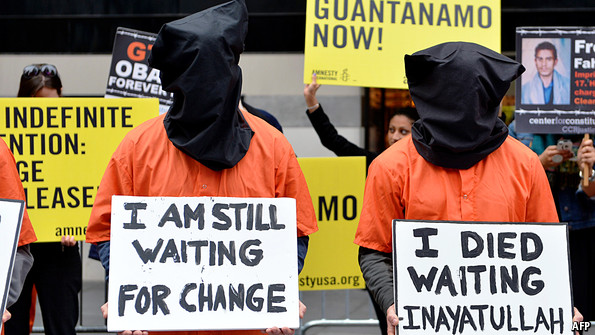
A desperate protest by prisoners at Guantánamo has shamed Barack Obama

GuantanamoHungerStrike“YOU have to hand it to some of these IRA boys,” Margaret Thatcher once remarked of the republican hunger-strikers who embarrassed her in 1981. “What a terrible waste of human life!” she said of the ten who died. Since some of the hunger-strikers at Guantánamo Bay are being force-fed through nasal tubes, Barack Obama may be spared Mrs Thatcher’s grief. But he has been shamed by their desperate gambit all the same. The protest is a reminder of one of his most glaring failures in office.

Officials count 100 hunger-strikers; lawyers for the detainees say there are 130; on any reckoning, a majority of the 166 remaining inmates are starving themselves. Through their lawyers, detainees complain of a rougher regime since the army took over guard duties from the navy last autumn. In particular they allege that their Korans were mistreated during an inspection in February, when the hunger-strike began (prison authorities vigorously deny that). A cell-block raid by guards on April 13th (provoked by the covering up of security cameras), during which some prisoners were shot with rubber pellets, hardened rather than broke the strikers.

But the underlying cause is simpler, and more personal. “The reason they’re willing to die”, says Carlos Warner, a federal defender who represents 11 of the detainees, “is President Obama.”

Mr Obama said this week that Guantánamo “hurts us in terms of our international standing.” That echoed the view he espoused when, on his second day in office in January 2009, he ordered the prison to be closed within a year. Its existence since 2002, he said, had “likely created more terrorists around the world than it ever detained”—an opinion eventually shared by assorted veterans of George W. Bush’s administration. And yet the only Guantánamo-related closure so far has been the shutting, in January this year, of the diplomatic office charged with resettling the inmates.

Mr Obama blames Congress—with some justification. It thwarted his original plan to transfer the detainees to a facility in Illinois. Then, either out of concern for national security, a yen to embarrass the president, or both, in clauses inserted into successive defence-spending bills Congress made it difficult for officials to transfer anyone anywhere. Difficult, but not impossible: Mr Obama can authorise transfers using a presidential waiver. He has chosen not to. (After a bomb plot with links to Yemen at the end of 2009, he also chose to halt transfers there—and most of the remaining prisoners are Yemeni.) He evidently calculated that, given the battles he is already waging with Congress, Guantánamo was one he could do without.

That stalemate has been an especial let-down for the 86 residual prisoners who, in 2010, were slated for transfer out of Guantánamo by a presidential review; some had already been designated for transfer under the previous administration. Many of these men claim to have committed no offence except being in the wrong place—Afghanistan—at the wrong time, or to have been sold to American forces for the bounties they offered. One such, and one of the hunger-strikers, is Shaker Aamer, a British resident picked up in Jalalabad in 2001 and allegedly tortured. His lawyer, Clive Stafford Smith, points out that the British government is well-equipped to monitor Mr Aamer should he be repatriated.

According to the review, many of these men were low-level fighters rather than total innocents. But none has been charged with a crime—and most have been at Guantánamo for over a decade. In fact, only seven of the 779 prisoners who have passed through the camp have been convicted by its military tribunals (and two of those verdicts have been challenged). Of those still there, only three have been convicted and only six currently face trial, including Khalid Sheikh Mohammed, the alleged mastermind of the September 11th attacks. Subject to multiple legal challenges, beset by scandals over hidden microphones and leaked defence documents, the tribunals are now regarded as a failure even by those untroubled by their dubious legal status. As Mr Obama pointed out, federal courts have proved a much more effective forum for prosecuting terrorists.

The result, at the camp, is near-total stasis. No new prisoner has arrived since 2008; none has left for over a year. Parole-style hearings planned for the group not designated for either trial or transfer have yet to begin. Prisoners have lawyers, but there is little the lawyers can do for them. This bleak situation, says Mr Stafford Smith, is worse than being on death row.

Last chance?

Beyond the feeling of personal betrayal by Mr Obama, the detainees also sense—correctly—that the attention of the foreign leaders, human-rights watchdogs and United Nations officials who once energetically protested at their predicament has wandered. The outrage that the manacled, blindfolded, jumpsuited figures first provoked has dimmed. Drone warfare has become a much bigger human-rights preoccupation. And yet, unpropitious as it might seem, the prisoners also fear that this may be their last chance to get out.

Mr Warner says that if, with the president’s views and legal background, Mr Obama “can’t get this done, I don’t know who could.” It is hard to see a future presidential candidate matching his troublesome pledge to shut the prison. And for Mr Obama as well, time is running out. Even if he chose to use his waiver powers, and leant on other governments to accept detainees, the diplomacy, including gathering the necessary assurances on security and humane treatment, would take time.

Meanwhile the Guantánamo authorities are seeking an extra $200m for refurbishments, on top of annual running costs that wildly exceed those for ordinary prisons. They are planning new medical facilities to care for elderly detainees.

This week Mr Obama vowed to re-engage with Congress. “I’m going to go back at this,” he promised. He should hurry. Once Guantánamo was a byword for an overmighty executive and the excesses of Mr Bush’s “war on terror”. Under Mr Obama it has become a victim and a symbol of the paralysing divisiveness of American politics. “It’s going to get worse,” he said this week. “It’s going to fester.”

Source: The Economist

The Permanent Militarization of America | New York Times Opinion

By Aaron B. O’Connell

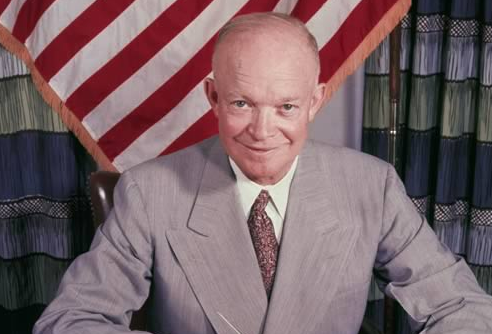
In 1961, President Dwight D. Eisenhower left office warning of the growing power of the military-industrial complex in American life. Most people know the term the president popularized, but few remember his argument.

In his farewell address, Eisenhower called for a better equilibrium between military and domestic affairs in our economy, politics and culture. He worried that the defense industry’s search for profits would warp foreign policy and, conversely, that too much state control of the private sector would cause economic stagnation. He warned that unending preparations for war were incongruous with the nation’s history. He cautioned that war and warmaking took up too large a proportion of national life, with grave ramifications for our spiritual health.

The military-industrial complex has not emerged in quite the way Eisenhower envisioned. The United States spends an enormous sum on defense — over $700 billion last year, about half of all military spending in the world — but in terms of our total economy, it has steadily declined to less than 5 percent of gross domestic product from 14 percent in 1953. Defense-related research has not produced an ossified garrison state; in fact, it has yielded a host of beneficial technologies, from the Internet to civilian nuclear power to GPS navigation. The United States has an enormous armaments industry, but it has not hampered employment and economic growth. In fact, Congress’s favorite argument against reducing defense spending is the job loss such cuts would entail.

Nor has the private sector infected foreign policy in the way that Eisenhower warned. Foreign policy has become increasingly reliant on military solutions since World War II, but we are a long way from the Marines’ repeated occupations of Haiti, Nicaragua and the Dominican Republic in the early 20th century, when commercial interests influenced military action. Of all the criticisms of the 2003 Iraq war, the idea that it was done to somehow magically decrease the cost of oil is the least credible. Though it’s true that mercenaries and contractors have exploited the wars of the past decade, hard decisions about the use of military force are made today much as they were in Eisenhower’s day: by the president, advised by the Joint Chiefs of Staff and the National Security Council, and then more or less rubber-stamped by Congress. Corporations do not get a vote, at least not yet.

But Eisenhower’s least heeded warning — concerning the spiritual effects of permanent preparations for war — is more important now than ever. Our culture has militarized considerably since Eisenhower’s era, and civilians, not the armed services, have been the principal cause. From lawmakers’ constant use of “support our troops” to justify defense spending, to TV programs and video games like “NCIS,” “Homeland” and “Call of Duty,” to NBC’s shameful and unreal reality show “Stars Earn Stripes,” Americans are subjected to a daily diet of stories that valorize the military while the storytellers pursue their own opportunistic political and commercial agendas. Of course, veterans should be thanked for serving their country, as should police officers, emergency workers and teachers. But no institution — particularly one financed by the taxpayers — should be immune from thoughtful criticism. Read more…

Source: New York Times Opinion

U.S. Military Intervention in Egypt: A Chapter in America’s Saudi Arabian End-Game | Collapse.net

By Dale G. Sinner

US military intervention in Egypt is prompting speculation over motives. Extraction of American citizens is the stated objective, but does evacuating the American expat community in Egypt warrant the flotilla of US warships recently positioned in the Suez Canal?  Does evacuating this expat community warrant the helicopters, Special Forces squads, and 2,200 Marines aboard those ships?  Here in the land of endless budget cuts, the obvious answer is “doubtful”.

While protests flare across North Africa, why would the US stir up already seething anti-American sentiment in the region with such a move?  Could today’s intervention lead to a long-term, “stabilizing” US presence in Egypt? Or could these events presage something far greater?  What of Egypt’s neighbor to the East – Saudi Arabia – home to a quarter of world oil reserves?

Egyptian President Hosni Mubarak is clearly defying US pressure to step down from an office he’s held for nearly 30 years.  Continued port strikes and unrest threaten vital ship traffic along the Suez Canal, and the likelihood of imminent military extraction of American citizens may present a tantalizing opportunity for oil elites to close the circle around the Arabian peninsula and place a major US force presence in Egypt – a presence with a potentially ominous goal: the eventual destabilization and Balkanization of the Arabian peninsula.

The Saudi royals are clearly opposed to US intervention in Egypt.  See here, here, and here.  This opinion regarding US meddling is understandable, as even the slightest provocation could spark similar civilian revolt on the Saudi side of the Red Sea.

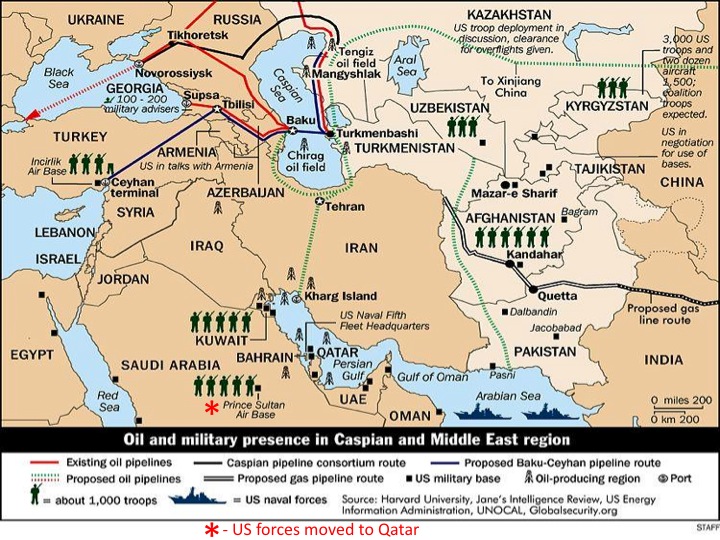
US forces were evicted from Saudi Arabia in mid-2003 and relocated to neighboring Qatar, but material and troop strength in US CENTCOM’s theatre of operations – including the permanent US “mega bases” in Iraq, might suggest a more lucrative alternative to Iran as the central target of US military strategic planning (see map below). Read more...

The Worldwide Network of US Military Bases: The Global Deployment of US Military Personnel | Global Research

By Prof. Jules Dufour

Editor’s Note: The Worldwide control of humanity’s economic, social and political activities is under the helm of US corporate and military power. Underlying this process are various schemes of direct and indirect military intervention. These US sponsored strategies ultimately consist in a process of global subordination.

Where is the Threat?

The 2000 Global Report published in 1980 had outlined “the State of the World” by focusing on so-called  “level of threats” which might negatively influence or undermine US interests.

Twenty years later, US strategists, in an attempt to justify their military interventions in different parts of the World, have conceptualized the greatest fraud in US history, namely “the Global War on Terrorism” (GWOT). The latter, using a fabricated pretext  constitutes a global war against all those who oppose US hegemony. A modern form of slavery, instrumented through militarization and the “free market” has unfolded.

Major elements of the conquest and world domination strategy by the US refer to:

  1. the control of the world economy and its financial markets,
  2. the taking over of all natural resources (primary resources and nonrenewable sources of energy). The latter constitute the cornerstone of US power through the activities of its multinational corporations.

Geopolitical Outreach: Network of Military Bases

The US has established its control over 191 governments which are members of the United Nations. The conquest, occupation and/or otherwise supervision of these various regions of the World is supported by an integrated network of military bases and installations which covers the entire Planet (Continents, Oceans and Outer Space). All this pertains to the workings of  an extensive Empire, the exact dimensions of which are not always easy to ascertain.

Known and documented from information in the public domaine including Annual Reports of the US Congress, we have a fairly good understanding of the structure of US military expenditure, the network of US military bases and  the shape of this US military-strategic configuration in different regions of the World.

The objective of this article is to build a summary profile of the World network of military bases, which are under the jurisdiction and/or control  of the US. The spatial distribution of these military bases will be examined together with an analysis of the multibillion dollar annual cost of their activities.

In a second section of this article, Worldwide popular resistance movements directed against US military bases and their various projects will be outlined. In a further article we plan to analyze the military networks of other major nuclear superpowers including  the United Kingdom, France and Russia.

I. The Military Bases

Military bases are conceived for training purposes, preparation and stockage of military equipment, used by national armies throughout the World. They are not very well known in view of the fact that they are not open to the public at large. Even though they take on different shapes, according to the military function for which they were established; they can broadly be classified under four main categories: a) Air Force Bases; b) Army or Land Bases; c) Navy Bases and; d) Communication and Spy Bases. Read more…