A desperate protest by prisoners at Guantánamo has shamed Barack Obama

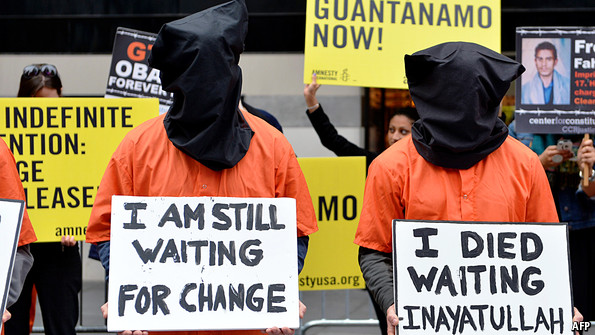
GuantanamoHungerStrike“YOU have to hand it to some of these IRA boys,” Margaret Thatcher once remarked of the republican hunger-strikers who embarrassed her in 1981. “What a terrible waste of human life!” she said of the ten who died. Since some of the hunger-strikers at Guantánamo Bay are being force-fed through nasal tubes, Barack Obama may be spared Mrs Thatcher’s grief. But he has been shamed by their desperate gambit all the same. The protest is a reminder of one of his most glaring failures in office.

Officials count 100 hunger-strikers; lawyers for the detainees say there are 130; on any reckoning, a majority of the 166 remaining inmates are starving themselves. Through their lawyers, detainees complain of a rougher regime since the army took over guard duties from the navy last autumn. In particular they allege that their Korans were mistreated during an inspection in February, when the hunger-strike began (prison authorities vigorously deny that). A cell-block raid by guards on April 13th (provoked by the covering up of security cameras), during which some prisoners were shot with rubber pellets, hardened rather than broke the strikers.

But the underlying cause is simpler, and more personal. “The reason they’re willing to die”, says Carlos Warner, a federal defender who represents 11 of the detainees, “is President Obama.”

Mr Obama said this week that Guantánamo “hurts us in terms of our international standing.” That echoed the view he espoused when, on his second day in office in January 2009, he ordered the prison to be closed within a year. Its existence since 2002, he said, had “likely created more terrorists around the world than it ever detained”—an opinion eventually shared by assorted veterans of George W. Bush’s administration. And yet the only Guantánamo-related closure so far has been the shutting, in January this year, of the diplomatic office charged with resettling the inmates.

Mr Obama blames Congress—with some justification. It thwarted his original plan to transfer the detainees to a facility in Illinois. Then, either out of concern for national security, a yen to embarrass the president, or both, in clauses inserted into successive defence-spending bills Congress made it difficult for officials to transfer anyone anywhere. Difficult, but not impossible: Mr Obama can authorise transfers using a presidential waiver. He has chosen not to. (After a bomb plot with links to Yemen at the end of 2009, he also chose to halt transfers there—and most of the remaining prisoners are Yemeni.) He evidently calculated that, given the battles he is already waging with Congress, Guantánamo was one he could do without.

That stalemate has been an especial let-down for the 86 residual prisoners who, in 2010, were slated for transfer out of Guantánamo by a presidential review; some had already been designated for transfer under the previous administration. Many of these men claim to have committed no offence except being in the wrong place—Afghanistan—at the wrong time, or to have been sold to American forces for the bounties they offered. One such, and one of the hunger-strikers, is Shaker Aamer, a British resident picked up in Jalalabad in 2001 and allegedly tortured. His lawyer, Clive Stafford Smith, points out that the British government is well-equipped to monitor Mr Aamer should he be repatriated.

According to the review, many of these men were low-level fighters rather than total innocents. But none has been charged with a crime—and most have been at Guantánamo for over a decade. In fact, only seven of the 779 prisoners who have passed through the camp have been convicted by its military tribunals (and two of those verdicts have been challenged). Of those still there, only three have been convicted and only six currently face trial, including Khalid Sheikh Mohammed, the alleged mastermind of the September 11th attacks. Subject to multiple legal challenges, beset by scandals over hidden microphones and leaked defence documents, the tribunals are now regarded as a failure even by those untroubled by their dubious legal status. As Mr Obama pointed out, federal courts have proved a much more effective forum for prosecuting terrorists.

The result, at the camp, is near-total stasis. No new prisoner has arrived since 2008; none has left for over a year. Parole-style hearings planned for the group not designated for either trial or transfer have yet to begin. Prisoners have lawyers, but there is little the lawyers can do for them. This bleak situation, says Mr Stafford Smith, is worse than being on death row.

Last chance?

Beyond the feeling of personal betrayal by Mr Obama, the detainees also sense—correctly—that the attention of the foreign leaders, human-rights watchdogs and United Nations officials who once energetically protested at their predicament has wandered. The outrage that the manacled, blindfolded, jumpsuited figures first provoked has dimmed. Drone warfare has become a much bigger human-rights preoccupation. And yet, unpropitious as it might seem, the prisoners also fear that this may be their last chance to get out.

Mr Warner says that if, with the president’s views and legal background, Mr Obama “can’t get this done, I don’t know who could.” It is hard to see a future presidential candidate matching his troublesome pledge to shut the prison. And for Mr Obama as well, time is running out. Even if he chose to use his waiver powers, and leant on other governments to accept detainees, the diplomacy, including gathering the necessary assurances on security and humane treatment, would take time.

Meanwhile the Guantánamo authorities are seeking an extra $200m for refurbishments, on top of annual running costs that wildly exceed those for ordinary prisons. They are planning new medical facilities to care for elderly detainees.

This week Mr Obama vowed to re-engage with Congress. “I’m going to go back at this,” he promised. He should hurry. Once Guantánamo was a byword for an overmighty executive and the excesses of Mr Bush’s “war on terror”. Under Mr Obama it has become a victim and a symbol of the paralysing divisiveness of American politics. “It’s going to get worse,” he said this week. “It’s going to fester.”

Source: The Economist
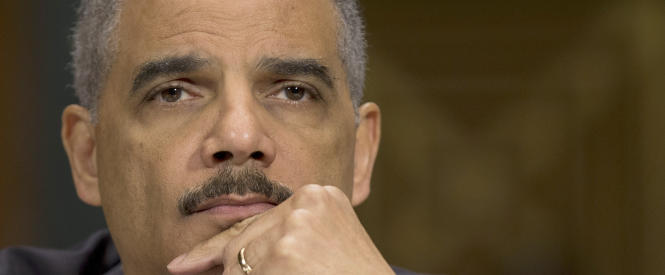
Holder: Big Banks’ Clout “Has an Inhibiting Impact” on Prosecutions | Frontline

Eric HolderAttorney General Eric Holder said that the Justice Department had considered the economic fallout that could result from prosecuting major banks for their role in the financial crisis, in Senate testimony on Tuesday.

Holder’s comments underscored remarks his deputy, Lanny Breuer, gave in an interview for FRONTLINE’s film The Untouchables that raised concerns among some in government that the Justice Department hasn’t been sufficiently aggressive in prosecuting major banks for the fiscal crisis.

“I am concerned that the size of some of these institutions becomes so large that it does become difficult to prosecute them,” Holder told the Senate Judiciary Committee. “When we are hit with indications that if you do prosecute, if you do bring a criminal charge it will have a negative impact on the national economy, perhaps world economy, that is a function of the fact that some of these institutions have become too large. It has an inhibiting impact on our ability to bring resolutions that I think would be more appropriate. That is something that you all need to consider.”

Holder added that he felt the department had been “appropriately aggressive,” in pursuing and bringing cases where it could prove companies or individuals had broken the law. “These are not easy cases to make,” he said. “Things were done wrong, but the question is whether they’re illegal.”

So far, no Wall Street executives have been prosecuted for fraud in connection with the financial crisis.

Breuer’s interview, which you can read in full here, sparked a Jan. 29 letter from Sens. Charles Grassley (R-Iowa) and Sherrod Brown (D-Ohio) asking for more information on how the Justice Department determined which cases to prosecute. It also asked for the names of any outside experts Justice consulted, and what they were paid.

The Justice Department responded (pdf) one month later, defending its record. But the senators said the letter was “aggressively evasive” and didn’t answer their questions.

On Tuesday, Holder told Grassley that the DOJ would “endeavor to answer” the senators’ letter.

Holder’s full testimony is embedded below. (The exchange on financial fraud prosecutions begins around the 2:17:22 mark.)

Source: Frontline

Ron Paul’s Farewell Address to Congress

Ron Paul: This may well be the last time I speak on the House Floor.  At the end of the year I’ll leave Congress after 23 years in office over a 36 year period.  My goals in 1976 were the same as they are today:  promote peace and prosperity by a strict adherence to the principles of individual liberty.

It was my opinion, that the course the U.S. embarked on in the latter part of the 20th Century would bring us a major financial crisis and engulf us in a foreign policy that would overextend us and undermine our national security.

To achieve the goals I sought, government would have had to shrink in size and scope, reduce spending, change the monetary system, and reject the unsustainable costs of policing the world and expanding the American Empire.

The problems seemed to be overwhelming and impossible to solve, yet from my view point, just following the constraints placed on the federal government by the Constitution would have been a good place to start.

How Much Did I Accomplish?

In many ways, according to conventional wisdom, my off-and-on career in Congress, from 1976 to 2012, accomplished very little.  No named legislation, no named federal buildings or highways—thank goodness.  In spite of my efforts, the government has grown exponentially, taxes remain excessive, and the prolific increase of incomprehensible regulations continues.  Wars are constant and pursued without Congressional declaration, deficits rise to the sky, poverty is rampant and dependency on the federal government is now worse than any time in our history.

All this with minimal concerns for the deficits and unfunded liabilities that common sense tells us cannot go on much longer.  A grand, but never mentioned, bipartisan agreement allows for the well-kept secret that keeps the spending going.  One side doesn’t give up one penny on military spending, the other side doesn’t give up one penny on welfare spending, while both sides support the bailouts and subsidies for the banking and  corporate elite.  And the spending continues as the economy weakens and the downward spiral continues.   As the government continues fiddling around, our liberties and our wealth burn in the flames of a foreign policy that makes us less safe.

The major stumbling block to real change in Washington is the total resistance to admitting that the country is broke. This has made compromising, just to agree to increase spending, inevitable since neither side has any intention of cutting spending.

The country and the Congress will remain divisive since there’s no “loot left to divvy up.”

Without this recognition the spenders in Washington will continue the march toward a fiscal cliff much bigger than the one anticipated this coming January.

I have thought a lot about why those of us who believe in liberty, as a solution, have done so poorly in convincing others of its benefits.  If liberty is what we claim it is- the principle that protects all personal, social and economic decisions necessary for maximum prosperity and the best chance for peace- it should be an easy sell.  Yet, history has shown that the masses have been quite receptive to the promises of authoritarians which are rarely if ever fulfilled. Read more…

Source: Ron Paul

GMOS. The Next Steps. Why We Won | Raw Spirit Community News

By Happy Oasis

Regarding the outcome of Proposition 37, Congratulations! How can I be offering “Congratulations” when it appears that Americans have not yet gained our right to know what we are eating? We got it on the ballot, did we not?! Moreover, we won the attention of the nation, which is huge. It is time for us to celebrate and rest for a moment to consider the big picture, to regroup and unite with more confidence than ever. Why was the opposition so great? Because we are a powerful force!

We Give Thanks to All who voted to protect our health or promoted voting for GMO labeling in CA, and especially to the many hard-working noble friends in California who put forth tireless effort to protect all of us from the pervasion of Frankensteinian GMOs.

The outcome of the election was not surprising to me. It is educational in that it more clearly reveals to those who did not comprehend how entrenched and pervasive are the reaches of this insidious force. To be effectual we need to clearly understand the extent of the strengths and weaknesses of the opposition. Californians have put forth a magnificent effort. We deeply acknowledge that effort. Honestly, are Californians opposed to knowing what they are eating? You know the answer.  Was there voter fraud, advertising fraud, ignorance, cohersion, threats, dirty deal-making or a combination of these? I think you know the answer.

This experiment will go down in history ~ if there is a history.  Let us remember that slavery was not overturned without many fights. Women were not given the right to vote overnight. Gandhi’s efforts took lives and time. For millenia, countless people have been jailed, imprisoned, robbed, tortured and killed for standing up for what is right. The imprisoned Mandela was freed, then voted into Presidency.

By all of us choosing to step up our combined efforts from this moment, GMOS will be labeled, then outright banned. Like some of you, who have shared with me, I too have been secretly subjected to death threats, character defamation, computer system failures, embezzlements and more due to standing up for what is true by those who do not wish for the power of eating an organic gmo-free raw vegan diet to be understood. This started happening back in 2008, Raw Spirit was about to start lobbying against GMOs in D.C. Meanwhile, I continue enjoying life to its fullest, remembering that the power of Love is the only real power and that Love eventually overcomes.

The Next Steps: This is a federal issue, (actually planetary) and requires lobbying against the most powerful force in Washington. Thank goodness for Californians who started the conversation. At the same time, what can we do? What about starting with banning GMOs from our own bodies, labeling ourselves, our cars, our homes, our streets, and our health-food stores as GMO-free? Remember bumper stickers? To do this requires educating ourselves and finding alternatives to any GMO-containing foods. Once this is achieved, we can label our villages and towns. We can ban GMOs from entering our neighborhoods and put up signs. History has shown that with any major issue, it takes time. We the people need to educate, think and approach this from myriad angles including those more grass roots than we have yet attempted. Are you willing to label yourself with a button saying,  “I’m GMO-free. Are You?” Plus, I trust that you will conjure up your own brilliant approaches.

Source: Raw Spirit Community News

President Obama’s acceptance speech (Full transcript) | The Washington Post

OBAMA: Thank you. Thank you. Thank you so much.

Tonight, more than 200 years after a former colony won the right to determine its own destiny, the task of perfecting our union moves forward.

OBAMA: It moves forward because of you. It moves forward because you reaffirmed the spirit that has triumphed over war and depression, the spirit that has lifted this country from the depths of despair to the great heights of hope, the belief that while each of us will pursue our own individual dreams, we are an American family and we rise or fall together as one nation and as one people.

Tonight, in this election, you, the American people, reminded us that while our road has been hard, while our journey has been long, we have picked ourselves up, we have fought our way back, and we know in our hearts that for the United States of America the best is yet to come. Read more…

Source: Washington Post

Click Image to View Video…

The Permanent Militarization of America | New York Times Opinion

By Aaron B. O’Connell

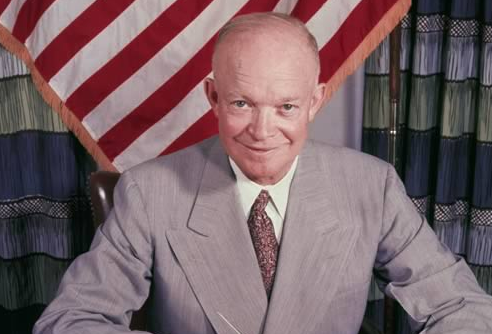
In 1961, President Dwight D. Eisenhower left office warning of the growing power of the military-industrial complex in American life. Most people know the term the president popularized, but few remember his argument.

In his farewell address, Eisenhower called for a better equilibrium between military and domestic affairs in our economy, politics and culture. He worried that the defense industry’s search for profits would warp foreign policy and, conversely, that too much state control of the private sector would cause economic stagnation. He warned that unending preparations for war were incongruous with the nation’s history. He cautioned that war and warmaking took up too large a proportion of national life, with grave ramifications for our spiritual health.

The military-industrial complex has not emerged in quite the way Eisenhower envisioned. The United States spends an enormous sum on defense — over $700 billion last year, about half of all military spending in the world — but in terms of our total economy, it has steadily declined to less than 5 percent of gross domestic product from 14 percent in 1953. Defense-related research has not produced an ossified garrison state; in fact, it has yielded a host of beneficial technologies, from the Internet to civilian nuclear power to GPS navigation. The United States has an enormous armaments industry, but it has not hampered employment and economic growth. In fact, Congress’s favorite argument against reducing defense spending is the job loss such cuts would entail.

Nor has the private sector infected foreign policy in the way that Eisenhower warned. Foreign policy has become increasingly reliant on military solutions since World War II, but we are a long way from the Marines’ repeated occupations of Haiti, Nicaragua and the Dominican Republic in the early 20th century, when commercial interests influenced military action. Of all the criticisms of the 2003 Iraq war, the idea that it was done to somehow magically decrease the cost of oil is the least credible. Though it’s true that mercenaries and contractors have exploited the wars of the past decade, hard decisions about the use of military force are made today much as they were in Eisenhower’s day: by the president, advised by the Joint Chiefs of Staff and the National Security Council, and then more or less rubber-stamped by Congress. Corporations do not get a vote, at least not yet.

But Eisenhower’s least heeded warning — concerning the spiritual effects of permanent preparations for war — is more important now than ever. Our culture has militarized considerably since Eisenhower’s era, and civilians, not the armed services, have been the principal cause. From lawmakers’ constant use of “support our troops” to justify defense spending, to TV programs and video games like “NCIS,” “Homeland” and “Call of Duty,” to NBC’s shameful and unreal reality show “Stars Earn Stripes,” Americans are subjected to a daily diet of stories that valorize the military while the storytellers pursue their own opportunistic political and commercial agendas. Of course, veterans should be thanked for serving their country, as should police officers, emergency workers and teachers. But no institution — particularly one financed by the taxpayers — should be immune from thoughtful criticism. Read more…

Source: New York Times Opinion

Pesticide Industry-Backed Opponents Prop 37: Caught Possible Criminal Act | Nation of Change

By Zach KaldVeer

The $36 million No on 37 campaign, bankrolled by $20 million from the world’s six largest pesticide companies, has been caught in yet another lie, this time possibly criminal.

These companies and their allies in the junk food industry know that their profit margins may suffer if consumers have a choice whether to purchase genetically engineered foods or not.  And that’s why opponents are spending nearly a million dollars per day trying to make Prop 37 complicated. But really it’s simple – we have the right to know what’s in our food.

To date, the No on 37 campaign has been able to repeat one lie after another with near impunity. But has this pattern of deceit finally caught up to it?

Yesterday, the Yes on 37 campaign sent letters to the U.S. Department of Justice requesting a criminal investigation of the No on 37 campaign for possible fraudulent misuse of the official seal of the U.S. Food and Drug Administration (FDA).

The No on 37 campaign affixed the FDA’s seal to one of the campaign’s mailers.Section 506 of the U.S. Criminal Code states: “Whoever…knowingly uses, affixes, or impresses any such fraudulently made, forged, counterfeited, mutilated, or altered seal or facsimile thereof to or upon any certificate, instrument, commission, document, or paper of any description…shall be fined under this title, or imprisoned not more than 5 years, or both.”

The letter also provides evidence that the No on 37 campaign falsely attributed a direct quote to the FDA in the campaign mailer. Alongside the FDA seal, the mailer includes this text in quotes. “The US Food and Drug Administration says a labeling policy like Prop 37 would be ‘inherently misleading.” The quote is entirely fabricated. The FDA did not make this statement and does not take a position on Prop 37. Read more…

Source: Nation of Change

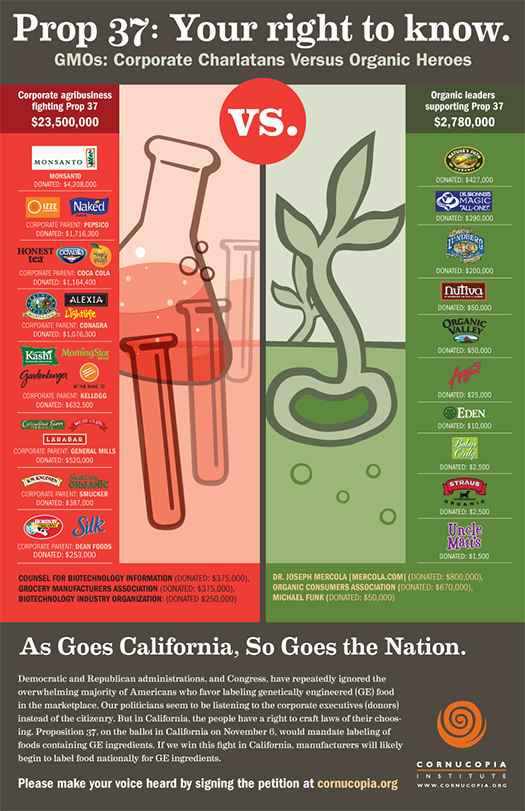
Many ‘Natural’ or “Organic’ Companies are Fighting Against the California Proposition for Labeling of GMO Foods

We were shocked to learn that many supposedly ‘natural’ or ‘organic’ companies, which have been bought out by big corporations, have joined Monsanto in giving huge donations to fight the California proposition for labeling of GMO foods. This includes popular brands like Odwalla, Naked, Gardenburger, Cascadian Farms Organic, Muir Glen, Knudsen, Santa Cruz Organic, Horizon Organic, Silk and more.

This document also gives the names of companies with more integrity that are donating to support Prop 37 for GMO labeling: Nature’s Path, Dr. Bronner’s, Lundberg, Nutiva, Organic Valley, Amy’s, Eden, Straus and others.

Since it feels important for us all to know where our food purchase dollars are going, I wanted to share this with you, in case you were not already aware of it.

Supreme Court Health Care Decision: Individual Mandate Survives | Huffington Post

Editor’s Note: This U.S. Supreme Court decision comes as yet another shocking departure from previous constitutional cases limiting federal authority in the states and over it’s respective Citizens. This wrong-headed, political decision expands even further the idea that the U.S. Congress and Executive Branch can decide for all Americans what they can and cannot do with their lives. I have lived healthy and free for over sixty years without health insurance, medicare, medicaid or any other insurance program. I for one will not be purchasing any health insurance under this government mandate. If this means I will no longer pay any federal taxes or file any returns to avoid the “penalties” the IRS will administer then so be it.

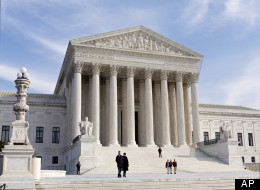
WASHINGTON – The individual health insurance mandate is constitutional, the Supreme Court ruled Thursday, upholding the central provision of President Barack Obama’s signature Affordable Care Act.

The controlling opinion, written by Chief Justice John Roberts, upheld the mandate as a tax, although concluded it was not valid as an exercise of Congress’ commerce clause power. Justices Ruth Bader Ginsburg, Stephen Breyer, Sonia Sotomayor and Elena Kagan joined in the outcome.

The decision in National Federation of Independent Business v. Sebelius comes as something of a surprise after the generally hostile reception the law received during the six hours of oral arguments held over three days in March. But by siding with the court’s four Democratic appointees, Chief Justice Roberts avoided the delegitimizing taint of politics that surrounds a party-line vote while passing Obamacare’s fate back to the elected branches. GOP candidates and incumbents will surely spend the rest of the 2012 campaign season running against the Supreme Court and for repeal of the law.

Five justices concluded that the mandate, which requires virtually all Americans to obtain minimum health insurance coverage or pay a penalty, falls within Congress’ power under the Constitution to “lay and collect taxes.”

“The individual mandate cannot be upheld as an exercise of Congress’s power under the Commerce Clause,” Roberts wrote. “That Clause authorizes Congress to regulate interstate commerce, not to order individuals to engage in it. In this case, however, it is reasonable to construe what Congress has done as increasing taxes on those who have a certain amount of income, but choose to go without health insurance. Such legislation is within Congress’s power to tax.”

Ginsburg, writing separately for the four liberals, said they would have upheld the mandate under the commerce clause too. “Unlike the market for almost any other product or service, the market for medical care is one in which all individuals inevitably participate,” she wrote. “Virtually every person residing in the United States, sooner or later, will visit a doctor or other health care professional.”

Justices Antonin Scalia, Anthony Kennedy, Clarence Thomas and Samuel Alito joined in a dissent. Together, Roberts’ controlling opinion, Ginsburg’s concurrence, the four-justice dissent and Thomas’ own dissent add up to 187 pages.

In a nod to the importance of the health care cases, Roberts, Ginsburg and Kennedy all chose to read summaries of their opinions from the bench.

In a section of his opinion joined by the liberal justices, Roberts noted that the conservative dissenters contend that the mandate cannot be upheld as a tax “because Congress did not ‘frame’ it as such. In effect, they contend that even if the Constitution permits Congress to do exactly what we interpret this statute to do, the law must be struck down because Congress used the wrong labels.”

But the majority was not persuaded by that argument. Roberts wrote that the mandate provision “need not be read to do more than impose a tax. That is sufficient to sustain it.”

On Medicaid expansion, the court upheld the expansion but with a critical caveat: The federal government may not threaten the states that don’t comply with the loss of their existing funding. Essentially, the Medicaid expansion is now optional for the states.

“As for the Medicaid expansion, that portion of the Affordable Care Act violates the Constitution by threatening existing Medicaid funding,” Roberts wrote. “Congress has no authority to order the States to regulate according to its instructions. Congress may offer the States grants and require the States to comply with accompanying conditions, but the States must have a genuine choice whether to accept the offer. The States are given no such choice in this case: They must either accept a basic change in the nature of Medicaid, or risk losing all Medicaid funding. The remedy for that constitutional violation is to preclude the Federal Government from imposing such a sanction.”

For their part, the dissenters were not impressed with Roberts’ parsing of the law. “The Court regards its strained statutory interpretation as judicial modesty. It is not. It amounts instead to a vast judicial overreaching,” wrote the four other conservatives.

They then looked to the political future: The majority’s decision, they argued, “creates a debilitated, inoperable version of health-care regulation that Congress did not enact and the public does not expect. It makes enactment of sensible health-care regulation more difficult, since Congress cannot start afresh but must take as its point of departure a jumble of now senseless provisions, provisions that certain interests favored under the Court’s new design will struggle to retain. And it leaves the public and the States to expend vast sums of money on requirements that may or may not survive the necessary congressional revision.”

Summarizing his delicate decision from the bench, Roberts reminded his listeners that it is “not our job to save the people from the consequences of their political choices.” Still, the decision appeared to do just that.

By narrowing Congress’ commerce and spending powers, Roberts moved the law in a decidedly conservative direction. Yet by invoking the taxing power, he saved not only the people but also Congress, the president and the Supreme Court itself from the consequences of their political choices that had seemed so evident at oral argument three months ago.

Careful legal parsing aside, the bottom line is: The Affordable Care Act has survived.

Source: Huffington Post