Source: YouTube

Source: YouTube
 Editor’s Note: We love Marianne for her fresh and insightful views originating from as an outsider to mainstream politics. In her appearance in the Democratic candidates debate she pointed out quite astutely that true health care cannot be achieved with the current system in place (whether it’s Obamacare or Medicare for All). The health care system is completely broken and must be rebuilt from the bottom up beginning with prevention and wellness. Thanks for contributing to this most important conversation and acknowledging the important of intelligent debate and civil discourse.
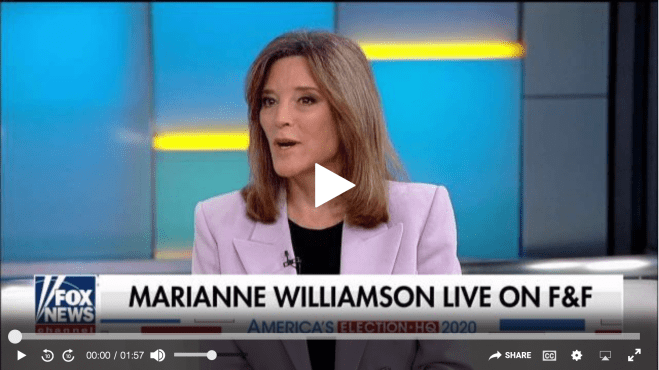
Marianne Williamson, a 2020 presidential hopeful and author, said she’s discovered the political system to be “even more corrupt” than she imagined, during a Tuesday interview with “Fox & Friends.”
“I was known in a world where people loved you and bought things from you. Now I’m in a world where a lot of people hate you,” she said. “I would say that I feel that I’ve learned the system is even more corrupt than I knew and people are even more wonderful than I hoped.”
Williamson also said there is a tendency in politics today to stifle opposing opinions, which weakens democracy and limits genuine debate.
“I have seen on the left as on the right, there are too many people who do not recognize how important honorable debate is in a democracy,” she said.
“You can disagree with somebody’s opinion but that doesn’t mean you should be shutting them down or lying about them or misrepresenting their views. That’s not a left-right issue. There’s a rough-and-tumble in politics.”
Co-host Lisa Boothe asked Williamson if she felt abandoned by the Democratic Party because she didn’t qualify for the upcoming debate, and she said that even if she did, she wouldn’t air her private grievances.
“No, I don’t feel abandoned,” she replied. “I’m a passionate Democrat… My mother always said if you have a problem with your family don’t talk about it outside the family. I’m not going to come on Fox and bad-mouth. The DNC has its rules and, listen, I signed up for this. And I’m playing by those rules”
Source: Fox News
 Editor’s Note: As a sovereignty educator for over twenty years I taught millions of people about the Federal Reserve, how it was created, the nature of money, banking, etc., and how this forever altered our constitutional Republic. That anybody in the Senate, except Former Congressmen Ron Paul and President Trump, is talking about Federal Reserve independence is good news for the Republic.
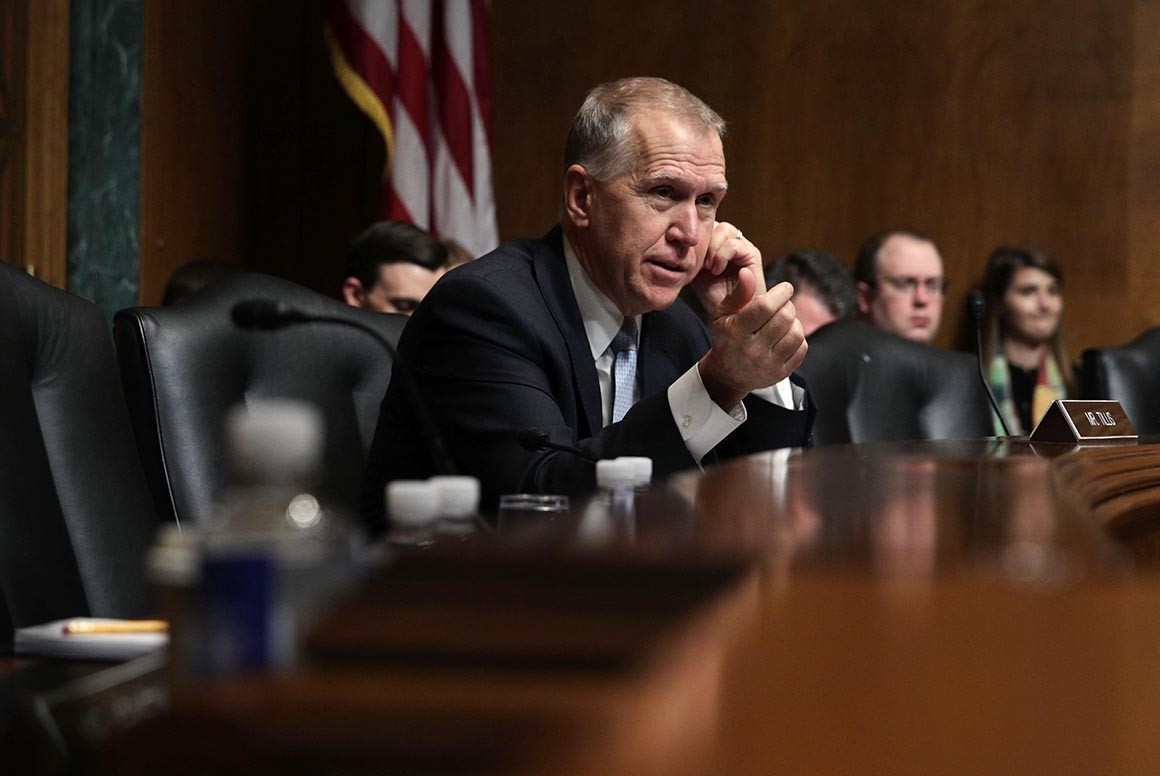
Republican Sen. Thom Tillis is calling for the Senate Banking Committee to probe the Federal Reserve’s independence after a former agency official suggested the upcoming presidential election “falls within the Fed’s purview” as it considers whether to cut interest rates.
Tillis, who is up for reelection next fall in swing state North Carolina, is siding with President Donald Trump in his ongoing feud with Federal Reserve Chairman Jay Powell. Bill Dudley, a former president of the Federal Reserve Bank of New York, wrote in a Bloomberg op-ed that the Fed should consider refusing to offer new economic stimuli because doing so could encourage Trump to plunge further into a trade war with China and would “reassert the Fed’s independence by distancing it from the administration’s policies.”
Tillis said he plans to ask the Banking Committee’s chairman, Sen. Mike Crapo (R-Idaho), about convening a hearing “regarding Fed independence and the danger of this institution taking unprecedented and inappropriate steps to meddle in the presidential election.”
“I am very disappointed that former Fed monetary Vice Chairman Bill Dudley is lobbying the Fed to use its authority as a political weapon against President Trump,” Tillis said in a statement. “The President is standing up for America against China after 30 years of our country and our workers being ripped off and there is now an effort to get the Fed to try to sabotage the President’s efforts.”
Senate Republicans generally stay out of Federal Reserve politics, but Tillis is aligning himself closely with Trump as he faces a primary challenge and a potentially difficult general election. The first-term senator previously supported a bill protecting special counsels, including Robert Mueller, and initially opposed Trump’s declaration of a national emergency on the southern border. He later supported it and has generally not deviated from Trump since.
The president has berated Powell, whom he appointed, for declining to further slash interest rates.
“The only problem we have is Jay Powell and the Fed,” Trump tweeted last week. “He’s like a golfer who can’t putt, has no touch. Big U.S. growth if he does the right thing, BIG CUT — but don’t count on him! So far he has called it wrong, and only let us down.”
The repeated attacks motivated Dudley to wade into the dispute and implore Powell to consider standing firm. He argued that the Federal Reserve’s desire to stay out of politics was admirable “but Trump’s ongoing attacks on Powell and on the institution have made that untenable.”
“Central bank officials face a choice: enable the Trump administration to continue down a disastrous path of trade war escalation, or send a clear signal that if the administration does so, the president, not the Fed, will bear the risks — including the risk of losing the next election,” Dudley wrote. “Trump’s reelection arguably presents a threat to the U.S. and global economy, to the Fed’s independence and its ability to achieve its employment and inflation objectives.”
Source: Politico
Editor’s Note: Enough talk from the Democrats about identifying with the working class. Every one of these candidates are multi-millionaires, part of the 1% they so enthusiastically despise. So Bernie and Elizabeth, you might want to change your narrative and get real. Running for office and getting elected makes you pretty darn rich (especially with all those special congressional benefits).
By Dan Alexander, Chase Peterson-Withorn and Michela Tindera
Everyone knows Donald Trump is rich. But how about the 25 people jockeying to replace him as president? Forbes dug into the details—examining financial disclosure statements, scouring local real estate records and calculating pension benefits—to figure out the finances of the 2020 candidates.
There were some surprises. Bernie is a millionaire. So is “middle-class Joe” Biden. Elizabeth Warren is richer than both of them, worth an estimated $12 million. But she’s a long way from John Delaney, whose $200 million fortune makes him twice as wealthy as every other Democratic candidate not named Tom Steyer. The hedge fund tycoon, who announced his candidacy in July 2019, is worth an estimated $1.6 billion.
Aside from Trump and Steyer, the average net worth is $12.9 million—the same as it was for the 2016 contenders. The median net worth is $2 million. The poorest is Pete Buttigieg, who has an estimated $100,000—or about 0.003% of Trump’s fortune.
We reached out to all of the candidates. No one, not even the Democrats who spend the most time bashing Trump for his financial dealings, answered every question. So we ranked the entire field on transparency, assigning scores ranging from 0 (lips sealed) to 5 (full disclosure). In the end, we uncovered the money, regardless of whether the candidates wanted it out in the open.


 Editor’s Note: Take note that continued federal deficit spending will land the United States corporation in an irreversible bankruptcy before 2029 when It would bring total debt to about 97 percent of Gross Domestic Product (GDP). That means the US would owe the Federal Reserve almost 100% of the GDP for the entire year (plus interest).
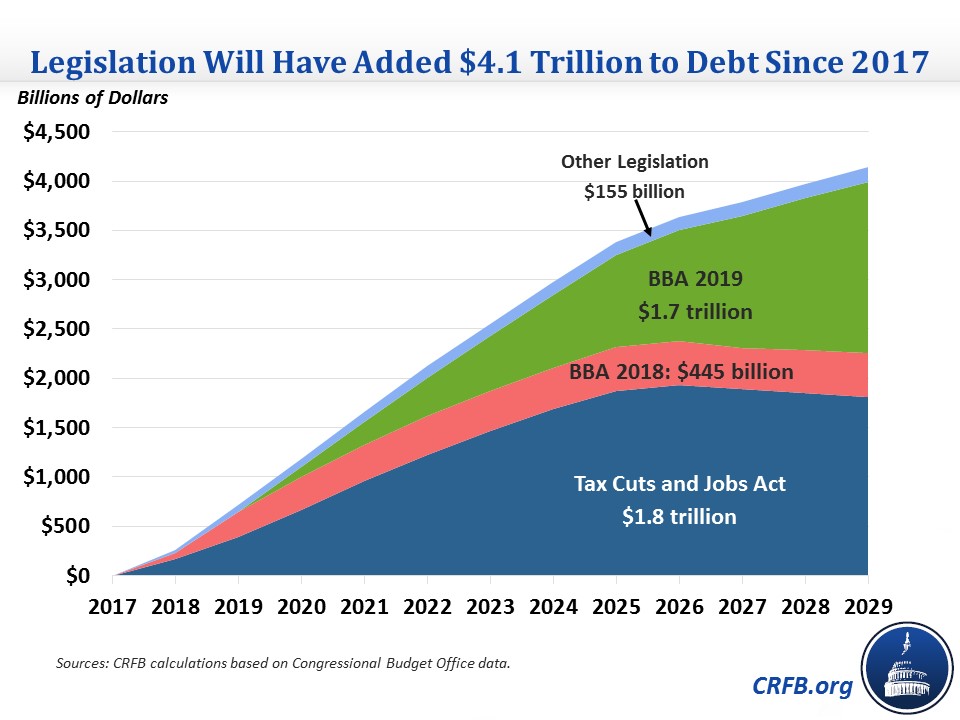
If the recent budget deal is signed into law, it will be the third major piece of deficit-financed legislation in President Trump’s term. In total, we estimate legislation signed by the President will have added $4.1 trillion to the debt between 2017 and 2029. Over a traditional ten-year budget window, the President will have added $3.4 to $3.8 trillion to the debt. The source of the debt expansion is split relatively evenly between tax and spending policy.
The Tax Cuts and Jobs Act (TCJA) was the single largest contributor to the $4.1 trillion figure, increasing debt by $1.8 trillion through 2029 (more than the entire cost is through 2027). This number could easily climb higher if lawmakers extend the individual tax cuts that are set to expire after 2025, which would add another $1 trillion to the debt.
The Bipartisan Budget Act (BBA) of 2018 was nearly as costly on an annual basis, adding nearly $450 billion to the debt due to its two-year nature. However, the Bipartisan Budget Act of 2019 would effectively make the increases in the BBA 2018 permanent, and in doing so, add another $1.7 trillion to the debt through 2029.
Smaller pieces of legislation are responsible for nearly $150 billion of debt. This includes several different bills containing disaster relief or emergency spending and continued delays of three Affordable Care Act (ACA) taxes, among other bills.
This analysis does not include the fiscal impact of many executive actions taken by the President, some which would increase deficits and others which would reduce them. It also assumes that temporary policies expire as scheduled.
If we evaluate the debt added over the standard ten-year window the Congressional Budget Office (CBO) uses, the numbers are similar but slightly smaller. Using the ten-year period (2018-2027) employed in 2017, lawmakers have added $3.8 trillion to deficits. Using the current ten-year period of 2020-2029, the debt increase is $3.4 trillion. Debt added is lower in the later period because some of the laws, like the TCJA and 2018 BBA, had larger short-term, rather than long-term, costs.
| Legislation | 2018-2027 Cost | 2020-2029 Cost | 2017-2029 Cost |
|---|---|---|---|
| Tax Cuts and Jobs Act | $1.9 trillion | $1.4 trillion | $1.8 trillion |
| Bipartisan Budget Act of 2019 | $1.3 trillion | $1.7 trillion | $1.7 trillion |
| Bipartisan Budget Act of 2018 | $420 billion | $190 billion | $445 billion |
| Other Legislation | $140 billion | $90 billion | $155 billion |
| Total | $3.8 trillion | $3.4 trillion | $4.1 trillion |
Source: CRFB calculations based on Congressional Budget Office data.
Importantly, the $4.1 trillion of debt signed into law by President Trump is on top of the $16.2 trillion we already owe and the $9.8 trillion we were projected to borrow over the next decade absent these proposals. It would bring debt to about 97 percent of Gross Domestic Product (GDP) in 2029, compared to 84 percent if no debt-increasing legislation had been passed.
To avoid the huge run-up in debt that is projected in the coming decades, lawmakers should reject unpaid-for spending increases, pay for the tax bill, and address the rising costs and looming insolvency of our nation’s largest health and retirement programs.
 Editor’s Note: The first wing of the impeachment inquiry against Donald Trump was related to his alleged violations of the emoluments clause of the U.S. Constitution. Looks like the 4th Circuit handed Trump a victory with respect to the Democrats allegations.
A federal appeals court Wednesday sided with President Trump, dismissing a lawsuit claiming the president is illegally profiting from foreign and state government visitors at his luxury hotel in downtown Washington.
The unanimous ruling from the U.S. Court of Appeals for the 4th Circuit is a victory for the president in a novel case brought by the attorneys general of Maryland and the District of Columbia involving anti-corruption provisions in the emoluments clauses of the U.S. Constitution.
In its ruling, the three-judge panel said the attorneys general lacked legal grounds to bring the lawsuit alleging the president is violating the Constitution when his business accepts payments from state and foreign governments. The decision — from Judges Paul V. Niemeyer, Dennis W. Shedd and A. Marvin Quattlebaum Jr. — also stops dozens of subpoenas to federal government agencies and Trump’s private business entities demanding financial records related to the D.C. hotel.
“The District and Maryland’s interest in enforcing the Emoluments Clauses is so attenuated and abstract that their prosecution of this case readily provokes the question of whether this action against the President is an appropriate use of the courts, which were created to resolve real cases and controversies between the parties,” Niemeyer wrote in the 36-page opinion.
President Trump quickly took to Twitter to celebrate the ruling, referring to the lawsuit as “ridiculous” and “a big part of the Deep State and Democrat induced Witch Hunt.”
“I don’t make money, but lose a fortune for the honor of serving and doing a great job as your President (including accepting Zero salary!),” he wrote.
The president has stepped back from day-to-day management of the Trump International Hoteland his other businesses, but he maintains ownership.
Maryland Attorney General Brian E. Frosh and D.C. Attorney General Karl A. Racine, both Democrats, said in a joint statement after the ruling that the three-judge panel “got it wrong.”
“Although the court described a litany of ways in which this case is unique, it failed to acknowledge the most extraordinary circumstance of all: President Trump is brazenly profiting from the Office of the President in ways that no other President in history ever imagined and that the founders expressly sought — in the Constitution — to prohibit,” they said.
“We will continue to pursue our legal options to hold him accountable.”
The three judges on the panel that heard oral argument in March were nominated to the bench by Republican presidents — Niemeyer by President George H.W. Bush, Shedd by President George W. Bush and Quattlebaum by Trump. Frosh and Racine have said they would consider appealing for a rehearing by a full panel of the 4th Circuit and would not be surprised to see the case reach the Supreme Court.
The president faces multiple legal challenges related to his private business. A federal appeals court in Washington is considering a separate “emoluments” lawsuit brought by congressional Democrats, who this week began issuing dozens of subpoenas for financial records from the president’s private entities.
The case extends beyond the D.C. hotel and is based on a different theory of standing. The Democratic lawmakers say the president is violating the Constitution because it gives Congress the right to approve — or withhold — consent before the president accepts payments or benefits from foreign governments.
Despite the legal challenges his company faces, to this point Trump has been able to prevent the release of any private business information to the courts, leaving Democrats to wonder whether he will be affected by any of the inquiries before he faces reelection next year.
At the 4th Circuit, Trump’s attorneys were appealing a ruling from a District Court judge in Maryland who allowed the case to move forward and adopted a broad definition of the emoluments ban to include “profit, gain, or advantage” received “directly or indirectly” from foreign, federal or state governments.
[Saudi-funded lobbyist paid for 500 rooms at Trump’s hotel after 2016 election]
The Richmond-based 4th Circuit, which reviews cases from Maryland, Virginia, West Virginia and the Carolinas, was specifically reviewing whether Maryland and the District of Columbia had legal grounds, or standing, to sue the president in the first place.
At least a half-dozen countries have booked large blocks of rooms or meeting space at Trump’s D.C. hotel, among them Saudi Arabia, Kuwait, Malaysia and the Republic of Georgia. Three years in a row, the Kuwaiti government held its National Day celebration there, and the plaintiffs allege that the 2017 event alone cost between $40,000 and $60,000.
The plaintiffs argued that these payments are violations of the foreign emoluments clause, while the Justice Department calls them market-rate deals that should not be considered emoluments.
The hotel occupies the Old Post Office Pavilion, a federal building leased to Trump’s business, in an arrangement that plaintiffs argue violates the domestic emoluments clause. The lease was signed before Trump entered office and stipulates that “no . . . elected official of the Government of the United States” shall benefit from the deal.
The General Services Administration, under Trump, ruled that the deal was in compliance.
The court’s ruling, however, centered on whether the plaintiffs had standing to bring their case against the president — not the merits of whether Trump is violating the Constitution with his business dealings. The 4th Circuit issued two rulings Wednesday — one dismissing the case against the president in his official capacity and the other in his individual capacity.
U.S. District Judge Peter J. Messitte had granted Maryland and the District of Columbia standing in part because Trump’s D.C. hotel could be taking foreign government business from convention centers and hotels in their jurisdictions as foreign leaders may be incentivized to spend money at the president’s property.
But the appeals court disagreed, writing that the attorneys general had failed to show that Trump’s conduct had harmed the financial interests of Maryland and the District and that intervening, by forcing the president to forgo his ownership, for instance, would make a difference.
“There is a distinct possibility — which was completely ignored by the District and Maryland, as well as by the district court — that certain government officials might avoid patronizing the Hotel because of the President’s association with it,” the court said.
“Even if government officials were patronizing the Hotel to curry the President’s favor, there is no reason to conclude that they would cease doing so were the President enjoined from receiving income from the Hotel. After all, the Hotel would still be publicly associated with the President, would still bear his name, and would still financially benefit members of his family.”
Source: The Washington Post
Source: The White House
Source: Judicial Watch/YouTube
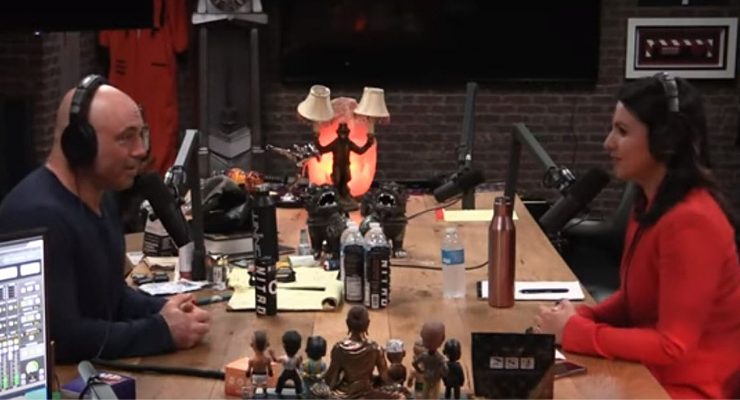 Editor’s Note: An interesting discussion of whether to reward or punish whistleblowers such as Snowden or Assange. Gabbard suggests that we encourage truth telling by insiders. I agree with her.
In midst of an interesting and wide-ranging discussion on the Joe Rogan Experience, Democratic congresswoman and presidential candidate Tulsi Gabbard said that if elected president she would drop all charges against NSA whistleblower Edward Snowden and WikiLeaks founder Julian Assange.
“What would you do about Julian Assange? What would you do about Edward Snowden?” Rogan asked in the latter part of the episode.
“As far as dropping the charges?” Gabbard asked.
“If you’re president of the world right now, what do you do?”
“Yeah, dropping the charges,” Gabbard replied.
Rogan noted that Sweden’s preliminary investigation of rape allegations has just been re-opened, saying the US government can’t stop that, and Gabbard said as president she’d drop the US charges leveled against Assange by the Trump administration.
“Yeah,” Gabbard said when asked to clarify if she was also saying that she’d give Edward Snowden a presidential pardon, adding, “And I think we’ve got to address why he did things the way that he did them. And you hear the same thing from Chelsea Manning, how there is not an actual channel for whistleblowers like them to bring forward information that exposes egregious abuses of our constitutional rights and liberties. Period. There was not a channel for that to happen in a real way, and that’s why they ended up taking the path that they did, and suffering the consequences.”
This came at the end of a lengthy discussion about WikiLeaks and the dangerous legal precedent that the Trump administration is setting for press freedoms by prosecuting Assange, as well as the revelations about NSA surveillance and what can be done to roll back those unchecked surveillance powers.
“What happened with [Assange’s] arrest and all the stuff that just went down I think poses a great threat to our freedom of the press and to our freedom of speech,” Gabbard said. “We look at what happened under the previous administration, under Obama. You know, they were trying to find ways to go after Assange and WikiLeaks, but ultimately they chose not to seek to extradite him or charge him, because they recognized what a slippery slope that begins when you have a government in a position to levy criminal charges and consequences against someone who’s publishing information or saying things that the government doesn’t want you to say, and sharing information the government doesn’t want you to share.
And so the fact that the Trump administration has chosen to ignore that fact, to ignore how important it is that we uphold our freedoms, freedom of the press and freedom of speech, and go after him, it has a very chilling effect on both journalists and publishers. And you can look to those in traditional media and also those in new media, and also every one of us as Americans. It was a kind of a warning call, saying Look what happened to this guy. It could happen to you. It could happen to any one of us.”
Gabbard discussed Mike Pompeo’s arbitrary designation of WikiLeaks as a hostile non-state intelligence service, the fact that James Clapper lied to Congress about NSA surveillance as Director of National Intelligence yet suffered no consequences and remains a respected TV pundit, and the opaque and unaccountable nature of FISA warrants.
Some other noteworthy parts of Gabbard’s JRE appearance for people who don’t have time to watch the whole thing, with hyperlinks to the times in the video:
I honestly think the entire American political system would be better off if the phoney debate stage format were completely abandoned and presidential candidates just talked one-on-one with Joe Rogan for two and a half hours instead. Cut through all the vapid posturing and the fake questions about nonsense nobody cares about and get them to go deep with a normal human being who smokes pot and curses and does sports commentary for cage fighting. Rogan asked Gabbard a bunch of questions that real people are interested in, in a format where she was encouraged to relax out of her standard politician’s posture and discuss significant ideas sincerely and spontaneously. It was a good discussion with an interesting political figure and I’m glad it’s already racked up hundreds of thousands of views.
Source: The Mind Unleashed
 “Every vote should count.” To many that sounds fair. It sounds right. But is it? “The Electoral College is wrong. The person who gets the most votes should be president.” Does that sound right to you?
The answer varies but falls under one fundamental belief: Do you believe America to be a democracy or a republic.
From that divide, you will understand the main difference between what conservatives are trying to preserve and what liberals are trying to fundamentally transform.
During the 2000 Presidential Election, many in the media and the left believed that Al Gore would win the Electoral College and Bush would in the popular vote. This was the last time the media and the Left staunchly defended the Electoral College while lying the groundwork for the very assault on it. It was after this election that I started studying what the Electoral College is and its importance.
So what is the Electoral College? Each state is afforded a certain number of votes, the amount of senators (2) combined with the amount of representatives in the house (which varies according to population). This makes the minimum amount of votes a state gives as three. These votes are determined by the popular vote each state making the winner the President of the United States.
The emphasis on States is important. Each state in America has different needs and desires. Each state under the Electoral College gets to choose which candidate they want as president by majority vote. (That’s the democracy in the republic you hear about.) The candidate that gets the most votes (270 at this time) from these states wins the Presidency. Under this system, each state matters and therefore the people of each individual state are important.
Under a popular vote, the one with the most votes wins. It’s simpler and therefore easier to circumvent most people. That means cheating is easier. Also ignoring large sects of this country also becomes expedient.
Elections are expensive. Under the popular vote, the middle is ignored because all a candidate need win is the big cities of the east and west coast. The Midwest, the Southwest, and parts of the South will no longer matter because their votes won’t win elections. Look at the state of New York. NYC rules the state, and the Democrat Party rules NYC with an iron fist.
Under a popular, every vote counts. That sounds great, but not every vote should count. “Every four years, the dead rise and vote democrat in Chicago,” the old joke says. The truth is sadder; in that, in many big cities, the dead vote. Add to that the millions of illegal aliens that vote. Then add to that those who vote more than once. Then add to that all those miraculous ballots that appear in bags which were handily put to the side in case needed to overturn an election barely won by a Republican which was how Al Franken won his seat in the Senate and many Republicans lost elections in 2018 they won on election night. Every vote counts. In the past election, some counties had more people vote in them than actually lived there by the thousands. Obviously, they all voted Democrats.
Once you put all those numbers together, it’s easy to see popular votes are easily doctored, and elections can easily be stolen. This is especially true because of an outwardly bias media who is out to cover for those on their side of the political aisle and dreg up the basest stories from the most unreliable sources to bury their competition. Many are willing to accept this because they want their candidate to win no matter what the cost. But what happens, when it’s someone they don’t like? At that point it doesn’t matter, because the republic is dead, and the government class rules us all without any checks or balances.
Ignorance is the greatest ally to the enemies of our Constitution. The reason so many are in favor of abolishing the Electoral College is that we have and Education system controlled by the Left who purposely keep their students from learning the importance of America’s greatness and what is needed to keep her free. Our institutes of educations have become indoctrination center of leftist ideology (socialism, humanism, atheism, etc.). Generations of children have become adults with no real understanding of our Constitution, and its greatness.
The Constitution is under siege. The States lost the battle for the Senate. Now the states may lose the battle of the Electoral College. We lose this and we lose the right to choose our leaders. The Republic needs you and me to educate the ignorant and show them why our founders were all against Democracies and why they chose a Republic instead.
Source: Metro Voice News
 Liberty International News