World Health Organization Blocked Medical Experts From Recommending Travel Bans | Trending Politics & Breitbart News

5e973108d8504large_NXEpnLnVyqgX2eQXfHKXy-3HbJWztb7TzgnTC7e0bwsBy Collin Rugg

According to a bombshell new report, the World Health Organization (WHO) blocked medical experts from recommending travel bans to help stop the spread of the Coronavirus during the early days of the pandemic.

“A report by Australia’s Sky News revealed that on January 30, WHO bureaucrats met with a group of doctors and medical experts to discuss a response to the coronavirus, which at the time was spreading from Wuhan, China, to nations like the United States, Italy, Iran, and South Korea,” Breitbart reports. “The report is based on the meeting’s official records.”Medical experts were intent on implementing travel bans however they were talked out of it by WHO bureaucrats during a meeting in Geneva, Switzerland. The bans would have most likely saved thousands of lives.

Check out what Sky News digital editor Jack Houghton had to say:

[WHO] actually decided not to go ahead with [travel ban recommendations] and not declare a global health emergency but there were a few dissenting voices. So the official meeting records say there was a divergence of views but they won’t actually go into detail about who was trying to block it. But there were doctors there who wanted to issue travel bans and the World Health Organization blocked it.

Breitbart continues:

In early and late February, while thousands of coronavirus cases were confirmed across the world, WHO bureaucrats continuously urged nations not to impose travel bans.

“WHO continues to advise against the application of travel or trade restrictions to countries experiencing COVID-19 outbreaks,” an official WHO statement from February 29 reads.

Despite WHO bureaucrats stopping the experts from recommending travel bans to nations looking to keep the coronavirus from spreading, President Trump moved forward with travel bans on China and Iran within weeks of the first confirmed case in the U.S.

About a month later, Trump issued a travel ban on Europe after the nation’s leading medical experts said the coronavirus was primarily being spread due to European travel. Specifically, National Institute of Allergy and Infectious Diseases Director Dr. Anthony Fauci said the travel bans were critical to fighting the coronavirus.

“I believe we would be in a worse position,” Fauci told congressional lawmakers on March 11 when asked what position the U.S. would have been in if not for Trump’s travel bans.

A study by experts at Mount Sinai states that New York City’s record-high coronavirus cases and deaths are “predominately” due to travel from Europe.

As Breitbart News reported, Australia implemented similar life-saving immigration restrictions despite the opposition of WHO bureaucrats. Australia moved relatively quickly to ban travel from China regardless of WHO Director-General Tedros Adhanom Ghebreyesu claiming such bans would “unnecessarily interfere with international travel and trade.”

Source: Trending Politics & Breitbart News

Tucker Carlson: The New Way Forward Act | YouTube

Sponsored by 44 House Democrats insuring that criminals can move to the USA with impunity at U.S. taxpayer expense. This is the most horrendous piece of legislation ever proposed by the radical left/liberal cabal in the House of Representatives. This is  treason and should be reckoned with. None or these sponsors have any business staying in the U.S. Congress for one more term. 

Source: YouTube

Impeachment Professors: Welcome to My World | American Crossroads

Editor’s Note: Take special note of the fourth academic Professor Jonathan Turley who cared to differ with his colleagues regarding impeachment and the grounds thereof. As a result he may suffer the consequences of stepping “out of line” from the other hard core socialist academia who testified before the House Judiciary Committee.

Commentary by Mary Grabar

Welcome to my world all you people appalled by the testimony of professors presenting Constitutional grounds for impeaching President Donald Trump.

Are you disgusted by the display of feminist rage, graduate student earnestness, and droning about the “framers” by tenured elites who have built careers presenting the Constitution as a “living document”?

Ha! Welcome to my world where I spent 20 years until 2013 studying and teaching college English.

I would still be in that world, having to listen to morning-after faculty lounge debates about the relative merits of these three scholars, were it not for the fact that a department chair, and then a college president, did not like op-eds I wrote, because the First Amendment applied only to people with their views. Then the privately funded program under which I was teaching at Emory University ended.

It’s not that I could get beyond the low-paying year-to-year contracts. My thesis and dissertation focused on dead white male cis-gendered (with no “homosexual,” or even “homo-social” tendencies) Christian writers. So I never had a chance.

During my years of struggle, I would try to convey what it was like to those on the outside—family members, friends, and people I met. I described the witchy cackling at meetings, screams about oppression from lecterns, inquisitorial stares from colleagues passing by in hallways, and examples of “scholarship”—like the poster with the giant phallus (and more that I can’t describe in this forum) adorning the office door of the head of “Sexuality Studies,” which was within the English department at Emory. Every day I trudged past that looming phallus, above the poster of Shakespeare in drag advertising a “Shakesqueer” conference.

Oh, that’s just those crazy English professors, said people in the business world and in the sciences. They looked at me slant-eyed after I stammered, “but, but … the giant phallus, and …”

Today, the standards of academe have infiltrated the business world. My former skeptics on the political right no longer post political comments on Facebook. Techies such as James Damore and CEOs are fired for their words and actions that have nothing to do with their job performance. Math and science professors are required to sign statements pledging allegiance to diversity, which means admitting less-qualified women and minorities. They’re required to believe their magical diverse powers will ensure that bridges do not collapse and patients, with their skulls cut open on the operating table, do not die. They must embrace Afrocentric math, “women’s ways of knowing” anatomy, and the path-breaking theory of Lysenkoism.

My world was the faculty lounge (the office with broken-down furniture where several instructors at one time held “office hours”). It’s a world where even such poorly paid hacks thought they were better, smarter, and holier than the majority of Americans and 100 percent of Republicans.

These people need not even look at evidence or consider scholarly shoddiness because they know that if it comes from the wrong source, it is wrong, as an Amazon review respondent who agreed with commentator “Prof. JayG” that I had not cited “any evidence” in my book “Debunking Howard Zinn,” affirmed. My book is simply “right-wing trash.” No doubt, philosophy professor David Detmer still believes I suffer from “Zinnophobia.”

Such “profs” do not need to read entire books and review footnotes because of their superior abilities to “deconstruct” texts. The deconstructionist theorists I had to read in graduate school saw the real meaning of an author’s words. While mere mortals may attach the signifier (the word) to the signified (the thing or concept), the deconstructionists could see beyond. They used this ability to also discern the motives of outsiders: white people, heterosexuals, men, Republicans—and those inside and outside these groups (excluding Republicans) who did not adhere to their ever-evolving standards of what today is called “wokeness.”

These people, unlike mortals, do not need facts. This was true about Donald Trump’s election. They knew there was cause to impeach him immediately after the election, and they said so to their students. I saw this here in Clinton, New York. Mere days after the election, professors chaperoned students from Hamilton College on the “hill” to the village square, where they marched and yelled “Impeach!” before they got on the luxury buses for the mile-and-a-half ride back to campus.

This ability to see beyond evidence has been honed for a long time. Back when a few middle-class Americans dared to form a “tea party” movement to protest with speeches, bunting, and prayer against the newly elected “global citizen” President Barack Obama’s agenda of “transforming” this country, the Ph.D.s and other super-intellects discerned that this was not really the desire of law-abiding, hard-working Americans to prevent their country from turning into Cuba. They knew, just knew, that this was racism.

So were the questions about Obama’s longtime “god-damning America” pastor, Weatherman friend Bill Ayers, brobuddy Hugo Chavez, and Communist Party USA mentor Frank Marshall Davis. Obama’s fundraising party comments about “bitter” Bible- and gun-toting Americans were simple truth. His declaration of being able to rule with his pen and phone was not any threat to the Constitutional separation of powers at all. The Obama Youth Brigade Formation’s chants of “because of Obama I’m inspired to be the next” architect, engineer, lawyer, etc., repeating points of Obama’s platform, and shouts of “Yes, we can!” were signs of rejuvenated youthful optimism.

Whereas professors had proudly sported bumper stickers proclaiming “Somewhere in Texas a village has lost its idiot” during the George W. Bush administration, they recognized Obama’s words as poetic genius.

Michelle Obama, a broad-shouldered statuesque woman was treated like the most beautiful and fashionable woman in the world—even when she dressed up like a giant banana. But a supermodel married to a Republican can have no fashion sense. Melania Trump’s white coat in a Christmas video among white-themed Christmas decorations, “exude[d] cold, dismissive aloofness”—so unlike the Santa Clausy Mao Christmas tree decorations in the Obama White House!

The fact that such reactionary outlets such as Fox News reported this as if there was something wrong with having the author of the famous Little Red Book on the tree alongside a drag queen and Obama etched into Mount Rushmore proves how close-minded they are. They’re incapable of seeing the brilliance of a theory developed by the natural genius Karl Marx whose social justice work was supported by the wealthy industrialist Friedrich Engels. (And isn’t it nice that George Soros and other billionaires support similar scholarship these days?)

Marx understood history so well because he had deconstructed it and could see the patterns. Therefore, he was able to predict the future. And he could tell what would usher in a paradise.

When everyday people, like peasants, or reporters doing reporting instead of going to the Kremlin’s fancy parties, presented counter-evidence (in the case of peasants by dropping dead from starvation), the professors shot back. They accused the few reporters jotting down the numbers of beggars and dead bodies (like William Henry Chamberlin and Eugene Lyons) of being reactionaries. They accused the peasants of bringing on their own starvation by not working enthusiastically enough on the collective farms the government had so generously provided them.

Even after Kruschev had denounced Stalin for errors, the professors did not lose faith. They knew socialism could work—if only the “right” people were in charge.

The professors in the 1960s kept teaching about the superiority of socialism, hoping as Bill Ayers and company did, that through the reeducation of their charges they would usher in and rule over a socialistic utopia. And even though the Vietnamese fled North Vietnam, the people there really wanted a communist government. These thinkers knew that Ho Chi Minh was more of a democrat than the slave-owning writer of the Declaration of Independence, Thomas Jefferson.

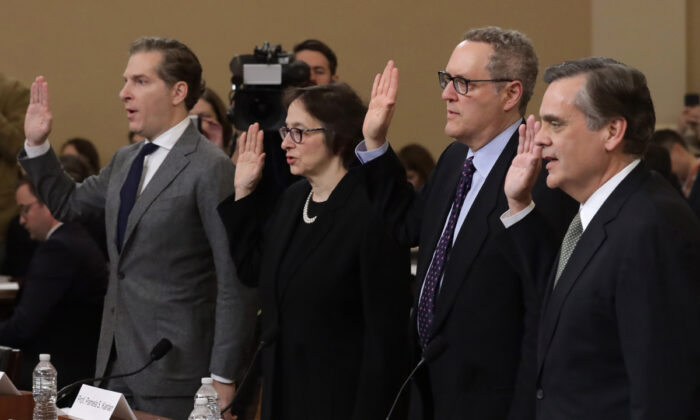
So, when I recently watched the testimony by the Constitutional scholars Pamela Karlan (Stanford), Noah Feldman (Harvard), and Michael Gerhardt (University of North Carolina), I thought, welcome to my world.

Welcome to my world where someone like Karlan, who at a 2017conference claimed she had to cross the street from Donald Trump’s hotel (the building apparently shoots cootie rays onto the sidewalk) and to know that Trump did not “believe in” democracy, “the rule of law,” or a “free press.” The legal scholar had denounced “voter suppression” (no, no, not about New Black Panthers outside the Philadelphia polling station in 2008; those were civil rights activists) and claimed that Trump’s sexual assault record was higher than “99.99% of all of the people who have entered this country illegally.” (Let us hope the FBI takes note of this inside information.)

In addition to being an ace legal mind, she was able to go beyond Freud and diagnosed Trump as not being able to tell the difference between truth and falsity. She claimed that he was trying to “destabilize the courts” and predicted that he would blame a Muslim on a future terroristic attack like the one in Oklahoma City in 1995.

At the hearing, she explained that “one of the most important provisions of our original Constitution is the guarantee of periodic elections for the presidency.” Therefore, this president needed to be removed. There are so many reasons—like the president’s reference to “Russia, if you’re listening,” i.e., to get on it about Hillary Clinton’s missing emails. All smart people know that this is not a joke, for Republicans are incapable of making jokes.

But those with Ph.D.s learn all the clever inside jokes at conferences. It was too bad that the rubes didn’t understand Karlan’s witty reference to the president’s 13-year-old son. She told Americans that “Trump is not a king” and that he could “name his son Barron” but could not “make him a baron.” But they just didn’t get it. So she magnanimously gave a “qualified apology,” pointing out that Trump had much to apologize for himself—like being born. And like all those feminists attacking phallologocentrism in “Paradise Lost” and “Huckleberry Finn,” she was applauded for “schooling” a “Trump crony,” Congressman Doug Collins (R-Ga.).

In my world, earnest graduate students presented comparison/contrast papers at conferences knowing, just knowing, that someone would recognize their genius. Noah Feldman may have known that his “insights” had been discussed thousands of times before at such insider events, but for the benefit of the folks he spelled it out, explaining that the “framers provided for the impeachment of the president because they feared the president might abuse his power of his office.”

“Let me begin now,” he continued, “of why the framers provided for impeachment in the first place. The framers borrowed the concept of impeachment from England, but with one enormous difference. The House of Commons and the House of Lords could use impeachment in order to limit the ministers of the king, but they could not impeach the king. And in that sense, the king was above the law.”

He then asked his enthralled audience, “I would like you to think now about a specific date in the Constitutional Convention, July 20, 1787. It was the middle of a long hot summer. …”

Feldman had been cogitating on impeachment for a while. Back in 2017, Feldman and Jacob Weisberg compared and contrasted “the collusion of Donald Trump’s presidential campaign and Russia” to Watergate, likening “Trump’s firing of FBI Director James Comey and warnings to Special Prosecutor Robert Mueller” to “President Nixon’s Saturday Night Massacre.”

Feldman also contributed to a collection edited by Cass Sunstein, who served in the Obama White House Office of Information and Regulatory Affairs. Titled quite originally “Can It Happen Here? Authoritarianism in America,” the book delved, naturally, into Trump’s authoritarianism. (Sunstein’s earlier book, “Nudge,” spelled out how the government could “nudge” citizens to do what it knew was good for them.) Sunstein, in his introduction, took some creative Sinclair Lewis-like liberties, presenting a future as Lewis did in his novel, even though it was fiction and did not come true then—even under a president who tried to pack the Supreme Court so he could fully take over the economy and who let in British spies to encourage war fervor.

Gerhardt (who has evolved on the Constitution since the Obama presidency) also lectured about the difference between the British system under monarchy and “in our constitution” where “no one, not even the president is above the law” and where there is “a separation of powers.” He concluded “from the public evidence” that the president had attacked the Constitution’s “safeguards against establishing a monarchy in this country.”

With all this talk of kings and monarchy I was reminded of the June 18, 2018, issue of Time Magazine, which on the cover presented Trump looking into a mirror and seeing his reflection with a crown and a king’s regalia—not that I’m doubting that the three professors came to their opinions after a careful review of the evidence—even over a pre-cooked mail-order turkey on Thanksgiving.

Then there was Jonathan Turley, an independent who has always voted Democrat, but who just didn’t get it. He blasphemed in stating that he didn’t believe that there was enough credible evidence to impeach and that Democrats were offering “passion” instead of “proof.” He dared to write about it, along with describing receiving “threatening messages and demands” that he be “fired from George Washington University”—even before he had finished his testimony. I fear that he may fall victim to the kind of purge to which others have succumbed, like Trotsky, and like the more recent one attempted on feminist professor Laura Kipnis.

Over 500 legal scholars after the testimony affixed their names to an open letter to Congress, stating their agreement with Karlan, Feldman, and Gerhardt. Turley had better see the light—that the king must be impeached—soon!

Whoever let him teach at George Washington Law School anyway?

The American people do not appreciate the wisdom of their betters, but President Bernie Sanders will be sure to remind them of how lucky they are to live in a country where the government provides all the food they need and where all they need do is stand in line for it, and not even worry their little brains about what to eat because the Director of the Department of Nutritional Guidance, Provision, and Distribution, Michelle Obama, will see to it that every American gets as much as he, she, they, or it truly needs. Now let’s move! Hop on that tractor! You have a quota to fill.

Mary Grabar holds a doctorate in English from the University of Georgia and is a resident fellow at the Alexander Hamilton Institute for the Study of Western Civilization. Grabar is the author of “Debunking Howard Zinn: Exposing the Fake History that Turned a Generation against America,” recently published by Regnery History.

Source: American Crossroads

Alexandria Ocasio-Cortez is already pulling back the curtain on the inner workings of Congress | CNBC

By Carmen Chapell

Alexandria Ocasio-Cortez is already pulling back the curtain on the inner workings of the Capitol.

The New York Democrat, along with other incoming freshman lawmakers, is trying to usher in a culture of openness that is enabled by a vast social media following. With nearly 3 million followers combined on Facebook, Instagram and Twitter, Ocasio-Cortez has used the platforms to involve her supporters during the transition period before she takes office.

Her enthusiastic and often pugnacious transparency campaign has earned her praise from inside and outside the Beltway. Yet it has also drawn criticism from several corners, including from President Donald Trump’s eldest son. Ocasio-Cortez hasn’t given any indication that she will let up, however.

In a series of pictures and videos on Instagram dubbed “Congress Camp,” she gave an inside look into new-member orientation, from choosing an office to voting for House leadership, while also showcasing the unique quirks of life on Capitol Hill.

“Guys, there are secret underground tunnels between all of these government buildings!” she whispers in one video. In another post, she polls her followers on whether she should choose an office with more space or one “close to our friends.”

But Ocasio-Cortez isn’t just focusing on the novelty of her experience. Last week, she tweeted sharp criticism of an orientation for new members of Congress hosted by Harvard. The event featured corporate CEOs but no labor representatives.

“Our ‘bipartisan’ Congressional orientation is cohosted by a corporate lobbyist group. Other members have quietly expressed to me their concern that this wasn’t told to us in advance,” she tweeted. “Lobbyists are here. Goldman Sachs is here. Where’s labor? Activists? Frontline community leaders?”

Fellow freshman member Rashida Tlaib, D-Mich., echoed her criticisms. Tlaib said that Gary Cohn, former chief economic advisor to President Donald Trump and former Goldman Sachs executive, told the new members at orientation that they don’t “know how the game is played.”

“No Gary, YOU don’t know what’s coming – a revolutionary Congress that puts people over profits,” Tlaib tweeted.

‘Those little things are very real’

Ocasio-Cortez rose to the spotlight after defeating longtime incumbent Joseph Crowley in the Democratic primary for New York’s 14th Congressional District, which encompasses parts of Queens and the Bronx. A self-identified Democratic socialist, she ran on a liberal platform and chose to emphasize her identity as a young woman of color. The 29-year-old’s victory in the general election anointed her as the youngest woman ever elected to Congress.

Ocasio-Cortez’s comments about her new role have also renewed longstanding debates on the financial challenges facing members of Congress and their staff. She has made it personal by revealing her own insecurities about her finances during the transition period.

“I have three months without a salary before I’m a member of Congress. So, how do I get an apartment? Those little things are very real,” she told The New York Times in an interview.

Many lawmakers struggle with the cost of living in Washington, D.C., even on the $174,000 congressional salary, going so far as to sleep in their offices to save on rent costs.

Ocasio-Cortez has also made it a point to talk about the economic conditions of congressional staff. Last week, she tweeted: “It is unjust for Congress to budget a living wage for ourselves, yet rely on unpaid interns & underpaid overworked staff just bc Republicans want to make a statement about ‘fiscal responsibility.'”

Low salaries as well as the prevalence of unpaid internships, which are often the first step to a full-time role, are seen as barriers to a more diverse congressional staff. Ocasio-Cortez pledged to pay her office’s interns $15 an hour, inspiring other lawmakers to make the same commitment.

She has also shared experiences that reveal the growing pains of an increasingly diverse Congress. “People keep giving me directions to the spouse and intern events instead of the ones for members of Congress,” she tweeted during orientation.

The changing face of Congress

Ocasio-Cortez is just one of the 42 women, 38 of them Democrats, part of Congress’ freshman class. They are being heralded as the faces of a new “Year of the Woman.” Ilhan Omar, D-Minn., and Michigan’s Tlaib are the first Muslim women elected to Congress, while Ayanna Pressley, a Democrat, is the first black woman elected to represent Massachusetts. Ocasio-Cortez posted a picture of the four women together on Instagram last month, captioning it “Squad.”

As a result of her high profile, Ocasio-Cortez’s unabashed takes on congressional life have frequently come under fire.

Eddie Scarry, a writer for the Washington Examiner, disputed Ocasio-Cortez’s account of her financial hardships based on her clothing choices.

“Hill staffer sent me this pic of Ocasio-Cortez they took just now,” Scarry tweeted. “I’ll tell you something: that jacket and coat don’t look like a girl who struggles.” The tweet has since been deleted after widespread backlash.

Rep. Sean Duffy, R-Wis., condemned the media for what he viewed as preferential treatment in coverage of Ocasio-Cortez. As a freshman congressman in 2011, Duffy received negative reactions after telling a constituent that he struggles to pay his bills.

“Hmm which headlines and article does media give to GOP and which to a Dem?” Duffy tweeted alongside screenshots of articles referencing himself and Ocasio-Cortez.

Last week, Donald Trump Jr., the president’s eldest son, shared a doctored image on Instagram in which Ocasio-Cortez asks, “Why are you so afraid of a socialist economy?” In the post, President Trump responds, “Because Americans want to walk their dogs, not eat them.” Trump Jr. captioned the meme “It’s funny cuz it’s true!!!”

Ocasio-Cortez fired back, tweeting: “Please, keep it coming Jr – it’s definitely a ‘very, very large brain’ idea to troll a member of a body that will have subpoena power in a month.” Democrats have made clear that they plan to use their new subpoena power in the House to further investigate potential Russian interference in the 2016 elections.

The representative-elect has also received praise for revealing parts of the political system that are typically left in the shadows.

Actress Kerry Washington, who stars in the political drama “Scandal,” commended Ocasio-Cortez’s behind-the-scenes revelations, tweeting, “@Ocasio2018 speaking truth to power. Sharing the NEEDED #BTS of our democracy at work. So grateful.”

“I’m learning more details about how the House actually works over the past two weeks than I ever did in the past 20 years,” one follower tweeted in reply to Ocasio-Cortez.

“Thank you so much for giving us the window into the inside baseball of Congress,” another follower said.

Paul Musgrave, assistant professor of political science at University of Massachusetts Amherst, praised Ocasio-Cortez on Twitter for “treating voters as neither super-sophisticated DC insiders, nor as people who can’t be trusted to make up their own minds, but rather as people who are curious and intelligent but who aren’t experts in DC process.”

“Sometimes,” he added, “you don’t need a new theory of politics to make change, just a willingness to state the obvious.”

Source: CNBC

How a Century of Racist Policies Made Ferguson Into a Pocket of Concentrated Despair | Bill Moyers

By Joshua Holland

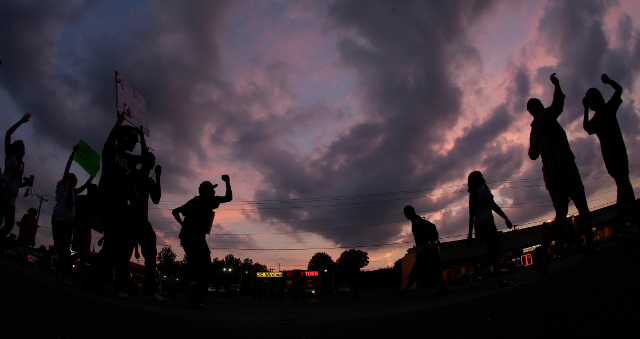
FergusonPovertyFerguson, Missouri, was a powder-keg waiting for a match long before August 9 and Michael Brown’s fateful encounter with Police Officer Darren Wilson. It is one of many predominantly black communities across the United States plagued by highly concentrated poverty, and all of the social problems that accompany it.

White America has come up with a number of rationales for these enduring pockets of despair. An elaborate mythology has developed that blames it on a “culture of poverty” — holding the poor culpable for their poverty and letting our political and economic systems off the hook. A somewhat more enlightened view holds that whites simply fled areas like Ferguson — which had a population that was 99 percent white as recently as 1970 — because of personal racial animus, leaving them as hollowed-out, predominantly black “ghettos.”

But a study by Richard Rothstein, a research fellow at the Economic Policy Institute, comes to a very different conclusion. In his report, “The Making of Ferguson,” Rothstein details how throughout the last century a series of intentionally discriminatory policies at the local, state and federal levels created the ghettos we see today. BillMoyers.com spoke with Rothstein about the report. The transcript below has been edited for length and clarity.

Joshua Holland: Most people believe that Ferguson became so racially polarized because of “white flight” — white people fled the area because of personal prejudice against African-Americans. In your report, you argue that this misses a crucial point. What are we overlooking?

Rothstein: The segregation that characterizes Ferguson, and that characterizes St. Louis, was the creation of purposeful public policy. We have a segregated nation by design.

The St. Louis metropolitan area was no different from most metropolitan areas of the country. The ghetto in the central city of St. Louis was redeveloped for universities, and for a number of other uses, and the African American population in the central city was shifted to inner ring suburbs like Ferguson.

It was done primarily with two policies: First, public housing was segregated, purposely, by the federal government, so that what were previously somewhat integrated neighborhoods in urban areas were separated into separate black and white public housing projects.

And then, in the 1950s, as suburbs came to be developed, the federal government subsidized white residents of St. Louis to move to the suburbs, but effectively prohibited black residents from doing so. The federal government subsidized the construction of many, many subdivisions by requiring that bank loans for the builders be made on the condition that no homes be sold to blacks.

Because black housing was so restrictive, there were so few places where African-Americans could live in St. Louis. So what was left of St. Louis’ African-American community became overcrowded. City services were not readily available. The city was zoned so that the industrial or commercial areas were placed in black neighborhoods but not in white neighborhoods. So the industrial areas, where African-Americans lived, became slums.

And then white residents in places like Ferguson came to associate slum conditions with African-Americans, not realizing that this was not a characteristic of the people themselves, but rather it was a creation of public policy.

This is a somewhat oversimplified description of a complex array of policies. But every policy that I described in this report can be found in every other metropolitan area throughout the country. These policies applied in the New York City area, and they applied in the liberal San Francisco area. It’s a story that characterizes the entire country, but you cannot understand what’s going on with Ferguson today without knowing this history.

Holland: Who was Adel Allen, and why is his story — which took place in nearby Kirkwood, Missouri — important for understanding how Ferguson came to be the city it is today?

Rothstein: Adel Allen was an African American engineer for the McDonnell Douglas Corporation. He was recruited from Kansas to work in the St. Louis metro area. When he got there, he couldn’t find housing anywhere in the suburban areas near the plant. He was about to move back to Kansas, because the only place he could find housing was in overcrowded conditions in the central St. Louis ghetto.

He finally got a white friend to buy a home for him in the town of Kirkwood. He moved into a block that was overwhelmingly white. There were 30 white families. Seven years later, there were 30 black families and two white families on that block. And this was largely because of practices in the real estate industry.

Ta-Nehisi Coates on Black vs. White Neighborhoods

Realtors engaged in a practice which came to be known as “blockbusting.” When a black family moved onto a block, like Adel Allen did in Kirkwood, the real estate agents would go door to door and try to panic their white neighbors into selling their homes at very reduced prices, with the idea that property values were going to be destroyed because African-Americans were moving into their neighborhood.

Those real estate agents then bought those properties at very low prices and resold them to African-Americans, who had to pay very high prices because they had no other housing options.

Now, this was something that was not considered unethical until the 1970s. In fact, licenses would be suspended by the state real estate commission if a real estate agent sold a home to a black family in a white neighborhood — until the first one sold, and then it was considered perfectly ethical for real estate agents to turn an entire block into an African-American block.

Once they moved into that block, all of a sudden, over the course of a few years, city services began to decline. Other parts of Kirkwood which were overwhelmingly white continued to get good services, but the African-American neighborhoods were denied. The rest of the city got sidewalks and curbs; the black blocks did not.

Holland: You also write, “State sponsored labor and employment discrimination reduced the incomes of African-Americans relative to whites in St. Louis.” So as a result, even absent these kinds of housing policies you describe, African-Americans would be hard-pressed to afford to live in a decent white suburb.

Rothstein: That’s right. In St. Louis, African-Americans were excluded from good-paying jobs for most of the 20th century. They opened up only beginning in the 1970s. For example, construction jobs during the enormous housing boom that created the suburbs in the 1940s, ’50s and ’60s were completely closed to African-Americans because they could not be admitted to construction unions, and the federal government certified every one of those segregated unions as the exclusive agent for their trades in those construction sites. So it’s not simply the result of private discrimination by the unions. This was something that was sanctioned by the federal government. It wasn’t until the 1960s that the National Labor Relations Board first withdrew certification from a segregated union and the policy didn’t become widespread for at least another 10 years or so.

There are many other examples I could give you. During the enormous employment boom during World War II, St. Louis was a big center of arms manufacturing. Lots of workers flooded to St. Louis from the Ozarks and other areas, black workers as well as white workers. But the largest ammunition producer would not hire African-Americans until the war was almost over.

So all of those lost opportunities for employment created a situation where African-American incomes were much, much lower than white incomes.

Holland: I’m going to ask you to connect some dots. Many of the things you describe in the paper haven’t been legal for quite a bit of time. How does this legacy of institutional racism in the past set up the unrest that has played out in Ferguson after the shooting death of Michael Brown?

Rothstein: As we know from a lot of recent research, intergenerational income mobility in this country is quite low. If you’re born into a low-income family, the chances are very, very great that you yourself will have a low income. We don’t have nearly the kind of mobility that is mythical in this country.

So after a century of policies which denied African-Americans access to jobs that pay decent wages, the likelihood is that their children and their children’s children will still be paying the price for those policies that held their parents and grandparents behind for so long.

And then there are the housing policies. Let me take the example of the suburb of Kirkwood. In the 1950s, when Kirkwood was being developed, those homes were selling for about $8,000 dollars each, which was about two times the national median income at that time. Working families could afford to buy a home for twice median income, but only whites were permitted to buy into Kirkwood. Any white working family could’ve afforded to buy those homes, and very often, they were further subsidized by the federal government — veterans could buy with no down payment, and obtain loans at very low interest rates.

Those families then benefited from a half-century of equity appreciation in their homes. If they moved, they profited on the sale. And they were able to transmit that equity to their children. Their children were secure. Their children were able to go to college.

Today, those same homes that sold for $8,000 in the 1950s sell for $400,000, which is about six or seven times national median income. So today, working families, whether white or black, can’t afford to buy in Kirkwood. Fifty years ago, when whites similar to them in every other respect except their race were populating the suburbs, African-American families were not permitted to do so, so the legacy of that discrimination continues to this date. Poor African-Americans got crowded into ghettos — into all black, low-income neighborhoods like Ferguson.

And because the Federal Housing Administration refused to guarantee mortgages for African-Americans and would only guarantee mortgages for whites, black people who could afford to buy homes couldn’t get mortgages for them. So speculators sold those homes to them on contract, like on an installment plan. And if they were ever late with a payment, their house would be immediately repossessed and resold again on contract to someone else. In order to be able to make these contract payments, which were very high because the demand for housing was so great relative to the supply available to African-Americans, families doubled up, they subdivided their homes, they rented out parts of their homes. That’s a great example of how public policies led to the formation of slums.

This then became a multigenerational problem.

Source: Bill Moyers