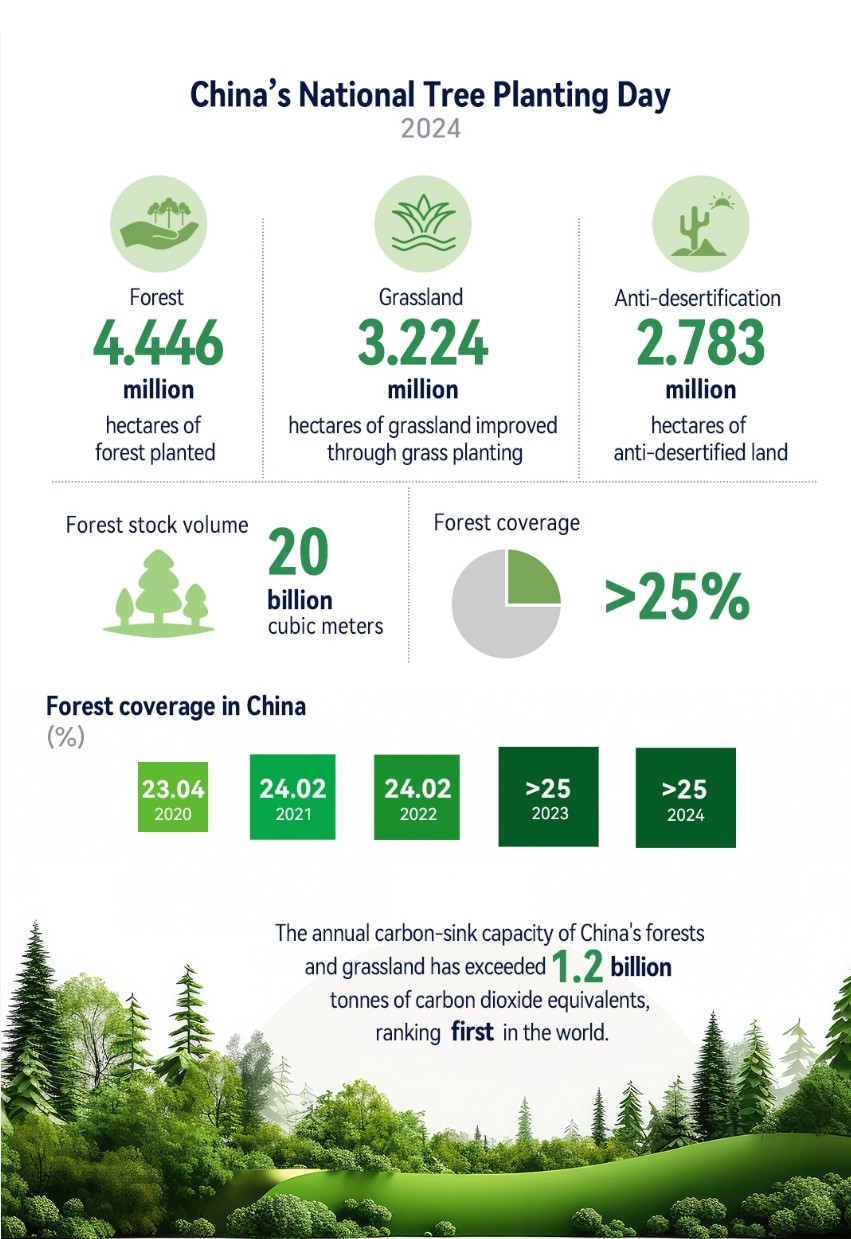
China is quietly replacing much of the world’s lost forests. In one of the greatest environmental turnarounds in history, China has added more than 500,000 km² of forest since 1990. In 2022 it pledged to plant, conserve, restore, and manage 70 billion trees by 2032—a cornerstone of the global ‘1 Trillion Trees’ initiative to supercharge carbon sinks and biodiversity.
In 2024 alone: • 4.45 million hectares of new trees planted • 3.22 million hectares of grassland restored • 2.78 million hectares reclaimed from desert
That pushed national forest cover past 25% (up from ~12% in the 1980s) blasting past the 2025 target of 24.1% ahead of schedule. Cumulative restoration since 2012 now exceeds 70 million hectares.
Meanwhile, humanity has destroyed more than half the world’s original native forests—mostly for agriculture. Today’s forests still cover ~31% of global land (the vast Taiga being the biggest survivor) but the Amazon tells a far darker story: 17–26 % already gone. Brazilian deforestation is up 27 % in 2025 so far, much of it arson-driven.
China’s ‘I Plant a Tree for the Climate’ campaign, run by the China Green Foundation, shows how top-down ambition can meet grassroots action. While others talk, China plants. It’s a genuine game-changer for a greener planet—hats off.
Unfortunately, we are living in a world where facts don’t matter much anymore. For instance, the wildfires that have swept across the western United States over the past few weeks are being almost universally blamed on climate change, even though the facts tell otherwise.
The fires in California and Oregon are not due to climate change. They are due to arson and sheer stupidity on the part of many, including those who are responsible for the environmental stewardship that is supposed to prevent them in the first place.
According to the Cal Fire San Bernardino Unit, “the El Dorado Fire, burning near Oak Glen in San Bernardino County, was caused by a smoke generating pyrotechnic device, used during a gender reveal party.” Chalk this one up to stupidity, not climate change.
Likewise, the Almeda Fire in Oregon, which has burned more than 600 homes, cannot be tied to climate change whatsoever because it was caused by arsonists. As Ashland Police Chief Tighe O’Meara said, “We have good reason to believe that there was a human element to it. We’re going to pursue it as a criminal investigation until we have reason to believe that it was otherwise.”
There are several more reports of arsonists instigating the blazes that are currently destroying hundreds of thousands of acres in the West.
Despite these facts, Rep. Nancy Pelosi (D-CA), recently said, “Mother Earth is angry. She’s telling us, whether, she’s telling us with hurricanes on the Gulf Coast, fires in the West, whatever it is, that climate crisis is real and has an impact.”
Of course, Pelosi didn’t offer one iota of evidence to support her contention that climate change is somehow responsible for all this. And since when did Mother Earth begin speaking to the Speaker of the House?
Not to be outdone, California Gov. Gavin Newsom also laid blame for his state’s out-of-control wildfires on climate change. “I say this lovingly — not as an ideologue, but as someone who prides himself on being open to argument, interested in evidence — but I quite literally have no patience for climate change deniers,” Newsom said. “It’s completely inconsistent, that point of view, with the reality on the ground, the facts as we are experiencing. You may not believe it intellectually, but your own eyes, your own experiences tell a different story.”
Conveniently, Newsom failed to mention that California has one of the poorest records of implementing commonsense environmental stewardship protocols, which no doubt has played a significant factor in the Golden State’s proclivity for wildfires over the past several years.
According to California’s state oversight agency, “During its review, the Commission found that California’s forests suffer from neglect and mismanagement, resulting in overcrowding that leaves them susceptible to disease, insects and wildfire.”
In other words, under decades of Democratic leadership, California has woefully underinvested in forest management efforts, which have left forests grossly overgrown and prone to wildfire.
Making matters worse, California’s insistence on becoming the renewable energy utopia of the United States has led the state’s primary energy utility, PG&E, to disregard properly maintaining existing energy infrastructure.
As the San Diego Union Tribune reports, “every dollar spent on additional costs of renewable energy results in a dollar not available to spend on culling vegetation, insulating power lines, placing lines underground and other measures.”
As if that were not enough, the article also notes, “a report prepared by the independent consulting firm Beacon Economics for the San Francisco-based think tank Next 10 estimated California wildfires last year produced about nine times more emissions than were reduced across the entire state’s economy between 2016 and 2017 — and wildfires contributed more than the commercial, residential or agriculture sectors did in 2017.”
Ironically, Newsom’s naïve attempt (and his predecessors) to make the Golden State the renewable energy mecca has actually led to more carbon emissions because the state’s abundant forests have been turned into a giant tinderbox.
Adding insult to injury, Newsom has pledged to double-down on his efforts to make California more reliant on renewable energy, regardless of the uptick in wildfires and rolling blackouts.
And the claim that wildfires are increasing is 100 percent false. According to the Congressional Research Service, the prevalence of wildfires has decreased over the past three decades. As the report notes, “Over the past 10 years, there were an average of 64,100 wildfires annually and an average of 6.8 million acres burned annually. In 2019, 50,477 wildfires burned 4.7 million acres nationwide, below the annual average for both statistics.”
John Adams once said, “Facts are stubborn things. They cannot be altered by our wishes, our inclinations, or the dictates of our passions.”
Fact-shunners like Gov. Newsom and Rep. Pelosi ought to put their wishes and passions aside and deal with the reality that their state is being decimated by wildfires due to their incompetence and ignorance, not because of so-called climate change.
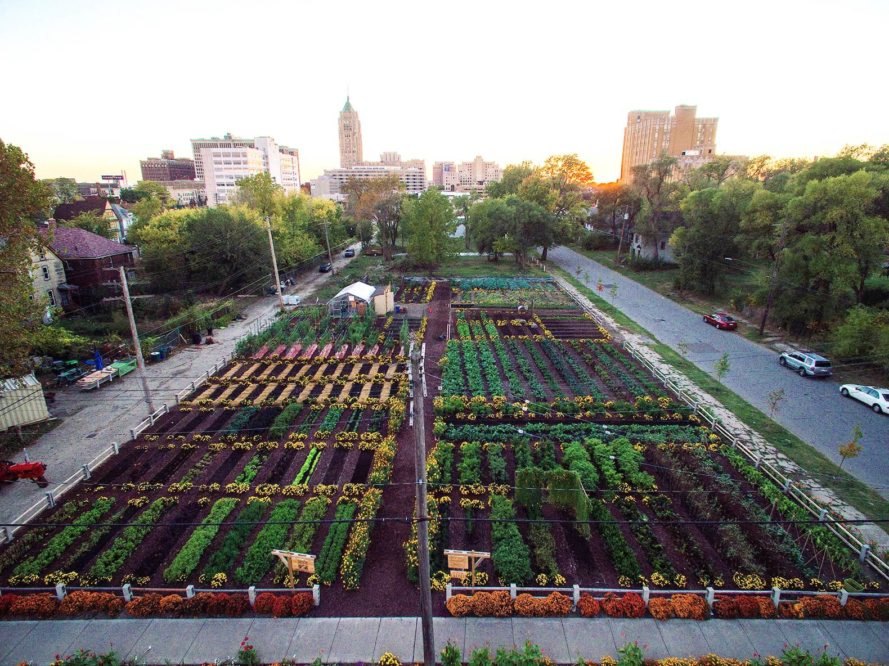
When you think of Detroit, ‘sustainable‘ and ‘agriculture‘ may not be the first two words that you think of. But a new urban agrihood debuted by The Michigan Urban Farming Initiative (MUFI) might change your mind. The three-acre development boasts a two-acre garden, a fruit orchard with 200 trees, and a sensory garden for kids.
If you need a refresher on the definition of agrihood, MUFI describes it as an alternative neighborhood growth model. An agrihood centers around urban agriculture, and MUFI offers fresh, local produce to around 2,000 households for free.
In a statement, MUFI co-founder and president Tyson Gersh said, “Over the last four years, we’ve grown from an urban garden that provides fresh produce for our residents to a diverse, agricultural campus that has helped sustain the neighborhood, attracted new residents and area investment.” Through urban agriculture, MUFI aims to solve problems Detroit residents face such as nutritional illiteracy and food insecurity.
Now in the works at the agrihood is a 3,200 square foot Community Resource Center. Once a vacant building, the center will become a colorful headquarters and education center. As MUFI is a non-profit operated by volunteers, they’ll receive a little help to restore the building from chemistry company BASF and global community Sustainable Brands. Near the center, a health food cafe will sprout on empty land.
MUFI describes the agrihood as America’s first sustainable urban agrihood. There are other agrihoods around the United States, such as this one Inhabitat covered earlier in 2016 in Davis, California. But the California agrihood is expensive; many people couldn’t afford to live there. The Michigan agrihood is far more accessible.
MUFI isn’t stopping with the community center. They’re also working on a shipping container home, and plan to restore another vacant home to house interns. A fire-damaged house near the agrihood will be deconstructed, but the basement will be turned into a water harvesting cistern to irrigate the farm.


 Liberty International News