Nunes Taking Legal Action Against CNN & Daily Beast | Trending Politics

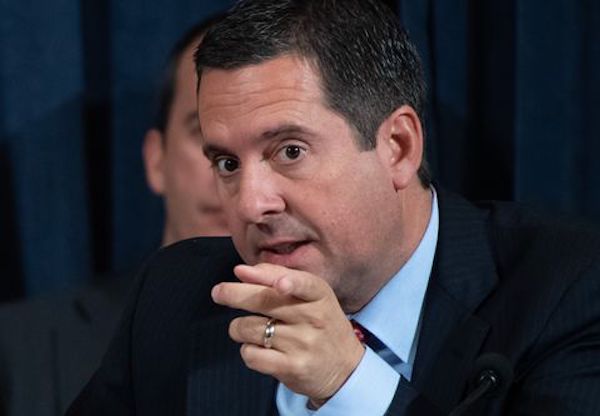
On Friday, House Intelligence Committee Ranking Member Devin Nunes revealed that he was filing a lawsuit against left wing news network CNN for publishing a false report.

In their report, CNN alleged that, “an indicted associate of Rudy Giuliani was willing to testify to Congress that Nunes met with a former Ukrainian prosecutor last year to discuss digging up dirt on former Vice President and current Democrat presidential candidate Joe Biden,” according to the Daily Wire.

“The attorney, Joseph A. Bondy, represents Lev Parnas, the recently indicted Soviet-born American who worked with Giuliani to push claims of Democratic corruption in Ukraine,” CNN reported. “Bondy said that Parnas was told directly by the former Ukrainian official that he met last year in Vienna with Rep. Devin Nunes.”

“Mr. Parnas learned from former Ukrainian Prosecutor General Victor Shokin that Nunes had met with Shokin in Vienna last December,” Bondy said to CNN. “Nunes had told Shokin of the urgent need to launch investigations into Burisma, Joe and Hunter Biden, and any purported Ukrainian interference in the 2016 election.”

The report by CNN claims that Bondy told them that Nunes communicated with Parnas at the same time as his trip to Vienna.

In a statement to Breitbart News, Nunes says: “These demonstrably false and scandalous stories published by the Daily Beast and CNN are the perfect example of defamation and reckless disregard for the truth. Some political operative offered these fake stories to at least five different media outlets before finding someone irresponsible enough to publish them. I look forward to prosecuting these cases, including the media outlets, as well as the sources of their fake stories, to the fullest extent of the law. I intend to hold the Daily Beast and CNN accountable for their actions. They will find themselves in court soon after Thanksgiving.”

Nunes has made it increasingly clear that he is tired of the Democrats’ games which is why he is going on the offensive.

During his opening statement on Thursday at the impeachment hearing, Nunes laid out seven times where Democrats were “caught” obstructing President Donald Trump.

“The Democrats have tried to solve this dilemma with a simple slogan: ‘He got caught!’” Nunes said. “President Trump, we are to believe, was just about to do something wrong, and getting caught was the only reason he backed down from whatever nefarious thought-crime the Democrats are accusing him of almost committing.”

“I once again urge Americans to consider the credibility of the Democrats on this committee who are now hurling these charges,” Nunes continued. “For the last three years, it’s not President Trump who got caught, it’s the Democrats who got caught.”

Read his seven examples below:

  • They got caught falsely claiming they had more than circumstantial evidence that Trump colluded with the Russians to hack the 2016 elections.
  • They got caught orchestrating this entire farce with the Whistleblower and lying about their secret meetings with him.
  • They got caught defending the false allegations of the Steele dossier, which was paid for by the Democrats.
  • They got caught breaking their promise that impeachment would only go forward with bipartisan support because of how damaging it is to the American people.
  • They got caught running a sham impeachment process featuring secret depositions, hidden transcripts, and an unending flood of Democrat leaks.
  • They got caught trying to obtain nude photos of President Trump from Russian pranksters pretending to be Ukrainians.
  • And they got caught covering up for Alexandra Chalupa—a Democratic National Committee operative who colluded with Ukrainian officials to smear the Trump campaign—by improperly redacting her name from deposition transcripts and refusing to let Americans hear her testimony as a witness in these proceedings.
  • Nunes continued by noting how this hearing was the last hearing as he called for Congress to do their actual job.

“I sincerely hope the Democrats end this affair as quickly as possible so our nation can begin to heal the many wounds it has inflicted on us,” Nunes said. “The people’s faith in government, and their belief that their vote counts for something, has been shaken.”

“From the Russia hoax to this shoddy Ukrainian sequel, the Democrats got caught,” Nunes concluded. “Let’s hope they finally learn a lesson, give their conspiracy theories a rest, and focus on governing for a change.”

Source: Trending Politics

The ‘Whistleblower’ and the President’s Right to Present a Defense | National Review

By Andrew C. McCarthy

Right church, wrong pew, as we Catholic types are wont to say.

As I tried to explain in Thursday’s column, Rand Paul is wrong to insist that the Sixth Amendment’s confrontation clause demands that the so-called whistleblower be unmasked and publicly questioned. That does not mean, though, that Senator Paul’s general idea (that the “whistleblower” should testify) is wrong; nor does it mean that the Constitution’s guarantee of trial rights is irrelevant.

The right to present a defense, also vouchsafed by the Sixth Amendment, is the guarantee on which Paul and the rest of the president’s supporters should focus.

This comes with the same caveats elaborated on Thursday. The Constitution vests the House and Senate with plenary authority over their respective impeachment proceedings (the House to decide whether to file articles of impeachment, the Senate to try the case). No court has the power to make either legislative chamber afford a particular quantum of due process.

That said, impeachment is inherently political. Here, it has been launched when we are less than a year out from an election in which the American people are supposed determine for themselves whether the president should keep his job. By the time impeachment has run its course, we could be just a few months from Election Day. Apparently, though, the political class is intent on end-running the sovereign, attempting to remove President Trump on its own. To pull that off, it will need to convince the country that (a) it has grounds so extraordinarily serious that Trump must be ousted forthwith and (b) the procedures under which it impeached were fundamentally fair.

I don’t think they have a prayer of demonstrating the former, such that two-thirds of the GOP-controlled Senate would be spurred to remove the president. (Trump’s approval rating among Republicans is hovering around 90 percent.) As for the latter concern, due process, there must be some and it must be meaningful — not because it is legally mandated, but because it is politically essential.

This is why many of the more pragmatic Democrats knew impeachment was a bad idea. As a practical matter, they don’t have close to the votes to remove, so it’s doomed to fail. The public knows it’s doomed to fail and may well resent Democrats for gratuitously putting the country through it. If Trump is denied due process, the proceedings will look like a kangaroo court and Democrats will be blamed. And if Trump is afforded due process, the case he presents may damage Democrats come November.

We do not have a ton of prior impeachment experience to go on, but the presidents in each episode were afforded the right to present a defense — both in the House proceedings leading to articles of impeachment and in the Senate trial.

The right to present a defense is importantly different from the right to confront the House Democrats’ case for impeachment.

As I noted in Wednesday’s column, the confrontation right emphasized by Senator Paul only allows the accused to cross-examine whatever witnesses the prosecution chooses to call in making its case. It does not give the accused a right to cross-examine every source who may have provided accusatory information, even sources whom the prosecutor does not call. Consequently, if the Democrats believe (as they do) that they could establish their case for articles of impeachment without summoning the so-called whistleblower as a witness, the president and his Republican defenders would have no right to call the whistleblower merely to cross-examine him on the statements made in his hearsay complaint.

By contrast, the right to present a defense is more extensive. Broadly speaking, it empowers an accused to do two things: (1) pointedly discredit the prosecution’s version of events, whether through cross-examination of the prosecution’s witnesses or presentation of the accused’s own witnesses, and (2) present the accused’s own witnesses and evidence in order to prove facts and theories that favor the accused and cast doubt on the worthiness of the prosecutor’s case.

In most any criminal case, courts will give the accused a decent-sized berth to prove and argue that the accused was set up by the investigators; or that the investigative procedures used were underhanded or otherwise skewed against the accused. Here, the president will want to persuade the factfinders (and the country) that Democrats have conspired with like-minded officials in the bureaucracy, particularly in the intelligence agencies (including the FBI and the Justice Department), to paralyze and, if possible, shorten the Trump presidency.

Most defenses based on government misconduct do not get very far. They tend to be fabricated, overblown, or focused on prosecutorial misconduct that is far afield from the charges against the accused. In this instance, however, the president has a great deal to work with.

Prominent Democrats and Trump detractors have been quite brazen in their public rhetoric about Trump (including, as is now being reported, the so-called whistleblower’s counsel, who has spoken explicitly about a “coup” by bureaucrats). Moreover, the Justice Department inspector general’s report on the Clinton emails investigation outlines in wince-inducing detail pervasive anti-Trump bias on the part of government investigators.

The same IG is about to release a report specifically dealing with investigative irregularities in the Trump-Russia investigation. Of course, we do not yet know what that report will yield (and even less what will come of the Barr/Durham probe of the Trump-Russia investigation’s origins). We do know, though, that the FBI and Justice Department represented to the Foreign Intelligence Surveillance Court that the FBI believed Trump’s campaign was likely complicit in Russia’s hacking operations to influence the 2016 election. And we know that the Obama administration — undoubtedly in collusion with foreign intelligence services — ran informants against Trump-campaign officials in an effort to establish a Trump–Russia conspiracy. Finally, we know that the president was repeatedly told that he was not a suspect of the FBI’s investigation, under circumstances where he appears to have been the central suspect.

After years of very aggressive, expensive investigation — by a special counsel who staffed his investigation with notorious partisans — no Trump–Russia conspiracy was found. Moreover, the FBI and the Justice Department on four occasions obtained warrants to monitor a former Trump-campaign adviser, telling the federal court under oath that he was a clandestine agent of a foreign power and a key cog in the Trump–Russia cyberespionage conspiracy; yet that adviser, Carter Page, was never accused of any crime, much less the traitorous misconduct outlined in the warrant applications.

The president and his supporters will want to lay much of this out in his defense case against any impeachment allegations. It is clearly relevant on the question whether the Democrats are to be believed that the Ukraine episode is what they portray it to be: a matter of such grave severity that Congress should remove the president from power just ahead of an election. The fact finders and the public are entitled to consider whether Democrats are blowing the Ukraine episode way out of proportion, just as they did with the collusion caper. Indeed, in the Clinton impeachment case, the president and his Democratic supporters were permitted to press the case that Republican claims about the egregiousness of his misconduct were overwrought, as evidenced, for example, by Clinton’s high approval ratings.

In the presentation of his defense, President Trump would thus seek to call the “whistleblower” as a witness (a hostile one, no doubt). His counsel and Republicans would proceed to try to demonstrate his connections to senior Democrats with intelligence-community ties who have been scurrilous in their public comments about the president. They would grill him on allegations that he is among the intelligence-community officials who leaked information in a manner intended to cast the president in a poor light. And they would press him on the preparation of his hearsay complaint — his consultation with an Adam Schiff staffer, his close collaboration with overtly anti-Trump lawyers, and so on. I might even have him read aloud from Schiff’s wannabe Godfather IV caricature of the Trump-Zelensky conversation and ask whether he helped the chairman’s staff write it.

It is in connection with the president’s right to present a defense, not his confrontation-clause right, that Senator Paul and the president’s defenders should frame their argument that the “whistleblower” should be subpoenaed to testify at public impeachment hearings.

A cautionary note. When I was a prosecutor, I loved defense cases. They were often not very well thought through — just an effort to dirty up investigators toward no coherent end, or toss in some favorable details about the accused that were quite beside the point of the charges. A defense case can open the door to prosecutors to place before the factfinders a great deal of unflattering information about the accused that would otherwise have been excluded as irrelevant. Defense lawyers tend to be much better at dismantling the prosecutor’s case for conviction than at presenting their own affirmative case for acquittal. When a defendant proceeded with an extensive defense case, I almost always ended up concluding that it had helped me more than it helped the defendant.

Presenting an affirmative case would not be without risk for the president. If the Democrats’ case for impeachment is weak and has no chance of success, he would probably be better advised to leave well enough alone. Nevertheless, if the president wants to argue that the bureaucracy has had it in for him from the start, and has coordinated with Democrats to undermine him, he has an unusual embarrassment of riches to exploit.

Source: National Review

2016 United States presidential election | Wikipedia

Editor’s Note: Despite the liberal media dominating the leftist narrative and the Democrats leading the charge in the impeachment inquiry, it seems the tables are turning positively towards reclaiming and restoring the Republic and the principles that once made America great. Since the impeachment inquiry began In September 2019 Trump’s twitter numbers have increased from 62.5 million to 66.6 million in little over a month. Polls have shown between a 50% overall support for the Trump Administration. The Republican Party has raised $305 million in this last quarter towards Trump’s reelection bid. Over 95% of Republicans stand behind Trump and his policies. What is also outstanding is how these numbers are comparable to the 2016 election results with the popular vote of 62,984,828, electoral vote of 304 with 30 states carried.

The 2016 United States presidential election was the 58th quadrennial American presidential election, held on Tuesday, November 8, 2016. The Republican ticket of businessman Donald Trump and Indiana Governor Mike Pence defeated the Democratic ticket of former Secretary of StateHillary Clinton and U.S. Senator from Virginia Tim Kaine, despite losing the popular vote.[2] Trump took office as the 45th president, and Pence as the 48th vice president, on January 20, 2017.

Trump emerged as the front-runner amidst a wide field of Republican primary candidates, while Clinton defeated Senator Bernie Sanders and became the first female presidential nominee of a major American party. Trump’s populist, nationalist campaign, which promised to “Make America Great Again” and opposed political correctness, illegal immigration, and many free-trade agreements,[3] garnered extensive free media coverage.[4][5] Clinton emphasized her extensive political experience, denounced Trump and many of his supporters as bigots, and advocated the expansion of President Obama’s policies; racial, LGBT, and women’s rights; and “inclusive capitalism“.[6] The tone of the general election campaign was widely characterized as divisive and negative.[7][8][9] Trump faced controversy over his views on race and immigration, incidents of violence against protestors at his rallies,[10][11][12] and his alleged sexual misconduct, while Clinton’s campaign was undermined by declining approval ratings[13] due to concerns about her ethics and trustworthiness,[14] and an FBI investigation of her improper use of a private email server, which received more media coverage than any other topic during the campaign.[15][16]

Clinton led in nearly every pre-election nationwide poll and in most swing state polls, leading some commentators to compare Trump’s victory to that of Harry S. Truman in 1948 as one of the greatest political upsets in modern U.S. history.[17][18] While Clinton received 2.87 million more votes than Trump did (the largest margin ever for a losing presidential candidate),[19] Trump received a majority of electoral votes and won upset victories in the pivotal Rust Belt region. Trump won six states that Democrat Barack Obama had won in 2012: Florida, Iowa, Michigan, Ohio, Pennsylvania, and Wisconsin.[20] Ultimately, Trump received 304 electoral votes and Clinton garnered 227, as two faithless electors defected from Trump and five defected from Clinton. Trump is the fifth person in U.S. history to become president while losing the nationwide popular vote.[b] He is the first president with neither prior public service nor military experience, and the oldest person to be inaugurated for a first presidential term.

The United States government’s intelligence agencies concluded on January 6, 2017, that the Russian government had interfered in the 2016 elections[22][23][24] in order to “undermine public faith in the U.S. democratic process, denigrate Secretary Clinton, and harm her electability and potential presidency”.[25] A Special Counsel investigation of alleged collusion between Russia and the Trump campaign began in May 2017[26][27]and ended in March 2019. The investigation concluded that Russian interference to favor Trump’s candidacy occurred “in sweeping and systematic fashion”, but “did not establish that members of the Trump campaign conspired or coordinated with the Russian government”.[28]

Source: Wikipedia

War Propaganda: “Fake News” and the Pentagon’s Office of Strategic Influence (OSI) | Collective Evolution & Global Research

Editor’s Note: Much of this article is excerpted from the original by Michel Chossudovsky of Global Research. Excellent background to the intelligence operation behind the impeachment effort.

By Arjun Walla

  • The Facts:The influence of intelligence and government agencies when it comes to mainstream media is quite large. This article provides numerous examples from documents to whistleblowers that clearly prove this point.
  • Reflect On:Our world has become quite Orwellian with regards to free and open information. There now seems to be a ‘Ministry of Truth’ that is hiding information from people, and telling them what to believe and how to think. Censorship is rampant.

A declassified document from the CIA archives in the form of a letter from a CIA task force addressed to the Director of the Central Intelligence Agency details the close relationship that exists between the CIA and mainstream media and academia.

The document states that the CIA task force “now has relationships with reporters from every major wire service, newspaper, news weekly, and television network in the nation,” and that “this has helped us turn some ‘intelligence failure’ stories into ‘intelligence success” stories,’ and has contributed to the accuracy of countless others.” Furthermore, it explains how the agency has “persuaded reporters to postpone, change, hold, or even scrap stories that could have adversely affected national security interests or jeopardized sources and methods.”

Although it is a document outlining their desire to become more open and transparent, the deception outlined by various whistleblowers (example) requires us to read between the lines and recognize that the relationships shared between intelligence agencies and our sources of information are not always warranted and pose inherent conflicts of interest.

Herein lies the problem: What is “national security,” and who determines that definition? JFK bravely told the world that the “dangers of excessive and unwarranted concealment of pertinent facts far outweigh[] the dangers which are cited to justify it.” He also said that “there is very grave danger that an announced need for increased security will be seized upon by those anxious to expand its meaning to the very limits of official censorship and concealment.” 

“National security” is now an umbrella term used to justify concealing information, but who makes these decisions?

The real reason why people like Julian Assange are treated the way they are treated is because they threaten immoral corporate and elitist actions/interests of various governments and institutions, and because they simply share truth and information.

This is why we are also seeing the mass censorship of alternative media outlets, like Collective Evolution.

Not long ago, William Arkin, a longtime well known military and war reporter who is best known for his groundbreaking, three-part Washington Post series in 2010, went public outing NBC/MSNBC as completely fake government run agencies.

He blasted NBC News along with MSNBC news in an email for “becoming captive and subservient to the national security state, reflexively pro-war in the name of stopping President Donald Trump, and now the prime propaganda instrument of the War Machine’s promotion of militarism and imperialism.” This is something, based on my research, mainstream media has always been. It’s why they were created in the first place.

Arkin stated that, as a result of this, “the national security establishment not only hasn’t issued a beat but indeed has gained dangerous strength, and “is ever more autonomous and practically impervious to criticism.”

Another great quote comes to mind here,

“The real menace of our Republic is the invisible government, which like a giant octopus sprawls its slimy legs over our cities, states and nation . . .  The little coterie of powerful international bankers virtually run the United States government for their own selfish purposes. They practically control both parties . . .  [and] control the majority of the newspapers and magazines in this country. They use the columns of these papers to club into submission or drive out of office public officials who refuse to do the bidding of the powerful corrupt cliques which compose the invisible government. It operates under cover of a self-created screen [and] seizes our executive officers, legislative bodies, schools, courts, newspapers and every agency created for the public protection.”  (source)(source) – Mayor of New York City from 1918-1925

MSNBC’s star national security reporter Ken Dilanian was widely mocked by media outlets for years for being an uncritical CIA stenographer before he became a beloved NBC/MSNBC reporter, and let’s not forget CNN’s Anderson Cooper’s connections to the CIA.

Operation Mockingbird, a CIA program to infiltrate mainstream media and use it to influence the minds of the masses decades ago, seems to be in full effect today, at a larger scale than anyone can possibly imagine.

In early 2018, NBC hired former CIA chief John Brennan to serve as a “senior national security and intelligence analyst.”

Dr. Udo Ulfkotte was a top German journalist and editor and has been for more than two decades. He went on the record stating that he was forced to publish the works of intelligence agents under his own name, also mentioning that noncompliance would result in him losing his job. Not long ago, he made an appearance on RT news Stating that:

“I’ve been a journalist for about 25 years, and I was educated to lie, to betray, and not to tell the truth to the public. But seeing right now within the last months how the German and American media tries to bring war to the people in Europe, to bring war to Russia — this is a point of no return and I’m going to stand up and say it is not right what I have done in the past, to manipulate people, to make propaganda against Russia, and it is not right what my colleagues do and have done in the past because they are bribed to betray the people, not only in Germany, all over Europe.” (source)

There are many examples, the information above is simply small fraction of information regarding a big problem.

This is why I thought it was important to share a piece written by by Dr.Michel Chossudovsky, titled “War Propaganda: “Fake News” and the Pentagon’s Office of Strategic Influence (OSI). Chossudovsky is an award-winning author, Professor of Economics (emeritus) at the University of Ottawa, Founder and Director of the Centre for Research on Globalization (CRG), Montreal.  It was originally posted on hist website, GlobalResearch.ca.

War Propaganda: “Fake News” and the Pentagon’s Office of Strategic Influence (OSI)

The following text on Rumsfeld’s “Office of Strategic Influence” (OSI) was first published by Global Research in January 2003 two months before the onslaught of the war on Iraq. The analysis largely pertained to the role of the Pentagon in planting fake stories in the news chain with a view to providing a “human face” to US-led military interventions.

Already in 2002, the “Militarization of the Media” was on the drawing board of the Pentagon. Defense Secretary Rumsfeld created the OSI with a view to influencing public opinion in the months leading up to the war on Iraq in March 2003. “The purpose [of the OSI] was to deliberately lie to advance American interests,” (quoted in Air Force Magazine, January 2003). It consisted in feeding disinformation into the news chain as well as seeking the support of the corporate media. Acknowledged by the New York Times:

“The Defense Department is considering issuing a secret directive to the American military to conduct covert operations aimed at influencing public opinion and policy makers in friendly and neutral countries [Germany, France, etc], senior Pentagon and administration officials say.

The fight, one Pentagon official said, is over ”the strategic communications for our nation, the message we want to send for long-term influence, and how we do it.”

As a military officer put it: ”We have the assets and the capabilities and the training to go into friendly and neutral nations to influence public opinion. We could do it and get away with it. That doesn’t mean we should.”…

In February [2002], Mr. Rumsfeld had to disband the Pentagon’s Office of Strategic Influence, ending a short-lived plan to provide news items, and possibly false ones, to foreign journalists to influence public sentiment abroad. Senior Pentagon officials say Mr. Rumsfeld is deeply frustrated that the United States government has no coherent plan for molding public opinion worldwide in favor of America in its global campaign against terrorism and militancy.(NYT, December 10, 2002)

Many administration officials agree that there is a role for the military in carrying out what it calls information operations against adversaries, especially before and during war, as well as routine public relations work in friendly nations like Colombia, the Philippines or Bosnia, whose governments have welcomed American troops.

… But the idea of ordering the military to take psychological aim at allies has divided the Pentagon — with civilians and uniformed officers on both sides of the debate.

Some are troubled by suggestions that the military might pay journalists to write stories favorable to American policies or hire outside contractors without obvious ties to the Pentagon to organize rallies in support of American policies. (NYT, December 16, 2002)

The Ongoing “Militarization of the Media”

Most people do not even know that an Office of Strategic Influence (tantamount to a “Ministry of Truth”)  existed within the confines of the Pentagon. Why? Rumsfeld decided to abolish the OSI. In reality, it was never abolished. They just changed the name to something else (as confirmed by Rumsfeld in a November 2002 Press Conference):

Rumsfeld: And then there was the office of strategic influence….  I went down that next day and said fine, if you want to savage this thing fine I’ll give you the corpse. There’s the name. You can have the name, but I’m gonna keep doing every single thing that needs to be done and I have.

That was intended to be done by that office is being done by that office, NOT by that office in other ways.

DARPA Press Conference (Dept of Defense, November 18, 2002 emphasis added)

Flash Forward: 2002- 2017

While the OSI process launched by the Pentagon in 2002 is still functional as intimated by Rumsfeld, it has become increasingly sophisticated. Moreover, the media environment has changed dramatically since 2002 with the rapid development of social media.

Today, the Militarization of the Media is accepted. It is part of a “New Normal”.  The actions of both by the Pentagon and NATO are now largely directed against the Blogosphere integrated by social media and independent online news and analysis.

“Strategic Influence” seeks to undermine critique or opinion by the alternative online media directed against (illegal) acts of war. Since 2001, a firm relationship has developed between the mainstream media and the Military establishment. War crimes are tacitly ignored. US-NATO “acts of war” are routinely upheld by the corporate media as humanitarian endeavors, i.e. a so-called  “Responsibility to Protect”(R2P).

 “America is Under Attack”  

On September 11, 2001,  Afghanistan had allegedly attacked America, according to NATO’s North Atlantic Council. The legal argument was that the September 11 attacks constituted an undeclared “armed attack” “from abroad” by an unnamed foreign power.

In the months leading up to the announced 2003 invasion of Iraq, the propaganda campaign consisted in sustaining the illusion that “America was under attack”.

A similar logic prevails today: America’s is allegedly being threatened by “rogue states”: Russia, China, Iran and North Korea.

“Information Operations” are now envisaged by the Pentagon against alternative media which refuse to acknowledge that “America is under attack”.  The online independent media are tagged as “adversaries”. Countering (critical) social media is part of a US-NATO’s agenda. NATO points to the “weaponization of disinformation”, suggesting that online media directed against US-NATO constitutes a “weapon”.

Both the US DoD and NATO consider that online “false information” (published by independent and alternative media) has “security implications”. The objective is ultimately to dismantle all civil society media and movements which are opposed to America’s global war agenda.

The Takeaway

The censorship of independent media is quite large. Here at Collective Evolution, we are in threat of shutting down due to the fact that we have been censored, as well as demonetized from platforms like YouTube. This is why we created CETV, it’s how people can support us and it allows us to continue what we are doing, by being funded by YOU.

At the end of the day, the censorship efforts are coinciding with multiple mass campaigns to influence the minds of the masses via mainstream media. Mainstream media is a huge tool for the global elite to push various agenda’s, our compliance and their justification for various geopolitical actions are justified through the manipulation of our consciousness, and there is no doubt that independent media has made that much harder for them.

Source: Collective Evolution & Global Research

Examining the House Impeachment Inquiry Resolution | National Review

By Andrew C. McCarthy

Editor’s Note: This is a fair assessment of the ongoing impeachment process in the House of Representatives. Read on!

On Tuesday, House Democrats published the resolution that, once passed, will approve and govern the impeachment inquiry on the question whether President Trump should be impeached. The vote is likely to take place on Thursday.

Some observations about the eight-page resolution.

1) The resolution is flawed, for reasons we’ll get to (the flaws could be major or minor, depending on how the resolution is implemented). By any measure, though, it is a significant improvement over the status quo ante. Once it’s passed, the House as an institution will have endorsed the impeachment inquiry. As we have pointed out, the Constitution commits the impeachment power to the House, not to the Speaker or the majority party in the House. The House acts as institution only by voting. It will finally have done so once this resolution is approved. The president and Republicans will no longer have a valid argument that the inquiry is constitutionally infirm. That has been the White House’s main justification for refusing to cooperate. (This refusal is overstated since a number of executive officials have submitted to closed-door interviews and otherwise participated. This has largely been done, though, despite the discouragement of the White House, which has otherwise declined to cooperate.)

2) Not surprisingly, Democrats are posturing that the passage of the resolution means the president must produce any information directed by the House. This is an overstatement. What the resolution means is that the White House’s position of blanket, indiscriminate non-cooperation will no longer be justifiable. Nevertheless, the president maintains all the legal privileges he enjoyed — including executive privilege and attorney-client privilege — regardless of whether there was a resolution.

3) It is not clear how extensive executive privilege is. In United States v. Nixon, the Supreme Court recognized that the president’s communications with key advisers in carrying out his official duties were presumptively privileged; but it further held that the privilege was not absolute and would have to give way to the needs of a criminal investigation — particularly if the evidence at issue was critical and there was no alternative source for obtaining it. A House impeachment inquiry is not a criminal investigation. It is, however, a core constitutional function, and I believe the courts would find that its needs for information are at least as compelling as those of a criminal investigation.

4) Chances are, however, that the courts will not be given the opportunity to rule on executive privilege. The House has plenty of other witnesses and sources for the information needed to investigate the Ukraine controversy, the details of which are already largely known. Moreover, Democrats are seeking to avoid the delay that would result from protracted court battles. If the president flouts a House demand for information, the House will simply add an article of impeachment for obstructing the investigation. Democrats would obviously prefer that to court challenges they could lose; it gives them incentive to ask for rafts of information.

5) Interestingly, the Resolution takes pains to refer to the Permanent Select Committee on Intelligence as “the Permanent Select Committee,” dropping “on Intelligence” after page two. If they were just trying to be succinct, they would use the usual HPSCI shorthand. Omitting reference to the Intelligence is more likely some recognition of the strangeness of running an impeachment inquiry behind closed doors in the intelligence committee, and a suggestion to the public that this committee has been specially selected for impeachment purposes. Impeachment should be the work of the Judiciary Committee (which will take the help in inquiry’s the next phase). By doing it through the Intelligence Committee, moreover, Democrats dodge Judiciary impeachment precedents that would provide for more due process. (See Thomas Jipping’s post at Bench Memos.)

6) Not surprisingly, the resolution endorses the “ongoing investigation” that Democrats have been conducting. The resolution is pitched as a means of continuing that inquiry, not beginning anew. This is a face-saving measure: Democrats should have passed this resolution at the beginning of the inquiry. They did not do that because, as discussed yesterday, they hoped to move public opinion in their favor with selective leaks to friendly media of their closed-door proceedings — a strategy that, sadly, has worked.

Republicans are right to complain (as, for example, Senate majority leader Mitch McConnell (R., Ky.) has complained) that Democrats are continuing the secret proceedings for now, notwithstanding the promise of imminent open hearings. The closed proceedings are nearly devoid of due process — they do not feature the Republican participation provisions attendant to the open hearings (and the presidential participation provisions envisioned once things more to the Judiciary Committee). Intelligence Committee chairman Adam Schiff (D., Calif.) says they are like a grand jury, but (as I’ve explained) they are not — they are a rubber stamp for Democrats who decided three years ago that Trump should be impeached, and a vehicle for shaping media coverage by selective disclosure.

Ironically, the resolution’s endorsement of the secret hearings is portrayed as part of Democrat’s’ commitment to “open and transparent investigative proceedings.”

7) Whether the proceedings ultimately will be seen as open and transparent will depend in large part on whether the heretofore secret proceedings are disclosed. Significantly, the resolution allows for that, but does not require it. The issue is placed in the discretion of Chairman Schiff. This is part of what I referred to at the start as the resolution’s flaws. Schiff is a notoriously sharp-elbowed partisan, the protégé Speaker Nancy Pelosi (D., Calif.) placed in charge of implementing the unauthorized (by a House vote) inquiry practices of closed hearings and selective leaking. The question of disclosing transcripts will be a good early test of how straight Chairman Schiff is going to play this. The resolution empowers him to decide what should be made public, and to direct “appropriate redactions” for not only any classified information but anything he decides is too “sensitive” to be disclosed.

8) With that as a concrete example of what’s at stake, we should pause to deal with the central procedural issue. Republicans continue validly to complain about the rigged process. Whether it will be rigged going forward, though, depends on how committed Schiff and, ultimately, Judiciary Committee chairman Jerry Nadler (D., N.Y.) are to open proceedings that both are and appear to be fair. It is not frivolous for Republicans to grouse that the future open proceedings with due process are tainted by the month of closed proceedings without due process, which has made impeachment a foregone conclusion. But the procedural argument won’t win the day, and Democrats still have to make their case to the public, no matter how one-sided things have been to this point.

I am not without hope that there will be real due process in the public hearings — not because hardcore partisans Schiff and Nadler will suddenly transform into paragons of fairness, but because it is in their interest to be fair.

The court here is public opinion, and — because the president is highly unlikely to be removed by the Senate — the verdict will come in November 2020. If the House Democrats have an impeachment case against the president, the Democrats have a strong incentive to let the process play out with deferential due process befitting the seriousness of the matter. If the case is thin gruel and the process is manifestly skewed against the president, with disclosure withheld, cross-examination slashed, exculpatory witnesses denied, etc., it will look like a partisan hit job — i.e., Democrats determined to impeach a president they never accepted, not spurred by egregious misconduct.

The public will judge the House impeachment inquiry on the finished product, not the dodgy start. In this vein, Republicans are seizing on the broad discretion and control that the resolution vests in Schiff. This is a sensible strategy: Schiff has conducted himself disreputably, theatrically reading an absurd caricature of the Trump-Zelensky transcript, concealing his staff’s coordination with the so-called whistleblower (and earlier, championing the discredited Steele dossier). A former prosecutor, Schiff is a very able interrogator; he is also hyper-partisan, sneaky, and erratic.

All that said, congressional inquiries are adversarial political proceedings, which means someone has to be in charge of them. Elections have consequences, so the someone is a Democrat. Since we are in a very partisan time, Republicans and Democrats tend to vote in antagonistic lockstep. Where there are disputes, Democrats will win because they have the numbers.That doesn’t mean the process has to be rigged. That will be up to Schiff. If Republicans make reasonable requests, Schiff would be well advised not to turn them into disputes; if he denies them, Democrats will look terrible. If Republicans make outlandish demands that appear designed to delay or derail the proceedings, there will be sympathy for Schiff. A lot rides on how he presides — and how Nadler does in phase-two.

To repeat, the president and his allies are going to need a substantive defense to the charge that, with a purpose to interfere in the 2020 election, he abused his foreign-relations power by encouraging a foreign government to investigate an American citizen for violating foreign law. Making Schiff the bogeyman is only going to get them so far. It will wear thin quickly if Schiff performs well.

9) The resolution outlines a bifurcated inquiry, the first half of which includes the closed-door investigative phase that has been underway for weeks under the direction of Schiff’s Intelligence Committee. That phase will soon go public. The resolution authorizes Schiff to conduct open hearings at which he and the Republican ranking member, Devin Nunes (R., Calif.), may, with equal time, question witnesses for up to 90 minutes — with the assistance of a member of the Committee’s professional staff (there are very experienced investigators and prosecutors on the staff). The Committee would then proceed with the familiar five-minute rounds of questioning by all members. (There are 22 members of the Committee, 13 Democrats and nine Republicans.)

10) In both this hearing phase, and the later Judiciary Committee phase, there is provision for the Republican minority to seek to call their own witnesses and present other evidence, including the ability to issue subpoenas for testimony and tangible evidence. Thomas Jipping’s Bench Memos post (noted above) observes that the minority is not being given the same procedural equal standing it got in the Clinton and Nixon impeachment inquiries. The distinction, however, may be more apparent than real. Underneath the veneer of bipartisan comity in prior impeachment lurked the reality that one side was the majority and would win if any dispute arose. This reality is more patent in the current resolution — for example, Schiff and the Democrats can subpoena whoever they want; Nunes and the Republicans must make a showing of relevance in writing to Schiff’s satisfaction. The brute fact, however, is that a House impeachment inquiry is a majority show, no matter how clearly the enabling resolution articulates it.

11) The resolution directs that the Intelligence Committee (in conjunction with the Foreign Affairs and Oversight Committees, which have also been investigating) file a public report with findings and recommendations, to be submitted to the Judiciary Committee — which would then proceed with impeachment articles.

The report is supposed to include any relevant materials Schiff deems appropriate. I would anticipate, then, that the report stage is when Schiff will release any currently sealed testimony and other evidence; the report will provide him with an opportunity to spin that information as he’d have people construe it, rather than allowing the public to form its own impressions. The Republican minority will be permitted to append dissenting views. The report will outline the Intelligence Committee’s findings and recommendations; presumably, that will be the first iteration of what will become the articles of impeachment.

12) After the report is filed, the proceedings shift to the Judiciary Committee. It is finally, at that stage, that the president and his counsel will have an opportunity to participate. It is the Judiciary Committee that will formally report articles of impeachment to the full House.

We’ll have more to say about the Judiciary Committee proceedings when we get there.

Source: National Review

Identity Of Ukraine ‘WhistleBlower’ Has Been Released | Trending Politics & Real Clear Investigations

Editor’s Note: As expected the identity of the whistleblower is an inside job of the CIA. Historically dozens of countries had their democratically elected Presidents overthrown by CIA orchestrated coups. Now, it’s come home to roost in these united states of America.

On Wednesday afternoon, the identity of the infamous whistleblower who is responsible for the beginning of the impeachment inquiry against President Trump was revealed to be registered Democrat Eric Ciaramella who has close ties to former President Barack Obama, former Vice President Joe Biden and corrupt former CIA Chief John Brennan.

Not only does Ciaramella have an extreme political bias against President Trump but he also helped start the Russian collusion investigation into President Trump back in 2016.

Ciaramella was present at many events including one with Melania Trump:

The bombshell revelation was released by Real Clear Investigations. Check out what they reported:

RealClearInvestigations is disclosing the name because of the public’s interest in learning details of an effort to remove a sitting president from office. Further, the official’s status as a “whistleblower” is complicated by his being a hearsay reporter of accusations against the president, one who has “some indicia of an arguable political bias … in favor of a rival political candidate” — as the Intelligence Community Inspector General phrased it circumspectly in originally fielding his complaint.

Federal documents reveal that the 33-year-old Ciaramella, a registered Democrat held over from the Obama White House, previously worked with former Vice President Joe Biden and former CIA Director John Brennan, a vocal critic of Trump who helped initiate the Russia “collusion” investigation of the Trump campaign during the 2016 election.

Further, Ciaramella (pronounced char-a-MEL-ah) left his National Security Council posting in the White House’s West Wing in mid-2017 amid concerns about negative leaks to the media. He has since returned to CIA headquarters in Langley, Virginia.

A formal NSC official previously spoke out about Ciaramella, revealing, “He was accused of working against Trump and leaking against Trump.”

It doesn’t end there. The whistleblower also worked closely with Democratic National Committee operative Alexandra Chalupa back in 2016 to dig up dirt on then-candidate Donald Trump.

Real Clear Investigations continues:

And Ciaramella worked with a Democratic National Committee operative who dug up dirt on the Trump campaign during the 2016 election, inviting her into the White House for meetings, former White House colleagues said. The operative, Alexandra Chalupa, a Ukrainian-American who supported Hillary Clinton, led an effort to link the Republican campaign to the Russian government. “He knows her. He had her in the White House,” said one former co-worker, who requested anonymity to discuss the sensitive matter.

Documents confirm the DNC opposition researcher attended at least one White House meeting with Ciaramella in November 2015. She visited the White House with a number of Ukrainian officials lobbying the Obama administration for aid for Ukraine.

With Ciaramella’s name long under wraps, interest in the intelligence analyst has become so high that a handful of former colleagues have compiled a roughly 40-page research dossier on him. A classified version of the document is circulating on Capitol Hill, and briefings have been conducted based on it. One briefed Republican has been planning to unmask the whistleblower in a speech on the House floor.

Source: Trending Politics & Real Clear Investigations

House to Vote This Week on Impeachment Inquiry, Says Pelosi | The Epoch Times

The House is slated to vote this week on the impeachment inquiry into President Donald Trump, top Democrats have said.

Speaker Nancy Pelosi (D-Calif.) said Monday that “we will bring a resolution to the Floor that affirms the ongoing, existing investigation that is currently being conducted by our committees as part of this impeachment inquiry, including all requests for documents, subpoenas for records and testimony, and any other investigative steps previously taken or to be taken as part of this investigation.”

Rep. Jim McGovern (D-Mass.), the chairman of the House Rules Committee, said on Monday that he will introduce a resolution to “ensure transparency” and “provide a clear path forward” in the inquiry.

According to the House Rules Committee’s website, a meeting will be held Wednesday “directing certain committees to continue their ongoing investigations as part of the existing House of Representatives inquiry into whether sufficient grounds exist for the House of Representatives to exercise its Constitutional power to impeach Donald John Trump, President of the United States of America, and for other purposes.”

McGovern, meanwhile, said that he plans on introducing it on Tuesday, according to a statement, as reported by CBS News.

It will be the first, formal vote on the impeachment process after House Speaker Nancy Pelosi (D-Calif.) announced the inquiry in September.

Republicans and the Trump administration have called for the House Democrats to hold a vote on the inquiry.

“As committees continue to gather evidence and prepare to present their findings, I will be introducing a resolution to ensure transparency and provide a clear path forward,” McGovern said in a statement. “This is the right thing to do for the institution and the American people.”

At the same time, Republicans have criticized the way in which Democrats have conducted the investigation, saying they are being held in secret while leaking information about them to the media. Last week, a coalition of GOP lawmakers entered a closed-door meeting that was being held by House Intelligence Chairman Adam Schiff (D-Calif.).

“We are taking this step to eliminate any doubt as to whether the Trump Administration may withhold documents, prevent witness testimony, disregard duly authorized subpoenas, or continue obstructing the House of Representatives,” said Pelosi in the statement.

Source: The Epoch Times


Deep state in total panic as Durham’s investigation confirmed to have transitioned to CRIMINAL phase… indictments imminent | Natural News

Editor’s Note: Perhaps these warriors of justice will find the light of day to expose the players behind the false Russian collusion narrative and the coordinated attempts by deep state agents within our own government and beyond to “influence not only an election” but to overthrow a duly elected President of the United States.

By Mike Adams

Beyond “bombshell” news, we now have confirmation that U.S. Attorney John Durham has transitioned into a “criminal investigation” which will likely lead to criminal indictments of deep state traitors. Those most likely to face criminal indictments are John Brennan and James Clapper, which may lead to evidence implicating James Comey, Robert Mueller, Barack Obama and Hillary Clinton, among others.

As the New York Times reported:

For more than two years, President Trump has repeatedly attacked the Russia investigation, portraying it as a hoax and illegal even months after the special counsel closed it. Now, Mr. Trump’s own Justice Department has opened a criminal investigation into how it all began… Justice Department officials have shifted an administrative review of the Russia investigation closely overseen by Attorney General William P. Barr to a criminal inquiry, according to two people familiar with the matter. The move gives the prosecutor running it, John H. Durham, the power to subpoena for witness testimony and documents, to impanel a grand jury and to file criminal charges.

The illegal coup against Trump was initiated by Hillary Clinton and the criminal deep state

Our analysis of events unfolding over the last few months concludes that interviews with alleged “Trump dossier” author Christopher Steele revealed explosive new evidence that the entire intelligence community coup effort against President Trump was initiated by a Hillary Clinton-funded smear document (the dossier) which wasn’t authored by Steele at all. The entire operation has always been a deep state coup attempt to reverse the 2016 election by any means necessary. The effort failed, the deep state traitors have been identified and they are about to face justice.

Two key names to watch in all this are Christopher Steele and Joseph Mifsud. As Conservative Treehouse explains:

So what the New York Times is outlining here, is the CIA ran an operation using Mifsud to place information into Papadopoulos, a classic set-up, and the FBI is now claiming they had no idea the CIA was the originating intelligence apparatus for that information. Very interesting…. aligns with the FBI defensive framework from last week.

Well the claim: “The F.B.I. did not use information from the C.I.A. in opening the Russia investigation” is demonstrably false.  The CIA produced an “electronic communication” (EC) to the FBI which officially launched the premise of operation “crossfire hurricane’.  That EC has never been released, though it has been seen by congressional investigators.  So whoever this “former American official” is, is lying.

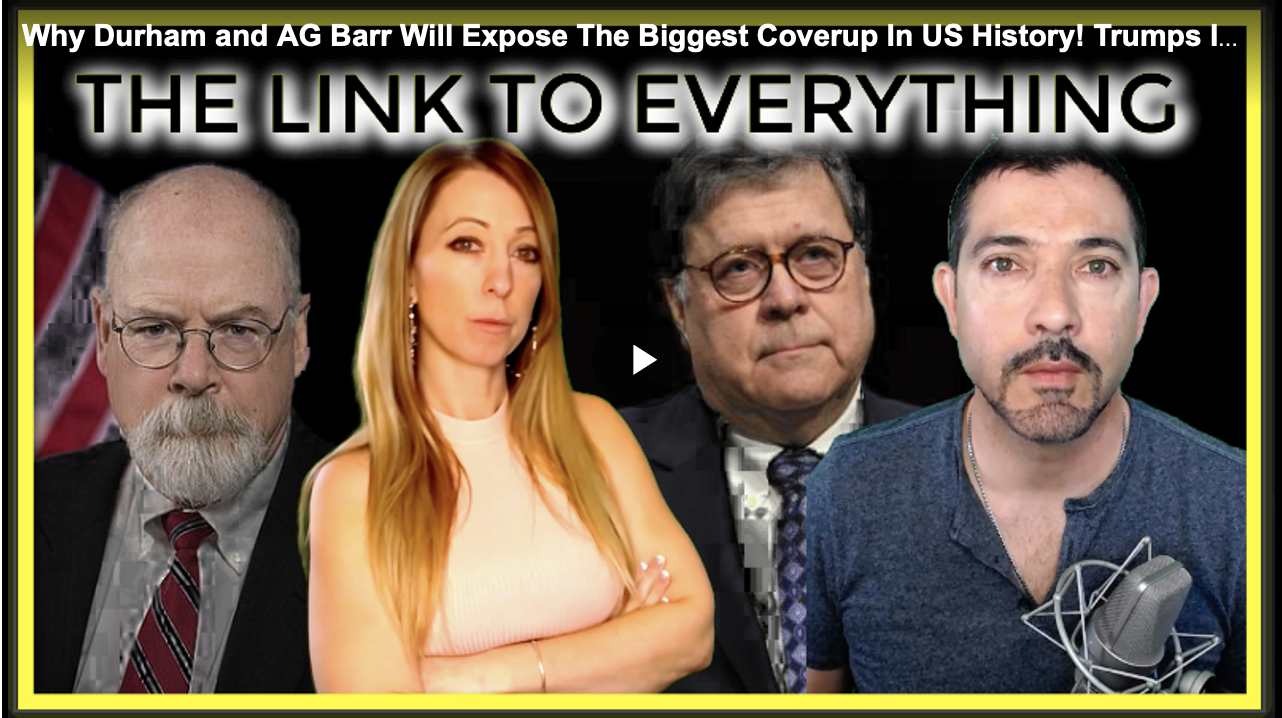
As Lisa Haven explains in this Brighteon video below, Durham’s criminal investigation is “the link to everything” and will expose the greatest cover-up in political history:

Observers are expecting criminal conspiracy charges to emerge from the Durham / Barr investigation. As The Gateway Pundit reports:

Former Trump campaign advisor George Papadopoulos reacted to the news tonight. Papadopoulos was set up by CIA-FBI operatives during the 2016 election.

George Papadopoulos: John Durham’s investigation has officially morphed into a criminal investigation. When I said Mifsud and Downer were in on it together and Halper was there to provide cover, I was serious. Expect conspiracy charges to come out of this. Great day for America!

Source: Natural News & The Gateway Pundit

Dick Morris: The Deep State is framing Trump on Ukraine | WND & The Western Journal

By Dick Morris, The Western Journal

Editor’s Note: There is always more going on than meets the eye especially via a highly politicized and polarized media from which we gather 99.9% of our information about what’s going on. To be truly informed, do your own research and learn from both sides of the equation to better understand the bigger picture. In this article we get a better understanding of why the US State Department is so riled up about Trump involving himself directly in foreign policy and building direct relationships with the leaders of the world (and why they are testifying against him).

Encased within the Democratic efforts to oust Trump is the determination of the deep state to limit presidential power to conduct foreign policy and the desire of allies of the EU to resist efforts to enlist the new Ukrainian president in their nationalist coalition.

Conservatives and Republicans are well aware by now of the deep state that permeates the Intelligence Community, having seen it operate to try to impeach President Donald Trump over phony charges of Russian collusion.

Now, meet the Deep State at State! The State Department and the National Security Council are filled with deep state operatives working feverishly to bring Trump down over the Ukraine affair.

Their pique at Trump’s heavy-handed intervention in Ukraine is rooted in their deep-seated belief that the president must be kept out of foreign policy despite the constitutional mandate that unambiguously puts in his lap.

Recognizing the president’s formal power, the deep state folks work overtime to get the president to do their bidding on foreign affairs.

William Taylor, former charge d’affaires of the U.S. embassy in Kiev told House investigators that he “began to sense that the two decision-making channels [formulating U.S. policy toward Ukraine] — the regular and the irregular — were separate and at odds.”

Translation: How dare the president conduct foreign policy without consulting us!

Atlanticist to the core, the deep state is heavily invested in the idea of globalism and the institution of the European Union. It watched, with alarm and dismay, the defection of the UK from the EU. They see Brexit as a tragedy. But now their focus turns to the eastern border of the EU as it threatens to defect as well.

There, a determined effort led by Hungarian prime minister Viktor Orban (a former client) is eroding the power of the EU. Allying with like-minded leaders in Poland and Italy, he is crafting an independent course away from Brussels.

President Trump set off alarm bells in the State Department deep state when, according to The New York Times, “Trump met, over the objections of this national security advisor, with one of [Ukraine’s] most virulent critics, Prime Minister Viktor Orban of Hungary.”

At that meeting, The Times said, Trump “was exposed to a harsh indictment of Ukraine” that “set the stage for events that led to the impeachment inquiry.”

Orban’s sin is opposing the EU, restricting Muslim immigration and battling with fellow Hungarian George Soros. Defying the EU, he has built a wall around Hungary to protect his country of only nine million from a hostile takeover by Muslim refugees and immigrants. He refuses to admit his quota of refugees assigned Hungary by the EU.

Eager to protect the 150,000 Hungarians living in Ukraine from forced assimilation, he has battled for permitting Hungarian to be used in the regions in which they live.

Seeking to preserve national identity is a no-no in the world of the EU.

And Organ also struck at left-wing billionaire George Soros who founded the Central European University in Budapest after the fall of communism. It’s increasingly leftist, anti-nationalist orientation has drawn criticism from Orban who has moved to restrict its government funding.

Orban is building a nationalist coalition in Eastern Europe that opposes immigration and resists EU domination. His Polish ally, Jaroslaw Kaczyński (another former client) just won the election there a few months ago. Leaders in Italy and other eastern European countries have backed Orban’s crusade.

Source: WND & The Western Journal

Senate Resolution Urges Formal House Vote on Initiating Impeachment Inquiry | The Epoch Times

Sen. Lindsey Graham (R-S.C.) holds a press conference about the House impeachment inquiry process, on Capitol Hill in Washington on Oct. 24, 2019. (Charlotte Cuthbertson/The Epoch Times)

Editor’s Note: We the People are witnessing an attempted coup d’tat of our United States government in broad daylight and this impeachment inquiry is a smokescreen, a distraction, a false narrative and coverup orchestrated by the many co-conspirators who before Trump was elected in 2016 decided to manufacture a false accusation re: Russian collusion to discredit him. These “enemies of the state” decided that should Trump be elected that they would take it into their own hands to overthrow a duly elected President of the United States. If you are one of the many naive American’s who actually believe what you read in the mainstream, corporate newspapers and are not savvy enough to understand the hidden powers that pull the strings behind the curtain of the U.S. Congress, then shame on you. Wake Up America before it’s too late!

Sen. Lindsey Graham (R-S.C.) introduced a non-binding resolution on Oct. 24 calling on House Democrats to hold a formal vote on initiating an impeachment inquiry before moving any further in the investigation of President Donald Trump.

Thirty-five Republican senators co-sponsored the resolution, which also demands that the impeachment inquiry accommodate Trump with constitutional due-process protections. By early evening on Oct. 24, the number of co-sponsors had reached 46.

“The House of Representatives is abandoning more than a century’s worth of precedent and tradition in impeachment proceedings and denying President Trump basic fairness and due process accorded every American,” the resolution (pdf) states.

“One of the cornerstones of the American Constitution is due process: the right to confront your accuser, call witnesses on your behalf, and challenge the accusations against you.”

Senate Republicans unveiled the resolution one day after roughly three dozen House Republicans stormed a hearing room during a House Intelligence Committee impeachment deposition to demand that the closed-door hearings be opened to lawmakers and the public.

The resolution points out that during the three prior impeachment proceedings, the House held a formal vote to initiate an impeachment inquiry. In Trump’s case, the process was replaced by a press conference by House Speaker Nancy Pelosi (D-Calif.), the Republicans charge.

“The proposition that the Speaker acting alone may direct committees to initiate impeachment proceedings without any debate or a vote on the House floor is unprecedented and undemocratic,” the resolution states.

Prior impeachment proceedings allowed the presidents to have counsel present at hearings and depositions, according to the resolution. In each case, the presidents’ lawyers were allowed to introduce and object to evidence and call on and cross-examine witnesses.

“By contrast, the House’s current impeachment ‘inquiry’ provides none of these basic rights and protections to President Trump,” the co-sponsors say. “The main allegations against President Trump are based on assertions and testimony from witnesses whom he is unable to confront, as part of a process in which he is not able to offer witnesses in his defense or have a basic understanding of the allegations lodged against him.”

House Democrats are investigating allegations related to President Donald Trump’s phone call with Ukrainian President Volodymyr Zelensky. During the conversation on July 25, Trump asked Zelensky to look into two matters. The first request concerned a server tied to Crowdstrike, the cybersecurity firm that analyzed the Democratic National Committee server allegedly breached by Russian government hackers. The second request concerned allegations of corruption by former vice president Joe Biden and his son Hunter Biden.

The Democrats have conducted all of the hearings to date behind closed doors. The public’s access to the information has so far been limited to leaks to the media and a handful of documents published by the committees.

The Democrats have defended the process, claiming that lawmakers in prior impeachment proceedings worked from material collected through an investigation by a special counsel. Meanwhile, the lawmakers took up the current case without letting a special counsel conduct an inquiry. As a result, the process requires secrecy so that witnesses don’t adjust their testimony.

The constant leaks from the inquiry have undermined the advantages gained through secret proceedings. Republicans say they don’t have access to transcripts of the depositions. Meanwhile, leaked information seems to consist almost entirely of sections of testimony damaging to Trump.

The minority Republicans on the three committees conducting the impeachment inquiry don’t have the same rights as those that were granted to the minority Democrats during the House impeachment inquiry of President Bill Clinton, including the ability to issue subpoenas. The resolution calls on the Democrats to follow precedent and grant Republicans the same rights.

“We’re not telling the House they can’t impeach the president. What we’re telling the House is, there’s a right way to do it, and a wrong way to do it,” Graham told reporters. “This is one part legal, and two parts politics.”

The White House has refused to cooperate with the impeachment inquiry unless the Democrats hold a vote to formally launch the inquiry. The president has denied any wrongdoing in his call with Zelensky. The Ukrainian leader said he wasn’t pressured during the phone call.

Trump on Oct. 23 criticized the impeachment inquiry along lines similar to the Senate resolution.

“Do Nothing Democrats allow Republicans Zero Representation, Zero due process, and Zero Transparency,” the president wrote on Twitter. “Does anybody think this is fair?”

The Democrats allege that in order to pressure Zelensky, Trump placed a temporary hold on military aid to Ukraine. All of the witnesses who have testified to date say that Ukrainian officials were unaware of the hold until one month after the Trump–Zelensky phone call.

Source: The Epoch Times