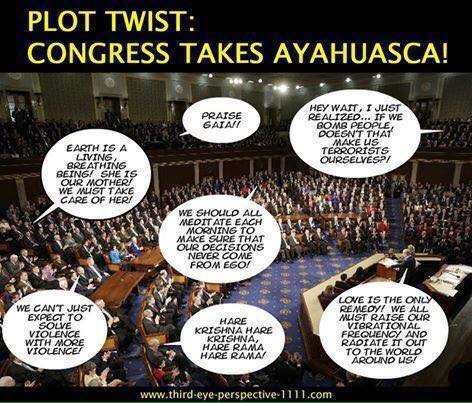
Congress Takes Ayahuasca | Cartoon
Editor’s Note: The Swami and I go way back to Ann Arbor, MI in the mid-seventies so we’re pleased to announce his annual “State of the Universe” address. Having a sense of humor is vital in these precocious and difficult times in our world.
Source: Wake Up Laughing & YouTube

 Hands up: who loves freedom of speech? By our count, roughly all of you now have your hands waving about in the air. And why wouldn’t you? Free speech is a cornerstone of any modern democracy and arguably the most important provision in the US Constitution.
But just because we all agree that something is awesome doesn’t mean that it’s going to be around forever. Right now, free speech is under assault across the world. And unless we do something to defend it soon, we’re gonna find ourselves living in a world where the “free” part of free speech is only ever used ironically.
You may have noticed that the Internet is a pretty nasty place. If you don’t believe us, feel free to go on Twitter and start sending out, say, pro-feminist or anti-Islam messages and see how long it takes for a lynch mob to form. But there’s recognizing that an environment is toxic, and then there’s attempting to sterilize it with a flamethrower. Right now, big Internet companies are choosing the latter.
Take the popular comment system Disqus. The company recently announced it was going to start censoring hate speech on its platform by deleting posts it deems “toxic.” In practical terms, this means that a shady algorithm will be removing reader comments from sites like Listverse without any input from our moderators or editors.
This is, to put it mildly, insane. It’s one thing for a site owner to decide what they will allow on their own site; it’s another for a comment platform to make that decision for them. Debates on controversial topics risk being censored because some biased algorithm deems something “inappropriate.” Then there’s the fact that it’s not Disqus’s place to delete inappropriate stuff in the first place. The First Amendment explicitly defends stuff most people would class as hate speech.[1] If we truly believe in free speech, that means believing that even the worst viewpoints have a right to be aired online.
In 2014, the Internet group Anonymous doxed a whole bunch of KKKmembers, releasing their identities online. People across the political spectrum cheered. Those who didn’t focused on the danger of accidentally outing an innocent person as a Klansman. But precious few spoke out about the real danger of doxing. By taking away these dumb racists’ right to express their dumbly racist opinions anonymously, the hackers were imperiling free speech for us all.
Multiple US Supreme Court rulings have asserted that the right to anonymous speech is covered by the First Amendment.[2] Three of the Founding Fathers, for example, wrote the Federalist Papers under a pseudonym. Anonymity gives us the chance to criticize the government without fear of reprisal. It lets us publish pictures of Muhammad without worrying about being gunned down in the street.
Doxing endangers all of that. It’s a growing threat in our online world, but actual doxing isn’t the real problem. It’s how we respond to it that really matters.
If we act like it’s cool to dox Klansmen, Gamergaters, outspoken feminists, or anyone at all, we’re signaling that some people don’t deserve anonymous speech. That’s a slippery path to go down. It means people will stop saying what they truly think for fear of their identity being outed. When we’re scared to speak our minds, we no longer have free speech.
Last week, Ireland announced it was dropping a blasphemy case against British actor and comedian Stephen Fry. Pause and let that sink in for a second. The crazy thing here isn’t that Ireland decided not to prosecute a comedian for saying God was “stupid.” It’s the fact that the law to prosecute him with even existed in the first place.
Sadly, the Irish example is one of a rising number of blasphemy cases that is threatening to destroy free speech across the world.[3] While Islamic nations tend to be worse, jailing or even executing people who insult the Prophet, Western countries are also getting in on the action. Poland prosecuted a singer in 2014 for ripping up a Bible onstage, while Greece handed out a ten-month suspended sentence to a guy who uploaded a picture of an Orthodox monk with pasta Photoshopped onto his face. Both convictions were quashed on appeal, but the fact that they ever went to trial is appalling.
As others have pointed out before, blasphemy laws don’t even make much sense on their own terms. If your God can’t deal with some doofus making spaghetti pictures of him, then he isn’t much of a God in the first place. Yet it seems not everyone sees it this way. As Britain’s Independent newspaper noted, a shocking number of people online responded to the 2015 Charlie Hebdo massacre not by reposting the offending cartoons (as we’re proud to say Listverse did) but by blaming the cartoonists for drawing them in the first place. If that’s not covertly supporting blasphemy laws, we don’t know what is.
It can seem right now like the media is everyone’s favorite punching bag. While it’s right and proper that journalists should be challenged on shoddy research, it’s a problem when people start thinking of journalists as the “enemy.” As the Index on Censorship has noted, this hostile climate led to 2016 being the most dangerous year for journalism in decades.[4]
Freedom of the press is so entwined with free speech that the First Amendment explicitly mentions it. If a journalist can’t file a story that makes the powerful look bad, then it doesn’t matter what the man on the street is or isn’t free to say; you are living in an anti-democratic society. Worryingly, this appears to be the case across the world more and more often. Journalists are frequently murdered for writing unflattering stories in places like Russia or locked up and “purged” from their jobs in countries like Turkey (as 2,500 recently were following the coup attempt against Erdogan).
Worryingly, the West, too, is turning its back on media freedom. France recently passed a law that could throw journalists in jail for seven years for protecting sources, while in the US, President Trump has threatened to muzzle the press with egregious new libel laws.
At what point did we as a society decide that it was cool to completely ruin people’s lives just for speaking their minds? That’s a serious question. In the last few years, a trend has been building that sees those who slip up and say something “bad” forced from their jobs, publicly humiliated, and never able to work again.
This is seen clearest on US campuses. Over the past few years, students have tried to destroy the lives of administrators who wrote an e-mail that refused to condemn insensitive Halloween costumes, other students who made “all lives matter” posters, fraternities that threw Kanye West–themed parties, journalism students who wrote articles critical of Black Lives Matter, and professors who committed microaggressions as bizarre as questioning the concept of microaggressions.[5]
Is anyone else shivering due to the subzero chilling effect here? Worryingly, such humiliation of those who speak up exists outside the campus, too. In 2013, two random guys at a tech conference were covertly filmed making jokes about “big dongles.” They wound up losing their jobs over the phrase’s perceived misogyny. When we’re at the stage that we can’t even make piss-poor jokes with our friends without our livelihoods being trashed, something is seriously wrong.
While we’re talking about insane assaults on free speech, we might as well deal with cultural appropriation. Wikipedia helpfully defines this as “ the adoption or use of the elements of one culture by members of another culture.” In practical terms, it means that talking about anything from a culture that isn’t your own can now land you in big trouble.
For example, a professor at the University of Ottawa had her student exercise classes cancelled for discussing yoga, with complainants likening her class to “genocide.” Also, food website Bon Appetit removed a contributor’s video and made them apologize after they confused the foods ramen and pho (which is certainly dumb but not worth getting censored over).[6] Or how about when Iggy Azalea was hounded online for being a white rapper. J.K. Rowling was harassed for daring to write a Native American magician into one of her books.
Does anyone else think this is completely absurd? While not as awful as arresting journalists or putting blasphemers on trial, we seem to have gotten to the stage where people are forced into silence on some subjects because they’re not from a specific demographic. When we’re seriously debating if it’s okay for a non-Asian food blogger to write Chinese food recipes, something has gone badly wrong with our culture’s conception of free speech.
There’s nothing like the fear of death to stop you from speaking your mind. That’s the whole concept behind the assassin’s veto. By gruesomely killing a handful of people who say something you dislike, you’ll shut down that entire avenue of conversation. Right now, it’s a veto that’s being wielded across the world to terrifying extremes.[7]
A whole lot of the time, it’s directed against those who insult or denigrate Islam. The murder of Dutch filmmaker Theo Van Gogh for making a film about Muslim women being abused, the massacre of the Charlie Hebdo staff, and the hacking to death of atheist bloggers in Bangladesh has made even joking about Muhammad a dance with death. But it goes further than just the extremists of one religion. In Mexico, drug cartels have taken to torturing and brutally murdering anyone who speaks out against them. In Italy, the Mafia does likewise. In the US, both pro-choice and anti-abortion activists have been shot for simply expressing their opinions.
The bleakest part of all this is that it works. Speeches, plays, concerts, comedy shows, and lectures are all routinely canceled because of threats. Feminists, critics of Islam, right-wing speakers, and more have all been forced to curtail their own freedom of speech in case someone kills them. The effect is to dampen free speech across the entire world.
Freedom of speech includes the right to protest speech you disagree with. Those who punch protestors at rallies can no more claim to support free speech than Lenin could claim to support capitalism. But there’s exercising your democratic right to protest, and then there’s using that right to completely shut down the views you’re protesting against. Recently, it seems that protestors are aiming solely for the latter.
The idea of creating an environment your opponent is afraid to enter seems to have really taken off around 2013. Prior to that, protests at campuses rarely blocked an invited speaker from attending. Today, you hear about canceled lectures[8] with mind-numbing regularity. Right-wing speakers like Milo Yiannopoulos, Anne Coulter, and Ben Shapiro have been chased off college campuses, as have left-wing speakers like pro-abortion Supreme Court justice Carol Beier. Each time it happens, it demonstrates how little value is now placed on free speech and enlightened debate, versus simply shouting your enemy down.
We can’t believe we have to write this sentence. Penning an essay that deals with student-lecturer relationships in US colleges is not sexual harassment. We all know that. Yet, sexual harassment is exactly what it has been classed as. In 2015, feminist film professor Laura Kipnis (pictured above) was placed under investigation and risked losing her job for writing that very essay. The reason for all this? The chilling, free speech–destroying Title IX.[9]
If you’ve never heard of it, Title IX was a piece of legislation which President Nixon introduced that originally protected women from discrimination in colleges. Under Obama, its remit was expanded, and now it deals with sexual assault and sexual violence against female students. At least, it’s supposed to. But the wording is so vague that it can conceivably be made to define almost anything as “assault” or “harassment.” The result? A swathe of American professors unable to start an intellectual discussion without wondering if they’re going to be fired and smeared as sexual abusers.
This isn’t abuse as you or I would define it. Professors have been labeled as sexual deviants simply for using the phrase “f—, no” in front of students. They’ve been investigated as sex offenders for having relationships with students years after those students have graduated. In the most chilling case of all, they’ve even been investigated for complaining about the chilling effect of Title IX itself.
By branding those who use rude words or want to discuss harassment as sex offenders, we’re destroying any pretense of intellectual freedom on US campuses. Not only that, but we’re trivializing genuinely awful things like rape, and for what?
We mentioned earlier that supporting free speech means supporting free speech you do not like. Intellectually, we all agree with this. But in reality? It seems when push comes to shove, many people are only cool with free speech so long as it aligns with their values.
We saw this recently with the firing of flamboyant alt-right controversialist Milo Yiannopoulos from Breitbart. As long as Milo was using his free speech to attack women, feminists, and liberals, Breitbart was willing to champion his rights. The moment Milo said something that shocked conservatives (namely defending gay relationships between older men and teenage boys), they ditched him. Or look at parts of the left. During the Bush years, they vigorously defended the rights of libraries to stock books that the religious right disagreed with. Now they want to ban those same books for including “microaggressions.”
The trouble with writing about free speech is that people love their partisanbubble. They love to believe, for example, that being anti–free speech is purely the preserve of college liberals. But college conservatives also shut down speakers and try to get professors fired. A National Coalition Against Censorship survey recently found that both sides of the political spectrum are demanding trigger warnings for the different things they find offensive in books.[10] Yet if you asked most of them what they thought of free speech, we’re willing to bet they’d say they love it and that it was those on the opposite side who were against it.
If we carry on this partisan path, things are just going to get worse where the freedom to speak our minds is concerned. The real, terrifying assaults on free speech don’t come when small groups try to impose restrictions on us. They come when politics so blinds us that we’re willing to let our side say anything they want and then cheer them on when they try to shut down the other side completely.
Source: ListVerse
 By Olivia Solon
Comey, has said that Americans should not have expectations of “absolute privacy”.
“There is no such thing as absolute privacy in America: there is no place outside of judicial reach,” Comey said at a Boston College conference on cybersecurity. The remark came as he was discussing the rise of encryption since Edward Snowden’s 2013 revelations of the NSA’s mass surveillance tools, used on citizens around the world.
Both the Snowden revelations and the CIA leak highlight the variety of creative techniques intelligence agencies can use to spy on individuals, at a time when many of us are voluntarily giving up our personal data to private companies and installing so-called “smart” devices with microphones (smart TVs, Amazon Echo) in our homes.
So, where does this leave us? Is privacy really dead, as Silicon Valley luminaries such as Mark Zuckerberg have previously declared?
Not according to the Electronic Frontier Foundation’s executive director, Cindy Cohn.
“The freedom to have a private conversation – free from the worry that a hostile government, a rogue government agent or a competitor or a criminal are listening – is central to a free society,” she said.
While not as strict as privacy laws in Europe, the fourth amendment to the US constitution does guarantee the right to be free from unreasonable searches and seizures.
That doesn’t mean citizens have “absolute privacy”.
“I don’t think there’s been absolute privacy in the history of mankind,” said Albert Gidari, director of privacy at the Stanford Center for Internet and Society. “You walk out in public and it’s no longer private. You shout from one window to another and someone will hear you in conversation.”
“At the same time things are more intrusive, persistent, searchable, they never die. So our conception of what is or isn’t risk from a privacy perspective does change and evolve over time.”
The law hasn’t kept pace with digital technologies. For example, there is a legal theory called the “third-party doctrine” that holds that people who give up their information to third parties like banks, phone companies, social networks and ISPs have “no reasonable expectation of privacy”. This has allowed the US government to obtain information without legal warrants.
Unlike the NSA techniques revealed by Snowden, the CIA appears to favour a more targeted approach: less dragnet, more spearfishing.
The WikiLeaks files show that the CIA has assembled a formidable arsenal of cyberweapons designed to target individuals’ devices such as mobile phones, laptops and TVs by targeting the operating systems such as Android, iOS and Windows with malware.
It’s encouraging to note that the government has yet to crack the encryption of secure messaging apps such as WhatsApp, Signal and Confide. However, it does not need to if it can instal malware on people’s devices that can collect audio and message traffic before encryption is applied.
Gidari isn’t that surprised. “It confirms what everyone saw in last week’s episode of 24. People expect these tools to exist,” he said, adding that people were more surprised that the FBI was initially incapable of breaking into the San Bernardino killer’s iPhone.
“People expect the government to have these magic tools,” he said.
American citizens should not be lulled into a false sense of security that the CIA only targets foreign nationals. The “Vault 7” documents show a broad exchange of tools and information between the CIA, the National Security Agency, and other US federal agencies, as well as intelligence services of close allies Australia, Canada, New Zealand and the United Kingdom.
“We can’t spy on our own citizens but we can spy on anyone else’s,” explained Neil Richards, a law professor from Washington University. “If agencies are friends with each other, they have everybody else do their work for them and they just share the data.”
“Dividing the world into American citizens and non-American citizens is a false dichotomy,” Gidari added. “We don’t have a monopoly on spy tools.”
This leaves us with a terrifying new prospect: government spies essentially deploying viruses and trojans against their own citizens.
The onus is now on the companies that make the devices to plug any holes in their operating systems – something they do regularly through bug bounty programs, where security researchers disclose vulnerabilities in return for rewards.
It’s clear from the CIA files that the US government has flouted this custom in order to stockpile “zero days” – undisclosed exploits – for its own advantage. This is a practice the US government has previously publicly denied.
“If companies aren’t aware that a vulnerability exists they can’t patch it. If it exists it can be exploited by any malicious actor – whether that’s a hacker, foreign state or criminal enterprise,” said Neema Singh Guliani, legislative counsel with the American Civil Liberties Union.
“I have a big problem with the government leaving us vulnerable to the same tools in hand so other nation states and hackers could exploit them,” Gidari said. “That isn’t protecting American citizens.”
Gidari’s view echoes Apple’s stance when the FBI demanded the company build a backdoor to the iPhone so they could access data on the San Bernardino killer’s phone.
“Apple believes deeply that people in the United States and around the world deserve data protection, security and privacy. Sacrificing one for the other only puts people and countries at greater risk,” the company said at the time. The iPhone maker was more muted in its response to the Vault 7 dump, vowing to “rapidly address” any security holes.
“There is nearly universal consensus from technologists that it’s impossible to build weaknesses or access mechanisms into technology that can only be used by the good guys and not the bad,” Cohn said.
This week’s revelations are sure to increase the strain on relations between Silicon Valley and the US government. While some of the older telephony companies such as AT&T and Verizon, which rely heavily on government contracts, have a history of compliance with government requests, tech giants Google, Facebook, Microsoft and Apple have proved to be less compliant.
It’s not possible to meaningfully participate in modern life without relationships with some or all of these technology companies processing our data, Richards added. So it’s important to know where their loyalties lie – to their customers or to government.
Since Snowden’s revelations of mass surveillance, companies such as Apple, Google and Microsoft have been working hard to rebuild trust with consumers through strengthening security, fighting government data requests and releasing transparency reports highlighting when and how many requests are made.
“It’s a very encouraging development if we care about civil liberties and the right to privacy, but at the same time it’s unsatisfying if the discretion of a company is the only real protection for our data,” Richards said.
“We need to build the digital society we want rather than the one handed to us by default,” he added.
This will require a complete overhaul of the laws relating to when the government can collect location and content information, something civil liberty campaigners have been pushing for.
“These decisions need to be made by the public, not by law enforcement or tech executives sitting in private,” Richards said.
Source: The Guardian
 Johnny Liberty, Editor’s Note: Even though this is old news it’s pertinent today as so many people are unwilling to remove the blindfolds and see what’s happening behind the scenes of current events. Turns out this “conspiracy theory” is “conspiracy fact”.
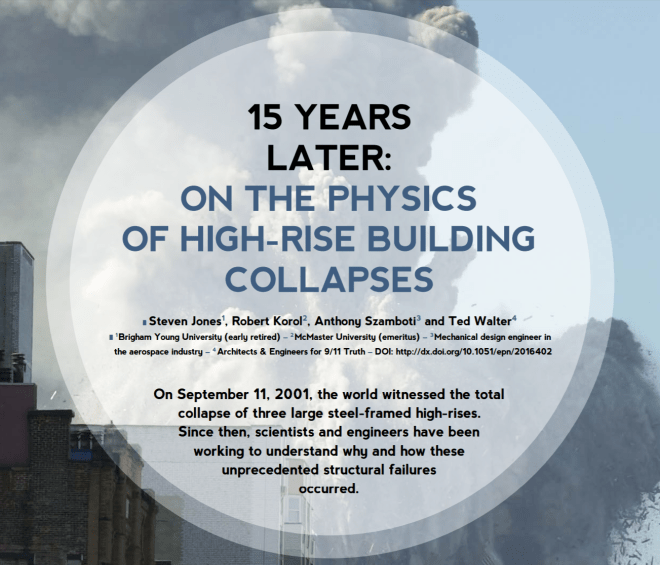
Over the past 15 years many highly respected academics and experts have come forward to challenge the official narrative on the collapse of the WTC towers forwarded by the U.S. government. The official government position holds that the collapse of all three towers was due to intense heat inside of the buildings.
But a new forensic investigation into the collapse of the three World Trade Center towers on 9/11, published in Europhysics News – a highly respected European physics magazine – claims that “the evidence points overwhelmingly to the conclusion that all three buildings were destroyed by controlled demolition.”
While many in the mainstream have attempted to label anyone questioning the official narrative as “tin foil hat” conspiracy theorist, many highly respected experts have come forward to lampoon the idea that the buildings collapsed due to the intense heat and fires following two terrorist-directed plane crashes.
The new report is the work of Steven Jones, former full professor of physics at Brigham Young University, Robert Korol, a professor emeritus of civil engineering at McMaster University in Ontario, Canada, Anthony Szamboti, a mechanical design engineer with over 25 years of structural design experience in the aerospace and communications industries and Ted Walter, the director of strategy and development for Architects & Engineers for 9/11 Truth, a nonprofit organization that today represents more than 2,500 architects and engineers.
The comprehensive report in Europhysics Magazine directly challenges the official narrative and lends to a growing body of evidence that seriously questions the veracity of the government narrative.
In 2002, the National Institute of Standards and Technology remarked that the case was exceptionally bizarre. There were no other known cases of total structural collapses in high-rise buildings caused by fires and so it is deeply unusual that it should have happened three times in the space of one day, noted NIST.
Official investigations have never been able to thoroughly and coherently explain how this might have happened and various teams tasked with examining the collapse have raised difficult questions about the veracity of the government’s story.
Perhaps most damning of all, the experts claimed that after a thorough forensic analysis of video footage of the building’s collapse, it revealed signs of a controlled implosion. Additionally, Jones has co-authored a number of papers documenting evidence of unreacted nano-thermitic material in the WTC dust.
The authors of the report note that the buildings fell with such speed and symmetry that they there was no other feasible explanation for the sudden collapse at free fall speeds – directly refuting studies that attempted to debunk the idea that the building fell without resistance. These respected experts’ new forensic analysis only adds to the growing movement of people calling for a new and impartial investigation into the collapse of the World Trade Center.
Revealing the scope and breadth of public disbelief in the official government narrative surrounding the events of 9/11, even presidential candidate Jill Stein has recently called for a new investigation.
When NSA whistleblower Edward Snowden leaked details of massive government surveillance programs in 2013, he ignited a raging debate over digital privacy and security. That debate came to a head this year, when Apple refused an FBI court order to access the iPhone of alleged San Bernardino Terrorist Syed Farook. Meanwhile, journalists and activists are under increasing attack from foreign agents. To find out the government’s real capabilities, and whether any of us can truly protect our sensitive information, VICE founder Shane Smith heads to Moscow to meet the man who started the conversation, Edward Snowden.
Source: VICE News
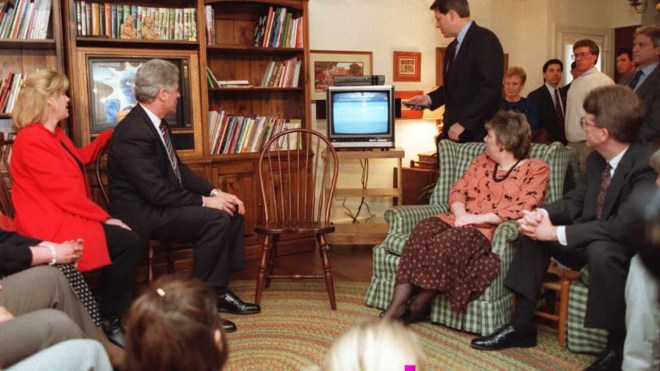 The media has become controlled by a handful of corporations thanks to the Telecommunications Act of 1996.
By Michael Corcoran
Wall Street’s sinister influence on the political process has, rightly, been a major topic during this presidential campaign. But history has taught us that the role that the media industry plays in Washington poses a comparable threat to our democracy. Yet this is a topic rarely discussed by the dominant media, or on the campaign trail.
But now is a good time to discuss our growing media crises. Twenty years ago last month, President Bill Clinton signed the Telecommunications Act of 1996. The act, signed into law on February 8, 1996, was “essentially bought and paid for by corporate media lobbies,” as Fairness and Accuracy in Reporting (FAIR) described it, and radically “opened the floodgates on mergers.”
The negative impact of the law cannot be overstated. The law, which was the first major reform of telecommunications policy since 1934, according to media scholar Robert McChesney, “is widely considered to be one of the three or four most important federal laws of this generation.” The act dramatically reduced important Federal Communications Commission (FCC) regulations on cross ownership, and allowed giant corporations to buy up thousands of media outlets across the country, increasing their monopoly on the flow of information in the United States and around the world.
“Never have so many been held incommunicado by so few,” said Eduardo Galeano, the Latin-American journalist, in response to the act.
Twenty years later the devastating impact of the legislation is undeniable: About 90 percent of the country’s major media companies are owned by six corporations. Bill Clinton’s legacy in empowering the consolidation of corporate media is right up there with the North American Free Trade Agreement (NAFTA) and welfare reform, as being among the most tragic and destructive policies of his administration.
The Telecommunications Act of 1996 is not merely a regrettable part of history. It serves as a stern warning about what is at stake in the future. In a media world that is going through a massive transformation, media companies have dramatically increased efforts to wield influence in Washington, with a massive lobbying presence and a steady dose of campaign donations to politicians in both parties — with the goal of allowing more consolidation, and privatizing and commodifying the internet.
This issue has not been central in the 2016 presidential election. But it is deeply concerning that, of all the presidential candidates running in 2016, the Big Media lobby has chosen to back Hillary Clinton. Media industry giants have donated way more to her than any other candidate in the race, according to data from the Center for Responsive Politics. In light of this, we must be mindful of the media reform challenges we face in the present, as we try to prevent the type of damage to our democracy that was caused by the passing of this unfortunate law.
A Threat to Democracy: The Telecommunications Act and Media Consolidation
When President Bill Clinton signed the Telecommunications Act into law, he did so with great fanfare. The bill, which was lobbied for in great numbers by the communications and media industry, was sadly a bipartisan misadventure — only 3 percent of Congress voted against the bill: five senators and 16 members of the House, including then-Rep. Bernie Sanders.
At the time, President Clinton touted the law as “truly revolutionary legislation … that really embodies what we ought to be about as a country.” House Speaker Newt Gingrich boasted ofprojected consumer savings and private job growth. Rep. John Dingell (D-Michigan) “thanked God” for the bill that would “make this country the best served, the best educated and the most successful country … in all areas of communications.”
Despite all of these glowing words, the consequences of the bill were disastrous. The act “fueled a consolidation so profound that even insiders are surprised by its magnitude,” said one trade publication, according to Robert McChesney, in his book, Rich Media, Poor Democracy: Communication Politics in Dubious Times.
“Before the ink was even dry on the 1996 Act,” wrote S. Derek Turner, research director of Free Press, in a 2009 report proposing a national broadband strategy, “the powerful media and telecommunications giants and their army of overpaid lobbyists went straight to work obstructing and undermining the competition the new law was intended to create.”
Media consolidation was already an extremely pressing concern long before 1996. In 1983, Ben Bagdikian published his groundbreaking book, The Media Monopoly, which revealed that just 50 corporations owned 90 percent of the media. That number gradually dwindled over the coming 13 years and was accelerated by the Telecommunications Act. This has led us to the aforementioned crisis where more than 90 percent of the media is owned by just six companies: Viacom, News Corporation, Comcast, CBS, Time Warner and Disney.
Radio has seen an equally appalling consolidation, which has been horrendous for both news media and music. In 1995, before the Telecommunications Act was passed, companies were not allowed to own more than 40 radio stations. “Since passage of the 1996 Telecommunications Act, Clear Channel [now called iHeartMedia] has grown from 40 stations to 1,240 stations — 30 times more than congressional regulation previously allowed,” according to a report from the Future of Music Coalition.
Local newspapers, too, have been stung by these deregulations. Gannett, for instance, owns more than 1,000 newspapers and 600 print periodicals. Layoffs have been the norm for the company, including at USA Today, the paper with the largest circulation in the country, where layoffs were described as a “total bloodbath” in the American Journalism Review.
Save the Internet: The Next Big Media Battle
There was a lot at stake when media companies lobbied for reform in 1996. There is just as much at stake today in the battle for a free and open press. Not only have big media companies continued to push for more consolidation and mergers, but they are also seeking to commodify and privatize the internet. This has become a major concern for advocates of “net neutrality,” who want to “save the internet,” and ensure it is protected as a public utility with equal access for everybody. An FCC ruling in February 2015 has protected the internet for now, but as Free Press warns, the internet is still “in danger.”
“Net neutrality has made the internet an unrivaled space for free speech, civic participation, innovation and opportunity. Net neutrality prohibits online discrimination and gives any individual, organization or company the same chance to share their ideas and find an audience,” explains Free Press’s website, Save the Internet. “Companies like Comcast and Verizon aren’t used to losing in Washington, and they’ll do everything they can to knock down the Title II protections the FCC approved on Feb. 26, 2015.”
The organization is right to be concerned. One reason for the passage of the Telecommunications Act of 1996, as McChesney wrote in 1997, was the sheer power that the media and communications industry has in Washington. “Both the Democratic and Republican parties have strong ties to the large communication firms and industries, and the communication lobbies are among the most feared, respected and well-endowed of all that seek favors on Capitol Hill.”
Today that power and influence has only increased. “From 2002-2008, the industry increased its spending on lobbying efforts every year,” reports the Center for Responsive Politics. “The streak snapped when the Great Recession set in and most clients cut back on their DC efforts, and then reversed again in 2013. In 2014, cable and satellite providers spent nearly $8.1 [million] on lobbying.”
Big Media’s Relationship With Hillary Clinton
What is most revealing when analyzing the donation patterns of these industries in the data from the Center for Responsive Politics — be it cable television, print and periodicals, radioor telecom services — is that Hillary Clinton is, by far, the largest recipient of donations of any candidate in the 2016 election in either party. In fact, of all the top industries that have donated to Clinton, the TV/movies/music category ranks behind only the securities and investments category. (This data is from reports filed on January 31, 2016, according to the Center for Responsive Politics.)
More troubling is that these filings come on the heels of a report from Politico that the Clinton Foundation has received donations, some of them very large, from most of all the major media companies directly: Viacom, News Corporation, Reuters, NBCUniversal, Newsmax, Time Warner, Mort Zuckerman (owner of US News &World Report and the New York Daily News), Comcast, AOL Huffington Post Media and Robert Allbritton (owner of Politico). George Stephanopoulos, one of ABC News’ most visible journalist and a former staffer for President Clinton, has also been under scrutiny for not disclosing a $75,000 donation to the foundation.
Of course, the Clinton Foundation is not a political campaign and does some philanthropic work. So while this all might be legal, it is extremely unsettling, especially in tandem with all the campaign donations Hillary Clinton has received from the major players in this industry.
In March 2015, for instance, a Comcast executive held a $50,000 per plate fundraiser for Clinton’s super PAC. “Comcast NBCUniversal operates in 39 states and has 130,000 employees across the country,” said company spokeswoman Sena Fitzmaurice at the time. “It is important for our customers, our employees and our shareholders that we participate in the political process.”
Of course, media companies don’t just donate to Clinton, but also to members of Congressfrom both parties. Further, as the Center for Responsive Politics reports, the FCC is filled with “revolving-door” employees, who have been switching back and forth between government work and lobbying for Comcast.
Their aggressiveness in Washington makes them a dangerous enemy in the fight for free and democratic media. In this environment, it should come as no surprise that the position of FCC chairman is typically held by a former lobbyist for the cable industry, such as Tom Wheeler, the current chairman, who was once president of the National Cable and Telecommunications Association, a major opponent of net neutrality.
And while it is good news that Clinton has come out in favor of net neutrality, it is a reasonable fear that she could change her views once elected, especially given her relationship with Big Media. It would not be the first time a president has changed a view after being elected, as we learned when Barack Obama embraced a mandate in health care, or when George H.W. Bush raised taxes, despite his infamous promisethat he never would.
It is important to note that, whatever her relationship with the telecommunications industry, it is not fair to blame Hillary Clinton for the Telecommunications Act of 1996. As first lady, Clinton was not in charge of telecommunications policy and there doesn’t appear to be evidence she played a role in constructing or fighting for the law in the White House. In fact, 20 years later, it is difficult to find any public statements from Hillary Clinton expressing her opinion about the law or its impacts. She did address a question at the 2012 YearlyKos convention about the Telecommunications Act. Her response, however, did little to clarify her views on the subject. She said:
You’ll have to ask [then-Vice President] Al Gore. We’ve had a lot of media consolidation. We’ve had some good competition. We have a lot that we need to do to begin to create a more competitive framework. Al was very involved in designing and pushing that through — he is an expert; I am not … We’ve got to take a hard look at this and I don’t want to say something I may not really support. So I have to look at that proposal.
Clinton is now, however, deep into a presidential run and could well be responsible for appointing the head of the FCC. She owes it to voters to describe her views on the Telecommunications Act, and on media consolidation more broadly, in a way that goes beyond advising Americans to “go ask Al Gore.”
Why Media Reform Matters
When McChesney observed that the communications lobby was “among the most feared, respected and well-endowed of all” groups in Washington, he also pointed out one of the great challenges about trying to fight Big Media.
“[The] only grounds for political independence in this case,” he wrote about the debate over the Telecommunications Act, “would be if there were an informed and mobilized citizenry ready to do battle for alternative policies. But where would citizens get informed?”
In other words, how can we have a real debate about media issues, when we depend on that very media to provide a platform for this debate? It is no surprise, for instance, that the media largely ignored the impact of Citizens United after the Supreme Court decision helped media companies generate record profits due to a new mass of political ads. “Super PACs may be bad for America, but they’re very good for CBS,” said CBS president Les Moonves, in a rare moment of candor at an entertainment conference in 2012.
This catch-22 is indeed one of the great difficulties about fighting for a vibrant media and a healthy democracy. But it is a challenge advocates of free media must embrace. Supporting independent media is one important way to help bring light to issues the corporate media ignores.
Media reform is the issue that affects all other issues. As the impact of the Telecommunications Act of 1996 has shown, democracy suffers when almost all media in the nation is owned by massive conglomerates. In this reality, no issue the left cares about — the environment, criminal legal reform or health care — will get a fair shake in the national debate.
Source: This post originally appeared at Truthout.
Foster: Last November, when we finally felt that the research we’d been doing for several years since the film came out had progressed to the point where it was solid enough to begin to share publicly, we shared a bunch of things. Here are some of the things we were sharing then that have come to pass.
The BRICS bank has now been funded and is going operational. There is a Shanghai gold exchange. There is a new rating service, which provides an option to Fitch, Moody’s, Standard & Poor’s, and so forth that I think is going to be much more honest in its ratings given that it’s not beholden to the Western banking cabal to do their bidding on rating particular corporations and governments, especially the U.S. The AIIB, the Asian Infrastructure Investment Bank, has now been launched with the participation of usual U.S. allies like the U.K. and Germany and over 50 other countries. The U.S. has chosen not to participate in the founding of that. Japan is the only other major country that has chosen not to participate at this time, most likely because Prime Minister Abe, as far as we can tell, is very much a puppet for the Rockefeller-Rothschild banking system so far. We have been told that there are deals going on behind closed doors that Japan is preparing to join but not until it is safe and appropriate to do that given their obligations.
Another one is that we had predicted (based on information from our sources) that there would be numerous banker and corporate CEO resignations. There have been over 500 of them worldwide. We also said that there would probably be suspicious deaths in the banking and corporate communities and we’ve been seeing those. I think there have been over 40 of those now in the European and U.S. banking communities. And there have been arrests of bankers in Iceland. Also, the U.S. has continued to stall the IMF 2010 reforms that would rebalance the representation of countries in the IMF in terms of decision-making and also include more currencies like the yuan in the international basket of currencies. The suppression of gold and silver prices has continued artificially and it looks from our sources we’re being told that that’s apt to continue until the yuan, the Chinese currency, is globally accepted because meanwhile they’re having the opportunity to buy gold and silver at low prices while the Western bankers are suppressing the prices in order to keep interest rates from going up which would so threaten the precarious situation of the major U.S. banks and governments themselves.
Finally, I just want to add in terms of the validation of the number of our insider sources that some of the things they say, we were like “What?” and then a few weeks or a few months later it happens again and again. Our sources predicted the end of quantitative easing by the Federal Reserve, which was pretty outrageous given that the Federal Reserve was still printing between $50 and $70 billion dollars of new fake money a month and now they have suspended that right on schedule. We are told that’s because their franchise to print money has been suspended by the Asian Elders to whom they’re indebted. They also predicted the revaluation of the Swiss Franc and a few days later that happened. Then, we were told that China would be making major infrastructure investments in Brazil. We were just told that about a week and a half to two weeks ago and then, sure enough, a few days later it started coming out in the mainstream news that that is in fact going on to the tune of tens of billions of dollars.
So that’s a sample of the things that might have sounded outrageous when we said them (or when people said them to us), but now they are in fact occurring and it certainly provides pieces of the puzzle showing the trends that are emerging.
So let’s move on to trends next. What are some of the trends that we’re seeing that are in the public view that have to do with global finance? First of all, negative interest rates, or what Chase Bank has taken to calling “balance sheet utilization fees” (BSUFs). What that really means is rather than getting interest on your deposits at the bank, now you’re going to have to pay them for them to keep your money while they fractionally multiply it for their own benefit. You can tell this is getting quite Orwellian and yet whatever they can get away with they’re obviously going to continue to do.
Meanwhile, Citigroup, Chase, Barclays, and the Royal Bank of Scotland have been fined a total of $9 billion, which is a lot of money, for their participation in rigging international markets. Again, that’s a lot of money and it’s good to see that there are some fines and so forth, but if you stand back and put this into context, there are no individual prosecutions, no jail time, no companies shut down, and meanwhile, during that same time, those same banks made an estimated $85 billion on their actions. Some wag might call this merely the cost of doing business and, of course, to the banks that is all it seems. It’s a little slap on the wrist publicly to keep the people quiet and keep them from revolting. They pay under 10% (or around 10%) basically as a fee to the government to let them keep rigging things and then business goes on as usual.
All of the major banks have also had to comply with a government requirement to submit plans for their own economic collapse, which of course, could lead to larger economic collapses and they’ve all done that. And there’s good reason for them to do that because the numbers I’ve heard are north of $700 trillion in derivatives debt that they’re currently holding on their books. Obviously, they’re not a solvent institution if that were to be taken seriously. Read more…
Source: Thrive Movement Thrive Connect
 Liberty International News