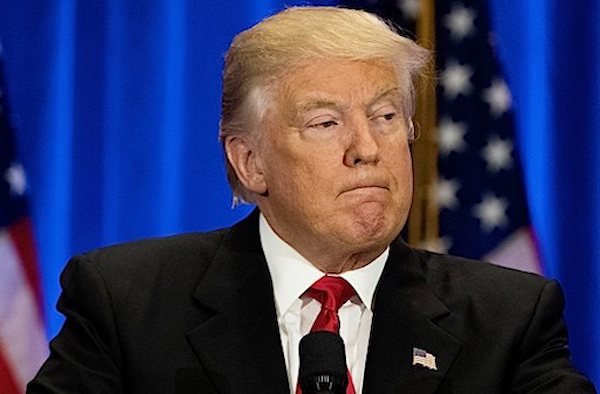
Tulsi Gabbard Nukes Dem Party During Primary Debate | Trending Politics

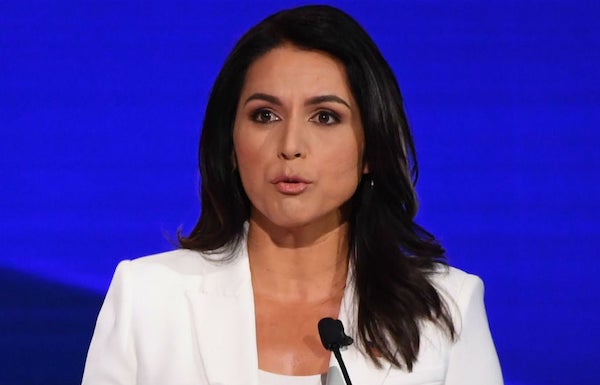
On Wednesday evening during the 2020 Democratic primary debates, Democratic candidate Tulsi Gabbard shredded her own party, stating that the Democratic party was no longer “for the people.”

“Our Democratic Party is unfortunately not the party that is of, by, and for the people,” Gabbard said.

“It is a party that has been and continues to be influenced by the foreign policy establishment in Washington represented by Hillary Clinton and others’ foreign policy, by the military industrial complex, and other greedy corporate interests,” Gabbard added.

Gabbard went on to say, “I’m running for president to be the democratic nominee that rebuilds our Democratic Party, takes it out of their hands, and truly puts it in the hands of the people of this country.”

Gabbard stated that she wanted the Democratic Party to become “a party that actually hears the voices who are struggling all across this country and puts it in the hands of veterans and fellow Americans who are calling for an end to this ongoing Bush, Clinton, Trump foreign policy doctrine.”

Gabbard’s attacks on her own party have been on the rise after failed 2016 Democratic presidential candidate Hillary Clinton accused her of being a Russian asset.

“They are also going to do third party again,” Clinton said during an interview with David Plouffe. “I’m not making any predictions, but I think they’ve got their eye on somebody who is currently in the Democratic primary and are grooming her to be the third-party candidate,” Clinton said while referring to Gabbard.

“She [Gabbard] is a favorite of the Russians. They have a bunch of sites and bots and other ways of supporting her so far. That’s assuming Jill Stein will give it up, which she might not because she is also a Russian asset,” Clinton bizarrely continued.

“They know they can’t win without a third-party candidate, and so I do not know who it’s going to be, but I can guarantee you they will have a vigorous third-party challenge in the key states that they most need it.”

In response to the attacks by Clinton, Gabbard said, “Great! Thank you @HillaryClinton. You, the queen of warmongers, embodiment of corruption, and personification of the rot that has sickened the Democratic Party for so long, have finally come out from behind the curtain.” Gabbard tweeted. “From the day I announced my candidacy, there has been a concerted campaign to destroy my reputation. We wondered who was behind it and why.”

She continued: “Now we know — it was always you, through your proxies and powerful allies in the corporate media and war machine, afraid of the threat I pose. It’s now clear that this primary is between you and me. Don’t cowardly hide behind your proxies. Join the race directly.”

Source: Trending Politics

The ‘Whistleblower’ and the President’s Right to Present a Defense | National Review

By Andrew C. McCarthy

Right church, wrong pew, as we Catholic types are wont to say.

As I tried to explain in Thursday’s column, Rand Paul is wrong to insist that the Sixth Amendment’s confrontation clause demands that the so-called whistleblower be unmasked and publicly questioned. That does not mean, though, that Senator Paul’s general idea (that the “whistleblower” should testify) is wrong; nor does it mean that the Constitution’s guarantee of trial rights is irrelevant.

The right to present a defense, also vouchsafed by the Sixth Amendment, is the guarantee on which Paul and the rest of the president’s supporters should focus.

This comes with the same caveats elaborated on Thursday. The Constitution vests the House and Senate with plenary authority over their respective impeachment proceedings (the House to decide whether to file articles of impeachment, the Senate to try the case). No court has the power to make either legislative chamber afford a particular quantum of due process.

That said, impeachment is inherently political. Here, it has been launched when we are less than a year out from an election in which the American people are supposed determine for themselves whether the president should keep his job. By the time impeachment has run its course, we could be just a few months from Election Day. Apparently, though, the political class is intent on end-running the sovereign, attempting to remove President Trump on its own. To pull that off, it will need to convince the country that (a) it has grounds so extraordinarily serious that Trump must be ousted forthwith and (b) the procedures under which it impeached were fundamentally fair.

I don’t think they have a prayer of demonstrating the former, such that two-thirds of the GOP-controlled Senate would be spurred to remove the president. (Trump’s approval rating among Republicans is hovering around 90 percent.) As for the latter concern, due process, there must be some and it must be meaningful — not because it is legally mandated, but because it is politically essential.

This is why many of the more pragmatic Democrats knew impeachment was a bad idea. As a practical matter, they don’t have close to the votes to remove, so it’s doomed to fail. The public knows it’s doomed to fail and may well resent Democrats for gratuitously putting the country through it. If Trump is denied due process, the proceedings will look like a kangaroo court and Democrats will be blamed. And if Trump is afforded due process, the case he presents may damage Democrats come November.

We do not have a ton of prior impeachment experience to go on, but the presidents in each episode were afforded the right to present a defense — both in the House proceedings leading to articles of impeachment and in the Senate trial.

The right to present a defense is importantly different from the right to confront the House Democrats’ case for impeachment.

As I noted in Wednesday’s column, the confrontation right emphasized by Senator Paul only allows the accused to cross-examine whatever witnesses the prosecution chooses to call in making its case. It does not give the accused a right to cross-examine every source who may have provided accusatory information, even sources whom the prosecutor does not call. Consequently, if the Democrats believe (as they do) that they could establish their case for articles of impeachment without summoning the so-called whistleblower as a witness, the president and his Republican defenders would have no right to call the whistleblower merely to cross-examine him on the statements made in his hearsay complaint.

By contrast, the right to present a defense is more extensive. Broadly speaking, it empowers an accused to do two things: (1) pointedly discredit the prosecution’s version of events, whether through cross-examination of the prosecution’s witnesses or presentation of the accused’s own witnesses, and (2) present the accused’s own witnesses and evidence in order to prove facts and theories that favor the accused and cast doubt on the worthiness of the prosecutor’s case.

In most any criminal case, courts will give the accused a decent-sized berth to prove and argue that the accused was set up by the investigators; or that the investigative procedures used were underhanded or otherwise skewed against the accused. Here, the president will want to persuade the factfinders (and the country) that Democrats have conspired with like-minded officials in the bureaucracy, particularly in the intelligence agencies (including the FBI and the Justice Department), to paralyze and, if possible, shorten the Trump presidency.

Most defenses based on government misconduct do not get very far. They tend to be fabricated, overblown, or focused on prosecutorial misconduct that is far afield from the charges against the accused. In this instance, however, the president has a great deal to work with.

Prominent Democrats and Trump detractors have been quite brazen in their public rhetoric about Trump (including, as is now being reported, the so-called whistleblower’s counsel, who has spoken explicitly about a “coup” by bureaucrats). Moreover, the Justice Department inspector general’s report on the Clinton emails investigation outlines in wince-inducing detail pervasive anti-Trump bias on the part of government investigators.

The same IG is about to release a report specifically dealing with investigative irregularities in the Trump-Russia investigation. Of course, we do not yet know what that report will yield (and even less what will come of the Barr/Durham probe of the Trump-Russia investigation’s origins). We do know, though, that the FBI and Justice Department represented to the Foreign Intelligence Surveillance Court that the FBI believed Trump’s campaign was likely complicit in Russia’s hacking operations to influence the 2016 election. And we know that the Obama administration — undoubtedly in collusion with foreign intelligence services — ran informants against Trump-campaign officials in an effort to establish a Trump–Russia conspiracy. Finally, we know that the president was repeatedly told that he was not a suspect of the FBI’s investigation, under circumstances where he appears to have been the central suspect.

After years of very aggressive, expensive investigation — by a special counsel who staffed his investigation with notorious partisans — no Trump–Russia conspiracy was found. Moreover, the FBI and the Justice Department on four occasions obtained warrants to monitor a former Trump-campaign adviser, telling the federal court under oath that he was a clandestine agent of a foreign power and a key cog in the Trump–Russia cyberespionage conspiracy; yet that adviser, Carter Page, was never accused of any crime, much less the traitorous misconduct outlined in the warrant applications.

The president and his supporters will want to lay much of this out in his defense case against any impeachment allegations. It is clearly relevant on the question whether the Democrats are to be believed that the Ukraine episode is what they portray it to be: a matter of such grave severity that Congress should remove the president from power just ahead of an election. The fact finders and the public are entitled to consider whether Democrats are blowing the Ukraine episode way out of proportion, just as they did with the collusion caper. Indeed, in the Clinton impeachment case, the president and his Democratic supporters were permitted to press the case that Republican claims about the egregiousness of his misconduct were overwrought, as evidenced, for example, by Clinton’s high approval ratings.

In the presentation of his defense, President Trump would thus seek to call the “whistleblower” as a witness (a hostile one, no doubt). His counsel and Republicans would proceed to try to demonstrate his connections to senior Democrats with intelligence-community ties who have been scurrilous in their public comments about the president. They would grill him on allegations that he is among the intelligence-community officials who leaked information in a manner intended to cast the president in a poor light. And they would press him on the preparation of his hearsay complaint — his consultation with an Adam Schiff staffer, his close collaboration with overtly anti-Trump lawyers, and so on. I might even have him read aloud from Schiff’s wannabe Godfather IV caricature of the Trump-Zelensky conversation and ask whether he helped the chairman’s staff write it.

It is in connection with the president’s right to present a defense, not his confrontation-clause right, that Senator Paul and the president’s defenders should frame their argument that the “whistleblower” should be subpoenaed to testify at public impeachment hearings.

A cautionary note. When I was a prosecutor, I loved defense cases. They were often not very well thought through — just an effort to dirty up investigators toward no coherent end, or toss in some favorable details about the accused that were quite beside the point of the charges. A defense case can open the door to prosecutors to place before the factfinders a great deal of unflattering information about the accused that would otherwise have been excluded as irrelevant. Defense lawyers tend to be much better at dismantling the prosecutor’s case for conviction than at presenting their own affirmative case for acquittal. When a defendant proceeded with an extensive defense case, I almost always ended up concluding that it had helped me more than it helped the defendant.

Presenting an affirmative case would not be without risk for the president. If the Democrats’ case for impeachment is weak and has no chance of success, he would probably be better advised to leave well enough alone. Nevertheless, if the president wants to argue that the bureaucracy has had it in for him from the start, and has coordinated with Democrats to undermine him, he has an unusual embarrassment of riches to exploit.

Source: National Review

GOP Sen. Kennedy on Impeachment Inquiry: ‘It’s Not Only Dumb’ — ‘It’s Dangerous’ | Breitbart

Editor’s Note: We couldn’t agree more.

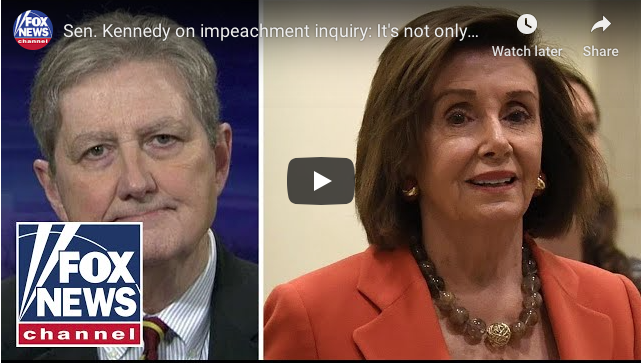
In a Friday interview with Fox News Channel’s “America’s Newsroom,” Sen. John Kennedy (R-LA) issued a stark warning for the House Democrats’ impeachment process over the alleged quid pro quo demand during a phone call between President Donald Trump and Ukraine President Volodymyr Zelensky.

Kennedy said the process is “not only dumb,” but it is also “dangerous” because it could lead to future “partisan impeachment” pushes.

“This whole process is not only dumb, but it’s dangerous,” Kennedy cautioned. “This is going to be the first partisan impeachment in the history of our country, and I’m worried that it’s going to establish a new normal. Some day we’ll have a Democratic president and then half of the country will be pushing us to impeach him or her. They’ll say, ‘Well, you did it to Trump, now do it to the new president.’ And I think that’s dangerous.”

Source: Breitbart News

2016 United States presidential election | Wikipedia

Editor’s Note: Despite the liberal media dominating the leftist narrative and the Democrats leading the charge in the impeachment inquiry, it seems the tables are turning positively towards reclaiming and restoring the Republic and the principles that once made America great. Since the impeachment inquiry began In September 2019 Trump’s twitter numbers have increased from 62.5 million to 66.6 million in little over a month. Polls have shown between a 50% overall support for the Trump Administration. The Republican Party has raised $305 million in this last quarter towards Trump’s reelection bid. Over 95% of Republicans stand behind Trump and his policies. What is also outstanding is how these numbers are comparable to the 2016 election results with the popular vote of 62,984,828, electoral vote of 304 with 30 states carried.

The 2016 United States presidential election was the 58th quadrennial American presidential election, held on Tuesday, November 8, 2016. The Republican ticket of businessman Donald Trump and Indiana Governor Mike Pence defeated the Democratic ticket of former Secretary of StateHillary Clinton and U.S. Senator from Virginia Tim Kaine, despite losing the popular vote.[2] Trump took office as the 45th president, and Pence as the 48th vice president, on January 20, 2017.

Trump emerged as the front-runner amidst a wide field of Republican primary candidates, while Clinton defeated Senator Bernie Sanders and became the first female presidential nominee of a major American party. Trump’s populist, nationalist campaign, which promised to “Make America Great Again” and opposed political correctness, illegal immigration, and many free-trade agreements,[3] garnered extensive free media coverage.[4][5] Clinton emphasized her extensive political experience, denounced Trump and many of his supporters as bigots, and advocated the expansion of President Obama’s policies; racial, LGBT, and women’s rights; and “inclusive capitalism“.[6] The tone of the general election campaign was widely characterized as divisive and negative.[7][8][9] Trump faced controversy over his views on race and immigration, incidents of violence against protestors at his rallies,[10][11][12] and his alleged sexual misconduct, while Clinton’s campaign was undermined by declining approval ratings[13] due to concerns about her ethics and trustworthiness,[14] and an FBI investigation of her improper use of a private email server, which received more media coverage than any other topic during the campaign.[15][16]

Clinton led in nearly every pre-election nationwide poll and in most swing state polls, leading some commentators to compare Trump’s victory to that of Harry S. Truman in 1948 as one of the greatest political upsets in modern U.S. history.[17][18] While Clinton received 2.87 million more votes than Trump did (the largest margin ever for a losing presidential candidate),[19] Trump received a majority of electoral votes and won upset victories in the pivotal Rust Belt region. Trump won six states that Democrat Barack Obama had won in 2012: Florida, Iowa, Michigan, Ohio, Pennsylvania, and Wisconsin.[20] Ultimately, Trump received 304 electoral votes and Clinton garnered 227, as two faithless electors defected from Trump and five defected from Clinton. Trump is the fifth person in U.S. history to become president while losing the nationwide popular vote.[b] He is the first president with neither prior public service nor military experience, and the oldest person to be inaugurated for a first presidential term.

The United States government’s intelligence agencies concluded on January 6, 2017, that the Russian government had interfered in the 2016 elections[22][23][24] in order to “undermine public faith in the U.S. democratic process, denigrate Secretary Clinton, and harm her electability and potential presidency”.[25] A Special Counsel investigation of alleged collusion between Russia and the Trump campaign began in May 2017[26][27]and ended in March 2019. The investigation concluded that Russian interference to favor Trump’s candidacy occurred “in sweeping and systematic fashion”, but “did not establish that members of the Trump campaign conspired or coordinated with the Russian government”.[28]

Source: Wikipedia

War Propaganda: “Fake News” and the Pentagon’s Office of Strategic Influence (OSI) | Collective Evolution & Global Research

Editor’s Note: Much of this article is excerpted from the original by Michel Chossudovsky of Global Research. Excellent background to the intelligence operation behind the impeachment effort.

By Arjun Walla

  • The Facts:The influence of intelligence and government agencies when it comes to mainstream media is quite large. This article provides numerous examples from documents to whistleblowers that clearly prove this point.
  • Reflect On:Our world has become quite Orwellian with regards to free and open information. There now seems to be a ‘Ministry of Truth’ that is hiding information from people, and telling them what to believe and how to think. Censorship is rampant.

A declassified document from the CIA archives in the form of a letter from a CIA task force addressed to the Director of the Central Intelligence Agency details the close relationship that exists between the CIA and mainstream media and academia.

The document states that the CIA task force “now has relationships with reporters from every major wire service, newspaper, news weekly, and television network in the nation,” and that “this has helped us turn some ‘intelligence failure’ stories into ‘intelligence success” stories,’ and has contributed to the accuracy of countless others.” Furthermore, it explains how the agency has “persuaded reporters to postpone, change, hold, or even scrap stories that could have adversely affected national security interests or jeopardized sources and methods.”

Although it is a document outlining their desire to become more open and transparent, the deception outlined by various whistleblowers (example) requires us to read between the lines and recognize that the relationships shared between intelligence agencies and our sources of information are not always warranted and pose inherent conflicts of interest.

Herein lies the problem: What is “national security,” and who determines that definition? JFK bravely told the world that the “dangers of excessive and unwarranted concealment of pertinent facts far outweigh[] the dangers which are cited to justify it.” He also said that “there is very grave danger that an announced need for increased security will be seized upon by those anxious to expand its meaning to the very limits of official censorship and concealment.” 

“National security” is now an umbrella term used to justify concealing information, but who makes these decisions?

The real reason why people like Julian Assange are treated the way they are treated is because they threaten immoral corporate and elitist actions/interests of various governments and institutions, and because they simply share truth and information.

This is why we are also seeing the mass censorship of alternative media outlets, like Collective Evolution.

Not long ago, William Arkin, a longtime well known military and war reporter who is best known for his groundbreaking, three-part Washington Post series in 2010, went public outing NBC/MSNBC as completely fake government run agencies.

He blasted NBC News along with MSNBC news in an email for “becoming captive and subservient to the national security state, reflexively pro-war in the name of stopping President Donald Trump, and now the prime propaganda instrument of the War Machine’s promotion of militarism and imperialism.” This is something, based on my research, mainstream media has always been. It’s why they were created in the first place.

Arkin stated that, as a result of this, “the national security establishment not only hasn’t issued a beat but indeed has gained dangerous strength, and “is ever more autonomous and practically impervious to criticism.”

Another great quote comes to mind here,

“The real menace of our Republic is the invisible government, which like a giant octopus sprawls its slimy legs over our cities, states and nation . . .  The little coterie of powerful international bankers virtually run the United States government for their own selfish purposes. They practically control both parties . . .  [and] control the majority of the newspapers and magazines in this country. They use the columns of these papers to club into submission or drive out of office public officials who refuse to do the bidding of the powerful corrupt cliques which compose the invisible government. It operates under cover of a self-created screen [and] seizes our executive officers, legislative bodies, schools, courts, newspapers and every agency created for the public protection.”  (source)(source) – Mayor of New York City from 1918-1925

MSNBC’s star national security reporter Ken Dilanian was widely mocked by media outlets for years for being an uncritical CIA stenographer before he became a beloved NBC/MSNBC reporter, and let’s not forget CNN’s Anderson Cooper’s connections to the CIA.

Operation Mockingbird, a CIA program to infiltrate mainstream media and use it to influence the minds of the masses decades ago, seems to be in full effect today, at a larger scale than anyone can possibly imagine.

In early 2018, NBC hired former CIA chief John Brennan to serve as a “senior national security and intelligence analyst.”

Dr. Udo Ulfkotte was a top German journalist and editor and has been for more than two decades. He went on the record stating that he was forced to publish the works of intelligence agents under his own name, also mentioning that noncompliance would result in him losing his job. Not long ago, he made an appearance on RT news Stating that:

“I’ve been a journalist for about 25 years, and I was educated to lie, to betray, and not to tell the truth to the public. But seeing right now within the last months how the German and American media tries to bring war to the people in Europe, to bring war to Russia — this is a point of no return and I’m going to stand up and say it is not right what I have done in the past, to manipulate people, to make propaganda against Russia, and it is not right what my colleagues do and have done in the past because they are bribed to betray the people, not only in Germany, all over Europe.” (source)

There are many examples, the information above is simply small fraction of information regarding a big problem.

This is why I thought it was important to share a piece written by by Dr.Michel Chossudovsky, titled “War Propaganda: “Fake News” and the Pentagon’s Office of Strategic Influence (OSI). Chossudovsky is an award-winning author, Professor of Economics (emeritus) at the University of Ottawa, Founder and Director of the Centre for Research on Globalization (CRG), Montreal.  It was originally posted on hist website, GlobalResearch.ca.

War Propaganda: “Fake News” and the Pentagon’s Office of Strategic Influence (OSI)

The following text on Rumsfeld’s “Office of Strategic Influence” (OSI) was first published by Global Research in January 2003 two months before the onslaught of the war on Iraq. The analysis largely pertained to the role of the Pentagon in planting fake stories in the news chain with a view to providing a “human face” to US-led military interventions.

Already in 2002, the “Militarization of the Media” was on the drawing board of the Pentagon. Defense Secretary Rumsfeld created the OSI with a view to influencing public opinion in the months leading up to the war on Iraq in March 2003. “The purpose [of the OSI] was to deliberately lie to advance American interests,” (quoted in Air Force Magazine, January 2003). It consisted in feeding disinformation into the news chain as well as seeking the support of the corporate media. Acknowledged by the New York Times:

“The Defense Department is considering issuing a secret directive to the American military to conduct covert operations aimed at influencing public opinion and policy makers in friendly and neutral countries [Germany, France, etc], senior Pentagon and administration officials say.

The fight, one Pentagon official said, is over ”the strategic communications for our nation, the message we want to send for long-term influence, and how we do it.”

As a military officer put it: ”We have the assets and the capabilities and the training to go into friendly and neutral nations to influence public opinion. We could do it and get away with it. That doesn’t mean we should.”…

In February [2002], Mr. Rumsfeld had to disband the Pentagon’s Office of Strategic Influence, ending a short-lived plan to provide news items, and possibly false ones, to foreign journalists to influence public sentiment abroad. Senior Pentagon officials say Mr. Rumsfeld is deeply frustrated that the United States government has no coherent plan for molding public opinion worldwide in favor of America in its global campaign against terrorism and militancy.(NYT, December 10, 2002)

Many administration officials agree that there is a role for the military in carrying out what it calls information operations against adversaries, especially before and during war, as well as routine public relations work in friendly nations like Colombia, the Philippines or Bosnia, whose governments have welcomed American troops.

… But the idea of ordering the military to take psychological aim at allies has divided the Pentagon — with civilians and uniformed officers on both sides of the debate.

Some are troubled by suggestions that the military might pay journalists to write stories favorable to American policies or hire outside contractors without obvious ties to the Pentagon to organize rallies in support of American policies. (NYT, December 16, 2002)

The Ongoing “Militarization of the Media”

Most people do not even know that an Office of Strategic Influence (tantamount to a “Ministry of Truth”)  existed within the confines of the Pentagon. Why? Rumsfeld decided to abolish the OSI. In reality, it was never abolished. They just changed the name to something else (as confirmed by Rumsfeld in a November 2002 Press Conference):

Rumsfeld: And then there was the office of strategic influence….  I went down that next day and said fine, if you want to savage this thing fine I’ll give you the corpse. There’s the name. You can have the name, but I’m gonna keep doing every single thing that needs to be done and I have.

That was intended to be done by that office is being done by that office, NOT by that office in other ways.

DARPA Press Conference (Dept of Defense, November 18, 2002 emphasis added)

Flash Forward: 2002- 2017

While the OSI process launched by the Pentagon in 2002 is still functional as intimated by Rumsfeld, it has become increasingly sophisticated. Moreover, the media environment has changed dramatically since 2002 with the rapid development of social media.

Today, the Militarization of the Media is accepted. It is part of a “New Normal”.  The actions of both by the Pentagon and NATO are now largely directed against the Blogosphere integrated by social media and independent online news and analysis.

“Strategic Influence” seeks to undermine critique or opinion by the alternative online media directed against (illegal) acts of war. Since 2001, a firm relationship has developed between the mainstream media and the Military establishment. War crimes are tacitly ignored. US-NATO “acts of war” are routinely upheld by the corporate media as humanitarian endeavors, i.e. a so-called  “Responsibility to Protect”(R2P).

 “America is Under Attack”  

On September 11, 2001,  Afghanistan had allegedly attacked America, according to NATO’s North Atlantic Council. The legal argument was that the September 11 attacks constituted an undeclared “armed attack” “from abroad” by an unnamed foreign power.

In the months leading up to the announced 2003 invasion of Iraq, the propaganda campaign consisted in sustaining the illusion that “America was under attack”.

A similar logic prevails today: America’s is allegedly being threatened by “rogue states”: Russia, China, Iran and North Korea.

“Information Operations” are now envisaged by the Pentagon against alternative media which refuse to acknowledge that “America is under attack”.  The online independent media are tagged as “adversaries”. Countering (critical) social media is part of a US-NATO’s agenda. NATO points to the “weaponization of disinformation”, suggesting that online media directed against US-NATO constitutes a “weapon”.

Both the US DoD and NATO consider that online “false information” (published by independent and alternative media) has “security implications”. The objective is ultimately to dismantle all civil society media and movements which are opposed to America’s global war agenda.

The Takeaway

The censorship of independent media is quite large. Here at Collective Evolution, we are in threat of shutting down due to the fact that we have been censored, as well as demonetized from platforms like YouTube. This is why we created CETV, it’s how people can support us and it allows us to continue what we are doing, by being funded by YOU.

At the end of the day, the censorship efforts are coinciding with multiple mass campaigns to influence the minds of the masses via mainstream media. Mainstream media is a huge tool for the global elite to push various agenda’s, our compliance and their justification for various geopolitical actions are justified through the manipulation of our consciousness, and there is no doubt that independent media has made that much harder for them.

Source: Collective Evolution & Global Research

Examining the House Impeachment Inquiry Resolution | National Review

By Andrew C. McCarthy

Editor’s Note: This is a fair assessment of the ongoing impeachment process in the House of Representatives. Read on!

On Tuesday, House Democrats published the resolution that, once passed, will approve and govern the impeachment inquiry on the question whether President Trump should be impeached. The vote is likely to take place on Thursday.

Some observations about the eight-page resolution.

1) The resolution is flawed, for reasons we’ll get to (the flaws could be major or minor, depending on how the resolution is implemented). By any measure, though, it is a significant improvement over the status quo ante. Once it’s passed, the House as an institution will have endorsed the impeachment inquiry. As we have pointed out, the Constitution commits the impeachment power to the House, not to the Speaker or the majority party in the House. The House acts as institution only by voting. It will finally have done so once this resolution is approved. The president and Republicans will no longer have a valid argument that the inquiry is constitutionally infirm. That has been the White House’s main justification for refusing to cooperate. (This refusal is overstated since a number of executive officials have submitted to closed-door interviews and otherwise participated. This has largely been done, though, despite the discouragement of the White House, which has otherwise declined to cooperate.)

2) Not surprisingly, Democrats are posturing that the passage of the resolution means the president must produce any information directed by the House. This is an overstatement. What the resolution means is that the White House’s position of blanket, indiscriminate non-cooperation will no longer be justifiable. Nevertheless, the president maintains all the legal privileges he enjoyed — including executive privilege and attorney-client privilege — regardless of whether there was a resolution.

3) It is not clear how extensive executive privilege is. In United States v. Nixon, the Supreme Court recognized that the president’s communications with key advisers in carrying out his official duties were presumptively privileged; but it further held that the privilege was not absolute and would have to give way to the needs of a criminal investigation — particularly if the evidence at issue was critical and there was no alternative source for obtaining it. A House impeachment inquiry is not a criminal investigation. It is, however, a core constitutional function, and I believe the courts would find that its needs for information are at least as compelling as those of a criminal investigation.

4) Chances are, however, that the courts will not be given the opportunity to rule on executive privilege. The House has plenty of other witnesses and sources for the information needed to investigate the Ukraine controversy, the details of which are already largely known. Moreover, Democrats are seeking to avoid the delay that would result from protracted court battles. If the president flouts a House demand for information, the House will simply add an article of impeachment for obstructing the investigation. Democrats would obviously prefer that to court challenges they could lose; it gives them incentive to ask for rafts of information.

5) Interestingly, the Resolution takes pains to refer to the Permanent Select Committee on Intelligence as “the Permanent Select Committee,” dropping “on Intelligence” after page two. If they were just trying to be succinct, they would use the usual HPSCI shorthand. Omitting reference to the Intelligence is more likely some recognition of the strangeness of running an impeachment inquiry behind closed doors in the intelligence committee, and a suggestion to the public that this committee has been specially selected for impeachment purposes. Impeachment should be the work of the Judiciary Committee (which will take the help in inquiry’s the next phase). By doing it through the Intelligence Committee, moreover, Democrats dodge Judiciary impeachment precedents that would provide for more due process. (See Thomas Jipping’s post at Bench Memos.)

6) Not surprisingly, the resolution endorses the “ongoing investigation” that Democrats have been conducting. The resolution is pitched as a means of continuing that inquiry, not beginning anew. This is a face-saving measure: Democrats should have passed this resolution at the beginning of the inquiry. They did not do that because, as discussed yesterday, they hoped to move public opinion in their favor with selective leaks to friendly media of their closed-door proceedings — a strategy that, sadly, has worked.

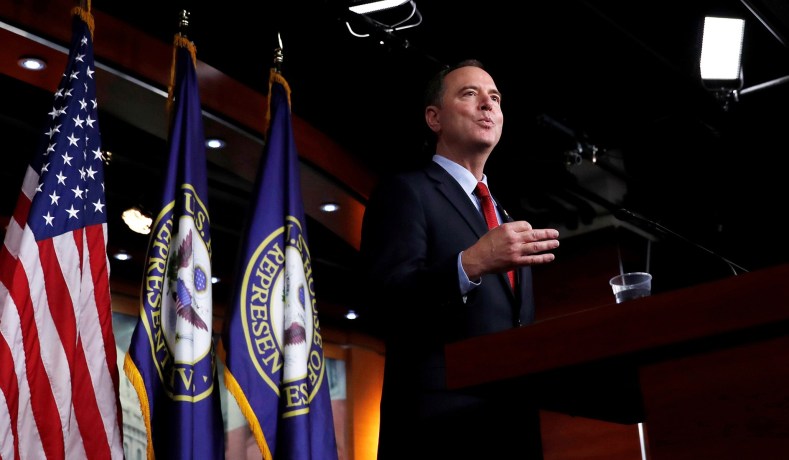
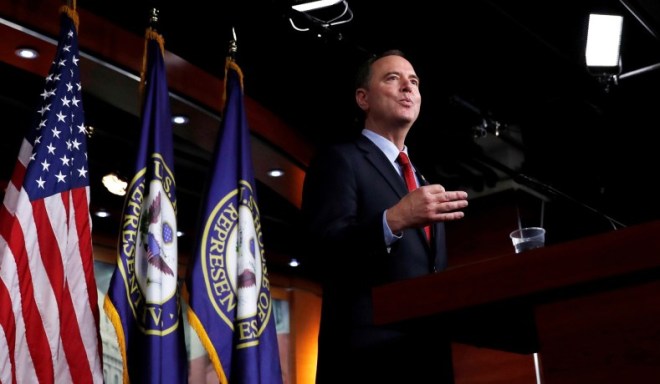
Republicans are right to complain (as, for example, Senate majority leader Mitch McConnell (R., Ky.) has complained) that Democrats are continuing the secret proceedings for now, notwithstanding the promise of imminent open hearings. The closed proceedings are nearly devoid of due process — they do not feature the Republican participation provisions attendant to the open hearings (and the presidential participation provisions envisioned once things more to the Judiciary Committee). Intelligence Committee chairman Adam Schiff (D., Calif.) says they are like a grand jury, but (as I’ve explained) they are not — they are a rubber stamp for Democrats who decided three years ago that Trump should be impeached, and a vehicle for shaping media coverage by selective disclosure.

Ironically, the resolution’s endorsement of the secret hearings is portrayed as part of Democrat’s’ commitment to “open and transparent investigative proceedings.”

7) Whether the proceedings ultimately will be seen as open and transparent will depend in large part on whether the heretofore secret proceedings are disclosed. Significantly, the resolution allows for that, but does not require it. The issue is placed in the discretion of Chairman Schiff. This is part of what I referred to at the start as the resolution’s flaws. Schiff is a notoriously sharp-elbowed partisan, the protégé Speaker Nancy Pelosi (D., Calif.) placed in charge of implementing the unauthorized (by a House vote) inquiry practices of closed hearings and selective leaking. The question of disclosing transcripts will be a good early test of how straight Chairman Schiff is going to play this. The resolution empowers him to decide what should be made public, and to direct “appropriate redactions” for not only any classified information but anything he decides is too “sensitive” to be disclosed.

8) With that as a concrete example of what’s at stake, we should pause to deal with the central procedural issue. Republicans continue validly to complain about the rigged process. Whether it will be rigged going forward, though, depends on how committed Schiff and, ultimately, Judiciary Committee chairman Jerry Nadler (D., N.Y.) are to open proceedings that both are and appear to be fair. It is not frivolous for Republicans to grouse that the future open proceedings with due process are tainted by the month of closed proceedings without due process, which has made impeachment a foregone conclusion. But the procedural argument won’t win the day, and Democrats still have to make their case to the public, no matter how one-sided things have been to this point.

I am not without hope that there will be real due process in the public hearings — not because hardcore partisans Schiff and Nadler will suddenly transform into paragons of fairness, but because it is in their interest to be fair.

The court here is public opinion, and — because the president is highly unlikely to be removed by the Senate — the verdict will come in November 2020. If the House Democrats have an impeachment case against the president, the Democrats have a strong incentive to let the process play out with deferential due process befitting the seriousness of the matter. If the case is thin gruel and the process is manifestly skewed against the president, with disclosure withheld, cross-examination slashed, exculpatory witnesses denied, etc., it will look like a partisan hit job — i.e., Democrats determined to impeach a president they never accepted, not spurred by egregious misconduct.

The public will judge the House impeachment inquiry on the finished product, not the dodgy start. In this vein, Republicans are seizing on the broad discretion and control that the resolution vests in Schiff. This is a sensible strategy: Schiff has conducted himself disreputably, theatrically reading an absurd caricature of the Trump-Zelensky transcript, concealing his staff’s coordination with the so-called whistleblower (and earlier, championing the discredited Steele dossier). A former prosecutor, Schiff is a very able interrogator; he is also hyper-partisan, sneaky, and erratic.

All that said, congressional inquiries are adversarial political proceedings, which means someone has to be in charge of them. Elections have consequences, so the someone is a Democrat. Since we are in a very partisan time, Republicans and Democrats tend to vote in antagonistic lockstep. Where there are disputes, Democrats will win because they have the numbers.That doesn’t mean the process has to be rigged. That will be up to Schiff. If Republicans make reasonable requests, Schiff would be well advised not to turn them into disputes; if he denies them, Democrats will look terrible. If Republicans make outlandish demands that appear designed to delay or derail the proceedings, there will be sympathy for Schiff. A lot rides on how he presides — and how Nadler does in phase-two.

To repeat, the president and his allies are going to need a substantive defense to the charge that, with a purpose to interfere in the 2020 election, he abused his foreign-relations power by encouraging a foreign government to investigate an American citizen for violating foreign law. Making Schiff the bogeyman is only going to get them so far. It will wear thin quickly if Schiff performs well.

9) The resolution outlines a bifurcated inquiry, the first half of which includes the closed-door investigative phase that has been underway for weeks under the direction of Schiff’s Intelligence Committee. That phase will soon go public. The resolution authorizes Schiff to conduct open hearings at which he and the Republican ranking member, Devin Nunes (R., Calif.), may, with equal time, question witnesses for up to 90 minutes — with the assistance of a member of the Committee’s professional staff (there are very experienced investigators and prosecutors on the staff). The Committee would then proceed with the familiar five-minute rounds of questioning by all members. (There are 22 members of the Committee, 13 Democrats and nine Republicans.)

10) In both this hearing phase, and the later Judiciary Committee phase, there is provision for the Republican minority to seek to call their own witnesses and present other evidence, including the ability to issue subpoenas for testimony and tangible evidence. Thomas Jipping’s Bench Memos post (noted above) observes that the minority is not being given the same procedural equal standing it got in the Clinton and Nixon impeachment inquiries. The distinction, however, may be more apparent than real. Underneath the veneer of bipartisan comity in prior impeachment lurked the reality that one side was the majority and would win if any dispute arose. This reality is more patent in the current resolution — for example, Schiff and the Democrats can subpoena whoever they want; Nunes and the Republicans must make a showing of relevance in writing to Schiff’s satisfaction. The brute fact, however, is that a House impeachment inquiry is a majority show, no matter how clearly the enabling resolution articulates it.

11) The resolution directs that the Intelligence Committee (in conjunction with the Foreign Affairs and Oversight Committees, which have also been investigating) file a public report with findings and recommendations, to be submitted to the Judiciary Committee — which would then proceed with impeachment articles.

The report is supposed to include any relevant materials Schiff deems appropriate. I would anticipate, then, that the report stage is when Schiff will release any currently sealed testimony and other evidence; the report will provide him with an opportunity to spin that information as he’d have people construe it, rather than allowing the public to form its own impressions. The Republican minority will be permitted to append dissenting views. The report will outline the Intelligence Committee’s findings and recommendations; presumably, that will be the first iteration of what will become the articles of impeachment.

12) After the report is filed, the proceedings shift to the Judiciary Committee. It is finally, at that stage, that the president and his counsel will have an opportunity to participate. It is the Judiciary Committee that will formally report articles of impeachment to the full House.

We’ll have more to say about the Judiciary Committee proceedings when we get there.

Source: National Review

Identity Of Ukraine ‘WhistleBlower’ Has Been Released | Trending Politics & Real Clear Investigations

Editor’s Note: As expected the identity of the whistleblower is an inside job of the CIA. Historically dozens of countries had their democratically elected Presidents overthrown by CIA orchestrated coups. Now, it’s come home to roost in these united states of America.

On Wednesday afternoon, the identity of the infamous whistleblower who is responsible for the beginning of the impeachment inquiry against President Trump was revealed to be registered Democrat Eric Ciaramella who has close ties to former President Barack Obama, former Vice President Joe Biden and corrupt former CIA Chief John Brennan.

Not only does Ciaramella have an extreme political bias against President Trump but he also helped start the Russian collusion investigation into President Trump back in 2016.

Ciaramella was present at many events including one with Melania Trump:

The bombshell revelation was released by Real Clear Investigations. Check out what they reported:

RealClearInvestigations is disclosing the name because of the public’s interest in learning details of an effort to remove a sitting president from office. Further, the official’s status as a “whistleblower” is complicated by his being a hearsay reporter of accusations against the president, one who has “some indicia of an arguable political bias … in favor of a rival political candidate” — as the Intelligence Community Inspector General phrased it circumspectly in originally fielding his complaint.

Federal documents reveal that the 33-year-old Ciaramella, a registered Democrat held over from the Obama White House, previously worked with former Vice President Joe Biden and former CIA Director John Brennan, a vocal critic of Trump who helped initiate the Russia “collusion” investigation of the Trump campaign during the 2016 election.

Further, Ciaramella (pronounced char-a-MEL-ah) left his National Security Council posting in the White House’s West Wing in mid-2017 amid concerns about negative leaks to the media. He has since returned to CIA headquarters in Langley, Virginia.

A formal NSC official previously spoke out about Ciaramella, revealing, “He was accused of working against Trump and leaking against Trump.”

It doesn’t end there. The whistleblower also worked closely with Democratic National Committee operative Alexandra Chalupa back in 2016 to dig up dirt on then-candidate Donald Trump.

Real Clear Investigations continues:

And Ciaramella worked with a Democratic National Committee operative who dug up dirt on the Trump campaign during the 2016 election, inviting her into the White House for meetings, former White House colleagues said. The operative, Alexandra Chalupa, a Ukrainian-American who supported Hillary Clinton, led an effort to link the Republican campaign to the Russian government. “He knows her. He had her in the White House,” said one former co-worker, who requested anonymity to discuss the sensitive matter.

Documents confirm the DNC opposition researcher attended at least one White House meeting with Ciaramella in November 2015. She visited the White House with a number of Ukrainian officials lobbying the Obama administration for aid for Ukraine.

With Ciaramella’s name long under wraps, interest in the intelligence analyst has become so high that a handful of former colleagues have compiled a roughly 40-page research dossier on him. A classified version of the document is circulating on Capitol Hill, and briefings have been conducted based on it. One briefed Republican has been planning to unmask the whistleblower in a speech on the House floor.

Source: Trending Politics & Real Clear Investigations

House to Vote This Week on Impeachment Inquiry, Says Pelosi | The Epoch Times

The House is slated to vote this week on the impeachment inquiry into President Donald Trump, top Democrats have said.

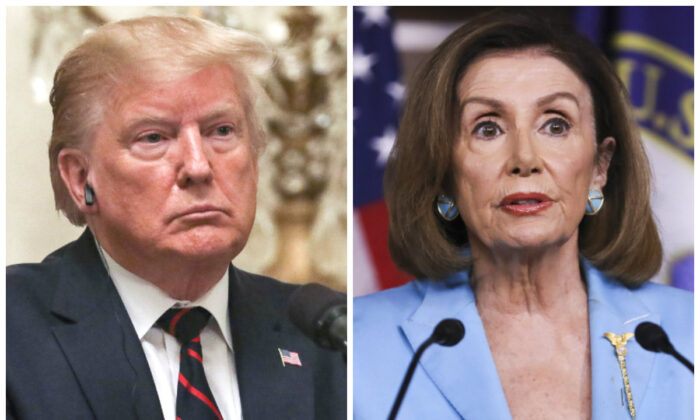
Speaker Nancy Pelosi (D-Calif.) said Monday that “we will bring a resolution to the Floor that affirms the ongoing, existing investigation that is currently being conducted by our committees as part of this impeachment inquiry, including all requests for documents, subpoenas for records and testimony, and any other investigative steps previously taken or to be taken as part of this investigation.”

Rep. Jim McGovern (D-Mass.), the chairman of the House Rules Committee, said on Monday that he will introduce a resolution to “ensure transparency” and “provide a clear path forward” in the inquiry.

According to the House Rules Committee’s website, a meeting will be held Wednesday “directing certain committees to continue their ongoing investigations as part of the existing House of Representatives inquiry into whether sufficient grounds exist for the House of Representatives to exercise its Constitutional power to impeach Donald John Trump, President of the United States of America, and for other purposes.”

McGovern, meanwhile, said that he plans on introducing it on Tuesday, according to a statement, as reported by CBS News.

It will be the first, formal vote on the impeachment process after House Speaker Nancy Pelosi (D-Calif.) announced the inquiry in September.

Republicans and the Trump administration have called for the House Democrats to hold a vote on the inquiry.

“As committees continue to gather evidence and prepare to present their findings, I will be introducing a resolution to ensure transparency and provide a clear path forward,” McGovern said in a statement. “This is the right thing to do for the institution and the American people.”

At the same time, Republicans have criticized the way in which Democrats have conducted the investigation, saying they are being held in secret while leaking information about them to the media. Last week, a coalition of GOP lawmakers entered a closed-door meeting that was being held by House Intelligence Chairman Adam Schiff (D-Calif.).

“We are taking this step to eliminate any doubt as to whether the Trump Administration may withhold documents, prevent witness testimony, disregard duly authorized subpoenas, or continue obstructing the House of Representatives,” said Pelosi in the statement.

Source: The Epoch Times


Google Joins the Pharmaceutical Industry | Health Impact News

Zurich, Switzerland – April 20, 2016: sign on the wall of a Google office building. Google is a multinational technology company specializing in Internet-related services and products, its largest European office is located in Zurich, Switzerland.

By Kate Raines, The Vaccine Reaction

Editor’s Note: If you’re wondering why it’s now difficult to find certain websites re: vaccine safety, etc. it’s because Google has modified its search engine algorithm to bury vaccine-related search requests as from their profit-making perspective it’s a conflict of interest (since they’re now making money selling vaccines and other pharmaceuticals). As the primary gateway to the internet Google now has too much power to control the flow of information in its own self-interest and deny alternative viewpoints to those using its search engines. This is only the beginning of internet censorship along with the other gatekeepers such as Facebook, Apple and Microsoft.

Google’s burgeoning ties to Big Pharma have been exposed with the disclosure of its new pharmaceutical division, which just happens to be led by the former head of GlaxoSmithKline’s global vaccine business. As cautioned by Progressive Radio Network journalists Gary Null, PhD and Richard Gale,

Google today is not only a weapon for promoting the pharmaceutical agenda but now also a drug company itself.”1

Google is Much More Than a Search Engine

Backing up a few years to 2015, Google’s co-founders Larry Page and Sergey Brin decided the multi-armed behemoth that Google had become would benefit from a drastic reorganization. Consequently, they split their “core internet business” off from their other minimally (or un-) related projects such as X Lab and the Calico life extension project. Along with Google itself, those secondary companies were grouped under the umbrella of a new corporation called “Alphabet.”2

The upshot was that Alphabet now owns Google, although the key players have not changed. Page and Brin now serve as CEO and President, respectively, of Alphabet, while former Google product chief Sundar Pichai is now CEO of Google.

Tracing a line from Google’s reorganization of itself to its structure today, the initial division kept all of the Internet entities under Google’s wing, under one “side” of the Alphabet umbrella. These included Google Maps, YouTube, Chrome, and Android. Google remained as the largest and most financially robust of Alphabet’s ventures.3

Other semi-independent companies under the Alphabet name included a diverse collection of corporations focused on such wide-ranging fields as biomedical or scientific advances, investment ventures, “smart home” applications, drone technologies and urban infrastructure.3

The Many Faces of Alphabet/Google

As the dust settled at Alphabet/Google, a number of the newly independent or semi-independent companies emerged, wielding some clout of their own. While Google’s revenues in 2017 continued to reap the lion’s share, reaching $110.9 billion, revenues from other ventures reported $1.2 billion. With operating losses reported at $3.4 billion, Google’s “side lines” were not yet profitable but climbing, up from 2016 losses of $4.6 billion.4

Those other ventures include X Lab (research and new ideas), G and CapitalG (investment funds), Sidewalk Labs (focused on urban innovation), Nest (smarthome devices), Chronicle (cybersecurity), Waymo (autonomous vehicles), Access (Internet provider innovations), Jigsaw (technological and geopolitics), Deep Mind (artificial intelligence), Verily (healthcare and managing disease) and Calico (biotech and lifespan extension).

The X Lab, or “Moonshot Factory,” is a research and development lab aimed at, in their own words, creating “radical new technologies to solve some of the world’s hardest problems.”5

Some of their projects include self-driving cars, delivery drones, renewable energy storage technology, artificial intelligence (AI) and learning robots, among many others. X acts as an incubation lab for cutting edge ideas that, once developed, may either be discontinued or “graduated” to become an independent entity.

Verily’s Pharmaceutical Ties

Verily Life Sciences is one of those Alphabet ideas now launched into independent status. Initially begun as a series of projects exploring the use of technologies including miniaturization and machine learning to create “wearable” devices such as smart lenses, Verily now partners with a number of pharmaceutical companies that develop vaccines on projects ranging from smart lenses with Alcon (a subsidiary of Novartis) and surgical robotics with Johnson & Johnson to early identification and intervention in chronic diseases with Merck Sharp & Dohme and diabetes management with Sanofi.6

Verily is partnered with Gilead on profiling the immune system to clarify the biological mechanisms of autoimmune disease and with Verve Therapeutics on nanoparticle formulations. Verily is also partnered with GlaxoSmithKline, the world’s largest vaccine manufacturer,7 in the development of bioelectronic medicine.6

With the creation of Galvani Bioelectronics in collaboration with GlaxoSmithKline, Verily now has its own pharmaceutical company that is working to “enable the research, development and commercialization of bioelectronic medicines,” which aim to treat disease using miniaturized implanted devices.8

Another of Verily’s projects is the development of the “sterile insect technique” to manipulate mosquito populations by releasing sterile male mosquitoes that will reduce the populations of insects carrying such diseases as dengue, Zika, chikungunya and yellow fever.9

The company has also entered the clinical study arena, first with its own study called Baseline, which seeks to connect potential study participants with clinical research groups.10

Partnering with Verily initiatives is appealing to pharmaceutical companies, including vaccine manufacturers and developers like Novartis, Sanofi, Otsuka and Pfizer, because of the young biotech company’s focus on modernizing and increasing the efficiency of data collection using tools such as electronic medical study process, as well as getting new drugs and vaccines to market faster. Although the partnered studies are not yet in progress, studies are being explored in cardiovascular disease, oncology, mental health, dermatology and diabetes.

Because anyone can join Baseline and potentially be connected with clinical trials relevant to their own life, keeping patient information private will be a challenge, but the projected market value of the program is expected to reach $69 billion by 2026. 11

As reporter Mark Terry put it for BioSpace, “Perhaps disconcertingly, a company that handles 92.4% of internet searches globally and already has significant amounts of information about your life, now wants to know medical and health information as well.” 12

Alphabet’s Other Medical Venture: Calico Labs

In addition to Verily, Alphabet has another older medical research company called Calico, founded in 2013 and headed by Arthur Levinson, the former CEO of Genentech, another pharmaceutical company that develops vaccines.13

According to Calico’s mission statement, the company wants “to harness advanced technologies to increase our understanding of the biology that controls lifespan” and will “require an unprecedented level of interdisciplinary effort.14

Dr. Aarif Khakoo, Head of Drug Development at Calico (and formerly a Vice President at Amgen, a pharmaceutical company that develops vaccines) said, “With the aging of the world population, there is a pressing need to gain a deeper understanding of the molecular underpinnings of human aging and to translate these insights into new therapies for aging and age-related diseases… I’m looking forward to working with the team and our external collaborators to move the lead therapeutic candidates into clinical studies in the future.”14

It has been obvious for some time now that Google’s algorithms have been adjusted to make it more difficult to find information, including information about vaccines, that doesn’t align with the messages about health and medical care that are approved by government and the pharmaceutical industry. In some cases, no matter how specific a search question is, or how it is worded and re-worded, the search results stubbornly return the same tired but mainstream medical authority-approved results.

Teasing out the infiltration of the pharmaceutical industry into Google, it seems that Alphabet is not just delivering an approved narrative, but Google’s message too.

Source: TheVaccineReaction.org.

SPLC brands evangelical group that fights antisemitism as ‘hate group’ | WND

Editor’s Note: Twenty years ago I found myself (aka “Johnny Liberty” and many of our associates on the distinguished SPLC listed as a “hate group” because we were largely successful in teaching millions of people about sovereignty through our audio courses and offshore seminars. SPLC labeled us as part of their continuing “disinformation” campaign waged on behalf of deep state operatives who wish to destroy this constitutional Republic at all costs. Unfortunately, SPLC was hired to miseducate police officers all across America to harass “constitutionalists” and sovereign citizens.

The Southern Poverty Law Center (SPLC), once widely praised for fighting the KKK, has devolved into routinely slapping its “hate” label on groups that don’t align with its far-left values

With that in mind, there may be a silver lining in SPLC’s designation of Proclaiming Justice to the Nations as a hate group, said PJTN’s founder and president, Laurie Cardoza-Moore.

“If being pro-Israel and against antisemitism is now considered a hate crime, I will wear the SPLC listing as a badge of honor,” she said

But she said that placing her group “alongside bigots and Nazis minimizes the true meaning of hate.”

“In reality, PJTN is on the front lines and in the headlines of fighting against antisemitism on a daily basis.”

She vowed to continue “to fight hate through our thousands of PJTN Watchmen around the globe.”

“Our answer to this absurd listing will be to open more PJTN chapters in American and fight harder to have antisemitism defined and confronted throughout the free world,” Cardoza-Moore said.

She pointed to the irony of SPLC’s claim that PJTN is a “hate” group, since PJTN “exists to fight the world’s oldest hatred – antisemitism.”

“PJTN has gained wide international media acclaim as it encourages state legislators to act against antisemitism and BDS,” the organization’s statement said.

“However, the Southern Poverty Law Center seems to believe that being pro-Israel and against antisemitism is now a hate crime.”

Cardoza-Moore said the SPLC list “has become nothing short of a witch hunt against organizations that don’t share their extremist liberal worldview.”

“Sadly, many institutions still look to the once credible SPLC for advice on hate groups. We hope that being blacklisted will not impede upon our ability to continue defending the Jewish people and Israel against global antisemitism,” she said.

“We will not be marginalized or silenced because of our support for Israel and the Jewish people. This will only strengthen our resolve to work harder. We call upon all of our supporters to write to the SPLC and demand that they immediately remove PJTN from their nefarious list before they lose any credibility they still have as a credible watchdog.”

The organization was established to urge Christians to stand with their Jewish brethren and Israel against the global surge of anti-Semitism.

Cardoza-Moore, who serves as a special envoy to the United Nations, recently called on Christians to stand vigil outside synagogues during the Rosh Hashanah holidays for Jews.

Pointing to several acts of violence against synagogues, she said there is “no justification on earth for these heinous attacks and no American should feel unsafe in their house of worship.”

Source: WND