Supreme Court clamps down on ‘excessive fines’ by states | The Hill

The Supreme Court on Wednesday ruled unanimously that states must adhere to the Constitution’s ban on excessive fines, a decision that will likely limit the ability of states to impose certain fees and seize property.

In delivering the opinion of the court, Justice Ruth Bader Ginsburg said the Eighth Amendment guards against abuses of the government’s punitive or criminal law-enforcement authority, and that it extends to fines.

“This safeguard, we hold, is ‘fundamental to our scheme of ordered liberty,’ with ‘deep roots in our history and tradition,’” she said, quoting Supreme Court precedent.

Ginsburg, who returned to the bench for oral arguments Tuesday for the first time since undergoing surgery in December, was joined in the ruling by Chief Justice John Roberts, Justices Stephen Breyer, Samuel Alito, Sonia Sotomayor, Elena Kagan, Neil Gorsuch and Brett Kavanaugh. Justice Clarence Thomas filed an opinion concurring in the judgment.

The case centered on Tyson Timbs, who pleaded guilty in Indiana state court to dealing in a controlled substance and conspiracy to commit theft. When Timbs was arrested, police seized the Land Rover he had purchased, for $42,000, from an insurance policy he received when his father died.

The state then brought a  civil forfeiture suit against Timbs for his vehicle because it had been used to transport heroin. The trial court denied the state’s forfeiture request.

Since Timbs had recently purchased the vehicle for more than four times the maximum $10,000 monetary fine he can be charged for the drug conviction, the court said the forfeiture violated the Eighth Amendment.

The Indiana Supreme Court ultimately reversed that ruling, holding that the Excessive Fines Clause constrains only federal action and is inapplicable to state impositions. Watch the video…

The high court vacated that ruling Wednesday.

Source: The Hill

A Complete (Dated) Psychological Analysis of Trump’s Support | Psychology Today

By Bobby Azarian, Ph.D.

Editor’s Note: There are lots of problems with this analysis especially because many assertions are sourced from the liberal media which has an agenda, but it has some interesting talking points for understanding our current political situation. Our nation was divided long before Donald Trump became President, his election just brought this fact to the surface. There are two America’s and they are not even talking with each other anymore. 

Whether we want to or not, we must try to understand the Donald Trump phenomenon, as it has completely swept the nation and also fiercely divided it. What is most baffling about it all is Trump’s apparent political invincibility. As he himself said even before he won the presidential election, “I could stand in the middle of 5th Avenue and shoot somebody and I wouldn’t lose voters.” Unfortunately for the American people, this wild-sounding claim appears to be truer than not. It should also motivate us to explore the science underlying such peculiar human behavior, so we can learn from it, and potentially inoculate against it.

In all fairness, we should recognize that lying is sadly not uncommon for politicians on both sides of the political aisle, but the frequency and magnitude of the current president’s lies should have us all wondering why they haven’t destroyed his political career, and instead perhaps strengthened it. Similarly, we should be asking why his inflammatory rhetoric and numerous scandals haven’t sunk him. We are talking about a man who was caught on tape saying, “When you’re a star, they let you do it. You can do anything. Grab them by the pussy.” Politically surviving that video is not normal, or anything close to it, and such a revelation would likely have been the end of Barack Obama or George Bush had it surfaced weeks before the election.

While dozens of psychologists have analyzed Trump, to explain the man’s political invincibility, it is more important to understand the minds of his staunch supporters. While various popular articles have illuminated a multitude of reasons for his unwavering support, there appears to be no comprehensive analysis that contains all of them. Since there seems to be a real demand for this information, I have tried to provide that analysis below.

Some of the explanations come from a 2017 review paper published in the Journal of Social and Political Psychology by the psychologist and UC Santa Cruz professor Thomas Pettigrew. Others have been put forth as far back as 2016, by me, in various articles and blog posts for publications like Psychology Today. A number of these were inspired by insights from psychologists like Sheldon Solomon, who laid the groundwork for the influential Terror Management Theory, and David Dunning, who did the same for the Dunning-Kruger effect.

This list will begin with the more benign reasons for Trump’s intransigent support. As the list goes on, the explanations become increasingly worrisome, and toward the end, border on the pathological. It should be strongly emphasized that not all Trump supporters are racist, mentally vulnerable, or fundamentally bad people. It can be detrimental to society when those with degrees and platforms try to demonize their political opponents or paint them as mentally ill when they are not. That being said, it is just as harmful to pretend that there are not clear psychological and neural factors that underlie much of Trump supporters’ unbridled allegiance.

The psychological phenomena described below mostly pertain to those supporters who would follow Trump off a cliff. These are the people who will stand by his side no matter what scandals come to light, or what sort of evidence for immoral and illegal behavior surfaces.

1. Practicality Trumps Morality

For some wealthy people, it’s simply a financial matter. Trump offers tax cuts for the rich and wants to do away with government regulation that gets in the way of businessmen making money, even when that regulation exists for the purpose of protecting the environment. Others, like blue-collared workers, like the fact that the president is trying to bring jobs back to America from places like China. Some people who genuinely are not racist (those who are will be discussed later) simply want stronger immigration laws because they know that a country with open borders is not sustainable. These people have put their practical concerns above their moral ones. To them, it does not make a difference if he’s a vagina-grabber, or if his campaign team colluded with Russia to help him defeat his political opponent. It is unknown whether these people are eternally bound to Trump in the way others are, but we may soon find out if the Mueller investigation is allowed to come to completion.

2. The Brain’s Attention System Is More Strongly Engaged by Trump

According to a study that monitored brain activity while participants watched 40 minutes of political ads and debate clips from the presidential candidates, Donald Trump is unique in his ability to keep the brain engaged. While Hillary Clinton could only hold attention for so long, Trump kept both attention and emotional arousal high throughout the viewing session. This pattern of activity was seen even when Trump made remarks that individuals didn’t necessarily agree with. His showmanship and simple language clearly resonate with some at a visceral level.

3. America’s Obsession with Entertainment and Celebrities

Essentially, the loyalty of Trump supporters may in part be explained by America’s addiction to entertainment and reality TV. To some, it doesn’t matter what Trump actually says because he’s so amusing to watch. With the Donald, you are always left wondering what outrageous thing he is going to say or do next. He keeps us on the edge of our seat, and for that reason, some Trump supporters will forgive anything he says. They are happy as long as they are kept entertained.

4. “Some Men Just Want to Watch the World Burn.”

Some people are supporting Trump simply to be rebellious or to introduce chaos into the political system. They may have such distaste for the establishment and democrats like Hillary Clinton that their support for Trump is a symbolic middle finger directed at Washington. These people may have other issues, like an innate desire to troll others or an obsession with schadenfreude.

5. The Fear Factor: Conservatives Are More Sensitive to Threat

Science has  shown that the conservative brain has an exaggerated fear response when faced with stimuli that may be perceived as threatening. A 2008 study in the journal Science found that conservatives have a stronger physiological reaction to startling noises and graphic images compared to liberals. A brain-imaging study published in Current Biology revealed that those who lean right politically tend to have a larger amygdala — a structure that is electrically active during states of fear and anxiety. And a 2014 fMRI study found that it is possible to predict whether someone is a liberal or conservative simply by looking at their brain activity while they view threatening or disgusting images, such as mutilated bodies. Specifically, the brains of self-identified conservatives generated more activity overall in response to the disturbing images.

These brain responses are automatic and not influenced by logic or reason. As long as Trump continues to portray Muslims and Hispanic immigrants as imminent threats, many conservative brains will involuntarily light up like light bulbs being controlled by a switch. Fear keeps his followers energized and focused on safety. And when you think you’ve found your protector, you become less concerned with offensive and divisive remarks.

6. The Power of Mortality Reminders and Perceived Existential Threat

A well-supported theory from social psychology, known as Terror Management Theory, explains why Trump’s fear mongering is doubly effective. The theory is based on the fact that humans have a unique awareness of their own mortality. The inevitably of one’s death creates existential terror and anxiety that is always residing below the surface. In order to manage this terror, humans adopt cultural worldviews — like religions, political ideologies, and national identities — that act as a buffer by instilling life with meaning and value.

Terror Management Theory predicts that when people are reminded of their own mortality, which happens with fear mongering, they will more strongly defend those who share their worldviews and national or ethnic identity, and act out more aggressively towards those who do not. Hundreds of studies have supported this hypothesis, and some have specifically shown that triggering thoughts of death tends to shift people towards the right.

Not only do death reminders increase nationalism, they may influence voting habits in favor of more conservative presidential candidates. And more disturbingly, in a study with American students, scientists found that making mortality salient increased support for extreme military interventions by American forces that could kill thousands of civilians overseas. Interestingly, the effect was present only in conservatives.

By constantly emphasizing existential threat, Trump may be creating a psychological condition that makes the brain respond positively rather than negatively to bigoted statements and divisive rhetoric.

7. The Dunning-Kruger Effect: Humans Often Overestimate Their Political Expertise

Some who support Donald Trump are under-informed or misinformed about the issues at hand. When Trump tells them that crime is skyrocketing in the United States, or that the economy is the worst it’s ever been, they simply take his word for it.

The Dunning-Kruger effect explains that the problem isn’t just that they are misinformed; it’s that they are completely unaware that they are misinformed, which creates a double burden.

Studies have shown that people who lack expertise in some area of knowledge often have a cognitive bias that prevents them from realizing that they lack expertise. As psychologist David Dunning puts it in an op-ed for Politico, “The knowledge and intelligence that are required to be good at a task are often the same qualities needed to recognize that one is not good at that task — and if one lacks such knowledge and intelligence, one remains ignorant that one is not good at the task. This includes political judgment.” These people cannot be reached because they mistakenly believe they are the ones who should be reaching others.

8. Relative Deprivation — A Misguided Sense of Entitlement

Relative deprivation refers to the experience of being deprived of something to which one believes they are entitled. It is the discontent felt when one compares their position in life to others who they feel are equal or inferior but have unfairly had more success than them.

Common explanations for Trump’s popularity among non-bigoted voters involve economics. There is no doubt that some Trump supporters are simply angry that American jobs are being lost to Mexico and China, which is certainly understandable, although these loyalists often ignore the fact that some of these careers are actually being lost due to the accelerating pace of automation.

These Trump supporters are experiencing relative deprivation, and are common among the swing states like Ohio, Michigan, and Pennsylvania. This kind of deprivation is specifically referred to as “relative,” as opposed to “absolute,” because the feeling is often based on a skewed perception of what one is entitled to.

9. Lack of Exposure to Dissimilar Others

Intergroup contact refers to contact with members of groups that are outside one’s own, which has been experimentally shown to reduce prejudice. As such, it’s important to note that there is growing evidence that Trump’s white supporters have experienced significantly less contact with minorities than other Americans. For example, a 2016 study found that “…the racial and ethnic isolation of Whites at the zip-code level is one of the strongest predictors of Trump support.” This correlation persisted while controlling for dozens of other variables. In agreement with this finding, the same researchers found that support for Trump increased with the voters’ physical distance from the Mexican border. These racial biases might be more implicit than explicit, the latter which is addressed in #14.

10. Trump’s Conspiracy Theories Target the Mentally Vulnerable

While the conspiracy theory crowd — who predominantly support Donald Trump and crackpot allies like Alex Jones and the shadowy QAnon — may appear to just be an odd quirk of modern society, some of them may suffer from psychological illnesses that involve paranoia and delusions, such as schizophrenia, or are at least vulnerable to them, like those with schizotypy personalities.

The link between schizotypy and belief in conspiracy theories is well-established, and a recent study published in the journal PsychiatryResearch has demonstrated that it is still very prevalent in the population. The researchers found that those who were more likely to believe in outlandish conspiracy theories, such as the idea that the U.S. government created the AIDS epidemic, consistently scored high on measures of “odd beliefs and magical thinking.” One feature of magical thinking is a tendency to make connections between things that are actually unrelated in reality.

Donald Trump and media allies target these people directly. All one has to do is visit alt-right websites and discussion boards to see the evidence for such manipulation.

11. Trump Taps into the Nation’s Collective Narcissism

Collective narcissism is an unrealistic shared belief in the greatness of one’s national group. It often occurs when a group who believes it represents the ‘true identity’ of a nation — the ‘ingroup,’ in this case White Americans — perceives itself as being disadvantaged compared to outgroups who are getting ahead of them ‘unrightfully.’ This psychological phenomenon is related to relative deprivation (#6).

study published last year in the journal Social Psychological and Personality Science found a direct link between national collective narcissism and support for Donald Trump. This correlation was discovered by researchers at the University of Warsaw, who surveyed over 400 Americans with a series of questionnaires about political and social beliefs. Where individual narcissism causes aggressiveness toward other individuals, collective narcissism involves negative attitudes and aggressiontoward ‘outsider’ groups (outgroups), who are perceived as threats.

Donald Trump exacerbates collective narcissism with his anti-immigrant, anti-elitist, and strongly nationalistic rhetoric. By referring to his supporters, an overwhelmingly white group, as being “true patriots” or “real Americans,” he promotes a brand of populism that is the epitome of “identity politics,” a term that is usually associated with the political left. Left-wing identity politics, as misguided as they may sometimes be, are generally aimed at achieving equality, while the right-wing brand is based on a belief that one nationality or race is superior or entitled to success and wealth for no other reason than identity.

12. The Desire to Want to Dominate Others

Social dominance orientation (SDO) — which is distinct from but related to authoritarian personality (#13) — refers to people who have a preference for the societal hierarchy of groups, specifically with a structure in which the high-status groups have dominance over the low-status ones. Those with SDO are typically dominant, tough-minded, and driven by self-interest.

In Trump’s speeches, he appeals to those with SDO by repeatedly making a clear distinction between groups that have a generally higher status in society (White), and those groups that are typically thought of as belonging to a lower status (immigrants and minorities). A 2016 survey study of 406 American adults published last year in the journal Personality and Individual Differences found that those who scored high on both SDO and authoritarianism were more likely to vote for Trump in the election.

13. Authoritarian Personality 

Authoritarianism refers to the advocacy or enforcement of strict obedience to authority at the expense of personal freedom, and is commonly associated with a lack of concern for the opinions or needs of others. Authoritarian personality is characterized by belief in total and complete obedience to authority. Those with this personality often display aggression toward outgroup members, submissiveness to authority, resistance to new experiences, and a rigid hierarchical view of society. Authoritarianism is often triggered by fear, making it easy for leaders who exaggerate threat or fear monger to gain their allegiance.

Although authoritarian personality is found among liberals, it is more common among the right-wing around the world. President Trump’s speeches, which are laced with absolutist terms like “losers” and “complete disasters,” are naturally appealing to those with such a personality.

While research showed that Republican voters in the U.S. scored higher than Democrats on measures of authoritarianism before Trump emerged on the political scene, a 2016 Politico survey found that high authoritarians greatly favored then-candidate Trump, which led to a correct prediction that he would win the election, despite the polls saying otherwise.

14. Racism and Bigotry

It would be grossly unfair and inaccurate to say that every one of Trump’s supporters have prejudice against ethnic and religious minorities, but it would be equally inaccurate to say that few do. The Republican party, going at least as far back to Richard Nixon’s “southern strategy,” has historically used tactics that appealed to bigotry, such as lacing speeches with “dog whistles” — code words that signaled prejudice toward minorities that were designed to be heard by racists but no one else.

While the dog whistles of the past were subtler, Trump’s signaling is sometimes shockingly direct. There’s no denying that he routinely appeals to racist and bigoted supporters when he calls Muslims “dangerous” and Mexican immigrants “rapists” and “murderers,” often in a blanketed fashion. Perhaps unsurprisingly, a recent study has shown that support for Trump is correlated with a standard scale of modern racism.

Source: Psychology Today
Trump officially legalizes industrial hemp | The Hill

President Trump legalized the cultivation of industrial hemp Thursday when he signed a widespread, bipartisan farm bill aimed at boosting the agriculture industry.

The fiber of hemp, a non-intoxicating derivative of the cannabis plant, is used to make a variety of products, such as cardboard, carpets, clothes, paper and more.

Hemp production and sales have historically been illegal under the same federal prohibition against marijuana. The farm bill only deals with industrial hemp and does not address recreational or medical marijuana.

Senate Majority Leader Mitch McConnell (R-Ky.) worked with Sens. Rand Paul (R-Ky.), Jeff Merkley(D-Ore.) and Ron Wyden (D-Ore.) to introduce a bill to legalize hemp, which was ultimately included in the farm bill. 

“I used my very own hemp pen to sign the conference report, clearing the way for the House and Senate to pass legislation and send it to the president’s desk. I’m proud that the bill includes my provision to legalize the production of industrial hemp. It’s a victory for farmers and consumers throughout our country,” McConnell said when the Senate advanced the farm bill earlier this month.

The farm bill helps removes obstacles farmers face in growing hemp, including restricted access to banking, water rights and crop insurance. Hemp is easier to grow than cotton, corn or soybeans as it requires little water and can be viable in lower-quality soil that is not practical for other crops.

The hemp provision is just one of several aspects of the farm bill meant to aid farmers as exports of agricultural products such as soybeans take a hit as Trump engages in a bitter trade war with China and other countries.

Source: The Hill

Bipartisan Criminal Justice Bill Closer To Becoming Law After Congressional Approval | NPR

By Ayesha Rascoe

A bipartisan bill aimed at overhauling federal prisons and reducing recidivism has been overwhelmingly approved by Congress.

The legislation is now on the verge of becoming law, with the House’s approval on Thursday, the Senate’s passage on Tuesday and the backing of President Trump.

Republican Speaker of the House Paul Ryan previously voiced support for the legislative package, pledging that the House was “ready to get it done.” They later passed the measure by a 358-36 margin.

The Senate on Tuesday voted 87-12 in favor of the bill, known as the First Step Act. The passage of the bill by the chamber is a significant victory for advocates on the left and the right, who have pressed for Congress to take action to lower the prison population.

It’s also a big win for the White House and for Trump adviser and son-in-law Jared Kushner, in particular. Kushner has made overhauling the criminal justice system one of his top projects in the White House.

Trump called Congress’ action a “great bi-partisan achievement” and “a wonderful thing for the U.S.A.!!” in a tweet on Thursday afternoon.

For months, the fate of the legislation seemed to be in a precarious position. Republican Sen. Chuck Grassley, who helms the Senate Judiciary Committee, stressed that he wanted to include sentencing provisions, which had been left out of the version of the bill passed by the House in May.

For a while, it was unclear whether Trump would back measures to cut down on lengthy sentences. His first attorney general, Jeff Sessions, was staunchly opposed to the move.

But, with Sessions pushed out of the administration in November, Trump came out in favor of the more expansive Senate package.

Some Republicans, like Sen. Tom Cotton of Arkansas, still oppose the legislation, which they argue will free dangerous criminals.

Facing pressure from advocates and the White House, Senate Majority Leader Mitch McConnell agreed to bring the bill up for a vote during the lame-duck session after its sponsors agreed to certain changes.

Here are some highlights from the legislation:

Measures focused on changing U.S. prisons

-Provides more access to rehabilitation and training programs that are aimed at helping prepare prisoners for life after their release. Certain prisoners would be eligible for incentives if they participate, including credits that would allow them to spend up to a year of their sentences in facilities like halfway houses or at home under supervision.

Republican critics of these incentives argue that prisoners could commit crimes while on supervised release. But, the bill’s sponsors say only offenders considered low or minimum risk would be eligible and the legislation excludes certain prisoners, including sex offenders and fentanyl traffickers.

-Makes it against the law to use restraints on pregnant inmates, unless they are an immediate threat to themselves or others or a flight risk.

-Requires that prisoners be incarcerated no more than 500 miles from their primary residence.

Measures focused on sentencing

-Ends automatic life sentences under the three-strike penalty for drug felonies. Instead of life, a third strike would now be a mandatory 25-year sentence. The mandatory sentence for a second offense would be reduced to 15 years compared to 20 years now.

This change would not be retroactive, so it would not help people already in prison serving life sentences under the three-strike rule. Some opponents of the bill have argued it does not go far enough to help people already affected by these laws.

-Expands the “safety valve” that allows judges to avoid imposing mandatory minimum sentences in certain cases.

-Addresses prisoners who were sentenced before laws were changed in 2010 to lessen disparities between the penalties for crack cocaine and powder cocaine. It would allow these prisoners to petition the courts to review their cases in light of the updated law.

Source: NPR

FBI releases part of Russia dossier summary used to brief Trump, Obama | Politico

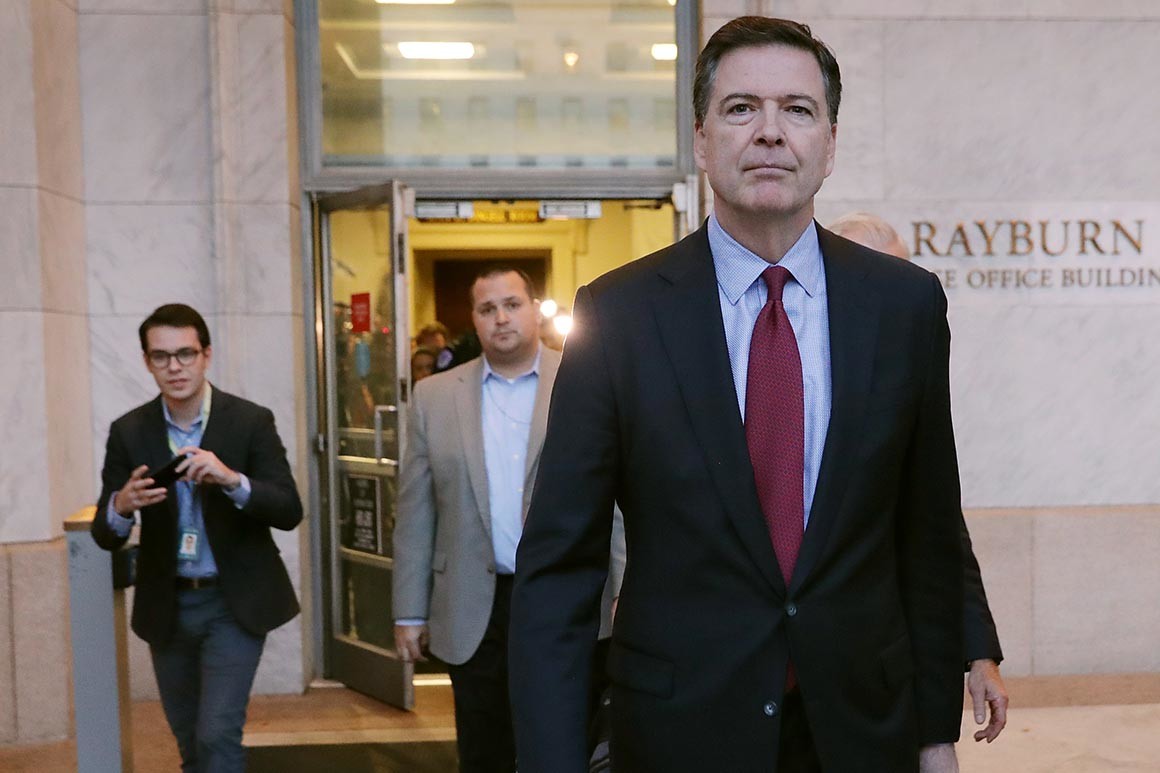
The FBI released for the first time Friday night a two-page summary former FBI Director James Comey used to brief President-elect Donald Trump nearly two years ago on a so-called dossier about Trump’s ties to Russia.

The version made public Friday could reignite previous criticism from Republicans and Trump allies that the FBI was too vague in its description of the fact that the dossier was funded by the campaign of Trump’s nemesis in the 2016 presidential election, Democratic nominee Hillary Rodham Clinton, as well as the Democratic National Committee.

Comey, who was fired by Trump in May 2017, acknowledged during a book tour earlier this year that he did not inform Trump who paid for the research.

The brief passage the FBI left unredacted in the newly released memo gives some background on the former British intelligence officer who compiled the dossier, Christopher Steele, although Steele’s name does not actually appear in the newly released version. The released portion of the synopsis is vague about who financed the project, referring to it as sponsored by “private clients.”

“An FBI source … volunteered highly politically sensitive information … on Russian influence efforts aimed at the US presidential election,” the memo labeled as “Annex A” says. “The source is an executive of a private business intelligence firm and a former employee of a friendly intelligence service who has been compensated for previous reporting over the past three years. The source maintains and collects information from a layered network of identified and unidentified subsources, some of which has been corroborated in the past. The source collected this information on behalf of private clients and was not compensated for it by the FBI.”

“The source’s reporting appears to have been acquired by multiple Western press organizations starting in October,” the document from January 2017 declares.

Comey has said he did not show or give Trump the memo, but used it as a reference when briefing him on the dossier, which U.S. intelligence officials feared Russia might try to use as blackmail against Trump. The synopsis was also used to brief President Barack Obama, officials have said.

Republicans had previously complained that the FBI failed to inform a federal court about the dossier’s provenance — that Steele’s work was commissioned by Fusion GPS, a research firm that had been hired by the Clinton campaign’s law firm, Perkins Coie, to dig up information about Trump’s business relationships overseas. Based in part on the dossier’s information, the court granted an FBI application to surveil a former Trump campaign associate in October 2016.

Aspects of the FBI’s surveillance application have since been released and revealed that the FBI did inform the court that Steele had political animus toward Trump and that it was funded by a politically motivated backer.

The document was released Friday in response to a Freedom of Information Act lawsuit brought by a POLITICO reporter and the James Madison Project, a pro-transparency group.

In January, U.S. District Court Judge Amit Mehta ruled that that the FBI was legally justified in refusing to confirm or deny the existence of any records related to the dossier, despite several tweets from President Donald Trump that described the document as “fake” or “discredited.”

However, shortly after that ruling, Trump declassified a House Intelligence Committee memo that included various claims about the FBI’s handling of the dossier. In August, Mehta said the official release of that material vitiated the FBI’s ability to claim that it had offered no public confirmation of its role in vetting or verifying the dossier, a collection of accurate, inaccurate, unverified and sometimes salacious claims about ties between Russia and various figures in Trump’s circle.

“It remains no longer logical nor plausible for the FBI to maintain that it cannot confirm nor deny the existence of documents” related to attempts to verify information in the dossier, Mehta wrote.

The FBI withheld the remainder of the two-page synopsis on a variety of grounds, including that the material remains classified either Secret or Top Secret. The law enforcement agency also indicated the information is exempt from release because it pertains to ongoing investigations or court proceedings, originated with a confidential source or describes confidential investigative techniques or procedures.

The FBI said Friday it lacked any records indicating final conclusions about any information in the dossier, said Brad Moss, one of the attorneys pressing for release of the records.

“After two years of legal games, the FBI today finally confirmed two pieces of speculation about the scandalous allegations regarding which Director Comey briefed President Trump in January 2017: all of those allegations remain part of the ongoing Russian ‘collusion’ investigation, and the FBI has not rendered final determinations about the accuracy of any of them,” Moss said. “Far from being debunked, the issues that raised concerns for the Intelligence Community in 2017 remain unresolved to this day.”

Moss said he plans to challenge the FBI’s withholdings in the case and to ask Mehta to order more of the information released.

Source: Politico

Alexandria Ocasio-Cortez is already pulling back the curtain on the inner workings of Congress | CNBC

By Carmen Chapell

Alexandria Ocasio-Cortez is already pulling back the curtain on the inner workings of the Capitol.

The New York Democrat, along with other incoming freshman lawmakers, is trying to usher in a culture of openness that is enabled by a vast social media following. With nearly 3 million followers combined on Facebook, Instagram and Twitter, Ocasio-Cortez has used the platforms to involve her supporters during the transition period before she takes office.

Her enthusiastic and often pugnacious transparency campaign has earned her praise from inside and outside the Beltway. Yet it has also drawn criticism from several corners, including from President Donald Trump’s eldest son. Ocasio-Cortez hasn’t given any indication that she will let up, however.

In a series of pictures and videos on Instagram dubbed “Congress Camp,” she gave an inside look into new-member orientation, from choosing an office to voting for House leadership, while also showcasing the unique quirks of life on Capitol Hill.

“Guys, there are secret underground tunnels between all of these government buildings!” she whispers in one video. In another post, she polls her followers on whether she should choose an office with more space or one “close to our friends.”

But Ocasio-Cortez isn’t just focusing on the novelty of her experience. Last week, she tweeted sharp criticism of an orientation for new members of Congress hosted by Harvard. The event featured corporate CEOs but no labor representatives.

“Our ‘bipartisan’ Congressional orientation is cohosted by a corporate lobbyist group. Other members have quietly expressed to me their concern that this wasn’t told to us in advance,” she tweeted. “Lobbyists are here. Goldman Sachs is here. Where’s labor? Activists? Frontline community leaders?”

Fellow freshman member Rashida Tlaib, D-Mich., echoed her criticisms. Tlaib said that Gary Cohn, former chief economic advisor to President Donald Trump and former Goldman Sachs executive, told the new members at orientation that they don’t “know how the game is played.”

“No Gary, YOU don’t know what’s coming – a revolutionary Congress that puts people over profits,” Tlaib tweeted.

‘Those little things are very real’

Ocasio-Cortez rose to the spotlight after defeating longtime incumbent Joseph Crowley in the Democratic primary for New York’s 14th Congressional District, which encompasses parts of Queens and the Bronx. A self-identified Democratic socialist, she ran on a liberal platform and chose to emphasize her identity as a young woman of color. The 29-year-old’s victory in the general election anointed her as the youngest woman ever elected to Congress.

Ocasio-Cortez’s comments about her new role have also renewed longstanding debates on the financial challenges facing members of Congress and their staff. She has made it personal by revealing her own insecurities about her finances during the transition period.

“I have three months without a salary before I’m a member of Congress. So, how do I get an apartment? Those little things are very real,” she told The New York Times in an interview.

Many lawmakers struggle with the cost of living in Washington, D.C., even on the $174,000 congressional salary, going so far as to sleep in their offices to save on rent costs.

Ocasio-Cortez has also made it a point to talk about the economic conditions of congressional staff. Last week, she tweeted: “It is unjust for Congress to budget a living wage for ourselves, yet rely on unpaid interns & underpaid overworked staff just bc Republicans want to make a statement about ‘fiscal responsibility.'”

Low salaries as well as the prevalence of unpaid internships, which are often the first step to a full-time role, are seen as barriers to a more diverse congressional staff. Ocasio-Cortez pledged to pay her office’s interns $15 an hour, inspiring other lawmakers to make the same commitment.

She has also shared experiences that reveal the growing pains of an increasingly diverse Congress. “People keep giving me directions to the spouse and intern events instead of the ones for members of Congress,” she tweeted during orientation.

The changing face of Congress

Ocasio-Cortez is just one of the 42 women, 38 of them Democrats, part of Congress’ freshman class. They are being heralded as the faces of a new “Year of the Woman.” Ilhan Omar, D-Minn., and Michigan’s Tlaib are the first Muslim women elected to Congress, while Ayanna Pressley, a Democrat, is the first black woman elected to represent Massachusetts. Ocasio-Cortez posted a picture of the four women together on Instagram last month, captioning it “Squad.”

As a result of her high profile, Ocasio-Cortez’s unabashed takes on congressional life have frequently come under fire.

Eddie Scarry, a writer for the Washington Examiner, disputed Ocasio-Cortez’s account of her financial hardships based on her clothing choices.

“Hill staffer sent me this pic of Ocasio-Cortez they took just now,” Scarry tweeted. “I’ll tell you something: that jacket and coat don’t look like a girl who struggles.” The tweet has since been deleted after widespread backlash.

Rep. Sean Duffy, R-Wis., condemned the media for what he viewed as preferential treatment in coverage of Ocasio-Cortez. As a freshman congressman in 2011, Duffy received negative reactions after telling a constituent that he struggles to pay his bills.

“Hmm which headlines and article does media give to GOP and which to a Dem?” Duffy tweeted alongside screenshots of articles referencing himself and Ocasio-Cortez.

Last week, Donald Trump Jr., the president’s eldest son, shared a doctored image on Instagram in which Ocasio-Cortez asks, “Why are you so afraid of a socialist economy?” In the post, President Trump responds, “Because Americans want to walk their dogs, not eat them.” Trump Jr. captioned the meme “It’s funny cuz it’s true!!!”

Ocasio-Cortez fired back, tweeting: “Please, keep it coming Jr – it’s definitely a ‘very, very large brain’ idea to troll a member of a body that will have subpoena power in a month.” Democrats have made clear that they plan to use their new subpoena power in the House to further investigate potential Russian interference in the 2016 elections.

The representative-elect has also received praise for revealing parts of the political system that are typically left in the shadows.

Actress Kerry Washington, who stars in the political drama “Scandal,” commended Ocasio-Cortez’s behind-the-scenes revelations, tweeting, “@Ocasio2018 speaking truth to power. Sharing the NEEDED #BTS of our democracy at work. So grateful.”

“I’m learning more details about how the House actually works over the past two weeks than I ever did in the past 20 years,” one follower tweeted in reply to Ocasio-Cortez.

“Thank you so much for giving us the window into the inside baseball of Congress,” another follower said.

Paul Musgrave, assistant professor of political science at University of Massachusetts Amherst, praised Ocasio-Cortez on Twitter for “treating voters as neither super-sophisticated DC insiders, nor as people who can’t be trusted to make up their own minds, but rather as people who are curious and intelligent but who aren’t experts in DC process.”

“Sometimes,” he added, “you don’t need a new theory of politics to make change, just a willingness to state the obvious.”

Source: CNBC

Feds plan unusual appeal in emoluments suit vs. Trump | Politico

By Josh Gerstein

The Justice Department is planning an unusual appeal to stop the governments of the State of Maryland and the District of Columbia from using a federal lawsuit to demand access to information about whether President Donald Trump is using his luxury Washington hotel to unconstitutionally profit from his office.

Last month, U.S. District Court Judge Peter Messitte turned down Trump’s request for permission to seek an appeal of early rulings in the case that went against him. Now, federal government lawyers say they plan to appeal anyway, using a rarely invoked process that can block a wayward judge from pressing on with a course of action alleged to be illegal or improper.

On Friday, the Justice Department informed Messitte that the federal government plans to try to get the Richmond-based 4th Circuit Court of Appeals to halt the case.

“The Solicitor General of the United States has authorized the filing in the U.S. Court of Appeals for the Fourth Circuit of a petition for writ of mandamus against this Court’s orders declining to dismiss the case and to certify an interlocutory appeal, as well as an application for a stay of District Court proceedings pending resolution of the mandamus petition,” Justice Department attorneys wrote.

Lawyers for Maryland and Washington, D.C.. have asked the judge to open a six-month discovery period where they could take depositions from witnesses, demand records and issue written questions focused on how the Trump International Hotel’s business has benefited from Trump’s election as president.

The suit, filed in June, alleges that Trump is violating two “emoluments” clauses in the Constitution by using his Pennsylvania Avenue hotel to reap financial dividends from his presidency. One provision covers business with foreign governments. The other prohibits federal officials from profiting from financial relationships with individual states.

The Trump Organization has pledged to donate to the U.S. Treasury any profits from hotel business with foreign governments. However, there is little transparency about how those amounts are calculated.

In his ruling last month denying Trump permission to appeal in the case, Messitte also noted that while lawyers representing Trump in the emoluments case were complaining that litigation would be a distracting burden for the president, the president regularly threatens to sue those he feels aggrieved by.
“It bears noting that the President himself appears to have had little reluctance to pursue personal litigation despite the supposed distractions it imposes upon his office,” the judge wrote.

Earlier this year, Messitte — an appointee of President Bill Clinton — issued an opinion turning down arguments from Justice Department attorneys that Maryland and D.C. lacked legal standing to pursue the emoluments issue against Trump. The judge also rejected arguments from Trump’s lawyers that the Constitution’s definition of emoluments includes only direct payment for official services and excludes all private business transactions.

Messitte, who sits in Greenbelt, had indicated he planned to issue an order opening discovery in the case Monday. Without some intervention by the 4thCircuit, the first formal exchange of information would likely be due within a week.

A similar suit against Trump brought by Democratic lawmakers cleared an initial hurdle in federal court in Washington , while a pair of suits filed in New York were thrown out by a judge there. That decision is on appeal.

Source: Politico

Do States Have the Right to Seize Vehicles for Minor Offenses? | Slate

By Aaron Tang

Tyson Timbs made an impulse buy. Then he made a series of mistakes.

After his father died, Timbs used roughly $42,000 of his father’s life insurance proceeds to buy a 2012 Land Rover. To support his heroin addiction, Timbs drove the Land Rover across Indiana to buy, transport, and sell drugs. Undercover police officers caught him in May 2013, and he was sentenced to one year of home detention, five years of probation, and roughly $1,200 in fines and court fees.

But that was not the end of the case. Under Indiana law, the state may seize any vehicle used in drug trafficking. So Indiana initiated a forfeiture action against Timbs’ Land Rover. The vehicle is itself a party to the case, leading to one of the more entertaining case titles in recent memory: Tyson Timbs and a 2012 Land Rover LR2 v. Indiana. While the name is unusual, forfeiture actions of this sort are quite common; by one count, states generated more than $250 million through forfeiture actions in 2012 alone.

This dispute is set make it all the way to our nation’s highest court later this month with important implications for law enforcement agencies and criminal justice reform. The case could rest on the say of one Supreme Court Justice in particular: Neil Gorsuch.

Although there was little dispute that the Land Rover was used in a crime, an Indiana district court judge denied the state’s attempt to seize it, reasoning forfeiture would violate the Eighth Amendment’s prohibition against “excessive fines.” After all, this is a crime for which Timbs was not even sentenced to a day in jail, and the total fines and court fees amounted to just a fraction of the Land Rover’s value. But the Indiana Supreme Court reversed, holding that the Eighth Amendment’s excessive fines clause does not even apply to the states. The U.S. Supreme Court granted certiorari to decide whether this striking conclusion is correct.

The state question here may be confusing. For a long period in our nation’s history, the Bill of Rights was understood only as a shield against federal encroachment on our rights. That changed with the 14th Amendment, which applied some (but not all) of the Bill of Rights’ protections at the state level. The precise pathway through which these rights are incorporated has long been a source of consternation for legal scholars, but the modern-day test is straightforward: States may not violate a right contained in the Bill of Rights if the right was “deeply rooted in our nation’s history and tradition.”

Timbs makes a forceful argument that the right to be free from excessive fines is deeply rooted in our history and tradition. That right first emerged in our Bill of Rights as an outgrowth from the 1689 English Bill of Rights and was quickly replicated across state constitutions. Indeed, by the time of the 14thAmendment’s enactment in 1868, 35 of the 37 states in the union had a ban against excessive fines. The need for protections against excessively punitive governmental exactions has only become more pressing with revelations of prosecutorial power abuses aimed at generating revenue in places like Ferguson, Missouri. For this very reason, Timbs drew supporting briefs from a wide array of groups ranging from the NAACP and ACLU to the U.S. Chamber of Commerce and Pacific Legal Foundation.

This should be the perfect case for a libertarian originalist like Neil Gorsuch. But it turns out there is an antecedent constitutional question in the case, and the historical evidence on that front points strongly in Indiana’s favor. That question is whether what Indiana has done—seize a vehicle used to traffic drugs through civil proceedings—can be said to constitute a fine.

There is ample evidence that the original meaning of the term “fine,” as it was used when the Eighth and 14th Amendments were ratified, did not extend to these kinds of civil forfeitures. After all, the federal government had a tradition of routinely seizing private property in ways that seem excessively harsh to the modern ear.

Consider the 1818 case of the Little Charles, a ship that the federal government seized after it sailed to Antigua in violation of an American embargo. In an opinion written by none other than Chief Justice John Marshall, the court reasoned that the ship could be subject to forfeiture even if it violated the embargo “without the authority, and against the will of the owner.”

Or take the Louisa Barbara case. Under an 1819 federal law, a ship could only carry a certain number of passengers based on its weight. The Louisa Barbara violated the limit by carrying 178 passengers—one more than it was authorized to carry. Yet the federal government proceeded to seize the entire ship. Federal courts were unmoved by the owner’s defense that many of the 178 passengers were children.

Stories of similarly harsh civil forfeitures fill Indiana’s brief in this case. Yet, as Indiana convincingly argues, no litigant even thought to argue that such forfeitures implicated the Eighth Amendment’s excessive fines clause. The first such argument was raised under a state constitution’s excessive fines clause in 1920 and failed; no court deemed a civil forfeiture to be an excessive fine until a federal court did in 1992—a position the Supreme Court ultimately agreed with the following year.

This history is what makes this case so hard for someone like Neil Gorsuch. If he follows the history and tradition of the Eighth Amendment to its logical extreme, the excessive fines clause would have nothing to say about an excessively harsh civil forfeiture. So, according to this thinking, Indiana could have seized Timbs’ vehicle due to its involvement in small scale drug trafficking even if it was the tawdriest of Ferraris. At the same time, there is the trouble of the aforementioned case called, Austin v. United States, in which the Supreme Court held in 1993 that the excessive fines clause does in fact cover civil forfeitures, at least when initiated by federal authorities. Yet Gorsuch has shown little reluctance to overrule settled precedent in his time on the bench so far. Finally, there is some evidence that the term “fine” was historically used interchangeably with “forfeiture,” which means that an ordinary member of the public in 1791 or 1868 may well have thought the latter encompassed by the former.

The court should acknowledge that both understandings of “fine” are plausible—one that includes forfeitures and one that does not. At that point, it seems wiser to decide which is the correct understanding of the Eighth Amendment by looking to the broader principles undergirding the Constitution, precedent, and the dire consequences of a rule authorizing limitless civil forfeitures for petty crimes. Each of those considerations weighs in Timbs’ favor. Or more precisely, they weigh in favor of a certain 2012 Land Rover and its odds of being reunited with its owner.

Source: Slate

U.S. has spent six trillion dollars on wars that killed half a million people since 9/11 | Newsweek

The United States has spent nearly $6 trillion on wars that directly contributed to the deaths of around 500,000 peoplesince the 9/11 attacks of 2001.

Brown University’s Watson Institute for International and Public Affairs published its annual “Costs of War” report Wednesday, taking into consideration the Pentagon’s spending and its Overseas Contingency Operations account, as well as “war-related spending by the Department of State, past and obligated spending for war veterans’ care, interest on the debt incurred to pay for the wars, and the prevention of and response to terrorism by the Department of Homeland Security.”

The final count revealed, “The United States has appropriated and is obligated to spend an estimated $5.9 trillion (in current dollars) on the war on terror through Fiscal Year 2019, including direct war and war-related spending and obligations for future spending on post 9/11 war veterans.”

“In sum, high costs in war and war-related spending pose a national security concern because they are unsustainable,” the report concluded. “The public would be better served by increased transparency and by the development of a comprehensive strategy to end the wars and deal with other urgent national security priorities.”

The U.S. embarked on a global war on terror following the 9/11 attacks that killed nearly 3,000 and were orchestrated by Islamist militant group Al-Qaeda. Weeks later, the U.S. led an invasion of Afghanistan, which at the time was controlled by Al-Qaeda ally the Taliban. In March 2003, Washington overthrew Iraqi President Saddam Hussein, accusing him of developing weapons of mass destruction and harboring U.S.-designated terrorist organizations.

Despite initial quick victories there, the U.S. military has been plagued by ongoing insurgencies these two countries and expanded counterterrorism operations across the region, including Libya, Pakistan, Somalia and Yemen. In 2014, the U.S. gathered an international coalition to face the Islamic State militant group (ISIS), which arose out of a post-invasion Sunni Muslim insurgency in Iraq and spread to neighboring Syria and beyond.

Wednesday’s report found that the “US military is conducting counterterror activities in 76 countries, or about 39 percent of the world’s nations, vastly expanding [its mission] across the globe.” In addition, these operations “have been accompanied by violations of human rights and civil liberties, in the US and abroad.”

Overall, researchers estimated that “between 480,000 and 507,000 people have been killed in the United States’ post-9/11 wars in Iraq, Afghanistan, and Pakistan.” This toll “does not include the more than 500,000 deaths from the war in Syria, raging since 2011” when a West-backed rebel and jihadi uprising challenged the government, an ally of Russia and Iran. That same year, the U.S.-led NATO Western military alliance intervened in Libya and helped insurgents overthrowlongtime leader Muammar el-Qaddafi, leaving the nation in an ongoing state of civil war.

The combined human cost for the U.S. throughout its actions in Afghanistan, Iraq and Pakistan was 6,951 troops, 21 civilians and 7,820 contractors.

“While we often know how many US soldiers die, most other numbers are to a degree uncertain. Indeed, we may never know the total direct death toll in these wars. For example, tens of thousands of civilians may have died in retaking Mosul and other cities from ISIS but their bodies have likely not been recovered,” the report noted.

“In addition, this tally does not include ‘indirect deaths.’ Indirect harm occurs when wars’ destruction leads to long term, ‘indirect,’ consequences for people’s health in war zones, for example because of loss of access to food, water, health facilities, electricity or other infrastructure,” it added.

In February, President Donald Trump estimated that “we have spent $7 trillion in the Middle East,” saying “what a mistake” it was. Weeks later, he reportedly told his military advisers to prepare a plan to withdraw from Syria as the war against ISIS entered its final phases, though senior Washington officials have since expanded the U.S. mission— considered illegal by the Syrian government and its allies—to include countering Iran and its allies.

This article has been updated to include a Statista chart detailing the findings of the Watson Institute for International and Public Affairs’ study.

Source: Newsweek

The Weaponization of Social Media | Counterpunch

troll-network_BF9747ECB468482488ECFF9A003635D6By Faisal Khan

The use of ‘bots’ present modern society with a significant dilemma; The technologies and social media platforms (such as Twitter and Facebook) that once promised to enhance democracy are now increasingly being used to undermine it. Writers Peter W Singer and Emerson Brooking believe ‘the rise of social media and the Internet has become a modern-day battlefield where information itself is weaponised’. To them ‘the online world is now just as indispensable to governments, militaries, activists, and spies at it is to advertisers and shoppers’. They argue this is a new form of warfare which they call ‘LikeWar’. The terrain of LikeWar is social media; ‘it’s platforms are not designed to reward morality or veracity but virality.’ The ‘system rewards clicks, interactions, engagement and immersion time…figure out how to make something go viral, and you can overwhelm even the truth itself.’

In its most simple form the word ‘bot’ is short for ‘robot’; beyond that, there is significant complexity. There are different types of bots. For example, there are ‘chatbots’ such as Siri and Amazon’s Alexa; they recognise human voice and speech and help us with our daily tasks and requests for information. There are search engine style ‘web bots’ and ‘spambots’. There are also ‘sockpuppets’ or ‘trolls’; these are often fake identities used to interact with ordinary users on social networks. There are ‘social bots’; these can assume a fabricated identity and can spread malicious links or advertisements. There are also ‘hybrid bots’ that combine automation with human input and are often referred to as ‘cyborgs’. Some bots are harmless; some more malicious, some can be both.

The country that is perhaps most advanced in this new form of warfare and political influence is Russia. According to Peter Singer and Emerson Brooking ‘Russian bots more than simply meddled in the 2016 U.S. presidential election…they used a mix of old-school information operations and new digital marketing techniques to spark real-world protests, steer multiple U.S. news cycles, and influence voters in one of the closest elections in modern history. Using solely online means, they infiltrated U.S. political communities so completely that flesh-and-blood American voters soon began to repeat scripts written in St. Petersburg and still think them their own’. Internationally, these ‘Russian information offensives have stirred anti-NATO sentiments in Germany by inventing atrocities out of thin air; laid the pretext for potential invasions of Estonia, Latvia, and Lithuania by fuelling the political antipathy of ethnic Russian minorities; and done the same for the very real invasion of Ukraine. And these are just the operations we know about.’

We witnessed similar influence operations here during the Brexit referendum in 2016. A study by the Financial Times reported that during the referendum campaign ‘the 20 most prolific accounts … displayed indications of high levels of automation’. The Anti-Muslim hate group TellMAMA recorded in its latest Annual report that manual bots based in St Petersburg were active in spreading Anti-Muslim hate online. Israel has also used manual ‘bots’ to promote a more positive image of itself online.

The Oxford Internet Institute (OII) has studied online political discussions relating to several countries on social media platforms such as Twitter and Facebook. It claims that in all the elections, political crises and national security-related discussions it examined, there was not one instance where social media opinion had not been manipulated by what they call ‘computational propaganda’. For them, while it remains difficult to quantify the impact bots have ‘computational propaganda’ is now one of the most ‘powerful tools against democracy’.

Donald Trump perhaps more than any other US President to date understands the power of social media. The OII found, for example, that although he alienated Latino voters on the campaign trail, he had some fake Latino twitter bots tweeting support for him. Emerson T Brooker informed me that social media bots can be highly-effective; for him ‘If a bot-driven conversation successfully enters the “Trending” charts of a service like Twitter, it can break into mainstream discussion and receive a great deal of attention from real flesh-and-blood users’. He continues ‘The first unequivocal use of political bots was in the 2010 Special Senate Election in Massachusetts, which ended in the election of Senator Scott Brown. The bots helped draw journalist (and donor) interest from across the country. The Islamic State was also a very effective user of botnets to spread its propaganda over Arabic-speaking Twitter. In 2014, it repeatedly drove hashtags related to its latest execution or battlefield victory (e.g. #AllEyesOnISIS) to international attention.’

So, what can be done to better regulate bots? The OII has called for social media platforms to act against bots and has suggested some steps. These include; making the posts they select for news feeds more ‘random’, so users don’t only see likeminded opinions. News feeds could be provided with a trustworthiness score; audits could be carried out of the algorithms they use to decide which posts to promote. However, the OII also cautions not to over-regulate the platforms to suppress political conversation altogether.  Marc Owen Jones of Exeter University who has researched bots feels that in the case of twitter better ‘verification procedures could tackle the bots’. According to Emerson Brooking ‘a simple non-invasive proposal bouncing around Congress now would mandate the labelling of bot accounts. This would allow bots positive automation functions to continue while keeping them from fooling everyday media users.’

Source: Counterpunch