Goldwater Institute to File Class Action Lawsuit Against Against Parts of the Indian Child Welfare Act | eNewsAZ

8e605557418c5bc7556c021e4698e9e0_LThe Goldwater Institute will launch a new project to reform the Indian Child Welfare Act and similar state laws that give abused and neglected Native American children fewer rights and protections than other American children. A major part of the project will be a federal class action lawsuit.

“When an abused child is removed from his or her home and placed in foster care or made available for adoption, judges are required to make a decision about where the child will live based on the child’s best interest. Except for Native American children. Courts are bound by federal law to disregard a Native American child’s best interest and place the child in a home with other Native Americans, even if it is not in his or her best interest,” said Darcy Olsen, president of the Goldwater Institute. “We want federal and state laws to be changed to give abused and neglected Native American children the same protections that are given to all other American children: the right to be placed in a safe home based on their best interests, not based on their race.”

On July 7, the Goldwater Institute will file a federal class action lawsuit to challenge the constitutionality of core provisions of the federal Indian Child Welfare Act. The same day, the Institute will release an investigative report that documents how federal law leaves Native American children with fewer protections under the law than all other American children, and the serious consequences that have resulted from this unequal treatment. Recommendations for changes to state and federal law will also be announced.

Media is invited to a press briefing that will formally announce the details of the lawsuit, release the investigation, and policy recommendations, and screen an 8-minute original documentary film. The briefing will featureDr. William B. Allen, the former chairman of the U.S. Commission on Civil Rights.

What: Press conference announcing the Equal Protection for Indian Children Project and federal class action lawsuit

When: Tuesday, July 7, 2015, 9:00 a.m. Pacific time

Where: Goldwater Institute, 500 East Coronado Road, Phoenix

Who: Press event will feature Darcy Olsen, president of the Goldwater Institute, Clint Bolick, the Institute’s vice president of litigation, Mark Flatten, the author of the Institute’s investigative report to be released, Dr. William Allen

Source: eNewsAZ

The California County That’s Leading the Way in Cutting the Banks Out of Its Economy | Alternet

By Robert Reich

MoneyWhat exactly does it mean for a big Wall Street bank to plead guilty to a serious crime? Right now, practically nothing.

But it will if California’s Santa Cruz County has any say.

First, some background.

Five giant banks – including Wall Street behemoths JPMorgan Chase and Citicorp – recently pleaded guilty to criminal felony charges that they rigged the world’s foreign-currency market for their own profit.

This wasn’t a small heist. We’re talking hundreds of billions of dollars worth of transactions every day.

The banks altered currency prices long enough for the banks to make winning bets before the prices snapped back to what they should have been.

Attorney General Loretta Lynch called it a “brazen display of collusion” that harmed “countless consumers, investors and institutions around the globe — from pension funds to major corporations, and including the banks’ own customers.”

The penalty? The banks have agreed to pay $5.5 billion. That may sound like a big chunk of change, but for a giant bank it’s the cost of doing business. In fact, the banks are likely to deduct the fines from their taxes as business costs.

The banks sound contrite. After all, they can’t have the public believe they’re outright crooks.

It’s “an embarrassment to our firm, and stands in stark contrast to Citi’s values,“ says Citigroup CEO Michael Corbat.

Values? Citigroup’s main value is to make as much money as possible. Corbat himself raked in $13 million last year.

JPMorgan CEO Jamie Dimon calls it “a great disappointment to us,” and says “we demand and expect better of our people.”

Expect better? If recent history is any guide – think of the bank’s notorious “London Whale” a few years ago, and, before that, the wild bets leading to the 2008 bailout – JPMorgan expects exactly this kind of behavior from its people.

Which helped Dimon rake in $20 million last year, as well as a $7.4 million cash bonus.

When real people plead guilty to felonies, they go to jail. But big banks aren’t people despite what the five Republican appointees to the Supreme Court say.

The executives who run these banks aren’t going to jail, either. Apologists say it’s not fair to jail bank executives because they don’t know what their rogue traders are up to.

Yet ex-convicts often suffer consequences beyond jail terms.

In many states they lose their right to vote. They can’t run for office or otherwise participate in the political process.

So why not take away the right of these convicted banks to participate in the political process, at least for some years? That would stop JPMorgan’s Dimon from lobbying Congress to roll back the Dodd-Frank act, as he’s been doing almost non-stop.

Why not also take away their right to pour money into politics? Wall Street banks have been among the biggest contributors to political campaigns. If they’re convicted of a felony, they should be barred from making any political contributions for at least ten years.

Real ex-convicts also have difficulty finding jobs. That’s because, rightly or wrongly, many people don’t want to hire them.

A strong case can be made that employers shouldn’t pay attention to criminal convictions of real people who need a fresh start, especially a job.

But giant banks that have committed felonies are something different. Why shouldn’t depositors and investors consider their past convictions?

Which brings us to Santa Cruz County.

The county’s board of supervisors just voted not to do business for five years with any of the five banks felons.

The county won’t use the banks’ investment services or buy their commercial paper, and will pull its money out of the banks to the extent it can.

“We have a sacred obligation to protect the public’s tax dollars and these banks can’t be trusted. Santa Cruz County should not be involved with those who rigged the world’s biggest financial markets,” says supervisor Ryan Coonerty.

The banks will hardly notice. Santa Cruz County’s portfolio is valued at about $650 million.

But what if every county, city, and state in America followed Santa Cruz County’s example, and held the big banks accountable for their felonies?

What if all of us taxpayers said, in effect, we’re not going to hire these convicted felons to handle our public finances? We don’t trust them.

That would hit these banks directly. They’d lose our business. Which might even cause them to clean up their acts.

There’s hope. Supervisor Coonerty says he’ll be contacting other local jurisdictions across the country, urging them to do what Santa Cruz County is doing.

Robert B. Reich has served in three national administrations, most recently as secretary of labor under President Bill Clinton. He also served on President Obama’s transition advisory board. His latest book is “Aftershock: The Next Economy and America’s Future.” His homepage is www.robertreich.org.

Source: Alternet
Global Financial Update with Foster Gamble | Thrive Movement Thrive Connect

Foster: Last November, when we finally felt that the research we’d been doing for several years since the film came out had progressed to the point where it was solid enough to begin to share publicly, we shared a bunch of things. Here are some of the things we were sharing then that have come to pass.

The BRICS bank has now been funded and is going operational. There is a Shanghai gold exchange. There is a new rating service, which provides an option to Fitch, Moody’s, Standard & Poor’s, and so forth that I think is going to be much more honest in its ratings given that it’s not beholden to the Western banking cabal to do their bidding on rating particular corporations and governments, especially the U.S. The AIIB, the Asian Infrastructure Investment Bank, has now been launched with the participation of usual U.S. allies like the U.K. and Germany and over 50 other countries. The U.S. has chosen not to participate in the founding of that. Japan is the only other major country that has chosen not to participate at this time, most likely because Prime Minister Abe, as far as we can tell, is very much a puppet for the Rockefeller-Rothschild banking system so far. We have been told that there are deals going on behind closed doors that Japan is preparing to join but not until it is safe and appropriate to do that given their obligations.

Another one is that we had predicted (based on information from our sources) that there would be numerous banker and corporate CEO resignations. There have been over 500 of them worldwide. We also said that there would probably be suspicious deaths in the banking and corporate communities and we’ve been seeing those. I think there have been over 40 of those now in the European and U.S. banking communities. And there have been arrests of bankers in Iceland. Also, the U.S. has continued to stall the IMF 2010 reforms that would rebalance the representation of countries in the IMF in terms of decision-making and also include more currencies like the yuan in the international basket of currencies. The suppression of gold and silver prices has continued artificially and it looks from our sources we’re being told that that’s apt to continue until the yuan, the Chinese currency, is globally accepted because meanwhile they’re having the opportunity to buy gold and silver at low prices while the Western bankers are suppressing the prices in order to keep interest rates from going up which would so threaten the precarious situation of the major U.S. banks and governments themselves.

Finally, I just want to add in terms of the validation of the number of our insider sources that some of the things they say, we were like “What?” and then a few weeks or a few months later it happens again and again. Our sources predicted the end of quantitative easing by the Federal Reserve, which was pretty outrageous given that the Federal Reserve was still printing between $50 and $70 billion dollars of new fake money a month and now they have suspended that right on schedule. We are told that’s because their franchise to print money has been suspended by the Asian Elders to whom they’re indebted. They also predicted the revaluation of the Swiss Franc and a few days later that happened. Then, we were told that China would be making major infrastructure investments in Brazil. We were just told that about a week and a half to two weeks ago and then, sure enough, a few days later it started coming out in the mainstream news that that is in fact going on to the tune of tens of billions of dollars.

So that’s a sample of the things that might have sounded outrageous when we said them (or when people said them to us), but now they are in fact occurring and it certainly provides pieces of the puzzle showing the trends that are emerging.

So let’s move on to trends next. What are some of the trends that we’re seeing that are in the public view that have to do with global finance? First of all, negative interest rates, or what Chase Bank has taken to calling “balance sheet utilization fees” (BSUFs). What that really means is rather than getting interest on your deposits at the bank, now you’re going to have to pay them for them to keep your money while they fractionally multiply it for their own benefit. You can tell this is getting quite Orwellian and yet whatever they can get away with they’re obviously going to continue to do.

Meanwhile, Citigroup, Chase, Barclays, and the Royal Bank of Scotland have been fined a total of $9 billion, which is a lot of money, for their participation in rigging international markets. Again, that’s a lot of money and it’s good to see that there are some fines and so forth, but if you stand back and put this into context, there are no individual prosecutions, no jail time, no companies shut down, and meanwhile, during that same time, those same banks made an estimated $85 billion on their actions. Some wag might call this merely the cost of doing business and, of course, to the banks that is all it seems. It’s a little slap on the wrist publicly to keep the people quiet and keep them from revolting. They pay under 10% (or around 10%) basically as a fee to the government to let them keep rigging things and then business goes on as usual.

All of the major banks have also had to comply with a government requirement to submit plans for their own economic collapse, which of course, could lead to larger economic collapses and they’ve all done that. And there’s good reason for them to do that because the numbers I’ve heard are north of $700 trillion in derivatives debt that they’re currently holding on their books. Obviously, they’re not a solvent institution if that were to be taken seriously. Read more…

Source: Thrive Movement Thrive Connect

2014 Term Opinions of the Supreme Court of the United States

banner_h120


The “slip” opinion is the second version of an opinion. It is sent to the printer later in the day on which the “bench” opinion is released by the Court. Each slip opinion has the same elements as the bench opinion–majority or plurality opinion, concurrences or dissents, and a prefatory syllabus–but may contain corrections not appearing in the bench opinion. The slip opinions collected here are those issued during October Term 2014 (October 6, 2014, through October 4, 2015).

These opinions are posted on the Website within minutes after the bench opinions are issued and will remain posted until the opinions for the entire Term are published in the bound volumes of the United States Reports. For further information, see Column Header Definitions and the file entitled Information About Opinions.

Caution: These electronic opinions may contain computer-generated errors or other deviations from the official printed slip opinion pamphlets. Moreover, a slip opinion is replaced within a few months by a paginated version of the case in the preliminary print, and–one year after the issuance of that print–by the final version of the case in a U. S. Reports bound volume. In case of discrepancies between the print and electronic versions of a slip opinion, the print version controls. In case of discrepancies between the slip opinion and any later official version of the opinion, the later version controls.

R- Date Docket Name J. Pt.
73 6/26/15 14-556 Obergefell v. Hodges K 576/2
72 6/26/15 13-7120 Johnson v. United States AS 576/2
71 6/25/15 13-1371 Texas Dept. of Housing and Community Affairs v. Inclusive Communities Project, Inc. K 576/2
70 6/25/15 14-114 King v. Burwell R 576/2
69 6/22/15 13-720 Kimble v. Marvel Entertainment, LLC EK 576/1
68 6/22/15 13-1175 Los Angeles v. Patel SS 576/1
67 6/22/15 14-6368 Kingsley v. Hendrickson B 576/1
66 6/22/15 14-275 Horne v. Department of Agriculture R 576/1
65 6/18/15 13-1433 Brumfield v. Cain SS 576/1
64 6/18/15 13-1428 Davis v. Ayala A 576/1
63 6/18/15 13-1352 Ohio v. Clark A 576/1
62 6/18/15 14-144 Walker v. Texas Div., Sons of Confederate Veterans, Inc. B 576/1
61 6/18/15 14-378 McFadden v. United States T 576/1
60 6/18/15 13-502 Reed v. Town of Gilbert T 576/1
59 6/15/15 14-185 Reyes Mata v. Lynch EK 576/1
58 6/15/15 14-103 Baker Botts L.L.P. v. ASARCO LLC T 576/1
57 6/15/15 13-1402 Kerry v. Din AS 576/1
56 6/08/15 13-628 Zivotofsky v. Kerry K 576/1
55 6/01/15 14-939 Taylor v. Barkes PC 575/2
54 6/01/15 13-1034 Mellouli v. Lynch G 575/2
53 6/01/15 13-1421 Bank of America, N. A. v. Caulkett T 575/2
52 6/01/15 14-86 EEOC v. Abercrombie & Fitch Stores, Inc. AS 575/2
51 6/01/15 13-983 Elonis v. United States R 575/2
50 5/26/15 13-935 Wellness Int’l Network, Ltd. v. Sharif SS 575/2
49 5/26/15 12-1497 Kellogg Brown & Root Services, Inc. v. United States ex rel. Carter A 575/2
48 5/26/15 13-896 Commil USA, LLC v. Cisco Systems, Inc. K 575/2
47 5/18/15 13-1487 Henderson v. United States EK 575/2
46 5/18/15 13-1412 City and County of San Francisco v. Sheehan A 575/2
45 5/18/15 13-485 Comptroller of Treasury of Md. v. Wynne A 575/2
44 5/18/15 13-1333 Coleman v. Tollefson B 575/2
43 5/18/15 13-550 Tibble v. Edison Int’l B 575/2
42 5/18/15 14-400 Harris v. Viegelahn G 575/2
41 5/04/15 14-116 Bullard v. Blue Hills Bank R 575/2
40 4/29/15 13-1019 Mach Mining, LLC v. EEOC EK 575/1
39 4/29/15 13-1499 Williams-Yulee v. Florida Bar R 575/1
38 4/22/15 13-1074 United States v. Kwai Fun Wong EK 575/1
37 4/21/15 13-271 Oneok, Inc. v. Learjet, Inc. B 575/1
36 4/21/15 13-9972 Rodriguez v. United States G 575/1
35 3/31/15 14-15 Armstrong v. Exceptional Child Center, Inc. AS 575/1
34 3/30/15 14-618 Woods v. Donald PC 575/1
33 3/30/15 14-593 Grady v. North Carolina PC 575/1
32 3/25/15 13-895 Alabama Legislative Black Caucus v. Alabama B 575/1
31 3/25/15 12-1226 Young v. United Parcel Service, Inc. B 575/1
30 3/24/15 13-435 Omnicare, Inc. v. Laborers Dist. Council Constr. Industry Pension Fund EK 575/1
29 3/24/15 13-352 B&B Hardware, Inc. v. Hargis Industries, Inc. A 575/1
28 3/09/15 126, Orig. Kansas v. Nebraska D 575/1
27 3/09/15 13-1041 Perez v. Mortgage Bankers Assn. SS 575/1
26 3/09/15 13-1080 Department of Transportation v. Association of American Railroads K 575/1
25 3/04/15 13-553 Alabama Dept. of Revenue v. CSX Transp., Inc. AS 575/1
24 3/03/15 13-1032 Direct Marketing Assn. v. Brohl T 575/1
23 2/25/15 13-7451 Yates v. United States G 574/2
22 2/25/15 13-534 North Carolina Bd. of Dental Examiners v. FTC K 574/2
21 2/24/15 126, Orig. Kansas v. Nebraska EK 574/2
20 1/26/15 13-1010 M&G Polymers USA, LLC v. Tackett T 574/2
19 1/21/15 13-1211 Hana Financial, Inc. v. Hana Bank SS 574/2
18 1/21/15 13-1174 Gelboim v. Bank of America Corp. G 574/2
17 1/21/15 13-894 Department of Homeland Security v. MacLean R 574/2
16 1/20/15 14-6873 Christeson v. Roper PC 574/2
15 1/20/15 13-6827 Holt v. Hobbs A 574/2
14 1/20/15 13-854 Teva Pharmaceuticals USA, Inc. v. Sandoz, Inc. B 574/2
13 1/14/15 13-975 T-Mobile South, LLC v. City of Roswell SS 574/2
12 1/14/15 13-7211 Jennings v. Stephens AS 574/2
11 1/13/15 13-9026 Whitfield v. United States AS 574/2
10 1/13/15 13-684 Jesinoski v. Countrywide Home Loans, Inc. AS 574/2
9 12/15/14 5, Orig. United States v. California D 574/1
8 12/15/14 13-719 Dart Cherokee Basin Operating Co. v. Owens G 574/1
7 12/15/14 13-604 Heien v. North Carolina R 574/1
6 12/09/14 13-517 Warger v. Shauers SS 574/1
5 12/09/14 13-433 Integrity Staffing Solutions, Inc. v. Busk T 574/1
4 11/17/14 14-95 Glebe v. Frost PC 574/1
3 11/10/14 14-212 Carroll v. Carman PC 574/1
2 11/10/14 13-1318 Johnson v. City of Shelby PC 574/1
1 10/06/14 13-946 Lopez v. Smith PC 574/1


Dr Peter Gøtzsche Exposes Big Pharma as Organized Crime | Health Impact News

Peter C Gøtzsche, MD exposes the pharmaceutical industries and their charade of fraudulent behavior, both in research and marketing where the morally repugnant disregard for human lives is the norm.

The main reason we take so many drugs is that drug companies don t sell drugs, they sell lies about drugs. This is what makes drugs so different from anything else in life… Virtually everything we know about drugs is what the companies have chosen to tell us and our doctors… the reason patients trust their medicine is that they extrapolate the trust they have in their doctors into the medicines they prescribe.

The patients don’t realize that, although their doctors may know a lot about diseases and human physiology and psychology, they know very, very little about drugs that hasn’t been carefully concocted and dressed up by the drug industry… If you don t think the system is out of control, please email me and explain why drugs are the third leading cause of death… If such a hugely lethal epidemic had been caused by a new bacterium or a virus,or even one-hundredth of it, we would have done everything we could to get it under control.

Peter C. Gøtzsche, MD is a Danish medical researcher, and leader of the Nordic Cochrane Center at Rigshospitalet in Copenhagen, Denmark. He has written numerous reviews within the Cochrane collaboration.

Source: Health Impact News

In 2 Minutes Russell Brand Says The Solution To Terrorism | YouTube

What I mostly like what he said was: “there are violent people to both sides of this ideology and they are exacerbating, and we, the people in the middle, we’ve got to stop supporting them.”

This speech makes so much sense if we look at things realistically.

Even the word itself says “the use of violence and intimidation in the pursuit of political aims.” The problem is ‘up’ there are the ones down are suffering its disturbance.

Source: YouTube

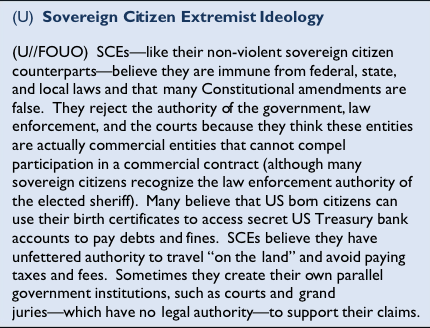
The Actual 2015 DHS Report On Sovereign Citizens Does Not Contain The Claims Made by CNN | Conservative Treehouse

DHSIntelligenceAssessmentSovereignCitizens

Editor’s Note: Department of Homeland Security (DHS) & Southern Poverty Law Center (SPLC) characterizations of sovereign citizens are extremely simple-minded. Furthermore the CNN spin on the report as noted below was grossly distorted. Most of the sovereign citizens I’ve had contact with over the years were non-violent, posed no threat to the government, were sincere in their efforts to restore accountability in government, justice in the courts and liberty to the country. For the record the founding fathers were sovereign citizens of their respective states.

Within the CNN analysis they claim serious threats:

[…] ”from sovereign citizen groups as equal to — and in some cases greater than — the threat from foreign Islamic terror groups, such as ISIS”.

Except, there’s something very divergent – The actual report does not claim that the threat to police is growing, it does not conflate sovereigns with other anti-government groups, it makes no broad claims about terror on the right,  and it does not compare the sovereigns to ISIS or to any other foreign terrorists.

There is absolutely nothing in the report to suggest such an interpretation.  Heck, the words “right-wing” do not even show up in the report anywhere. 

As Reason.Com outlines:

[…]  The document declares on its first page that most sovereign citizens are nonviolent, and that it will focus only on the violent fringe within a fringe—the people it calls “sovereign citizen extremists,” or SCEs. It describes their violence as “sporadic,” and it does not expect its rate to rise, predicting instead that the violence will stay “at the same sporadic level” in 2015. The author or authors add that most of the violence consists of “unplanned, reactive” clashes with police officers, not preplanned attacks. (more)

Here is the actual report. You can compare it to the CNN interpretation and decide for yourself.

Download: Sovereign Citizen Extremist Ideology Report (February 5, 2015)
Source: Conservative Treehouse

DHSCharacterization

US government faces pressure after biggest leak in banking history | The Guardian

HSBC bank branchThe US government will come under intense pressure this week to explain what action it took after receiving a massive cache of leaked data that revealed how the Swiss banking arm of HSBC, the world’s second-largest bank, helped wealthy customers conceal billions of dollars of assets.

The leaked files, which reveal how HSBC advised some clients on how to circumvent domestic tax authorities, were obtained through an international collaboration of news outlets, including the Guardian, the French daily Le Monde, CBS 60 Minutes and the Washington-based International Consortium of Investigative Journalists.

The files reveal how HSBC’s Swiss private bank colluded with some clients to conceal undeclared “black” accounts from domestic tax authorities across the world and provided services to international criminals and other high-risk individuals.

The disclosure amounts to one of the biggest banking leaks in history shedding light on some 30,000 accounts holding almost $120bn (£78bn) of assets. Of those, around 2,900 clients were connected to the US, providing the IRS with a trail of evidence of potential American taxpayers who may have been hiding assets in Geneva.

The data was leaked by a computer expert turned whistleblower working in HSBC’s Geneva office. French authorities later obtained the files and shared them with the US Internal Revenue Service in 2010. That year, amid growing scrutiny from US tax authorities, HSBC’s private bank in Switzerland stopped doing business with US residents entirely.

The US Department of Justice and IRS have been investigating HSBC’s Swiss banking operations ever since but the scale of those inquiries remain unclear.

Confronted by the Guardian’s evidence, HSBC admitted wrongdoing by its Geneva-based subsidiary. “We acknowledge and are accountable for past compliance and control failures,” the bank said in a statement. The Swiss arm, the statement said, had not been fully integrated into HSBC after its purchase in 1999, allowing “significantly lower” standards of compliance and due diligence to persist. Read more…

Source: The Guardian