Why Last Night Was Not Just Huge For Pot, But The Entire Criminal Justice System | Think Progress

ProportionalPunishmentBy

Last night wasn’t a good night for Democrats. But when asked instead to vote on issues that many Democrats care about, voters backed progressive ballot initiatives around the country. This is particularly true in the area of criminal justice, which has become a rare point of bipartisanship among some Democrats and Republicans. In a spate of ballot initiatives around the country, voters sent a signal that they are ready to reform a system that has sent more people in the United States to jail than in any other country in the world.

Each of these initiatives embraces a notion known as “Smart on Crime.” The phrase is a replacement for the old adage of “tough-on-crime” and means that, rather than threatening heavy punishments for a long list of so-called crimes, jurisdictions focus instead on doing what actually, empirically, makes communities safer. In reducing or eliminating penalties for some actions that would be better addressed through public health or rehabilitative policies, jurisdictions can focus more resources on serious, violent crimes. Or, as U.S. Attorney General Eric Holder put it last year, “Too many people go to too many prisons for far too long for no good law enforcement reason.”

Marijuana

Alaska, Oregon, and Washington, D.C. put pot legalization on the ballot, and all three passed it. As of last night, there are now more than double the number of jurisdictions that have legalized marijuana for recreational use, even as it remains federally prohibited. In Washington, D.C., where African Americans make up almost half the population, the margin of victory was staggering, with voters supporting the measure by a ratio of 7 to 3.

Alaska and Oregon were not as certain to pass the initiatives. But both passed by margins of several points ballot initiatives that don’t just legalize possession and growth of pot, but also its sale and taxation. (Washington, D.C. is not permitted to tax and regulate by ballot initiative, and lawmakers plan to follow up with a bill to achieve this).

In each of these jurisdictions, different messages dominated. In libertarian-heavy Alaska, where pot policy was already liberalized, the focus of the campaign was that marijuana is no less safe than alcohol, and those who use it shouldn’t be penalized differently. In Washington, D.C., by contrast, a significant population of very liberal gentrifiers mixed with longtime African American residents who are sick and tired of criminal justice policies that arrest African Americans for pot at eight times the rate of whites.

Majorities also voted in favor of medical marijuana. In Guam, a measure to pass medical marijuana passed early in the day. And in Florida, a medical marijuana ballot initiative that became heavily politicized with a well-funded opposition movement failed, but only because it required a 60 percent vote to amend the Constitution. Despite the initiative’s failure, a solid majority — 58 percent — voted in favor of the measure. The initiative’s loss is still a bit of a surprise, because polls have shown that support among Florida residents for the idea of medical marijuana is as high as 90 percent. In fact, lawmakers passed a much narrower medical marijuana provision last year that, remarkably, had the support of almost every state lawmaker. If their goal in passing it was to pick off support for the more expansive measure on the ballot, they succeeded.

Rounding off the evening, two cities in New Mexico — Santa Fe and Bernalillo — voted to decriminalize pot.

The statewide initiatives won’t go into effect today. There will be months of policy-making, political wrangling, and pushback from Congress. But majorities in every jurisdiction where the question was posed voted to reduce the penalties for marijuana.

Proportional Penalties

In California, voters passed an initiative that embraces that Smart on Crime notion in a more comprehensive way. Proposition 47 reduces the penalties for low-level nonviolent offenses including many drug and property crimes, on the notion that locking people up who haven’t done anything dangerous doesn’t do anybody any good. The initiative changes a number of offenses from felonies to misdemeanors, meaning the sentence for conviction is much lower, and that the impact on an individual’s criminal record won’t be as significant. Many job and voting restrictions, for example, only apply to felonies. Offenses that will be affected by the measure include drug possession offenses, as well as shoplifting, credit card fraud, and forgery.

The initiative also means that some 10,000 individuals already behind bars will be eligible for re-sentencing. This is particularly relevant for California, which has been struggling to reduce its prison population since the U.S. Supreme Court declared its prisons so overcrowded that they violate the Eighth Amendment prohibition against cruel and unusual punishment.

With a passage rate of 58 percent, the initiative may serve as a model for other states. The state already decriminalized marijuana possession several years ago, and has seen arrests go down without significant adverse consequences.

Bail Reform

In New Jersey, Democrats and Republicans have joined forces over the past year to pass a package of measures that ensure those behind bars are those who pose a greater danger to society, not the ones who can’t afford to pay bail. Lawmakers took up the issue after a study found that some 40 percent of those who are jailed after they are arrested but before their trial or conviction are there simply because they were poor.

The idea behind bail is that individuals who are charged with a crime put up a bond of significant value to increase the likelihood that they will return for future court dates. But the system creates a class divide. Many are charged with bail under $2,500 — a sum that many wealthier individuals can pay, but is completely out of reach for low-income defendants. Those who end up stuck behind bars pending their trial do not have the same capacity to defend their case. They are more likely to eventually plead guilty, and many have called pretrial detention “ransom” intended to extract such guilty pleas.

Two companion bills were passed by the New Jersey legislature to make the bail system less about how much money defendants have, and more about whether they pose a danger to the public. One bill passed by the legislature took income out of the equation for less dangerous offenders by conducting risk assessments of defendants, and allow those not deemed dangerous to participate in a monitoring program until their trail, rather than to sit in jail. A second bill put Tuesday’s ballot initiative before the voters. That ballot initiative asked voters to give judges power to hold the most dangerous offenders behind bars before their trial — even if they could afford bail. By passing this measure Tuesday, the bail reform package is now fully in effect.

Gun Violence

The idea of “Smart on Crime” initiatives is to eliminate the counterproductive criminal policies and re-allocate resources toward those policies that actually reduce violent crime. To that end, some might also consider it a win that in Washington State (where pot is already legal), voters both approved a measure to close a loophole in firearms background checks, and rejected a competing ballot initiative that would have narrowed the state’s gun laws. The measure means that gun sellers and buyers can’t get around limitations on who can own a guy by selling them in private online sales or at gun shows.

Source:  Think Progress

How a Century of Racist Policies Made Ferguson Into a Pocket of Concentrated Despair | Bill Moyers

By Joshua Holland

FergusonPovertyFerguson, Missouri, was a powder-keg waiting for a match long before August 9 and Michael Brown’s fateful encounter with Police Officer Darren Wilson. It is one of many predominantly black communities across the United States plagued by highly concentrated poverty, and all of the social problems that accompany it.

White America has come up with a number of rationales for these enduring pockets of despair. An elaborate mythology has developed that blames it on a “culture of poverty” — holding the poor culpable for their poverty and letting our political and economic systems off the hook. A somewhat more enlightened view holds that whites simply fled areas like Ferguson — which had a population that was 99 percent white as recently as 1970 — because of personal racial animus, leaving them as hollowed-out, predominantly black “ghettos.”

But a study by Richard Rothstein, a research fellow at the Economic Policy Institute, comes to a very different conclusion. In his report, “The Making of Ferguson,” Rothstein details how throughout the last century a series of intentionally discriminatory policies at the local, state and federal levels created the ghettos we see today. BillMoyers.com spoke with Rothstein about the report. The transcript below has been edited for length and clarity.

Joshua Holland: Most people believe that Ferguson became so racially polarized because of “white flight” — white people fled the area because of personal prejudice against African-Americans. In your report, you argue that this misses a crucial point. What are we overlooking?

Rothstein: The segregation that characterizes Ferguson, and that characterizes St. Louis, was the creation of purposeful public policy. We have a segregated nation by design.

The St. Louis metropolitan area was no different from most metropolitan areas of the country. The ghetto in the central city of St. Louis was redeveloped for universities, and for a number of other uses, and the African American population in the central city was shifted to inner ring suburbs like Ferguson.

It was done primarily with two policies: First, public housing was segregated, purposely, by the federal government, so that what were previously somewhat integrated neighborhoods in urban areas were separated into separate black and white public housing projects.

And then, in the 1950s, as suburbs came to be developed, the federal government subsidized white residents of St. Louis to move to the suburbs, but effectively prohibited black residents from doing so. The federal government subsidized the construction of many, many subdivisions by requiring that bank loans for the builders be made on the condition that no homes be sold to blacks.

Because black housing was so restrictive, there were so few places where African-Americans could live in St. Louis. So what was left of St. Louis’ African-American community became overcrowded. City services were not readily available. The city was zoned so that the industrial or commercial areas were placed in black neighborhoods but not in white neighborhoods. So the industrial areas, where African-Americans lived, became slums.

And then white residents in places like Ferguson came to associate slum conditions with African-Americans, not realizing that this was not a characteristic of the people themselves, but rather it was a creation of public policy.

This is a somewhat oversimplified description of a complex array of policies. But every policy that I described in this report can be found in every other metropolitan area throughout the country. These policies applied in the New York City area, and they applied in the liberal San Francisco area. It’s a story that characterizes the entire country, but you cannot understand what’s going on with Ferguson today without knowing this history.

Holland: Who was Adel Allen, and why is his story — which took place in nearby Kirkwood, Missouri — important for understanding how Ferguson came to be the city it is today?

Rothstein: Adel Allen was an African American engineer for the McDonnell Douglas Corporation. He was recruited from Kansas to work in the St. Louis metro area. When he got there, he couldn’t find housing anywhere in the suburban areas near the plant. He was about to move back to Kansas, because the only place he could find housing was in overcrowded conditions in the central St. Louis ghetto.

He finally got a white friend to buy a home for him in the town of Kirkwood. He moved into a block that was overwhelmingly white. There were 30 white families. Seven years later, there were 30 black families and two white families on that block. And this was largely because of practices in the real estate industry.

Ta-Nehisi Coates on Black vs. White Neighborhoods

Realtors engaged in a practice which came to be known as “blockbusting.” When a black family moved onto a block, like Adel Allen did in Kirkwood, the real estate agents would go door to door and try to panic their white neighbors into selling their homes at very reduced prices, with the idea that property values were going to be destroyed because African-Americans were moving into their neighborhood.

Those real estate agents then bought those properties at very low prices and resold them to African-Americans, who had to pay very high prices because they had no other housing options.

Now, this was something that was not considered unethical until the 1970s. In fact, licenses would be suspended by the state real estate commission if a real estate agent sold a home to a black family in a white neighborhood — until the first one sold, and then it was considered perfectly ethical for real estate agents to turn an entire block into an African-American block.

Once they moved into that block, all of a sudden, over the course of a few years, city services began to decline. Other parts of Kirkwood which were overwhelmingly white continued to get good services, but the African-American neighborhoods were denied. The rest of the city got sidewalks and curbs; the black blocks did not.

Holland: You also write, “State sponsored labor and employment discrimination reduced the incomes of African-Americans relative to whites in St. Louis.” So as a result, even absent these kinds of housing policies you describe, African-Americans would be hard-pressed to afford to live in a decent white suburb.

Rothstein: That’s right. In St. Louis, African-Americans were excluded from good-paying jobs for most of the 20th century. They opened up only beginning in the 1970s. For example, construction jobs during the enormous housing boom that created the suburbs in the 1940s, ’50s and ’60s were completely closed to African-Americans because they could not be admitted to construction unions, and the federal government certified every one of those segregated unions as the exclusive agent for their trades in those construction sites. So it’s not simply the result of private discrimination by the unions. This was something that was sanctioned by the federal government. It wasn’t until the 1960s that the National Labor Relations Board first withdrew certification from a segregated union and the policy didn’t become widespread for at least another 10 years or so.

There are many other examples I could give you. During the enormous employment boom during World War II, St. Louis was a big center of arms manufacturing. Lots of workers flooded to St. Louis from the Ozarks and other areas, black workers as well as white workers. But the largest ammunition producer would not hire African-Americans until the war was almost over.

So all of those lost opportunities for employment created a situation where African-American incomes were much, much lower than white incomes.

Holland: I’m going to ask you to connect some dots. Many of the things you describe in the paper haven’t been legal for quite a bit of time. How does this legacy of institutional racism in the past set up the unrest that has played out in Ferguson after the shooting death of Michael Brown?

Rothstein: As we know from a lot of recent research, intergenerational income mobility in this country is quite low. If you’re born into a low-income family, the chances are very, very great that you yourself will have a low income. We don’t have nearly the kind of mobility that is mythical in this country.

So after a century of policies which denied African-Americans access to jobs that pay decent wages, the likelihood is that their children and their children’s children will still be paying the price for those policies that held their parents and grandparents behind for so long.

And then there are the housing policies. Let me take the example of the suburb of Kirkwood. In the 1950s, when Kirkwood was being developed, those homes were selling for about $8,000 dollars each, which was about two times the national median income at that time. Working families could afford to buy a home for twice median income, but only whites were permitted to buy into Kirkwood. Any white working family could’ve afforded to buy those homes, and very often, they were further subsidized by the federal government — veterans could buy with no down payment, and obtain loans at very low interest rates.

Those families then benefited from a half-century of equity appreciation in their homes. If they moved, they profited on the sale. And they were able to transmit that equity to their children. Their children were secure. Their children were able to go to college.

Today, those same homes that sold for $8,000 in the 1950s sell for $400,000, which is about six or seven times national median income. So today, working families, whether white or black, can’t afford to buy in Kirkwood. Fifty years ago, when whites similar to them in every other respect except their race were populating the suburbs, African-American families were not permitted to do so, so the legacy of that discrimination continues to this date. Poor African-Americans got crowded into ghettos — into all black, low-income neighborhoods like Ferguson.

And because the Federal Housing Administration refused to guarantee mortgages for African-Americans and would only guarantee mortgages for whites, black people who could afford to buy homes couldn’t get mortgages for them. So speculators sold those homes to them on contract, like on an installment plan. And if they were ever late with a payment, their house would be immediately repossessed and resold again on contract to someone else. In order to be able to make these contract payments, which were very high because the demand for housing was so great relative to the supply available to African-Americans, families doubled up, they subdivided their homes, they rented out parts of their homes. That’s a great example of how public policies led to the formation of slums.

This then became a multigenerational problem.

Source: Bill Moyers

Vote all you want. The secret government won’t change | Boston Globe

By Jordan Michael Smith

DoubleGovernment The voters who put Barack Obama in office expected some big changes. From the NSA’s warrantless wiretapping to Guantanamo Bay to the Patriot Act, candidate Obama was a defender of civil liberties and privacy, promising a dramatically different approach from his predecessor.

But six years into his administration, the Obama version of national security looks almost indistinguishable from the one he inherited. Guantanamo Bay remains open. The NSA has, if anything, become more aggressive in monitoring Americans. Drone strikes have escalated. Most recently it was reported that the same president who won a Nobel Prize in part for promoting nuclear disarmament is spending up to $1 trillion modernizing and revitalizing America’s nuclear weapons.

Why did the face in the Oval Office change but the policies remain the same? Critics tend to focus on Obama himself, a leader who perhaps has shifted with politics to take a harder line. But Tufts University political scientist Michael J. Glennon has a more pessimistic answer: Obama couldn’t have changed policies much even if he tried.

Though it’s a bedrock American principle that citizens can steer their own government by electing new officials, Glennon suggests that in practice, much of our government no longer works that way. In a new book, “National Security and Double Government,” he catalogs the ways that the defense and national security apparatus is effectively self-governing, with virtually no accountability, transparency, or checks and balances of any kind. He uses the term “double government”: There’s the one we elect, and then there’s the one behind it, steering huge swaths of policy almost unchecked. Elected officials end up serving as mere cover for the real decisions made by the bureaucracy.

RELATED: Coverage of the 2014 midterm elections

Glennon cites the example of Obama and his team being shocked and angry to discover upon taking office that the military gave them only two options for the war in Afghanistan: The United States could add more troops, or the United States could add a lot more troops. Hemmed in, Obama added 30,000 more troops.

Glennon’s critique sounds like an outsider’s take, even a radical one. In fact, he is the quintessential insider: He was legal counsel to the Senate Foreign Relations Committee and a consultant to various congressional committees, as well as to the State Department. “National Security and Double Government” comes favorably blurbed by former members of the Defense Department, State Department, White House, and even the CIA. And he’s not a conspiracy theorist: Rather, he sees the problem as one of “smart, hard-working, public-spirited people acting in good faith who are responding to systemic incentives”—without any meaningful oversight to rein them in.

How exactly has double government taken hold? And what can be done about it? Glennon spoke with Ideas from his office at Tufts’ Fletcher School of Law and Diplomacy. This interview has been condensed and edited.

IDEAS: Where does the term “double government” come from?

GLENNON:It comes from Walter Bagehot’s famous theory, unveiled in the 1860s. Bagehot was the scholar who presided over the birth of the Economist magazine—they still have a column named after him. Bagehot tried to explain in his book “The English Constitution” how the British government worked. He suggested that there are two sets of institutions. There are the “dignified institutions,” the monarchy and the House of Lords, which people erroneously believed ran the government. But he suggested that there was in reality a second set of institutions, which he referred to as the “efficient institutions,” that actually set governmental policy. And those were the House of Commons, the prime minister, and the British cabinet.

IDEAS: What evidence exists for saying America has a double government?

GLENNON:I was curious why a president such as Barack Obama would embrace the very same national security and counterterrorism policies that he campaigned eloquently against. Why would that president continue those same policies in case after case after case? I initially wrote it based on my own experience and personal knowledge and conversations with dozens of individuals in the military, law enforcement, and intelligence agencies of our government, as well as, of course, officeholders on Capitol Hill and in the courts. And the documented evidence in the book is substantial—there are 800 footnotes in the book.

IDEAS: Why would policy makers hand over the national-security keys to unelected officials?

GLENNON: It hasn’t been a conscious decision….Members of Congress are generalists and need to defer to experts within the national security realm, as elsewhere. They are particularly concerned about being caught out on a limb having made a wrong judgment about national security and tend, therefore, to defer to experts, who tend to exaggerate threats. The courts similarly tend to defer to the expertise of the network that defines national security policy.

The presidency itself is not a top-down institution, as many people in the public believe, headed by a president who gives orders and causes the bureaucracy to click its heels and salute. National security policy actually bubbles up from within the bureaucracy. Many of the more controversial policies, from the mining of Nicaragua’s harbors to the NSA surveillance program, originated within the bureaucracy. John Kerry was not exaggerating when he said that some of those programs are “on autopilot.”

RELATED: Answers sought on CIA role in ‘78 JFK probe

IDEAS: Isn’t this just another way of saying that big bureaucracies are difficult to change?

GLENNON: It’s much more serious than that. These particular bureaucracies don’t set truck widths or determine railroad freight rates. They make nerve-center security decisions that in a democracy can be irreversible, that can close down the marketplace of ideas, and can result in some very dire consequences.

IDEAS: Couldn’t Obama’s national-security decisions just result from the difference in vantage point between being a campaigner and being the commander-in-chief, responsible for 320 million lives?

GLENNON: There is an element of what you described. There is not only one explanation or one cause for the amazing continuity of American national security policy. But obviously there is something else going on when policy after policy after policy all continue virtually the same way that they were in the George W. Bush administration.

IDEAS: This isn’t how we’re taught to think of the American political system.

GLENNON: I think the American people are deluded, as Bagehot explained about the British population, that the institutions that provide the public face actually set American national security policy. They believe that when they vote for a president or member of Congress or succeed in bringing a case before the courts, that policy is going to change. Now, there are many counter-examples in which these branches do affect policy, as Bagehot predicted there would be. But the larger picture is still true—policy by and large in the national security realm is made by the concealed institutions.

IDEAS: Do we have any hope of fixing the problem?

GLENNON: The ultimate problem is the pervasive political ignorance on the part of the American people. And indifference to the threat that is emerging from these concealed institutions. That is where the energy for reform has to come from: the American people. Not from government. Government is very much the problem here. The people have to take the bull by the horns. And that’s a very difficult thing to do, because the ignorance is in many ways rational. There is very little profit to be had in learning about, and being active about, problems that you can’t affect, policies that you can’t change.

Source: Boston Globe

John Pilger on ISIS: Only When We See the War Criminals In Our Midst Will the Blood Begin to Dry | Films for Action

By John Pilger

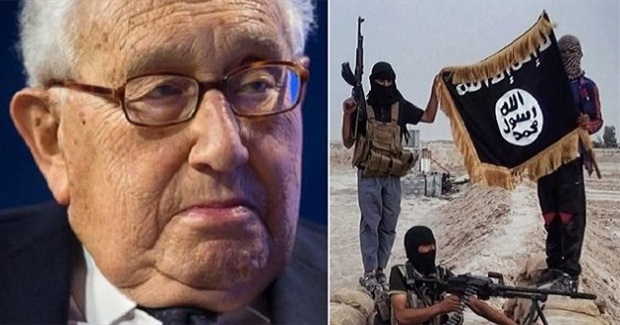
KissingerISISIn transmitting President Richard Nixon’s orders for a “massive” bombing of Cambodia in 1969, Henry Kissinger said, “Anything that flies on everything that moves”.  As Barack Obama ignites his seventh war against the Muslim world since he was awarded the Nobel Peace Prize, the orchestrated hysteria and lies make one almost nostalgic for Kissinger’s murderous honesty.

As a witness to the human consequences of aerial savagery – including the beheading of victims, their parts festooning trees and fields – I am not surprised by the disregard of memory and history, yet again. A telling example is the rise to power of Pol Pot and his Khmer Rouge, who had much in common with today’s Islamic State in Iraq and Syria (ISIS). They, too, were ruthless medievalists who began as a small sect. They, too, were the product of an American-made apocalypse, this time in Asia.

According to Pol Pot, his movement had consisted of “fewer than 5,000 poorly armed guerrillas uncertain about their strategy, tactics, loyalty and leaders”. Once Nixon’s and Kissinger’s B52 bombers had gone to work as part of “Operation Menu”, the west’s ultimate demon could not believe his luck.

The Americans dropped the equivalent of five Hiroshimas on rural Cambodia during 1969-73. They levelled village after village, returning to bomb the rubble and corpses. The craters left monstrous necklaces of carnage, still visible from the air. The terror was unimaginable. A former Khmer Rouge official described how the survivors “froze up and they would wander around mute for three or four days. Terrified and half-crazy, the people were ready to believe what they were told… That was what made it so easy for the Khmer Rouge to win the people over.”

A Finnish Government Commission of Enquiry estimated that 600,000 Cambodians died in the ensuing civil war and described the bombing as the “first stage in a decade of genocide”. What Nixon and Kissinger began, Pol Pot, their beneficiary, completed. Under their bombs, the Khmer Rouge grew to a formidable army of 200,000.

ISIS has a similar past and present. By most scholarly measure, Bush and Blair’s invasion of Iraq in 2003 led to the deaths of some 700,000 people – in a country that had no history of jihadism. The Kurds had done territorial and political deals; Sunni and Shia had class and sectarian differences, but they were at peace; intermarriage was common. Three years before the invasion, I drove the length of Iraq without fear. On the way I met people proud, above all, to be Iraqis, the heirs of a civilization that seemed, for them, a presence.

Bush and Blair blew all this to bits. Iraq is now a nest of jihadism. Al-Qaeda – like Pol Pot’s “jihadists” – seized the opportunity provided by the onslaught of Shock and Awe and the civil war that followed. “Rebel” Syria offered even greater rewards, with CIA and Gulf state ratlines of weapons, logistics and money running through Turkey. The arrival of foreign recruits was inevitable. A former British ambassador, Oliver Miles, wrote recently, “The [Cameron] government seems to be following the example of Tony Blair, who ignored consistent advice from the Foreign Office, MI5 and MI6 that our Middle East policy – and in particular our Middle East wars – had been a principal driver in the recruitment of Muslims in Britain for terrorism here.”

ISIS is the progeny of those in Washington and London who, in destroying Iraq as both a state and a society, conspired to commit an epic crime against humanity. Like Pol Pot and the Khmer Rouge, ISIS are the mutations of a western state terror dispensed by a venal imperial elite undeterred by the consequences of actions taken at great remove in distance and culture. Their culpability is unmentionable in “our” societies.

It is 23 years since this holocaust enveloped Iraq, immediately after the first Gulf War, when the US and Britain hijacked the United Nations Security Council and imposed punitive “sanctions” on the Iraqi population – ironically, reinforcing the domestic authority of Saddam Hussein. It was like a medieval siege. Almost everything that sustained a modern state was, in the jargon, “blocked” – from chlorine for making the water supply safe to school pencils, parts for X-ray machines, common painkillers and drugs to combat previously unknown cancers carried in the dust from the southern battlefields contaminated with Depleted Uranium.

Just before Christmas 1999, the Department of Trade and Industry in London restricted the export of vaccines meant to protect Iraqi children against diphtheria and yellow fever. Kim Howells, parliamentary Under-Secretary of State in the Blair government, explained why. “The children’s vaccines”, he said, “were capable of being used in weapons of mass destruction”. The British Government could get away with such an outrage because media reporting of Iraq – much of it manipulated by the Foreign Office – blamed Saddam Hussein for everything.

Under a bogus “humanitarian” Oil for Food Programme, $100 was allotted for each Iraqi to live on for a year. This figure had to pay for the entire society’s infrastructure and essential services, such as power and water. “Imagine,” the UN Assistant Secretary General, Hans Von Sponeck, told me, “setting that pittance against the lack of clean water, and the fact that the majority of sick people cannot afford treatment, and the sheer trauma of getting from day to day, and you have a glimpse of the nightmare. And make no mistake, this is deliberate. I have not in the past wanted to use the word genocide, but now it is unavoidable.”

Disgusted, Von Sponeck resigned as UN Humanitarian Co-ordinator in Iraq. His predecessor, Denis Halliday, an equally distinguished senior UN official, had also resigned. “I was instructed,” Halliday said, “to implement a policy that satisfies the definition of genocide: a deliberate policy that has effectively killed well over a million individuals, children and adults.”

A study by the United Nations Children’s Fund, Unicef, found that between 1991 and 1998, the height of the blockade, there were 500,000 “excess” deaths of Iraqi infants under the age of five. An American TV reporter put this to Madeleine Albright, US Ambassador to the United Nations, asking her, “Is the price worth it?” Albright replied, “We think the price is worth it.”

In 2007, the senior British official responsible for the sanctions, Carne Ross, known as “Mr. Iraq”, told a parliamentary selection committee, “[The US and UK governments] effectively denied the entire population a means to live.”  When I interviewed Carne Ross three years later, he was consumed by regret and contrition. “I feel ashamed,” he said. He is today a rare truth-teller of how governments deceive and how a compliant media plays a critical role in disseminating and maintaining the deception. “We would feed [journalists] factoids of sanitised intelligence,” he said, “or we’d freeze them out.”

On 25 September, a headline in the Guardian read: “Faced with the horror of Isis we must act.” The “we must act” is a ghost risen, a warning of the suppression of informed memory, facts, lessons learned and regrets or shame. The author of the article was Peter Hain, the former Foreign Office minister responsible for Iraq under Blair. In 1998, when Denis Halliday revealed the extent of the suffering in Iraq for which the Blair Government shared primary responsibility, Hain abused him on the BBC’s Newsnight as an “apologist for Saddam”. In 2003, Hain backed Blair’s invasion of stricken Iraq on the basis of transparent lies. At a subsequent Labour Party conference, he dismissed the invasion as a “fringe issue”.

Now Hain is demanding “air strikes, drones, military equipment and other support” for those “facing genocide” in Iraq and Syria. This will further “the imperative of a political solution”. Obama has the same in mind as he lifts what he calls the “restrictions” on US bombing and drone attacks. This means that missiles and 500-pound bombs can smash the homes of peasant people, as they are doing without restriction in Yemen, Pakistan, Afghanistan and Somalia – as they did in Cambodia, Vietnam and Laos. On 23 September, a Tomahawk cruise missile hit a village in Idlib Province in Syria, killing as many as a dozen civilians, including women and children. None waved a black flag.

The day Hain’s article appeared, Denis Halliday and Hans Von Sponeck happened to be in London and came to visit me. They were not shocked by the lethal hypocrisy of a politician, but lamented the enduring, almost inexplicable absence of intelligent diplomacy in negotiating a semblance of truce. Across the world, from Northern Ireland to Nepal, those regarding each other as terrorists and heretics have faced each other across a table. Why not now in Iraq and Syria.

Like Ebola from West Africa, a bacteria called “perpetual war” has crossed the Atlantic. Lord Richards, until recently head of the British military, wants “boots on the ground” now. There is a vapid, almost sociopathic verboseness from Cameron, Obama and their “coalition of the willing” – notably Australia’s aggressively weird Tony Abbott – as they prescribe more violence delivered from 30,000 feet on places where the blood of previous adventures never dried. They have never seen bombing and they apparently love it so much they want it to overthrow their one potentially valuable ally,  Syria. This is nothing new, as the following leaked UK-US intelligence file illustrates:

“In order to facilitate the action of liberative [sic] forces… a special effort should be made to eliminate certain key individuals [and] to proceed with internal disturbances in Syria. CIA is prepared, and SIS (MI6) will attempt to mount minor sabotage and coup de main [sic] incidents within Syria, working through contacts with individuals… a necessary degree of fear… frontier and [staged] border clashes [will] provide a pretext for intervention… the CIA and SIS should use… capabilities in both psychological and action fields to augment tension.”

That was written in 1957, though it could have been written yesterday. In the imperial world, nothing essentially changes. Last year, the former French Foreign Minister Roland Dumas revealed that “two years before the Arab spring”, he was told in London that a war on Syria was planned. “I am going to tell you something,” he said in an interview with the French TV channel LPC, “I was in England two years before the violence in Syria on other business. I met top British officials, who confessed to me that they were preparing something in Syria… Britain was organising an invasion of rebels into Syria. They even asked me, although I was no longer Minister for Foreign Affairs, if I would like to participate… This operation goes way back. It was prepared, preconceived and planned.”

The only effective opponents of ISIS are accredited demons of the west – Syria, Iran, Hezbollah. The obstacle is Turkey, an “ally” and a member of Nato, which has conspired with the CIA, MI6 and the Gulf medievalists to channel support to the Syrian “rebels”, including those now calling themselves ISIS. Supporting Turkey in its long-held ambition for regional dominance by overthrowing the Assad government beckons a major conventional war and the horrific dismemberment of the most ethnically diverse state in the Middle East.

A truce – however difficult to achieve – is the only way out of this imperial maze; otherwise, the beheadings will continue. That genuine negotiations with Syria should be seen as “morally questionable” (the Guardian) suggests that the assumptions of moral superiority among those who supported the war criminal Blair remain not only absurd, but dangerous.

Together with a truce, there should be an immediate cessation of all shipments of war materials to Israel and recognition of the State of Palestine. The issue of Palestine is the region’s most festering open wound, and the oft-stated justification for the rise of Islamic extremism. Osama bin Laden made that clear. Palestine also offers hope. Give justice to the Palestinians and you begin to change the world around them.

More than 40 years ago, the Nixon-Kissinger bombing of Cambodia unleashed a torrent of suffering from which that country has never recovered. The same is true of the Blair-Bush crime in Iraq. With impeccable timing, Henry Kissinger’s latest self-serving tome has just been released with its satirical title, “World Order”. In one fawning review, Kissinger is described as a “key shaper of a world order that remained stable for a quarter of a century”. Tell that to the people of Cambodia, Vietnam, Laos, Chile, East Timor and all the other victims of his “statecraft”.  Only when “we” recognise the war criminals in our midst will the blood begin to dry.


Source: John Pilger
‘Citizenfour’: Documentary with Edward Snowden Released | RT

Edward Snowden is not “skulking” in a secret Russian bunker but is living an ordinary life in Moscow with his longtime girlfriend, Lindsay Mills. “Citizenfour,” a documentary about the whistleblower, premiered Friday at the New York Film Festival.

It has been three months since Lindsay Mills, whom Snowden had to leave behind in Hawaii in May 2013, was reunited with him in Moscow in July, “Citizenfour” reveals. The documentary was directed by investigative journalist and filmmaker Laura Poitras, an associate of former Guardian reporter Glenn Greenwald, who has been Snowden’s primary media contact throughout the NSA revelations campaign.

Source: Russia Today

Inside the New York Fed: Secret Recordings and a Culture Clash | BillMoyers.com

CarmenSegarraBy Jake Bernstein

Barely a year removed from the devastation of the 2008 financial crisis, the president of the Federal Reserve Bank of New York faced a crossroads. Congress had set its sights on reform. The biggest banks in the nation had shown that their failure could threaten the entire financial system. Lawmakers wanted new safeguards.

The Federal Reserve, and, by dint of its location off Wall Street, the New York Fed, was the logical choice to head the effort. Except it had failed miserably in catching the meltdown.

New York Fed President William Dudley had to answer two questions quickly: Why had his institution blown it, and how could it do better? So he called in an outsider, a Columbia University finance professor named David Beim, and granted him unlimited access to investigate. In exchange, the results would remain secret.

After interviews with dozens of New York Fed employees, Beim learned something that surprised even him. The most daunting obstacle the New York Fed faced in overseeing the nation’s biggest financial institutions was its own culture. The New York Fed had become too risk-averse and deferential to the banks it supervised. Its examiners feared contradicting bosses, who too often forced their findings into an institutional consensus that watered down much of what they did.

The report didn’t only highlight problems. Beim provided a path forward. He urged the New York Fed to hire expert examiners who were unafraid to speak up and then encourage them to do so. It was essential, he said, to preventing the next crisis.

A year later, Congress gave the Federal Reserve even more oversight authority. And the New York Fed started hiring specialized examiners to station inside the too-big-to fail institutions, those that posed the most risk to the financial system.

One of the expert examiners it chose was Carmen Segarra.

Segarra appeared to be exactly what Beim ordered. Passionate and direct, schooled in the Ivy League and at the Sorbonne, she was a lawyer with more than 13 years of experience in compliance – the specialty of helping banks satisfy rules and regulations. The New York Fed placed her inside one of the biggest and, at the time, most controversial banks in the country, Goldman Sachs.

It did not go well. She was fired after only seven months.

As ProPublica reported last year, Segarra sued the New York Fed and her bosses, claiming she was retaliated against for refusing to back down from a negative finding about Goldman Sachs. A judge threw out the case this year without ruling on the merits, saying the facts didn’t fit the statute under which she sued.

At the bottom of a document filed in the case, however, her lawyer disclosed a stunning fact: Segarra had made a series of audio recordings while at the New York Fed. Worried about what she was witnessing, Segarra wanted a record in case events were disputed. So she had purchased a tiny recorder at the Spy Store and began capturing what took place at Goldman and with her bosses.

Segarra ultimately recorded about 46 hours of meetings and conversations with her colleagues. Many of these events document key moments leading to her firing. But against the backdrop of the Beim report, they also offer an intimate study of the New York Fed’s culture at a pivotal moment in its effort to become a more forceful financial supervisor. Fed deliberations, confidential by regulation, rarely become public.

The recordings make clear that some of the cultural obstacles Beim outlined in his report persisted almost three years after he handed his report to Dudley. They portray a New York Fed that is at times reluctant to push hard against Goldman and struggling to define its authority while integrating Segarra and a new corps of expert examiners into a reorganized supervisory scheme.

Segarra became a polarizing personality inside the New York Fed — and a problem for her bosses — in part because she was too outspoken and direct about the issues she saw at both Goldman and the Fed. Some colleagues found her abrasive and complained. Her unwillingness to conform set her on a collision course with higher-ups at the New York Fed and, ultimately, led to her undoing.

In a tense, 40-minute meeting recorded the week before she was fired, Segarra’s boss repeatedly tries to persuade her to change her conclusion that Goldman was missing a policy to handle conflicts of interest. Segarra offered to review her evidence with higher-ups and told her boss she would accept being overruled once her findings were submitted. It wasn’t enough.

“Why do you have to say there’s no policy?” her boss said near the end of the grueling session.

“Professionally,” Segarra responded, “I cannot agree.”

The New York Fed disputes Segarra’s claim that she was fired in retaliation.

“The decision to terminate Ms. Segarra’s employment with the New York Fed was based entirely on performance grounds, not because she raised concerns as a member of any examination team about any institution,” it said in a two-page statement responding to an extensive list of questions from ProPublica and This American Life.

The statement also defends the bank’s record as regulator, saying it has taken steps to incorporate Beim’s recommendations and “provides multiple venues and layers of recourse to help ensure that its employees freely express their views and concerns.”

“The New York Fed,” the statement says, “categorically rejects the allegations being made about the integrity of its supervision of financial institutions.” Read more…

Source: Bill Moyers


A Primer: What is the Islamic State, and Why Are We Fighting Them? | BillMoyers.com

By Joshua Holland

Who Are These Islamic State Guys?

IS is a group of violent Islamic fundamentalists that first formed in Iraq in the aftermath of the US invasion as Jama’at al-Tawhid wal-Jihad, or “The Organization of Monotheism and Jihad.” It has gone by many names; today, it is also known as the Islamic State, The Islamic State of Iraq and Syria (ISIS) and the Islamic State of Iraq and the Levant (ISIL). As the latter name implies, they ultimately aspire to create an ultra-conservative Islamic state in Iraq, Syria, Lebanon, Israel, Jordan, Cyprus and Southern Turkey.

To simplify a complex history, the organization, which was most familiar to Americans as “Al-Qaeda in Iraq,” began in late 2004 as a home-grown Iraqi Sunni insurgency group that pledged allegiance to Osama Bin Laden. It has expanded into Syria during that country’s civil war, where it attracted extremists from around the world and grew in numbers and strength. Last October, Liz Sly reported for The Washington Post that “thousands of Arabs and other non-Syrian Muslims” had “streamed into Syria over the past two years to join in the fight.”

Experts say that IS has now become so powerful and well-organized that it’s misleading to call it a “terrorist group.” Jessica Lewis of the Washington-based Institute for the Study of War told Time Magazine that it now has “an advanced military leadership… They have incredible command and control and they have a sophisticated reporting mechanism from the field that can relay tactics and directives up and down the line,” she said. “They are well-financed, and they have big sources of manpower, not just the foreign fighters, but also prisoner escapees.”

Martin Chulov reports for The Guardian that IS has “secured massive cashflows from the oilfields of eastern Syria, and supplemented those revenues by robbing banks and looting antiquities.” According to Chulov, the network may have access to $2 billion.

Writing for The Atlantic, Aaron Zelin notes that IS has established a very severe form of Islamic law in areas it has occupied, while also employing “a soft-power governing strategy that includes social services, religious lectures, and da’wa(proselytizing) to local populations.” And at The Nation, Robert Dreyfuss suggeststhat there’s “a real danger that ISIS and its allies can set up a rump statelet in northwest Iraq and northern and eastern Syria controlled by ISIS, and its allies, including groups more closely affiliated to Al Qaeda.”

What’s the Regional Context Here?

This is both an Iraqi conflict, and also a tangled web of proxy wars fought along various regional fault lines.

This chart, by Hayes Brown and Adam Peck from ThinkProgress, is a helpful guide to all of the parties in this highly interconnected conflict:

Media accounts often focus on the discord between the Gulf states, led by Saudi Arabia, and the “Shiite crescent” — Iraq and Iran, where Shiites are the majority; Lebanon, where Hezbollah is a powerful faction; and Syria, where the Alawites (an offshoot of Shia Islam) are a dominant minority. As the chart above illustrates, this tension also affects Turkey, which has launched multiple strikes against Kurdish separatists in Iraq, and the Israeli-Palestinian conflict.

The Pew Research Center finds that throughout the region, from Tunisia to Egypt, there are “widespread fears” that the “violence in Syria would spill over into neighboring states.”

Are We Responsible for This Mess?

APTOPIX Mideast IraqThat’s an oversimplification.

It also takes a short view of history: As the birthplace of the three major Abrahamic religions — and the repository for a good chunk of the world’s oil reserves — the Middle East has long been plagued by conflict. The European colonial powers that sliced up the territory according to their own needs also deserve a lot of credit for its current instability — at GlobalPost, Charles Sennott writes that ISIS is in the process of “tearing up the map” created by France and Great Britain during World War I.

That said, it’s impossible to deny that the US invasion of Iraq in March 2003, plus a series of ideologically informed decisions by the Bush administration that followed, is the proximate cause of the bloody conflict raging there today.

The Bush administration went into Iraq with a “small footprint” — that is, insufficient forces to provide security — fired the army and police as part of its “de-baathification” program, privatized the Iraqi economy instead of investing in adequate public services and established a Shiite-dominated government that marginalized the Sunni community.

At The New Yorker, Dexter Filkins argues that the current wave of extremism in Iraq is “America’s legacy.” He writes: “When the Americans invaded they destroyed the Iraqi state—its military, its bureaucracy, its police force, and most everything else that might hold a country together.”

In 2004, The Atlantic’s James Fallows reported that “the Administration will be condemned for what it did with what was known. The problems the United States has encountered are precisely the ones its own expert agencies warned against.” Naomi Klein reported for Harper’s that the administration’s free-market ideology was the root cause of many of the problems that plagued US reconstruction efforts. In 2007, Nir Rosen wrote in The Washington Post that an “obsession with sects informed the U.S. approach to Iraq from day one of the occupation, but it was not how Iraqis saw themselves — at least, not until very recently. Iraqis were not primarily Sunnis or Shiites; they were Iraqis first, and their sectarian identities did not become politicized until the Americans occupied their country, treating Sunnis as the bad guys and Shiites as the good guys. ” That same year, Raed Jarrar and I said that US officials in Iraq had thwarted a number of plans for peace and reconciliation that had been put forth by parties that opposed the occupation.

The US also played a major role in Nouri al-Maliki’s rise to power following the handover from the Iraqi Coalition Government. Maliki has governed in a fiercely sectarian manner — Al-Monitor states that many “inhabitants of Mosul see the Iraqi army as a Shiite occupation army from Baghdad, and some civilians welcomed ISIS when they entered Mosul and removed all Iraqi army checkpoints. And while The Washington Post’s David Ignatius wrote back in 2007 that “the most important fact about Maliki’s election is that it’s a modest declaration of independence from Iran,” Maliki spent a decade in exile in Iran and, despite some ideological differences, the party he heads, Dawa, has received consistent support from Tehran.

Dexter Filkins reported for The New Yorker that a crucial deal that brought the current Iraqi government together was orchestrated by Qassem Suleimani, the head of Iran’s Quds Force and the architect of Syrian President Bashar al-Assad’s war against the Syrian insurgency.

Source: Bill Moyers


What’s Possible, a New Film for World Leaders on the Urgency of Global Warming | Moyers & Company

More than 120 world leaders – including President Barack Obama – kicked off a one-day United Nations’ summit on climate change in New York City by viewing What’s Possible, a short film on the urgency of global warming.

Narrated by Morgan Freeman, the film’s images, some disturbing and some magnificent, are meant to remind them of what’s at stake: global warming will place our planet and all its inhabitants at destruction’s door unless our governments take immediate action.

The creators of the four-minute film, Lyn Davis Lear and Louie Schwartzberg, spoke with Bill about what they hope their film — translated into six languages and simulcast around the world — will achieve. “They have to focus on the fact that all of us together united add up to something significant,” Lear told Bill. “And the world leaders need to know there is a movement happening right now. People want this to happen.”

The film is not only meant to make an impact on world leaders but also on the world’s citizens. As Schwartzberg puts it: “We hope we can inspire them to take actions in their life that will allow life to be sustainable… And more importantly to elect leaders who share the same values.”

About the Filmmakers

Lyn Davis Lear is a producer, activist and philanthropist. She is one of the founders, along with her husband Norman Lear, of the Environmental Media Association. She is a recipient of the Global Green Millennium Award for Entertainment Industry Environmental Leadership, and was the executive producer of the documentary Cesar’s Last Fast, nominated for the Grand Jury Prize at this year’s Sundance Film Festival.

Louie Schwartzberg is acclaimed the world over for his remarkable work. He specializes in the creation of films that use time-lapse, high-definition and 3-D photography to reveal nature as it is seldom seen by the naked eye. He is founder of the studio Moving Art.

Source: Moyers & Company

5 Minute Speech that Got Judge Napolitano Fired from Fox News | YouTube

Asking questions as Judge Andrew Napolitano did in a recent broadcast on his now cancelled daily show may very well be the reason behind his recent dismissal from Fox. Though specific details are hard to come by because the Judge has yet to give any interviews on the matter, it’s believed that his refusal to bow to commonly manufactured media narratives is among one of several key reasons he is no longer with the network.

The following 5-Minute Speech that Got Napolitano Fired from Fox News is one that should not only be forwarded and shared with every single man, woman and child in this country, but taught and expounded upon in every social studies, civics and government class from first grade through college.

Source: YouTube

The Complete History of Monsanto, “The World’s Most Evil Corporation” | Global Research

monsanto roundup

Of all the mega-corps running amok, Monsanto has consistently outperformed its rivals, earning the crown as “most evil corporation on Earth!” Not content to simply rest upon its throne of destruction, it remains focused on newer, more scientifically innovative ways to harm the planet and its people.

1901: The company is founded by John Francis Queeny, a member of the Knights of Malta, a thirty year pharmaceutical veteran married to Olga Mendez Monsanto, for which Monsanto Chemical Works is named. The company’s first product is chemical saccharin, sold to Coca-Cola as an artificial sweetener.

Even then, the government knew saccharin was poisonous and sued to stop its manufacture but lost in court, thus opening the Monsanto Pandora’s Box to begin poisoning the world through the soft drink.

1920s: Monsanto expands into industrial chemicals and drugs, becoming the world’s largest maker of  aspirin, acetylsalicyclic acid, (toxic of course). This is also the time when things began to go horribly wrong for the planet in a hurry with the introduction of  their polychlorinated biphenyls (PCBs).

“PCBs were considered an industrial wonder chemical, an oil that wouldn’t burn, impervious to degradation and had almost limitless applications. Today PCBs are considered one of the gravest chemical threats on the planet. Widely used as lubricants, hydraulic fluids, cutting oils, waterproof coatings and liquid sealants, are potent carcinogens and have been implicated in reproductive, developmental and immune system disorders. The world’s center of PCB manufacturing was Monsanto’s plant on the outskirts of East St. Louis, Illinois, which has the highest rate of fetal death and immature births in the state.”(1)

Even though PCBs were eventually banned after fifty years for causing such devastation, it is still present in just about all animal and human blood and tissue cells across the globe. Documents introduced in court later showed Monsanto was fully aware of the deadly effects, but criminally hid them from the public to keep the PCB gravy-train going full speed!

toxiclove1930s: Created its first hybrid seed corn and expands into detergents, soaps, industrial cleaning products, synthetic rubbers and plastics. Oh yes, all toxic of course!

1940s: They begin research on uranium to be used for the Manhattan Project’s first atomic bomb, which would later be dropped on Hiroshima and Nagasaki, killing hundreds of thousands of Japanese, Korean and US Military servicemen and poisoning millions more.

The company continues its unabated killing spree by creating pesticides for agriculture containing deadly dioxin, which poisons the food and water supplies. It was later discovered Monsanto failed to disclose that dioxin was used in a wide range of their products because doing so would force them to acknowledge that it had created an environmental Hell on Earth.

1950s: Closely aligned with The Walt Disney Company, Monsanto creates several attractions at Disney’s Tomorrowland, espousing the glories of chemicals and plastics. Their “House of the Future” is constructed entirely of toxic plastic that is not biodegradable as they had asserted. What, Monsanto lied? I’m shocked!

“After attracting a total of 20 million visitors from 1957 to 1967, Disney finally tore the house down, but discovered it would not go down without a fight. According to Monsanto Magazine, wrecking balls literally bounced off the glass-fiber, reinforced polyester material. Torches, jackhammers, chain saws and shovels did not work. Finally, choker cables were used to squeeze off parts of the house bit by bit to be trucked away.”(2)

Monsanto’s Disneyfied vision of the future:

1960s: Monsanto, along with chemical partner-in-crime DOW Chemical, produces dioxin-laced Agent Orange for use in the U.S.’s Vietnam invasion. The results? Over 3 million people contaminated, a half-million Vietnamese civilians dead, a half-million Vietnamese babies born with birth defects and thousands of U.S. military veterans suffering or dying from its effects to this day!

 Monsanto is hauled into court again and internal memos show they knew the deadly effects of dioxin in Agent Orange when they sold it to the government. Outrageously though, Monsanto is allowed to present their own “research” that concluded dioxin was safe and posed no negative health concerns whatsoever. Satisfied, the bought and paid for courts side with Monsanto and throws the case out. Afterwards, it comes to light that Monsanto lied about the findings and their real research concluded that dioxin kills very effectively.

A later internal memo released in a 2002 trial admitted

“that the evidence proving the persistence of these compounds and their universal presence as residues in the environment is beyond question … the public and legal pressures to eliminate them to prevent global contamination are inevitable. The subject is snowballing. Where do we go from here? The alternatives: go out of business; sell the hell out of them as long as we can and do nothing else; try to stay in business; have alternative products.”(3)

Monsanto partners with I.G. Farben, makers of Bayer aspirin and the Third Reich’s go-to chemical manufacturer producing deadly Zyklon-B gas during World War II. Together, the companies use their collective expertise to introduce aspartame, another extremely deadly neurotoxin, into the food supply. When questions surface regarding the toxicity of saccharin, Monsanto exploits this opportunity to introduce yet another of its deadly poisons onto an unsuspecting public.

1970s: Monsanto partner, G.D. Searle, produces numerous internal studies which claim aspartame to be safe, while the FDA’s own scientific research clearly reveals that aspartame causes tumors and massive holes in the brains of rats, before killing them. The FDA initiates a grand jury investigation into G.D. Searle for “knowingly misrepresenting findings and concealing material facts and making false statements” in regard to aspartame safety.

During this time, Searle strategically taps prominent Washington insider Donald Rumsfeld, who served as Secretary of Defense during the Gerald Ford and George W. Bush  presidencies, to become CEO. The corporation’s primary goal is to have Rumsfeld utilize his political influence and vast experience in the killing business to grease the FDA to play ball with them.

A few months later, Samuel Skinner receives “an offer he can’t refuse,” withdraws from the investigation and resigns his post at the U.S. Attorney’s Office to go work for Searle’s law firm. This mob tactic stalls the case just long enough for the statute of limitation to run out and the grand jury investigation is abruptly and conveniently dropped.

1980s: Amid indisputable research that reveals the toxic effects of aspartame and as then FDA commissioner Dr. Jere Goyan was about to sign a petition into law keeping it off the market, Donald Rumsfeld calls Ronald Reagan for a favor the day after he takes office. Reagan fires the uncooperative Goyan and appoints Dr. Arthur Hayes Hull to head the FDA, who then quickly tips the scales in Searle’s favor and NutraSweet is approved for human consumption in dried products.This becomes sadly ironic since Reagan, a known jelly bean and candy enthusiast, later suffers from Alzheimers during his second term, one of the many horrific effects of aspartame consumption.

Searle’s real goal though was to have aspartame approved as a soft drink sweetener since exhaustive studies revealed that at temperatures exceeding 85 degrees Fahrenheit, it “breaks down into known toxins Diketopiperazines (DKP), methyl (wood) alcohol, and formaldehyde.”(4), becoming many times deadlier than its powdered form!

The National Soft Drink Association (NSDA) is initially in an uproar, fearing future lawsuits from consumers permanently injured or killed by drinking the poison. When Searle is able to show that liquid aspartame, though incredibly deadly, is much more addictive than crack cocaine, the NSDA is convinced that skyrocketing profits from the sale of soft drinks laced with aspartame would easily offset any future liability. With that, corporate greed wins and the unsuspecting soft drink consumers pay for it with damaged healths.

Coke leads the way once again (remember saccharin?) and begins poisoning Diet Coke drinkers with aspartame in 1983. As expected, sales skyrocket as millions become hopelessly addicted and sickened by the sweet poison served in a can. The rest of the soft drink industry likes what it sees and quickly follows suit, conveniently forgetting all about their initial reservations that aspartame is a deadly chemical. There’s money to be made, lots of it and that’s all that really matters to them anyway!

In 1985, undaunted by the swirl of corruption and multiple accusations of fraudulent research undertaken by Searle, Monsanto purchases the company and forms a new aspartame subsidiary called NutraSweet Company. When multitudes of independent scientists and researchers continue to warn about aspartame’s toxic effects, Monsanto goes on the offensive, bribing the National Cancer Institute and providing their own fraudulent papers to get the NCI to claim that formaldehyde does not cause cancer so that aspartame can stay on the market.

The known effects of aspartame ingestion are: “mania, rage, violence, blindness, joint-pain, fatigue, weight-gain, chest-pain, coma, insomnia, numbness, depression, tinnitus, weakness, spasms, irritability, nausea, deafness, memory-loss, rashes, dizziness, headaches, seizures, anxiety, palpitations, fainting, cramps, diarrhoea, panic, burning in the mouth. Diseases triggered/mimmicked include diabetes, MS, lupus, epilepsy, Parkinson’s, tumours, miscarriage, infertility, fibromyalgia, infant death, Alzheimer’s… Source : U.S. Food & Drug Administration.(5)

Further, 80% of complaints made to the FDA regarding food additives are about aspartame, which is now in over 5,000 products including diet and non-diet sodas and sports drinks, mints, chewing gum, frozen desserts, cookies, cakes, vitamins, pharmaceuticals, milk drinks, instant teas, coffees, yogurt, baby food and many, many more!(6) Read labels closely and do not buy anything that contains this horrific killer!

Amidst all the death and disease, FDA’s Arthur Hull resigns under a cloud of corruption and is immediately hired by Searle’s public relations firm as a senior scientific consultant. No, that’s not a joke! Monsanto, the FDA and many government health regulatory agencies have become one and the same! It seems the only prerequisite for becoming an FDA commissioner is that they spend time at either Monsanto or one of the pharmaceutical cartel’s organized crime corps.

1990s: Monsanto spends millions defeating state and federal legislation that disallows the corporation from continuing to dump dioxins, pesticides and other cancer-causing poisons into drinking water systems. Regardless, they are sued countless times for causing disease in their plant workers, the people in surrounding areas and birth defects in babies.

With their coffins full from the massive billions of profits, the $100 million dollar settlements are considered the low cost of doing business and thanks to the FDA, Congress and White House, business remains very good. So good that Monsanto is sued for giving radioactive iron to 829 pregnant women for a study to see what would happen to them.

In 1994, the FDA once again criminally approves Monsanto’s latest monstrosity, the Synthetic Bovine Growth Hormone (rBGH), produced from a genetically modified E. coli bacteria, despite obvious outrage from the scientific community of its dangers. Of course, Monsanto claims that diseased pus milk, full of antibiotics and hormones is not only safe, but actually good for you!

 Worse yet, dairy companies who refuse to use this toxic cow pus and label their products as“rBGH-free” are sued by Monsanto, claiming it gives them an unfair advantage over competitors that did. In essence, what Monsanto was saying is “yeah, we know rBGH makes people sick, but it’s not alright that you advertise it’s not in your products.”

 The following year, the diabolical company begins producing GMO crops that are tolerant to their toxic herbicide Roundup. Roundup-ready canola oil (rapeseed), soybeans, corn and BT cotton begin hitting the market, advertised as being safer, healthier alternatives to their organic non-GMO rivals. Apparently, the propaganda worked as today over 80% of canola on the market is their GMO variety.

A few things you definitely want to avoid in your diet are GMO soy, corn, wheat and canola oil, despite the fact that many “natural” health experts claim the latter to be a healthy oil. It’s not, but you’ll find it polluting many products on grocery store shelves.

 Because these GM crops have been engineered to ‘self-pollinate,’ they do not need  nature or bees to do that for them. There is a very dark side agenda to this and that is to wipe out the world’s bee population.

 Monsanto knows that birds and especially bees, throw a wrench into their monopoly due to their ability to pollinate plants, thus naturally creating foods outside of the company’s “full domination control agenda.” When bees attempt to pollinate a GM plant or flower, it gets poisoned and dies. In fact, the bee colony collapse was recognized and has been going on since GM crops were first introduced.

To counter the accusations that they deliberately caused this ongoing genocide of bees, Monsanto devilishly buys out Beeologics, the largest bee research firm that was dedicated to studying the colony collapse phenomenon and whose extensive research named the monster as the primary culprit! After that, it’s “bees, what bees? Everything’s just dandy!” Again, I did not make this up, but wish I had!

During the mid-90s, they decide to reinvent their evil company as one focused on controlling the world’s food supply through artificial, biotechnology means to preserve the Roundup cash-cow from losing market-share in the face of competing, less-toxic herbicides. You see, Roundup is so toxic that it wipes out non-GMO crops, insects, animals, human health and the environment at the same time. How very efficient!

 Because Roundup-ready crops are engineered to be toxic pesticides masquerading as food, they have been banned in the EU, but not in America! Is there any connection between that and the fact that Americans, despite the high cost and availability of healthcare, are collectively the sickest people in the world? Of course not!

 As was Monsanto’s plan from the beginning, all non-Monsanto crops would be destroyed, forcing farmers the world over to use only its toxic terminator seeds. And Monsanto made sure farmers who refused to come into the fold were driven out of business or sued when windblown terminator seeds poisoned organic farms.

This gave the company a virtual monopoly as terminator seed crops and Roundup worked hand in glove with each other as GMO crops could not survive in a non-chemical environment so farmers were forced to buy both.

Their next step was to spend billions globally buying up as many seed companies as possible and transitioning them into terminator seed companies in an effort to wipe out any rivals and eliminate organic foods off the face of the earth. In Monsanto’s view, all foods must be under their full control and genetically modified or they are not safe to eat!

 They pretend to be shocked that their critics in the scientific community question whether crops genetically modified with the genes of diseased pigs, cows, spiders, monkeys, fish, vaccines and viruses are healthy to eat. The answer to that question is obviously a very big “no way!”

You’d think the company would be so proud of their GMO foods that they’d serve them to their employees, but they don’t. In fact, Monsanto has banned GM foods from being served in their own employee cafeterias. Monsanto lamely responded “we believe in choice.” What they really means is “we don’t want to kill the help.”

It’s quite okay though to force-feed poor nations and Americans these modified monstrosities as a means to end starvation since dead people don’t need to eat! I’ll bet the thought on most peoples’ minds these days is that Monsanto is clearly focused on eugenics and genocide, as opposed to providing foods that will sustain the world. As in Monsanto partner Disney’s Sleeping Beauty, the wicked witch gives the people the poisoned GMO apple that puts them to sleep forever!

2000s: By this time Monsanto controls the largest share of the global GMO market. In turn, the US gov’t spends hundreds of millions to fund aerial spraying of Roundup, causing massive environmental devastation. Fish and animals by the thousands die within days of spraying as respiratory ailments and cancer deaths in humans spike tremendously. But this is all considered an unusual coincidence so the spraying continues. If you thought Monsanto and the FDA were one and the same, well you can add the gov’t to that sorry list now.

The monster grows bigger: Monsanto merges with Pharmacia & Upjohn, then separates from its chemical business and rebrands itself as an agricultural company. Yes, that’s right, a chemical company whose products have devastated the environment, killed millions of people and wildlife over the years now wants us to believe they produce safe and nutritious foods that won’t kill people any longer. That’s an extremely hard-sell, which is why they continue to grow bigger through mergers and secret partnerships.

Because rival DuPont is too large a corporation to be allowed to merge with, they instead form a stealth partnership where each agrees to drop existing patent lawsuits against one another and begin sharing GMO technologies for mutual benefit. In layman’s terms, together they would be far too powerful and politically connected for anything to stop them from owning a virtual monopoly on agriculture; “control the food supply & you control the people!”

 Not all is rosy as the monster is repeatedly sued for $100s of millions for causing illness, infant deformities and death by illegally dumping all manner of PCBs into ground water, and continually lying about products safety – you know, business as usual.

The monster often perseveres and proves difficult to slay as it begins filing frivolous suits against farmers it claims infringe on their terminator seed patents. In virtually all cases, unwanted seeds are windblown onto farmers’ lands by neighboring terminator-seeded farms. Not only do these horrendous seeds destroy the organic farmers’ crops, the lawsuits drive them into bankruptcy, while the Supreme Court overturns lower court rulings and sides with Monsanto each time.

At the same time, the monster begins filing patents on breeding techniques for pigs, claiming animals bred any way remotely similar to their patent would grant them ownership. So loose was this patent filing that it became obvious they wanted to claim all pigs bred throughout the world would infringe upon their patent.

The global terrorism spreads to India as over 100,000 farmers who are bankrupted by GMO crop failure, commit suicide by drinking Roundup so their families will be eligible for death insurance payments. In response, the monster takes advantage of the situation by alerting the media to a new project to assist small Indian farmers by donating the very things that caused crop failures in the country in the first place! Forbes then names Monsanto “company of the year.” Sickening, but true.

 More troubling is that Whole Foods, the corporation that brands itself as organic, natural and eco-friendly is proven to be anything but. They refuse to support Proposition 37, California’s GMO-labeling measure that Monsanto and its GMO-brethren eventually helped to defeat.

Why? Because Whole Foods has been in bed with Monsanto for a long time, secretly stuffing its shelves with overpriced, fraudulently advertized “natural & organic” crap loaded with GMOs, pesticides, rBGH, hormones and antibiotics. So, of course they don’t want mandatory labelling as that would expose them as the Whole Frauds and Whore Foods that they really are!

 However, when over twenty biotech-friendly companies including WalMart, Pepsico and ConAgra recently met with FDA in favor of mandatory labelling laws, this after fighting tooth and nail to defeat Prop 37, Whole Foods sees an opportunity to save face and becomes the first grocery chain to announce mandatory labelling of their GMO products…in 2018! Uh, thanks for nothing, Whore.

 And if you think its peers have suddenly grown a conscience, think again. They are simply reacting to the public’s outcry over the defeat of Prop 37 by crafting deceptive GMO-labelling laws to circumvent any real change, thus keeping the status quo intact.

 To add insult to world injury, Monsanto and their partners in crime Archer Daniels Midland, Sodexo and Tyson Foods write and sponsor The Food Safety Modernization Act of 2009: HR 875. This criminal “act” gives the corporate factory farms a virtual monopoly to police and control all foods grown anywhere, including one’s own backyard, and provides harsh penalties and jail sentences for those who do not use chemicals and fertilizers. President Obama decided this sounded reasonable and gave his approval.

 With this Act, Monsanto claims that only GM foods are safe and organic or homegrown foods potentially spread disease, therefore must be regulated out of existence for the safety of the world. If eating GM pesticide balls is their idea of safe food, I would like to think the rest of the world is smart enough to pass.

As further revelations have broken open regarding this evil giant’s true intentions, Monsanto crafted the ridiculous HR 933 Continuing Resolution, aka Monsanto Protection Act, which Obama robo-signed into law as well.This law states that no matter how harmful Monsanto’s GMO crops are and no matter how much devastation they wreak upon the country, U.S. federal courts cannot stop them from continuing to plant them anywhere they choose. Yes, Obama signed a provision that makes Monsanto above any laws and makes them more powerful than the government itself. We have to wonder who’s really in charge of the country because it’s certainly not him!

There comes a tipping point though when a corporation becomes too evil and the world pushes back…hard! Many countries continue to convict Monsanto of crimes against humanity and have banned them altogether, telling them to “get out and stay out!”

The world has begun to awaken to the fact that the corporate monster does not want control over the global production of food simply for profit’s sake. No, it’s become clear by over a century of death & destruction that the primary goal is to destroy human health and the environment, turning the world into a Mon-Satanic Hell on Earth!

 Research into the name itself reveals it to be latin, meaning “my saint,” which may explain why critics often refer to it as “Mon-Satan.” Even more conspiratorially interesting is that free masons and other esoteric societies assigned numbers to each letter in our latin-based alphabet system in a six system. Under that number system, what might Monsanto add up to? Why, of course 6-6-6!

 Know that all is not lost. Evil always loses in the end once it is widely exposed to the light of truth as is occurring now. The fact that the Monsanto-led government finds it necessary to enact desperate legislation to protect its true leader proves this point. Being evicted elsewhere, the United States is Monsanto’s last stand so to speak.

Yet, even here many have begun striking back by protesting against and rejecting GMO monstrosities, choosing to grow their own foods and shop at local farmers markets instead of the Monsanto-supported corporate grocery chains.

 The awakening people are also beginning to see they have been misled by corporate tricksters and federal government criminals poisoned by too much power, control and greed, which has resulted in the creation of the monstrous, out-of-control corporate beast.

 Source: Global Research
Notes: (1,3) http://bestmeal.info/monsanto/company-history.shtml
(2) http://www.sourcewatch.org/index.php/Monsanto