Sen. Warren and Prof. Lessig: Constitutional Accountability Center | Bill Moyers

In an event sponsored by the Constitutional Accountability Center, Senator Elizabeth Warren (D-MA) and Professor Lawrence Lessig, director of Harvard’s Edmond J. Safra Foundation Center for Ethics, discuss why they believe the founding fathers would disagree with the way in which the Supreme Court interpreted the term “corruption” in its ruling on Citizens United v. FEC, the decision that allowed outside groups like super PACs to pour unlimited money into the political process.

A new case before the Court this term, McCutcheon v. FEC, could mean the repeal of limits on the amount individuals can give to candidates — basically, Citizens United 2.0.

“The Framers had a very specific conception of the term ‘corruption’ in mind, one at odds with McCutcheon’s more modern understanding of that term,” Lessig wrote in an amicus brief for the case. “For the Framers, ‘corruption’ predicated of institutions as well as individuals, and when predicated of institutions, was often constituted by an ‘improper dependence.’

“…The aggregate limits, which permit an individual to make a total of $123,200 in contributions in each two-year election cycle ($48,600 to candidates and $74,600 to political parties and non-party political committees), play a necessary role in securing a government free from corrupting dependence on high-dollar donors. By preventing massive hard money contributions to candidates and their political parties, the aggregate limits aim to prevent the very sort of improper dependence on outside forces that the Framers wrote the Constitution to check.”

Source: Bill Moyers

What To Do if The Police Stop You at a Music Festival | Showbams

festival-lawyer_2postWritten by The Festival Lawyer

I know what you are thinking. What the heck’s a Festival Lawyer?

Is it a Public Defender who helps you out if you get arrested at a concert? No. (Although, to be honest, I wish I had thought of that as a job option after law school).

I’m a criminal defense attorney with a background as a former prosecutor. But I also have a background as a drummer, a DJ, and avid festival goer. The idea behind “The Festival Lawyer” column is to combine these backgrounds to give you legal and practical advice that will make you a safer, more responsible Festival Goer.

Advice like how to protect your rights if the police approach you at a concert. Or how to recognize the symptoms of a drug or alcohol overdose. We will talk about things like California’s Medical Marijuana laws or what to do if stopped for a DUI on your way to a concert. But mainly, the column will be focused on how we can make the Festival Experience work better for everyone as a more responsible, positive community.

As an aside, I’ve noticed that as soon as I start talking about knowing your rights, a certain percentage of people start complaining that I am somehow “teaching people how to commit crimes.”

This is dangerous nonsense. We don’t live in a police state (well, not yet anyway). As citizens it is not only our right but our duty to know and defend our Constitutional Rights and keep an eye on the police.

Anyway, let’s start with a hypothetical situation where the police stop you out of the blue in the middle of a music festival and start questioning you. They don’t say why they are stopping you but just immediately ask permission to search your person and backpack.

What should you do?


1. Like the Clash said, “Know Your Rights.”

Okay, quick criminal procedure tutorial.

In any encounter with the police, a Judge will be looking after the fact at whether the police had a right to stop you in the first place. This is because the 4th Amendment of the Constitution says that you have a right as a citizen to freely go about your business unless the police can show they had a belief you were engaged in criminal activity.

What the police have to show to a Judge later depends completely on whether the Judge finds that you were being “arrested”, “detained” or were “free to leave”.

If the police arrest you, they have to show they had “Probable Cause” to believe you were committing a crime.

On the other hand, the police will probably argue that they weren’t arresting you but just “detaining” you. A “detention” is a situation where the police stop you briefly while they investigate a crime but haven’t arrested you yet. In a detention, the police have a much lower burden of proof. They only have to show a “reasonable suspicion” as to why they were detaining you. Or the police may argue that their entire contact with you was just a “consensual encounter” where you were free to go at anytime. In a consensual encounter, they don’t really need to justify why they stopped you because they were just talking to you and you were “free to leave”, (Because people always feel free to walk away when contacted by the police, right?)


2. Remember the Festival Lawyer’s Key Phrases.

So knowing the above, what should you do If a cop stops you?

The first question out of your mouth should be, “Am I being detained?” Then, “Why? What am being stopped for? Am I free to go, or am I under arrest?”

Memorize this. Repeat it out loud: “Am I being detained? Why? Am I free to go, or am I under arrest?”

Yes I am aware that like the cop in 99 Problems, the cop may not appreciate you being so “sharp as a tack” and view you as a potential troublemaker.

So your job in this situation is to keep calm and cool. Be respectful but clear and firm in what you are saying. It is completely reasonable (and legal) to ask why you are being stopped and whether you are free to go. By asking from the start if you are under arrest or free to leave you are forcing the officer to tell you exactly what is happening and whether you are a suspect.


3. Miranda Rights Myths vs. Reality

One of the most common urban myths out there is that the police have to read you your Miranda rights or the arrest gets thrown out of court.

Not true. The police don’t have to read you these rights. In fact, the police have the right to completely lie to you in any interview. The only time they have to read Miranda rights is if:

  • A) You are under arrest
  • B) They want to use a statement you made after being arrested in court against you.

The Right against Self Incrimination is in the Bill of Rights for a reason. USE IT. You should NEVER give a statement to the police without a lawyer. Period. No exceptions.

In the above scenario, questions like “whose backpack is this?” should be answered with a firm, “Officer, I am choosing to remain silent. I want a lawyer.”


4. Do not give the authorities consent to search you.

One other major Constitutional right you have is the right to be free from an unlawful search of your person and property.

So lets say you are already in a Festival when the police approach you. They won’t let you leave and ask for permission to search your backpack. (Obviously, security has a right to search you as you enter a festival and go through their initial security screening.)

Cops always make it seem like you’re some kind of a criminal if you express the slightest hesitation about having your property searched without a warrant. You can expect to hear an “If you have nothing to hide, why can’t we search your stuff?” type of verbal approach from the cops.

Know this…If the police are asking you permission to search you or your property, it usually means they know they are making an illegal search. Let that sink in for a second. When the police ask you “Can I search this bag?”, they KNOW they are asking you to let them make a search they are not legally entitled to make.

My advice? Respectfully tell the police officer, “I’m not giving you consent to search my property.” If they ask what you have to hide, don’t argue with them. Simply say again, “Officer, I’m sorry I’m not giving you consent to search my person or my property. If I’m free to leave I’d like to leave. If not, I’d like a lawyer please…”

At this point, they can still search you if they have probable cause, but what you’ve done with your statements is make them declare their reason for doing so and force them to show they are legally entitled to search you.


5. Document the Encounter.

In future columns we are going to talk a lot about what a Festival Buddy is and what their responsibilities are. In this scenario, the Festival Buddy’s job isn’t to yell “Hey man leave him alone” or drunkenly argue with the cops. Festival Buddy’s job is to whip out his or cell phone and document the entire encounter.

SPOILER ALERT – COPS REALLY FREAKING HATE THIS. The best thing to happen to Civil Liberties in this country was the invention of the cell phone camera and YouTube. But just bear in mind, cops will do just about anything to avoid having you upload your video of them on YouTube or on Social Media.

This is an area where your own comfort level has to dictate how far you push it. Legally, since you are in a public place you are completely entitled to film and record what is happening. But cops will sometimes argue that you are “interfering with an investigation” and threaten to arrest you. Or if you have had anything to drink they will suddenly decide that you are “publicly intoxicated” and try to arrest you. As a Festival Buddy you have to decide if you can safely film what is happening. That’s because your other job as FB is to stay out of custody and post bail and let your buddy’s family know he just got arrested.

I suggest that you say the following if cops order you to turn off your camera.

“Officer, I’m not interfering with you in any way. I am just documenting this arrest. This is a public place and I’m entitled to record this”.

While making this statement, I would make a show of backing up and getting out of the way to prove that you are not interfering but just observing.

If that doesn’t work and your Latin is good you can just tell them, “Quis custodiet ipsos custodes” (pssst…that’s a joke but go ahead and Google it kids)

If things get crazier, be sure to get footage of the cop screaming “turn that camera off” before you turn it off. Everyone (You Tube, Media, Juries, Internal Affairs) loves footage of cops screaming “turn off that camera” to a calm person who is doing nothing but saying “I’m not interfering, just watching to make sure you are following the law.”

Okay that’s it for this column. Be sure to follow me on Twitter @Festivallawyer and be sure to tweet at me for comments on this story or future story ideas. I’ll be back in two weeks with a new column!


BIO – The Festival Lawyer is not a professional writer (duh). I am also not a journalist or concert promoter. I am just a fan who has gone to concerts all my life. I like to say that I’ve gone to a “saw Pink Floyd, The Clash, White Stripes before they broke up” and “I wish I had started wearing ear plugs a long time ago” years-worth of concerts. I’m hoping you will consider The Festival Lawyer your legal spirit guide.

Source: Showbams

Victory: Senate to Kill Monsanto Protection Act Amid Outrage | Natural Society

By

In a major victory brought upon by serious activism and public outrage, new legislation changes will shut down the Monsanto Protection Act rider that granted Monsanto protection from legal action and was set to renew on September 30th.

This unprecedented move shows the true power of the anti-GMO, anti-Monsanto movement, and how elected officials are now being forced to side with the concerned population over the money-spewing Monsanto. After all, it was Monsanto who purchased its way into the initial Senate spending bill legislation via a rider dubbed the ‘Monsanto Protection Act’  through Senator Roy Blunt.

Officially labeled the Farmer Assurance Provision under Sec. 735 of the Senate Continuing Resolution spending bill, Senator Blunt was conveniently given over $64,000 by Monsanto before he handed the biotech corporation the ability to write its own legislation for the Monsanto Protection Act. And as I told you back in March here on the frontlines of anti-GMO activism, the financial payload dished out by Monsanto was enough to secure a major victory for corporations over both the public and even the federal government.

It was last March that Obama signed the initial Senate spending bill into law, subsequently bringing the Monsanto Protection Act rider into legal validity as well. But the rider only extended until September 30th of this year, and it was up to Monsanto to pull another slippery legislative trick out of their sleeves in order to pass a Monsanto Protection Act 2.0 renewal. Once again, however, Monsanto executives underestimated the power of the alternative news community and the intelligence of those who do not want to eat contaminated food.

And as a result, Senators are being forced to respond in a big way. As one Senator put it:

“That provision will be gone,” said Sen. Mark Pryor (D-Ark.) told Politico.

There is even discussion of how the Monsanto Protection Act came to exist in the first place, and more importantly how we can hold the politicians responsible.

“Short-term appropriations bills are not an excuse for Congress to grandfather in bad policy,” said Colin O’Neil, director of government affairs for the Center for Food Safety.

Once again, we have achieved a major victory in the fight against Monsanto and GMOs at large. As information on the subject continues to spread like intellectual wildfire, Monsanto’s days as a food supply hog consistently dwindle.

Students Told They Can’t Pass Out Constitution on Constitution Day | The Washington Free Beacon

Washington ConstitutionBy

Administrators and campus security told students at California’s Modesto Junior College that they could not hand out copies of the Constitution to fellow students on Constitution Day.

The attempt by Megan Rainwater and Robert Van Tuinen to hand out copies of the Constitution was shut down on Tuesday by campus officials. They were told they would only be able to pass out the Constitution in the college’s free speech zone, and only after scheduling it ahead of time.

In the exchange that was captured on video, a campus police officer approaches the students and tells them to stop handing out the Constitution.

“Why are there rules tied to my free speech?” Van Tuinen asks the officer.

The officer responds that there is a “process” he has to go through.

Both Van Tuinen and the officer then proceed to the Student Center. He is then told by an administrator that the college has a “time, place, and manner.”

“And that’s the free speech area, and the free speech area is over there in front of the student center, in that little cement area. That’s the time, place, and manner free speech area for anybody that’s going to be on campus, which comes through my office, and they would need to fill out an application,” she told Van Tuinen.

The administrator then said she would need a photo of his ID, and he would need to read the guidelines and procedures. “We’re not telling you you can’t, you just need to follow the guidelines,” the administrator says.

Van Tuinen was then was referred to the vice president of Student Services.

Van Tuinen said he was “very surprised” at being told he couldn’t hand out copies of the Constitution this week.

“The Constitution is the highest law in the land—it allows me to talk to fellow students,” he said.

According to Van Tuinen, he gave away around 50 copies before he was shut down. He said he “didn’t know” about the restrictions nor did he “plan to get shut down.” He indicated that he didn’t fill out the paperwork because he thought it applied to holding events, and he was just handing out copies.

“The idea that I can’t pass out Constitutions is really ridiculous,” Van Tuinen said. Other students he has spoken to and who have seen the video are confused about the college’s actions, according to Van Tuinen.

“What the school did is just plain wrong,” he said.

The Foundation for Individual Rights in Education agreed with Van Tuinen.

“The video of Modesto Junior College police and administrators stubbornly denying a public college student’s right to freely pass out pamphlets to fellow students—copies of the Constitution, no less!—should send a chill down the spine of every American,” said Robert Shibley, senior vice president of FIRE.

The organization has written to Modesto Junior College President Jill Stearns demanding the school’s policy be rescinded immediately.

“That students at MJC, a public institution bound by the First Amendment, were prohibited from distributing copies of the Constitution on campus—on a day created to celebrate the Constitution, no less—is profoundly offensive to the First Amendment and shocking to the conscience,” the letter states.

FIRE’s letter told Stearns that the college’s actions are unconstitutional.

“To be clear: MJC’s requirement that students request permission to distribute printed materials on campus is unconstitutional. Its requirement that such requests be submitted a minimum of five business days in advance is unconstitutional. Finally, its exile of all approved campus expression to a single small area of the campus is unconstitutional,” the letter stated.

Stearns did not respond to a request for comment.

Shibley said Modesto Junior College is clearly in the wrong. “Your right to engage in free speech in this country is not contingent on the contents of some bureaucrat’s binder, and the fact that two people on campus are currently speaking their minds doesn’t mean you can’t,” said Shibley.

“Virtually everything that Modesto Junior College could do wrong, it did do wrong. It sent police to enforce an unconstitutional rule, said that students could not freely distribute literature, placed a waiting period on free speech, produced an artificial scarcity of room for free speech with a tiny ‘free speech area,’ and limited the number of speakers on campus to two at a time,” Shibley said.

Calling it “outrageous from start to finish,” Shibley said, “every single person at Modesto responsible for enforcing this policy should have known better.”

Van Tuinen said he doesn’t foresee handing out any other material for a while but does plan on forming a chapter of Young Americans for Liberty at the college.

Source:  The Washington Free Beacon

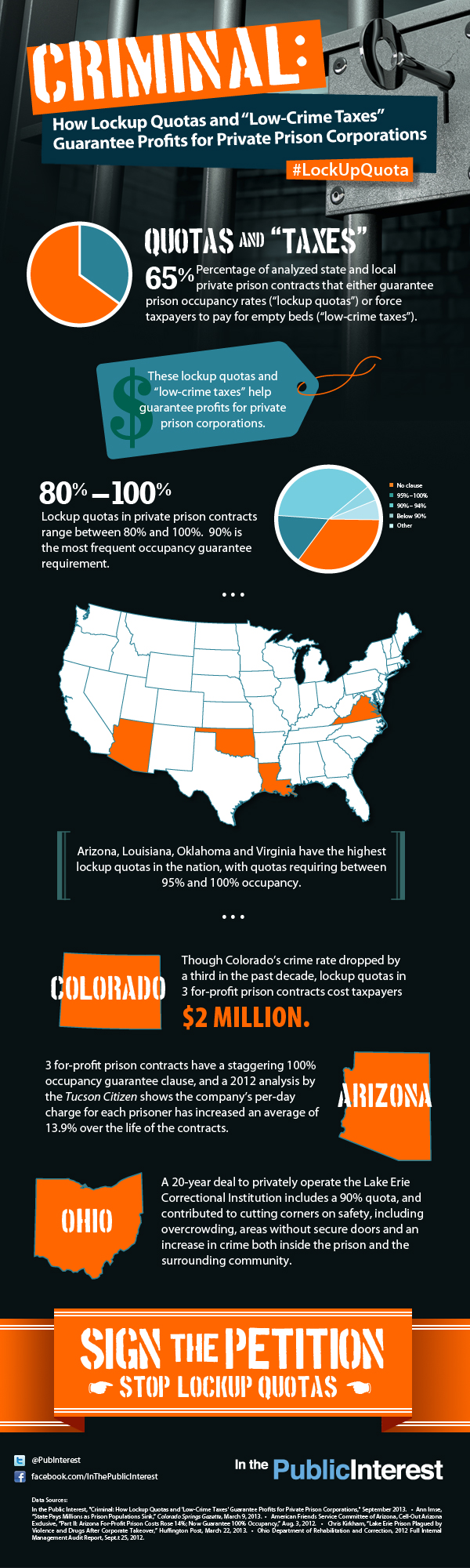
Criminal: How Lockup Quotas and “Low-Crime Taxes” Guarantee Profits for Private Prison Corporations | In the Public Interest

This report discusses the use of prison bed occupancy guarantee clauses in prison privatization contracts and explores how bed occupancy guarantees undermine criminal justice policy and democratic, accountable government. The report sheds light on the for-profit private prison industry’s reliance on high prison populations, and how these occupancy guarantee provisions directly benefit its bottom line. Also discussed are the prevalence of bed guarantee clauses, drawing on set of contracts that ITPI obtained through state open records requests.

We also address how occupancy guarantees have harmed states, focusing on the experiences of Arizona, Colorado, and Ohio — three states that have agreed to these provisions to detrimental consequences. Lastly, the report discusses our recommendation that governments can and should reject prison occupancy guarantees.

Download the full report:
Share the following infographic on social media:
Criminal-Lockup-Quota-Infographic

Source: In the Public Interest

Police Made One Marijuana Arrest Every 42 Seconds in 2012 | U.S. News & World Report

By Steven Nelson

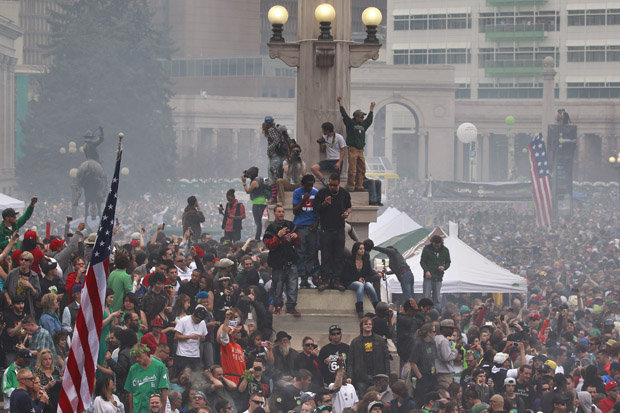
MarihuanaJumpingforJoyResidents of two states voted to legalize marijuana in 2012, but despite an increase in public support for liberalizing drug policy, American police arrested about the same number of people last year on pot-related charges as in 2011.

Data released Monday by the Federal Bureau of Investigation show there were an estimated 1,552,432 arrests for drug-related crimes in 2012 – a slight uptick from the 1,531,251 drug arrests in 2011.

Marijuana offenses accounted for 48.3 percent of all drug arrests, a slight reduction from 49.5 percent in 2011, which itself was the highest rate since before 1995.

Most marijuana-related arrests were for possession of the drug. By mere possession, there was one marijuana arrest every 48 seconds in 2012. Including arrests for distribution, there was a pot-related arrest every 42 seconds, the same interval as in 2011.

Advocacy groups that back campaigns to legalize or decriminalize weed said police should prioritize solving violent crimes – the number of which bumped upward from 2011 to 2012 – over arresting marijuana users.

According to the FBI’s Uniform Crime Report data, there were an estimated 1,214,462 violent crimes reported to police in 2012, a 0.7 percent increase. FBI Director James Comey noted in a statement this was the first overall increase in violent crime in six years.

Just 40.1 percent of the 84,376 forcible rapes reported to police and 28.1 percent of the 354,520 robberies were solved by law enforcement. Around 62.5 percent of the 14,827 murder cases were closed, as were 55.8 percent of the 760,739 aggravated assaults.

“As a former prosecuting attorney myself, I believe it is irresponsible to squander our limited law enforcement resources on this disastrous public policy failure,” said Dan Riffle, Marijuana Policy Project federal policies director, in a statement. “That is especially true when so many violent crimes remain unsolved. Every second spent arresting and prosecuting adults for marijuana is time that could have been spent preventing and solving real crimes.”

The group Law Enforcement Against Prohibition, made up of former and current law-enforcers who want to dampen drug prohibition, said the same.

“Each one of those arrests is the story of someone who may suffer a variety of adverse effects from their interaction with the justice system,” said LEAP Executive Director Neill Franklin, a former Maryland policeman, in a statement. “Commit a murder or a robbery and the government will still give you a student loan. Get convicted for smoking a joint and you’re likely to lose it.”

A poll released in April by the Pew Research Center found 52 percent of American adults believe marijuana should be legal.

It’s possible the national arrest tally for marijuana will be lower in 2013. State and local police enforce most anti-pot laws, and Washington and Colorado residents, who make up around 4 percent of the total U.S. population, will enjoy a largely arrest-free year.

The FBI report said there were 12,196,959 arrests for any reason in 2012, around one every two seconds.

Source: U.S. News & World Report

The Plan Acccording to U.S. General Wesley Clark (Ret.) | YouTube

In an interview with Amy Goodman on March 2, 2007, U.S. General Wesley Clark (Ret.), explains that the Bush Administration planned to take out 7 countries in 5 years: Iraq, Syria, Lebanon, Lybia, Somalia, Sudan, Iran.

We didn’t have to invade them, but just throw out their governments and divide the countries with the help of destabilisation.

  • Iraq – ✓[2003]
  • Afghanistan – ✓ [2001]
  • Libya – ✓ [ The fall of Gaddafi 2011 ]
  • Sudan – ✓[Divided last year in two states after US sponsored terrorism.]
  • Somalia – ✓ [US puppets in government]
  • Lebanon – [In progress right now. The Syrian war is spreading across the borders just last week]
  • Syria – [In progress right now. US financed terrorism]
  • Iran – The final stage. And it will be loud one.

Islamic charity founder Pete Seda ‘vindicated’ by ruling saying feds tried to turn tax fraud into terrorism | The Oregonian

By Bryon Denson

A federal appeals court Friday overturned the 2010 criminal conviction of Pete Seda, a key figure in an Ashland charity accused of supporting terrorism by smuggling money 10 years earlier to Chechen guerrillas at war with the Russian Federation.

The 9th U.S. Circuit Court of Appeals opinion accuses federal prosecutors of improperly influencing the outcome of Seda’s trial by concealing that they had paid a witness. The government also exceeded the scope of a search warrant and omitted facts that might have helped the defense, the court ruled.

“This is a tax fraud case that was transformed into a trial on terrorism,” Circuit Judge M. Margaret McKeown wrote in the panel’s 2-1 opinion.

The Iranian-born Seda, whose formal name is Pirouz Sedaghaty, was charged with falsifying a 2000 tax form filed on behalf of the U.S. wing of the Al-Haramain Islamic Foundation Inc., a Saudi Arabian charity. The U.S. government accused the charity of sending $150,000 through Saudi Arabia to fund terrorist activities and support the Chechen mujahideen “under the guise of humanitarian aid,” McKeown wrote.

Seda’s defense team, headed by Federal Public Defender Steven T. Wax, argued that Seda’s accountant caused the discrepancy in his client’s 2001 tax form and that Seda had a long, fruitful history as a man peacefully advancing the word of Islam.

A jury in Eugene’s U.S. District Court found Seda guilty of defrauding the U.S. government by making false statements on the tax return. He was later sentenced to 33 months in prison.

Wax told The Oregonian that he and Seda had waited nervously for the 9th Circuit opinion since arguing the case before the panel last December. When he got the news, Wax phoned Seda at a Portland halfway house — where he was serving the final day of his sentence since leaving prison in May.

“Pete was quite pleased to finally have some vindication of his position,” Wax said. “He has denied his guilt from the outset of these proceedings and is quite happy that the circuit has recognized that the trial was not a fair one.”

Amanda Marshall, the U.S. attorney for Oregon, said her office is reviewing the opinion and considering its options. Those range from dismissing the case to holding a new trial to filing appeals that might take the case all the way to the U.S. Supreme Court.

“Any decision about whether we will seek further review will have to be made in consultation with the (U.S. Department of Justice) Criminal Division and Solicitor General’s Office,” Marshall said in a prepared statement.

Government prosecutors withheld “significant impeachment evidence” by not telling the trial court that one of its key witnesses had been paid by the FBI, the appeals court found.

The panel also concluded that FBI agents, who obtained a search warrant from a U.S. magistrate for Seda’s home and the charity’s office, “went well beyond” the limitations imposed by the order when they searched Seda’s computer hard drives.

“The appeal illustrates the fine line between the government’s use of relevant evidence to document motive for a cover-up and its use of inflammatory, unrelated evidence about Osama Bin-Laden and terrorist activity that prejudices the jury,” McKeown wrote.

U.S. District Judge Michael Hogan did not properly follow the Classified Information Procedures Act as he tried the Seda case, the appellate panel found.

The law, known as CIPA, is intended to protect government secrets from disclosure at trial while ensuring that defendants are given substitute documents — typically written summaries — of classified materials. The appeals court found that the substitution approved by Hogan did not provide Seda “with substantially the same ability to make his defense as would disclosure of the specified classified information.”

Government prosecutors in Oregon have used CIPA to protect U.S. secrets in a number of national security cases. Those include the 2002 Portland Seven terrorism case, the 2009 spy case against former CIA officer Jim Nicholson and the trial of Mohamed Mohamud, the man found guilty in January of attempting to set off a bomb at Portland’s 2010 holiday tree-lighting ceremony.

The appellate ruling on CIPA won’t change the law, but it’s likely to give judges who find themselves trying national-security cases some pause, said Tung Yin, a professor at Lewis & Clark Law School who has followed the Seda case.

The ruling, he said, will serve as “a reminder to pay a little more attention to the substitutions and make sure they are crafted neutrally.”

Source: The Oregonian

DOJ pursues immunity for Bush and six others for Iraq war crimes | The Examiner

By David Phillips

George W. Bush Speaks At Naturalization Ceremony At Bush Presidential CenterThe Department of Justice has filed a Grant of Immunity for war crimes against George W. Bush, Richard Cheney, Condoleezza Rice, Colin Powell, Paul Wolfowitz, and Donald Rumsfeld. The filing for the immunity of war crimes was made with the United States District Court, Northern District of California San Francisco Division.

The filing is for procedural immunity in a case alleging that they planned and waged the Iraq War in violation of international law.

The Plaintiff in this case is Sundus Shaker Saleh, an Iraqi single mother and refugee now living in Jordan. She filed a complaint in March 2013 in a San Francisco federal court alleging that the planning and waging of the war constituted a “crime of aggression” against Iraq, a legal theory that was used by the Nuremberg Tribunal to convict Nazi war criminals after World War II.

In her lawsuit, Saleh alleges that:

  • Richard Cheney, Donald Rumsfeld and Paul Wolfowitz began planning the Iraq War in 1998 through their involvement with the “Project for the New American Century,” a Washington DC non-profit that advocated for the military overthrow of Saddam Hussein.
  • Once they came to power, Saleh alleges that Cheney, Rumsfeld and Wolfowitz convinced other Bush officials to invade Iraq by using 9/11 as an excuse to mislead and scare the American public into supporting a war.
  • Finally, she claims that the United States failed to obtain United Nations approval prior to the invasion, rendering the invasion illegal and an act of impermissible aggression.

“The DOJ claims that in planning and waging the Iraq War, ex-President Bush and key members of his Administration were acting within the legitimate scope of their employment and are thus immune from suit,” chief counsel Inder Comar of Comar Law said.

The “Westfall Act certification,” submitted pursuant to the Westfall Act of 1988, permits the Attorney General, at his or her discretion, to substitute the United States as the defendant and essentially grant absolute immunity to government employees for actions taken within the scope of their employment.

“The good news is that while we were disappointed with the certification, we were prepared for it,” Comar stated. “We do not see how a Westfall Act certification is appropriate given that Ms. Saleh alleges that the conduct at issue began prior to these defendants even entering into office. I think the Nuremberg prosecutors, particularly American Chief Prosecutor Robert Jackson, would be surprised to learn that planning a war of aggression at a private non-profit, misleading a fearful public, and foregoing proper legal authorization somehow constitute lawful employment duties for the American president and his or her cabinet.”

The case is Saleh v. Bush (N.D. Cal. Mar. 13, 2013, No. C 13 1124 JST).

Source: The Examiner

Bradley Manning: a sentence both unjust and unfair | The Guardian

Bradley ManningPfc Manning sought to hold his country to the values it claims to uphold, yet his prison term dwarfs other military convictions

Bradley Manning has received a prison sentence that was 10 years longer than the period of time after which many of the documents he released would have been automatically declassified. The military judge handed down the longest ever sentence for a leak of US government information.

Mr Manning, according to this logic, did more harm than the soldier who gave a Jordanian intelligence agent information on the build-up to the first Iraq war, or the marine who gave the KGB the identities of CIA agents and floorplans of the embassies in Moscow and Vienna. Mr Manning did three times as much harm in transmitting to WikiLeaks in 2010 the war logs or field reports from Iraq and Afghanistan, as Charles Graner did. He was the army reserve corporal who became ringleader of the Abu Ghraib abuse ring and was set free after serving six and a half years of his 10-year sentence.

Among the 700,000 classified documents Mr Manning downloaded while stationed in Iraq was a video that showed a US Apache helicopter in Baghdad opening fire on a group of Iraqis, including two Reuters journalists and their children, who had attempted to rescue a severely injured man. More devastating than the film was the cockpit chatter of the soldiers who joked as they shot people in the streets.

“Look at those dead bastards,” said one. “Nice,” said another.

The Apache crew has never been charged with any offence (all their adult targets were listed as insurgents) and neither has any other individual as a result of Mr Manning’s revelations. But the shortened 17-minute version of the video has been viewed more than 3m times on YouTube.

So, the central question to answer in judging the proportionality of this sentence is whether the desire to punish a whistleblower driven by moral outrage stems from the alleged harm he did US military and diplomatic interests, or whether it derives more from sheer embarrassment. The judge presiding, Col Denise Lind, had already thrown out the gravest charge, that of “aiding the enemy”. Col Lind had also limited the admissibility of evidence regarding the “chilling effects” that Mr Manning’s actions had on US diplomacy by releasing 250,000 state department cables. A military witness conceded there was no evidence that anyone had been killed after being named in the releases.

Mr Manning’s recent apology for his actions does not, and should not, detract from the initial defence he gave for them, when he spoke of his shock at the “delightful bloodlust” displayed by that helicopter crew, or his belief that stimulating a debate about the wars was the right thing to do. We know what his motives as a whistleblower were and we have applauded them. They are certainly not akin to treachery or any act fit to be judged – if anything is – by an espionage act rushed onto the statute book in 1917 after America entered the first world war.

Mr Manning exposed the abuse of detainees by Iraqi officers under the watch of US minders. He showed that civilian deaths during the Iraq war were much higher than the official estimates. If they were published today, these claims would be uncontentious. They have already slipped into the official history of this war. But the author of this orthodoxy will continue to pay for the record he helped establish by a prison term that he will serve well into the next decade, which is when the first date for his parole application becomes due. Mr Manning was seeking to hold his country and its army to the values they claim to uphold.

It is unclear what the US military hopes to achieve by securing a sentence that dwarfs those of other military convictions. Deterrence features large in its thinking. Whistleblowing will not only endanger your career, it wants to say, but your freedom – for most of your adult life. In 2008, one could have hoped that the US had a president whose administration would distinguish between leaks in the public interest and treason. But this sentence tells a different story. Mr Manning’s sentence, which is both unjust and unfair, can still be reduced on appeal. Let us hope that it is.

Source: The Guardian