University of BC Doctors Expose Vaccination Cover-up: Official Documents Released From The UK | Collective Evolution

vaccDr Chris Shaw, from the University of British Colombia’s (UBC)  Department of Ophthalmology, Visual Sciences, Experimental Medicine and Neuroscience published a paper in the Journal Inorganic Biochemistry along with his colleague, Dr.  Lucija Tomljenovic that revealed Government experts have known about the dangers associated with vaccinations. They investigated information exposing a 30 year scandal of official meetings by UK government vaccine committees and independent medical ‘experts’ with drug industry connections. The paper is at the bottom of the article under “sources”.

A Freedom of Information Act request filed with the CDC  seeking information on what the CDC knows about the dangers of vaccines, had by law to be responded to in 20 days. Nearly 7 years later a judge ordered the CDC to turn over the documents on September 30th, 2011. These documents were part of the study discussed in this article.

The paper has received a lot of attention. UBC even held a symposium about vaccination safety as a result in an effort to arouse more critical thinking and discussion around the topic. The response was disturbing  with a number of UBC professors upset that the discussion was taking place in the first place. It’s disturbing to know that there are those out there who wish to silence an opposition to vaccination, and not even keep an open mind to potential dangers. Much of the medical literature examined by researchers comes straight from pharmaceutical company-sponsored medical research. It’s time for us to wake up and make some obvious connections. Here is a quote from the published, peer reviewed paper.

Deliberately concealing information from parents for the sole purpose of getting them to comply with an “official” vaccination schedule could be considered as a form of ethical violation or misconduct. Official documents obtained from the UK Department of Health (DH) and the Joint Committee on Vaccination and Immunisation (JCVI) reveal that the British health authorities have been engaging in such practice for the last 30 years, apparently for the sole purpose of protecting the national vaccination program(1).

The documents reveal that vaccinations don’t work, and that they cause the disease they are supposed to prevent. They also indicate scientific fraud, that government ‘experts’ are working to conceal information. The 45 page paper was published in 2011 and presented at the BSEM scientific conference (2)

Here I present the documentation which appears to show that the JCVI made continuous efforts to withhold critical data on severe adverse reactions and contraindications to vaccinations to both parents and health practitioners in order to reach overall vaccination rates which they deemed were necessary for “herd immunity”, a concept which with regards to vaccination, and contrary to prevalent beliefs, does not rest on solid scientific evidence as will be explained. As a result of such vaccination policy promoted by the JCVI and the DH, many children have been vaccinated without their parents being disclosed the critical information about demonstrated risks of serious adverse reactions, one that the JCVI appeared to have been fully aware of. It would also appear that, by withholding this information, the JCVI/DH neglected the right of individuals to make an informed consent concerning vaccination. By doing so, the JCVI/DH may have violated not only International Guidelines for Medical Ethics. –  Dr Lucija Tomljenovic (1)

She also mentions evidence of ties between vaccine manufacturers and pharmaceutical companies.

The transcripts of the JCVI meetings also show that some of the Committee members had extensive ties to pharmaceutical companies and that the JCVI frequently co-operated with vaccine manufacturers on strategies aimed at boosting vaccine uptake. Some of the meetings at which such controversial items were discussed were not intended to be publicly available, as the transcripts were only released later, through the Freedom of Information Act (FOI). These particular meetings are denoted in the transcripts as “commercial in confidence”, and reveal a clear and disturbing lack of transparency, as some of the information was removed from the text (i.e., the names of the participants) prior to transcript release under the FOI section at the JCVI website – Dr Lucija Tomljenovic (1)

The documents go on to show that when strong evidence was presented against vaccination, they were completely ignored and overlooked by the Joint Committee on Vaccinations and Immunizations. Furthermore, the committee has constantly dismissed independent research and downplayed vaccine concerns while over inflating the benefits. They’ve also promoted and elaborated a plan for introducing new vaccines of questionable efficacy and safety into the routine pediatric schedule, on the assumption that the licenses would eventually be granted. All of these violate the JCVI’s own code of conduct.

Alternative media outlets continue to raise awareness about vaccinations and their potential dangers. With the world handing over credibility to a certain criteria, we thank all of the researchers out there who continue to examine all information, and a wide variety of sources. With the work of these researchers and doctors, the truth about vaccinations continues to spread across the planet.

Source: Collective Evolution

(1) http://www.ecomed.org.uk/wp-content/uploads/2011/09/3-tomljenovic.pdf
(2)http://www.ecomed.org.uk/publications/the-health-hazards-of-disease-prevention
(3) http://www.vancourier.com/Responses+vaccine+paper+problem+free+scientific+inquiry+expression/6073466/story.html
(4) http://nsnbc.me/2013/05/10/the-vaccine-hoax-is-over-freedom-of-information-act-documents-from-uk-reveal-30-years-of-coverup
(5) http://childhealthsafety.wordpress.com/2012/03/14/government-experts-cover-up-vaccine-hazards

OpenSecrets.org’s Resources on Politically Active Tax-Exempt Groups

The first congressional hearing triggered by the news that the Internal Revenue Service inappropriately targeted tea party groups for additional scrutiny begins Friday, and it’s clear the issue isn’t going away anytime soon.

The Center for Responsive Politics has been intensively researching and writing about politically active nonprofits — also known as 501(c)(4) organizations, or, more colloquially, “dark money” groups — for more than a year. Since the 2010 Citizens United Supreme Court decision freed them to participate more directly in electoral politics, they have been used to pour money into the system at an unprecedented rate.

There has been an explosion of spending by nonprofit groups over the last three election cycles, from less than $17 million in 2006 to well over $300 million in 2012.
nonprofit spending growth by type.JPG
These groups, unlike the more commonly known super PACs, are not required to divulge the names of their donors, and much of their spending is unreported, too. Their annual tax filings with the IRS list how much money they have, who their officers are and the recipients of any grants they may have made.

But when they spend their money directly in support of or opposition to a candidate, they must report to the Federal Election Commission. FEC data collected and analyzed by OpenSecrets.org shows that in the 2012 election alone, politically active nonprofits reported spending more than $308 million. Many millions more were likely spent on “issue ads” that escaped reported rules.

If you follow that link, you’ll notice none of the organizations at the top of our list are tea party groups. In fact, they have remained relatively small players in the game.
What we do know is that many of these groups on the list are conservative in nature — though they come in many flavors of conservative. There are several important liberal groups active in this area, as well, but right-leaning groups dominate. About 85 percent of the money that was spent by nonprofits in the 2012 cycle, as reported to the FEC, was paid out by conservative groups.
nonprofit spending growth by viewpt.JPG
We’ve also applied old-fashioned reporting in our effort to bring these groups to the public’s attention, in particular with our Shadow Money Trail series. Despite the current concern about IRS employees applying too much scrutiny to certain groups because of their political slant, we’ve actually found many instances where political operatives from across the spectrum seem to be taking advantage of the fact that the IRS generally applies very little scrutiny to these entities.

By painstakingly going through public tax returns filed by tax-exempt groups, we have been able to trace how some of the money has flowed between them. We have posted that information (here’s an example) when we have it.

Some of the topics we’ve covered in this series:
  • How conservative group American Committment seemed to make $10 million disappear by churning money between its various related groups.
  • How Obama’s dark money allies make big payments to political consultants.
  • The phenomenon of dark money mailboxes — social welfare organizations that act as way stations for dark money and have few or no activities of their own.
  • How one prominent liberal group churns money through a confusing web of similarly named 501(c)(4)s and 527 groups.

There are a host of other stories on our Shadow Money Trail page, including “Shadow Money Magic,” our five-part report on how some of these groups game the IRS.

Source: OpenSecrets.org

Monsanto wins Supreme Court fight over its genetically engineered soybeans | Washington Post

GoHomeMonsantoThe Supreme Court said Monday that an Indiana farmer violated Monsanto Co.’s patents on soybean seeds resistant to its weed-killer by growing the beans without buying new seeds from the corporation.

The justices unanimously rejected the farmer’s argument that cheap soybeans he bought from a grain elevator are not covered by the Monsanto patents, even though most of them also were genetically modified to resist the company’s Roundup herbicide.

While Monsanto won this case, the court refused to make a sweeping decision that would cover other self-replicating technologies like DNA molecules and nanotechnologies, leaving that for another day. Businesses and researchers had been closely watching this case in hopes of getting guidance on patents, but Justice Elena Kagan said the court’s holding Monday only “addresses the situation before us.”

In a statement, Monsanto officials said they were pleased with the court’s ruling.

“The court’s ruling today ensures that longstanding principles of patent law apply to breakthrough 21st century technologies that are central to meeting the growing demands of our planet and its people,” said David F. Snively, Monsanto’s top lawyer. “The ruling also provides assurance to all inventors throughout the public and private sectors that they can and should continue to invest in innovation that feeds people, improves lives, creates jobs, and allows America to keep its competitive edge.”

In the case decided by the court, farmer Vernon Hugh Bowman bought expensive, patented Monsanto’s “Roundup Ready” seeds for his main crop of soybeans, but decided to look for something cheaper for a risky, late-season soybean planting. He went to a grain elevator that held soybeans it typically sells for feed, milling and other uses, but not as seed.

Bowman reasoned that most of those soybeans also would be resistant to weed killers, as they initially came from herbicide-resistant seeds too. He was right, and he bought soybeans from the grain elevator and planted them over eight years. In 2007, Monsanto sued and won an $84,456 judgment.

Monsanto has a policy to protect its investment in seed development that prohibits farmers from saving or reusing the seeds once the crop is grown. Farmers must buy new seeds every year. More than 90 percent of American soybean farms use Monsanto’s seeds, which first came on the market in 1996.

Bowman’s lawyers argued that Monsanto’s patent rights stopped with the sale of the first crop of beans instead of extending to each new crop soybean farmers grow that has the gene modification that allows it to withstand the application of weed-killer.

But Kagan disagreed. “Bowman planted Monsanto’s patented soybeans solely to make and market replicas of them, thus depriving the company of the reward patent law provides for the sale of each article,” she said. “Patent exhaustion provides no haven for such conduct.”

Bowman also said he should not be liable, in part, because soybeans naturally sprout when planted.

Kagan said the court also did not buy that argument. “We think the blame-the-bean defense tough to credit,” she said.

Andrew Kimbrell, executive director of Center for Food Safety, said the ruling was wrong. “The court chose to protect Monsanto over farmers,” Kimbrell said. “The court’s ruling is contrary to logic and to agronomics, because it improperly attributes seeds’ reproduction to farmers, rather than nature.”

But a soybean growers’ association said it was the correct decision. “The Supreme Court has ensured that America’s soybean farmers, of which Mr. Bowman is one, can continue to rely on the technological innovation that has pushed American agriculture to the forefront of the effort to feed a global population projected to pass 9 billion by 2050,” said Danny Murphy, president of the American Soybean Association.

Calls to Bowman by The Associated Press were unanswered.

The soybean case is Bowman v. Monsanto Co., 11-796.

Source: Washington Post

A desperate protest by prisoners at Guantánamo has shamed Barack Obama

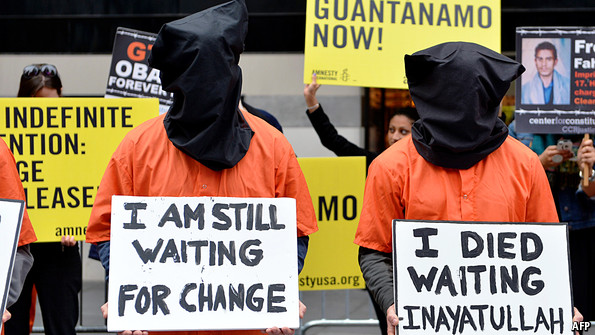
GuantanamoHungerStrike“YOU have to hand it to some of these IRA boys,” Margaret Thatcher once remarked of the republican hunger-strikers who embarrassed her in 1981. “What a terrible waste of human life!” she said of the ten who died. Since some of the hunger-strikers at Guantánamo Bay are being force-fed through nasal tubes, Barack Obama may be spared Mrs Thatcher’s grief. But he has been shamed by their desperate gambit all the same. The protest is a reminder of one of his most glaring failures in office.

Officials count 100 hunger-strikers; lawyers for the detainees say there are 130; on any reckoning, a majority of the 166 remaining inmates are starving themselves. Through their lawyers, detainees complain of a rougher regime since the army took over guard duties from the navy last autumn. In particular they allege that their Korans were mistreated during an inspection in February, when the hunger-strike began (prison authorities vigorously deny that). A cell-block raid by guards on April 13th (provoked by the covering up of security cameras), during which some prisoners were shot with rubber pellets, hardened rather than broke the strikers.

But the underlying cause is simpler, and more personal. “The reason they’re willing to die”, says Carlos Warner, a federal defender who represents 11 of the detainees, “is President Obama.”

Mr Obama said this week that Guantánamo “hurts us in terms of our international standing.” That echoed the view he espoused when, on his second day in office in January 2009, he ordered the prison to be closed within a year. Its existence since 2002, he said, had “likely created more terrorists around the world than it ever detained”—an opinion eventually shared by assorted veterans of George W. Bush’s administration. And yet the only Guantánamo-related closure so far has been the shutting, in January this year, of the diplomatic office charged with resettling the inmates.

Mr Obama blames Congress—with some justification. It thwarted his original plan to transfer the detainees to a facility in Illinois. Then, either out of concern for national security, a yen to embarrass the president, or both, in clauses inserted into successive defence-spending bills Congress made it difficult for officials to transfer anyone anywhere. Difficult, but not impossible: Mr Obama can authorise transfers using a presidential waiver. He has chosen not to. (After a bomb plot with links to Yemen at the end of 2009, he also chose to halt transfers there—and most of the remaining prisoners are Yemeni.) He evidently calculated that, given the battles he is already waging with Congress, Guantánamo was one he could do without.

That stalemate has been an especial let-down for the 86 residual prisoners who, in 2010, were slated for transfer out of Guantánamo by a presidential review; some had already been designated for transfer under the previous administration. Many of these men claim to have committed no offence except being in the wrong place—Afghanistan—at the wrong time, or to have been sold to American forces for the bounties they offered. One such, and one of the hunger-strikers, is Shaker Aamer, a British resident picked up in Jalalabad in 2001 and allegedly tortured. His lawyer, Clive Stafford Smith, points out that the British government is well-equipped to monitor Mr Aamer should he be repatriated.

According to the review, many of these men were low-level fighters rather than total innocents. But none has been charged with a crime—and most have been at Guantánamo for over a decade. In fact, only seven of the 779 prisoners who have passed through the camp have been convicted by its military tribunals (and two of those verdicts have been challenged). Of those still there, only three have been convicted and only six currently face trial, including Khalid Sheikh Mohammed, the alleged mastermind of the September 11th attacks. Subject to multiple legal challenges, beset by scandals over hidden microphones and leaked defence documents, the tribunals are now regarded as a failure even by those untroubled by their dubious legal status. As Mr Obama pointed out, federal courts have proved a much more effective forum for prosecuting terrorists.

The result, at the camp, is near-total stasis. No new prisoner has arrived since 2008; none has left for over a year. Parole-style hearings planned for the group not designated for either trial or transfer have yet to begin. Prisoners have lawyers, but there is little the lawyers can do for them. This bleak situation, says Mr Stafford Smith, is worse than being on death row.

Last chance?

Beyond the feeling of personal betrayal by Mr Obama, the detainees also sense—correctly—that the attention of the foreign leaders, human-rights watchdogs and United Nations officials who once energetically protested at their predicament has wandered. The outrage that the manacled, blindfolded, jumpsuited figures first provoked has dimmed. Drone warfare has become a much bigger human-rights preoccupation. And yet, unpropitious as it might seem, the prisoners also fear that this may be their last chance to get out.

Mr Warner says that if, with the president’s views and legal background, Mr Obama “can’t get this done, I don’t know who could.” It is hard to see a future presidential candidate matching his troublesome pledge to shut the prison. And for Mr Obama as well, time is running out. Even if he chose to use his waiver powers, and leant on other governments to accept detainees, the diplomacy, including gathering the necessary assurances on security and humane treatment, would take time.

Meanwhile the Guantánamo authorities are seeking an extra $200m for refurbishments, on top of annual running costs that wildly exceed those for ordinary prisons. They are planning new medical facilities to care for elderly detainees.

This week Mr Obama vowed to re-engage with Congress. “I’m going to go back at this,” he promised. He should hurry. Once Guantánamo was a byword for an overmighty executive and the excesses of Mr Bush’s “war on terror”. Under Mr Obama it has become a victim and a symbol of the paralysing divisiveness of American politics. “It’s going to get worse,” he said this week. “It’s going to fester.”

Source: The Economist

Sedgwick, Maine is first town to declare total food sovereignty, opposing state and federal laws | NaturalNews

By  J.D. Hayes

There is a food revolution taking hold all over America, whether it is in the form of demanding labeling of GM foods, the right to produce and sell raw milk and other commodities, or – in the case of Sedgwick, Maine – declaring all local food transactions of any kind free and legal.
According to the website FoodRenegade.com, Sedgwick is the first city in the U.S. to free itself from the constraints of federal and state food regulation. Published reports say the town has passed an ordinance that gives its citizens the right “to produce, sell, purchase, and consume local foods of their choosing,” regulations be damned. The ordinance includes raw milk, meats that are slaughtered locally, all produce and just about anything else you might imagine.

And what’s more, three additional towns in Maine are expected to take up similar ordinances soon, said the FoodRenegade.com.

Gee – good, ol’ fashioned buyer-seller agreements?

Observers of the Sedgwick ordinance say it is much more than just “statement” legislation. Writes blogger David Grumpert, at TheCompletePatient.com:

This isn’t just a declaration of preference. The proposed warrant added, “It shall be unlawful for any law or regulation adopted by the state or federal government to interfere with the rights recognized by this Ordinance.” In other words, no state licensing requirements prohibiting certain farms from selling dairy products or producing their own chickens for sale to other citizens in the town.

What about potential legal liability and state or federal inspections? It’s all up to the seller and buyer to negotiate. “Patrons purchasing food for home consumption may enter into private agreements with those producers or processors of local foods to waive any liability for the consumption of that food. Producers or processors of local foods shall be exempt from licensure and inspection requirements for that food as long as those agreements are in effect.” Imagine that-buyer and seller can agree to cut out the lawyers. That’s almost un-American, isn’t it?

According to Deborah Evans, a Sedgwick citizen, the ordinance further states:

  1. Producers or processors of local foods in the Town of Sedgwick are exempt from licensure and inspection provided that the transaction is only between the producer or processor and a patron when the food is sold for home consumption.
  2. Producers or processors of local foods in the Town of Sedgwick are exempt from licensure and inspection provided that the products are prepared for, consumed or sold at a community social event.

For those questioning the legality of the ordinance – as in, it obviously circumvents state and federal food laws – she notes:

[W]e the radicals who concocted this mutinous act of infamy believe that according to the Home Rule provisions of our State Constitution, the citizens of Sedgwick have the right to enact an ordinance that is “local and municipal in character.”

‘It’s about time’

Many of the local farmers say the ordinance is just what is needed.

“This ordinance creates favorable conditions for beginning farmers and cottage-scale food processors to try out new products, and to make the most of each season’s bounty,” farmer Bob St. Peter told the website FoodFreedom.com. “My family is already working on some ideas we can do from home to help pay the bills and get our farm going.”

“Tears of joy welled in my eyes as my town voted to adopt this ordinance,” said Sedgwick resident and local farm patron Mia Strong. “I am so proud of my community. They made a stand for local food and our fundamental rights as citizens to choose that food.”

St. Peter, who is a board member of the National Family Farm Council, a food freedom advocacy group, notes that small farmers have a much tougher row to hoe, especially in today’s economy, so they need the ability to sell their products more freely.

“It’s tough making a go of it in rural America,” he said. “Rural working people have always had to do a little of this and a little of that to make ends meet. But up until the last couple generations, we didn’t need a special license or new facility each time we wanted to sell something to our neighbors. Small farmers and producers have been getting squeezed out in the name of food safety, yet it’s the industrial food that is causing food borne illness, not us.”

Sources:
http://www.foodrenegade.com/maine-town-declares-food-sovereignty/
http://www.thecompletepatient.com
http://foodfreedom.wordpress.com
http://www.nffc.net

Bruce Cockburn – Live On World Café

01 Thoughts On September 11
02 How I Spent My Fall Vacation
03 Bruce’s Sabbatical
04 Anything Anytime Anywhere
05 Bruce On Finding His Voice
06 Creation Dream
07 Instrumental
08 The Inspiration For ‘Celestial Horses’
09 Celestial Horses
10 Thoughts On Singer-Songwriters Today
11 The Trouble With Normal
12 What’s Next

Holder: Big Banks’ Clout “Has an Inhibiting Impact” on Prosecutions | Frontline

Eric HolderAttorney General Eric Holder said that the Justice Department had considered the economic fallout that could result from prosecuting major banks for their role in the financial crisis, in Senate testimony on Tuesday.

Holder’s comments underscored remarks his deputy, Lanny Breuer, gave in an interview for FRONTLINE’s film The Untouchables that raised concerns among some in government that the Justice Department hasn’t been sufficiently aggressive in prosecuting major banks for the fiscal crisis.

“I am concerned that the size of some of these institutions becomes so large that it does become difficult to prosecute them,” Holder told the Senate Judiciary Committee. “When we are hit with indications that if you do prosecute, if you do bring a criminal charge it will have a negative impact on the national economy, perhaps world economy, that is a function of the fact that some of these institutions have become too large. It has an inhibiting impact on our ability to bring resolutions that I think would be more appropriate. That is something that you all need to consider.”

Holder added that he felt the department had been “appropriately aggressive,” in pursuing and bringing cases where it could prove companies or individuals had broken the law. “These are not easy cases to make,” he said. “Things were done wrong, but the question is whether they’re illegal.”

So far, no Wall Street executives have been prosecuted for fraud in connection with the financial crisis.

Breuer’s interview, which you can read in full here, sparked a Jan. 29 letter from Sens. Charles Grassley (R-Iowa) and Sherrod Brown (D-Ohio) asking for more information on how the Justice Department determined which cases to prosecute. It also asked for the names of any outside experts Justice consulted, and what they were paid.

The Justice Department responded (pdf) one month later, defending its record. But the senators said the letter was “aggressively evasive” and didn’t answer their questions.

On Tuesday, Holder told Grassley that the DOJ would “endeavor to answer” the senators’ letter.

Holder’s full testimony is embedded below. (The exchange on financial fraud prosecutions begins around the 2:17:22 mark.)

Source: Frontline

Nanoparticles in your food? You’re already eating them | Grist

By Twilight Greenaway

What’s engineered in a lab, added to processed foods, and never labeled? If you thought GMOs were mysterious, try nanoparticles.

I’ve been keeping my eye on the role of nanotechnology in food for a few years now, so I was interested to see a feature-length investigation called “Eating Nano” in this month’s E Magazine. In it, E editor Brita Belli takes a deep dive into the growing role of nanotechnology in food and agriculture, the current lack of oversight and regulations, and the growing consensus that more information and transparency are both sorely needed in relation to this growing field.

Nanotechnology involves the engineering and manipulation of particles at a nano scale. Nanoparticles, as they’re called, are measured in nanometers or billionths of one meter. Another way to put it: If a nanoparticle were the size of a football, a red blood cell would be the size of the field. Although some nanoparticles have been found to exist in nature (carbon nanoparticles exist in caramelized foods, for instance, and silverware has been shown to shed nano-sized silver particles), it’s the nanoparticles that are engineered in laboratories that have environmental health advocates concerned.

Here’s the thing: It turns out most materials start behaving differently at that size. According to the British corporate accountability organization As You Sow, which has been keeping tabs on the nanotech industry for several years, “materials reduced to the nanoscale either through engineered or natural processes can suddenly show very different properties compared to what they exhibit on a macroscale, enabling unique applications such as alterations in color, electrical conductance, or permeability.”

Considering the fact that nanoparticles are now used to help deliver nutrients, keep food fresh for longer, and act as thickening and coloring agents in processed foods, these “different properties” might be cause for concern. Or — at the very least — they might be reason enough to conduct thorough research into their health impacts.

In actuality, companies are not required to disclose nano-sized ingredients, nor is there much active questioning about their safety. Instead, Belli writes, “From the government’s perspective, nano forms of silver, iron or titanium are no different, fundamentally, from their scaled-up counterparts which have already been safety tested, so the agency has ushered the particles into the food supply under the Generally Recognized as Safe provision.”

I’ve been hearing about nanoparticles in food packaging for a while now (it’s a market Belli says is expected to reach $20 billion by 2020), but I had no idea that there was nano-coating in the works for bananas. And what I was most surprised to learn is just how many food products already contain nanoparticles. As Belli writes:

Nanoparticles can be used to purify water, as anticaking and gelatin-forming agents and in packaging to protect against UV light, prevent the growth of microbes or detect contamination. Titanium dioxide is added to a huge swath of products in nano form including paints, paper and plastics but also lends white pigment to most toothpastes and many processed foods, including Mentos, Trident and Dentyne gum, M&Ms, Betty Crocker Whipped Cream Frosting, Jello Banana Cream Pudding, Vanilla Milkshake Pop Tarts and Nestlé Original Coffee Creamer. The aforementioned products were featured in a report in February 2012 in the journal Environmental Science & Technology which concluded that each of us likely consumes some amount of titanium dioxide (TiO2) nanoparticles each day, and children under 10 likely consume the greatest amounts (around 1-2 mg TiO2 per kilogram body weight per day) due to their higher intake of frosted foods, candy, gum and other sweets.

Although there is less science focused on ingested nanotech particles than on, say, the ones that are inhaled in industrial environments, Belli does point to the few studies that exist, including a recent one out of Cornell University that looked at chickens’ abilities to absorb iron after eating nanoparticles generally considered safe for human consumption. In it, researchers found that acute exposure to the particles changed the structure of the lining of the chickens’ intestinal walls, a change the lead scientist noted “serves to underscore how such particles, which have been widely studied and considered safe, cause barely detectable changes that could lead to, for example, over-absorption of other, harmful compounds.”

When it comes to questions about the health effects of eating nanoparticles, Belli quotes a guide on the American Society of Safety Engineers’ website, which reads:

Nanoparticles may be ingested through drinking water, food additives, atmospheric dust on food, toothpaste and dental fillings and implants. Ingested nanoparticles can then be absorbed through ‘Peyer’s Plaques’ or small nodules in intestinal tissue that are part of the immune defense system. If nanoparticles enter the digestive system and proceed into the bloodstream, they could move throughout the body and cause damage.

Of course, most of this — and much of the science Belli points to — is preliminary, based on very little hard science. And if that lack of a cautionary approach to science in a multibillion-dollar industry sounds familiar, that’s because — well, it is. The comparison to genetically modified foods is unavoidable.

In fact, Timothy Duncan, a research chemist from the Food and Drug Administration, admitted as much about the nanotech industry (which likely has thousands of food and food packaging products in the research and development stage) while writing in the journal Nature Nanotechnology last year.“What’s holding back the introduction of nanofoods is the hesitation of the food industry, fearing a public backlash along the lines of what happened with genetically modified foods, and public fears in some countries about tampering with nature,” Duncan wrote.

And considering how little media coverage these larger questions about nanotechnology and food have received — not to mention inclusion on the larger “food movement” laundry list — it looks like the lesson the food industry has learned from GMOs is not one about the importance of transparency, but quite the opposite.

As Tom Philpott observed in Grist in 2010, the last time big questions surfaced about nanotech in food in the media: “As with GMOs, the strategy seems to be: release into the food supply en masse first; assess risks later (if ever).”

Source: Grist & EMagazine

Ron Paul’s Farewell Address to Congress

Ron Paul: This may well be the last time I speak on the House Floor.  At the end of the year I’ll leave Congress after 23 years in office over a 36 year period.  My goals in 1976 were the same as they are today:  promote peace and prosperity by a strict adherence to the principles of individual liberty.

It was my opinion, that the course the U.S. embarked on in the latter part of the 20th Century would bring us a major financial crisis and engulf us in a foreign policy that would overextend us and undermine our national security.

To achieve the goals I sought, government would have had to shrink in size and scope, reduce spending, change the monetary system, and reject the unsustainable costs of policing the world and expanding the American Empire.

The problems seemed to be overwhelming and impossible to solve, yet from my view point, just following the constraints placed on the federal government by the Constitution would have been a good place to start.

How Much Did I Accomplish?

In many ways, according to conventional wisdom, my off-and-on career in Congress, from 1976 to 2012, accomplished very little.  No named legislation, no named federal buildings or highways—thank goodness.  In spite of my efforts, the government has grown exponentially, taxes remain excessive, and the prolific increase of incomprehensible regulations continues.  Wars are constant and pursued without Congressional declaration, deficits rise to the sky, poverty is rampant and dependency on the federal government is now worse than any time in our history.

All this with minimal concerns for the deficits and unfunded liabilities that common sense tells us cannot go on much longer.  A grand, but never mentioned, bipartisan agreement allows for the well-kept secret that keeps the spending going.  One side doesn’t give up one penny on military spending, the other side doesn’t give up one penny on welfare spending, while both sides support the bailouts and subsidies for the banking and  corporate elite.  And the spending continues as the economy weakens and the downward spiral continues.   As the government continues fiddling around, our liberties and our wealth burn in the flames of a foreign policy that makes us less safe.

The major stumbling block to real change in Washington is the total resistance to admitting that the country is broke. This has made compromising, just to agree to increase spending, inevitable since neither side has any intention of cutting spending.

The country and the Congress will remain divisive since there’s no “loot left to divvy up.”

Without this recognition the spenders in Washington will continue the march toward a fiscal cliff much bigger than the one anticipated this coming January.

I have thought a lot about why those of us who believe in liberty, as a solution, have done so poorly in convincing others of its benefits.  If liberty is what we claim it is- the principle that protects all personal, social and economic decisions necessary for maximum prosperity and the best chance for peace- it should be an easy sell.  Yet, history has shown that the masses have been quite receptive to the promises of authoritarians which are rarely if ever fulfilled. Read more…

Source: Ron Paul

Legal drugs, deadly outcomes | Los Angeles Times

By Scott Glover & Lisa Girion

Prescription overdoses kill more people than heroin and cocaine. An L.A. Times review of coroners’ records finds that drugs prescribed by a
small number of doctors caused or contributed to a disproportionate number of deaths…A Los Angeles Times investigation has found that in nearly half of the accidental deaths from prescription drugs in four Southern California counties, the deceased had a doctor’s prescription for at least one drug that caused or contributed to the death.

Reporters identified a total of 3,733 deaths from prescription drugs from 2006 through 2011 in Los Angeles, Orange, Ventura and San Diego counties.

An examination of coroners’ records found that:

  • In 1,762 of those cases — 47% — drugs for which the deceased had a prescription were the sole cause or a contributing cause of death.
  • A small cadre of doctors was associated with a disproportionate number of those fatal overdoses. Seventy-one — 0.1% of all practicing doctors in the four counties — wrote prescriptions for drugs that caused or contributed to 298 deaths. That is 17% of the total linked to doctors’ prescriptions.
  • Each of those 71 physicians prescribed drugs to three or more patients who died.

Experts said the findings challenge the prevailing view of what is driving the surge in overdose deaths and should prompt closer scrutiny of doctors and their prescribing practices. Read more…

Source: Los Angeles Times