Predicting the outcome of a hypothetical World War III involves considering a myriad of factors including military capabilities, alliances, technological advancements, economic strength, and strategic positioning. Here’s a balanced analysis based on current military strengths and geopolitical dynamics:
U.S. and NATO:
Military Power: The United States has the world’s most advanced military technology, with significant investments in cyber warfare, space capabilities, and nuclear forces. NATO allies, particularly countries like the UK, France, and Germany, add to this with their own substantial military forces and advanced technologies.
Alliances: NATO provides a collective defense framework, which could potentially involve 31 member countries, offering a broad base of support in terms of troops, logistics, and strategic depth.
Technological Edge: The U.S. leads in military technology, including stealth technology, drones, cyber warfare capabilities, and missile defense systems. This could give NATO an initial advantage in precision strikes and defensive operations.
Global Influence: The U.S. has numerous military bases around the world, providing strategic flexibility and the ability to project power globally.
Russia, China, and Potential Allies:
Military Hardware: Russia has one of the largest nuclear arsenals and has been modernizing its conventional forces, particularly with advanced missile technology. China has been rapidly expanding its military, focusing on both quantity and quality, with significant advancements in hypersonic missile technology and naval capabilities.
Economic and Industrial Base: Both Russia and China have substantial industrial capabilities. China’s ability to produce military hardware at scale could be crucial in prolonged conflict.
Cyber and Space: China has shown significant capabilities in cyber operations and has been advancing in space technology, which could disrupt communications and satellite operations.
Alliances: While less formal than NATO, countries like North Korea, Iran, and potentially others might align with Russia and China for ideological or strategic reasons. However, these alliances are less predictable.
Potential Outcomes:
Conventional Warfare: NATO might have an early advantage due to technological superiority and global reach. However, if the conflict drags on, China’s production capabilities could become a significant factor. Russia’s ability to endure prolonged conflict, learned from its experiences, would also play a role.
Nuclear Escalation: If nuclear weapons come into play, the scenario becomes unpredictable. The doctrine of Mutually Assured Destruction (MAD) could deter nuclear use, but regional conflicts or miscalculations could lead to escalation.
Geopolitical Shifts: The involvement of other global powers or neutral nations could shift the balance. For instance, India’s stance could be pivotal due to its military strength and strategic location.
Economic Impact: A global conflict would severely impact the global economy, potentially leading to a situation where no clear winner emerges due to the destruction of economic infrastructure.
Cyber and Information Warfare: This aspect of modern warfare could be decisive, where neither side might achieve a traditional military victory but could dominate in terms of information control and cyber capabilities, influencing global perception and control of critical infrastructure.
Conclusion:
From a purely military standpoint, without considering the nuclear aspect:
If it remains conventional: The U.S. and NATO might have an upper hand early on due to technological advantages and global military presence. However, a prolonged conflict might see China’s industrial might and Russia’s resilience become more influential.
With nuclear escalation: All bets are off as the scale of destruction could be so immense that the concept of ‘winning’ becomes meaningless, leading to a scenario where no one truly wins.
The discourse around such scenarios often leans on the idea that in a modern World War, the real losers would be humanity and the planet, with victory being a hollow concept amidst global devastation.
Donald Trump formulates his political course using memes. Strategies, programs and action plans are then drawn up by people around him. But the impetus comes from the main character’s pronouncements.
That’s why we hear the US president-elect promise to end the war in Ukraine in 24 hours. It sounds unrealistic, to say the least, but it reflects his desire. Which is obviously a conscious one. Which means it shouldn’t be dismissed out of hand.
It’s a pointless exercise to speculate on the basis of leaks and anonymous comments from people – supposedly – close to Trump about what he really has in mind. In all likelihood, he doesn’t yet know himself what he will do. What matters is something else: how Trump’s approach to Ukraine will differ from that of the current presidential administration, and whether he even understands rapprochement.
With regards to the first of these, the difference is stark. President Joe Biden and his team represent a cohort of politicians whose views were shaped by the end of the Cold War. America’s ideological and moral righteousness – and its unquestioned power superiority – determined not even the possibility, but rather the necessity of world domination. The emergence of rival powers that could challenge certain elements of the liberal world order has been met with fierce resistance.
That’s because this setup didn’t allow for any deviation from its basic principles and refused to allow for compromise on fundamental issues. Russia’s actions in Ukraine are seen as an encroachment on the very essence of the liberal order. Hence the call for Moscow’s “strategic defeat.”
Trump stands for a change in positioning. Instead of global dominance, there will a vigorous defense of specific American interests. Priority will be given to those that bring clear benefits (not in the long term, but now). Belief in the primacy of domestic over foreign policy, which has always characterized Trump’s supporters and has now spread throughout the Republican Party, means that the choice of international issues is going to be selective. Preserving the moral and political hegemony of the US is not an end in itself, but a tool. In such a system of priorities, the Ukrainian project loses the destiny it has in the eyes of the adherents of the liberal order. It becomes a pawn in a larger game.
Another peculiarity of the president-elect is that even his detractors largely admit that he doesn’t see war as an acceptable tool. Yes, he’ll use hard bargaining, muscle-flexing and coercive pressure (as practiced in his usual business). But not destructive armed conflict, because that is irrational. Trump doesn’t seem to have a twisted heart when he talks about the need to stop the bloodshed in Ukraine and Gaza.
Now let’s look at his methods. Trump’s previous term offers two examples of his approach to regional conflicts. One was the ‘Abraham Accords’, an agreement that facilitated formal relations between Israel and a number of Arab countries. The second was the meetings with Kim Jong-un, including a full-fledged summit in Hanoi.
The first was the result of shuttle diplomacy by Trump’s son-in-law Jared Kushner. The powerful financial interests of America, the Gulf monarchies and Israel led to a series of shady political deals. The current situation in the region is many times worse than it was then, but it cannot be said that the arrangements have collapsed. The framework is still in place. But such a foundation can hardly be considered a model. The system of relations in the Middle East is very special, and the scale of the Ukraine conflict is incomparably greater.
The second example is negative. Trump hastily tried to shift the systemic confrontation by resorting to a spectacle. The bet was on pleasing the ego of the interlocutor – the first North Korean leader to meet with a US president. It didn’t work, because beyond that there was no idea how to solve the real complex problems.
However, we can’t simply project the legacy of 2016-2020 onto the period ahead. Trump has gained some experience. His environment is different now, and his electoral mandate is what he could only have dreamed of back then. There is more room for maneuver than before, but not enough for the genuine concessions needed for a comprehensive agreement with Moscow.
It is in Russia’s interest to remain calm, and to refuse to react to any provocations. Yes, objectively the situation is changing. But now everyone will be talking about the fact that a window of opportunity has opened for a short time, and we must not miss this chance. In crises like the Ukrainian one, there are no simple solutions or easy “shortcuts.” Either this window is a gateway to new stable relations – and it cannot be forced open, but will need a careful approach. Or it’s a portal to an even more brutal struggle, because it births yet another disappointment.
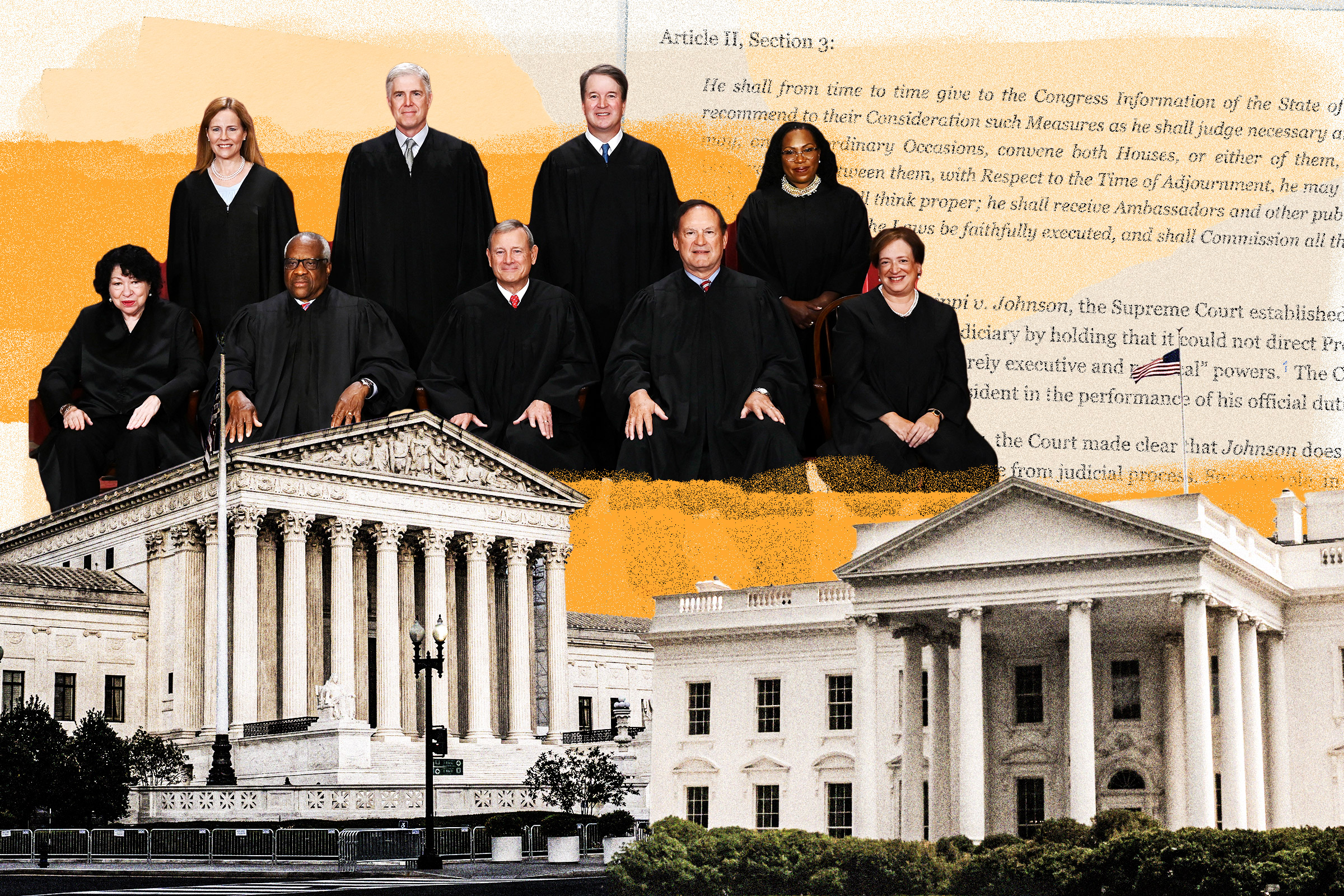
On July 1, the Supreme Court ruled that presidents and former presidents enjoy “absolute immunity” from criminal prosecution for “conduct within his exclusive sphere of constitutional authority,” setting guidelines for which acts in former President Donald Trump’s federal election case can remain in the indictment but leaving large amounts of litigation for the district court.
The case, which has been on hold since December 2023, is unlikely to proceed to trial before the November election but may soon see a flurry of legal activity.
Chief Justice John Roberts wrote the majority opinion, with Justice Clarence Thomas adding his own concurring opinion. Justice Amy Coney Barret concurred in part, noting several lines of legal disagreement with the majority. Justice Sonia Sotomayor wrote the dissenting opinion, joined by Justices Elena Kagan and Ketanji Brown Jackson, who also penned a separate dissent.
Trump Case Will Continue
The Supreme Court has given the case back to the U.S. District Court of the District of Columbia, where Judge Tanya Chutkan will have to determine whether several of President Trump’s actions in the indictment were, essentially, official or unofficial.
“Despite the unprecedented nature of this case, and the very significant constitutional questions that it raises, the lower courts rendered their decisions on a highly expedited basis,” the opinion reads.
Both the district and circuit courts completely rejected assertions of presidential immunity, so there has been no briefing on whether actions in the indictment were official or unofficial.
“That categorization raises multiple unprecedented and momentous questions,” the opinion reads.
When Judge Chutkan rejected the motion to dismiss based on presidential immunity last year, the appeals court fast-tracked the appeal, rejected the motion, and also fast-tracked the appeal process to the Supreme Court.
All case proceedings were paused in the meantime, and Judge Chutkan had taken the case—originally scheduled for March 4—off her calendar. At the time, the judge still had a number of motions to rule on, including a major ruling on what evidence and arguments could be used at trial.
Now Judge Chutkan will have to sort out what actions must be removed from the indictment before the case can continue. This may not necessarily be a quick process; as court filings by both parties have shown, the defense and prosecution have clashing theories as to whether certain acts were official or unofficial.
Prosecutors have acknowledged that some of the acts in the indictment were indeed the official acts of a president, and it has largely been expected that special counsel Jack Smith may trim down the indictment so as to proceed with the case with minimal holdup.
Supreme Court Sets Some Guidelines
The special counsel has charged former President Trump with four counts of conspiracy and obstruction for his actions to challenge the 2020 election results.
Crucially, the Supreme Court decision does not throw out any of these charges.
However, several actions involved in some of the charges may need to be tossed. The majority opinion finds that presidents have absolute immunity for core constitutional powers and presumptive immunity for other official acts. This immunity does “not extend to conduct in areas where his authority is shared with Congress,” and unofficial acts taken while in office receive no immunity at all.
President Donald Trump, Attorney General William Barr, and state attorneys general discuss protections from social media abuses at the White House on Sept. 23, 2020. (Mandel Ngan/AFP via Getty Images)
The court ruled that President Trump’s conversations with the acting attorney general were core conduct subject to absolute immunity.
It also ruled that his conversations with the vice president about the counting of the votes were part of his official duties, thus subject to presumptive, but not absolute, immunity—finding that Judge Chutkan should now assess whether prosecution of these actions intrudes on the authority and functions of the executive branch, and prosecutors will have to rebut the presumption of immunity if so.
The court then found that President Trump’s conversations with state officials and other parties require more fact finding as to whether the actions were official or not—another task for the district court.
It offered similar guidance regarding President Trump’s speech on and leading up to Jan. 6, 2021. Some speech falls within the outer perimeter of official responsibilities, but there are contexts in which presidents speak unofficially, the majority opinion reads.
The Supreme Court also ruled that courts “may not inquire into the President’s motives” while considering whether an action was official or unofficial, as this “highly intrusive” line of inquiry could expose official conduct to judicial examination, a violation of the separation of powers.
The court remanded the case for the district court to “carefully analyze” whether the indictment’s remaining allegations are free from official acts and ruled that testimony or private records probing the president’s or his advisers’ official conduct may not be used as evidence at trial.
Court Tosses Impeachment Theory
Although the Supreme Court ruling could be read as a win for the former president (he posted on social media shortly after the decision, “BIG WIN FOR OUR CONSTITUTION AND DEMOCRACY”), the court rejected his attorneys’ legal theory.
Former President Trump’s attorneys had argued that presidents must be impeached before they are subject to prosecution on those same actions and that former President Trump’s acquittal in the Senate thus precluded prosecution, warranting dismissal of the indictment.
The high court majority had instead relied on views of the framers of the Constitution regarding the separation of powers to reach their opinion and dismissed the impeachment argument as one with little constitutional support.
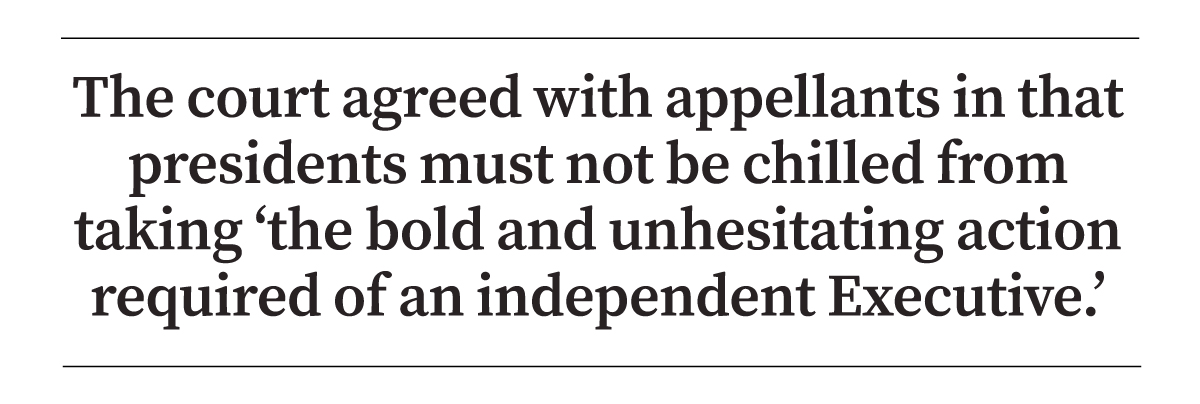
However, the court agreed with the Trump attorneys in that “the ‘bold and unhesitating action’ required of an independent Executive” must not be chilled.
Majority Emphasize Need for Strong Executive
Chief Justice Roberts, writing for the majority, emphasized that the Framers of the Constitution had the vision of a strong executive. Unlike the other two branches, the president is “the only person who alone composes a branch of government,” he wrote, citing his previous opinion from an unrelated Trump case.
The court—and the Framers—have held an “energetic executive” to be crucial to national security, good government, and the safeguarding of liberty.
Prosecutors and dissenting judges had argued that the criminal justice system inherently includes safeguards that would prevent the wrongful prosecution of a president or chilling effects that may stem from this possibility.
The majority held that this was not protection enough, as the mere prospect of prosecution may “distort Presidential decisionmaking” and cause “undue caution,” effectively undermining the independence of the executive branch.
“The hesitation to execute the duties of his office fearlessly and fairly that might result when a President is making decisions under ‘a pall of potential prosecution’ … raises unique risks to the effective functioning of government,” the opinion reads.
Demonstrators and protesters gather with members of the news media in front of the Supreme Court to wait for it to announce its last decisions for this session in Washington on July 1, 2024. (Chip Somodevilla/Getty Images)
4 Justices Say Official Acts Can Sometimes Be Unconstitutional
All nine justices recognized immunity for a president’s exercising of “core constitutional powers,” but four found the majority’s test to be far too broad.
Justice Barrett, in her partly concurring opinion, and Justices Sotomayor, Kagan, and Jackson, in a dissenting opinion, wrote that there may be cases in which official acts are unconstitutional or criminal and should be subject to prosecution.
Justice Barrett wrote in favor of a narrower test for immunity, with a two-step process to determine the validity of criminal charges for official acts. The first is determining whether the criminal statute applies to the president, and the second step is to determine if that prosecution imposes any danger of intruding on the powers of the executive branch.
Justice Sotomayor wrote that the court’s ruling gave the appellant even more immunity than he asked for, finding no support for immunity from criminal prosecution outlined in the Constitution.
The dissenting opinion, joined by two other justices, takes a reproving view of President Trump’s actions on Jan. 6, 2021, and, as outlined in the indictment, also the majority opinion.
Justice Sotomayor wrote that the challenge of exercising core constitutional powers, such as the president’s veto power, was never challenged in the indictment. As the majority defines “core immunity,” “all sorts of noncore conduct” could be shielded from criminal prosecution, she wrote, including “nightmare scenarios” such as ordering the military to carry out an assassination of a political rival, organizing a military coup, or taking a bribe in exchange for a pardon.
Similar scenarios were discussed during oral arguments, and Justice Samuel Alito expressed skepticism, cautioning judges not to slander the military in presenting these hypotheticals.
Voters cast ballots in Georgia’s primary election at a polling location in Atlanta on May 21, 2024. The Supreme Court decision may affect former President Trump’s case in Georgia, as some of the acts listed in the indictment overlap with the federal case. (Elijah Nouvelage/Getty Images)
Case May Return to Supreme Court
This case may yet end up in the Supreme Court on another appeal.
Trump attorneys can be expected to challenge unfavorable district court rulings on whether certain acts were official or unofficial, and Judge Chutkan still has several pending motions to rule on—including other motions to dismiss the indictment.
An additional complication that could arise for prosecutors is the fact that Mr. Smith is prosecuting a second case against former President Trump in the Southern District of Florida, where a federal judge is set to rule on whether Mr. Smith was constitutionally appointed. Should the judge determine that he wasn’t and that the special counsel has no authority to prosecute, an appeal could end up before the Supreme Court, affecting both cases.
Ruling May Affect Georgia Election Case
Former President Trump was indicted in a similar case in Georgia. In the state case, he and 18 others were charged with racketeering for their actions in challenging the 2020 election results, and some of the acts listed in the indictment overlap with the federal case.
While the federal case charges no alleged co-conspirators, the state case also charges former Justice Department official Jeffrey Clark for actions that he has argued were part of his official duties.
That case is currently on hold, as the Georgia Court of Appeals has agreed to review the trial court’s decision to not disqualify the Fulton County District Attorney Fani Willis from prosecuting the case over alleged misconduct.
Should the appeals court rule quickly after it hears oral arguments in October and then decide not to disqualify the district attorney, prosecutors will still need to revisit the indictment to remove any official acts before proceeding with the case.




 Liberty International News