
By Stephen F. Cohen
By criminalizing alleged “contacts with the Kremlin” – and by demonizing Russia itself – today’s Democrats are becoming the party of the new and more perilous Cold War.
Stephen F. Cohen, professor emeritus of Russian Studies and Politics (at NYU and Princeton), and John Batchelor hold their (usually) weekly discussions of the new US-Russian Cold War. (Previous installments, now in their fourth year, are at TheNation.com.)
In light of recent events, from Washington to the false alerts in Hawaii and Japan, Cohen returns to a theme he has explored previously: the ways in which the still-unproven Russiagate allegations, promoted primarily by the Democratic Party, have become the number-one threat to American national security. Historical context is needed, which returns Cohen briefly to related subjects he has also previously discussed with Batchelor.
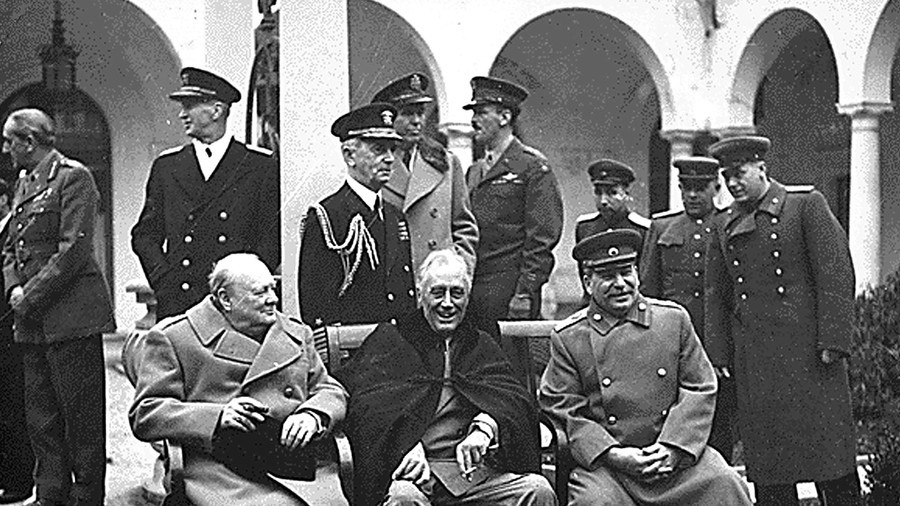
This year marks the 70th anniversary of what is usually said to have been the full onset of the long Cold War, in 1948. In fact, 2018 marks the 100th anniversary of US-Russian cold wars, which began with the Russian Civil War when, for the next 15 years, Washington refused to formally recognize the victorious Soviet government – surely a very cold relationship, though one without an arms race. The first of several détente policies – attempts to reduce the dangers inherent in cold war by introducing important elements of cooperation – was initiated by President Franklin D. Roosevelt in 1933, when he formally extended diplomatic recognition to the Soviet Union, then ruled by Stalin. That is, FDR was the father of détente, a circumstance forgotten or disregarded by many Democrats, especially today.
Three major détentes were pursued later in the 20th century, all by Republican presidents: Eisenhower in the 1950s, Nixon in the 1970s, and by Reagan in the second half of the 1980s, which was so fulsome and successful that he and his Soviet counterpart, Mikhail Gorbachev, thought they had ended the Cold War altogether.
And yet today, post–Soviet Russia and the United States are in a new and even more dangerous Cold War, one provoked in no small measure by the Democratic Party, from President Clinton’s winner-take-all policies toward Russia in the 1990s to President Obama’s refusal to cooperate significantly with Moscow against international terrorism, particularly in Syria; the role of his administration in the illegal overthrow of Ukrainian President Yanukovych in 2014 (a coup by any other name); and the still-shadowy role of Obama’s intelligence chiefs, not only those at the FBI, in instigating Russiagate allegations against Donald Trump early in 2016.
(Obama’s so-called “reset” of Russia policy was a kind of pseudo-détente and doomed from the outset. It asked of Moscow, and got, far more than the Obama administration offered; was predicated on the assumption that Vladimir Putin, then prime minister, would not return to the presidency; and was terminated by Obama himself when he broke his promise to his reset partner, then-Russian President Dmitry Medvedev, by overthrowing Libyan leader Gaddafi.)
It should also be remembered that the current plan to “modernize” US nuclear weapons by making them smaller, more precise, and thus more “usable” was launched by the Obama administration.
Which brings Cohen to President Trump, who, whether Trump fully understood it or not, sought to be the fourth Republican president to initiate a policy of détente – or “cooperate with Russia” – in times of perilous Cold War. In the past, a “dovish” wing of the Democratic Party supported détente, but not this time. Russiagate allegations, still mostly a Democratic project, have been leveled by leading Democrats and their mainstream media against Trump every time he has tried to develop necessary cooperative agreements with President Putin, characterizing those initiatives as disloyal to America, even “treasonous.”
Still more, the same Democratic actors have increasingly suggested that normal “contacts” with Russia at various levels – a practice traditionally encouraged by pro-détente US leaders – are evidence of “collusion with the Kremlin.” (A particularly egregious example is General Michael Flynn’s “contacts” with a Russian ambassador on behalf of President-elect Trump, a long-standing tradition now being criminalized.) Still worse, criticism of US policy toward Russia since the 1990s, which Cohen and a few other Russia specialists have often expressed, is being equated with “colluding” with Putin’s views, as in the case of a few words by Carter Page – that is, also as disloyal.
Until recently, Democratic Russiagate allegations were motivated primarily by a need to explain away and take revenge for Hillary Clinton’s defeat in the 2016 presidential election. Now, however, they are being codified into a Democratic Party program for escalated and indefinite Cold War against Russia, presumably to be a major plank in the party’s appeal to voters in 2018 and 2020, as evidenced by two recent publications: a flagrantly cold-warfare article coauthored by former Vice President Joseph Biden, who is clearly already campaigning for the party’s 2020 presidential nomination, in the current issue of Foreign Affairs; and an even more expansive “report” produced by Democratic Senator Ben Cardin purporting to show that Putin is attacking not only America, as he purportedly did in 2016, but democracies everywhere in the world and that America must respond accordingly.
Both are recapitulations of primitive American (and Soviet) “propaganda” that characterized the onset of the early stage of the post-1948 Cold War: full of unbalanced prosecutorial narratives, selective and questionable “facts,” Manichean accounts of Moscow’s behavior, and laden with ideological, not analytical, declarations.
Indeed, both suggest that “Putin’s Russia” is an even more fearsome threat than was Soviet Communist Russia. Tellingly, both implicitly deny that Russia has any legitimate national interests abroad and, with strong Russophobic undertones, that it is a nation worthy in any way. Both preclude, of course, any rethinking of US policy toward Russia except for making it more aggressive.
These latter approaches to Soviet Russia were eventually tempered or abandoned during the era of détente for the sake of diplomacy, relegated mainly to fringe groups. Now they are becoming the proposed policies of the Democratic Party.
Leave aside, Cohen continues, the consequences of another prolonged Cold War for a “progressive agenda” at home. Consider instead the supremely existential and real danger of nuclear war, which as Reagan wisely concluded, “cannot be won and therefore must never be fought.” And consider the false alarms of incoming nuclear missiles recently experienced in Hawaii and Japan. These episodes alone should compel any Democratic Party worthy of the name to support Trump’s pro-détente instincts, however inadequate they may be, and urge him to pursue with Putin agreements that would take all nuclear weapons off high alert, which gives both leaders only a few minutes to decide whether such alarms are authentic or false before launching massive retaliation; adopt a reassuring mutual doctrine of no-first-use of nuclear weapons; and move quickly toward radical reductions of those weapons on both sides.
But for that to happen, the Democratic Party would need to give American national security a higher priority than its obsession with Russiagate, which is currently very far from the case.
Some Democratic members of Congress seem to understand this imperative, at least privately, but evidently lack the civic courage to speak out. And, to be ecumenical, so do those Republican members and their media who now allege that Russiagate is somehow a function of “Russian propaganda” having been smuggled into American politics.
Hegel liked to say, “The Owl of Minerva spreads its wings only with the falling of dusk” — that wisdom comes too late. A Hegel-like historical irony may also be unfolding. FDR was the first pro-détente president. Due primarily to today’s Democrats, Trump might be the last.
Stephen F. Cohen is a professor emeritus of Russian studies and politics at New York University and Princeton University and a contributing editor of The Nation.
Source: RT & The Nation



 Liberty International News