Edward Snowden is a whistleblower, not a spy – but do our leaders care? | The Guardian

Mike Rogers, CA 'Dutch' Ruppersberger

By Spencer Akerman
The Twitter account of House intelligence committee chairman Mike Rogers, left, placed Edward Snowden in the company of two infamous double agents. Photograph: J Scott Applewhite/AP

According to US legislators and journalists, the surveillance whistleblower Edward Snowden actively aided America’s enemies. They are just missing one essential element for the meme to take flight: evidence.

An op-ed by Representative Mike Pompeo (Republican, Kansas) proclaiming Snowden, who provided disclosed widespread surveillance on phone records and internet communications by the National Security Agency, “not a whistleblower” is indicative of the emerging narrative. Writing in the Wichita Eagle on 30 June Pompeo, a member of the House intelligence committee, wrote that Snowden “has provided intelligence to America’s adversaries“.

Pompeo correctly notes in his op-ed that “facts are important”. Yet when asked for the evidence justifying the claim that Snowden gave intelligence to American adversaries, his spokesman, JP Freire, cited Snowden’s leak of NSA documents. Those documents, however, were provided to the Guardian and the Washington Post, not al-Qaeda or North Korea.

It’s true that information published in the press can be read by anyone, including people who mean America harm. But to conflate that with actively handing information to foreign adversaries is to foreclose on the crucial distinction between a whistleblower and a spy, and makes journalists the handmaidens of enemies of the state.

Yet powerful legislators are eager to make that conflation about Snowden.

The Twitter account of Representative Mike Rogers (Republican, Michigan), the chairman of the House intelligence committee, on 18 June placed Snowden and accused WikiLeaks source Bradley Manning in the same company as Aldrich Ames and Robert Hanssen, two infamous CIA and FBI double-agents. (The tweet appears to have been deleted.)

When I asked about the conflation, Rogers’ Twitter account responded: “All 4 gave critical national security information to our enemies. Each did it in different ways but the result was the same.”

Never to be outdone, Peter King, a New York Republican and former chair of the House homeland security committee, proclaimed Snowden a “defector” on 10 June. Days later, Snowden left Hong Kong to seek asylum in an undetermined country – a curious move for a defector to make.

Once elected and appointed leaders casually conflate leaking and espionage, it is a matter of time before journalists take the cue. For insight into the “fear and isolation that NSA leaker Edward Snowden is living through”, CNN turned to Christopher Boyce – who sold US secrets to the USSR before becoming a bank robber.

There are understandable suspicions that Snowden may have aided foreign intelligence services in order to aid in his escape from American criminal justice. While some have speculated that the Russian or Chinese intelligence services might have snuck a look at the highly sensitive intelligence material Snowden is carrying, that material is heavily encrypted. For what it’s worth, in a Guardian webchat I asked Snowden directly if he would trade access to his documents for asylum. He said he would not.

Perhaps Snowden lied. Perhaps he might change his mind. But all of that is far off in the realm of speculation. As things stand now, there is no evidence Snowden has aided any US adversary or intelligence service, wittingly or not.

Even the Obama administration has stopped short of terming Snowden a spy, even in the course of attacking his character. (Yes, he was indicted under the Espionage Act, but the actual charges against him are theft of government property, unauthorized communication of national defense information, and willful communication of classified intelligence information to an unauthorized person.) In an email meant to discredit Snowden in the press, an anonymous “senior administration official” told reporters on 24 June that Snowden’s ostensible idealism “is belied by the protectors he has potentially chosen: China, Russia, Cuba, Venezuela and Ecuador”. That’s something to remember the next time Washington wants to talk about its commitment to human rights while cooperating with, say, China and Russia.

Edward Snowden Edward Snowden. Photograph: Reuters/The GuardianWhen asked directly if there was any evidence that Snowden had cooperated with any intelligence service or American adversary, the administration and Congress declined to provide any. The office of the director of national intelligence, James Clapper, declined to comment for this story. The Justice Department and the House intelligence committee didn’t even respond to inquiries.

By all means, consider Snowden a hero, a traitor or a complex individual with a mixture of motives and interests. Lots of opinions about Snowden are valid. He is a necessarily polarizing figure. The information he revealed speaks to some of the most basic questions about the boundaries between the citizen and the state, as well as persistent and real anxieties about terrorism.

What isn’t valid is the blithe assertion, absent evidence, that the former NSA contractor actively collaborated with America’s enemies. Snowden made classified information about widespread surveillance available to the American public. That’s a curious definition of an enemy for US legislators to adopt.

Source: The Guardian

Carbon Offsets Could Create Loophole for Industry to Pollute as Usual | EcoWatch

LoggingBy Maureen Nandini Mitra and Michael Stoll

One hot day this spring John Buckley scrambled up a dusty slope of a patch of deforested land in the middle of California’s Stanislaus National Forest in the Sierra Nevada, five miles west of Yosemite National Park, and surveyed the bleak landscape: 20 acres of blackened tree stumps and the shriveled remains of undergrowth. On neighboring ridges, similar brown expanses dotted the green forest canopy. “This,” he said, spreading his arms wide, “is resource management.”

The denuded clearing is on a tract of private forestland owned by timber giant Sierra Pacific Industries that is close to being approved as a sort of carbon bank under California’s new cap-and-trade scheme. It will soon grow into a plantation of mostly Douglas fir, ponderosa pine and cedar.

Based on calculations of how much carbon the new and old trees in this forest area will remove from the atmosphere, the timber giant will soon be able to sell carbon credits, which regulators call “offsets,” to the largest California polluters so they can compensate for their greenhouse gas emissions. Looking to make a profit from their environmental practices, companies in forestry and other industries are rushing to meet the demand.

Buckley, an environmental activist from Tuolumne County, is dismayed that projects like these—that involve clearing out old, diverse forests and replanting the area with a handful of quick-growing timber varieties—are being considered as a means to enable California industries to emit more pollutants into the air.

Many environmentalists say that because it is notoriously difficult to prove that such projects actually reduce the state’s overall carbon footprint, California should proceed slowly in approving a vast expansion of the cap-and-trade market.

The plan is to start the Compliance Offset Program this summer. Sellers include some of the largest forestland owners in the U.S., dairy farms and companies that neutralize greenhouse effect-producing refrigerants. The program might also expand to other activities, such as methane capture from mining and rice farming.

Proponents say that by providing incentives to voluntarily reduce emissions and use new technology, the offset program could help California meet its legal requirement, set in 2006, to reduce its carbon footprint from all sources by about 16 percent by 2020, and even more in later years.

But critics call offsets a loophole that could undermine an effective cap-and-trade system. They say pledges of reductions that are not required by law often cannot be considered real, since companies might have made them anyway without the extra money from selling offsets. Left unchecked, the critics warn, poorly measured offsets could lead to an overall increase in California’s emissions. Read more…

Source: Earth Island Journal & EcoWatch

‘Rampant Injustice’: The IRS And DOJ Raid Small Businesses With Paramilitary, Gestapo Style Tactics | Breitbart

By Debra Heine

A short documentary by Jan Morgan of JanMorganMedia, called “Rampant Injustice”  exposes the federal abuse of power that has taken place since Obama was elected. This underexposed video documents the  egregious trampling of the Constitutional rights of Americans during white collar crime investigations by the Department of Justice and the Criminal Investigation Division of the Internal Revenue Service.

Between 2009 and 2011, IRS audits against small businesses increased 32%. Federal warrants against businesses have also increased substantially with many of the raids conducted by SWAT teams.

Among the hundreds of businesses raided by the IRS and Department of Justice, using paramilitary, gestapo like tactics, was Mountain Pure Water Bottling Company and Duncan Outdoors, Inc., both situated in Arkansas and Gibson Guitar located in Tennessee. Their stories are profiled in the documentary which has been up on YouTube since October 31 of last year. The abusive targeting practices of the IRS toward conservative organizations  have finally made the news,  but these stories need exposure too.

The IRS and DOJ are out of control, and have been at war against small businesses.

At 8:00 a.m. on January 18, 2012, 40 -50 heavily armed, hostile government agents raided Mountain Pure water, scaring the dickens out of everyone in the building.

What you’re about to see is a reenactment of something that really happened.  The owner, John Stacks told me on the phone that it was even worse than depicted in the video.

He says he was cursed at, spat on,  and bullied in such an egregious fashion, he felt like they were trying to provoke him to react violently. His son, Court Stacks, the General Manager, had a loaded gun pointed to his face. His seven and a half month pregnant wife watched news coverage of the raid at home in horror. She would later lose the baby.

“I am not a militant”, Jerry Miller the Comptroller of Mountain Pure Water said. “They’ve thrown the Constitution away!”

John Stacks (a Republican) and his  son Ryan, an attorney, were not allowed to enter the building. Why? According to Miller, one of the agents told him, “we’re the federal government and we can do anything we want to.”

“They threw our liberties out the window”,
Miller concluded. “They treated us like third class citizens…if people are not outraged, they need to be. This used to be America – now it’s not.”

“I never fathomed that something to this extent could take place in the United States”, said Ryan Stacks. He went on to say they were being  treated similarly to “some type of terrorists, essentially.”

Duncan Outdoors faced a similar gestapo like raid with the eerily familiar refrain from one of the officers, “we’re from the IRS and we can do anything we want.”

John Stacks told me he lost business over the episode, because people generally think you’ve done something wrong when you get raided by the feds. Stacks’ “crime” stems from financial records being sought regarding a FEMA loan he got after a tornado destroyed one of his properties in May of 2008. The harassment started about a year and a half later, he said, on a loan he’s never been late in  paying.

“This documentary is not about the guilt or innocence of the citizens involved”, said Jan Morgan, an Investigative TV Journalist and Conservative Columnist said at the end of the video. “It is about the increasing number of unconstitutional, paramilitary, gestapo style raid tactics involving two agencies of the federal government.”

*Clarification: It was an SBA loan he secured through FEMA to recover the tornado losses to his home, warehouse, and associated equipment.

Mr. Stacks told James Simpson of AIM that the SBA “apparently doesn’t believe that assets listed as damaged in the storm were actually damaged.”

Source: Breitbart

University of BC Doctors Expose Vaccination Cover-up: Official Documents Released From The UK | Collective Evolution

vaccDr Chris Shaw, from the University of British Colombia’s (UBC)  Department of Ophthalmology, Visual Sciences, Experimental Medicine and Neuroscience published a paper in the Journal Inorganic Biochemistry along with his colleague, Dr.  Lucija Tomljenovic that revealed Government experts have known about the dangers associated with vaccinations. They investigated information exposing a 30 year scandal of official meetings by UK government vaccine committees and independent medical ‘experts’ with drug industry connections. The paper is at the bottom of the article under “sources”.

A Freedom of Information Act request filed with the CDC  seeking information on what the CDC knows about the dangers of vaccines, had by law to be responded to in 20 days. Nearly 7 years later a judge ordered the CDC to turn over the documents on September 30th, 2011. These documents were part of the study discussed in this article.

The paper has received a lot of attention. UBC even held a symposium about vaccination safety as a result in an effort to arouse more critical thinking and discussion around the topic. The response was disturbing  with a number of UBC professors upset that the discussion was taking place in the first place. It’s disturbing to know that there are those out there who wish to silence an opposition to vaccination, and not even keep an open mind to potential dangers. Much of the medical literature examined by researchers comes straight from pharmaceutical company-sponsored medical research. It’s time for us to wake up and make some obvious connections. Here is a quote from the published, peer reviewed paper.

Deliberately concealing information from parents for the sole purpose of getting them to comply with an “official” vaccination schedule could be considered as a form of ethical violation or misconduct. Official documents obtained from the UK Department of Health (DH) and the Joint Committee on Vaccination and Immunisation (JCVI) reveal that the British health authorities have been engaging in such practice for the last 30 years, apparently for the sole purpose of protecting the national vaccination program(1).

The documents reveal that vaccinations don’t work, and that they cause the disease they are supposed to prevent. They also indicate scientific fraud, that government ‘experts’ are working to conceal information. The 45 page paper was published in 2011 and presented at the BSEM scientific conference (2)

Here I present the documentation which appears to show that the JCVI made continuous efforts to withhold critical data on severe adverse reactions and contraindications to vaccinations to both parents and health practitioners in order to reach overall vaccination rates which they deemed were necessary for “herd immunity”, a concept which with regards to vaccination, and contrary to prevalent beliefs, does not rest on solid scientific evidence as will be explained. As a result of such vaccination policy promoted by the JCVI and the DH, many children have been vaccinated without their parents being disclosed the critical information about demonstrated risks of serious adverse reactions, one that the JCVI appeared to have been fully aware of. It would also appear that, by withholding this information, the JCVI/DH neglected the right of individuals to make an informed consent concerning vaccination. By doing so, the JCVI/DH may have violated not only International Guidelines for Medical Ethics. –  Dr Lucija Tomljenovic (1)

She also mentions evidence of ties between vaccine manufacturers and pharmaceutical companies.

The transcripts of the JCVI meetings also show that some of the Committee members had extensive ties to pharmaceutical companies and that the JCVI frequently co-operated with vaccine manufacturers on strategies aimed at boosting vaccine uptake. Some of the meetings at which such controversial items were discussed were not intended to be publicly available, as the transcripts were only released later, through the Freedom of Information Act (FOI). These particular meetings are denoted in the transcripts as “commercial in confidence”, and reveal a clear and disturbing lack of transparency, as some of the information was removed from the text (i.e., the names of the participants) prior to transcript release under the FOI section at the JCVI website – Dr Lucija Tomljenovic (1)

The documents go on to show that when strong evidence was presented against vaccination, they were completely ignored and overlooked by the Joint Committee on Vaccinations and Immunizations. Furthermore, the committee has constantly dismissed independent research and downplayed vaccine concerns while over inflating the benefits. They’ve also promoted and elaborated a plan for introducing new vaccines of questionable efficacy and safety into the routine pediatric schedule, on the assumption that the licenses would eventually be granted. All of these violate the JCVI’s own code of conduct.

Alternative media outlets continue to raise awareness about vaccinations and their potential dangers. With the world handing over credibility to a certain criteria, we thank all of the researchers out there who continue to examine all information, and a wide variety of sources. With the work of these researchers and doctors, the truth about vaccinations continues to spread across the planet.

Source: Collective Evolution

(1) http://www.ecomed.org.uk/wp-content/uploads/2011/09/3-tomljenovic.pdf
(2)http://www.ecomed.org.uk/publications/the-health-hazards-of-disease-prevention
(3) http://www.vancourier.com/Responses+vaccine+paper+problem+free+scientific+inquiry+expression/6073466/story.html
(4) http://nsnbc.me/2013/05/10/the-vaccine-hoax-is-over-freedom-of-information-act-documents-from-uk-reveal-30-years-of-coverup
(5) http://childhealthsafety.wordpress.com/2012/03/14/government-experts-cover-up-vaccine-hazards

OpenSecrets.org’s Resources on Politically Active Tax-Exempt Groups

The first congressional hearing triggered by the news that the Internal Revenue Service inappropriately targeted tea party groups for additional scrutiny begins Friday, and it’s clear the issue isn’t going away anytime soon.

The Center for Responsive Politics has been intensively researching and writing about politically active nonprofits — also known as 501(c)(4) organizations, or, more colloquially, “dark money” groups — for more than a year. Since the 2010 Citizens United Supreme Court decision freed them to participate more directly in electoral politics, they have been used to pour money into the system at an unprecedented rate.

There has been an explosion of spending by nonprofit groups over the last three election cycles, from less than $17 million in 2006 to well over $300 million in 2012.
nonprofit spending growth by type.JPG
These groups, unlike the more commonly known super PACs, are not required to divulge the names of their donors, and much of their spending is unreported, too. Their annual tax filings with the IRS list how much money they have, who their officers are and the recipients of any grants they may have made.

But when they spend their money directly in support of or opposition to a candidate, they must report to the Federal Election Commission. FEC data collected and analyzed by OpenSecrets.org shows that in the 2012 election alone, politically active nonprofits reported spending more than $308 million. Many millions more were likely spent on “issue ads” that escaped reported rules.

If you follow that link, you’ll notice none of the organizations at the top of our list are tea party groups. In fact, they have remained relatively small players in the game.
What we do know is that many of these groups on the list are conservative in nature — though they come in many flavors of conservative. There are several important liberal groups active in this area, as well, but right-leaning groups dominate. About 85 percent of the money that was spent by nonprofits in the 2012 cycle, as reported to the FEC, was paid out by conservative groups.
nonprofit spending growth by viewpt.JPG
We’ve also applied old-fashioned reporting in our effort to bring these groups to the public’s attention, in particular with our Shadow Money Trail series. Despite the current concern about IRS employees applying too much scrutiny to certain groups because of their political slant, we’ve actually found many instances where political operatives from across the spectrum seem to be taking advantage of the fact that the IRS generally applies very little scrutiny to these entities.

By painstakingly going through public tax returns filed by tax-exempt groups, we have been able to trace how some of the money has flowed between them. We have posted that information (here’s an example) when we have it.

Some of the topics we’ve covered in this series:
  • How conservative group American Committment seemed to make $10 million disappear by churning money between its various related groups.
  • How Obama’s dark money allies make big payments to political consultants.
  • The phenomenon of dark money mailboxes — social welfare organizations that act as way stations for dark money and have few or no activities of their own.
  • How one prominent liberal group churns money through a confusing web of similarly named 501(c)(4)s and 527 groups.

There are a host of other stories on our Shadow Money Trail page, including “Shadow Money Magic,” our five-part report on how some of these groups game the IRS.

Source: OpenSecrets.org

Monsanto wins Supreme Court fight over its genetically engineered soybeans | Washington Post

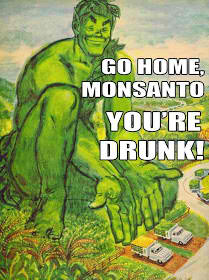
GoHomeMonsantoThe Supreme Court said Monday that an Indiana farmer violated Monsanto Co.’s patents on soybean seeds resistant to its weed-killer by growing the beans without buying new seeds from the corporation.

The justices unanimously rejected the farmer’s argument that cheap soybeans he bought from a grain elevator are not covered by the Monsanto patents, even though most of them also were genetically modified to resist the company’s Roundup herbicide.

While Monsanto won this case, the court refused to make a sweeping decision that would cover other self-replicating technologies like DNA molecules and nanotechnologies, leaving that for another day. Businesses and researchers had been closely watching this case in hopes of getting guidance on patents, but Justice Elena Kagan said the court’s holding Monday only “addresses the situation before us.”

In a statement, Monsanto officials said they were pleased with the court’s ruling.

“The court’s ruling today ensures that longstanding principles of patent law apply to breakthrough 21st century technologies that are central to meeting the growing demands of our planet and its people,” said David F. Snively, Monsanto’s top lawyer. “The ruling also provides assurance to all inventors throughout the public and private sectors that they can and should continue to invest in innovation that feeds people, improves lives, creates jobs, and allows America to keep its competitive edge.”

In the case decided by the court, farmer Vernon Hugh Bowman bought expensive, patented Monsanto’s “Roundup Ready” seeds for his main crop of soybeans, but decided to look for something cheaper for a risky, late-season soybean planting. He went to a grain elevator that held soybeans it typically sells for feed, milling and other uses, but not as seed.

Bowman reasoned that most of those soybeans also would be resistant to weed killers, as they initially came from herbicide-resistant seeds too. He was right, and he bought soybeans from the grain elevator and planted them over eight years. In 2007, Monsanto sued and won an $84,456 judgment.

Monsanto has a policy to protect its investment in seed development that prohibits farmers from saving or reusing the seeds once the crop is grown. Farmers must buy new seeds every year. More than 90 percent of American soybean farms use Monsanto’s seeds, which first came on the market in 1996.

Bowman’s lawyers argued that Monsanto’s patent rights stopped with the sale of the first crop of beans instead of extending to each new crop soybean farmers grow that has the gene modification that allows it to withstand the application of weed-killer.

But Kagan disagreed. “Bowman planted Monsanto’s patented soybeans solely to make and market replicas of them, thus depriving the company of the reward patent law provides for the sale of each article,” she said. “Patent exhaustion provides no haven for such conduct.”

Bowman also said he should not be liable, in part, because soybeans naturally sprout when planted.

Kagan said the court also did not buy that argument. “We think the blame-the-bean defense tough to credit,” she said.

Andrew Kimbrell, executive director of Center for Food Safety, said the ruling was wrong. “The court chose to protect Monsanto over farmers,” Kimbrell said. “The court’s ruling is contrary to logic and to agronomics, because it improperly attributes seeds’ reproduction to farmers, rather than nature.”

But a soybean growers’ association said it was the correct decision. “The Supreme Court has ensured that America’s soybean farmers, of which Mr. Bowman is one, can continue to rely on the technological innovation that has pushed American agriculture to the forefront of the effort to feed a global population projected to pass 9 billion by 2050,” said Danny Murphy, president of the American Soybean Association.

Calls to Bowman by The Associated Press were unanswered.

The soybean case is Bowman v. Monsanto Co., 11-796.

Source: Washington Post

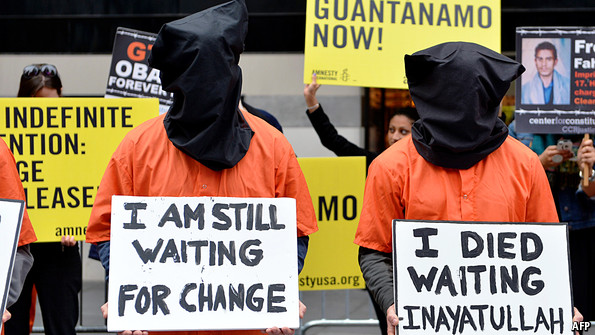
A desperate protest by prisoners at Guantánamo has shamed Barack Obama

GuantanamoHungerStrike“YOU have to hand it to some of these IRA boys,” Margaret Thatcher once remarked of the republican hunger-strikers who embarrassed her in 1981. “What a terrible waste of human life!” she said of the ten who died. Since some of the hunger-strikers at Guantánamo Bay are being force-fed through nasal tubes, Barack Obama may be spared Mrs Thatcher’s grief. But he has been shamed by their desperate gambit all the same. The protest is a reminder of one of his most glaring failures in office.

Officials count 100 hunger-strikers; lawyers for the detainees say there are 130; on any reckoning, a majority of the 166 remaining inmates are starving themselves. Through their lawyers, detainees complain of a rougher regime since the army took over guard duties from the navy last autumn. In particular they allege that their Korans were mistreated during an inspection in February, when the hunger-strike began (prison authorities vigorously deny that). A cell-block raid by guards on April 13th (provoked by the covering up of security cameras), during which some prisoners were shot with rubber pellets, hardened rather than broke the strikers.

But the underlying cause is simpler, and more personal. “The reason they’re willing to die”, says Carlos Warner, a federal defender who represents 11 of the detainees, “is President Obama.”

Mr Obama said this week that Guantánamo “hurts us in terms of our international standing.” That echoed the view he espoused when, on his second day in office in January 2009, he ordered the prison to be closed within a year. Its existence since 2002, he said, had “likely created more terrorists around the world than it ever detained”—an opinion eventually shared by assorted veterans of George W. Bush’s administration. And yet the only Guantánamo-related closure so far has been the shutting, in January this year, of the diplomatic office charged with resettling the inmates.

Mr Obama blames Congress—with some justification. It thwarted his original plan to transfer the detainees to a facility in Illinois. Then, either out of concern for national security, a yen to embarrass the president, or both, in clauses inserted into successive defence-spending bills Congress made it difficult for officials to transfer anyone anywhere. Difficult, but not impossible: Mr Obama can authorise transfers using a presidential waiver. He has chosen not to. (After a bomb plot with links to Yemen at the end of 2009, he also chose to halt transfers there—and most of the remaining prisoners are Yemeni.) He evidently calculated that, given the battles he is already waging with Congress, Guantánamo was one he could do without.

That stalemate has been an especial let-down for the 86 residual prisoners who, in 2010, were slated for transfer out of Guantánamo by a presidential review; some had already been designated for transfer under the previous administration. Many of these men claim to have committed no offence except being in the wrong place—Afghanistan—at the wrong time, or to have been sold to American forces for the bounties they offered. One such, and one of the hunger-strikers, is Shaker Aamer, a British resident picked up in Jalalabad in 2001 and allegedly tortured. His lawyer, Clive Stafford Smith, points out that the British government is well-equipped to monitor Mr Aamer should he be repatriated.

According to the review, many of these men were low-level fighters rather than total innocents. But none has been charged with a crime—and most have been at Guantánamo for over a decade. In fact, only seven of the 779 prisoners who have passed through the camp have been convicted by its military tribunals (and two of those verdicts have been challenged). Of those still there, only three have been convicted and only six currently face trial, including Khalid Sheikh Mohammed, the alleged mastermind of the September 11th attacks. Subject to multiple legal challenges, beset by scandals over hidden microphones and leaked defence documents, the tribunals are now regarded as a failure even by those untroubled by their dubious legal status. As Mr Obama pointed out, federal courts have proved a much more effective forum for prosecuting terrorists.

The result, at the camp, is near-total stasis. No new prisoner has arrived since 2008; none has left for over a year. Parole-style hearings planned for the group not designated for either trial or transfer have yet to begin. Prisoners have lawyers, but there is little the lawyers can do for them. This bleak situation, says Mr Stafford Smith, is worse than being on death row.

Last chance?

Beyond the feeling of personal betrayal by Mr Obama, the detainees also sense—correctly—that the attention of the foreign leaders, human-rights watchdogs and United Nations officials who once energetically protested at their predicament has wandered. The outrage that the manacled, blindfolded, jumpsuited figures first provoked has dimmed. Drone warfare has become a much bigger human-rights preoccupation. And yet, unpropitious as it might seem, the prisoners also fear that this may be their last chance to get out.

Mr Warner says that if, with the president’s views and legal background, Mr Obama “can’t get this done, I don’t know who could.” It is hard to see a future presidential candidate matching his troublesome pledge to shut the prison. And for Mr Obama as well, time is running out. Even if he chose to use his waiver powers, and leant on other governments to accept detainees, the diplomacy, including gathering the necessary assurances on security and humane treatment, would take time.

Meanwhile the Guantánamo authorities are seeking an extra $200m for refurbishments, on top of annual running costs that wildly exceed those for ordinary prisons. They are planning new medical facilities to care for elderly detainees.

This week Mr Obama vowed to re-engage with Congress. “I’m going to go back at this,” he promised. He should hurry. Once Guantánamo was a byword for an overmighty executive and the excesses of Mr Bush’s “war on terror”. Under Mr Obama it has become a victim and a symbol of the paralysing divisiveness of American politics. “It’s going to get worse,” he said this week. “It’s going to fester.”

Source: The Economist

Sedgwick, Maine is first town to declare total food sovereignty, opposing state and federal laws | NaturalNews

By  J.D. Hayes

There is a food revolution taking hold all over America, whether it is in the form of demanding labeling of GM foods, the right to produce and sell raw milk and other commodities, or – in the case of Sedgwick, Maine – declaring all local food transactions of any kind free and legal.
According to the website FoodRenegade.com, Sedgwick is the first city in the U.S. to free itself from the constraints of federal and state food regulation. Published reports say the town has passed an ordinance that gives its citizens the right “to produce, sell, purchase, and consume local foods of their choosing,” regulations be damned. The ordinance includes raw milk, meats that are slaughtered locally, all produce and just about anything else you might imagine.

And what’s more, three additional towns in Maine are expected to take up similar ordinances soon, said the FoodRenegade.com.

Gee – good, ol’ fashioned buyer-seller agreements?

Observers of the Sedgwick ordinance say it is much more than just “statement” legislation. Writes blogger David Grumpert, at TheCompletePatient.com:

This isn’t just a declaration of preference. The proposed warrant added, “It shall be unlawful for any law or regulation adopted by the state or federal government to interfere with the rights recognized by this Ordinance.” In other words, no state licensing requirements prohibiting certain farms from selling dairy products or producing their own chickens for sale to other citizens in the town.

What about potential legal liability and state or federal inspections? It’s all up to the seller and buyer to negotiate. “Patrons purchasing food for home consumption may enter into private agreements with those producers or processors of local foods to waive any liability for the consumption of that food. Producers or processors of local foods shall be exempt from licensure and inspection requirements for that food as long as those agreements are in effect.” Imagine that-buyer and seller can agree to cut out the lawyers. That’s almost un-American, isn’t it?

According to Deborah Evans, a Sedgwick citizen, the ordinance further states:

  1. Producers or processors of local foods in the Town of Sedgwick are exempt from licensure and inspection provided that the transaction is only between the producer or processor and a patron when the food is sold for home consumption.
  2. Producers or processors of local foods in the Town of Sedgwick are exempt from licensure and inspection provided that the products are prepared for, consumed or sold at a community social event.

For those questioning the legality of the ordinance – as in, it obviously circumvents state and federal food laws – she notes:

[W]e the radicals who concocted this mutinous act of infamy believe that according to the Home Rule provisions of our State Constitution, the citizens of Sedgwick have the right to enact an ordinance that is “local and municipal in character.”

‘It’s about time’

Many of the local farmers say the ordinance is just what is needed.

“This ordinance creates favorable conditions for beginning farmers and cottage-scale food processors to try out new products, and to make the most of each season’s bounty,” farmer Bob St. Peter told the website FoodFreedom.com. “My family is already working on some ideas we can do from home to help pay the bills and get our farm going.”

“Tears of joy welled in my eyes as my town voted to adopt this ordinance,” said Sedgwick resident and local farm patron Mia Strong. “I am so proud of my community. They made a stand for local food and our fundamental rights as citizens to choose that food.”

St. Peter, who is a board member of the National Family Farm Council, a food freedom advocacy group, notes that small farmers have a much tougher row to hoe, especially in today’s economy, so they need the ability to sell their products more freely.

“It’s tough making a go of it in rural America,” he said. “Rural working people have always had to do a little of this and a little of that to make ends meet. But up until the last couple generations, we didn’t need a special license or new facility each time we wanted to sell something to our neighbors. Small farmers and producers have been getting squeezed out in the name of food safety, yet it’s the industrial food that is causing food borne illness, not us.”

Sources:
http://www.foodrenegade.com/maine-town-declares-food-sovereignty/
http://www.thecompletepatient.com
http://foodfreedom.wordpress.com
http://www.nffc.net

Bruce Cockburn – Live On World Café

01 Thoughts On September 11
02 How I Spent My Fall Vacation
03 Bruce’s Sabbatical
04 Anything Anytime Anywhere
05 Bruce On Finding His Voice
06 Creation Dream
07 Instrumental
08 The Inspiration For ‘Celestial Horses’
09 Celestial Horses
10 Thoughts On Singer-Songwriters Today
11 The Trouble With Normal
12 What’s Next

Holder: Big Banks’ Clout “Has an Inhibiting Impact” on Prosecutions | Frontline

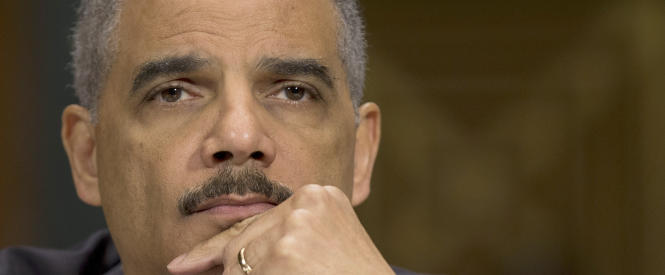
Eric HolderAttorney General Eric Holder said that the Justice Department had considered the economic fallout that could result from prosecuting major banks for their role in the financial crisis, in Senate testimony on Tuesday.

Holder’s comments underscored remarks his deputy, Lanny Breuer, gave in an interview for FRONTLINE’s film The Untouchables that raised concerns among some in government that the Justice Department hasn’t been sufficiently aggressive in prosecuting major banks for the fiscal crisis.

“I am concerned that the size of some of these institutions becomes so large that it does become difficult to prosecute them,” Holder told the Senate Judiciary Committee. “When we are hit with indications that if you do prosecute, if you do bring a criminal charge it will have a negative impact on the national economy, perhaps world economy, that is a function of the fact that some of these institutions have become too large. It has an inhibiting impact on our ability to bring resolutions that I think would be more appropriate. That is something that you all need to consider.”

Holder added that he felt the department had been “appropriately aggressive,” in pursuing and bringing cases where it could prove companies or individuals had broken the law. “These are not easy cases to make,” he said. “Things were done wrong, but the question is whether they’re illegal.”

So far, no Wall Street executives have been prosecuted for fraud in connection with the financial crisis.

Breuer’s interview, which you can read in full here, sparked a Jan. 29 letter from Sens. Charles Grassley (R-Iowa) and Sherrod Brown (D-Ohio) asking for more information on how the Justice Department determined which cases to prosecute. It also asked for the names of any outside experts Justice consulted, and what they were paid.

The Justice Department responded (pdf) one month later, defending its record. But the senators said the letter was “aggressively evasive” and didn’t answer their questions.

On Tuesday, Holder told Grassley that the DOJ would “endeavor to answer” the senators’ letter.

Holder’s full testimony is embedded below. (The exchange on financial fraud prosecutions begins around the 2:17:22 mark.)

Source: Frontline