Nanoparticles in your food? You’re already eating them | Grist

By Twilight Greenaway

What’s engineered in a lab, added to processed foods, and never labeled? If you thought GMOs were mysterious, try nanoparticles.

I’ve been keeping my eye on the role of nanotechnology in food for a few years now, so I was interested to see a feature-length investigation called “Eating Nano” in this month’s E Magazine. In it, E editor Brita Belli takes a deep dive into the growing role of nanotechnology in food and agriculture, the current lack of oversight and regulations, and the growing consensus that more information and transparency are both sorely needed in relation to this growing field.

Nanotechnology involves the engineering and manipulation of particles at a nano scale. Nanoparticles, as they’re called, are measured in nanometers or billionths of one meter. Another way to put it: If a nanoparticle were the size of a football, a red blood cell would be the size of the field. Although some nanoparticles have been found to exist in nature (carbon nanoparticles exist in caramelized foods, for instance, and silverware has been shown to shed nano-sized silver particles), it’s the nanoparticles that are engineered in laboratories that have environmental health advocates concerned.

Here’s the thing: It turns out most materials start behaving differently at that size. According to the British corporate accountability organization As You Sow, which has been keeping tabs on the nanotech industry for several years, “materials reduced to the nanoscale either through engineered or natural processes can suddenly show very different properties compared to what they exhibit on a macroscale, enabling unique applications such as alterations in color, electrical conductance, or permeability.”

Considering the fact that nanoparticles are now used to help deliver nutrients, keep food fresh for longer, and act as thickening and coloring agents in processed foods, these “different properties” might be cause for concern. Or — at the very least — they might be reason enough to conduct thorough research into their health impacts.

In actuality, companies are not required to disclose nano-sized ingredients, nor is there much active questioning about their safety. Instead, Belli writes, “From the government’s perspective, nano forms of silver, iron or titanium are no different, fundamentally, from their scaled-up counterparts which have already been safety tested, so the agency has ushered the particles into the food supply under the Generally Recognized as Safe provision.”

I’ve been hearing about nanoparticles in food packaging for a while now (it’s a market Belli says is expected to reach $20 billion by 2020), but I had no idea that there was nano-coating in the works for bananas. And what I was most surprised to learn is just how many food products already contain nanoparticles. As Belli writes:

Nanoparticles can be used to purify water, as anticaking and gelatin-forming agents and in packaging to protect against UV light, prevent the growth of microbes or detect contamination. Titanium dioxide is added to a huge swath of products in nano form including paints, paper and plastics but also lends white pigment to most toothpastes and many processed foods, including Mentos, Trident and Dentyne gum, M&Ms, Betty Crocker Whipped Cream Frosting, Jello Banana Cream Pudding, Vanilla Milkshake Pop Tarts and Nestlé Original Coffee Creamer. The aforementioned products were featured in a report in February 2012 in the journal Environmental Science & Technology which concluded that each of us likely consumes some amount of titanium dioxide (TiO2) nanoparticles each day, and children under 10 likely consume the greatest amounts (around 1-2 mg TiO2 per kilogram body weight per day) due to their higher intake of frosted foods, candy, gum and other sweets.

Although there is less science focused on ingested nanotech particles than on, say, the ones that are inhaled in industrial environments, Belli does point to the few studies that exist, including a recent one out of Cornell University that looked at chickens’ abilities to absorb iron after eating nanoparticles generally considered safe for human consumption. In it, researchers found that acute exposure to the particles changed the structure of the lining of the chickens’ intestinal walls, a change the lead scientist noted “serves to underscore how such particles, which have been widely studied and considered safe, cause barely detectable changes that could lead to, for example, over-absorption of other, harmful compounds.”

When it comes to questions about the health effects of eating nanoparticles, Belli quotes a guide on the American Society of Safety Engineers’ website, which reads:

Nanoparticles may be ingested through drinking water, food additives, atmospheric dust on food, toothpaste and dental fillings and implants. Ingested nanoparticles can then be absorbed through ‘Peyer’s Plaques’ or small nodules in intestinal tissue that are part of the immune defense system. If nanoparticles enter the digestive system and proceed into the bloodstream, they could move throughout the body and cause damage.

Of course, most of this — and much of the science Belli points to — is preliminary, based on very little hard science. And if that lack of a cautionary approach to science in a multibillion-dollar industry sounds familiar, that’s because — well, it is. The comparison to genetically modified foods is unavoidable.

In fact, Timothy Duncan, a research chemist from the Food and Drug Administration, admitted as much about the nanotech industry (which likely has thousands of food and food packaging products in the research and development stage) while writing in the journal Nature Nanotechnology last year.“What’s holding back the introduction of nanofoods is the hesitation of the food industry, fearing a public backlash along the lines of what happened with genetically modified foods, and public fears in some countries about tampering with nature,” Duncan wrote.

And considering how little media coverage these larger questions about nanotechnology and food have received — not to mention inclusion on the larger “food movement” laundry list — it looks like the lesson the food industry has learned from GMOs is not one about the importance of transparency, but quite the opposite.

As Tom Philpott observed in Grist in 2010, the last time big questions surfaced about nanotech in food in the media: “As with GMOs, the strategy seems to be: release into the food supply en masse first; assess risks later (if ever).”

Source: Grist & EMagazine

Ron Paul’s Farewell Address to Congress

Ron Paul: This may well be the last time I speak on the House Floor.  At the end of the year I’ll leave Congress after 23 years in office over a 36 year period.  My goals in 1976 were the same as they are today:  promote peace and prosperity by a strict adherence to the principles of individual liberty.

It was my opinion, that the course the U.S. embarked on in the latter part of the 20th Century would bring us a major financial crisis and engulf us in a foreign policy that would overextend us and undermine our national security.

To achieve the goals I sought, government would have had to shrink in size and scope, reduce spending, change the monetary system, and reject the unsustainable costs of policing the world and expanding the American Empire.

The problems seemed to be overwhelming and impossible to solve, yet from my view point, just following the constraints placed on the federal government by the Constitution would have been a good place to start.

How Much Did I Accomplish?

In many ways, according to conventional wisdom, my off-and-on career in Congress, from 1976 to 2012, accomplished very little.  No named legislation, no named federal buildings or highways—thank goodness.  In spite of my efforts, the government has grown exponentially, taxes remain excessive, and the prolific increase of incomprehensible regulations continues.  Wars are constant and pursued without Congressional declaration, deficits rise to the sky, poverty is rampant and dependency on the federal government is now worse than any time in our history.

All this with minimal concerns for the deficits and unfunded liabilities that common sense tells us cannot go on much longer.  A grand, but never mentioned, bipartisan agreement allows for the well-kept secret that keeps the spending going.  One side doesn’t give up one penny on military spending, the other side doesn’t give up one penny on welfare spending, while both sides support the bailouts and subsidies for the banking and  corporate elite.  And the spending continues as the economy weakens and the downward spiral continues.   As the government continues fiddling around, our liberties and our wealth burn in the flames of a foreign policy that makes us less safe.

The major stumbling block to real change in Washington is the total resistance to admitting that the country is broke. This has made compromising, just to agree to increase spending, inevitable since neither side has any intention of cutting spending.

The country and the Congress will remain divisive since there’s no “loot left to divvy up.”

Without this recognition the spenders in Washington will continue the march toward a fiscal cliff much bigger than the one anticipated this coming January.

I have thought a lot about why those of us who believe in liberty, as a solution, have done so poorly in convincing others of its benefits.  If liberty is what we claim it is- the principle that protects all personal, social and economic decisions necessary for maximum prosperity and the best chance for peace- it should be an easy sell.  Yet, history has shown that the masses have been quite receptive to the promises of authoritarians which are rarely if ever fulfilled. Read more…

Source: Ron Paul

Legal drugs, deadly outcomes | Los Angeles Times

By Scott Glover & Lisa Girion

Prescription overdoses kill more people than heroin and cocaine. An L.A. Times review of coroners’ records finds that drugs prescribed by a
small number of doctors caused or contributed to a disproportionate number of deaths…A Los Angeles Times investigation has found that in nearly half of the accidental deaths from prescription drugs in four Southern California counties, the deceased had a doctor’s prescription for at least one drug that caused or contributed to the death.

Reporters identified a total of 3,733 deaths from prescription drugs from 2006 through 2011 in Los Angeles, Orange, Ventura and San Diego counties.

An examination of coroners’ records found that:

  • In 1,762 of those cases — 47% — drugs for which the deceased had a prescription were the sole cause or a contributing cause of death.
  • A small cadre of doctors was associated with a disproportionate number of those fatal overdoses. Seventy-one — 0.1% of all practicing doctors in the four counties — wrote prescriptions for drugs that caused or contributed to 298 deaths. That is 17% of the total linked to doctors’ prescriptions.
  • Each of those 71 physicians prescribed drugs to three or more patients who died.

Experts said the findings challenge the prevailing view of what is driving the surge in overdose deaths and should prompt closer scrutiny of doctors and their prescribing practices. Read more…

Source: Los Angeles Times

GMOS. The Next Steps. Why We Won | Raw Spirit Community News

By Happy Oasis

Regarding the outcome of Proposition 37, Congratulations! How can I be offering “Congratulations” when it appears that Americans have not yet gained our right to know what we are eating? We got it on the ballot, did we not?! Moreover, we won the attention of the nation, which is huge. It is time for us to celebrate and rest for a moment to consider the big picture, to regroup and unite with more confidence than ever. Why was the opposition so great? Because we are a powerful force!

We Give Thanks to All who voted to protect our health or promoted voting for GMO labeling in CA, and especially to the many hard-working noble friends in California who put forth tireless effort to protect all of us from the pervasion of Frankensteinian GMOs.

The outcome of the election was not surprising to me. It is educational in that it more clearly reveals to those who did not comprehend how entrenched and pervasive are the reaches of this insidious force. To be effectual we need to clearly understand the extent of the strengths and weaknesses of the opposition. Californians have put forth a magnificent effort. We deeply acknowledge that effort. Honestly, are Californians opposed to knowing what they are eating? You know the answer.  Was there voter fraud, advertising fraud, ignorance, cohersion, threats, dirty deal-making or a combination of these? I think you know the answer.

This experiment will go down in history ~ if there is a history.  Let us remember that slavery was not overturned without many fights. Women were not given the right to vote overnight. Gandhi’s efforts took lives and time. For millenia, countless people have been jailed, imprisoned, robbed, tortured and killed for standing up for what is right. The imprisoned Mandela was freed, then voted into Presidency.


By all of us choosing to step up our combined efforts from this moment, GMOS will be labeled, then outright banned. Like some of you, who have shared with me, I too have been secretly subjected to death threats, character defamation, computer system failures, embezzlements and more due to standing up for what is true by those who do not wish for the power of eating an organic gmo-free raw vegan diet to be understood. This started happening back in 2008, Raw Spirit was about to start lobbying against GMOs in D.C. Meanwhile, I continue enjoying life to its fullest, remembering that the power of Love is the only real power and that Love eventually overcomes.

The Next Steps: This is a federal issue, (actually planetary) and requires lobbying against the most powerful force in Washington. Thank goodness for Californians who started the conversation. At the same time, what can we do? What about starting with banning GMOs from our own bodies, labeling ourselves, our cars, our homes, our streets, and our health-food stores as GMO-free? Remember bumper stickers? To do this requires educating ourselves and finding alternatives to any GMO-containing foods. Once this is achieved, we can label our villages and towns. We can ban GMOs from entering our neighborhoods and put up signs. History has shown that with any major issue, it takes time. We the people need to educate, think and approach this from myriad angles including those more grass roots than we have yet attempted. Are you willing to label yourself with a button saying,  “I’m GMO-free. Are You?” Plus, I trust that you will conjure up your own brilliant approaches.

Source: Raw Spirit Community News

President Obama’s acceptance speech (Full transcript) | The Washington Post

OBAMA: Thank you. Thank you. Thank you so much.

Tonight, more than 200 years after a former colony won the right to determine its own destiny, the task of perfecting our union moves forward.

OBAMA: It moves forward because of you. It moves forward because you reaffirmed the spirit that has triumphed over war and depression, the spirit that has lifted this country from the depths of despair to the great heights of hope, the belief that while each of us will pursue our own individual dreams, we are an American family and we rise or fall together as one nation and as one people.

Tonight, in this election, you, the American people, reminded us that while our road has been hard, while our journey has been long, we have picked ourselves up, we have fought our way back, and we know in our hearts that for the United States of America the best is yet to come. Read more…

Source: Washington Post

Click Image to View Video…

The Permanent Militarization of America | New York Times Opinion

By Aaron B. O’Connell

In 1961, President Dwight D. Eisenhower left office warning of the growing power of the military-industrial complex in American life. Most people know the term the president popularized, but few remember his argument.

In his farewell address, Eisenhower called for a better equilibrium between military and domestic affairs in our economy, politics and culture. He worried that the defense industry’s search for profits would warp foreign policy and, conversely, that too much state control of the private sector would cause economic stagnation. He warned that unending preparations for war were incongruous with the nation’s history. He cautioned that war and warmaking took up too large a proportion of national life, with grave ramifications for our spiritual health.

The military-industrial complex has not emerged in quite the way Eisenhower envisioned. The United States spends an enormous sum on defense — over $700 billion last year, about half of all military spending in the world — but in terms of our total economy, it has steadily declined to less than 5 percent of gross domestic product from 14 percent in 1953. Defense-related research has not produced an ossified garrison state; in fact, it has yielded a host of beneficial technologies, from the Internet to civilian nuclear power to GPS navigation. The United States has an enormous armaments industry, but it has not hampered employment and economic growth. In fact, Congress’s favorite argument against reducing defense spending is the job loss such cuts would entail.

Nor has the private sector infected foreign policy in the way that Eisenhower warned. Foreign policy has become increasingly reliant on military solutions since World War II, but we are a long way from the Marines’ repeated occupations of Haiti, Nicaragua and the Dominican Republic in the early 20th century, when commercial interests influenced military action. Of all the criticisms of the 2003 Iraq war, the idea that it was done to somehow magically decrease the cost of oil is the least credible. Though it’s true that mercenaries and contractors have exploited the wars of the past decade, hard decisions about the use of military force are made today much as they were in Eisenhower’s day: by the president, advised by the Joint Chiefs of Staff and the National Security Council, and then more or less rubber-stamped by Congress. Corporations do not get a vote, at least not yet.

But Eisenhower’s least heeded warning — concerning the spiritual effects of permanent preparations for war — is more important now than ever. Our culture has militarized considerably since Eisenhower’s era, and civilians, not the armed services, have been the principal cause. From lawmakers’ constant use of “support our troops” to justify defense spending, to TV programs and video games like “NCIS,” “Homeland” and “Call of Duty,” to NBC’s shameful and unreal reality show “Stars Earn Stripes,” Americans are subjected to a daily diet of stories that valorize the military while the storytellers pursue their own opportunistic political and commercial agendas. Of course, veterans should be thanked for serving their country, as should police officers, emergency workers and teachers. But no institution — particularly one financed by the taxpayers — should be immune from thoughtful criticism. Read more…

Source: New York Times Opinion

Pesticide Industry-Backed Opponents Prop 37: Caught Possible Criminal Act | Nation of Change

By Zach KaldVeer

The $36 million No on 37 campaign, bankrolled by $20 million from the world’s six largest pesticide companies, has been caught in yet another lie, this time possibly criminal.

These companies and their allies in the junk food industry know that their profit margins may suffer if consumers have a choice whether to purchase genetically engineered foods or not.  And that’s why opponents are spending nearly a million dollars per day trying to make Prop 37 complicated. But really it’s simple – we have the right to know what’s in our food.

To date, the No on 37 campaign has been able to repeat one lie after another with near impunity. But has this pattern of deceit finally caught up to it?

Yesterday, the Yes on 37 campaign sent letters to the U.S. Department of Justice requesting a criminal investigation of the No on 37 campaign for possible fraudulent misuse of the official seal of the U.S. Food and Drug Administration (FDA).

The No on 37 campaign affixed the FDA’s seal to one of the campaign’s mailers.Section 506 of the U.S. Criminal Code states: “Whoever…knowingly uses, affixes, or impresses any such fraudulently made, forged, counterfeited, mutilated, or altered seal or facsimile thereof to or upon any certificate, instrument, commission, document, or paper of any description…shall be fined under this title, or imprisoned not more than 5 years, or both.”

The letter also provides evidence that the No on 37 campaign falsely attributed a direct quote to the FDA in the campaign mailer. Alongside the FDA seal, the mailer includes this text in quotes. “The US Food and Drug Administration says a labeling policy like Prop 37 would be ‘inherently misleading.” The quote is entirely fabricated. The FDA did not make this statement and does not take a position on Prop 37. Read more…

Source: Nation of Change

The man who changed Iceland – The message for Greece | Knowledge of Today

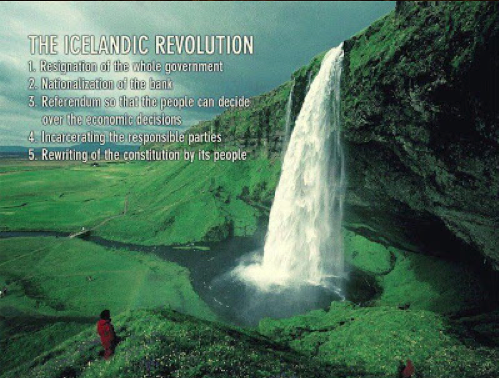
The man who forced the government of Iceland to resign and kicked out the IMF representatives from his country, Hordur Torfarson, is now teaching meta-modern democracy throughout Europe. The rest of the world would benefit from following the example set by Iceland: Arresting the corrupt bankers who are responsible for the current economic turmoil.

The true measure of the leader is not how many follower he has, but how many leaders he creates. Too many people hold the idea that psychopaths are essentially killers or convicts. The general public hasn’t been educated to see beyond the social stereotypes to understand that psychopaths can be entrepreneurs, politicians, CEOs and other successful individuals who may never see the inside of a prison. The difference between bankers and the mafia is becoming increasingly indistinguishable.

Control Your Money or Your Money Will Control You Change your attitude toward debt. Every time you use credit for a purchase think,“Debt is slavery; I am making myself a slave.”

“Manipulators rarely advise you to seek new and diverse information or to ‘learn and research for yourself,’ it tends to be safer for exploitative and irresponsible leaders to keep their citizens in the dark; in their view less independent thought is better. Independent thought leads to an inquiring mind, a mindset that eventually leads to the questioning of authority figures, and that is the one thing that inadequate leaders do not want.”

Governments have never existed to solve problems domestic or international. Governments and their institutions exist merely to further and secure the interests of favored groups, but We the People are never the favored group.

Source: Knowledge of Today

Fact Check: So who’s checking the fact-finders? | The Florida Times-Union & Jacksonville Times

Journalists have always been fact-checkers. Now, thanks to the Internet and social media, everyone has a soapbox, and everyone can send truths and untruths to hundreds of people with the push of a button. Spoofs and satires become gospel. Unpopular viewpoints and people are targeted.

To get at the truth, many news organizations now include fact-checking columns, like this one.

But the fact-checkers themselves are not free from criticism. More often than not, the criticism comes from the right because, with a Democrat in the White House, that’s where most of the viral criticism comes from. So most of the fact-checking is of those allegations. Fact-finding sources that appear in the Times-Union, however, pride themselves on being accurate – using original reporting, source-checking, corroborating research and well-documented reports from other fact-finding groups to get at the truth.

So how do we know if we’re getting the straight skinny?

When we use other sources, we corroborate results. If we can’t be certain about something, we say so. But we do rely on some fact-finders that repeatedly have come under fire.

SNOPES.COM

Snopes.com is at the top of that list. An email circulating since 2008 warns not to use Snopes.com because of its political leanings: “I have recently discovered that Snopes.com is owned by a flaming liberal and this man is in the tank for Obama. …”

Snopes.com is the oldest fact-finder on the Internet. It was well-respected for years when it fact-checked urban legends, such as whether more domestic abuse occurs on Super Bowl Sunday than on any other day. But when Snopes.com starting debunking rumors about candidate-then-President Barack Obama, it was roundly criticized.

Snopes.com is owned and run by David and Barbara Mikkelson of California, who have not hidden their identities as one of the viral email claims. Check out the list that shows this at www.snopes.com/info/articles.asp.

As far as being liberal, other fact-checkers, such as Truthorfiction.com; David Emery, who researches urban legends for the information website About.com; and FactCheck.org have researched Snopes.com and none has found any instance where the Mikkelsons have stated a political preference or affiliation.

Barbara Mikkelson is a Canadian citizen, so she can’t contribute to a political campaign or vote in U.S. elections. David Mikkelson provided his voter registration papers to FactCheck.org that show he registered as a Republican in 2000, and had no party affiliation in 2008.

A check of the donor list at the Center for Responsive Politics, which tracks campaign contributions (1990-2012), shows no contributions by Mikkelson to any candidate from any party. You can check yourself at www.opensecrets.org.

If there is proof that refutes this, or shows that the Mikkelsons are “flaming liberals,” no one has come up with it.

Truth be told, there are emails that present what they say is verifiable proof that Snopes.com is biased.

One viral email suggested that Elena Kagan was nominated to the Supreme Court because as solicitor general she fended off all the lawsuits challenging Obama’s eligibility to be president. Snopes.com was castigated for debunking the rumor, but all it did was look at the docket items cited by the email and found that not a single one was about Obama’s eligibility. A check of those dockets at www.supremecourt.gov confirms that.

Emery, who said he has looked at the texts about Obama forwarded to Snopes.com, states that he “has found no any evidence of advocacy for or against. To the contrary, I see a consistent effort to provide even-handed analyses. …”

FactCheck.org also fact-checked Snopes.com: “We reviewed a sampling of their political offerings, including some on rumors about George W. Bush, Sarah Palin and Barack Obama, and we found them [Snopes.com] to be utterly poker-faced.”

There have also been viral emails charging that Snopes.com is financed by business magnate and philanthropist George Soros. There have been no verifiable reports of a Soros connection, but Snopes.com’s books are not open for all to see, so we can’t say for absolutely certain.

Some of the emails disparaging Snopes.com cite that TruthorFiction.com is a much more reliable site. TruthorFiction.com lauds Snopes.com as an “excellent” and “authoritative” resource (www.truthorfiction.com/rumors/s/snopes.htm).

Although Snopes.com could do a better job of linking to sources within its stories, it does list its sources, so it is easy to confirm accuracy.

FACTCHECK.ORG

FactCheck.org is a nonpartisan fact-finding project of the Annenberg Public Policy Center at the University of Pennsylvania. It has been attacked as a leftist group in an email that says that Wallis Annenberg, president and CEO of the Annenberg Foundation, contributed $25,000 to the Democratic National Committee.

In March 2007, Wallis Annenberg did personally donate $25,000 to the Democratic Congressional Campaign Committee. This had nothing to do with FactCheck.org. And, according to the Federal Election Commission campaign contribution database (www.fec.gov), she has also given to numerous Republican campaigns.

Brooks Jackson, a journalist who launched FactCheck.org, told the Times-Union that the group’s charter stipulates nonpartisanship.

It is ironic that the viral emails charge FactCheck.org as being a leftist organization when philanthropist Walter Annenberg was a fervid Republican, as was his wife Leonore. But even so, the foundation has never influenced FactCheck.org one way or the other, Jackson said.

TRUTHORFICTION.COM

TruthorFiction.com was founded in 1999 by the late Rich Buhler, a Christian radio broadcaster, speaker, author and producer who researched and wrote about urban legends for more than 30 years, according to various media reports. Its staff researches the rumors; original sources are usually listed or linked, so it is a good site to corroborate facts.

POLITIFACT.COM

PolitiFact.com is a fact-finding project of the Tampa Bay Times (formerly The St. Petersburg Times) and has been assailed as a partisan member of the “liberal media.”

PolitiFact.com, which was awarded a Pulitzer Prize, examines statements by politicians and pundits and rates what they say on its Truth-O-Meter. The website also tracks promises by Obama and Republican leaders.

It is true that some of its reporters work for the Tampa Bay Times, a fact not lost on a website called PolitiFactbias.com, which exposes what it calls liberal bias by PolitiFact.com.

But PolitiFact.com uses strict journalistic standards, according to its mandate. Its reporters and researchers use original reports rather than news stories. When possible, PolitiFact.com uses original sources to verify the claims and interviews impartial experts.

These fact-finders all help to arrive at the truth. But we believe that confirming accuracy through multiple sources and original reporting is the best guarantee. And as Emery says:

“In the thorny search for truth, there’s no substitute for doing one’s own research and applying one’s own considered judgment before thinking oneself informed.”

Source: The Florida Times-Union & Jacksonville Times