Does the Constitution allow for a delayed presidential election? | National Constitution Center

votingboothgenericEditor’s Note: Due to the Democrats call for mail-in voting systems for the November 2020 election, there may be a significant delay in some states reporting verified results in a timely fashion. Here is what the U.S. constitution says about delays in the Presidential and Vice-Presidential elections and what would happen if there was a tie in the Electoral College on or before January 20, 2020. 

As America battles the COVID-19 virus, speculation has started that a prolonged public health crisis could delay or even postpone this year’s presidential election. So how would the Constitution deal with such an unusual situation?

In general, a combination of state or congressional actions could delay elections but not postpone the selection of a president and vice president. The only hard deadline spelled out in the Constitution is the end of a president’s term and a vice president’s term on January 20 of the year following a general election. (That same deadline applies regardless of term limits imposed on the president under the 22nd Amendment.)

The Constitution’s text requires that a group of electors, commonly called the Electoral College, chooses the next president. If a majority of electors fails to agree on a winner, Congress picks the winner in continent elections held within Congress under the terms of the 12th Amendment.

In Article II, Section 1, the Constitution requires two steps in the general election and Electoral College process.

First, the states (and the District of Columbia) are required to appoint members of the Electoral College. “Each State shall appoint, in such Manner as the Legislature thereof may direct, a Number of Electors, equal to the whole Number of Senators and Representatives to which the State may be entitled in the Congress: but no Senator or Representative, or Person holding an Office of Trust or Profit under the United States, shall be appointed an Elector.”

Then, Article II, Section 1 delegates the Electoral College deadlines to Congress: “The Congress may determine the Time of chusing [original spelling] the Electors, and the Day on which they shall give their Votes; which Day shall be the same throughout the United States.”

The Constitution’s 20th Amendment also requires the president and vice president to end their terms of office on January 20 at noon in the year following the general election.

In addition to those basic constitutional requirements, Congress by statute controls when electoral votes are counted at the states and at Congress. The current statute reads that “the electors of President and Vice President of each State shall meet and give their votes on the first Monday after the second Wednesday in December next following their appointment at such place in each State as the legislature of such State shall direct.” This year, that day is December 14, 2020.

Another part of the election law requires the states to send in their electoral votes to Congress by December 23, 2020. If electoral votes are not received by the fourth Wednesday in December, then the President of the Senate or the Archivist of the United States can use “the most expeditious method available” to get the votes sent to Congress. The electoral votes received by Congress are counted in a joint session at 1 p.m. on January 6. If a presidential or vice presidential candidate does not receive a majority of the electoral votes, the House selects the next president and the Senate selects the next vice president.

In the modern era, the states have used public elections to pick the winners of electoral votes in presidential elections. With the exceptions of Maine and Nebraska (which divide their electoral votes among districts), each state conducts winner-take-all contests, where the winner of the popular vote gets his or her slate of electors designated as their Electoral College representative. Each state legislature has a process for selecting the slate of electors that represents a candidate. The states and political parties work together on the presidential primary process. In some cases, disputes about that process are settled by the courts, with the most notable example being the Bush v. Gore ruling by the Supreme Court in December 2000.

Three opinions from the Congressional Research Service explain scenarios about the possible delays in the presidential election process. One report, released last month, indicates a state under its own laws could postpone the general election date that results in the selection of electors; in the election this year that date is Tuesday, November 3, 2020. At least 45 states have statutes that deal with election day emergencies, the CRS says.

What remains clear is that only the states and Congress have the power to delay that part of the election process. “Unlike the practice of some states that allow the Governor to postpone an election during emergencies, neither the Constitution nor Congress provides any similar power to the President or other federal officials to change this date outside of Congress’s regular legislative process,” the report says.

Congress also would have the power, by changing the appropriate statutes, to change the general election date and as well the dates electoral votes are received in Washington and counted in Congress. Such changes would require the consent of the House and the Senate and would be extraordinary since “the presidential election date has never been changed in response to an emergency,” the CRS concluded.

In 2004, the CRS also looked at the various scenarios of a delayed presidential election in the aftermath of the 9/11 terrorist attacks. It determined Congress could by statute delegate some of its electoral process powers to the Executive Branch in emergency situations. “While the Executive Branch has significant delegated authority regarding some aspects of election law, this authority does not currently extend to setting or changing the times of elections,” the CRS said.

But Congress does not have the power to delay elections without a deadline, the CRS reasoned. “Congress could not postpone elections indefinitely, as the Constitution requires that Members of the House of Representatives shall be chosen ‘every second year’ (under Article I, Section 2) and Senators shall be chosen for terms of ‘six years’ (under the 17th Amendment).

A separate CRS study from October 2004 evaluated scenarios of election delays for the Presidency and Congress due to catastrophic events such as “peril to life and extensive damage to infrastructure.” While a delay could be needed, the requirement to elect a president and vice president still existed: “Congress would tend to accept the delay, so long as the rescheduled elections were held before the date in December when the Electoral College casts its ballots, and the beginning of the next Congress, respectively.”

And, in conjunction with the presidential election, a new Congress also needs to be in place on January 3 following the general election under the 20th Amendment. That new Congress would select a president and a vice president if the Electoral College voters do not agree on a majority winner for each office.

Absent a clear winner of the presidential election on January 20, the Speaker of the House would serve as Acting President under the current succession law. The 20th Amendment requires that the duly elected president and vice president assume their positions at some point. “Congress may by law provide for the case wherein neither a President elect nor a Vice President shall have qualified, declaring who shall then act as President, or the manner in which one who is to act shall be selected, and such person shall act accordingly until a President or Vice President shall have qualified.”

Source: National Constitution Center

Inaccurate Virus Models Are Panicking Officials Into Ill-Advised Lockdowns | The Federalist

InaccurateBy Madeline Osburn

Editor’s Note: Just when we thought it couldn’t get any worse, as it turns out this COVID-19 crisis has been manufactured in part (not the disease mind you, but the rapid response) by a few behind the scenes organizations which just happen to have Democrat activists at the forefront. Impeachment didn’t work to eradicate Trump, so let’s take advantage of an alleged pandemic to drive down the economy and put the blame on him (so he won’t get reelected). Read this article and weep.

How a handful of Democratic activists created alarming, but bogus data sets to scare local and state officials into making rash, economy-killing mandates.

As U.S. state and local officials halt the economy and quarantine their communities over the Wuhan virus crisis, one would hope our leaders were making such major decisions based on well-sourced data and statistical analysis. That is not the case.

A scan of statements made by media, state governors, local leaders, county judges, and more show many relying on the same source, an online mapping tool called COVID Act Now. The website says it is “built to enable political leaders to quickly make decisions in their Coronavirus response informed by best available data and modeling.”

An interactive map provides users a catastrophic forecast for each state, should they wait to implement COVID Act Now’s suggested strict measures to “flatten the curve.” But a closer look at how many of COVID Act Now’s predictions have already fallen short, and how they became a ubiquitous resource across the country overnight, suggests something more sinister.

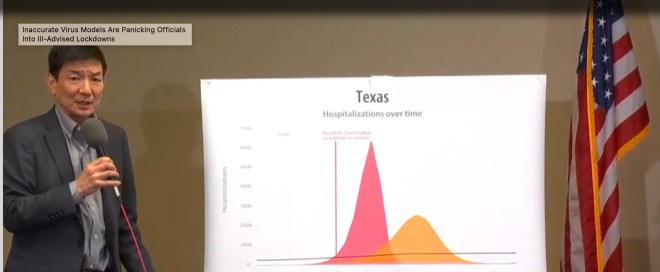
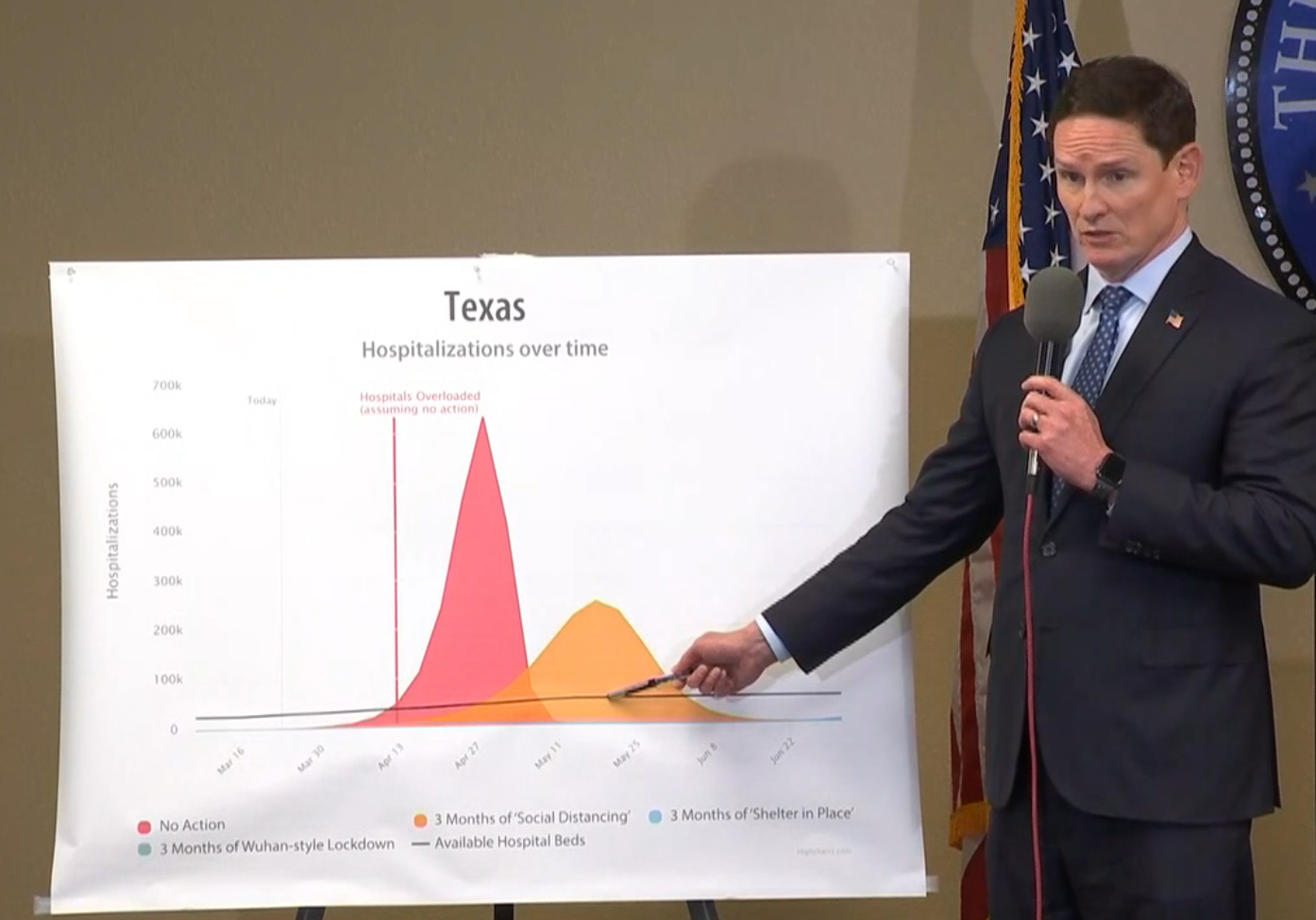
When Dallas County Judge Clay Jenkins announced a shelter-in-place order on Dallas County Sunday, he displayed COVID Act Now graphs with predictive outcomes after three months if certain drastic measures are taken. The NBC Dallas affiliate also embedded the COVID Act Now models in their story on the mandate.

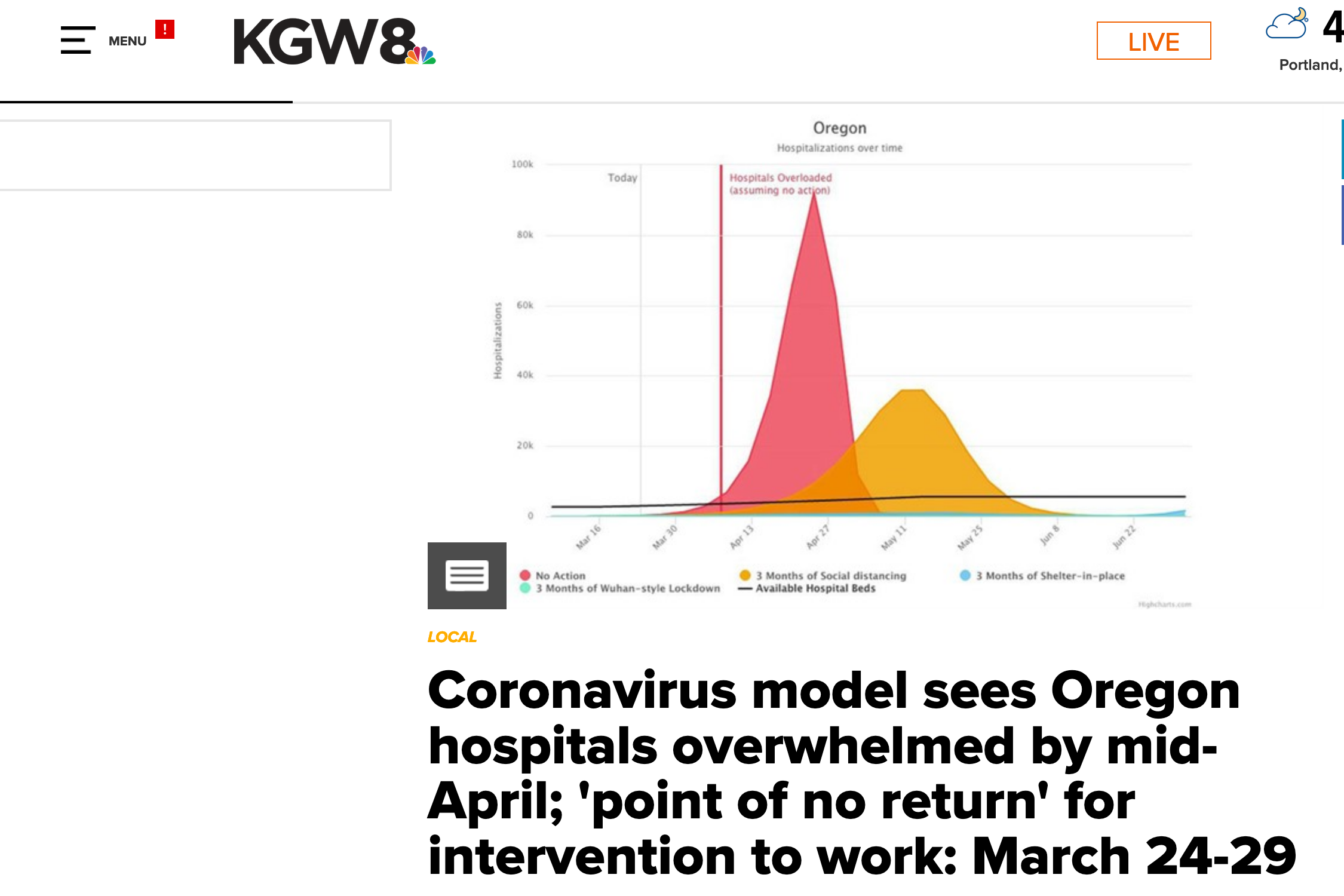
The headline of an NBC Oregon affiliate featured COVID Act Now data, and a headline blaring, “Coronavirus model sees Oregon hospitals overwhelmed by mid-April.” Both The Oregonian and The East Oregonian also published stories featuring the widely shared data predicting a “point of no return.”

Michigan Gov. Gretchen Whitmer cited COVID Act Now when telling her state they would exceed 7 million cases in Michigan, with 1 million hospitalized and 460,000 deaths if the state did nothing.

A local CBS report in Georgia featured an Emory University professor urging Gov. Brian Kemp with the same “point of no return” language and COVID Act Now models.

Carlos del Rio

@CarlosdelRio7

We need ⁦@GovKemp⁩ to act now, the point of “no return” for GA is rapidly closing. To prevent a catastrophe in the healthcare system due to we need for him to shut down GA now. ⁦@drmt⁩ ⁦⁦@Armstrws⁩ ⁦@colleenkraftmdhttps://covidactnow.org/state/GA 

This model predicts the last day each state can act before the point of no return

The only thing that matters right now is the speed of your response

covidactnow.org

The models are being shared across social media, news reports, and finding their way into officials’ daily decisions, which is concerning because COVID Act Now’s predictions have already been proven to be wildly wrong.

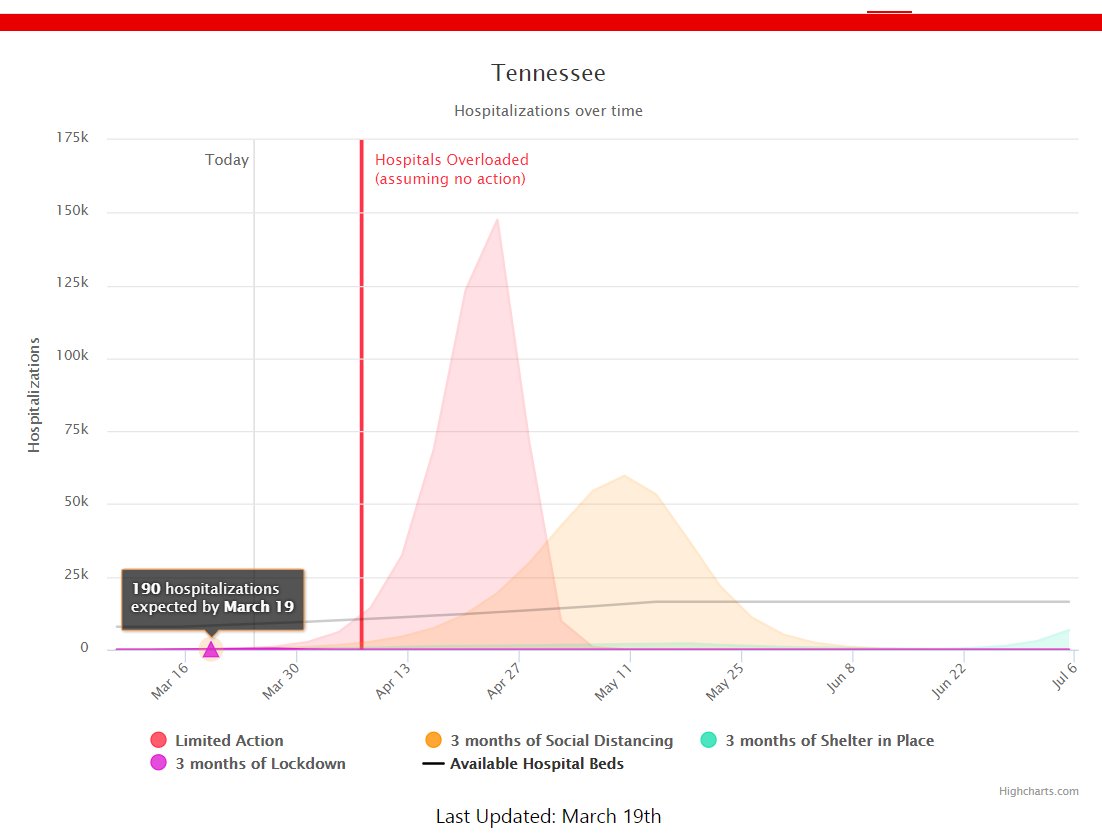
COVID Act Now predicted that by March 19 the state of Tennessee could expect 190 hospitalizations of patients with confirmed Wuhan virus. By March 19, they only had 15 patients hospitalized.

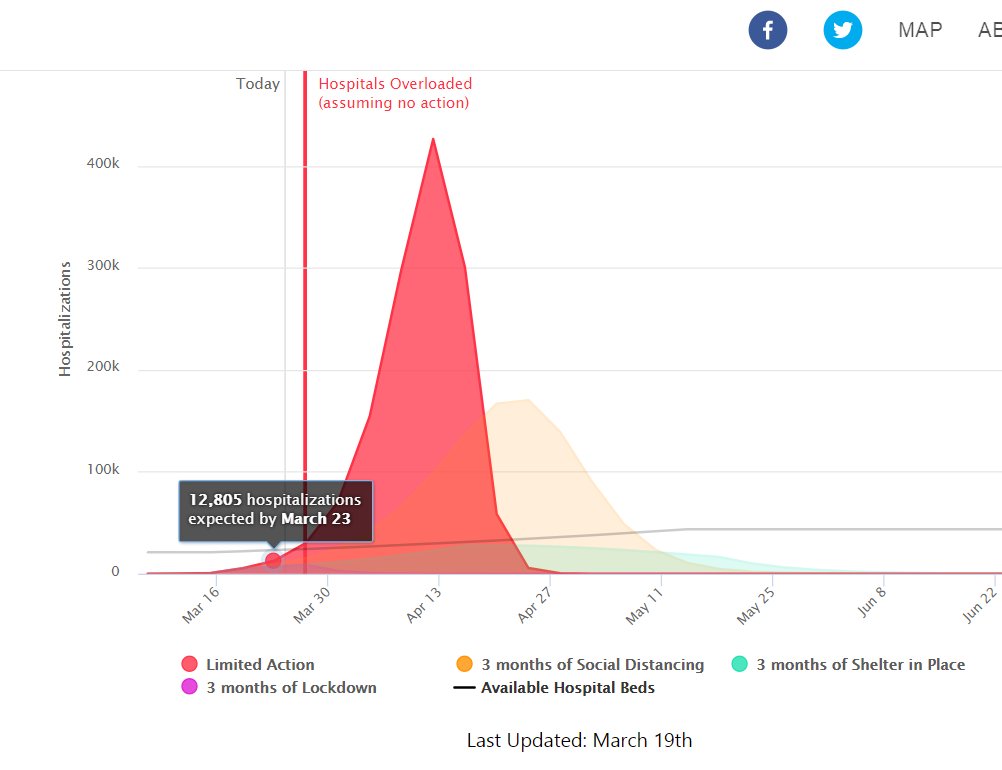
In New York, Covid Act Now claimed nearly 5,400 New Yorkers would’ve been hospitalized by March 19. The actual number of hospitalizations is around 750. The site also claimed nearly 13,000 New York hospitalizations by March 23. The actual number was around 2,500.

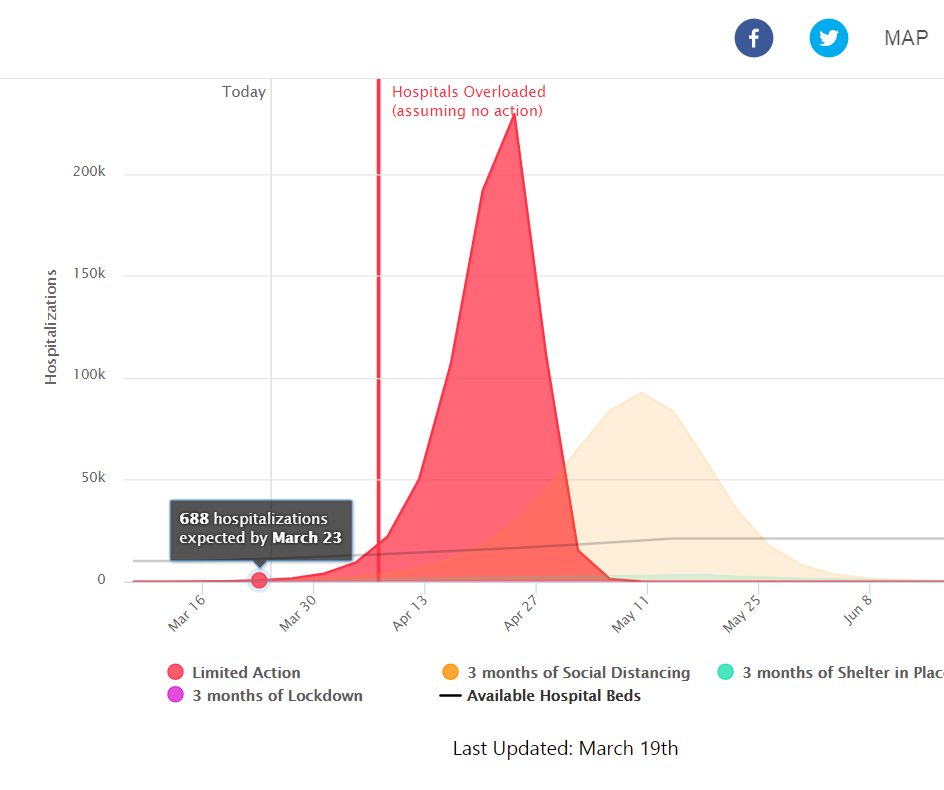
In Georgia, COVID Act Now predicted 688 hospitalizations by March 23. By that date, they had around 800 confirmed cases in the whole state, and fewer than 300 hospitalized.

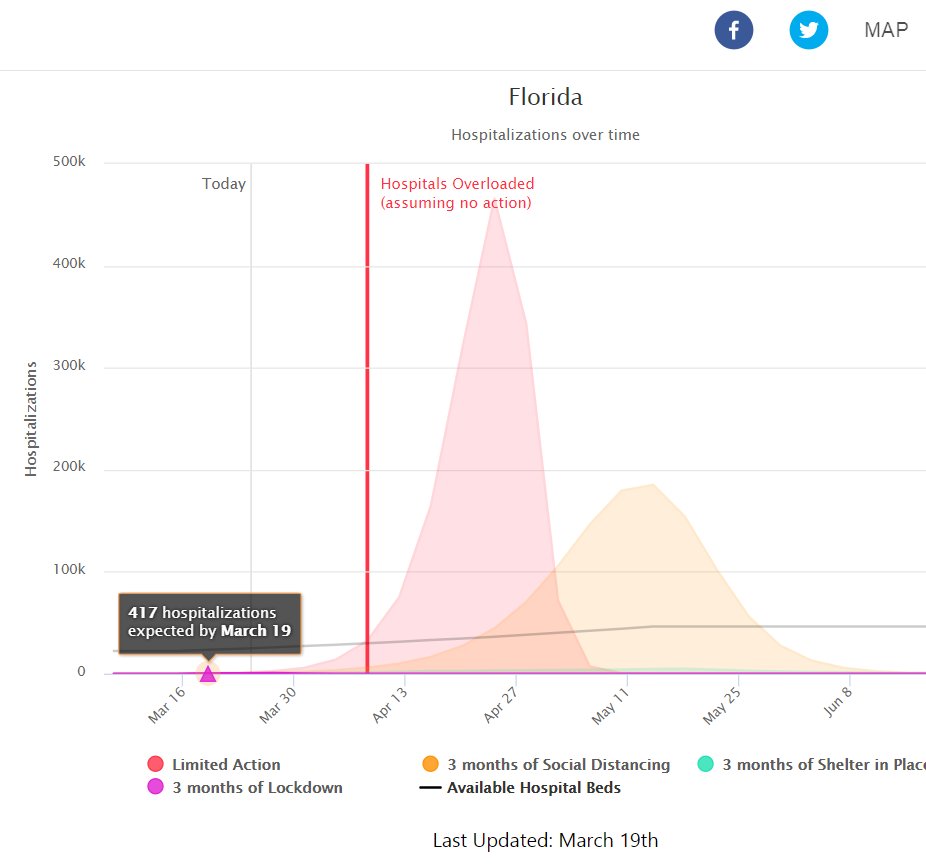
In Florida, Covid Act Now predicted that by March 19, the state would face 400 hospitalizations. On March 19, Gov. Ron DeSantis said 90 people in Florida had been hospitalized.

COVID Act Now’s models in other states, including Oklahoma and Virginia, were also far off in their predictions. Jordan Schachtel, a national security writer, said COVID Act Now’s modeling comes from one team based at Imperial College London that is not only highly scrutinized, but has a track record of bad predictions.

Jordan Schachtel

@JordanSchachtel

4) Their models come 100% from Imperial College UK projection that is coming under *heavy* scrutiny from scientific community. IC UK produced the famed doomsday scenario that guaranteed 2MM dead Americans. The man behind the projections is refusing to make his code public.

Jessica Hamzelou at New Scientist notes the systematic errors researchers and scientists have found with the modeling COVID Act Now relies on:

Chen Shen at the New England Complex Systems Institute, a research group in Cambridge, Massachusetts, and his colleagues argue that the Imperial team’s model is flawed, and contains ‘incorrect assumptions’. They point out that the Imperial team’s model doesn’t account for the availability of tests, or the possibility of ‘super-spreader events’ at gatherings, and has other issues.

Among other issues, COVID Act Now lists the “Known Limitations” of their model. Here are a few that seem especially alarming, considering they generate a model for each individual state:

Many of the inputs into this model (hospitalization rate, hospitalization rate) are based on early estimates that are likely to be wrong.

Demographics, populations, and hospital bed counts are outdated. Demographics for the USA as a whole are used, rather than specific to each state.

The model does not adjust for the population density, culturally-determined interaction frequency and closeness, humidity, temperature, etc in calculating R0.

This is not a node-based analysis, and thus assumes everyone spreads the disease at the same rate. In practice, there are some folks who are ‘super-spreaders,’ and others who are almost isolated.

So why is the organization or seemingly innocent online mapping tool using inaccurate algorithms to scaremonger leaders into tanking the economy? Politics, of course.

Founders of the site include Democratic Rep. Jonathan Kreiss-Tomkins and three Silicon Valley tech workers and Democratic activists — Zachary Rosen, Max Henderson, and Igor Kofman — who are all also donors to various Democratic campaigns and political organizations since 2016. Henderson and Kofman donated to the Hillary Clinton campaign in 2016, while Rosen donated to the Democratic National Committee, recently resigned Democratic Rep. Katie Hill, and other Democratic candidates. Prior to building the COVID Act Now website, Kofman created an online game designed to raise $1 million for the eventual 2020 Democratic candidate and defeat President Trump. The game’s website is now defunct.

Perhaps the goal of COVID Act Now was never to provide accurate information, but to scare citizens and government officials into to implementing rash and draconian measures. The creators even admit as much with the caveat that “this model is designed to drive fast action, not predict the future.”

They generated this model under the guise of protecting communities from overrun hospitals, a trend that is not on track to happen as they predicted. Not only is the data false, and looking more incorrect with each passing day, but the website is optimized for a disinformation campaign.

A social media share button prompts users to share their models and alarming graphs on Facebook and Twitter with the auto-fill text, “This is the point of no return for intervention to prevent X’s hospital system from being overloaded by Coronavirus.

The daunting phrase, the “point of no return,” is the same talking point being repeated by government officials justifying their shelter-in-place orders and filling local news headlines.

Democrats are not going to waste such a rich political opportunity as a global pandemic. Americans already witnessed Speaker of the House Nancy Pelosi and House Democrats attempt to take advantage of an economic recession with a pipe-dream relief bill this week. Projects like COVID Act Now are another attempt to play the same political games, but with help from unknown, behind-the-scenes Democratic activists instead.

Our community leaders, the mayors and the city councils, deserve better than to be swindled by a handful Silicon Valley tech bros. Our governors and state officials deserve better data and analysis than a Democratic activists’ model that doesn’t adjust for important geographical factors like population density or temperature. Americans and their families deserve better than to be jobless, hopeless, and quarantined because of a single website’s inaccurate and hyperbolic hospitalization models.

Madeline Osburn is a staff editor at the Federalist and the producer of The Federalist Radio Hour. Follow her on Twitter.

2016 United States presidential election | Wikipedia

Editor’s Note: Despite the liberal media dominating the leftist narrative and the Democrats leading the charge in the impeachment inquiry, it seems the tables are turning positively towards reclaiming and restoring the Republic and the principles that once made America great. Since the impeachment inquiry began In September 2019 Trump’s twitter numbers have increased from 62.5 million to 66.6 million in little over a month. Polls have shown between a 50% overall support for the Trump Administration. The Republican Party has raised $305 million in this last quarter towards Trump’s reelection bid. Over 95% of Republicans stand behind Trump and his policies. What is also outstanding is how these numbers are comparable to the 2016 election results with the popular vote of 62,984,828, electoral vote of 304 with 30 states carried.

The 2016 United States presidential election was the 58th quadrennial American presidential election, held on Tuesday, November 8, 2016. The Republican ticket of businessman Donald Trump and Indiana Governor Mike Pence defeated the Democratic ticket of former Secretary of StateHillary Clinton and U.S. Senator from Virginia Tim Kaine, despite losing the popular vote.[2] Trump took office as the 45th president, and Pence as the 48th vice president, on January 20, 2017.

Trump emerged as the front-runner amidst a wide field of Republican primary candidates, while Clinton defeated Senator Bernie Sanders and became the first female presidential nominee of a major American party. Trump’s populist, nationalist campaign, which promised to “Make America Great Again” and opposed political correctness, illegal immigration, and many free-trade agreements,[3] garnered extensive free media coverage.[4][5] Clinton emphasized her extensive political experience, denounced Trump and many of his supporters as bigots, and advocated the expansion of President Obama’s policies; racial, LGBT, and women’s rights; and “inclusive capitalism“.[6] The tone of the general election campaign was widely characterized as divisive and negative.[7][8][9] Trump faced controversy over his views on race and immigration, incidents of violence against protestors at his rallies,[10][11][12] and his alleged sexual misconduct, while Clinton’s campaign was undermined by declining approval ratings[13] due to concerns about her ethics and trustworthiness,[14] and an FBI investigation of her improper use of a private email server, which received more media coverage than any other topic during the campaign.[15][16]

Clinton led in nearly every pre-election nationwide poll and in most swing state polls, leading some commentators to compare Trump’s victory to that of Harry S. Truman in 1948 as one of the greatest political upsets in modern U.S. history.[17][18] While Clinton received 2.87 million more votes than Trump did (the largest margin ever for a losing presidential candidate),[19] Trump received a majority of electoral votes and won upset victories in the pivotal Rust Belt region. Trump won six states that Democrat Barack Obama had won in 2012: Florida, Iowa, Michigan, Ohio, Pennsylvania, and Wisconsin.[20] Ultimately, Trump received 304 electoral votes and Clinton garnered 227, as two faithless electors defected from Trump and five defected from Clinton. Trump is the fifth person in U.S. history to become president while losing the nationwide popular vote.[b] He is the first president with neither prior public service nor military experience, and the oldest person to be inaugurated for a first presidential term.

The United States government’s intelligence agencies concluded on January 6, 2017, that the Russian government had interfered in the 2016 elections[22][23][24] in order to “undermine public faith in the U.S. democratic process, denigrate Secretary Clinton, and harm her electability and potential presidency”.[25] A Special Counsel investigation of alleged collusion between Russia and the Trump campaign began in May 2017[26][27]and ended in March 2019. The investigation concluded that Russian interference to favor Trump’s candidacy occurred “in sweeping and systematic fashion”, but “did not establish that members of the Trump campaign conspired or coordinated with the Russian government”.[28]

Source: Wikipedia

House to Vote This Week on Impeachment Inquiry, Says Pelosi | The Epoch Times

The House is slated to vote this week on the impeachment inquiry into President Donald Trump, top Democrats have said.

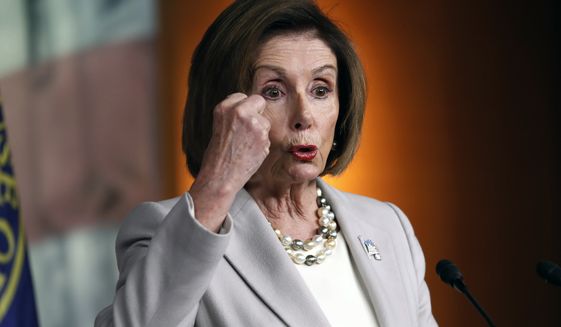
Speaker Nancy Pelosi (D-Calif.) said Monday that “we will bring a resolution to the Floor that affirms the ongoing, existing investigation that is currently being conducted by our committees as part of this impeachment inquiry, including all requests for documents, subpoenas for records and testimony, and any other investigative steps previously taken or to be taken as part of this investigation.”

Rep. Jim McGovern (D-Mass.), the chairman of the House Rules Committee, said on Monday that he will introduce a resolution to “ensure transparency” and “provide a clear path forward” in the inquiry.

According to the House Rules Committee’s website, a meeting will be held Wednesday “directing certain committees to continue their ongoing investigations as part of the existing House of Representatives inquiry into whether sufficient grounds exist for the House of Representatives to exercise its Constitutional power to impeach Donald John Trump, President of the United States of America, and for other purposes.”

McGovern, meanwhile, said that he plans on introducing it on Tuesday, according to a statement, as reported by CBS News.

It will be the first, formal vote on the impeachment process after House Speaker Nancy Pelosi (D-Calif.) announced the inquiry in September.

Republicans and the Trump administration have called for the House Democrats to hold a vote on the inquiry.

“As committees continue to gather evidence and prepare to present their findings, I will be introducing a resolution to ensure transparency and provide a clear path forward,” McGovern said in a statement. “This is the right thing to do for the institution and the American people.”

At the same time, Republicans have criticized the way in which Democrats have conducted the investigation, saying they are being held in secret while leaking information about them to the media. Last week, a coalition of GOP lawmakers entered a closed-door meeting that was being held by House Intelligence Chairman Adam Schiff (D-Calif.).

“We are taking this step to eliminate any doubt as to whether the Trump Administration may withhold documents, prevent witness testimony, disregard duly authorized subpoenas, or continue obstructing the House of Representatives,” said Pelosi in the statement.

Source: The Epoch Times


Senate Resolution Urges Formal House Vote on Initiating Impeachment Inquiry | The Epoch Times

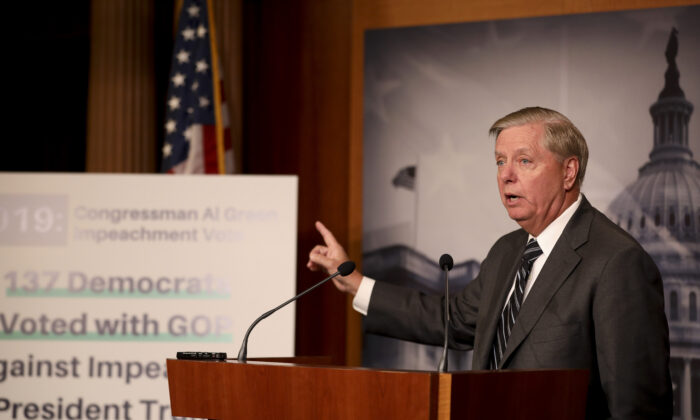
Sen. Lindsey Graham (R-S.C.) holds a press conference about the House impeachment inquiry process, on Capitol Hill in Washington on Oct. 24, 2019. (Charlotte Cuthbertson/The Epoch Times)

Editor’s Note: We the People are witnessing an attempted coup d’tat of our United States government in broad daylight and this impeachment inquiry is a smokescreen, a distraction, a false narrative and coverup orchestrated by the many co-conspirators who before Trump was elected in 2016 decided to manufacture a false accusation re: Russian collusion to discredit him. These “enemies of the state” decided that should Trump be elected that they would take it into their own hands to overthrow a duly elected President of the United States. If you are one of the many naive American’s who actually believe what you read in the mainstream, corporate newspapers and are not savvy enough to understand the hidden powers that pull the strings behind the curtain of the U.S. Congress, then shame on you. Wake Up America before it’s too late!

Sen. Lindsey Graham (R-S.C.) introduced a non-binding resolution on Oct. 24 calling on House Democrats to hold a formal vote on initiating an impeachment inquiry before moving any further in the investigation of President Donald Trump.

Thirty-five Republican senators co-sponsored the resolution, which also demands that the impeachment inquiry accommodate Trump with constitutional due-process protections. By early evening on Oct. 24, the number of co-sponsors had reached 46.

“The House of Representatives is abandoning more than a century’s worth of precedent and tradition in impeachment proceedings and denying President Trump basic fairness and due process accorded every American,” the resolution (pdf) states.

“One of the cornerstones of the American Constitution is due process: the right to confront your accuser, call witnesses on your behalf, and challenge the accusations against you.”

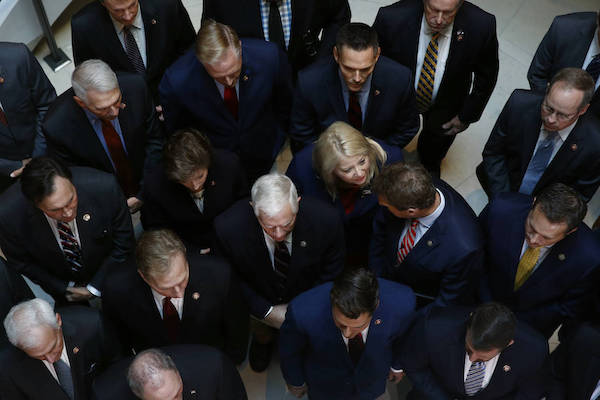
Senate Republicans unveiled the resolution one day after roughly three dozen House Republicans stormed a hearing room during a House Intelligence Committee impeachment deposition to demand that the closed-door hearings be opened to lawmakers and the public.

The resolution points out that during the three prior impeachment proceedings, the House held a formal vote to initiate an impeachment inquiry. In Trump’s case, the process was replaced by a press conference by House Speaker Nancy Pelosi (D-Calif.), the Republicans charge.

“The proposition that the Speaker acting alone may direct committees to initiate impeachment proceedings without any debate or a vote on the House floor is unprecedented and undemocratic,” the resolution states.

Prior impeachment proceedings allowed the presidents to have counsel present at hearings and depositions, according to the resolution. In each case, the presidents’ lawyers were allowed to introduce and object to evidence and call on and cross-examine witnesses.

“By contrast, the House’s current impeachment ‘inquiry’ provides none of these basic rights and protections to President Trump,” the co-sponsors say. “The main allegations against President Trump are based on assertions and testimony from witnesses whom he is unable to confront, as part of a process in which he is not able to offer witnesses in his defense or have a basic understanding of the allegations lodged against him.”

House Democrats are investigating allegations related to President Donald Trump’s phone call with Ukrainian President Volodymyr Zelensky. During the conversation on July 25, Trump asked Zelensky to look into two matters. The first request concerned a server tied to Crowdstrike, the cybersecurity firm that analyzed the Democratic National Committee server allegedly breached by Russian government hackers. The second request concerned allegations of corruption by former vice president Joe Biden and his son Hunter Biden.

The Democrats have conducted all of the hearings to date behind closed doors. The public’s access to the information has so far been limited to leaks to the media and a handful of documents published by the committees.

The Democrats have defended the process, claiming that lawmakers in prior impeachment proceedings worked from material collected through an investigation by a special counsel. Meanwhile, the lawmakers took up the current case without letting a special counsel conduct an inquiry. As a result, the process requires secrecy so that witnesses don’t adjust their testimony.

The constant leaks from the inquiry have undermined the advantages gained through secret proceedings. Republicans say they don’t have access to transcripts of the depositions. Meanwhile, leaked information seems to consist almost entirely of sections of testimony damaging to Trump.

The minority Republicans on the three committees conducting the impeachment inquiry don’t have the same rights as those that were granted to the minority Democrats during the House impeachment inquiry of President Bill Clinton, including the ability to issue subpoenas. The resolution calls on the Democrats to follow precedent and grant Republicans the same rights.

“We’re not telling the House they can’t impeach the president. What we’re telling the House is, there’s a right way to do it, and a wrong way to do it,” Graham told reporters. “This is one part legal, and two parts politics.”

The White House has refused to cooperate with the impeachment inquiry unless the Democrats hold a vote to formally launch the inquiry. The president has denied any wrongdoing in his call with Zelensky. The Ukrainian leader said he wasn’t pressured during the phone call.

Trump on Oct. 23 criticized the impeachment inquiry along lines similar to the Senate resolution.

“Do Nothing Democrats allow Republicans Zero Representation, Zero due process, and Zero Transparency,” the president wrote on Twitter. “Does anybody think this is fair?”

The Democrats allege that in order to pressure Zelensky, Trump placed a temporary hold on military aid to Ukraine. All of the witnesses who have testified to date say that Ukrainian officials were unaware of the hold until one month after the Trump–Zelensky phone call.

Source: The Epoch Times

GOP Members Storm Closed Door House Session | Trending Politics

Editor’s. Note: An impeachment process must be transparent, open and factual. There’s something terribly wrong and one-sided if Republicans are not allowed to participate in the inquiry. 

On Wednesday, GOP members made the move to storm a closed door impeachment session, forcing far-left Rep. Adam Schiff to suspend the meeting and run from the scene.

Democrats have made the ongoing impeachment inquiry as secret as possible, offering no public transparency.

During a press conference before storming the hearing, Rep. Matt Gaetz (R-FL) said: “We’re going to try and go in there, and we’re going to try to figure out what’s going on, on behalf of the millions of Americans that we represent that want to see this Congress working for them and not obsess with attacking a president who we believe has not done anything to deserve impeachment.”

House Minority Whip Steve Scalise also spoke out: “What is Adam Schiff trying to hide? I think that’s the question so many people have, so many of my colleagues have, so many people in the press should have.”

“Voting members of Congress are being denied access from being able to see what’s happening behind these closed doors where they’re trying to impeach the president of the United States with a one-sided set of rules,” Scalise continued. “They call the witnesses. They don’t let anybody else call the witnesses.”

“We’re gonna’ go and see if we can get inside,” Gaetz added.

It was then when the 30 Republicans stormed the closed-door hearing, forcing Schiff to run out and hide.

“He doesn’t have the guts to come talk to us,” Rep. Roger Marshall said. “He left, he just got up and left. He doesn’t have the guts to tell us why we can’t come in the room, why he doesn’t want this to be transparent. It’s the biggest facade, biggest farce of my life.”

Rep. Bradley Byrne too to Twitter saying: “Adam Schiff just SHUT DOWN his secret underground impeachment hearing after I led a group of Republicans into the room. Now he’s threatening me with an Ethics complaint! I’m on the Armed Services Cmte but being blocked from the Dept. Asst. SecDef’s testimony. This is a SHAM!” he wrote.

Republicans are clearly upset with the lack of transparency from Schiff and the rest of the Democrats. Gaetz has tried to attend the meetings however “he could not attend because he is not part of the House Intelligence Committee, which is conducting the investigation along with the House Oversight and Foreign Affairs Committees,” Fox New reported.

“Judiciary Chairman [Jerry Nadler] claimed to have begun the impeachment inquiry weeks ago,” Gaetz previously said. “Now, his own Judiciary members aren’t even allowed to participate in it. And yes — my constituents want me actively involved in stopping the #KangarooCourtCoup run by Shifty Schiff.”

House Democrats defended Schiff, saying that Schiff was in the right.

“I guess when you’re desperate you go back to complaining about the process, and that’s what they’re doing,” said Rep. Val Demings said.

“I think it’s completely inappropriate. I think when the facts are against you, the law is against you, the President apparently committed a crime, you are left with arguing process, and that’s what they’re arguing,” Rep. Harley Rouda (D-CA) said.

“We’re embarrassing ourselves in front of company,” said Rep. Mike Quigley of the House Intelligence Committee.

Source: Trending Politics

Former House lawyer says Pelosi’s impeachment inquiry ‘is illegal’ | The Washington Times

Editor’s Note: The House Permanent Select Committee on Intelligence led by Rep. Adam B. Schiff is not authorized under the rules to lead an impeachment probe. Under H.Res 658 established by the 95th Congress (1977- 78), this Select Committee has oversight over the activities of the CIA and has no jurisdiction to conduct an impeachment inquiry against the President of the USA.

Thanks to a flurry of Ukraine activity, House Speaker Nancy Pelosi and her Democratic majority have approved more subpoenas to investigate President Trump than they have written laws.

The subpoena issued Tuesday morning to former Ambassador William Taylor marked the 56th that has been publicly acknowledged and aimed at Mr. Trump and his team. That is 10 more than the 46 House bills that have become law this year.

It’s far from a subpoena record, but it is complicating Mrs. Pelosi’s attempt to portray her troops as focused on their agenda.

Perhaps more worrying to Mrs. Pelosi’s cause is the conclusion of a former senior oversight attorney for the House, who said the spate of subpoenas issued this month as part of Democrats’ impeachment inquiry is illegal.

Samuel Dewey, a lawyer at McDermott Will & Emery who used to lead investigations for the House Financial Services Committee, said the House Permanent Select Committee on Intelligence, led by Rep. Adam B. Schiff of California, is not authorized under the rules to lead an impeachment probe.

“Unless there’s a bunch of stuff that’s not public, which would in itself be extraordinary, there is no way he has jurisdiction to conduct an impeachment inquiry. I think his proceeding is illegal,” Mr. Dewey said.

Mr. Schiff’s impeachment inquiry subpoenas have all centered around Mr. Trump’s attempts to rope Ukraine into investigating a potential political opponent, former Vice President Joseph R. Biden. The Washington Times counts 15 publicly acknowledged subpoenas issued on the Ukraine matter so far, including the one Tuesday to Mr. Taylor.

The House also has approved 22 subpoenas related to special counsel Robert Mueller’s investigation into Russian meddling and Trump campaign behavior in 2016, seven subpoenas dealing with the president’s finances, three concerning White House matters such as security clearances or the activities of Trump aide Kellyanne Conway, five subpoenas over immigration policy, three over Mr. Trump’s now-abandoned attempt to ask about citizenship on the 2020 census, and one subpoena to the State Department over U.S. policy in Afghanistan.

Those are publicly acknowledged subpoenas that have been approved or for which chairmen have given notice. Other subpoenas may have been sent in secret, which would mean the ratio of subpoenas to bills could be even higher.

“This is becoming a do-nothing Congress, and it will ultimately cost them the majority in 2020,” said Corey Lewandowski, a confidant of Mr. Trump and the target of one of the 56 subpoenas, sent in August.

Mr. Lewandowski questioned the way Democrats went about calling him. He said it seemed more about confrontation than getting information.

His subpoena was issued even though his attorney told the House Judiciary Committee that he was willing to testify voluntarily — as he had already done for two other committees. But Chairman Jerrold Nadler of New York issued a subpoena anyway. Mr. Lewandowski said he learned about it first from a reporter, hours before his own attorney received notice from the committee.

“Perhaps they wanted to make it a media story,” he said. “I think that the hearing itself was for show.”

He pointed out that the subpoena was issued the same day Mr. Trump was traveling to New Hampshire, where he all but endorsed a potential U.S. Senate bid for Mr. Lewandowski.

He also said the committee treated him differently than Mr. Mueller, who, unlike Mr. Lewandowski, demanded to be subpoenaed.

When during his July hearing a lawmaker asked Mr. Mueller to read parts of his report and he declined, the committee accepted that. When Mr. Lewandowski was asked and tried to decline, he was castigated.

“I just wanted to be treated the same,” he said. “I don’t think they did that.”

Mr. Lewandowski said he doesn’t question the legality of his subpoena. By that point, Mr. Nadler was arguing to the courts that he was engaged in an impeachment inquiry and had received his committee’s approval for 18 subpoenas related to the Russia investigation.

That probe petered out after Mr. Lewandowski’s testimony.

Now the focus is on Ukraine, and Mr. Nadler’s committee has been sidelined.

The Washington Times reached out to staff for Mr. Nadler’s committee and three others responsible for almost all of the subpoenas. None of them responded.

But Rep. Gerald E. Connolly, a Virginia Democrat and senior member of the Oversight and Reform Committee, challenged The Times’ comparison of laws to subpoenas. He said the House can issue the subpoenas on its own but needs cooperation from the Republican-led Senate and Mr. Trump to write legislation.

He said Senate Majority Leader Mitch McConnell, Kentucky Republican, is refusing to pass Democrats’ bills, hurting their legislative record.

“Something becomes law when both parties vote for it. And we’ve passed easily 100 pieces of legislation waiting at the grim reaper’s — Mitch McConnell — desk,” he said. “We’ve got at least 100 more ready to go. They won’t bring it up.”

The House is on a good pace with 46 bills signed into law. Eight years ago, when Democrats controlled the White House and Senate and Republicans led the lower chamber, the House had written 32 bills signed into law at this point.

In 1995, when Republicans took both houses of Congress under a Democratic president, just 23 House bills were signed into law by this point.

Mrs. Pelosi’s tally this year is inflated by nine ceremonial pieces of legislation, such as renaming post offices. Even among the substantive bills, many are tweaks or extensions to current law, leaving few marquee accomplishments.

Mr. Connolly said whatever the ratio, the House is well behind Republicans in terms of subpoena records. When Republicans controlled the House and Barack Obama was in the White House, he said, the Oversight and Government Reform Committee alone fired off “well over 100 subpoenas.”

During the 1990s, when President Clinton was in office, Rep. Dan Burton sent out more than 1,000, including one notorious incident in which he sent a subpoena to the wrong person because he confused two people with similar Asian surnames.

But Rep. Jim Jordan of Ohio, the top Republican on the oversight committee, said the subpoena numbers summed up Mrs. Pelosi’s tenure.

“We’ve been saying this. When the Democrats are completely focused on attacking the president, it’s tough to do what’s best for the country,” he told The Times.

Mr. Dewey, the former House attorney, indicated that Democrats have been more publicly confrontational in their approach to subpoenas than past congresses.

He said his own usual approach was to make a voluntary request to a target for documents or testimony and try to reach accommodations with those who resisted. Only after that failed would a subpoena be necessary, he said. He also said he worked with his counterparts in the other party, notifying them when subpoenas were issued.

“Honestly, if you’re cutting corners on procedure, my experience is you’re hiding something or you’re just lazy,” he said.

Mr. Dewey said Democrats could face a legal challenge over any impeachment-related subpoenas because the House has yet to vote to authorize an inquiry. Mrs. Pelosi created an inquiry by proclamation, turning the reins over to Mr. Schiff. Mr. Nadler, meanwhile, has argued to the courts that he has been in the midst of an inquiry for months.

Mr. Dewey said those arguments aren’t frivolous, but “I think they’re wrong.”

“I do not think as a matter of law that the Judiciary Committee can exercise the impeachment power without a vote of the full House,” he said. “And I think independently of that, I do not think any other committee can exercise the impeachment power.”

He said that could be an argument Mr. Trump’s team could make to defy some of the impeachment inquiry’s demands.

“It’s the defense to a subpoena,” he said. “I think that you would have a way to challenge it.”

Source: The Washington Times

Final Note: The committee oversees all or part of the following executive branch departments and agencies:

Trump’s Error-filled Cabinet Meeting | FactCheck.org

By , , , and

For more than an hour, President Donald Trump presided over a cabinet meeting, reeling off numerous false or misleading claims:

  • Trump claimed, without evidence, that President Barack Obama tried to call North Korean leader Kim Jong Un “11 times” but that “the man on the other side … did not take his call” due to a “lack of respect.” Obama’s national security adviser and deputy national security adviser both called Trump’s claim false.
  • Trump took credit for making a “deal” between Turkey and the Syrian Kurds that he said “people have been trying to make” for years. One expert called this claim “nonsense.” The deal is only a five-day pause in the conflict that arose when Trump pulled U.S. troops from the Syria-Turkey border.
  • The president boasted that “nobody has ever done” a National Prescription Drug Take Back Day until he took office. In fact, it started in 2010.
  • He wrongly claimed that “many” of the “ambassadors” House Democrats are interviewing in the impeachment inquiry were “put there” by past administrations. Seven of the nine officials who have testified behind closed doors so far were appointed to their most recent positions under Trump’s administration.
  • Trump made the illogical and unsubstantiated claim that there was no informant who provided information to the whistleblower, whose complaint triggered an impeachment inquiry. And even more absurdly, Trump suggested the informant was Rep. Adam Schiff, chairman of the House intelligence committee.
  • Trump was wrong in saying “no other president” has donated his salary. John F. Kennedy and Herbert Hoover also did so, according to news reports and Hoover’s library.
  • In defending the quashed plans to hold the next G-7 at his own resort, Trump suggested that Obama getting a book deal was like “running a business” while Obama was in office. The deal came after Obama left office.
  • Trump said, “China is doing very poorly — worst year they’ve had in 57 years.” China announced its economy grew by 6% in the third quarter of 2019, when compared with the same period the previous year. That was “the weakest pace in at least 27-1/2 years,” according to a Reuter’s analysis of quarterly data.

Trump made his remarks during an Oct. 21 cabinet meeting, which started — after a prayer from Housing and Urban Development Secretary Ben Carson — with the president talking about the U.S. economy, which he described as doing “fantastically well.” (See “Trump’s Numbers October 2019 Update” for a statistical measure of how things have changed since Trump took office.)

Calling Kim Jong Un

Trump claimed, without evidence, that President Barack Obama tried to call North Korean leader Kim Jong Un “11 times,” but Kim “did not take his call.”

Trump, Oct. 21: I like Kim; he likes me. We get along. I respect him; he respects me. You could end up in a war. President Obama told me that. He said, “The biggest problem — I don’t know how to solve it.” He told me doesn’t know how to solve it. I said, “Did you ever call him?” “No.” Actually, he tried 11 times. But the man on the other side — the gentleman on the side did not take his call. Okay? Lack of respect. But he takes my call.

Obama’s national security adviser and deputy national security adviser both called Trump’s claim false.

Susan Rice, who served under Obama as the U.S. ambassador to the United Nations from 2009 to 2013 and as Obama’s national security adviser from 2013 to 2017, tweeted that Trump’s claim is “a total fabrication.” She added, “Trump is completely delusional, and it’s scary.”

Likewise, Ben Rhodes, who served as Obama’s deputy national security adviser, tweeted, “Obama never called Kim Jong Un. Obama never tried to meet Kim Jong Un. Trump is a serial liar and not well.”

Trump’s claim is similar to one we fact-checked back in July. Then, Trump said Obama was “constantly … begging for meetings” but that Kim Jong Un refused. As we wrote then, Obama administration officials and experts on U.S.-North Korea relations said that’s not true.

“At the risk of stating the obvious, this is horse-sh*t,” Rice tweeted then. “Yes. It’s horseshit,” added Gen. Michael Hayden, via TwitterHayden served as director of the CIA from 2006 to Feb. 12, 2009, shortly after Obama took office.

A Deal Between Turkey and Syrian Kurds

Trump praised his decision to withdraw U.S. troops from northern Syria, saying the subsequent fighting that resulted between Turkey and the Syrian Kurds sparked a “deal” that he claimed “people have been trying to make” for years.

Trump, Oct. 21: If shooting didn’t start for a couple of days, I don’t think the Kurds would have moved. I don’t think, frankly, you would’ve been able to make a very easy deal with Turkey. … If they didn’t go through two and a half days of hell, I don’t think they would’ve done it. I think you couldn’t have made a deal. And people have been trying to make this deal for years. But we’re close to making it. We’ll see what happens.

Henri Barkey, a professor of international relations at Lehigh University and adjunct senior fellow for Middle East studies at the Council on Foreign Relations, called Trump’s claim of failed past attempts to broker such a deal “complete nonsense.”

“There is no effort of any sorts in the past between Turkey and Syrian Kurds,” Barkey told us in an email. “He is making things up.”

On Oct. 6, the White House announced it would withdraw U.S. special forces in northern Syria and that Turkey would soon move “forward with its long-planned [military] operation” against the Syrian Kurds, who had been U.S. allies in the fight against the Islamic State. Three days later, Turkish President Recep Tayyip Erdogan started “Operation Peace Spring,” resulting in dozens of deaths of civilians and Kurdish fighters.

After bipartisan criticism, Trump sent Vice President Mike Pence to meet with Erdogan in Ankara, Turkey, where on Oct. 17 they announced a five-day pause in the Turkish military operation to “allow for the withdrawal of YPG” from “the nearly 20-mile-wide safe zone area, south of the Turkish border in Syria.” The People’s Protection Units, or the YPG, is the armed wing of the Syrian Kurdish Democratic Union Party.

Turkey does have a long history of conflict with the Kurds, but direct Turkish involvement in northern Syria dates only to 2016. In August 2016, Turkey began Operation Euphrates Shield in northern Syria to clear the area of Islamic State terrorists and “prevent the YPG from establishing an autonomous area along the northern Syrian border with Turkey,” as explained in a January Congressional Research Service report.

Turkey felt threatened by the Syrian Kurds on its border. The Kurds were hoping for support from their allies in Washington, D.C. “Syrian Kurds wanted political recognition from DC,” and “down the road support for their autonomous state” in northern Syria, Barkey said.

National Prescription Take Back Day

Trump falsely said that “nobody has ever done” a National Prescription Drug Take Back Day, an event in which Americans can safely dispose of unused prescription drugs. The Drug Enforcement Administration began holding such national events in 2010.

Trump’s claim followed a briefing from White House counselor Kellyanne Conway on an upcoming take-back day on Oct. 26. After thanking Conway, he said, “Take Back Day is a big deal. And they’ve been talking about it for a long time. Nobody has ever done it. But it is big.”

The scheduled take back day, however, will not be the first, nor was the first national take back under Trump’s watch.

The initiative launched under Obama in 2010, with the primary aim of reducing misuse of old prescription drugs. The DEA has since organized two events each year — one in the spring and one in the fall — to encourage people to get rid of drugs lingering in their medicine cabinets. The most recent one was in April; Saturday’s take back will be the 18th event.

At the April 2016 event, the DEA collected a then-record 893,498 pounds of unwanted medicines. A new record was set two years later with 949,046 pounds. So far, across all 17 completed events, the DEA has collected nearly 12 million pounds of drugs.

During a take back, people can drop off their expired, unused or unwanted medications anonymously and for free — no questions asked — at a variety of locations across the country. This year, for the first time, the DEA will accept vaping devices and cartridges, in light of the recent spate of deaths and lung injuries linked to those products.

This isn’t the first time that Trump has falsely taken credit for launching a new program.

Last October, he took credit for the Veterans Choice Program, which allows veterans to seek health care outside of the VA if there are long wait times or travel burdens, and falsely added that it had taken “44 years” to pass the legislation. In fact, the program was created in 2014 under Obama. And in July 2018, Trump inaccurately said that prior to a law he signed in 2017, there was “nothing you could do” to get rid of VA employees who mistreat military veterans. On average, around 2,300 VA workers were fired each fiscal year before Trump’s legislation going back to 2005.

Trump Appointees

In remarks about the ongoing House impeachment inquiry, Trump wrongly claimed that “many” of the “ambassadors” Democratic-controlled House committees are interviewing were “put there during Obama, during Clinton, during the Never Trump or Bush era.”

Actually, among the nine government officials who have testified in closed sessions so far, just two were appointed to their current or recently resigned positions under the Obama administration. The other seven were appointed by Trump or Trump appointees, such as Secretary of State Mike Pompeo.

Trump, Oct. 21: They’re interviewing — they’re interviewing ambassadors who I’d never heard of. I don’t know who these people are. I never heard of them. … Don’t forget, many of these people were put there during Obama, during Clinton, during the Never Trump or Bush era.

Let’s go through the list:

  • Steve A. Linick, the State Department inspector general, met with impeachment investigators on Oct. 2 and provided documents pertaining to Ukraine. Linick was appointed to the IG job by then-President Obama in 2013, and had served in the Justice Department under then-President George W. Bush and Obama from 2006 to 2010.
  • Kurt Volker was appointed special representative for Ukraine negotiations on July 7, 2017, by then-Secretary of State Rex Tillerson, a Trump appointee. Volker resigned from that job on Sept. 27 and testified before the House committees on Oct. 3.
  • Michael K. Atkinson, the inspector general of the intelligence community, was nominated to the post by Trump in November 2017 and sworn in on May 17, 2018. Atkinson, who worked in the Justice Department for more than 15 years under both Republican and Democratic administrations, testified on Oct. 4.
  • George P. Kent, the deputy assistant secretary of state in the European and Eurasian bureau, assumed that job on Sept. 4, 2018, under Secretary of State Pompeo, a Trump appointee. He joined the foreign service in 1992; he testified Oct. 15.
  • Gordon Sondland, a Trump nominee, was confirmed as ambassador to the European Union on June 29, 2018. Sondland, the founder and CEO of Provenance Hotels, donated $1 million to Trump’s inauguration committee through four companies registered to him, according to The Intercept. He testified on Oct. 17.
  • Marie “Masha” Yovanovitch was nominated to be ambassador to Ukraine by Obama on May 18, 2016, and confirmed by the Senate two months later. Yovanovitch, who joined the foreign service in 1986, was removed from her post by the Trump administration in May. She testified on Oct. 11.
  • Michael McKinley, another career diplomat, who joined the foreign service in 1982, was appointed senior adviser to Pompeo in May 2018. He testified on Oct. 16, days after resigning.
  • William B. Taylor served under the Bush and Obama administrations and was appointedchargé d’affaires of the U.S. Embassy in Ukraine in June after Yovanovitch was removed as ambassador. Taylor had been ambassador to Ukraine from 2006 to 2009. He testified on Oct. 22.
  • Fiona Hill became deputy assistant to the president and senior director for European and Russian Affairs under the National Security Council in 2017. Hill resigned this summer and testified on Oct. 14.

That list doesn’t include Acting Director of National Intelligence Joseph Maguire, a Trump appointee, who publicly testified before the House intelligence committee on Sept. 26.

Trump’s Strange Whistleblower Theory

Trump also made the illogical claim that there was no informant who provided information to the whistleblower. And even more absurdly, Trump suggested the informant was Rep. Adam Schiff.

Trump said the whistleblower relied on “second- and thirdhand information” and Trump questioned the very existence of an informant who told the whistleblower about the content of Trump’s July phone conversation with Ukrainian President Volodymyr Zelensky.

Trump, Oct. 21: Now, I happen to think there probably wasn’t an informant. You know, the informant went to the whistleblower, the whistleblower had second- and thirdhand information. You remember that. It was a big problem. But the information was wrong. So was there actually an informant? Maybe the informant was Schiff. It could be Shifty Schiff. In my opinion, it’s possibly Schiff.

Later, in an interview with Sean Hannity on Fox News, Trump reiterated his groundless theory.

Trump, Oct. 21: And where is the person who gave the whistleblower the information? Because is that person a spy? Or does that person even exist? I have a feeling that person doesn’t exist. I think Schiff might’ve made it up.

Let’s quickly deconstruct why Trump’s theory makes no sense.

Despite Trump repeatedly claiming that the whistleblower “gave a totally false account of my conversation” with the Ukrainian president, as we have written, the whistleblower’s account of the phone call matches up with the White House-released memo. (Though the president takes issue with the whistleblower’s allegation that he “pressured” Zelensky to investigate the Bidens.)

Specifically, the whistleblower made these three claims that were corroborated by the memo: Trump asked Zelensky to “initiate or continue an investigation” into former Vice President Joe Biden and his son, Hunter Biden; assist the U.S. in investigating allegations that “Russian interference in the 2016 U.S. presidential election originated in Ukraine”; and “meet or speak” about these matters with Trump’s personal attorney Rudy Giuliani and Attorney General William Barr.

The whistleblower, described by the New York Times as a CIA officer who was detailed to the National Security Council, wrote in his complaint that while he did not participate in Trump’s phone call with the Ukraine president, “in the course of official interagency business” he was informed about details of the phone call by “multiple White House officials with direct knowledge of the call.”

The intelligence community’s inspector general conducted a preliminary review of the whistleblower’s complaint and determined there were “reasonable grounds to believe that the complaint relating to the urgent concern ‘appears credible.’” Fox News reported that during the closed-door testimony of Intelligence Community Inspector General Michael Atkinson to House lawmakers, it was revealed that the preliminary investigation included interviews with a handful of witnesses, including two of the whistleblower’s supervisors.

Since then, the New York Times reported that a second whistleblower, one with firsthand knowledge of the phone call, has stepped forward and was interviewed by Atkinson’s office.

Given that the original whistleblower did not participate directly in the Ukraine phone call, and yet got key details about it correct, it stands to reason he was provided that information by an informant.

As for Trump’s theory that the informant might be Schiff, that makes no sense. As we wrote, Schiff, chair of the House intelligence committee, wrongly implied that his committee had no contact with the whistleblower before receiving the complaint, when the whistleblower had in fact reached out to a committee aide before filing a complaint. Trump has speculatedthat Schiff “probably helped write” the complaint, but there’s no evidence of that, and a spokesman for Schiff and the House intelligence committee said in a statement, “At no point did the Committee review or receive the complaint in advance.”

But Schiff did not participate in the phone call, and therefore could not have provided details to the whistleblower about it, at least not unless Schiff was debriefed on the call by — an informant.

Trump Isn’t Only President to Donate Salary

Trump does indeed donate his salary, which we’ve written about before, but he was wrong when he said “no other president has done it.”

Trump, Oct. 21: I give away my salary. It’s, I guess, close to $450,000. I give it away. Nobody ever said he gives away his salary.  … They say that no other president has done it. … They think George Washington did, but they say no other.

Trump’s annual salary is $400,000, and the press has covered the quarterly announcementson which government programs would be receiving Trump’s donated salary.

But John F. Kennedy also donated his salary in 1961, according to a Nov. 14, 1962, news article that attributed that information to the Minneapolis Tribune and Des Moines Register. The article said Kennedy was following the practice of Herbert Hoover, who “banked his presidential salary and gave it entirely to charity,” according to the Hoover presidential library.

Snopes.com wrote about this issue before Trump took office, noting that in Washington’s case, according to one book, he did refuse the salary at first but then accepted it at Congress’ urging.

In his book, “George Washington’s 1791 Southern Tour,” Warren L. Bingham wrote: “At first, Washington refused the salary, but Congress insisted on the principle, on which Washington also agreed, that the presidency should not be reserved for only those wealthy enough to work for free.”

Obama’s Book Deal

In defending his decision to host the 2020 G-7 at his Doral golf resort in Miami — and his subsequent reversal in the face of criticism — Trump claimed that other presidents “ran their business” while in office, citing Obama’s book and Netflix deals. But the book, reportedly a memoir on his presidency, and Netflix collaboration were announced after Obama left office.

Trump, Oct. 21: Hey, Obama made a deal for a book. Is that running a business? I’m sure he didn’t even discuss it while he was President. Oh, yeah. He has a deal with Netflix. When did they start talking about that? That’s only, you know, a couple of examples.

Penguin Random House announced on Feb. 28, 2017, a month after Obama left office, that it would publish books both by the former president and former First Lady Michelle Obama. The deal is reportedly worth about $65 million. Netflix announced a production deal with the Obamas in May 2018.

Trump also overlooks the fact that hosting the G-7 at Doral was akin to awarding a government contract to himself and accepting payments from foreign governments.

China’s Economy

Trump made several claims about China’s economy, and some of them were inaccurate.

First, Trump said, “China is doing very poorly — worst year they’ve had in 57 years.” Later, he claimed, “they announced that they have the worst numbers they’ve had in 20 years.” He was closer to being accurate the second time.

“They announced six,” Trump said, referring to China’s growth in its real gross domestic product.

Most recently, China announced its economy grew by 6% in the third quarter of 2019, when compared with the same period the previous year. That was “the weakest pace in at least 27-1/2 years,” according to a Reuters’ analysis of quarterly data.

On an annual basis, China is currently projected to have real GDP growth of 6.1% for all of 2019, according to the International Monetary Fund. But that would be the lowest annual growth in 29 years — since China’s GDP grew by 3.9% in 1990, according to World Bank data going back to 1961.

Trump went on to say: “So, if I weren’t elected, by right now, China would be the largest economy in the world. It was expected. It was said by many people that China would, right now — they were expecting around the second year of this term.”

We don’t know where Trump saw that China was projected to surpass the U.S. as the world’s largest economy in 2018. As of 2016, China’s GDP in nominal dollars was $11.2 trillion, which was still about 40 percent less than the U.S. GDP of $18.7 trillion.

Plus, by one measure — purchasing power parity, which accounts for differences in prices across countries — China had already become the leading economy in 2014, according to a Congressional Research Service report updated in June. Citing figures from the IMF and World Economic Forum, the CRS report said, based on PPP, China ($25.27 trillion) was still ahead of the U.S. ($20.49 trillion) in 2018, while the U.S. ($20.49 trillion) still outranked China ($13.40 trillion) in nominal dollars.

Trump also was wrong when he said, “And we’re getting bigger, and they’re not.” China’s economic growth has slowed in recent years, but it is still increasing at a faster rate than real U.S. GDP, which grew by 2.9% in 2018 and at an annual rate of 2% in the second quarter of 2019.

And as the IMF noted in July 2018, “[e]ven with a gradual slowdown in growth, China,” in nominal figures, “could become the world’s largest economy by 2030.”

Source: FactCheck.org

Deep State Enemies List Targeting Trump Family, Allies? Coup Update & More | Judicial Watch

Source: Judicial Watch/YouTube

Tulsi Sets The Internet Ablaze With Fiery Response To Hillary Clinton | Trending Politics

Congresswoman Tulsi Gabbard fires back at former first lady over comments suggesting she was being groomed by Russia.

n Friday, Democratic Presidential Candidate Tulsi Gabbard absolutely shredded failed 2016 presidential candidate Hillary Clinton after she falsely stated that Gabbard was a Russian asset.

“Great! Thank you @HillaryClinton. You, the queen of warmongers, embodiment of corruption, and personification of the rot that has sickened the Democratic Party for so long, have finally come out from behind the curtain.” Gabbard tweeted. “From the day I announced my candidacy, there has been a concerted campaign to destroy my reputation. We wondered who was behind it and why.”

She continued: “Now we know — it was always you, through your proxies and powerful allies in the corporate media and war machine, afraid of the threat I pose. It’s now clear that this primary is between you and me. Don’t cowardly hide behind your proxies. Join the race directly.”

This scathing statement from Gabbard immediately set the internet on fire, resulting in hundreds of thousands of tweets relating to the subject matter.

Gabbards tweets come in response to a conspiracy theory promoted by Hillary Clinton on Friday where she falsely claimed that Russia was “grooming” Gabbard to help President Trump win again in 2020.

The corrupt Democrat made the conspiracy theory during a podcast with President Barack Obama’s 2008 campaign manager David Plouffe.

“They are also going to do third party again,” Clinton said. “I’m not making any predictions, but I think they’ve got their eye on somebody who is currently in the Democratic primary and are grooming her to be the third-party candidate,” Clinton said while referring to Gabbard.

“She is a favorite of the Russians. They have a bunch of sites and bots and other ways of supporting her so far. That’s assuming Jill Stein will give it up, which she might not because she is also a Russian asset,” Clinton bizarrely continued.

“They know they can’t win without a third-party candidate, and so I do not know who it’s going to be, but I can guarantee you they will have a vigorous third-party challenge in the key states that they most need it.”

Unlike Clinton, Gabbard has honorably served her country and has never been an asset to a foreign country. The failed presidential candidate and the rest of the Democratic party as a whole is spreading this conspiracy theory for one reason and one reason only. Gabbard is the only Democratic candidate who hasn’t sold her soul to the far-left base.

During the CNN debate on Tuesday, Gabbard went nuclear on CNN and the New York Times for slandering her, when they, like Hillary Clinton called her a Russian asset. CNN and the NYT also previously lied about her position on regime change in Syria, which Gabbard said was “completely despicable.”

The 38-year-old Iraq War veteran shredded CNN and the New York Times to their faces over their extremely biased coverage of her.

“Not only that, New York Times and CNN have also smeared veterans like myself for calling for an end to this regime change war,” Gabbard said.

“Just two days ago The New York Times put out an article saying that I’m a Russian asset and an [Syrian President Bashar] al-Assad apologist and all these different smears. This morning a CNN commentator said on national television that I’m an asset of Russia,” she added.

What are your thoughts? Let us know in the comments below!

Source: Trending PoliticsAl Jazeera