The Net Worth Of Every 2020 Presidential Candidate | Forbes

Editor’s Note: Enough talk from the Democrats about identifying with the working class. Every one of these candidates are multi-millionaires, part of the 1% they so enthusiastically despise. So Bernie and Elizabeth, you might want to change your narrative and get real. Running for office and getting elected makes you pretty darn rich (especially with all those special congressional benefits). 

By Dan Alexander, Chase Peterson-Withorn and Michela Tindera

Everyone knows Donald Trump is rich. But how about the 25 people jockeying to replace him as president? Forbes dug into the details—examining financial disclosure statements, scouring local real estate records and calculating pension benefits—to figure out the finances of the 2020 candidates.

There were some surprises. Bernie is a millionaire. So is “middle-class Joe” Biden. Elizabeth Warren is richer than both of them, worth an estimated $12 million. But she’s a long way from John Delaney, whose $200 million fortune makes him twice as wealthy as every other Democratic candidate not named Tom Steyer. The hedge fund tycoon, who announced his candidacy in July 2019, is worth an estimated $1.6 billion.

Aside from Trump and Steyer, the average net worth is $12.9 million—the same as it was for the 2016 contenders. The median net worth is $2 million. The poorest is Pete Buttigieg, who has an estimated $100,000—or about 0.003% of Trump’s fortune.

We reached out to all of the candidates. No one, not even the Democrats who spend the most time bashing Trump for his financial dealings, answered every question. So we ranked the entire field on transparency, assigning scores ranging from 0 (lips sealed) to 5 (full disclosure). In the end, we uncovered the money, regardless of whether the candidates wanted it out in the open.


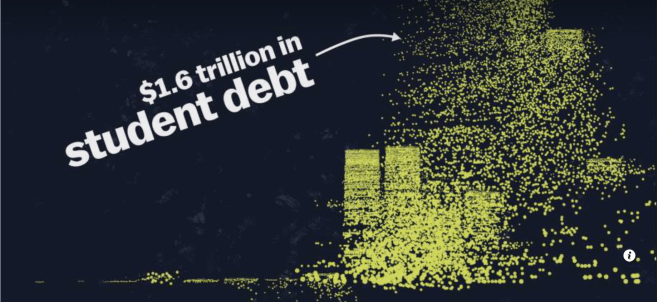
$1.6 trillion in student debt | MSN & Vox

Editor’s Note: Perhaps colleges and universities established as non-profits for the benefit of society should pay off a share of the student debt with a share of their massive endowment funds worth billions and billions of dollars (instead of passing on the burden of debt cancellation for colleges and universities to the American taxpayers). Great socialist idea, but bad for the overall economy.

Student loan debt has increased exponentially in the past few decades. So now, some Democratic presidential candidates propose canceling those debts — all $1.6 trillion of it. But is this a good idea? Who exactly does it benefit? Watch this video…

Source: MSN & Vox

Congressional Progressive Caucus | Wikipedia

Editor’s Note: The 98-member Congressional Progressive Caucus is closely allied with the Democratic Socialists of America. The Communist Party USA identifies Progressive Caucus members as its “allies in Congress.”

The Congressional Progressive Caucus (CPC) is a caucus within the Democratic congressional caucus in the United States Congress.[6] The CPC is a left-leaning organization that works to advance progressive and liberalissues and positions and represents the progressive faction of the Democratic Party.[7][8] It was founded in 1991 and has grown steadily since then.

Entering the 116th United States Congress, the CPC has 98 members, making it the second largest caucus within the Democratic Party and the third largest caucus in Congress. The CPC is currently co-chaired by U.S. Representatives Mark Pocan (D-WI) and Pramila Jayapal (D-WA).

Source: Wikipedia

President Trump’s $4 Trillion Debt Increase | Committee for a Responsible Federal Budget

Editor’s Note: Take note that continued federal deficit spending will land the United States corporation in an irreversible bankruptcy before 2029 when It would bring total debt to about 97 percent of Gross Domestic Product (GDP). That means the US would owe the Federal Reserve almost 100% of the GDP for the entire year (plus interest). 

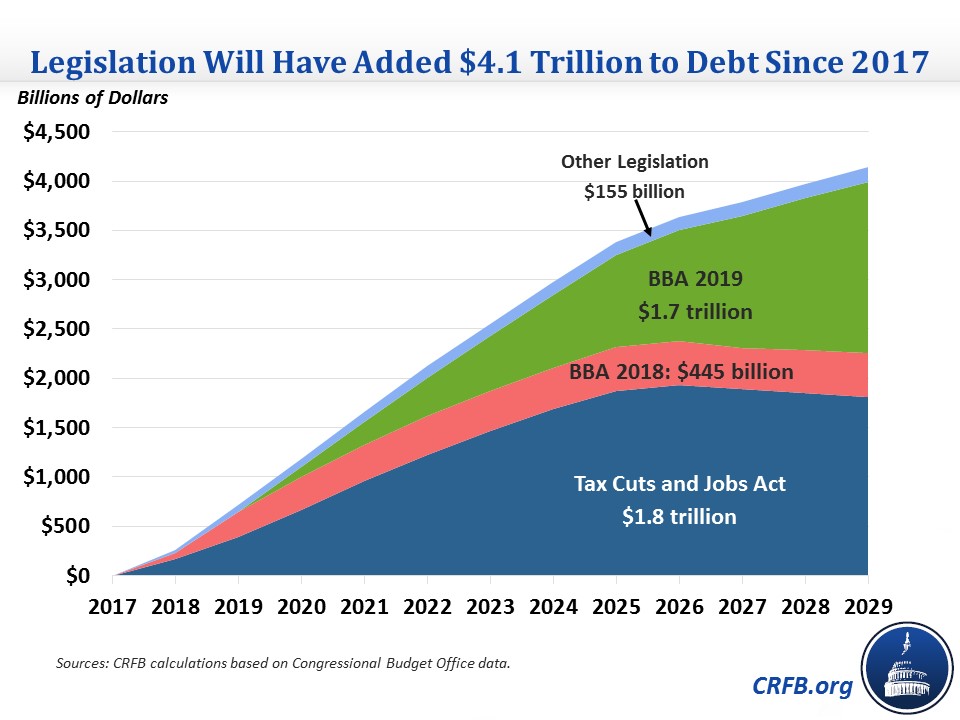
If the recent budget deal is signed into law, it will be the third major piece of deficit-financed legislation in President Trump’s term. In total, we estimate legislation signed by the President will have added $4.1 trillion to the debt between 2017 and 2029. Over a traditional ten-year budget window, the President will have added $3.4 to $3.8 trillion to the debt. The source of the debt expansion is split relatively evenly between tax and spending policy.

The Tax Cuts and Jobs Act (TCJA) was the single largest contributor to the $4.1 trillion figure, increasing debt by $1.8 trillion through 2029 (more than the entire cost is through 2027). This number could easily climb higher if lawmakers extend the individual tax cuts that are set to expire after 2025, which would add another $1 trillion to the debt.

The Bipartisan Budget Act (BBA) of 2018 was nearly as costly on an annual basis, adding nearly $450 billion to the debt due to its two-year nature. However, the Bipartisan Budget Act of 2019 would effectively make the increases in the BBA 2018 permanent, and in doing so, add another $1.7 trillion to the debt through 2029.

Smaller pieces of legislation are responsible for nearly $150 billion of debt. This includes several different bills containing disaster relief or emergency spending and continued delays of three Affordable Care Act (ACA) taxes, among other bills.

This analysis does not include the fiscal impact of many executive actions taken by the President, some which would increase deficits and others which would reduce them. It also assumes that temporary policies expire as scheduled.

If we evaluate the debt added over the standard ten-year window the Congressional Budget Office (CBO) uses, the numbers are similar but slightly smaller. Using the ten-year period (2018-2027) employed in 2017, lawmakers have added $3.8 trillion to deficits. Using the current ten-year period of 2020-2029, the debt increase is $3.4 trillion. Debt added is lower in the later period because some of the laws, like the TCJA and 2018 BBA, had larger short-term, rather than long-term, costs.

Debt Added Since 2017 Over Different Periods

Legislation 2018-2027 Cost 2020-2029 Cost 2017-2029 Cost
Tax Cuts and Jobs Act $1.9 trillion $1.4 trillion $1.8 trillion
Bipartisan Budget Act of 2019 $1.3 trillion $1.7 trillion $1.7 trillion
Bipartisan Budget Act of 2018 $420 billion $190 billion $445 billion
Other Legislation $140 billion $90 billion $155 billion
Total $3.8 trillion $3.4 trillion $4.1 trillion

Source: CRFB calculations based on Congressional Budget Office data.

Importantly, the $4.1 trillion of debt signed into law by President Trump is on top of the $16.2 trillion we already owe and the $9.8 trillion we were projected to borrow over the next decade absent these proposals. It would bring debt to about 97 percent of Gross Domestic Product (GDP) in 2029, compared to 84 percent if no debt-increasing legislation had been passed.

To avoid the huge run-up in debt that is projected in the coming decades, lawmakers should reject unpaid-for spending increases, pay for the tax bill, and address the rising costs and looming insolvency of our nation’s largest health and retirement programs.

Source: Committee for a Responsible Federal Budget

Appeals court dismisses emoluments lawsuit involving Trump’s D.C. hotel | The Washington Post

A federal appeals court Wednesday sided with President Trump, dismissing a lawsuit claiming the president is illegally profiting from foreign and state government visitors at his luxury hotel in downtown Washington.

The unanimous ruling from the U.S. Court of Appeals for the 4th Circuit is a victory for the president in a novel case brought by the attorneys general of Maryland and the District of Columbia involving anti-corruption provisions in the emoluments clauses of the U.S. Constitution.

In its ruling, the three-judge panel said the attorneys general lacked legal grounds to bring the lawsuit alleging the president is violating the Constitution when his business accepts payments from state and foreign governments. The decision — from Judges Paul V. Niemeyer, Dennis W. Shedd and A. Marvin Quattlebaum Jr. — also stops dozens of subpoenas to federal government agencies and Trump’s private business entities demanding financial records related to the D.C. hotel.

“The District and Maryland’s interest in enforcing the Emoluments Clauses is so attenuated and abstract that their prosecution of this case readily provokes the question of whether this action against the President is an appropriate use of the courts, which were created to resolve real cases and controversies between the parties,” Niemeyer wrote in the 36-page opinion.

President Trump quickly took to Twitter to celebrate the ruling, referring to the lawsuit as “ridiculous” and “a big part of the Deep State and Democrat induced Witch Hunt.”

“I don’t make money, but lose a fortune for the honor of serving and doing a great job as your President (including accepting Zero salary!),” he wrote.

The president has stepped back from day-to-day management of the Trump International Hoteland his other businesses, but he maintains ownership.

Maryland Attorney General Brian E. Frosh and D.C. Attorney General Karl A. Racine, both Democrats, said in a joint statement after the ruling that the three-judge panel “got it wrong.”

“Although the court described a litany of ways in which this case is unique, it failed to acknowledge the most extraordinary circumstance of all: President Trump is brazenly profiting from the Office of the President in ways that no other President in history ever imagined and that the founders expressly sought — in the Constitution — to prohibit,” they said.

“We will continue to pursue our legal options to hold him accountable.”

The three judges on the panel that heard oral argument in March were nominated to the bench by Republican presidents — Niemeyer by President George H.W. Bush, Shedd by President George W. Bush and Quattlebaum by Trump. Frosh and Racine have said they would consider appealing for a rehearing by a full panel of the 4th Circuit and would not be surprised to see the case reach the Supreme Court.

The president faces multiple legal challenges related to his private business. A federal appeals court in Washington is considering a separate “emoluments” lawsuit brought by congressional Democrats, who this week began issuing dozens of subpoenas for financial records from the president’s private entities.

The case extends beyond the D.C. hotel and is based on a different theory of standing. The Democratic lawmakers say the president is violating the Constitution because it gives Congress the right to approve — or withhold — consent before the president accepts payments or benefits from foreign governments.

Despite the legal challenges his company faces, to this point Trump has been able to prevent the release of any private business information to the courts, leaving Democrats to wonder whether he will be affected by any of the inquiries before he faces reelection next year.

At the 4th Circuit, Trump’s attorneys were appealing a ruling from a District Court judge in Maryland who allowed the case to move forward and adopted a broad definition of the emoluments ban to include “profit, gain, or advantage” received “directly or indirectly” from foreign, federal or state governments.

The Richmond-based 4th Circuit, which reviews cases from Maryland, Virginia, West Virginia and the Carolinas, was specifically reviewing whether Maryland and the District of Columbia had legal grounds, or standing, to sue the president in the first place.

At least a half-dozen countries have booked large blocks of rooms or meeting space at Trump’s D.C. hotel, among them Saudi Arabia, Kuwait, Malaysia and the Republic of Georgia. Three years in a row, the Kuwaiti government held its National Day celebration there, and the plaintiffs allege that the 2017 event alone cost between $40,000 and $60,000.

The plaintiffs argued that these payments are violations of the foreign emoluments clause, while the Justice Department calls them market-rate deals that should not be considered emoluments.

The hotel occupies the Old Post Office Pavilion, a federal building leased to Trump’s business, in an arrangement that plaintiffs argue violates the domestic emoluments clause. The lease was signed before Trump entered office and stipulates that “no . . . elected official of the Government of the United States” shall benefit from the deal.

The General Services Administration, under Trump, ruled that the deal was in compliance.

The court’s ruling, however, centered on whether the plaintiffs had standing to bring their case against the president — not the merits of whether Trump is violating the Constitution with his business dealings. The 4th Circuit issued two rulings Wednesday — one dismissing the case against the president in his official capacity and the other in his individual capacity.

U.S. District Judge Peter J. Messitte had granted Maryland and the District of Columbia standing in part because Trump’s D.C. hotel could be taking foreign government business from convention centers and hotels in their jurisdictions as foreign leaders may be incentivized to spend money at the president’s property.

But the appeals court disagreed, writing that the attorneys general had failed to show that Trump’s conduct had harmed the financial interests of Maryland and the District and that intervening, by forcing the president to forgo his ownership, for instance, would make a difference.

“There is a distinct possibility — which was completely ignored by the District and Maryland, as well as by the district court — that certain government officials might avoid patronizing the Hotel because of the President’s association with it,” the court said.

“Even if government officials were patronizing the Hotel to curry the President’s favor, there is no reason to conclude that they would cease doing so were the President enjoined from receiving income from the Hotel. After all, the Hotel would still be publicly associated with the President, would still bear his name, and would still financially benefit members of his family.”

Source: The Washington Post

Study touts planting 1 trillion trees as most effective climate change solution | The Hill

Healthy green trees in a forest of old spruce, fir and pine trees in wilderness of a national park. Sustainable industry, ecosystem and healthy environment concepts and background.

The cheapest way to halt the effects of climate change could be planting 1 trillion trees, according to a new study.

The study in the journal Science, first reported by The Associated Press, found that planting trees could be the most effective way to remove carbon from the atmosphere, but cautioned that it would have little effect without a reduction of emissions around the globe.

“This is by far — by thousands of times — the cheapest climate change solution” study co-author Thomas Crowther, an ecologist at the Swiss Federal Institute of Technology, said.

“It’s certainly a monumental challenge, which is exactly the scale of the problem of climate change,” he added.

Though, Crowther cautioned, “None of this works without emissions cuts.”

Scientists with the United Nations have called for a major reduction in carbon emissions over the next decade to stave off the worst effects of climate change, including rising sea levels and dangerous weather phenomena.

Lawmakers around the world have debated on how to address the issue, and in 2017 the U.S. withdrew from a major accord meant to battle climate change due to President Trump‘s opposition to the pact.

Democratic candidates for president, including former Vice President Joe Biden, have called for the U.S. to rejoin the agreement. Progressives are pushing an ambitious plan to cut U.S. carbon emissions, the Green New Deal, introduced earlier this year by Sen. Ed Markey (D-Mass.) and Rep. Alexandria Ocasio-Cortez (D-N.Y.).

If enacted, the Green New Deal calls for the transition of America’s energy grid away from fossil fuels to renewable energy.

Source: The Hill

Trump Administration Accomplishments | The White House

  • Almost 4 million jobs created since election.
  • More Americans are now employed than ever recorded before in our history.
  • We have created more than 400,000 manufacturing jobs since my election.
  • Manufacturing jobs growing at the fastest rate in more than THREE DECADES.
  • Economic growth last quarter hit 4.2 percent.
  • New unemployment claims recently hit a 49-year low.
  • Median household income has hit highest level ever recorded.
  • African-American unemployment has recently achieved the lowest rate ever recorded.
  • Hispanic-American unemployment is at the lowest rate ever recorded.
  • Asian-American unemployment recently achieved the lowest rate ever recorded.
  • Women’s unemployment recently reached the lowest rate in 65 years.
  • Youth unemployment has recently hit the lowest rate in nearly half a century.
  • Lowest unemployment rate ever recorded for Americans without a high school diploma.
  • Under my Administration, veterans’ unemployment recently reached its lowest rate in nearly 20 years.
  • Almost 3.9 million Americans have been lifted off food stamps since the election.
  • The Pledge to America’s Workers has resulted in employers committing to train more than 4 million Americans. We are committed to VOCATIONAL education.
  • 95 percent of U.S. manufacturers are optimistic about the future—the highest ever.
  • Retail sales surged last month, up another 6 percent over last year.
  • Signed the biggest package of tax cuts and reforms in history. After tax cuts, over $300 billion poured back in to the U.S. in the first quarter alone.
  • As a result of our tax bill, small businesses will have the lowest top marginal tax rate in more than 80 years.
  • Helped win U.S. bid for the 2028 Summer Olympics in Los Angeles.
  • Helped win U.S.-Mexico-Canada’s united bid for 2026 World Cup.
  • Opened ANWR and approved Keystone XL and Dakota Access Pipelines.
  • Record number of regulations eliminated.
  • Enacted regulatory relief for community banks and credit unions.
  • Obamacare individual mandate penalty GONE.
  • My Administration is providing more affordable healthcare options for Americans through association health plans and short-term duration plans.
  • Last month, the FDA approved more affordable generic drugs than ever before in history. And thanks to our efforts, many drug companies are freezing or reversing planned price increases.
  • We reformed the Medicare program to stop hospitals from overcharging low-income seniors on their drugs—saving seniors hundreds of millions of dollars this year alone.
  • Signed Right-To-Try legislation.
  • Secured $6 billion in NEW funding to fight the opioid epidemic.
  • We have reduced high-dose opioid prescriptions by 16 percent during my first year in office.
  • Signed VA Choice Act and VA Accountability Act, expanded VA telehealth services, walk-in-clinics, and same-day urgent primary and mental health care.
  • Increased our coal exports by 60 percent; U.S. oil production recently reached all-time high.
  • United States is a net natural gas exporter for the first time since 1957.
  • Withdrew the United States from the job-killing Paris Climate Accord.
  • Cancelled the illegal, anti-coal, so-called Clean Power Plan.
  • Secured record $700 billion in military funding; $716 billion next year.
  • NATO allies are spending $69 billion more on defense since 2016.
  • Process has begun to make the Space Force the 6th branch of the Armed Forces.
  • Confirmed more circuit court judges than any other new administration.
  • Confirmed Supreme Court Justice Neil Gorsuch and nominated Judge Brett Kavanaugh.
  • Withdrew from the horrible, one-sided Iran Deal.
  • Moved U.S. Embassy to Jerusalem.
  • Protecting Americans from terrorists with the Travel Ban, upheld by Supreme Court.
  • Issued Executive Order to keep open Guantanamo Bay.
  • Concluded a historic U.S.-Mexico Trade Deal to replace NAFTA. And negotiations with Canada are underway as we speak.
  • Reached a breakthrough agreement with the E.U. to increase U.S. exports.
  • Imposed tariffs on foreign steel and aluminum to protect our national security.
  • Imposed tariffs on China in response to China’s forced technology transfer, intellectual property theft, and their chronically abusive trade practices.
  • Net exports are on track to increase by $59 billion this year.
  • Improved vetting and screening for refugees, and switched focus to overseas resettlement.
  • We have begun BUILDING THE WALL. Republicans want STRONG BORDERS and NO CRIME. Democrats want OPEN BORDERS which equals MASSIVE CRIME.

Source: The White House

NY Times admits it sends stories to US government (i.e. national security officials) for approval before publication | The Gray Zone

new-york-times-buildingBy Ben Norton

Editor’s Note: We’ve long understood the entanglement between the mainstream press and the national security system. This article gives us some deeper insight.

The New York Times has publicly acknowledged that it sends some of its stories to the US government for approval from “national security officials” before publication.

This confirms what veteran New York Times correspondents like James Risen have said: The American newspaper of record regularly collaborates with the US government, suppressing reporting that top officials don’t want made public.

On June 15, the Times reported that the US government is escalating its cyber attacks on Russia’s power grid. According to the article, “the Trump administration is using new authorities to deploy cybertools more aggressively,” as part of a larger “digital Cold War between Washington and Moscow.”

In response to the report, Donald Trump attacked the Times on Twitter, calling the article “a virtual act of Treason.”

The New York Times PR office replied to Trump from its official Twitter account, defending the story and noting that it had, in fact, been cleared with the US government before being printed.

“Accusing the press of treason is dangerous,” the Times communications team said. “We described the article to the government before publication.”

“As our story notes, President Trump’s own national security officials said there were no concerns,” the Times added.

Indeed, the Times report on the escalating American cyber attacks against Russia is attributed to “current and former [US] government officials.” The scoop in fact came from these apparatchiks, not from a leak or the dogged investigation of an intrepid reporter.

‘Real’ journalists get approval from ‘national security’ officials

The neoliberal self-declared “Resistance” jumped on Trump’s reckless accusation of treason (the Democratic Coalition, which boasts, “We help run #TheResistance,” responded by calling Trump “Putin’s puppet”). The rest of the corporate media went wild.

But what was entirely overlooked was the most revealing thing in the New York Times’ statement: The newspaper of record was essentially admitting that it has a symbiotic relationship with the US government.

In fact, some prominent American pundits have gone so far as to insist that this symbiotic relationship is precisely what makes someone a journalist.

In May, neoconservative Washington Post columnist Marc Thiessen — a former speechwriter for President George W. Bush — declared that WikiLeaks publisher and political prisoner Julian Assange is “not a journalist”; rather, he is a “spy” who “deserves prison.” (Thiessen also once called Assange “the devil.”)

What was the Post columnist’s rationale for revoking Assange’s journalistic credentials?

Unlike “reputable news organizations, Assange did not give the U.S. government an opportunity to review the classified information WikiLeaks was planning to release so they could raise national security objections,” Thiessen wrote. “So responsible journalists have nothing to fear.”

In other words, this former US government speechwriter turned corporate media pundit insists that collaborating with the government, and censoring your reporting to protect so-called “national security,” is definitionally what makes you a journalist.

This is the express ideology of the American commentariat.

NY Times editors ‘quite willing to cooperate with the government’

The symbiotic relationship between the US corporate media and the government has been known for some time. American intelligence agencies play the press like a musical instrument, using it it to selectively leak information at opportune moments to push US soft power and advance Washington’s interests.

But rarely is this symbiotic relationship so casually and publicly acknowledged.

In 2018, former New York Times reporter James Risen published a 15,000-word article in The Intercept providing further insight into how this unspoken alliance operates.

Risen detailed how his editors had been “quite willing to cooperate with the government.” In fact, a top CIA official even told Risen that his rule of thumb for approving a covert operation was, “How will this look on the front page of the New York Times?”

There is an “informal arrangement” between the state and the press, Risen explained, where US government officials “regularly engaged in quiet negotiations with the press to try to stop the publication of sensitive national security stories.”

“At the time, I usually went along with these negotiations,” the former New York Times reported said. He recalled an example of a story he was writing on Afghanistan just prior to the September 11, 2001 attacks. Then-CIA Director George Tenet called Risen personally and asked him to kill the story.

“He told me the disclosure would threaten the safety of the CIA officers in Afghanistan,” Risen said. “I agreed.”

Risen said he later questioned whether or not this was the right decision. “If I had reported the story before 9/11, the CIA would have been angry, but it might have led to a public debate about whether the United States was doing enough to capture or kill bin Laden,” he wrote. “That public debate might have forced the CIA to take the effort to get bin Laden more seriously.”

This dilemma led Risen to reconsider responding to US government requests to censor stories. “And that ultimately set me on a collision course with the editors at the New York Times,” he said.

“After the 9/11 attacks, the Bush administration began asking the press to kill stories more frequently,” Risen continued. “They did it so often that I became convinced the administration was invoking national security to quash stories that were merely politically embarrassing.”

In the lead-up to the Iraq War, Risen frequently “clashed” with Times editors because he raised questions about the US government’s lies. But his stories “stories raising questions about the intelligence, particularly the administration’s claims of a link between Iraq and Al Qaeda, were being cut, buried, or held out of the paper altogether.”

The Times’ executive editor Howell Raines “was believed by many at the paper to prefer stories that supported the case for war,” Risen said.

In another anecdote, the former Times journalist recalled a scoop he had uncovered on a botched CIA plot. The Bush administration got wind of it and called him to the White House, where then-National Security Adviser Condoleezza Rice ordered the Times to bury the story.

Risen said Rice told him “to forget about the story, destroy my notes, and never make another phone call to discuss the matter with anyone.”

“The Bush administration was successfully convincing the press to hold or kill national security stories,” Risen wrote. And the Barack Obama administration subsequently accelerated the “war on the press.”

CIA media infiltration and manufacturing consent

In their renowned study of US media, “Manufacturing Consent: The Political Economy of the Mass Media,” Edward S. Herman and Chomsky articulated a “propaganda model,” showing how “the media serve, and propagandize on behalf of, the powerful societal interests that control and finance them,” through “the selection of right-thinking personnel and by the editors’ and working journalists’ internalization of priorities and definitions of newsworthiness that conform to the institution’s policy.”

But in some cases, the relationship between US intelligence agencies and the corporate media is not just one of mere ideological policing, indirect pressure, or friendship, but rather one of employment.

In the 1950s, the CIA launched a covert operation called Project Mockingbird, in which it surveilled, influenced, and manipulated American journalists and media coverage, explicitly in order to direct public opinion against the Soviet Union, China, and the growing international communist movement.

Legendary journalist Carl Bernstein, a former Washington Post reporter who helped uncover the Watergate scandal, published a major cover story for Rolling Stone in 1977 titled “The CIA and the Media: How America’s Most Powerful News Media Worked Hand in Glove with the Central Intelligence Agency and Why the Church Committee Covered It Up.”

Bernstein obtained CIA documents that revealed that more than 400 American journalists in the previous 25 years had “secretly carried out assignments for the Central Intelligence Agency.”

Bernstein wrote:

“Some of these journalists’ relationships with the Agency were tacit; some were explicit. There was cooperation, accommodation and overlap. Journalists provided a full range of clandestine services—from simple intelligence gathering to serving as go‑betweens with spies in Communist countries. Reporters shared their notebooks with the CIA. Editors shared their staffs. Some of the journalists were Pulitzer Prize winners, distinguished reporters who considered themselves ambassadors without‑portfolio for their country. Most were less exalted: foreign correspondents who found that their association with the Agency helped their work; stringers and freelancers who were as interested in the derring‑do of the spy business as in filing articles; and, the smallest category, full‑time CIA employees masquerading as journalists abroad. In many instances, CIA documents show, journalists were engaged to perform tasks for the CIA with the consent of the managements of America’s leading news organizations.”

Virtually all major US media outlets cooperated with the CIA, Bernstein revealed, including ABC, NBC, the AP, UPI, Reuters, Newsweek, Hearst newspapers, the Miami Herald, the Saturday Evening Post, and the New York Herald‑Tribune.

However, he added, “By far the most valuable of these associations, according to CIA officials, have been with the New York Times, CBS and Time Inc.”

These layers of state manipulation, censorship, and even direct crafting of the news media show that, as much as they claim to be independent, The New York Times and other outlets effectively serve as de facto spokespeople for the government — or at least for the US national security state.

Source: The Gray Zone
Emails Show FBI-Media Collusion against Trump, CA Begins 1.5 Million Inactive Voter Cleanup | Judicial Watch

Source: Judicial Watch/YouTube

Supreme Court rules in case watched for impact on Trump pardons | Politico

The Supreme Court ruled Monday in a closely watched “double jeopardy” case, issuing a decision that preserves states’ power to limit the impact of future pardons by President Donald Trump or his successors.

In a 7-2 ruling, the justices declined to disturb a longstanding legal principle known as dual sovereignty, which allows state governments to bring their own charges against defendants already tried or convicted in federal court, or vice versa.

Lawyers for an Alabama man facing a gun charge in federal court after pleading guilty to the same offense in state court — resulting in a nearly three-year extension of his prison sentence — failed in their effort to persuade the justices to hold that the Constitution’s prohibition on double jeopardy prevents such follow-on prosecutions.

The federal government had argued that overturning the dual-sovereignty doctrine would upend the country’s federalist system, and that the phenomenon of overcriminalization makes states’ ability to preserve their own sphere of influence and prevent federal encroachment on law enforcement more important.

Democrats and others bracing for potential pardons by Trump of individuals convicted in former special counsel Robert Mueller’s investigation were tracking the case, Terance Gamble v. U.S., because a decision overturning the dual sovereigns rule could have complicated efforts by state prosecutors to blunt the impact of any attempt Trump may make to grant clemency to those targeted by Mueller’s team.

Still, the high court case was not seen as make-or-break for state prosecutions because Mueller didn’t bring charges on every potential crime he uncovered. In addition, the federal prosecution of former Trump campaign chairman Paul Manafort resulted in a combination of jury convictions, guilty pleas, mistried charges and dismissals as part of a plea deal.

The complex result in Manafort’s case left fertile ground for New York prosecutors, who jumped into the breach in March with a 16-count indictment charging the longtime lobbyist and political consultant with mortgage fraud, falsifying business records and other crimes. The offenses seemed to partially overlap with crimes Manafort was charged with in federal court in Virginia.

Manafort’s lawyers in the state case have indicated they plan to argue that the indictment obtained by Manhattan District Attorney Cyrus Vance Jr. violates a New York law that limits state prosecutions of crimes already prosecuted at the federal level.

New York’s Democrat-controlled Legislature has been trying to alter that law to limit its application in cases where a defendant receives a presidential pardon or commutation.

A bill aimed at doing that won formal approval last month from both chambers of the state legislature but has not yet been sent to Gov. Andrew Cuomo, who has signaled he plans to sign it. The measure includes language seeking to cover individuals already convicted, tried or who pleaded guilty, but it’s unclear whether applying the law that way is constitutional.

The bulk of the opinions the justices issued Monday were focused on historical evidence about whether the founders expected that dual prosecutions would be permitted or forbidden by the Constitution.

“Gamble’s historical arguments must overcome numerous ‘major decisions of this Court’ spanning 170 years,” Justice Samuel Alito wrote on behalf of the seven-justice majority. “In light of these factors, Gamble’s historical evidence must, at a minimum, be better than middling. And it is not.”

The decision drew separate dissents from justices at opposite ends of the court’s ideological spectrum: liberal Ruth Bader Ginsburg and conservative Neil Gorsuch.

“It is the doctrine’s premise that each government has — and must be allowed to vindicate — a distinct interest in enforcing its own criminal laws,” Ginsburg wrote. “That is a peculiar way to look at the Double Jeopardy Clause, which by its terms safeguards the ‘person’ and restrains the government.” She argued that the legal precedent was weak, noting that “early American courts regarded with disfavor the prospect of successive prosecutions by the Federal and State Governments” and that, with regard to concerns about federal and state governments interfering with each other, “cooperation between authorities is the norm.”

Gorsuch, meanwhile, argued that “a free society does not allow its government to try the same individual for the same crime until it’s happy with the result. Unfortunately, the Court today endorses a colossal exception to this ancient rule against double jeopardy.”

He added that the separate sovereigns exception “finds no meaningful support in the text of the Constitution,” unlike the Constitution’s ban on double jeopardy.

Fordham University law professor Jed Shugerman told POLITICO that the Gamble decision will have “no real impact on Trump cases.” Manafort is still facing state prosecutions in New York and Virginia, which have their own jeopardy rules, he noted. And former national security adviser Michael Flynn’s guilty plea to one count of making false statements to the FBI was limited to federal law, Shugerman said. The same appears true of Roger Stone’s prosecution on false statement and witness tampering charges, he added.

“Trump and others aren’t getting prosecuted federally anyway before 2021, so they haven’t faced a single jeopardy yet,” Shugerman said. “A pardon wouldn’t create jeopardy, so they’d still face state prosecutions post-pardons.”

Some opponents of the proposed New York changes urged legislators to hold off passing them until the Supreme Court ruled in the case decided Monday. Experts said the decision might encourage more states to tinker with their double-jeopardy limits.

“The big question may be how states react to this ruling, and whether it will incentivize some states to ban trials by separate sovereigns of the same defendant for the same conduct, or, now that the Court has said the federal Constitution isn’t offended, whether states that already have such bans might relax them,” said University of Texas law professor Stephen Vladeck.

Source: Politico