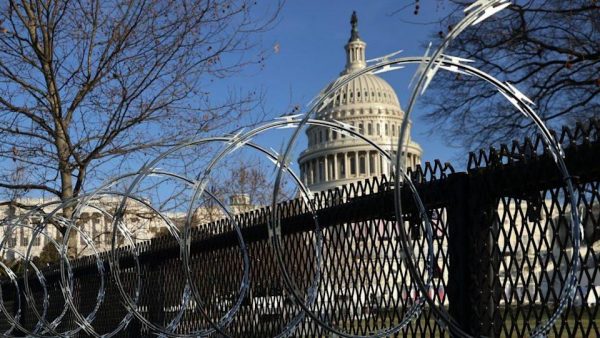
Pulitzer Prize-winning journalist Glenn Greenwald spoke to RT’s Chris Hedges about the eerie similarities between the US government’s legally excessive actions after the 9/11 terror attacks and the Capitol riot earlier this year.
Those who “questioned” measures taken in the name of combating terrorism were treated as terrorist sympathizers in the months following the 9/11, Greenwald told Hedges during an appearance on RT’s ‘On Contact’, and the same argument is being made now by the media and Congress against anyone questioning the government’s response to January 6.
“Exactly the same thing is happening now,” the investigative journalist said, noting that the Justice Department’s targeting of “mostly poor and impoverished and lawyerless people” is similar to what was experienced by many Muslims who faced accusations or ended up in Guantanamo Bay, with few legal options.
“What they’re doing here is essentially running a parallel investigation to the Justice Department because they’re angry that the Justice Department hasn’t indicted anybody on these grandiose claims,” Greenwald said of the House committee investigating the riot, calling the actual investigation a “spectacle” to feed a “hungry liberal mob.” A federal grand jury released an indictment for former Donald Trump advisor Steve Bannon for failing to answer a subpoena to testify in front of the committee earlier this week.
Congress’ involvement helps to “vilify” those accused as a “supplement” to the Justice Department’s already questionable treatment, Greenwald argued. Greenwald has referred to this as the “second war on terror” due to the similarities in government action. Numerous Capitol rioters taken into custody have been denied bail and reportedly faced harsh conditions in prison, similar to the treatment of those accused of terrorism in the months following 9/11.
People being investigated in connection with January 6 are often not even aware, Greenwald added, thanks to third-party subpoenas provided to phone companies, email servers, etc. that request the person in question not be informed. The lack of oversight and safeguards makes it “almost knowingly and deliberately illegal,” the journalist, who is famous for publishing materials on mass US government surveillance exposed by NSA whistleblower Edward Snowden, said.
Another striking similarity, Greenwald told Hedges, is reports of the FBI’s involvement with the acts in question. Many domestic terror plots foiled by officials in the months following 9/11 involved numerous FBI agents and informants, Greenwald recalled, and the same could be true for January 6, as reports have indicated FBI informants were in contact with some at the protest.
“To what extent did the FBI have advanced knowledge?” Greenwald asked, noting many of the “ringleaders” encouraging violence on January 6 have not been charged, while numerous nonviolent offenders have.
As we exit the pandemic, expect to hear much more about The Great Reset and building back better. Far from resulting in a low-carbon dream life, though, it’s a cartoonish fantasy that will hand the global elite even more power.
‘The Great Reset’ is a term that has been bandied about quite readily by most Western neo-liberal politicians. So often, in fact, and without proper explanation, that it strikes the prudent observer as a kind of paid advertisement.
But what is it exactly? The term rose to prominence at the 50th annual meeting of the World Economic Forum (WEF) in June 2020. It was initially launched by the Prince of Wales, before being absorbed into the philosophy of the sartorially dystopian sci-fi villain Klaus Schwab, founder and executive chairman of the WEF.
The Great Reset refers to a plan to rebuild the world’s infrastructure ‘in a sustainable way’ following the economic ravages of the Covid-19 pandemic and to establish a global treaty to prevent future pandemics, or as it is described more formally, to “build a more robust international health architecture that will protect future generations.” If you ever hear people talking about “building back better,” they are referring to The Great Reset.
Probably the most disturbing part of The Great Reset is how much it strongly resembles business-as-usual, only with EXTRA globalism. Most of the plan’s outlines include a further weakening of national boundaries and individual national autonomy, in favour of a more ‘universal governance.’ As usual, it is the rapidly vanishing Western middle class which must shoulder this burden, as their freedoms are further curtailed to meet the quotas of corporate-media-fuelled activism.
Regardless, many world leaders, no doubt charmed into acquiescence by Schwab’s commandingly sinister Blofeld-esque wardrobe, agreed to the Great Reset, including Boris Johnson, Emmanuel Macron, Angela Merkel, Kyriakos Mitsotakis, Mark Rutte, Pedro Sánchez, Erna Solberg and Volodymyr Zelensky. According to John Kerry, Joe Biden’s administration is on board, too.
But the general agreement of the Western leaders is absolutely typical of any agenda which is espoused by NATO, the UN, or the WEF. If an emotionally charged, politically vague and ultimately ineffectual edict or bill is proposed by one of these entities – each resembling a shabby, globe-trotting team of insurance salesmen – our effete politicians line up to show the most fervent compliance.
As a rule, it seems their solutions to specific environmental or scientific problems mysteriously become entwined with LGBTQ+ rights, workplace equity, open borders initiatives and other unrelated social justice causes. It’s as though any goals they have are somehow unilaterally from the same source, or entail the same solution, regardless of causality or consequence. Therefore, a united response to a global pandemic mysteriously also equals trans rights activism.
In their own words, “No single government or multilateral agency can address this (pandemic) threat alone. Together, we must be better prepared to predict, prevent, detect, assess and effectively respond to pandemics in a highly co-ordinated fashion.”
There are many other sweeping sentiments expressed by Schwab and his acolytes which can seem either trite or threatening. Consider“the gulf between what markets value and what people value will close” and “we want more attention paid to scientific experts. No one can “self-isolate” from climate change so we all need to “act in advance and in solidarity.” There is much talk of the pursuit of “fairer and equitable outcomes.”
International treaties always tend to be about concentrating power. It’s one of those rules of life, for realists, as there is no escaping power dynamics in human affairs. Real problems don’t often have feel-good solutions. Often, they require ‘solutions that sound mean’, that don’t sound good on a corporate goals bulletin. Initiatives like The Great Reset all entail the gradual loss of the autonomy of individual nations, as their decision-making power is transferred to an international, disembodied rule-maker.
It has been, without a doubt, a globalist fantasy for a long time, but the key question is: do they realise what they are doing or not?
As far as their amazing coordinated pandemic response goes, this appears to be nothing more than forced world-wide vaccinations for EVERYBODY. According to Klaus Schwab himself: “As long as not everybody is vaccinated, nobody will be safe.” To which the attendant neo-liberal world leaders nodded in re-affirming unison, repeating in unison their mantra: “Global public good.”
Schwab, despite appearing like an immortal brothel-keeper at Kublai Khan’s Xanadu, is really cut from the same cloth as your typical EU technocrat. His ideas are not creative, they are quite staid and pedestrian, and research of his career shows they have been unchanged since the 1970s. He has consistently been preaching the very same thing, like a broken record.
Schwab believes we can achieve environmental solutions without altering capitalism in the slightest, by creating treaties of “mutual accountability and shared responsibility, transparency and co-operation within the international system.” His idea involves ‘ethical capitalism’ – where the excesses of capitalism will somehow be held at bay by ‘ethical stakeholders,’ to whom the corporations will be held accountable, while (conveniently) the elites and systems already in place will continue as they are. This is the master plan of the World Economic Forum, largely unchanged for 40 years.
The result? A green technocracy, one assumes, with a WEF-mandated ‘ethical stakeholder’ apparatus, a worldwide spiderweb organisation ruling by the threatened fears of pandemic and carbon doom. No section of society would be exempt from edicts of ‘the new treaty.’
The Great Reset website appears to be little more than an advertisement for modern pod-living. It seems to style itself as a low-carbon dream-life (without loss of modern convenience) to effeminate hipsters. One can see slovenly-looking neo-liberal youths, frequent references to LGBTQ+ values, and an overall urgency about carbon footprints.
There is a hint of Adbusters about the website, creator of the Occupy Wall Street movement. Despite the fact that the WEF and Davos and all associated entities are entirely elite institutions, the website styles itself on grassroots urban activism. There is much cringeworthy symbology in its white papers, such as a green and rainbow flag-combination with fey slogans like ‘we salute you, zoom queen!’
Schwab refers to the aim of The Great Reset as “the Fourth Industrial Revolution,” with the first being powered by water and steam, the second introducing mass production, and the third electronic automation. The fourth will blur the lines between “physical, digital and biological spheres.”
In this grab-bag of magical advances, he lists, “fields such as artificial intelligence, robotics, the Internet of Things, autonomous vehicles, 3-D printing, nanotechnology, biotechnology, materials science, energy storage and quantum computing.”
This sounds like cartoonish optimism, as many of these technologies are anything but clean and don’t seem to de facto relate to side-stepping out of industrialism or anything else. On top of that, fewer than 9% of companies use the machine learning, robotics, touch screens and other advanced technologies listed as somehow ‘changing everything.’ Stakeholder capitalism, as a concept, does not explain itself as foolproof, and will no doubt be freely interpreted by the likes of Silicon Valley or supply chain conglomerates.
The jewel in the crown of Great Reset optimism has to be the belief that the advent of AI will alter everything positively, again without specifics, to somehow create a low-carbon new world.
It appears at best to be all be smoke and mirrors, a childish corporate fantasy manufactured by isolated bean counters. At worst, it is an intentional power-grab by unaccountable international agencies and hidden oligarchs.
Either way, it is a fake utopia at the price of privacy and autonomy, sold to us by used-car salesmen who think they are princes.
“That was when they suspended the Constitution. They said it would be temporary. There wasn’t even any rioting in the streets. People stayed home at night, watching television, looking for some direction. There wasn’t even an enemy you could put your finger on.”—Margaret Atwood, The Handmaid’s Tale
By John W. Whitehead & Nisha Whitehead
The Constitution of the United States represents the classic solution to one of humankind’s greatest political problems: that is, how does a small group of states combine into a strong union without the states losing their individual powers and surrendering their control over local affairs?
The fifty-five delegates who convened in Philadelphia during the sweltering summer of 1787 answered this question with a document that called for a federal plan of government, a system of separation of powers with checks and balances, and a procedure for orderly change to meet the needs and exigencies of future generations.
In an ultimate sense, the Constitution confirmed the proposition that original power resided in the people—not, however, in the people as a whole but in their capacity as people of the several states. To bring forth the requisite union, the people through the states would transfer some of their powers to the new federal government. All powers not reserved by the people in explicit state constitutional limitations remained in the state governments.
Although the Constitution was adopted on September 17, 1787, the fear of the new federal government was so strong that a “bill of rights” was demanded and became an eventuality.
Intended to protect the citizenry’s fundamental rights or “first liberties” against usurpation by the newly created federal government, the Bill of Rights—the first ten amendments of the Constitution—is essentially a list of immunities from interference by the federal government.
Unfortunately, although the Bill of Rights was adopted as a means of protecting the people against government tyranny, in America today, the government does whatever it wants, freedom be damned.
“We the people” have been terrorized, traumatized, and tricked into a semi-permanent state of compliance by a government that cares nothing for our lives or our liberties.
The bogeyman’s names and faces have changed over time (terrorism, the war on drugs, illegal immigration, a viral pandemic, and more to come), but the end result remains the same: in the so-called name of national security, the Constitution has been steadily chipped away at, undermined, eroded, whittled down, and generally discarded with the support of Congress, the White House, and the courts.
A recitation of the Bill of Rights—set against a backdrop of government surveillance, militarized police, SWAT team raids, asset forfeiture, eminent domain, overcriminalization, armed surveillance drones, whole body scanners, stop and frisk searches, vaccine mandates, travel lockdowns, and the like (all sanctioned by Congress, the White House, and the courts)—would understandably sound more like a eulogy to freedoms lost than an affirmation of rights we truly possess.
What we are left with today is but a shadow of the robust document adopted more than two centuries ago. Sadly, most of the damage has been inflicted upon the Bill of Rights.
Here is what it means to live under the Constitution, post-9/11 and in the midst of a COVID-19 pandemic.
The First Amendment is supposed to protect the freedom to speak your mind, assemble and protest nonviolently without being bridled by the government. It also protects the freedom of the media, as well as the right to worship and pray without interference. In other words, Americans should not be silenced by the government. To the founders, all of America was a free speech zone.
Despite the clear protections found in the First Amendment, the freedoms described therein are under constant assault. Increasingly, Americans are being arrested and charged with bogus “contempt of cop” charges such as “disrupting the peace” or “resisting arrest” for daring to film police officers engaged in harassment or abusive practices. Journalists are being prosecuted for reporting on whistleblowers. States are passing legislation to muzzle reporting on cruel and abusive corporate practices. Religious ministries are being fined for attempting to feed and house the homeless. Protesters are being tear-gassed, beaten, arrested and forced into “free speech zones.” And under the guise of “government speech,” the courts have reasoned that the government can discriminate freely against any First Amendment activity that takes place within a so-called government forum.
The Second Amendment was intended to guarantee “the right of the people to keep and bear arms.” Essentially, this amendment was intended to give the citizenry the means to resist tyrannical government. Yet while gun ownership has been recognized by the U.S. Supreme Court as an individual citizen right, Americans remain powerless to defend themselves against SWAT team raids and government agents armed to the teeth with military weapons better suited to the battlefield. As such, this amendment has been rendered nearly null and void.
The Third Amendment reinforces the principle that civilian-elected officials are superior to the military by prohibiting the military from entering any citizen’s home without “the consent of the owner.” With the police increasingly training like the military, acting like the military, and posing as military forces—complete with heavily armed SWAT teams, military weapons, assault vehicles, etc.—it is clear that we now have what the founders feared most—a standing army on American soil.
The Fourth Amendment prohibits government agents from conducting surveillance on you or touching you or invading you, unless they have some evidence that you’re up to something criminal. In other words, the Fourth Amendment ensures privacy and bodily integrity. Unfortunately, the Fourth Amendment has suffered the greatest damage in recent years and has been all but eviscerated by an unwarranted expansion of police powers that include strip searches and even anal and vaginal searches of citizens, surveillance (corporate and otherwise) and intrusions justified in the name of fighting terrorism, as well as the outsourcing of otherwise illegal activities to private contractors.
The Fifth Amendment and the Sixth Amendment work in tandem. These amendments supposedly ensure that you are innocent until proven guilty, and government authorities cannot deprive you of your life, your liberty or your property without the right to an attorney and a fair trial before a civilian judge. However, in the new suspect society in which we live, where surveillance is the norm, these fundamental principles have been upended. Certainly, if the government can arbitrarily freeze, seize or lay claim to your property (money, land or possessions) under government asset forfeiture schemes, you have no true rights.
The Seventh Amendment guarantees citizens the right to a jury trial. Yet when the populace has no idea of what’s in the Constitution—civic education has virtually disappeared from most school curriculums—that inevitably translates to an ignorant jury incapable of distinguishing justice and the law from their own preconceived notions and fears. However, as a growing number of citizens are coming to realize, the power of the jury to nullify the government’s actions—and thereby help balance the scales of justice—is not to be underestimated. Jury nullification reminds the government that “we the people” retain the power to ultimately determine what laws are just.
The Eighth Amendment is similar to the Sixth in that it is supposed to protect the rights of the accused and forbid the use of cruel and unusual punishment. However, the Supreme Court’s determination that what constitutes “cruel and unusual” should be dependent on the “evolving standards of decency that mark the progress of a maturing society” leaves us with little protection in the face of a society lacking in morals altogether.
The Ninth Amendment provides that other rights not enumerated in the Constitution are nonetheless retained by the people. Popular sovereignty—the belief that the power to govern flows upward from the people rather than downward from the rulers—is clearly evident in this amendment. However, it has since been turned on its head by a centralized federal government that sees itself as supreme and which continues to pass more and more laws that restrict our freedoms under the pretext that it has an “important government interest” in doing so.
As for the Tenth Amendment’s reminder that the people and the states retain every authority that is not otherwise mentioned in the Constitution, that assurance of a system of government in which power is divided among local, state and national entities has long since been rendered moot by the centralized Washington, DC, power elite—the president, Congress and the courts.
If there is any sense to be made from this recitation of freedoms lost, it is simply this: our individual freedoms have been eviscerated so that the government’s powers could be expanded.
Yet those who gave us the Constitution and the Bill of Rights believed that the government exists at the behest of its citizens. It is there to protect, defend and even enhance our freedoms, not violate them.
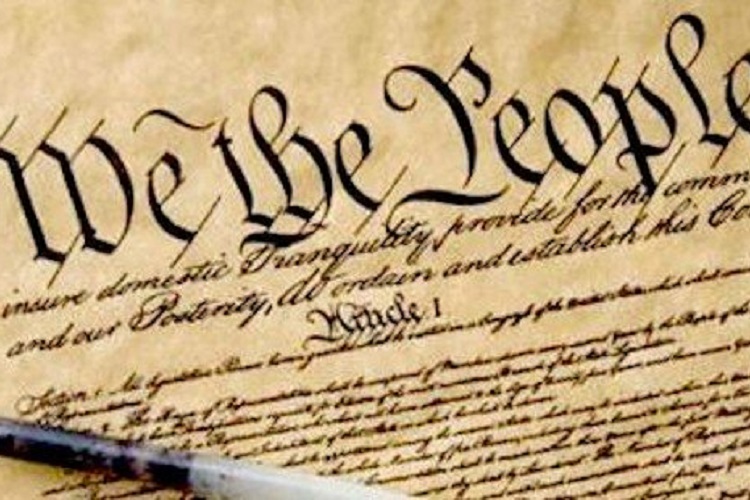
It was no idle happenstance that the Constitution opens with these three powerful words: “We the people.” As the Preamble proclaims:
We, the people of the United States, in order to form a more perfect Union, establish justice, insure domestic tranquility, provide for the common defense, promote the general welfare, and secure the blessings of liberty to ourselves and our posterity, do ordain and establish this CONSTITUTION for the United States of America.
In other words, we have the power to make and break the government. We are the masters and they are the servants. We the American people—the citizenry—are the arbiters and ultimate guardians of America’s welfare, defense, liberty, laws and prosperity.
Most citizens have little, if any, knowledge about their basic rights. And our educational system does a poor job of teaching the basic freedoms guaranteed in the Constitution and the Bill of Rights. For instance, a survey by the Annenberg Public Policy Center found that a little more than one-third of respondents (36 percent) could name all three branches of the U.S. government, while another one-third (35 percent) could not name a single one.
Many who responded to the survey had a strange conception of what was in the First Amendment. For example, 21% said the “right to own a pet” was listed someplace between “Congress shall make no law” and “redress of grievances.” Some 17% said that the First Amendment contained the “right to drive a car,” and 38% believed that “taking the Fifth” was part of the First Amendment.
In fact, while some educators want students to learn about freedom, they do not necessarily want them to exercise their freedoms in school. As the researchers conclude, “Most educators think that students already have enough freedom, and that restrictions on freedom in the school are necessary. Many support filtering the Internet, censoring T-shirts, disallowing student distribution of political or religious material, and conducting prior review of school newspapers.”
Government leaders and politicians are also ill-informed. Although they take an oath to uphold, support and defend the Constitution against “enemies foreign and domestic,” their lack of education about our fundamental rights often causes them to be enemies of the Bill of Rights.
As Jefferson wrote in 1820: “I know no safe depository of the ultimate powers of our society but the people themselves; and if we think them not enlightened enough to exercise their control with a wholesome discretion, the remedy is not to take it from them, but to inform their discretion by education. This is the true corrective of abuses of constitutional power.”
From the President on down, anyone taking public office should have a working knowledge of the Constitution and the Bill of Rights and should be held accountable for upholding their precepts. One way to ensure this would be to require government leaders to take a course on the Constitution and pass a thorough examination thereof before being allowed to take office.
Some critics are advocating that students pass the United States citizenship exam in order to graduate from high school. Others recommend that it must be a prerequisite for attending college. I’d go so far as to argue that students should have to pass the citizenship exam before graduating from grade school.
Here’s an idea to get educated and take a stand for freedom: anyone who signs up to become a member of The Rutherford Institute gets a wallet-sized Bill of Rights card and a Know Your Rights card. Use this card to teach your children the freedoms found in the Bill of Rights.
If this constitutional illiteracy is not remedied and soon, freedom in America will be doomed.
Our national priorities need to be re-prioritized. For instance, some argue that we need to make America great again. I, for one, would prefer to make America free again.
“It’s time for us to resist,” U.S. Senator Ron Paul asserted to his fellow Americans.
“They can’t arrest all of us. They can’t keep all of your kids home from school. They can’t keep every government building closed – although I’ve got a long list of ones they might keep closed or might ought to keep closed,” Paul said. “We don’t have to accept the mandates, lockdowns, and harmful policies of the petty tyrants and bureaucrats. We can simply say no, not again.”
“Nancy Pelosi — you will not arrest or stop me or anyone on my staff from doing our jobs. We have either had COVID, had the vaccine, or been offered the vaccine,” Paul added. “We will make our own health choices. We will not show you a passport, we will not wear a mask, we will not be forced into random screenings and testings so you can continue your drunk-with-power rein over the Capitol.”
Paul went on to say that that Americans should not accept “anti-science” positions from the Biden administration, adding that he will “stop every bill coming through the Senate with an amendment to cut their funding if they don’t come to work in person.”
Paul also mention the importance of getting children back to school, stating that “every adult who works in schools has either had the vaccine or had their chance to get vaccinated.”
“Children are falling behind in school, and are being harmed physically and psychologically by the tactics that you have used to keep them from the classroom during the last year. We won’t allow it again,” Paul said. “If a school system attempts to keep the children from full-time, in-person school, I will hold up every bill with two amendments. One to defund them, and another to allow parents the choice of where the money goes for their child’s education.”
“Do I sound fed up to you? That’s because I am. I’m not a career politician. I practiced medicine for 33 years. I graduated from Duke Medical School, I’ve worked in emergency rooms, I’ve studied immunology and virology, and I ultimately chose to become an eye surgeon,” Paul added.
Paul also unleashed on Dr. Anthony Fauci.
“I’m not the only one who is fed up,” Paul continued. “I can’t go anywhere these days without people coming up and thanking me for standing up for them. Whether I’m at work, or at events in Kentucky, at airports, in restaurants, or in stores, people thank me for taking a stand. They thank me for standing up for actual science. For standing up for freedom. For standing against mandates, lockdowns, and bureaucratic power grabs.”
“I think the tide is turning as more and more people are willing to stand up. I see stories from across the country of parents standing up to the unions and school boards,” Paul said. “I see brave moms standing up and saying, ‘My kids need to go back to school in-person.’ I see members of Congress refusing to comply with Petty Tyrant Pelosi. We are at a moment of truth and a crossroads. Will we allow these people to use fear and propaganda to do further harm to our society, economy, and children? Or will we stand together and say, absolutely not? Not this time. I choose freedom.”
The move comes as the company currently faces around 30,000 legal claims from customers who believe use of these products — including the flagship Roundup — caused them to develop cancer, as AgWeb reported.
“Bayer’s decision to end U.S. residential sale of Roundup is a historic victory for public health and the environment,” Center for Food Safety executive director Andrew Kimbrell said in a statement. “As agricultural, large-scale use of this toxic pesticide continues, our farmworkers remain at risk. It’s time for EPA to act and ban glyphosate for all uses.”
Glyphosate is a controversial ingredient because it has been linked to the development of non-Hodgkin lymphoma, as Cure noted. The World Health Organization’s International Agency for Research on Cancer declared that it was “probably carcinogenic to humans,” in 2015. While the U.S. Environmental Protection Agency (EPA) under former President Donald Trump ruled that the chemical did not pose any risk to human health, the Biden Administration later admitted that the review was flawed and needed to be redone, as Common Dreams reported. Still, it refused to take it off the market in the meantime.
Bayer’s decision comes in response to the many lawsuits related to glyphosate that it inherited when it acquired Monsanto in 2018. Juries sided with the plaintiffs in three highly-watched trials before Bayer settled around 95,000 cases in 2020 to the tune of $10 billion. That settlement, which was one of the largest in U.S. history, allowed Bayer to continue to sell Roundup without any warnings. However, the company still faces further litigation, and said it decided to pull the product from residential use in order to prevent more. More than 90 percent of recent claims come from the residential home and garden market, AgWeb reported.
“This move is being made exclusively to manage litigation risk and not because of any safety concerns,” the company said when it announced its decision.
The products will be replaced with different active ingredients beginning in 2023, following reviews by the EPA and state regulatory bodies. January 2023 was the earliest the change could reasonably be implemented, Bayer Crop Science Division president Liam Condon told AgWeb.
“This is from a regulatory and logistical point of view (of what’s) possible,” Condon said during a conference call with investors, as AgWeb reported.
Editor’s Note: If you have been wondering who is making the decisions behind the Biden Administration (since we all know Sleepy Joe is not in charge), then we may have an answer for you. It’s one company founded in 2017 that is providing much of the leadership in the Biden Administration including the State and National Security Departments. The globalists have now taken over the U.S. Government.
By Kyle Becker
Many of the highest-ranking members of the Biden administration came from the same shadowy firm. It is a relatively new name among revolving-door power brokers in Washington D.C., which makes it all the more surprising.
Founded in 2017, WestExec describes itself as a “diverse group of senior national security professionals with the most recent experience at the highest levels of the U.S. government. With deep knowledge and networks in the fields of defense, foreign policy, intelligence, cybersecurity, international economics, and strategic communications, our team has worked together around the White House Situation Room table, deliberating and deciding our nation’s foreign and national security policies.”
WestExec Advisors gets its name from “West Executive Avenue,” which the official site says is “the closed street that runs between the West Wing of the White House and the Eisenhower Executive Office Building. It is, quite literally, the road to the Situation Room, and it is the road everyone associated with WestExec Advisors has crossed many times en route to meetings of the highest national security consequence.”
At least we can rest easy that it hasn’t been President Joe Biden who has been calling the shots. But a closer look at WestExec Advisers finds that it manages portfolios for some of the biggest companies in the world, drawing concerns about private companies co-opting U.S. security and intelligence policies. However, WestExec does not publicly disclose the names of its clients, only describing them in broad terms.
“The insularity of this network of policymakers poses concerns about the potential for groupthink, conflicts of interest, and what can only be called, however oxymoronically, legalized corruption,” The Intercept/American Prospect noted on WestExec’s influence. “The private sector can in essence co-opt the public sector.”
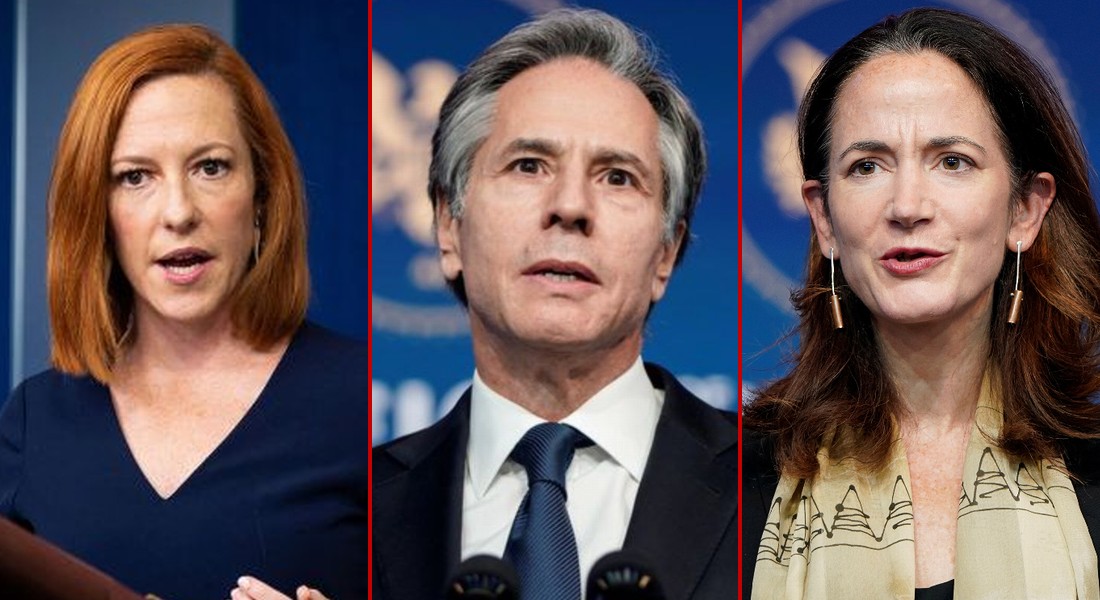
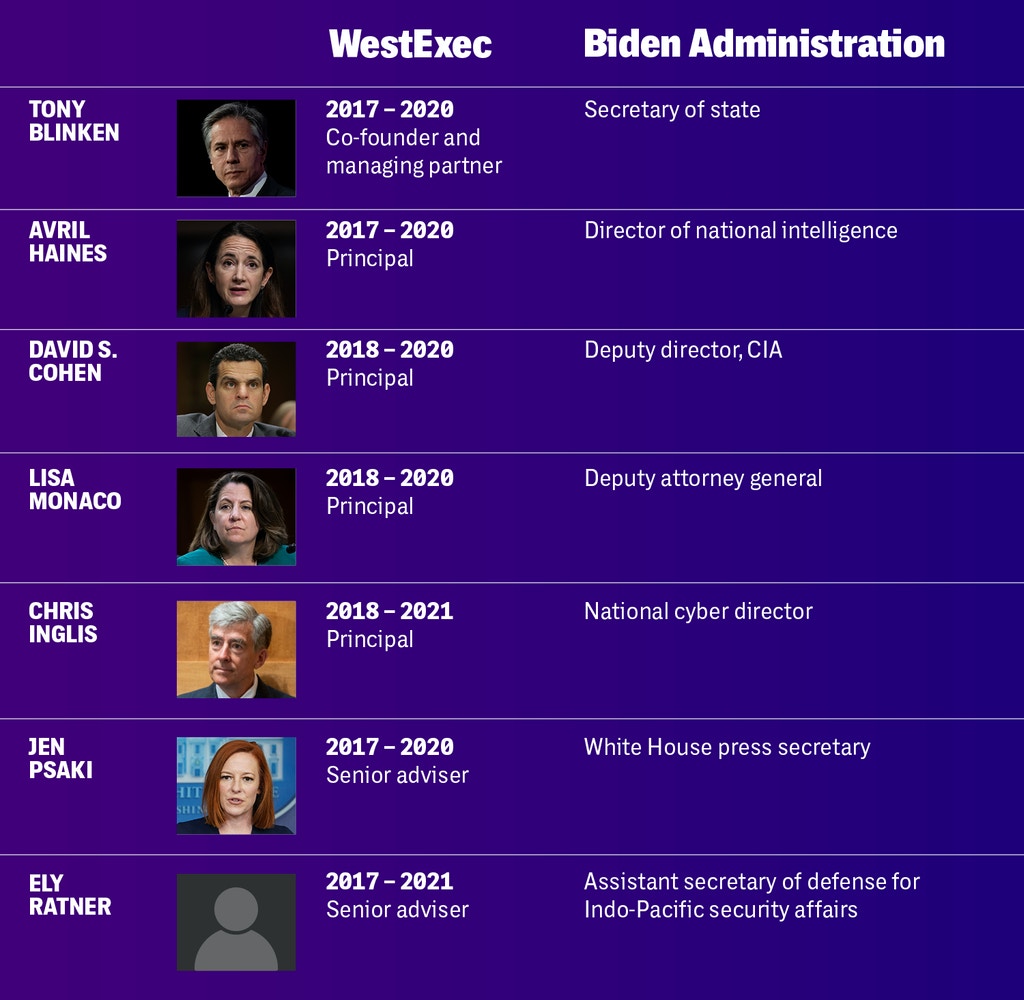
WestExec has staffed the administration with over 23 of its executives, who have sprawled out across the national security and intelligence apparatus. The Intercept and The American Prospect dug into these profiles, and some of the biggest names in government are among them, including:
Tony Blinken, U.S. Secretary of State; Co-founder and managing partner of WestExec
Avril Haines, Director of National Intelligence; Principal
David S. Cohen, Deputy Director at the CIA; Principal
Lisa Monaco, Deputy Attorney General; Principal
Chris Inglis, National Cyber Director; Principal
Jen Psaki, White House Press Secretary; Senior Adviser
Ely Ratner, Asst. Sec. of Defense for Indo-Pacific Security Affairs; Senior Adviser
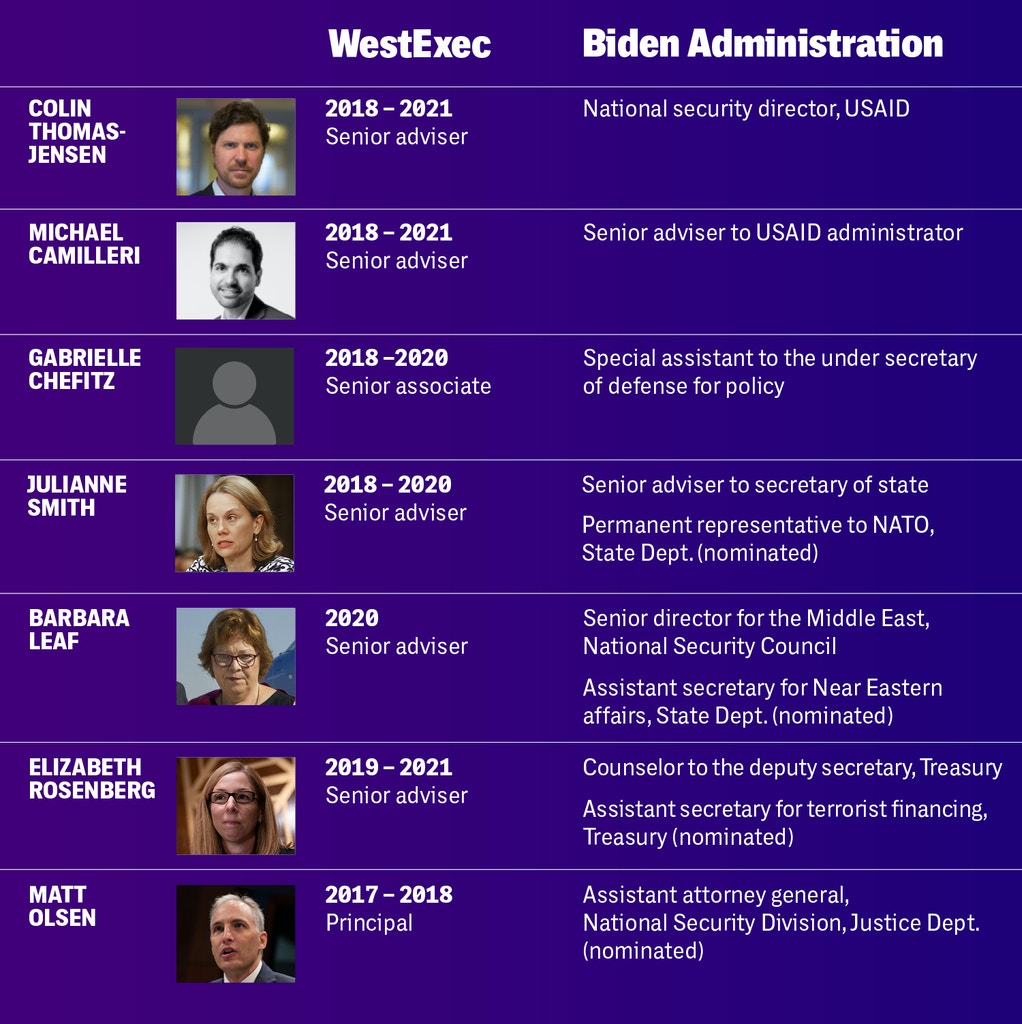
It is an impressive list, as concerning as it might be that one security cabal could singlehandedly consolidate such influence in one presidential administration. But the list isn’t finished yet.
Colin Thomas-Jensen, National Security Director for USAID; Senior Adviser
Michael Camilleri, Sr. Adviser to USAID Admin.; Senior Adviser
Gabrielle Chefitz, Special Asst. to Under Sec. of Defense for Policy; Senior Associate
Julianne Smith, Senior Adviser to Sec. of State; Senior Adviser
Barbara Leaf, Senior Director for Middle East, NSC; Senior Adviser
Elizabeth Rosenberg, Counselor to Deputy Sec. of Treasury; Senior Advisor
Matt Olsen, Asst. Attorney General; Principal
These weren’t all the Biden advisers and Biden/Harris transition team members listed in the report.
“The WestExec to Biden administration pipeline, part two. Not pictured: senior adviser to the domestic policy adviser Erin Pelton; director of scheduling for the secretary of state Sarah McCool; nominee for assistant secretary of defense Celeste Wallander; Biden-Harris transition team advisers Andrea Kendall-Taylor, Cristina Killingsworth, Jay Shambaugh, and Puneet Talwar; deputy director for the U.S. Cyberspace Solarium Commission John Costello; and vice chair of the National Security Commission on Artificial Intelligence Robert O. Work.”
Did you think that must be it? Wrong. There are even more in mid-tier positions throughout the administration.
“Even Bidenworld’s backbenchers are entangled in the firm,” the Intercept/American Prospect report states. “The Biden-Harris transition team was advised by WestExec consultants Andrea Kendall-Taylor, Puneet Talwar, Jay Shambaugh, and Cristina Killingsworth. Further, the firm’s members oversee influential nonpartisan federal commissions: Robert O. Work at the National Security Commission for Artificial Intelligence and John Costello at the Cyberspace Solarium Commission.”
That makes for at least thirty executives from one shadowy firm that has spread its tentacles around a single presidential administration. If that isn’t a ‘takeover’ of the U.S. government, then what is?
Aldous Huxley (July 16, 1894–November 22, 1963) — author of the classic Brave New World, little-known children’s book wordsmith, staple of Carl Sagan’s reading list — would have been 118 today. To celebrate his mind and his legacy, here is a rare 1958 conversation with Mike Wallace — the same masterful interviewer who also offered rare glimpses into the minds of Salvador Dalí and Ayn Rand — in which Huxley predicts the “fictional world of horror” depicted in Brave New World is just around the corner for humanity. He explains how overpopulation is among the greatest threats to our freedom, admonishes against the effects of advertising on children, and, more than half a century before Occupy Wall Street, outlines how global economic destabilization will incite widespread social unrest.
Far from being a war against “white supremacy,” the Biden administration’s new “domestic terror” strategy clearly targets primarily those who oppose US government overreach and those who oppose capitalism and/or globalization.
In the latest sign that the US government’s War on Domestic Terror is growing in scope and scale, the White House on Tuesday revealed the nation’s first ever government-wide strategy for confronting domestic terrorism. While cloaked in language about stemming racially motivated violence, the strategy places those deemed “anti-government” or “anti-authority” on a par with racist extremists and charts out policies that could easily be abused to silence or even criminalize online criticism of the government.
Even more disturbing is the call to essentially fuse intelligence agencies, law enforcement, Silicon Valley, and “community” and “faith-based” organizations such as the Anti-Defamation League, as well as unspecified foreign governments, as partners in this “war,” which the strategy makes clear will rely heavily on a pre-crime orientation focused largely on what is said on social media and encrypted platforms. Though the strategy claims that the government will “shield free speech and civil liberties” in implementing this policy, its contents reveal that it is poised to gut both.
Indeed, while framed publicly as chiefly targeting “right-wing white supremacists,” the strategy itself makes it clear that the government does not plan to focus on the Right but instead will pursue “domestic terrorists” in “an ideologically neutral, threat-driven manner,” as the law “makes no distinction based on political view—left, right or center.” It also states that a key goal of this strategic framework is to ensure “that there is simply no governmental tolerance . . . of violence as an acceptable mode of seeking political or social change,” regardless of a perpetrator’s political affiliation.
Considering that the main cheerleaders for the War on Domestic Terror exist mainly in establishment left circles, such individuals should rethink their support for this new policy given that the above statements could easily come to encompass Black Lives Matter–related protests, such as those that transpired last summer, depending on which political party is in power.
Once the new infrastructure is in place, it will remain there and will be open to the same abuses perpetrated by both political parties in the US during the lengthy War on Terror following September 11, 2001. The history of this new “domestic terror” policy, including its origins in the Trump administration, makes this clear.
It’s Never Been Easier to Be a “Terrorist”
In introducing the strategy, the Biden administration cites “racially or ethnically motivated violent extremists” as a key reason for the new policy and a main justification for the War on Domestic Terror in general. This was most recently demonstrated Tuesday in Attorney General Merrick Garland’s statement announcing this new strategy. However, the document itself puts “anti-government” or “anti-authority” “extremists” in the same category as violent white supremacists in terms of being a threat to the homeland. The strategy’s characterization of such individuals is unsettling.
For instance, those who “violently oppose” “all forms of capitalism” or “corporate globalization” are listed under this less-discussed category of “domestic terrorist.” This highlights how people on the left, many of whom have called for capitalism to be dismantled or replaced in the US in recent years, could easily be targeted in this new “war” that many self-proclaimed leftists are currently supporting. Similarly, “environmentally-motivated extremists,” a category in which groups such as Extinction Rebellion could easily fall, are also included.
In addition, the phrasing indicates that it could easily include as “terrorists” those who oppose the World Economic Forum’s vision for global “stakeholder capitalism,” as that form of “capitalism” involves corporations and their main “stakeholders” creating a new global economic and governance system. The WEF’s stakeholder capitalism thus involves both “capitalism” and “corporate globalization.”
The strategy also includes those who “take steps to violently resist government authority . . . based on perceived overreach.” This, of course, creates a dangerous situation in which the government could, purposely or otherwise, implement a policy that is an obvious overreach and/or blatantly unconstitutional and then label those who resist it “domestic terrorists” and deal with them as such—well before the overreach can be challenged in court.
Another telling addition to this group of potential “terrorists” is “any other individual or group who engages in violence—or incites imminent violence—in opposition to legislative, regulatory or other actions taken by the government.” Thus, if the government implements a policy that a large swath of the population finds abhorrent, such as launching a new, unpopular war abroad, those deemed to be “inciting” resistance to the action online could be considered domestic terrorists.
Such scenarios are not unrealistic, given the loose way in which the government and the media have defined things like “incitement” and even “violence” (e. g., “hate speech” is a form of violence) in the recent past. The situation is ripe for manipulation and abuse. To think the federal government (including the Biden administration and subsequent administrations) would not abuse such power reflects an ignorance of US political history, particularly when the main forces behind most terrorist incidents in the nation are actually US government institutions like the FBI (more FBI examples here, here, here, and here).
Furthermore, the original plans for the detention of American dissidents in the event of a national emergency, drawn up during the Reagan era as part of its “continuity of government” contingency, cited popular nonviolent opposition to US intervention in Latin America as a potential “emergency” that could trigger the activation of those plans. Many of those “continuity of government” protocols remain on the books today and can be triggered, depending on the whims of those in power. It is unlikely that this new domestic terror framework will be any different regarding nonviolent protest and demonstrations.
Yet another passage in this section of the strategy states that “domestic terrorists” can, “in some instances, connect and intersect with conspiracy theories and other forms of disinformation and misinformation.” It adds that the proliferation of such “dangerous” information “on Internet-based communications platforms such as social media, file-upload sites and end-to-end encrypted platforms, all of these elements can combine and amplify threats to public safety.”
Thus, the presence of “conspiracy theories” and information deemed by the government to be “misinformation” online is itself framed as threatening public safety, a claim made more than once in this policy document. Given that a major “pillar” of the strategy involves eliminating online material that promotes “domestic terrorist” ideologies, it seems inevitable that such efforts will also “connect and intersect” with the censorship of “conspiracy theories” and narratives that the establishment finds inconvenient or threatening for any reason.
Pillars of Tyranny
The strategy notes in several places that this new domestic-terror policy will involve a variety of public-private partnerships in order to “build a community to address domestic terrorism that extends not only across the Federal Government but also to critical partners.” It adds, “That includes state, local, tribal and territorial governments, as well as foreign allies and partners, civil society, the technology sector, academic, and more.”
The mention of foreign allies and partners is important as it suggests a multinational approach to what is supposedly a US “domestic” issue and is yet another step toward a transnational security-state apparatus. A similar multinational approach was used to devastating effect during the CIA-developed Operation Condor, which was used to target and “disappear” domestic dissidents in South America in the 1970s and 1980s. The foreign allies mentioned in the Biden administration’s strategy are left unspecified, but it seems likely that such allies would include the rest of the Five Eyes alliance (the UK, Australia, Canada, New Zealand) and Israel, all of which already have well-established information-sharing agreements with the US for signals intelligence.
The new domestic-terror strategy has four main “pillars,” which can be summarized as (1) understanding and sharing domestic terrorism-related information, including with foreign governments and private tech companies; (2) preventing domestic terrorism recruitment and mobilization to violence; (3) disrupting and deterring domestic terrorism activity; and (4) confronting long-term contributors to domestic terrorism.
The first pillar involves the mass accumulation of data through new information-sharing partnerships and the deepening of existing ones. Much of this information sharing will involve increased data mining and analysis of statements made openly on the internet, particularly on social media, something already done by US intelligence contractors such as Palantir. While the gathering of such information has been ongoing for years, this policy allows even more to be shared and legally used to make cases against individuals deemed to have made threats or expressed “dangerous” opinions online.
Included in the first pillar is the need to increase engagement with financial institutions concerning the financing of “domestic terrorists.” US banks, such as Bank of America, have already gone quite far in this regard, leading to accusations that it has begun acting like an intelligence agency. Such claims were made after it was revealed that the BofA had passed to the government the private banking information of over two hundred people that the bank deemed as pointing to involvement in the events of January 6, 2021. It seems likely, given this passage in the strategy, that such behavior by banks will soon become the norm, rather than an outlier, in the United States.
The second pillar is ostensibly focused on preventing the online recruitment of domestic terrorists and online content that leads to the “mobilization of violence.” The strategy notes that this pillar “means reducing both supply and demand of recruitment materials by limiting widespread availability online and bolstering resilience to it by those who nonetheless encounter it.“ The strategy states that such government efforts in the past have a “mixed record,” but it goes on to claim that trampling on civil liberties will be avoided because the government is “consulting extensively” with unspecified “stakeholders” nationwide.
Regarding recruitment, the strategy states that “these activities are increasingly happening on Internet-based communications platforms, including social media, online gaming platforms, file-upload sites and end-to-end encrypted platforms, even as those products and services frequently offer other important benefits.” It adds that “the widespread availability of domestic terrorist recruitment material online is a national security threat whose front lines are overwhelmingly private-sector online platforms.”
The US government plans to provide “information to assist online platforms with their own initiatives to enforce their own terms of service that prohibits the use of their platforms for domestic terrorist activities” as well as to “facilitate more robust efforts outside the government to counter terrorists’ abuse of Internet-based communications platforms.”
Given the wider definition of “domestic terrorist” that now includes those who oppose capitalism and corporate globalization as well as those who resist government overreach, online content discussing these and other “anti-government” and “anti-authority” ideas could soon be treated in the same way as online Al Qaeda or ISIS propaganda. Efforts, however, are unlikely to remain focused on these topics. As Unlimited Hangoutreported last November, both UK intelligence and the US national-security state were developing plans to treat critical reporting on the COVID-19 vaccines as “extremist” propaganda.
Another key part of this pillar is the need to “increase digital literacy” among the American public, while censoring “harmful content” disseminated by “terrorists” as well as by “hostile foreign powers seeking to undermine American democracy.” The latter is a clear reference to the claim that critical reporting of US government policy, particularly its military and intelligence activities abroad, was the product of “Russian disinformation,” a now discredited claim that was used to heavily censor independent media. This new government strategy appears to promise more of this sort of thing.
It also notes that “digital literacy” education for a domestic audience is being developed by the Department of Homeland Security (DHS). Such a policy would have previously violated US law until the Obama administration worked with Congress to repeal the Smith-Mundt Act, thus lifting the ban on the government directing propaganda at domestic audiences.
The third pillar of the strategy seeks to increase the number of federal prosecutors investigating and trying domestic-terror cases. Their numbers are likely to jump as the definition of “domestic terrorist” is expanded. It also seeks to explore whether “legislative reforms could meaningfully and materially increase our ability to protect Americans from acts of domestic terrorism while simultaneously guarding against potential abuse of overreach.” In contrast to past public statements on police reform by those in the Biden administration, the strategy calls to “empower” state and local law enforcement to tackle domestic terrorism, including with increased access to “intelligence” on citizens deemed dangerous or subversive for any number of reasons.
To that effect, the strategy states the following (p. 24):“The Department of Justice, Federal Bureau of Investigation, and Department of Homeland Security, with support from the National Counterterrorism Center [part of the intelligence community], are incorporating an increased focus on domestic terrorism into current intelligence products and leveraging current mechanisms of information and intelligence sharing to improve the sharing of domestic terrorism-related content and indicators with non-Federal partners. These agencies are also improving the usability of their existing information-sharing platforms, including through the development of mobile applications designed to provide a broader reach to non-Federal law enforcement partners, while simultaneously refining that support based on partner feedback.”
Such an intelligence tool could easily be, for example, Palantir, which is already used by the intelligence agencies, the DHS, and several US police departments for “predictive policing,” that is, pre-crime actions. Notably, Palantir has long included a “subversive” label for individuals included on government and law enforcement databases, a parallel with the controversial and highly secretive Main Core database of US dissidents.
DHS Secretary Alejandro Mayorkas made the “pre-crime” element of the new domestic terror strategy explicit on Tuesday when he said in a statement that DHS would continue “developing key partnerships with local stakeholders through the Center for Prevention Programs and Partnerships (CP3) to identify potential threats and prevent terrorism.” CP3, which replaced DHS’ Office for Targeted Violence and Terrorism Prevention this past May, officially “supports communities across the United States to prevent individuals from radicalizing to violence and intervene when individuals have already radicalized to violence.”
The fourth pillar of the strategy is by far the most opaque and cryptic, while also the most far-reaching. It aims to address the sources that cause “terrorists” to mobilize “towards violence.” This requires “tackling racism in America,” a lofty goal for an administration headed by the man who controversially eulogized Congress’ most ardent segregationist and who was a key architect of the 1994 crime bill. As well, it provides for “early intervention and appropriate care for those who pose a danger to themselves or others.”
In regard to the latter proposal, the Trump administration, in a bid to “stop mass shootings before they occur,” considered a proposal to create a “health DARPA” or “HARPA” that would monitor the online communications of everyday Americans for “neuropsychiatric” warning signs that someone might be “mobilizing towards violence.” While the Trump administration did not create HARPA or adopt this policy, the Biden administration has recently announced plans to do so.
Finally, the strategy indicates that this fourth pillar is part of a “broader priority”: “enhancing faith in government and addressing the extreme polarization, fueled by a crisis of disinformation and misinformation often channeled through social media platforms, which can tear Americans apart and lead some to violence.” In other words, fostering trust in government while simultaneously censoring “polarizing” voices who distrust or criticize the government is a key policy goal behind the Biden administration’s new domestic-terror strategy.
Calling Their Shots?
While this is a new strategy, its origins lie in the Trump administration. In October 2019, Trump’s attorney general William Barr formally announced in a memorandum that a new “national disruption and early engagement program” aimed at detecting those “mobilizing towards violence” before they commit any crime would launch in the coming months. That program, known as DEEP (Disruption and Early Engagement Program), is now active and has involved the Department of Justice, the FBI, and “private sector partners” since its creation.
Barr’s announcement of DEEP followed his unsettling “prediction” in July 2019 that “a major incident may occur at any time that will galvanize public opinion on these issues.” Not long after that speech, a spate of mass shootings occurred, including the El Paso Walmart shooting, which killed twenty-three and about which many questions remain unanswered regarding the FBI’s apparent foreknowledge of the event. After these events took place in 2019, Trump called for the creation of a government backdoor into encryption and the very pre-crime system that Barr announced shortly thereafter in October 2019. The Biden administration, in publishing this strategy, is merely finishing what Barr started.
Indeed, a “prediction” like Barr’s in 2019 was offered by the DHS’ Elizabeth Neumann during a Congressional hearing in late February 2020. That hearing was largely ignored by the media as it coincided with an international rise of concern regarding COVID-19. At the hearing, Neumann, who previously coordinated the development of the government’s post-9/11 terrorism information sharing strategies and policies and worked closely with the intelligence community, gave the following warning about an imminent “domestic terror” event in the United States:“And every counterterrorism professional I speak to in the federal government and overseas feels like we are at the doorstep of another 9/11, maybe not something that catastrophic in terms of the visual or the numbers, but that we can see it building and we don’t quite know how to stop it.”
This “another 9/11” emerged on January 6, 2021, as the events of that day in the Capitol were quickly labeled as such by both the media and prominent politicians, while also inspiring calls from the White House and the Democrats for a “9/11-style commission” to investigate the incident. This event, of course, figures prominently in the justification for the new domestic-terror strategy, despite the considerable video and other evidence that shows that Capitol law enforcement, and potentially the FBI, were directly involved in facilitating the breach of the Capitol. In addition, when one considers that the QAnon movement, which had a clear role in the events of January 6, was itself likely a government-orchestratedpsyop, the government hand in creating this situation seems clear.
It goes without saying that the official reasons offered for these militaristic “domestic terror” policies, which the US has already implemented abroad—causing much more terror than it has prevented—does not justify the creation of a massive new national-security infrastructure that aims to criminalize and censor online speech. Yet the admission that this new strategy, as part of a broader effort to “enhance faith in government,” combines domestic propaganda campaigns with the censorship and pursuit of those who distrust government heralds the end of even the illusion of democracy in the United States.
The US and some other Western nations held up as “models of liberal democracy” are rapidly turning into totalitarian regimes reminiscent of the Soviet Union, the head of Russia’s Foreign Intelligence Service has claimed.
Speaking on Thursday at the Moscow Conference on International Security, Sergey Naryshkin claimed that there are “almost all signs of a totalitarian dictatorship” in some Western countries, including a “monopoly on the media,” the “police nature of the state,” and the “irremovability of oligarchic elites.”
“It is astonishing to see how the West is trying to divide our diverse world into two completely artificial camps – a supposedly democratic one and a supposedly authoritarian one,” Naryshkin said, noting Russia, China, and Iran have been placed into the second camp, along with NATO ally Turkey and, on some issues, EU member state Poland.
“The US and other so-called models of liberal democracy seem not to notice that they themselves are rapidly turning into a liberal-totalitarian regime,” the chief spook said.
According to Naryshkin, the West’s imposition of ideological attitudes is somewhat reminiscent of the history of the late Soviet Union, in that it doesn’t even believe the values it tries to project abroad.
However, the head spy pointed to the US-Russia summit in Switzerland earlier this month as a potential turning point, noting that he hopes the West will be able to use “the spirit of Geneva to try to build a safer and fairer world.”
Naryshkin’s belief that the West is attempting to split the world into ‘democratic’ and ‘authoritarian’ echoes a statement made by Defense Minister Sergey Shoygu at the same conference on Wednesday.
“Today, a new trend is coming to the fore,” Shoygu said. “The formation of global coalitions, the division of the world into ‘friends’ and ‘strangers.’”
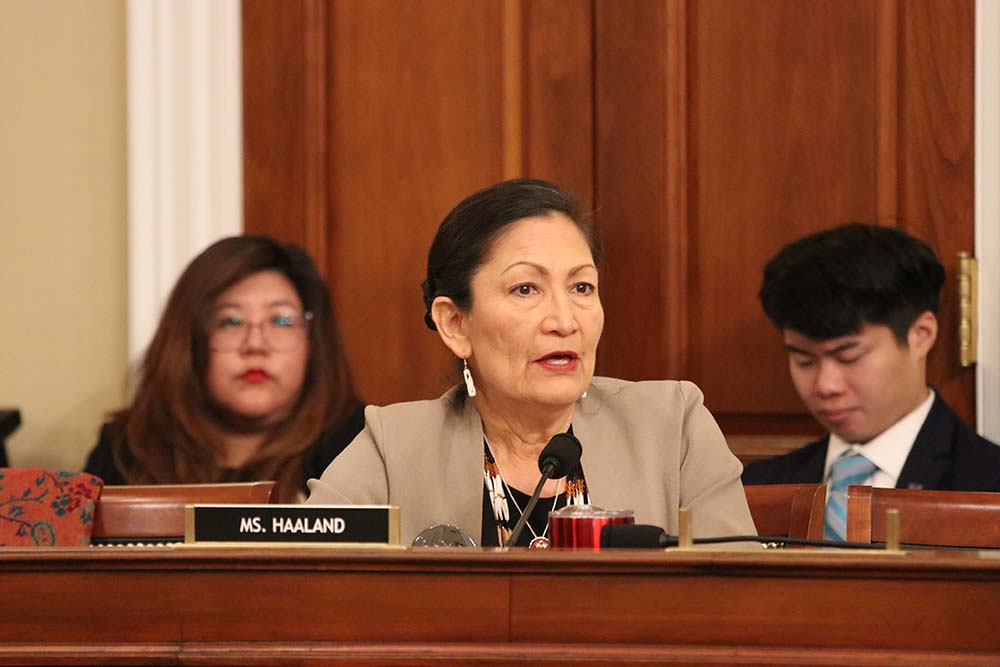
Interior Secretary Deb Haaland (Laguna Pueblo) will outline the Interior Department’s next steps to “begin to reconcile the troubled legacy of federal boarding school policies” on June 22 during the National Congress of American Indians (NCAI) 2021 Mid Year Conference, the department announced Monday.
The announcement follows the recent discovery of a mass unmarked grave of 215 Indigenous children on the grounds of the former Kamloops Indian Residential School in British Columbia, Canada. The finding was met by widespread media coverage, reopening the conversation around the harm and trauma wrought by the federal boarding school systems for Indigenous peoples in the U.S. and Canada.
On June 11, Haaland called for acknowledgement of the past and present impacts of the boarding school system in an op-ed published in The Washington Post.
“Though it is uncomfortable to learn that the country you love is capable of committing such acts, the first step to justice is acknowledging these painful truths and gaining a full understanding of their impacts so that we can unravel the threads of trauma and injustice that linger,” Haaland wrote.
There were 357 Indian boarding schools operating throughout the U.S. from 1819 to the 1960s. In 1925, more than 60,000 children attended the schools. The federal government and church organizations were responsible for managing the schools, where students were forbidden from practicing their culture or speaking their native language, and many endured physical, sexual, emotional, and psychological abuse.
The Canadian residential school system operated from the 1880s to the late 1990s for the same purpose: taking Indigenous children from their families and stripping them of their culture. There, Indigenous children experienced similar horrors of physical and sexual abuse, as well as high mortality rates in the schools.
Poor, overcrowded conditions and disease led to thousands of student deaths in the boarding school systems, and many students’ remains were not returned to their families. The harmful intergenerational effects of the schools lives on in many Indigenous communities in the U.S. and Canada.
Along with Principal Deputy Assistant Secretary for Indian Affairs Bryan Newland, Haaland will announce the next steps in addressing the legacy of the U.S. federal boarding school system during the NCAI’s “Department of the Interior Update” at 2:50 p.m. EDT.
The conference’s full agenda, which runs from June 20-24, is accessible here.






 Liberty International News