JFK to 911 Everything Is A Rich Man’s Trick (film) | YouTube & IMDB

Authoritatively written and narrated by Francis Richard Conolly, the film begins its labyrinthine tale during the era of World War I, when the wealthiest and most powerful figures of industry discovered the immense profits to be had from a landscape of ongoing military conflict. The film presents a persuasive and exhaustively researched argument that these towering figures formed a secret society by which they could orchestrate or manipulate war-mongering policies to their advantage on a global scale, and maintain complete anonymity in their actions from an unsuspecting public. Conolly contends that these sinister puppet masters have functioned and thrived throughout history – from the formation of Nazism to the build-up and aftermath of September 11.

Source: IMDB & YouTube

The Coming Collapse | Common Dreams

whitehouseThe Trump administration did not rise, prima facie, like Venus on a half shell from the sea. Donald Trump is the result of a long process of political, cultural and social decay. He is a product of our failed democracy. The longer we perpetuate the fiction that we live in a functioning democracy, that Trump and the political mutations around him are somehow an aberrant deviation that can be vanquished in the next election, the more we will hurtle toward tyranny. The problem is not Trump. It is a political system, dominated by corporate power and the mandarins of the two major political parties, in which we don’t count. We will wrest back political control by dismantling the corporate state, and this means massive and sustained civil disobedience, like that demonstrated by teachers around the country this year. If we do not stand up we will enter a new dark age.

The Democratic Party, which helped build our system of inverted totalitarianism, is once again held up by many on the left as the savior. Yet the party steadfastly refuses to address the social inequality that led to the election of Trump and the insurgency by Bernie Sanders. It is deaf, dumb and blind to the very real economic suffering that plagues over half the country. It will not fight to pay workers a living wage. It will not defy the pharmaceutical and insurance industries to provide Medicare for all. It will not curb the voracious appetite of the military that is disemboweling the country and promoting the prosecution of futile and costly foreign wars. It will not restore our lost civil liberties, including the right to privacy, freedom from government surveillance, and due process. It will not get corporate and dark money out of politics. It will not demilitarize our police and reform a prison system that has 25 percent of the world’s prisoners although the United States has only 5 percent of the world’s population. It plays to the margins, especially in election seasons, refusing to address substantive political and social problems and instead focusing on narrow cultural issues like gay rights, abortion and gun control in our peculiar species of anti-politics.

In an open and democratic political process, one not dominated by party elites and corporate money, these people would not hold political power. They know this. They would rather implode the entire system than give up their positions of privilege.

This is a doomed tactic, but one that is understandable. The leadership of the party, the Clintons, Nancy Pelosi, Chuck Schumer, Tom Perez, are creations of corporate America. In an open and democratic political process, one not dominated by party elites and corporate money, these people would not hold political power. They know this. They would rather implode the entire system than give up their positions of privilege. And that, I fear, is what will happen. The idea that the Democratic Party is in any way a bulwark against despotism defies the last three decades of its political activity. It is the guarantor of despotism.

Trump has tapped into the hatred that huge segments of the American public have for a political and economic system that has betrayed them. He may be inept, degenerate, dishonest and a narcissist, but he adeptly ridicules the system they despise. His cruel and demeaning taunts directed at government agencies, laws and the established elites resonate with people for whom these agencies, laws and elites have become hostile forces. And for many who see no shift in the political landscape to alleviate their suffering, Trump’s cruelty and invective are at least cathartic.

Trump, like all despots, has no ethical core. He chooses his allies and appointees based on their personal loyalty and fawning obsequiousness to him. He will sell anyone out. He is corrupt, amassing money for himself—he made $40 million from his Washington, D.C., hotel alone last year—and his corporate allies. He is dismantling government institutions that once provided some regulation and oversight. He is an enemy of the open society. This makes him dangerous. His turbocharged assault on the last vestiges of democratic institutions and norms means there will soon be nothing, even in name, to protect us from corporate totalitarianism.

But the warnings from the architects of our failed democracy against creeping fascism, Madeleine Albright among them, are risible. They show how disconnected the elites have become from the zeitgeist. None of these elites have credibility. They built the edifice of lies, deceit and corporate pillage that made Trump possible. And the more Trump demeans these elites, and the more they cry out like Cassandras, the more he salvages his disastrous presidency and enables the kleptocrats pillaging the country as it swiftly disintegrates.

It refuses to critique or investigate the abuses by corporate power, which has destroyed our democracy and economy and orchestrated the largest transfer of wealth upward in American history.

The press is one of the principal pillars of Trump’s despotism. It chatters endlessly like 17th-century courtiers at the court of Versailles about the foibles of the monarch while the peasants lack bread. It drones on and on and on about empty topics such as Russian meddling and a payoff to a porn actress that have nothing to do with the daily hell that, for many, defines life in America. It refuses to critique or investigate the abuses by corporate power, which has destroyed our democracy and economy and orchestrated the largest transfer of wealth upward in American history. The corporate press is a decayed relic that, in exchange for money and access, committed cultural suicide. And when Trump attacks it over “fake news,” he expresses, once again, the deep hatred of all those the press ignores. The press worships the idol of Mammon as slavishly as Trump does. It loves the reality-show presidency. The press, especially the cable news shows, keeps the lights on and the cameras rolling so viewers will be glued to a 21st-century version of “The Cabinet of Dr. Caligari.” It is good for ratings. It is good for profits. But it accelerates the decline.

All this will soon be compounded by financial collapse. Wall Street banks have been handed $16 trillion in bailouts and other subsidies by the Federal Reserve and Congress at nearly zero percent interest since the 2008 financial collapse. They have used this money, as well as the money saved through the huge tax cuts imposed last year, to buy back their own stock, raising the compensation and bonuses of their managers and thrusting the society deeper into untenable debt peonage. Sheldon Adelson’s casino operations alone got a $670 million tax break under the 2017 legislation. The ratio of CEO to worker pay now averages 339 to 1, with the highest gap approaching 5,000 to 1. This circular use of money to make and hoard money is what Karl Marx called “fictitious capital.” The steady increase in public debt, corporate debt, credit card debt and student loan debt will ultimately lead, as Nomi Prins writes, to “a tipping point—when money coming in to furnish that debt, or available to borrow, simply won’t cover the interest payments. Then debt bubbles will pop, beginning with higher yielding bonds.”

An economy reliant on debt for its growth causes our interest rate to jump to 28 percent when we are late on a credit card payment. It is why our wages are stagnant or have declined in real terms—if we earned a sustainable income we would not have to borrow money to survive. It is why a university education, houses, medical bills and utilities cost so much. The system is designed so we can never free ourselves from debt.

However, the next financial crash, as Prins points out in her book “Collusion: How Central Bankers Rigged the World,” won’t be like the last one. This is because, as she says, “there is no Plan B.” Interest rates can’t go any lower. There has been no growth in the real economy. The next time, there will be no way out. Once the economy crashes and the rage across the country explodes into a firestorm, the political freaks will appear, ones that will make Trump look sagacious and benign.

And so, to quote Vladimir Lenin, what must be done?

We must invest our energy in building parallel, popular institutions to protect ourselves and to pit power against power. These parallel institutions, including unions, community development organizations, local currencies, alternative political parties and food cooperatives, will have to be constructed town by town. The elites in a time of distress will retreat to their gated compounds and leave us to fend for ourselves. Basic services, from garbage collection to public transportation, food distribution and health care, will collapse. Massive unemployment and underemployment, triggering social unrest, will be dealt with not through government job creation but the brutality of militarized police and a complete suspension of civil liberties. Critics of the system, already pushed to the margins, will be silenced and attacked as enemies of the state. The last vestiges of labor unions will be targeted for abolition, a process that will soon be accelerated given the expected ruling in a case before the Supreme Court that will cripple the ability of public-sector unions to represent workers. The dollar will stop being the world’s reserve currency, causing a steep devaluation. Banks will close. Global warming will extract heavier and heavier costs, especially on the coastal populations, farming and the infrastructure, costs that the depleted state will be unable to address. The corporate press, like the ruling elites, will go from burlesque to absurdism, its rhetoric so patently fictitious it will, as in all totalitarian states, be unmoored from reality. The media outlets will all sound as fatuous as Trump. And, to quote W.H. Auden, “the little children will die in the streets.”

As a foreign correspondent I covered collapsed societies, including the former Yugoslavia. It is impossible for any doomed population to grasp how fragile the decayed financial, social and political system is on the eve of implosion. All the harbingers of collapse are visible: crumbling infrastructure; chronic underemployment and unemployment; the indiscriminate use of lethal force by police; political paralysis and stagnation; an economy built on the scaffolding of debt; nihilistic mass shootings in schools, universities, workplaces, malls, concert venues and movie theaters; opioid overdoses that kill some 64,000 people a year; an epidemic of suicides; unsustainable military expansion; gambling as a desperate tool of economic development and government revenue; the capture of power by a tiny, corrupt clique; censorship; the physical diminishing of public institutions ranging from schools and libraries to courts and medical facilities; the incessant bombardment by electronic hallucinations to divert us from the depressing sight that has become America and keep us trapped in illusions. We suffer the usual pathologies of impending death. I would be happy to be wrong. But I have seen this before. I know the warning signs. All I can say is get ready.

Source: Common Dreams

How 5G will change (destroy) the world | World Economic Forum

large_m297nKs9NwkwFNcZIsHG-pB8DPtURngI4QodH4rR8Rc

Editor’s Note: The unforeseen consequences of unleashing an electronic network worldwide with nowhere to hide, with a bombardment of such powerful frequencies as to disrupt every living system with proven oxygen shattering and immune suppressing technology is beginning to unfold. This article is an industry puff piece for the global leaders of industry promoting 5G as the next panacea for all our problems. My friends, this is a crisis of consciousness and will forever map the trajectory of human evolution. Only robots will survive this 5G rollout. Read it and weep!

By Don Rosenberg

It is not an easy time to be an internationalist, to seek global solutions to global problems amid what feels like one of history’s periodic inclinations toward divisiveness.

Yet, ironically, we’re on the verge of a new age of interconnectedness, when the daily lives of people across the planet will be more closely intertwined than ever. Advances in technology will usher in the age of fifth generation, or 5G, telecommunications. And, if past is prologue, this technological evolution will lead to dramatic societal changes.

The first generation of mobile communications, with brick-sized phones, brought just a handful of users expensive and often unreliable analogue voice calling. The second generation introduced digital voice service that was less likely to be dropped, available to many more people and ultimately cheaper to use. 3G ushered in the mobile internet, mobile computing, and the proliferation of apps. 4G (often called LTE) made possible all we have come to expect of mobile broadband: streaming video and audio; instantaneous ride hailing; the explosion of social media.

We take all this connectivity for granted, but the engineering inside the device in your bag or pocket today would have seemed impossible less than 20 years ago.

So, where will 5G take us?

Think about a world in which not just people but all things are connected: cars to the roads they are on; doctors to the personal medical devices of their patients; augmented reality available to help people shop and learn and explore wherever they are. This requires a massive increase in the level of connectivity.

5G is the technological answer, making possible billions of new connections, and making those connections secure and instantaneous. 5G will impact every industry – autos, healthcare, manufacturing and distribution, emergency services, just to name a few. And 5G is purposely designed so that these industries can take advantage of cellular connectivity in ways that wouldn’t have been possible before, and to scale upwards as use of 5G expands.

But generational change in mobile communications doesn’t just appear overnight. It requires significant effort in research and development and the resources necessary to support that effort. Work on 4G took nearly a decade and the challenges were not easy. Consider one of tens of thousands of problems that needed to be solved as described by an engineer at Qualcomm, where much of this technology was invented:

“When the signal leaves the base station, it can undergo a loss of up to 130 decibels before it reaches your mobile phone. To put that loss into perspective, if you consider the transmitted signal power to be roughly the size of the Earth, then the received signal power would be equivalent to the size of a tiny bacteria.”

That is a tremendous loss of power, and it requires some pretty impressive engineering to compensate for the effect of the loss on the words, pictures, and other data we send and receive across the airwaves in a transparent, seamless and instantaneous way.

But we weren’t alone. The international engineering co-operation that goes into development of a telecom standard illustrates how much can be achieved when disparate national, commercial and scientific parties work together for the common good.

Like 3G and 4G, 5G is the responsibility of the standards-setting organisation 3GPP, where the handful of companies that invent technologies come together with many, many more companies who will develop products that implement those technologies.

Think about this process for a moment: engineers from rival inventing companies, rival product makers, rival wireless network operators, all from different countries and continents, discussing, testing, striving to perfect tens of thousands of different technical solutions that ultimately make up a standard like 5G.

They judge each technical solution using a merit-based, consensus-building approach. This process has been at the foundation of a technological revolution that spawned myriad new industries, millions of new jobs and well over a $1 trillion in economic growth.

It’s the fusion of commercial self-interest with the recognition that some problems are best solved by working together. And it’s not a bad model of human behaviour if we are to meet the World Economic Forum’s goal this year to address the problems of “a fractured world”.

The benefits and advantages of 5G technology are expected to be available sometime in 2019. We believe 5G will change the world even more profoundly than 3G and 4G; that it will be as revolutionary as electricity or the automobile, benefitting entire economies and entire societies.

Developing nations have rivalled or surpassed their industrialised counterparts in benefiting from the deployment of mobile technology, and there’s every reason to think 5G will have an even bigger levelling effect than its predecessors.

Economists estimate the global economic impact of 5G in new goods and services will reach $12 trillion by 2035 as 5G moves mobile technology from connecting people to people and information, towards connecting people to everything.


Many of the benefits probably aren’t yet apparent to us. Wireless network operators initially resisted proposals to give their customers mobile access to the internet, questioning why they would want it. At the dawn of 4G’s adoption no one could have predicted the new business models that grew on the back of mobile broadband, like Uber, Spotify and Facebook.

Now, according to the European Patent Office, the number of patent applications related to “smart connected objects” has surged 54% over the last three years, suggesting new, related and as-yet unknown inventions will arrive even before 5G becomes available.

This is news that should encourage us amid glum commentaries on the state of the world. There is promise yet in what we’re capable of achieving.

Source: World Economic Forum

Plans To Release Entire Fukushima Waste Into Ocean Confirmed By Tepco | Social Consciousness

Editor’s Note: The dumping of highly radioactive material in the Pacific Ocean from Japan’s Fukushima has been occurring for years with no plans to stop dumping or bio-remediate this massive problem for all life in our oceans. This is yet another by-product of civilization which has been ignored by government, scientists and climate-change activists.  

Tepco has confirmed it plans to release the radioactive material from the Fukushima plant into the ocean saying that the “decision has already been made”. The decision has an upset local fisherman who says the decision will kill their industry as a result of a massive loss of sea life.

Under the controversial plan, which could be a massive environmental disaster, the radioactive material tritium, which is being used to cool reactors whose cooling systems were damaged in 2011 tsunami, will now be released into the ocean.

rt.com reports: “I’m very sorry that Tepco has been prolonging making a decision,” the new chairman of Tokyo Electric Power Company Holdings (TEPCO) Takashi Kawamura told reporters on Thursday, reported Reuters. “We could have decided much earlier, and that is Tepco’s responsibility.”

The plan still requires the approval of the Japanese government before TEPCO can proceed. Some 770,000 tons (metric) of tritium-containing water is currently stored in 580 tanks at the plant, reported the Japan Times. Toxic water at the plant is currently being treated through a processing system that can remove 62 different types of radioactive material, except tritium.

The local fishermen cooperative has hit out at the plan, saying it had not been discussed with local residents. “Releasing (tritium) into the sea will create a new wave of unfounded rumors, making our efforts all for naught,” Kanji Tachiya, head of a local fishermen cooperative, told the Japan Times.

Situated 10 meters above sea-level, three of the nuclear power plant’s six reactors’ cooling systems were crippled by flooding caused by the tsunami, making the disaster the worst since the Chernobyl catastrophe in the USSR in 1986.

The plan still requires the approval of the Japanese government before TEPCO can proceed. Related: Fukushima Radiation: The Entire Pacific Ocean Has Been Contaminated, And It’s Going To Get Worse Fukushima Radiation: Your Days of Eating Pacific Ocean Fish Are Over, Or Worse Officials Warn: Fukushima Has Now Contaminated 1/3 Of The World’s Oceans

Source: Social Consciousness

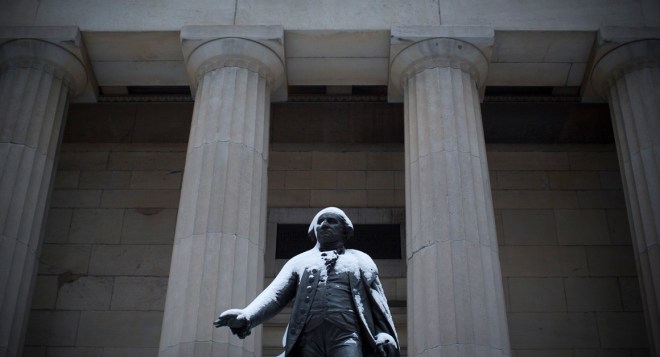
George Washington’s Farewell Warning: Partisanship would lead to the “ruins of public liberty,” our first president said. He was more right than he knew. | POLITICO Magazine

washington

By John Avlon

When Barack Obama takes to the lectern to deliver his farewell address in Chicago on Tuesday, he’ll likely have a few things to say about a political climate that has grown viciously polarized over the past 8 years and culminated in a bruising, insult-driven campaign in 2016. If he does call out the destructive effects of hyper-partisanship on our democracy, he will be following in the footsteps of the first farewell address, by George Washington, printed in the American Daily Advertiser on September 19, 1796.

Washington warned of the dangers of political factions to democratic republics throughout history. His aversion to partisanship reflected the fact that just a few decades earlier, in 1746, political parties had driven England to civil war. This first farewell address, from our only truly independent president, hearkens back to an age when distrust of political divisions was perhaps higher than it is now—and offers a solution to what ails us today.

“I was no party man myself,” Washington wrote Thomas Jefferson,“and the first wish of my heart was, if parties did exist, to reconcile them.” As our first and only independent president, Washington’s independence was a function not only of his pioneering place in American history but also of political principles he developed over a lifetime.

To Washington, moderation was a source of strength. He viewed its essential judiciousness as a guiding principle of good government, rooted in ancient wisdom as well as Enlightenment-era liberalism. Much could be achieved “by prudence, much by conciliation, and much by firmness.” A stable, civil society depends on resisting intolerant extremes. The Constitution did not mention political parties, and during the debate over ratification, James Madison and Alexander Hamilton praised the Constitution’s “spirit of moderation” in contrast to the “intolerant spirit” of “those who are ever so much persuaded of their being in the right in any controversy.”

Washington was nonpartisan but he was not neutral. He was decisive after consulting differing opinions. “He seeks information from all quarters, and judges more independently than any man I ever knew,” attested Vice President John Adams.

Washington understood the danger of demagogues in a democracy. He was a passionate advocate of moderation as a means of calming partisan passions and creating problem-solving coalitions. Adams also believed that “without the great political virtues of humility, patience, and moderation … every man in power becomes a ravenous beast of prey.”

And it was a source of personal pain for Washington to see his Cabinet degenerate into exaggerated suspicions and vicious slanders during his presidency. Most frustrating was to watch his motives twisted and attacked for partisan gain by “infamous scribblers” in the newspapers. Even in the days after winning independence from Britain, Washington warned of the dangerous interplay between extremes. “There is a natural and necessary progression from the extreme of anarchy to the extreme of tyranny,” he wrote in his Circular Letter to the States, and “arbitrary power is most easily established on the ruins of liberty abused to licentiousness.” As liberty in France turned to anarchy and then tyranny during his administration, it confirmed his deepest instincts.

As a young man, Washington devoured the popular early-eighteenth century essays of Joseph Addison in the Spectator of London. Addison was the author of his favorite play, Cato, and while reflecting on the sources of England’s bloody civil war in the 1640s, he had written an influential essay on “the Malice of Parties.” It’s worth quoting at length: “There cannot a greater judgment befall a country than a dreadful spirit of division as rends a government into two distinct people, and makes them greater strangers, and more averse to one another, than if they were actually two different nations. The effects of such a division are pernicious to the last degree, not only with regard to those advantages which they give the common enemy, but to those private evils which they produce in the heart of almost every particular person. This influence is very fatal both to men’s morals and their understandings; it sinks the virtue of a nation, and not only so, but destroys even common sense. A furious party spirit, when it rages in its full violence, exerts itself in civil war and bloodshed; and when it is under its greatest restraints, naturally breaks out in falsehood, detraction, calumny, and a partial administration of justice. In a word, it fills a nation with spleen and rancor, and extinguishes all the seeds of good nature, compassion and humanity.”

Addison was not the only wise voice warning the revolutionary generation against the danger of hyper-partisanship. The English poet Alexander Pope declared that party spirit “is but the madness of many for the gain of a few.” The early 18th-century British opposition leader Henry St. John, 1st Viscount of Bolingbroke, described parties as “a political evil.” Informed by experience in both journalism and politics, Bolingbroke wrote that “a man who has not seen the inside of parties, nor had opportunities to examine nearly their secret motives, can hardly conceive how little share principle of any sort, though principle of some sort or other be always pretended, has in the determination of their conduct.”

The founding fathers’ suspicion of faction was rooted in the classical tradition that celebrated the virtue of moderation—and the subsequent independence of thought and action that moderation can create. “According to the classical doctrine, membership in a political party inevitably involved defending the indefensible vices of one’s allies and attempting to dominate one’s fellow citizens in order to satisfy a narrow self-interest,” wrote historian Carl J. Richard in The Founders and the Classics in 1994. “In the eighteenth century the greatest compliment one man could pay another was to call him ‘disinterested.’ To be disinterested was to place justice above all considerations, including one’s own interests and those of one’s family, friends and political allies.”

Throughout his career in Virginia’s House of Burgesses and as president of the Constitutional Convention, Washington took labors to remain in the role of moderate. In his twenties, while serving in the Virginia legislature, when the House of Burgesses was divided between moderates and militants in their resistance to the British royals, Washington played a pivotal role by bridging the divides with personal diplomacy, dining with leaders of the different factions.

During the war, there was no political will to raise revenue to pay the soldiers. Washington’s frustration with the weak and fractured Congress helped form his belief that a strong central government led by an honest, energetic executive was essential to a successful democracy.

Amid “the want of harmony in our councils—the declining zeal of the people,” Washington wrote his friend Gouverneur Morris, “it is well worth the ambition of a patriot statesman at this juncture to endeavor to pacify party differences—to give fresh vigor to the springs of government—to inspire the people with confidence.”

Washington’s call for a “patriot statesman” echoed Bolingbroke’s call for a “Patriot King” in a widely read 1749 pamphlet that articulated an antidote to the corruption and fanaticism of parties that led to England’s civil war. For Bolingbroke, the ideal was a benign monarch who could “defeat the designs, and break the spirit of faction” in a parliamentary democracy, toward the goal of delivering “true principles of government independent of all.” Washington’s substitution of “statesman” for “king” reframed the concept for an American audience. The ideal of a strong leader who operated beyond partisanship retained its attractiveness.

When Washington became president, he intended to establish a government above faction and special interests. “No local prejudices or attachments; no separate views, nor party animosities,” he promised in his first inaugural address, “will misdirect the comprehensive and equal eye which ought to watch over this great assemblage of communities and interests.”

Washington did not want or expect unanimity of opinion in his Cabinet, perhaps reflecting the idea that in a place where everyone thinks alike, no one is thinking very much. He was aware of his limits on specific issues—especially law and finance. A competition of ideas and opinions was something to be celebrated, as he made clear in a letter to the governor of North Carolina two months after taking the oath of office: “A difference of opinion on political points is not to be imputed to freemen as a fault, since it is to be presumed that they are all actuated by an equally laudable and sacred regard for the liberties of their country.”

But as Washington preached an enlightened self-interest consistent with classical liberalism, dissension grew in his Cabinet ranks, as political divisions hardened and suspicions drove onetime allies apart. He was always aware that these fault lines could rupture the fragile federal government.

“My greatest fear has been that the nation would not be sufficiently cool and moderate in making arrangements for the security of that liberty,” he wrote after nine months in office. “If we mean to support the liberty and independence which it has cost us so much blood and treasure to establish,” he wrote to Rhode Island governor Arthur Fenner, “we must drive far away the demon of party spirit and local reproach.”

In the spring of 1796, when he picked back up the first draft of his farewell address, which Washington had asked Madison to draft in his first term, Washington added new language explaining to the public that given the “considerable changes … both at home and abroad, I shall ask your indulgence while I express with more lively sensibility the following most ardent wishes of my heart.”

The next line in the draft drove right to the rise of faction: “That party disputes among all the friends and lovers of their country may subside, or, as the wisdom of Providence hath ordained that men, on the same subjects, shall not always think alike, that charity and benevolence, when they happen to differ, may so far shed their benign influence as to banish those invectives which proceed from illiberal prejudices and jealousy.”

In a line he deleted from the final draft, Washington went even further, warning that in a large republic, a military coup was unlikely to undermine democracy, even if backed by the wealthy and powerful. The base of the country was too broad. “In such republics,” he said, “it is safe to assert that the conflicts of popular factions are the chief, if not the only, inlets of usurpation and tyranny.”

Washington acknowledged that the spirit of party “unfortunately, is inseparable from our nature, having its root in the strongest passions of the human mind. It exists under different shapes in all governments.” But he understood partisans’ perspective, stating plainly, “there is an opinion that parties in free countries are useful checks upon the administration of the government and serve to keep alive the spirit of liberty. This within certain limits is probably true.”

Beyond those wise limits, Washington warned, rampant factions were a “fatal tendency” in democracies. The thin history of republics up to that point showed that partisan factions led by “cunning, ambitious and unprincipled men” distorted democracies by pursuing narrow agendas at the expense of the national interest. Washington identified regional parties based on “geographical discriminations” as a particular danger, because they undermined national unity in pursuit of power. “Designing men may endeavor to excite a belief that there is a real difference of local interests and views” by misrepresenting the “opinions and aims” of people from other states and regions. “You cannot shield yourselves too much against the jealousies and heartburnings which spring from these misrepresentations,” Washington warned. “They tend to render alien to each other those who ought to be bound together by fraternal affection.”

But the greatest danger could spring from the chaos of a dysfunctional democracy, compounded by relentless party warfare, which, Washington warned, would erode faith in the effectiveness of self-governance and open the door to a demagogue with authoritarian ambitions. “The disorders and miseries which result gradually incline the minds of men to seek security and repose in the absolute power of an individual; and sooner or later the chief of some prevailing faction, more able or more fortunate than his competitors, turns this disposition to the purposes of his own elevation, on the ruins of public liberty.”

Washington’s remedy was modest but comprehensive: Partisanship could not be removed from democracy, but it could be constrained by vigilant citizens and the sober-minded separation of powers. “The common and continual mischiefs of the spirit of party are sufficient to make it the interest and duty of a wise people to discourage and restrain it,” Washington wrote. Doubling down for emphasis, he added that “there being constant danger of excess, the effort ought to be, by force of public opinion, to mitigate and assuage it.”

For Washington, this wise balance was the prime pillar of our political liberty. By devoting so much of his farewell address to warning about the dangers of hyper-partisanship, Washington penned a manifesto for moderation, a guide for future leaders and citizens who would try to walk the line between the extremes, focused on the never-ending task of forming a more perfect union.

Now, in 2017, after an eight-year presidency that promised to bridge our divides but confronted the political reality of polarization and the election of a successor whose victory has highlighted the deep divisions in America, Washington’s vision for vigorous citizens checking the rise of extreme partisanship is striking in its relevance. We need to heed Washington’s warning.

Source: POLITICO Magazine

NASA-Backed Study Says Humanity Is Pretty Much Screwed | Gizmodo

By Robert Sorokonitch

HotEarthHope you’ve enjoyed civilized life, folks. Because a new study sponsored by NASA’s Goddard Space Flight Center says the world’s industrial societies are poised to collapse under the weight of their own unsustainable appetites for resources. There goes the weekend . . . and everything after it for the rest of our lives.

NASA released a statement clarifying its involvement, saying this study “was not solicited, directed or reviewed by NASA. It is an independent study by the university researchers utilizing research tools developed for a separate NASA activity.”

The research article appears in the peer-reviewed scientific journal Ecological Economics, but Dr. Nafeez Ahmed, executive director of the Institute for Policy Research & Development, has a more understandable (but no less harrowing) summary over at The Guardian. Either way, the news isn’t good—as the researchers point out, history doesn’t seem to hold out any favor for advanced societies.

The fall of the Roman Empire, and the equally (if not more) advanced Han, Mauryan, and Gupta Empires, as well as so many advanced Mesopotamian Empires, are all testimony to the fact that advanced, sophisticated, complex, and creative civilizations can be both fragile and impermanent.

Who’s to blame? You. Me. Everyone walking around outside your window. Even the technology we invented to save us from ourselves is contributing to our decline.

Technological change can raise the efficiency of resource use, but it also tends to raise both per capita resource consumption and the scale of resource extraction, so that, absent policy effects, the increases in consumption often compensate for the increased efficiency of resource use.

Is there a way out? Of course. But you’re probably not gonna like it. Dr. Ahmed sums up the researchers’ suggestions:

The two key solutions are to reduce economic inequality so as to ensure fairer distribution of resources, and to dramatically reduce resource consumption by relying on less intensive renewable resources and reducing population growth.

Which is just as difficult and improbable as it sounds.

Seriously, you should read the whole rundown of what the research says. It’s eye-opening, and a serious call to action—if the crushing bleakness of what we’ve done to ourselves hasn’t already doomed you to abandon all hope. Here, watch a funny video to make you feel better. [The Guardian]

Source: Gizmodo

We Are the New Civilization

sanctuarylabyrinth-432.jpg
Photo: Crestone, Colorado

As Gandhi once said, “Civilization, would be a good idea.”

We are here.
We are waking up now, out of the past, to dream a bigger dream.
We are friends and equals, we are diverse and unique and we’re united for something bigger than our differences.
We believe in freedom and cooperation, abundance and harmony.
We are a culture emerging, a renaissance of the essence of humanity.
We find our own guidance, and we discern our own truth.
We go in many directions, and yet we refuse to disperse.
We have many names, we speak many languages.
We are local, we are global.

We are in all regions of the world, we’re everywhere in the air.
We are universe being aware of itself, we are the wave of evolution.
We are in every child’s eyes, we face the unknown with wonder and excitement.
We are messengers from the future, living in the present.
We come from silence and we speak our truth.
We cannot be quieted, because our voice is within everyone.

We have no enemies, no boundaries can hold us.
We respect the cycles and expressions of nature, because we are nature.
We don’t play to win, we play to live and learn.
We act out of inspiration, love and integrity.
We explore, we discover, we feel and we laugh.
We are building a world that works for everyone.
We endeavor to live our lives to their fullest potential.
We are independent, self-sufficient and responsible.
We relate to each other in peace, with compassion and respect, we unite in community.
We celebrate the wholeness within and around us all.
We dance to the rhythm of creation.
We weave the threads of the new times.
We are the new civilization.

Source: Submitted by Linda, Author Unknown