Sen. Warren and Prof. Lessig: Constitutional Accountability Center | Bill Moyers

In an event sponsored by the Constitutional Accountability Center, Senator Elizabeth Warren (D-MA) and Professor Lawrence Lessig, director of Harvard’s Edmond J. Safra Foundation Center for Ethics, discuss why they believe the founding fathers would disagree with the way in which the Supreme Court interpreted the term “corruption” in its ruling on Citizens United v. FEC, the decision that allowed outside groups like super PACs to pour unlimited money into the political process.

A new case before the Court this term, McCutcheon v. FEC, could mean the repeal of limits on the amount individuals can give to candidates — basically, Citizens United 2.0.

“The Framers had a very specific conception of the term ‘corruption’ in mind, one at odds with McCutcheon’s more modern understanding of that term,” Lessig wrote in an amicus brief for the case. “For the Framers, ‘corruption’ predicated of institutions as well as individuals, and when predicated of institutions, was often constituted by an ‘improper dependence.’

“…The aggregate limits, which permit an individual to make a total of $123,200 in contributions in each two-year election cycle ($48,600 to candidates and $74,600 to political parties and non-party political committees), play a necessary role in securing a government free from corrupting dependence on high-dollar donors. By preventing massive hard money contributions to candidates and their political parties, the aggregate limits aim to prevent the very sort of improper dependence on outside forces that the Framers wrote the Constitution to check.”

Source: Bill Moyers

DOJ pursues immunity for Bush and six others for Iraq war crimes | The Examiner

By David Phillips

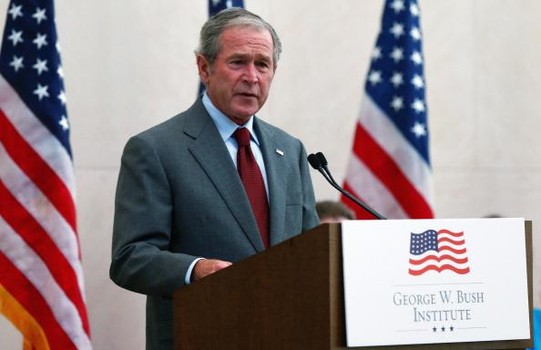
George W. Bush Speaks At Naturalization Ceremony At Bush Presidential CenterThe Department of Justice has filed a Grant of Immunity for war crimes against George W. Bush, Richard Cheney, Condoleezza Rice, Colin Powell, Paul Wolfowitz, and Donald Rumsfeld. The filing for the immunity of war crimes was made with the United States District Court, Northern District of California San Francisco Division.

The filing is for procedural immunity in a case alleging that they planned and waged the Iraq War in violation of international law.

The Plaintiff in this case is Sundus Shaker Saleh, an Iraqi single mother and refugee now living in Jordan. She filed a complaint in March 2013 in a San Francisco federal court alleging that the planning and waging of the war constituted a “crime of aggression” against Iraq, a legal theory that was used by the Nuremberg Tribunal to convict Nazi war criminals after World War II.

In her lawsuit, Saleh alleges that:

  • Richard Cheney, Donald Rumsfeld and Paul Wolfowitz began planning the Iraq War in 1998 through their involvement with the “Project for the New American Century,” a Washington DC non-profit that advocated for the military overthrow of Saddam Hussein.
  • Once they came to power, Saleh alleges that Cheney, Rumsfeld and Wolfowitz convinced other Bush officials to invade Iraq by using 9/11 as an excuse to mislead and scare the American public into supporting a war.
  • Finally, she claims that the United States failed to obtain United Nations approval prior to the invasion, rendering the invasion illegal and an act of impermissible aggression.

“The DOJ claims that in planning and waging the Iraq War, ex-President Bush and key members of his Administration were acting within the legitimate scope of their employment and are thus immune from suit,” chief counsel Inder Comar of Comar Law said.

The “Westfall Act certification,” submitted pursuant to the Westfall Act of 1988, permits the Attorney General, at his or her discretion, to substitute the United States as the defendant and essentially grant absolute immunity to government employees for actions taken within the scope of their employment.

“The good news is that while we were disappointed with the certification, we were prepared for it,” Comar stated. “We do not see how a Westfall Act certification is appropriate given that Ms. Saleh alleges that the conduct at issue began prior to these defendants even entering into office. I think the Nuremberg prosecutors, particularly American Chief Prosecutor Robert Jackson, would be surprised to learn that planning a war of aggression at a private non-profit, misleading a fearful public, and foregoing proper legal authorization somehow constitute lawful employment duties for the American president and his or her cabinet.”

The case is Saleh v. Bush (N.D. Cal. Mar. 13, 2013, No. C 13 1124 JST).

Source: The Examiner

It’s Official: US Funding Al Qaeda and Taliban |Charleston Voice

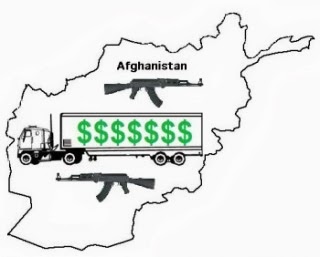
Afghanistan$$$By Dr. Stuart Jeanne Bramhall

It’s extremely ironic for the US State Department to be issuing travel alerts for US citizens in the Middle East and North Africa the same week we learn that the Pentagon is contracting with Al Qaeda and Taliban supporters to carry out Afghan reconstruction projects.

Tony Capaccio of Bloomberg News cites a quarterly report to Congress by Special Inspector for Afghan Reconstruction John Sopko.

The report reveals Sopko asked the US Army Suspension and Disbarment office to cancel 43 contracts to known Al Qaeda and Taliban supporters. They refused. The reason? The Suspension and Disbarment Office claims it would violate Al Qaeda and Taliban “due process rights.”

Curious, isn’t it? Official terrorist groups have due process rights, but not whistleblowers, Guantanamo detainees, or ordinary Americans subject to continual surveillance by NSA.

The intelligence community has been quietly leaking evidence for more than a decade that the US is secretly funding Al Qaeda to promote political instability (and justify continued military intervention) in the Middle East. In the last two years the CIA has been caught red-handed funding and training Al Qaeda militants in Libya and Syria.

Based on Sopko’s report, Pentagon support for Al Qaeda and the Taliban is official as of August 1.

Let me see if I can think this through: the Pentagon is giving Al Qaeda and the Taliban funding, even though Al Qaeda and the Taliban are planning to carry out attacks on US citizens. How can this be happening? It would appear the US government is at war with their own people.

The 236 page quarterly report Sopko submitted to Congress also raises grave concerns about Obama’s request for $10.7 billion in 2014 for Afghan reconstruction projects. All would be carrying out by civilian contractors, of which 30-40% would be local Afghan businesses.

Sopko argues the Pentagon already fails abysmally in monitoring an existing $32 million program to install bars or gratings in culverts to prevent insurgents from planting roadside bombs in them. He thinks at bare minimum the Department of Defense should now how many contracts they have issued under this program. They don’t. Thus is seems pretty obvious they aren’t vetting the contractors, much less monitoring where the money is going.

Source: Charleston Voice

OpenSecrets.org’s Resources on Politically Active Tax-Exempt Groups

The first congressional hearing triggered by the news that the Internal Revenue Service inappropriately targeted tea party groups for additional scrutiny begins Friday, and it’s clear the issue isn’t going away anytime soon.

The Center for Responsive Politics has been intensively researching and writing about politically active nonprofits — also known as 501(c)(4) organizations, or, more colloquially, “dark money” groups — for more than a year. Since the 2010 Citizens United Supreme Court decision freed them to participate more directly in electoral politics, they have been used to pour money into the system at an unprecedented rate.

There has been an explosion of spending by nonprofit groups over the last three election cycles, from less than $17 million in 2006 to well over $300 million in 2012.
nonprofit spending growth by type.JPG
These groups, unlike the more commonly known super PACs, are not required to divulge the names of their donors, and much of their spending is unreported, too. Their annual tax filings with the IRS list how much money they have, who their officers are and the recipients of any grants they may have made.

But when they spend their money directly in support of or opposition to a candidate, they must report to the Federal Election Commission. FEC data collected and analyzed by OpenSecrets.org shows that in the 2012 election alone, politically active nonprofits reported spending more than $308 million. Many millions more were likely spent on “issue ads” that escaped reported rules.

If you follow that link, you’ll notice none of the organizations at the top of our list are tea party groups. In fact, they have remained relatively small players in the game.
What we do know is that many of these groups on the list are conservative in nature — though they come in many flavors of conservative. There are several important liberal groups active in this area, as well, but right-leaning groups dominate. About 85 percent of the money that was spent by nonprofits in the 2012 cycle, as reported to the FEC, was paid out by conservative groups.
nonprofit spending growth by viewpt.JPG
We’ve also applied old-fashioned reporting in our effort to bring these groups to the public’s attention, in particular with our Shadow Money Trail series. Despite the current concern about IRS employees applying too much scrutiny to certain groups because of their political slant, we’ve actually found many instances where political operatives from across the spectrum seem to be taking advantage of the fact that the IRS generally applies very little scrutiny to these entities.

By painstakingly going through public tax returns filed by tax-exempt groups, we have been able to trace how some of the money has flowed between them. We have posted that information (here’s an example) when we have it.

Some of the topics we’ve covered in this series:
  • How conservative group American Committment seemed to make $10 million disappear by churning money between its various related groups.
  • How Obama’s dark money allies make big payments to political consultants.
  • The phenomenon of dark money mailboxes — social welfare organizations that act as way stations for dark money and have few or no activities of their own.
  • How one prominent liberal group churns money through a confusing web of similarly named 501(c)(4)s and 527 groups.

There are a host of other stories on our Shadow Money Trail page, including “Shadow Money Magic,” our five-part report on how some of these groups game the IRS.

Source: OpenSecrets.org

Holder: Big Banks’ Clout “Has an Inhibiting Impact” on Prosecutions | Frontline

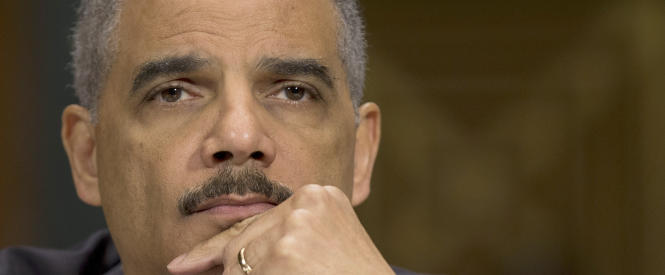
Eric HolderAttorney General Eric Holder said that the Justice Department had considered the economic fallout that could result from prosecuting major banks for their role in the financial crisis, in Senate testimony on Tuesday.

Holder’s comments underscored remarks his deputy, Lanny Breuer, gave in an interview for FRONTLINE’s film The Untouchables that raised concerns among some in government that the Justice Department hasn’t been sufficiently aggressive in prosecuting major banks for the fiscal crisis.

“I am concerned that the size of some of these institutions becomes so large that it does become difficult to prosecute them,” Holder told the Senate Judiciary Committee. “When we are hit with indications that if you do prosecute, if you do bring a criminal charge it will have a negative impact on the national economy, perhaps world economy, that is a function of the fact that some of these institutions have become too large. It has an inhibiting impact on our ability to bring resolutions that I think would be more appropriate. That is something that you all need to consider.”

Holder added that he felt the department had been “appropriately aggressive,” in pursuing and bringing cases where it could prove companies or individuals had broken the law. “These are not easy cases to make,” he said. “Things were done wrong, but the question is whether they’re illegal.”

So far, no Wall Street executives have been prosecuted for fraud in connection with the financial crisis.

Breuer’s interview, which you can read in full here, sparked a Jan. 29 letter from Sens. Charles Grassley (R-Iowa) and Sherrod Brown (D-Ohio) asking for more information on how the Justice Department determined which cases to prosecute. It also asked for the names of any outside experts Justice consulted, and what they were paid.

The Justice Department responded (pdf) one month later, defending its record. But the senators said the letter was “aggressively evasive” and didn’t answer their questions.

On Tuesday, Holder told Grassley that the DOJ would “endeavor to answer” the senators’ letter.

Holder’s full testimony is embedded below. (The exchange on financial fraud prosecutions begins around the 2:17:22 mark.)

Source: Frontline

Audit of the Federal Reserve Reveals $16 Trillion in Secret Bailouts | Unelected

The first ever GAO(Government Accountability Office) audit of the Federal Reserve was carried out in the past few months due to the Ron Paul, Alan Grayson Amendment to the Dodd-Frank bill, which passed last year. Jim DeMint, a Republican Senator, and Bernie Sanders, an independent Senator, led the charge for a Federal Reserve audit in the Senate, but watered down the original language of the house bill(HR1207), so that a complete audit would not be carried out.

Ben Bernanke (pictured to the right), Alan Greenspan, and various other bankers vehemently opposed the audit and lied to Congress about the effects an audit would have on markets. Nevertheless, the results of the first audit in the Federal Reserve’s nearly 100 year history were posted on Senator Sander’s webpage earlier this morning.

What was revealed in the audit was startling: $16,000,000,000,000.00 had been secretly given out to US banks and corporations and foreign banks everywhere from France to Scotland. From the period between December 2007 and June 2010, the Federal Reserve had secretly bailed out many of the world’s banks, corporations, and governments. The Federal Reserve likes to refer to these secret bailouts as an all-inclusive loan program, but virtually none of the money has been returned and it was loaned out at 0% interest. Why the Federal Reserve had never been public about this or even informed the United States Congress about the $16 trillion dollar bailout is obvious — the American public would have been outraged to find out that the Federal Reserve bailed out foreign banks while Americans were struggling to find jobs.

To place $16 trillion into perspective, remember that GDP of the United States is only $14.12 trillion. The entire national debt of the United States government spanning its 200+ year history is “only” $14.5 trillion. The budget that is being debated so heavily in Congress and the Senate is “only” $3.5 trillion. Take all of the outrage and debate over the $1.5 trillion deficit into consideration, and swallow this Red pill: There was no debate about whether $16,000,000,000,000 would be given to failing banks and failing corporations around the world.

In late 2008, the TARP Bailout bill was passed and loans of $800 billion were given to failing banks and companies. That was a blatant lie considering the fact that Goldman Sachs alone received 814 billion dollars. As is turns out, the Federal Reserve donated $2.5 trillion to Citigroup, while Morgan Stanley received $2.04 trillion. The Royal Bank of Scotland and Deutsche Bank, a German bank, split about a trillion and numerous other banks received hefty chunks of the $16 trillion.

When you have conservative Republican stalwarts like Jim DeMint(R-SC) and Ron Paul(R-TX) as well as self identified Democratic socialists like Bernie Sanders all fighting against the Federal Reserve, you know that it is no longer an issue of Right versus Left. When you have every single member of the Republican Party in Congress and progressive Congressmen like Dennis Kucinich sponsoring a bill to audit the Federal Reserve, you realize that the Federal Reserve is an entity onto itself, which has no oversight and no accountability.

Americans should be swelled with anger and outrage at the abysmal state of affairs when an unelected group of bankers can create money out of thin air and give it out to megabanks and supercorporations like Halloween candy. If the Federal Reserve and the bankers who control it believe that they can continue to devalue the savings of Americans and continue to destroy the US economy, they will have to face the realization that their trillion dollar printing presses will eventually plunder the world economy.

The list of institutions that received the most money from the Federal Reserve can be found on page 131 of the GAO Audit and are as follows..

Citigroup: $2.5 trillion ($2,500,000,000,000)
Morgan Stanley: $2.04 trillion ($2,040,000,000,000)
Merrill Lynch: $1.949 trillion ($1,949,000,000,000)
Bank of America: $1.344 trillion ($1,344,000,000,000)
Barclays PLC (United Kingdom): $868 billion ($868,000,000,000)
Bear Sterns: $853 billion ($853,000,000,000)
Goldman Sachs: $814 billion ($814,000,000,000)
Royal Bank of Scotland (UK): $541 billion ($541,000,000,000)
JP Morgan Chase: $391 billion ($391,000,000,000)
Deutsche Bank (Germany): $354 billion ($354,000,000,000)
UBS (Switzerland): $287 billion ($287,000,000,000)
Credit Suisse (Switzerland): $262 billion ($262,000,000,000)
Lehman Brothers: $183 billion ($183,000,000,000)
Bank of Scotland (United Kingdom): $181 billion ($181,000,000,000)
BNP Paribas (France): $175 billion ($175,000,000,000)
and many many more including banks in Belgium of all places

View the 266-page GAO audit of the Federal Reserve(July 21st, 2011): http://www.scribd.com/doc/60553686/GAO-Fed-Investigation

Source: http://www.gao.gov/products/GAO-11-696
FULL PDF on GAO server: http://www.gao.gov/new.items/d11696.pdf
Senator Sander’s Article: http://sanders.senate.gov/newsroom/news/?id=9e2a4ea8-6e73-4be2-a753-62060dcbb3c3

Criminal Charges Loom For Goldman Sachs After Scathing Senate Report | Forbes

By Halah Touryalai

A Senate panel released a damning report accusing the likes of Goldman Sachs of engaging in massive conflicts of interest, contaminating the U.S. financial system with toxic mortgages and undermining public trust in U.S. markets in the months leading up to the financial crisis.

Just when you thought Washington lawmakers were over that whole financial crisis thing, Senator Carl Levin, D-Mich., and Senator Tom Coburn M.D., R-Okla, blast Wall Street in a 635-page report stemming from a 2-year bipartisan investigation on the key causes of the crisis.

The report comes at a time when much of the feeling from lawmakers in Washington is that Wall Street is being over-regulated by the new Dodd-Frank rules.

The report from the Senate’s Permanent Subcommittee on Investigations however takes an opposite view by citing internal documents and private communications of bank executives, regulators, credit ratings agencies and investors to depict an industry that  was rife with conflicts of interest and reckless during the mortgage surge.

Senator Levin said in the release yesterday:

“Using emails, memos and other internal documents, this report tells the inside story of an economic assault that cost millions of Americans their jobs and homes, while wiping out investors, good businesses, and markets,” said Levin. “High risk lending, regulatory failures, inflated credit ratings, and Wall Street firms engaging in massive conflicts of interest, contaminated the U.S. financial system with toxic mortgages and undermined public trust in U.S. markets.  Using their own words in documents subpoenaed by the Subcommittee, the report discloses how financial firms deliberately took advantage of their clients and investors, how credit rating agencies assigned AAA ratings to high risk securities, and how regulators sat on their hands instead of reining in the unsafe and unsound practices all around them.  Rampant conflicts of interest are the threads that run through every chapter of this sordid story.”

The report takes specific issue with the way Goldman Sachs touted investments to clients on one end but bet against them on the other. A similar accusation against Goldman by the SEC lead to a $550 settlement last year, but Levin and his team don’t think that punishment fits the crime. From the report:

When Goldman Sachs realized the mortgage market was in decline, it took actions to profit from that decline at the expense of its clients.  New documents detail how, in 2007, Goldman’s Structured Products Group twice amassed and profited from large net short positions in mortgage related securities.  At the same time the firm was betting against the mortgage market as a whole, Goldman assembled and aggressively marketed to its clients poor quality CDOs that it actively bet against by taking large short positions in those transactions.

New documents and information detail how Goldman recommended four CDOs, Hudson, Anderson, Timberwolf, and Abacus, to its clients without fully disclosing key information about those products, Goldman’s own market views, or its adverse economic interests.  For example, in Hudson, Goldman told investors that its interests were “aligned” with theirs when, in fact, Goldman held 100% of the short side of the CDO and had adverse interests to the investors, and described Hudson’s assets were “sourced from the Street,” when in fact, Goldman had selected and priced the assets without any third party involvement.

New documents also reveal that, at one point in May 2007, Goldman Sachs unsuccessfully tried to execute a “short squeeze” in the mortgage market so that Goldman could scoop up short positions at artificially depressed prices and profit as the mortgage market declined.

This isn’t the first time Levin is gunning for Goldman. Back in April 2010, the Senator had a memorable back-and-forth with a Goldman executive during a testimony where the two discussed a “shitty deal” the firm was selling to clients.

In fact, Levin is referred to that very testimony yesterday saying he doesn’t think Goldman executives were being truthful about its activity, and that he would refer the testimony to the Department of Justice and the Securities and Exchange Commission for possible criminal investigations.

“In my judgment, Goldman clearly misled their clients and they misled the Congress,” he said.

Goldman isn’t alone in feeling Levin’s wrath though. The report also points to Deutsche Bank AG (DB) saying the Frankfurt-based company created a $1.1 billion CDO with assets that its traders referred to as “crap” and “pigs” but then attempted to sell “before the market falls off a cliff.”

Not even credit rating agencies are spared in this report which concluded that “the most immediate cause of the financial crisis was the July 2007 mass ratings downgrades by Moody’s and Standard & Poor’s that exposed the risky nature of mortgage-related investments that, just months before, the same firms had deemed to be as safe as Treasury bills.”

Here’s more:

Internal emails show that credit rating agency personnel knew their ratings would not “hold” and delayed imposing tougher ratings criteria to “massage the … numbers to preserve market share.”  Even after they finally adjusted their risk models to reflect the higher risk mortgages being issued, the firms often failed to apply the revised models to existing securities, and helped investment banks rush risky investments to market before tougher rating criteria took effect.

They also continued to pull in lucrative fees of up to $135,000 to rate a mortgage backed security and up to $750,000 to rate a collateralized debt obligation (CDO) – fees that might have been lost if they angered issuers by providing lower ratings.  The mass rating downgrades they finally initiated were not an effort to come clean, but were necessitated by skyrocketing mortgage delinquencies and securities plummeting in value.  In the end, over 90% of the AAA ratings given to mortgage-backed securities in 2006 and 2007 were downgraded to junk status, including 75 out of 75 AAA-rated Long Beach securities issued in 2006.

When sound credit ratings conflicted with collecting profitable fees, credit rating agencies chose the fees.

Among the 19 recommendations from the panel on how to handle the problems is one suggestion that asks the SEC to rank credit rating agencies according to the accuracy of their ratings.

At this stage, do we think the SEC can handle that?

Source:  Forbes

Report: Big Profits Drove Faulty Ratings at Moody’s, S&P | McClatchy Newspapers

By Kevin G. Hall

Analysts who reviewed complex mortgage bonds that ultimately collapsed and ruined the U.S. housing market were threatened with firing if they lost lucrative business, prompting faulty ratings on trillions of dollars worth of junk mortgage bonds, a Senate report said Wednesday.The 639-page report by the Senate Permanent Subcommittee on Investigations confirms much of what McClatchy first reported about mismanagement by credit ratings agencies in 2009.

Credit rating agencies are supposed to provide independent assessments on the quality of debt being issued by companies or governments. Traditionally, investments rated AAA had a probability of failure of less than 1 percent.

But in collusion with Wall Street investment banks, the Senate report concludes, the top two ratings agencies — Moody’s Investors Service and Standard & Poor’s — effectively cashed in on the housing boom by ignoring mounting evidence of problems in the housing market.

“Instead of using this information to temper their ratings, the firms continued to issue a high volume of investment-grade ratings for mortgage backed securities,” the report said.

Profits at both companies soared, with revenues at market leader Moody’s more than tripling in five years. Then the bottom fell out of the housing market, and Moody’s stock lost 70 percent of its value; it has yet to fully recover. More than 90 percent of AAA ratings given in 2006 and 2007 to pools of mortgage-backed securities were downgraded to junk status.

Wednesday’s report provided greater detail about the behavior of Brian Clarkson, the president of Moody’s at the time of his departure in mid-2008, when the financial crisis was in full bloom.

Clarkson rose from the head of Structured Finance, which rated complex bonds backed by U.S. mortgages, to president of the company. His rise paralleled the decline in ratings quality. He has refused to talk to McClatchy or other news organizations, and was scheduled to testify last year before the Financial Crisis Inquiry Commission but was rushed to the hospital with a kidney stone.

Analysts had confided to McClatchy that Clarkson bullied and threatened them as he rose up the ranks, and the Senate report details that in numerous emails. One email dating to 2003 shows Clarkson suggesting the need to “refine our approach” to keep pace with competitors “easing their standards to capture (market) share.”

Similarly, an S&P employee in an August 2006 email described his company’s cozy relationship with Wall Street banks this way: “They’ve become so beholden to their top issuers for revenue they have all developed a kind of Stockholm syndrome…”

Stockholm syndrome is the bond a kidnapping victim feels with captors.

Source:  McClatchy Newspapers

Foreign Banks Tapped Feds Secret Lifeline Most at Crisis Peak | Bloomsberg

By Bradley Keoun and Craig Torres

U.S. Federal Reserve Chairman Ben S. Bernanke’s two-year fight to shield crisis-squeezed banks from the stigma of revealing their public loans protected a lender to local governments in Belgium, a Japanese fishing-cooperative financier and a company part-owned by the Central Bank of Libya.

Dexia SA (DEXB), based in Brussels and Paris, borrowed as much as $33.5 billion through its New York branch from the Fed’s “discount window” lending program, according to Fed documents released yesterday in response to a Freedom of Information Act request. Dublin-based Depfa Bank Plc, taken over in 2007 by a German real-estate lender later seized by the German government, drew $24.5 billion.

The biggest borrowers from the 97-year-old discount window as the program reached its crisis-era peak were foreign banks, accounting for at least 70 percent of the $110.7 billion borrowed during the week in October 2008 when use of the program surged to a record. The disclosures may stoke a reexamination of the risks posed to U.S. taxpayers by the central bank’s role in global financial markets.

“The caricature of the Fed is that it was shoveling money to big New York banks and a bunch of foreigners, and that is not conducive to its long-run reputation,” said Vincent Reinhart, the Fed’s director of monetary affairs from 2001 to 2007.

Commercial Paper

Separate data disclosed in December on temporary emergency- lending programs set up by the Fed also showed big foreign banks as borrowers. Six European banks were among the top 11 companies that sold the most debt overall — a combined $274.1 billion — to the Commercial Paper Funding Facility.

Those programs also loaned hundreds of billions of dollars to the biggest U.S. banks, including JPMorgan Chase & Co. (JPM), Bank of America Corp. (BAC), Citigroup Inc. and Morgan Stanley. (MS)

The discount window, which began lending in 1914, is the Fed’s primary program for providing cash to banks to help them avert a liquidity squeeze. In an April 2009 speech, Bernanke said that revealing the names of discount-window borrowers “might lead market participants to infer weakness.”

The Fed released the documents after court orders upheld FOIA requests filed by Bloomberg LP, the parent company of Bloomberg News, and News Corp.’s Fox News Network LLC. In all, the Fed released more than 29,000 pages of documents, covering the discount window and several Fed emergency-lending programs established during the crisis from August 2007 to March 2010.

Public Outrage

“The American people are going to be outraged when they understand what has been going on,” U.S. Representative Ron Paul, a Texas Republican who is chairman of the House subcommittee that oversees the Fed, said in a Bloomberg Television interview.

“What in the world are we doing thinking we can pass out tens of billions of dollars to banks that are overseas?” said Paul, who has advocated abolishing the Fed. “We have problems here at home with people not being able to pay their mortgages, and they’re losing their homes.”

David Skidmore, a Fed spokesman, declined to comment. Fed officials have said all the discount window loans made during the worst financial crisis since the 1930s have been repaid with interest.

The Monetary Control Act of 1980 says that a U.S. branch or agency of a foreign bank that maintains reserves at a Fed bank may receive discount-window credit.

“Our job is to provide liquidity to keep the American economy going,” Richard W. Fisher, president of the Federal Reserve’s regional bank in Dallas, told reporters today. “The loans were all paid back and they were well-collateralized.”

Wachovia’s Loans

Wachovia Corp. was the only U.S. bank among the top five discount-window borrowers as the crisis peaked.

The company, based in Charlotte, North Carolina, borrowed $29 billion from the discount window on Oct. 6, in the week after it almost collapsed, the data show. Wachovia agreed in principle to sell itself to Citigroup Inc. on Sept. 29, before announcing a definitive agreement to sell itself to Wells Fargo & Co. (WFC) on Oct. 3. The Wells Fargo deal closed at the end of 2008.

Wells Fargo spokeswoman Mary Eshet declined to comment on Wachovia’s discount-window borrowing.

Bank of Scotland Plc, which had $11 billion outstanding from the discount window on Oct. 29, 2008, was a unit of Edinburgh-based HBOS Plc, which announced its takeover by London-based Lloyds TSB Group Plc in September 2008.

The borrowings in 2008 didn’t involve Lloyds, which hadn’t completed its acquisition of HBOS at the time, said Sara Evans, a spokeswoman for the company, which is now called Lloyds Banking Group Plc. (LLOY)

‘Historic’ Use

“This is historic usage and on each occasion the borrowing was repaid at maturity,” Evans said. “The discount window has not been accessed by the group since.”

Other foreign discount-window borrowers on Oct. 29, 2008, included Societe Generale (GLE) SA, France’s second-biggest bank; and Norinchukin Bank, which finances and provides services to Japanese agricultural, fishing and forestry cooperatives. Paris- based Societe Generale borrowed $5 billion that day, and Tokyo- based Norinchukin borrowed $6 billion.

Jim Galvin, a spokesman for Societe Generale, declined to comment.

“We used it in concert with Japanese and U.S. authorities in the purpose of contributing to the stabilization of the market,” said Fumiaki Tanaka, a spokesman at Norinchukin.

Bank of China

Bank of China, the country’s oldest bank, was the second- largest borrower from the Fed’s discount window during a nine- day period in August 2007 as subprime-mortgage defaults first roiled broader markets. The Chinese bank’s New York branch borrowed $198 million on Aug. 17 of that month.

“It was just routine borrowing,” said Dale Zhu, head of the Bank of China New York branch’s treasury.

Two Deutsche Bank AG divisions borrowed $1 billion each, according to a document released yesterday.

Arab Banking Corp., then 29 percent-owned by the Libyan central bank, used its New York branch to get at least 73 loans from the Fed in the 18 months after Lehman Brothers Holdings Inc. collapsed. The largest single loan amount outstanding was $1.2 billion in July 2009, according to the Fed documents.

The foreign banks took advantage of Fed lending programs even as their host countries moved to prop them up or orchestrate takeovers.

Dexia received billions of euros in capital and funding guarantees from France, Belgium and Luxembourg during the credit crunch.

‘High-Quality’ Collateral

The Fed loans were “secured by high-quality U.S. dollar municipal securities,” and used only to fund U.S. loans, bonds and other financial assets, Ulrike Pommee, a spokeswoman for the company, said in an e-mail.

“The Fed played its role as central banker, providing liquidity to banks that needed it,” she said, adding that Dexia’s outstanding balance at the Fed has been reduced to zero. “This information is backward-looking.”

Depfa was taken over in October 2007 by Hypo Real Estate Holding AG, which in turn was seized by the German government in 2009.

“Since the end of May 2010, Depfa is not making use of the Federal Reserve Discount Window,” Oliver Gruss, a spokesman for the bank, said in an e-mailed statement. He declined to comment further.

Dollar Assets

Many foreign banks own large pools of dollar assets — bonds, securities and loans — funded by short-term borrowings in money markets. The system works when markets are calm, said Dino Kos, former executive vice president at the New York Fed in charge of open-market operations. In times of stress, banks can be subject to sudden liquidity squeezes, he said.

“They are playing with fire,” said Kos, a managing director at Hamiltonian Associates Ltd. in New York, an economic research firm. “When the market dries up, and they can’t roll over their funding — bingo, you have a liquidity crisis.”

The potential for dollar shortages remains. As the Greek fiscal crisis roiled financial markets last year, the Fed had to open swap lines with the European Central Bank, the Swiss National Bank, the Bank of England and two other central banks to make more dollars available around the world. That move was partially the result of U.S. money market funds shrinking their exposure to European bank commercial paper.

Bloomberg News is posting the Fed documents here for subscribers to the Bloomberg Professional Service as well as online at http://www.bloomberg.com.

To contact the reporters on this story: Bradley Keoun in New York at bkeoun@bloomberg.net; Craig Torres in Washington at ctorres3@bloomberg.net

To contact the editor responsible for this story: David Scheer at dscheer@bloomberg.net

Source:  Bloomberg