Lessons From Leprosy For Coronavirus: Quarantine And Isolation Can Backfire | NPR

ap_5202240353_custom-411110ad4e887291bb9734e508582927c20cc275-s1400-c85Hundreds of people returning to the U.S. from Wuhan, China face mandatory two-week quarantines. And in China, the government is rounding up those who show signs of the deadly coronavirus, to be confined in massive quarantine centers.

Protecting public health is a delicate balance between the rights and freedom of individuals and the safety of society. But past efforts to isolate disease show that such moves — as well-intentioned as they might be — don’t always go as planned. And perhaps offer a cautionary lesson.

When my husband’s grandfather was diagnosed with leprosy in Connecticut in 1922, the first thing he did was run away. He packed his things that night and left his family and business behind to move to New York. It was the only state at the time that did not require those with this much-feared infectious disease to be sent to a remote hospital in Carville, La., and confined. By hiding from authorities, he could keep his freedom and presumably go on with his life.

He was not the only one to respond this way. When the U.S. government decided to establish a national leprosarium in 1917, it determined that the best way to contain the bacteria that caused leprosy was to segregate those infected. Since there was no cure at the time, that usually meant confinement for life. Patients were torn from their families and friends. They lost their freedom, as well as their livelihoods, civil rights and the respect of their fellow man. Women who gave birth at the hospital had their babies taken away.

Such dire consequences drove many who suspected, or knew, they had leprosy to conceal it from authorities. They avoided seeking medical assistance and failed to take steps to protect the people they loved from the remote possibility that they too might contract what we now know is a barely contagious disease.

When the federal government sought to identify all the leprosy cases in the country in the early 1900s, it found only 278. But public health investigators told Congress there likely were many more in hiding out of fear. The same year that my husband’s grandfather fled to New York, the assistant surgeon general announced that there were “1,200 lepers at large” in the country. He wanted Congress to give him the authority to round them up.

It turns out that the government’s solution was counterproductive. Instead of containing the disease, it only perpetuated it by discouraging treatment and the search for a cure. In the process, thousands of lives were disrupted and destroyed.

The current effort to contain the coronavirus differs in many ways from what happened to leprosy patients in the last century. Americans who might have been exposed to the virus in China will be quarantined for 14 days, not condemned to a lifetime of isolation. Medical treatment is much improved, and the chance for recovery is good. Still, coronavirus is much more contagious than leprosy, from which 95% of humans are naturally immune. Precautions certainly make sense.

But this latest outbreak raises similar questions to those health authorities grappled with decades ago. Are quarantines and isolation the most effective way to contain a disease? Do they make people more reluctant to identify themselves as potential victims?

“It backfires because people head for the hills,” Wendy Parmet, a professor of health law policy at Northeastern University told NPR’s Rob Stein. “People don’t call and seek health care… And health care providers become fearful of treating patients because they don’t want to get caught up in the quarantine.”

There are other questions too.

Will the U.S. decision to shut its borders to foreigners who have recently visited China do more harm than good? The World Health Organization thinks such travel bans might and has warned against any moves that instill panic and fear.

Perhaps more important, how will those believed to be potential carriers of the virus be treated by those around them? NPR’s Maria Godoy reports that some Asian Americans are already feeling some blowback. One student said she was told to leave a coffee shop and “take the coronavirus with her.”

When Americans feared a potential leprosy pandemic in the late 1800s, people of Asian descent were also unjustly stigmatized. A top Louisiana health official warned — falsely — that Chinese laundrymen were spreading the “loathsome” disease by spitting on their customer’s laundry before it was ironed. A racist labor leader, Denis Kearney, paraded a Chinese man with leprosy through the streets of San Francisco to make his case that “moon-eyed lepers” were a threat to the nation.

Throughout history, those believed to have leprosy, now called Hansen’s disease, were among the most reviled members of society, outcasts sometimes believed to be sinners who brought the illness upon themselves. Even today, the threat of leprosy is used to demonize immigrants and people living in homeless encampments as potential carriers of the disease — although there’s no evidence that’s true.

About 200,000 people around the world are diagnosed each year with Hansen’s disease. Many of them still prefer not to make their diagnosis public for fear of how they’ll be treated by the rest of society. Many delay seeking treatment even though the disease can be quickly cured with antibiotics. Those delays can lead to serious, lifelong disabilities, including the loss of limbs. It turns out that the stigma is still much more dangerous than the disease.

My husband’s grandfather was soon joined in New York City by his wife and children. He lived there for thirteen years before he got so sick that he was taken to the Carville leprosy hospital, the only place in the country that treated the disease. He died there three years later, in 1938. But it was decades before the truth came out. His wife and children were so afraid of the stigma of leprosy and how people would react, they kept his illness a secret for more than 60 years.

Source: NPR

Scenes from Wuhan’s Makeshift Hospitals for Coronavirus Patients: Like a ‘Death Camp’ | The Epoch Times

TOPSHOT-CHINA-HEALTH-VIRUS

Johnny Liberty, Editor’s Note: We were travelling in the southern island of Thailand when the Wuhan Coronavirus outbreak was first reported and noticed some of the impacts first-hand. This is a serious crisis. To avoid flying home through China, we rerouted our return flights through Australia and New Zealand.

“There is no medicine, no medical staff, no hot water, very limited food, no heating, unstable electricity… Please help us!” said one patient who was being confined at a makeshift hospital in Wuhan, where the coronavirus first broke out. In a Feb. 6 video posted onto social media, the patient can be heard saying, “This in fact is a death camp!”

Since Feb. 5, the Wuhan government began sending coronavirus patients with mild or moderate symptoms to these makeshift hospitals—called “fangcang” facilities in Chinese—which have been set up in over a dozen stadiums, school gyms, and exhibition centers across the city.

Since the policy was put in place, more and more patients published videos capturing the scenes at these facilities, where there is a lack of treatment and unsanitary conditions.

Some are on the edge of a mental breakdown, and began to destroy furniture out of frustration and anger. Some even began fighting with each other.

Manager Tells the Truth

In another widely circulated Feb. 6 video, a man introduces himself as the manager of a makeshift hospital.

“I’m the person in charge of this place,” he says to a group of patients and their relatives. “In fact, I can tell you, this is only a quarantine place, not a hospital. No one will take responsibility if something bad happens.”

A relative asks him, “If my mom needs an injection, who can help her?” The manager replies, “We can’t resolve such needs because we don’t have medical equipment.”

One patient asks, “What will happen after I finish my medicine?” The manager answered,  “You have to tell your relatives and ask them to bring the medicine here and hand it to the medical staff here. They will then bring the medicine to you.”

The manager repeatedly explained the situation thusly: “We have some medical staff, but we don’t have any medical devices. We can’t treat the patients… You need to stay here calmly and be quarantined.”

In the end, the manager told the patients: “The key point is that you can’t leave here after you’ve entered. Sending you here is to prevent infections [to healthy people]… Relatives, please don’t enter.”

Patients Plead for Help

On Feb. 6 early morning, an elderly patient posted a video where she asks for help. She said that around midnight, she was transferred to a makeshift facility set up inside the Hongshan Stadium.

“Here, there is no bathroom, no medicine, no hot water, no place to wash hands. The only restroom is located outside, which is more than 200 meters [656 feet] away from the building. It’s raining heavily right now,” she said.

“I thought I could receive good treatment after entering a hospital. But the result is just the opposite,” she complained. “Here, it’s full of patients like me. Some have more severe symptoms than me. We must have cross-infected each other.”

The lady said hundreds of patients are staying inside the stadium. Some don’t have a bed and are forced to sleep on a mattress placed on the floor.

“Please save us!” the woman cried.

A Wuhan netizen posted photos that her mother took at the Wuhan International Conference and Exhibition Center, which was converted to accommodate hospital beds. The bathrooms strewn with garbage, as no one is cleaning the facility, the netizen wrote in her post.

She added that the exhibition center was very cold; the roughly one thousand patients inside did not have enough clothes and blankets to warm themselves. The electricity also shut down, so patients couldn’t charge their devices.

In another video, patients can be heard coughing heavily, while others could not stand straight. But there were no medical staff who attended to them.

In yet another shared on Feb. 6, an elderly woman is seen kicking chairs and crying for medicine. The video post said the woman became angry because there were no basic supplies and medical staff.

The 2019 Novel Coronavirus (2019-nCov) first broke out in Wuhan, located in central China’s Hubei Province, in early December 2019. Tens of thousands have been infected within China, while dozens of countries are also reporting cases.

Source: The Epoch Times

Chinese Netizens and Expert Suspect Wuhan Bioresearch Lab Is the Source of the Coronavirus | The Epoch Times

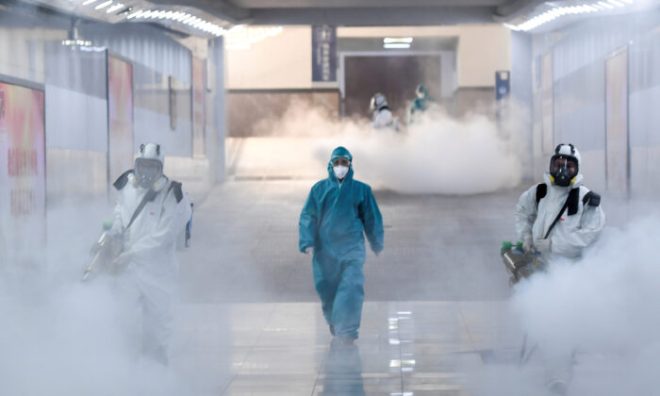
Volunteers in protective suits disinfect a railway station as the country is hit by an outbreak of the new coronavirus, in ChangshaWhen virologists and medical experts around the globe discussed the suspicious nature of the novel coronavirus and pointed to Wuhan’s P4 lab as a likely source, netizens inside China were watching. A Chinese scholar recently challenged Wuhan’s P4 lab to explain how the proteins of the novel coronavirus seem to have been precisely engineered to enable the virus to bind onto human cells. He also disclosed unethical and unprofessional practices he previously observed in China’s bioresearch labs.

According to Wuhan-based Yangtze Daily, Shi Zhengli, Deputy Director of Wuhan’s P4 Lab, publicized a statement on Feb. 2 saying: “I pledge with my life that the 2019 novel coronavirus has nothing to do with our lab. This virus is a punishment imposed on mankind from nature, to condemn mankind’s uncivilized way of living. Those of you who believe rumors or so-called scientific analysis by unqualified researchers, I advise you to shut your damn mouths!”

Shi’s statement irritated many Chinese netizens. “For such a huge calamity that may take countless lives, give us facts and evidence, not pretentious statements such as pledging with your life,” one netizen commented.

A social media user named Wu Xiaohua, with a Ph.D. in biological related fields according to his WeChat profile, challenged Shi to answer key questions about the suspicious gene mutations found in the new virus.

Wu pointed out there is no way that these mutations are the outcome of natural recombination.

“Now, many scientists, including Shi herself, believe that this virus must have originated from bats, and would involve one or two virus hosts to explain the gene mutations. Based on current scientific publications, the virus must jump from rats to primates before it can infect humans. Then how is this step—from rats to primates—usually achieved? It can only be done in a research lab by scientists inserting a certain protein from primates into rats,” Wu wrote.

“I have personally performed the same type of genetic engineering experiments. You cannot get away by being cavalier. Do you dare to accept the challenge and give us an explanation?” he asked.

Wu also disclosed that some biolabs in China are very poorly regulated.

“For instance, some researchers in these labs kept the laboratory dogs as pets; some disposed of animal carcasses casually because following the biosafety rules and cremating them costs a lot of money. Some cut up the laboratory pigs and took the meat home to eat. I know this happened at Beijing 301 Hospital’s spine surgery lab. Worst of all, some laboratory animals were sold to wet markets as wild-caught animals for profit,” he wrote.

Xu Bo, a well-known IT magnate and billionaire in China, cited reports and articles to support Wu’s statements.

In his blog, Xu cited a news report about a lawsuit against biologist Li Ning.

Li is an academician of China Engineering Academy, and a former professor at China Agricultural University. The judgment in Li’s case, which came out on Jan. 2 this year, stated that between 2008 and 2012, Li’s lab sold experimental pigs, cows, and milk to local markets. These animal and animal products were bought using research funds; but Li and his fellow colleagues pocketed the money, a total of 10,179,201 yuan ($1,460,304), from the sale of these animals and animal products.

Li was sentenced to 12 years in prison for embezzlement.

According to a 2016 report from the China Experimental Animal Information Network, Chinese researchers use tens of millions of laboratory animals every year. The Experimental Animal Research Center of Hubei Province alone handles about 300,000 animals a year, either for bioresearch experiments inside the center, or to be sold and distributed to other labs in Hubei Province.

Xu and many other Chinese netizens say they suspect that the novel coronavirus is a genetically engineered virus that somehow escaped from Wuhan P4 Biosafety lab.

A P4 lab handles level 4 biosafety pathogens, the highest level and most dangerous, which have high fatality rates and no known treatments, such as, the ebola and SARS viruses. Such a lab must follow the highest microbiological safety standards to ensure the safety of researchers and the public.

The P4 lab in Wuhan is not only the first of its kind in China, but also the first in Asia. When it opened in 2017, U.S. scientists expressed concerns that, considering China’s opaque administrative structure, if one of those killer viruses “escaped” from the lab, it could cause a doomsday disaster.

Source: The Epoch Times

Writer of the Biological Weapons Anti-Terrorism Act Shares His Thoughts On The Coronavirus | Collective Evolution

bioIN BRIEF

  • The Facts:Dr. Francis Boyle, a law professor who drafted the Biological Weapons Anti-Terrorism Act, recently shared his thoughts about the Coronavirus.
  • Reflect On:Disease outbreaks are nothing new, and massive amounts of fear propaganda usually follow. Is this another ‘swine flu?’ Something that has emerged and will die down eventually?

Dr. Francis Boyle is an international law professor at the University of Illinois College of Law. He currently serves as counsel to Bosnia and Herzegovina and to the Provisional Government of the Palestinian Authority. He was involved in developing the indictments against Slobodan Milosević for genocide and for other war crimes in Bosnia and Herzegovina.

He is well known globally for representing the Blackfoot Nation (Canada), the Nation of Hawaii, the Lakota Nation, as well as advising on several individual death penalty and human rights cases. He has been a force of good will, having counselled numerous international bodies in the areas of human rights, war crimes and genocide, nuclear policy, and bio-warfare. From 1991-92, he served as Legal Advisor to the Palestinian Delegation to the Middle East Peace Negotiations.

He currently sits on the  Board of Directors of Amnesty International, as a consultant to the American Friends Service Committee, and on the Advisory Board for the Council for Responsible Genetics.

Furthermore, he drafted the U.S. domestic legislation for the Biological Weapons Convention, known as the Biological Weapons Anti-Terrorism Act of 1989. It was approved unanimously by both Houses of the U.S. Congress and signed into law.

He has a lot of knowledge on the topic of biological warfare, which is why it’s interesting to hear is thoughts and opinions on the Coronavirus.

Coronavirus

As stated in the interview below, he believes that the Coronavirus is a biological warfare weapon, and that it may have leaked out unintentionally. Regardless, he believes that pharmaceutical companies are set to profit off of this outbreak in a big way.

Dr. Boyle has come across information suggesting that Chinese scientists may have stolen this virus out of a lab in Winnipeg, where Canada tests a lot of their biological warfare weapons. He believes the virus then leaked out of a lab in Wuhan (BSL-4), in the wake of reports of previous reports of leaks coming out of this specific lab. The Wuhan BSL-4 lab is also a specially designated World Health Organization (WHO) research lab and Dr. Boyle contends that the WHO knows full well what is occurring.

CBC news report maintains that, while there is truth that the lab in Winnipeg had some policy breaches with researchers who were Chinese nationals, it is not confirmed that this involved stealing the virus and bringing it to Wuhan. CBC maintains that the connection between this and the outbreak of the Coronavirus in Wuhan is  a ‘conspiracy theory.’

It appears that the Coronavirus that we are dealing with here is an offensive biological warfare weapon that leaked…I’m not saying it was done deliberately…I’m afraid that’s what we are dealing with today.

Final Thoughts

When it comes to this type of information, and these types of outbreaks, I’m reminded of the swine flu outbreak many years ago. There is a lot of ‘fear propaganda’ being put out by the media, and I personally don’t really pay much attention to it. I’m not saying it’s not dangerous, and it’s not a concern, I’m just saying that ultimately it’s a waste of time to worry.

At the end of the day, the best thing we can do for ourselves for protection is to simply optimize your health and boost your immune system. When it comes to this actual virus and it’s origins, I have not looked into it enough. I thought it was important to share the interview above from a knowledgeable individual in this area, as mainstream media doesn’t seem to go into this type of stuff despite the fact that it does seem like important and relevant information. Furthermore, it can be confusing when such a well read academic and researcher in the field shares information, yet mainstream media simply categorizes it as a conspiracy theory.

It’s always great to look at and listen to multiple sources of information when curious about a topic, especially when we are hit so hard with the same thing over and over again by big media. In my opinion, just as the swine flu, this outbreak will eventually die off. Hopefully.

Source: Collective Evolution