Bernie Sanders unveils comprehensive $16.3 trillion Green New Deal plan amid climate crisis | CNN

Editor’s Note: I include this post as an interesting conversation starter, but do not consider the Green New Deal a sound proposal for addressing climate change (unless you intend on bankrupting the country to achieve it). 

By Gregory King

Sen. Bernie Sanders on Thursday added progressive meat to the bones of the Green New Deal with the release of his comprehensive $16.3 trillion climate change program ahead of a campaign stop in Paradise, California, the city leveled by a devastating 2018 wildfire.

Sanders was an early backer of the activist-inspired Green New Deal framework and introduced, with Reps. Alexandria Ocasio-Cortez and Earl Blumenauer, a resolution in July to declare climate change a national emergency.

“Young people, advocates, tribes, cities and states all over this country have already begun this important work,” the campaign says in its new pitch, “and we will continue to follow their lead.”

The Sanders plan channels the rhetoric of the climate movement, calling for a World War II-style mobilization to halt and reverse the effects of global warming over a decade. In the process, the campaign claims, it would create 20 million new jobs in “steel and auto manufacturing, construction, energy efficiency retrofitting, coding and server farms, and renewable power plants.” Sanders’ blueprint will be compared to proposals put forward by Sen. Elizabeth Warren and Washington Gov. Jay Inslee, who released a robust suite of cross-sector plans before ending his campaign on Wednesday.

In a CNN poll from late April, 96% of potential Democratic voters said “aggressive action to slow the effects of climate change” was somewhat or very important — the closest to a unanimous finding in the survey. The Democratic National Committee has so far not hosted a climate-specific debate, but 10 of the 2020 primary candidates will take part in a September 4 CNN town hall focused exclusively on the crisis.

During his time in office, President Donald Trump has rolled back dozens of environmental rules and regulations. Sanders in his plan promises to “aggressively enforce” the Clean Air Act, through the Environmental Protection Agency, to restrict dangerous emissions.

But the proposals unveiled Thursday go much further.

Sanders’ prime targets include meeting the Intergovernmental Panel on Climate Change’s goal of 100% renewable energy for electricity and transportation by 2030; cutting domestic emissions by 71% over that period; creating a $526 billion electric “smart grid;” investing $200 billion in the Green Climate Fund; and prioritizing what activists call a “just transition” for fossil fuel workers who would be dislocated during the transition.

The Vermont independent would also cut off billions in subsidies to fossil fuel companies and impose bans on extractive practices, including fracking and mountaintop coal mining, while halting the import and export of coal, oil and natural gas. Additionally, he would use his Justice Department and the Securities and Exchange Commission to pursue criminal and civil cases against energy companies that hid or withheld information — over decades — about the damage their businesses were doing to the environment.

Sanders in 2015 and 2016, during his first presidential campaign, memorably called climate change the foremost national security threat. In recent remarks on the campaign trail, he has promised to reassert US power internationally by taking a more assertive role in climate talks.

“Climate change cannot only be addressed by the United States. It is a global issue,” Sanders said this week in Iowa. “But my promise to you is, instead of ignoring this issue as Trump does, I will help lead the world in bringing countries together to address the issue.”

The proposal is the most in-depth to date from Sanders, who says it will “pay for itself over 15 years” and includes new details on the potential funding sources.

The most significant, at an estimated $6.4 trillion, would come from revenue generated by the sale of clean energy — which will be administered by publicly owned utilities — between 2023 and 2035. Before that, Sanders would cut military spending used to protect global energy interests by more than $1.2 trillion while hitting up fossil fuel companies for more than $3 trillion in “litigation (against polluters), fees, and taxes.” An additional $2.3 trillion, the campaign says, would be raised from the taxes paid on the 20 million new jobs it promises to create.

Part of that money would go toward mitigating the damage already done by climate change — with $162 billion set aside for coastal communities under threat and an additional $18 billion going toward firefighters to combat a spike in dangerous wildfires like the one in Paradise.

To deliver the political will for such a radical transformation, Sanders, as he has throughout his presidential campaigns, is counting on the youth-led activists and progressive movements that he has often inspired and, now, hopes to count on as a source of electoral strength.
Their continued vigor and ability to successfully pressure elected officials is written into the plan.

“We will do this,” the campaign says, “by coming together in a truly inclusive movement that prioritizes young people, workers, indigenous peoples, communities of color, and other historically marginalized groups to take on the fossil fuel industry and other polluters to push this over the finish line and lead the globe in solving the climate crisis.”

President Trump’s $4 Trillion Debt Increase | Committee for a Responsible Federal Budget

Editor’s Note: Take note that continued federal deficit spending will land the United States corporation in an irreversible bankruptcy before 2029 when It would bring total debt to about 97 percent of Gross Domestic Product (GDP). That means the US would owe the Federal Reserve almost 100% of the GDP for the entire year (plus interest). 

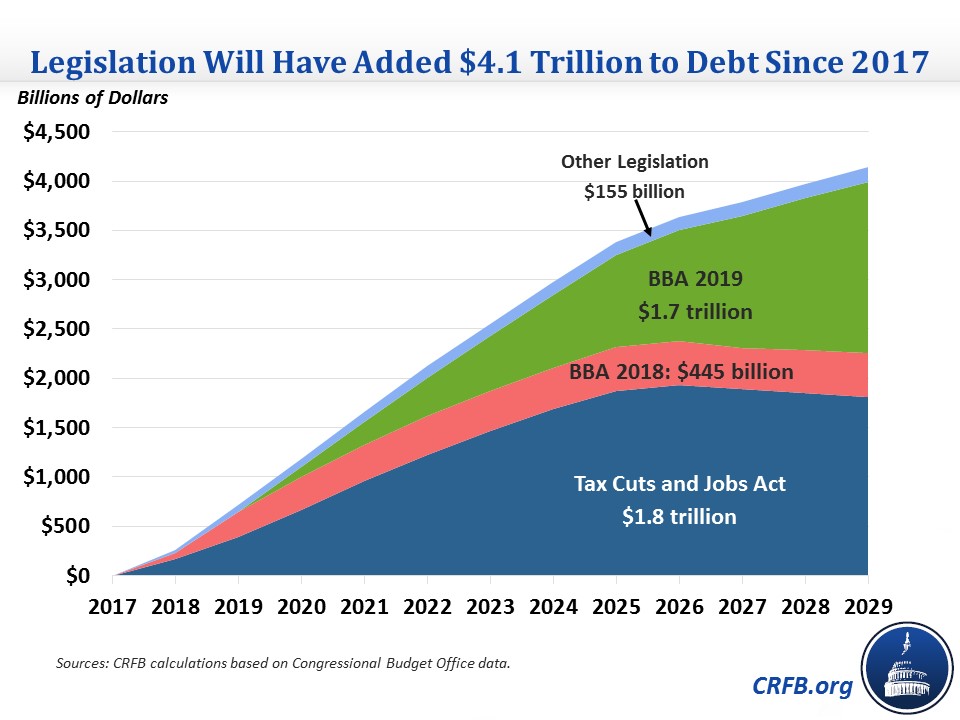
If the recent budget deal is signed into law, it will be the third major piece of deficit-financed legislation in President Trump’s term. In total, we estimate legislation signed by the President will have added $4.1 trillion to the debt between 2017 and 2029. Over a traditional ten-year budget window, the President will have added $3.4 to $3.8 trillion to the debt. The source of the debt expansion is split relatively evenly between tax and spending policy.

The Tax Cuts and Jobs Act (TCJA) was the single largest contributor to the $4.1 trillion figure, increasing debt by $1.8 trillion through 2029 (more than the entire cost is through 2027). This number could easily climb higher if lawmakers extend the individual tax cuts that are set to expire after 2025, which would add another $1 trillion to the debt.

The Bipartisan Budget Act (BBA) of 2018 was nearly as costly on an annual basis, adding nearly $450 billion to the debt due to its two-year nature. However, the Bipartisan Budget Act of 2019 would effectively make the increases in the BBA 2018 permanent, and in doing so, add another $1.7 trillion to the debt through 2029.

Smaller pieces of legislation are responsible for nearly $150 billion of debt. This includes several different bills containing disaster relief or emergency spending and continued delays of three Affordable Care Act (ACA) taxes, among other bills.

This analysis does not include the fiscal impact of many executive actions taken by the President, some which would increase deficits and others which would reduce them. It also assumes that temporary policies expire as scheduled.

If we evaluate the debt added over the standard ten-year window the Congressional Budget Office (CBO) uses, the numbers are similar but slightly smaller. Using the ten-year period (2018-2027) employed in 2017, lawmakers have added $3.8 trillion to deficits. Using the current ten-year period of 2020-2029, the debt increase is $3.4 trillion. Debt added is lower in the later period because some of the laws, like the TCJA and 2018 BBA, had larger short-term, rather than long-term, costs.

Debt Added Since 2017 Over Different Periods

Legislation 2018-2027 Cost 2020-2029 Cost 2017-2029 Cost
Tax Cuts and Jobs Act $1.9 trillion $1.4 trillion $1.8 trillion
Bipartisan Budget Act of 2019 $1.3 trillion $1.7 trillion $1.7 trillion
Bipartisan Budget Act of 2018 $420 billion $190 billion $445 billion
Other Legislation $140 billion $90 billion $155 billion
Total $3.8 trillion $3.4 trillion $4.1 trillion

Source: CRFB calculations based on Congressional Budget Office data.

Importantly, the $4.1 trillion of debt signed into law by President Trump is on top of the $16.2 trillion we already owe and the $9.8 trillion we were projected to borrow over the next decade absent these proposals. It would bring debt to about 97 percent of Gross Domestic Product (GDP) in 2029, compared to 84 percent if no debt-increasing legislation had been passed.

To avoid the huge run-up in debt that is projected in the coming decades, lawmakers should reject unpaid-for spending increases, pay for the tax bill, and address the rising costs and looming insolvency of our nation’s largest health and retirement programs.

Source: Committee for a Responsible Federal Budget

Venezuela’s collapse worst outside of war in decades: Economists say | Business Standard & The New York Times

Editor’s Note: The radical leftists, socialists, communists, Marxists and Democrats wish to take America down this road. Remember the former Soviet Union under Lenin and Stalin. Remember Communist China under Mao. Remember Venezuela and other socialist failures before you vote for this.

Venezuelas fall due to poor governance, corruption and the misguided policies of President Nicolas Maduro and his predecessor Hugo Chavez is the single largest economic collapse outside of war in 45 years, outpacing Zimbabwes crumbling under Robert Mugabe, Cubas disastrous unravelling in the 1990s and the fall of the Soviet Union, economists say.

“It’s really hard to think of a human tragedy of this scale outside civil war,” said Kenneth Rogoff, an economics professor at Harvard University and former chief economist at the International Monetary Fund (IMF).

“This will be a touchstone of disastrous policies for decades to come.”

To find similar levels of economic devastation, economists at the IMF pointed to nations that were ripped apart by war, like Libya earlier this decade or Lebanon in the 1970s, the New York Times reported on Friday.

But Venezuela, at one point Latin America’s wealthiest country, has not been shattered by armed conflict. Instead, economists say, the poor governance, corruption and misguided policies of Maduro and Chavez have increased inflation, shuttered businesses and brought the country to its knees.

And in recent months, the Donald Trump administration has tried to cripple it further by imposing stiff sanctions.

As Venezuela’s economy plummeted, armed gangs took control of entire towns, public services collapsed and the purchasing power of most Venezuelans has been reduced to a couple of kg of flour a month.

In markets, butchers hit by regular blackouts struggle to sell decomposing stock by sunset. Former labourers scavenge through garbage dumps for leftovers and recyclable plastic.

Dejected retailers make dozens of trips to the bank in hopes of depositing several pounds’ worth of bills made worthless by hyperinflation, the report said.

The crisis has escalated due to American sanctions intended to force Maduro to cede power to the nation’s opposition leader, Juan Guaido. The US sanctions on Venezuela’s state oil company have made it difficult for the government to sell its main commodity, oil.

Together with the American ban on trading Venezuelan bonds, the Trump administration has made it harder for Venezuela to import any goods, including food and medication.

Maduro blames the widespread hunger and lack of medical supplies on the US and its opposition allies – but most independent economists say the recession began years before the sanctions, which at most accelerated the collapse.

Venezuela has the world’s largest proven oil reserves. But its oil output, once Latin America’s largest, has fallen faster in the past year than Iraq’s after the American invasion in 2003, according to data from the Organization of Petroleum Exporting Countries.

It has lost a tenth of its population in the past two years as people fled, setting off Latin America’s biggest ever refugee crisis.

The country’s hyperinflation — expected to reach 10 million per cent this year according to the IMF — is on track to become the longest period of runaway price rises.

“This is essentially a total collapse in consumption,” said Sergi Lanau, Deputy Chief Economist at the Institute of International Finance, a financial trade association.

The institute estimates that the drop in Venezuela’s economic output under Maduro has undergone “the steepest decline by any country not at war since at least 1975”.

By year’s end, Venezuela’s gross domestic product will shrink by 62 per cent since the beginning of the recession in 2013, which coincided with Maduro coming to power, according to the institute’s estimates.

Source: Business Standard & The New York Times

How Much Will Medicare for All Cost? | Committee for a Responsible Federal Budget

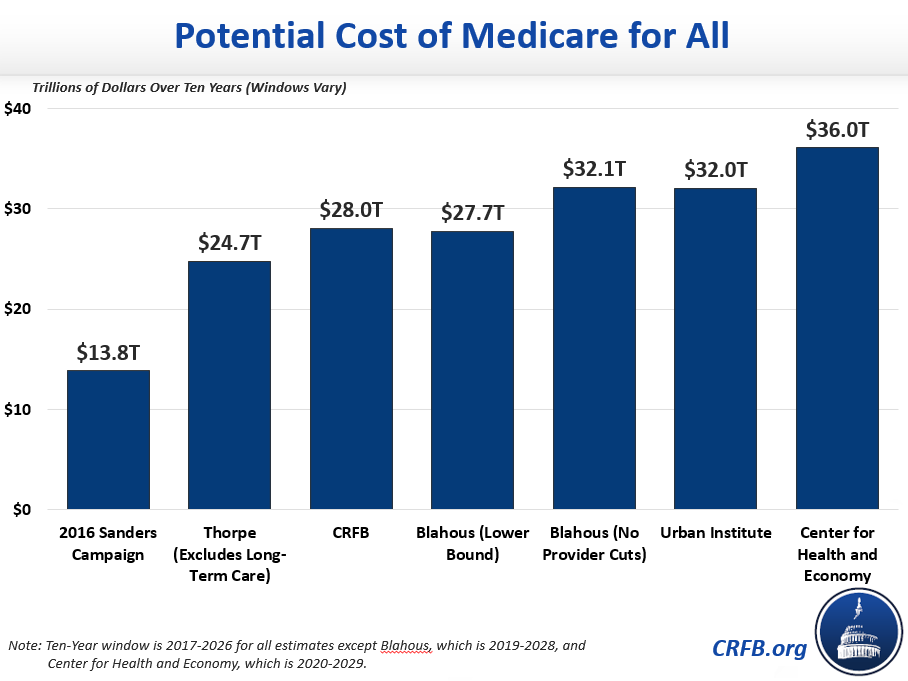
Representative Pramila Jayapal (D-WA), a co-chair of the Medicare for All Caucus, released a bill today that would adopt a single-payer system, where the federal government replaces private health insurance companies as the sole provider of most health care financing. While we are not aware of any estimates of this particular proposal, similar proposals have been estimated to cost the federal government roughly $28-32 trillion over a decade.

Representative Jayapal’s Medicare for All Act would replace nearly all current insurance with a government-run single-payer plan and extend that plan to those who currently lack health coverage. The plan itself would be far more generous than either Medicare or most private coverage, as it would include no deductibles or copayments, would not restrict beneficiaries to networks of care, and would offer a broad suite of benefits including dental care, vision care, transportation for disabled and low-income patients, certain dietary and nutritional care, long-term care, and other long-term services and support. The proposal also establishes a global health budget, moves away from fee-for-service and toward lump-sum payments for many providers, includes a number of measures to hold down drug prices, and makes a variety of other changes to the health care system.

The proposal is broadly similar to Senator Sanders’s proposed single-payer plan introduced during the 2016 Presidential campaign. While the campaign itself estimated that plan would cost the federal government about $14 trillion over a decade, most other estimates that we are aware of are at least twice that high.

At the time, for example, the Committee for a Responsible Federal Budget estimated roughly that the plan would cost $28 trillion through 2026 (we estimated the Sanders plan in particular would also raise $11 trillion of revenue, leading to $17 trillion of net costs). All other estimates come to similar conclusions.

For example, economist Kenneth Thorpe estimated that single-payer health care would cost the federal government $24.7 trillion through 2026, excluding the costs associated with long-term care benefits (likely about $3 trillion). The Urban Institute estimated a $32 trillion cost over the same period, including those long-term care benefits. The Center for Health and Economy (H&E) produced an estimate that the American Action Forum calculates would cost the federal government $36 trillion through 2029.

In addition, former Social Security and Medicare Trustee and current Mercatus Center fellow Chuck Blahous estimated that Medicare for All as proposed in Senator Sanders’s 2017 legislation would cost the federal government $27.7 trillion through 2028 assuming steep provider cuts and $32.1 trillion assuming no provider cuts (these estimates, like most others, assume immediate implementation).

Importantly, these totals represent the increased cost to the federal government, not the change of total national health expenditures. National health expenditures would likely change by no more than a few trillion dollars over decade. The direction of that change is unclear and would depending on the whether the increased cost of expanding coverage (by making health insurance more generous and offering it to more people) is larger or smaller than the amount saved from lower provider payments, drug payments, and administrative spending.

The totals also do not represent debt impact, which would depend not only on the cost to the federal government but also on any funds the government might choose to raise through premiums, taxes, or both. For example, Senator Sanders’s campaign plan included roughly $11 trillion of tax increases, which could fund more than one-third of Medicare for All.

While any new revenue would in part be replacing current premiums, identifying pay-fors still remains a challenge. Enacting this type of Medicare for All would mean increasing federal spending by about 60 percent (excluding interest), and financing a $30 trillion program would require the equivalent of tripling payroll taxes or more than doubling all other taxes.

Supporters of Medicare for All should work to identify new revenue, premiums, and/or spending cuts to finance new federal costs or else scale back their proposal if they are unable to identify sufficient funding.

Source: Committee for a Responsible Federal Budget


Trump officially legalizes industrial hemp | The Hill

President Trump legalized the cultivation of industrial hemp Thursday when he signed a widespread, bipartisan farm bill aimed at boosting the agriculture industry.

The fiber of hemp, a non-intoxicating derivative of the cannabis plant, is used to make a variety of products, such as cardboard, carpets, clothes, paper and more.

Hemp production and sales have historically been illegal under the same federal prohibition against marijuana. The farm bill only deals with industrial hemp and does not address recreational or medical marijuana.

Senate Majority Leader Mitch McConnell (R-Ky.) worked with Sens. Rand Paul (R-Ky.), Jeff Merkley(D-Ore.) and Ron Wyden (D-Ore.) to introduce a bill to legalize hemp, which was ultimately included in the farm bill. 

“I used my very own hemp pen to sign the conference report, clearing the way for the House and Senate to pass legislation and send it to the president’s desk. I’m proud that the bill includes my provision to legalize the production of industrial hemp. It’s a victory for farmers and consumers throughout our country,” McConnell said when the Senate advanced the farm bill earlier this month.

The farm bill helps removes obstacles farmers face in growing hemp, including restricted access to banking, water rights and crop insurance. Hemp is easier to grow than cotton, corn or soybeans as it requires little water and can be viable in lower-quality soil that is not practical for other crops.

The hemp provision is just one of several aspects of the farm bill meant to aid farmers as exports of agricultural products such as soybeans take a hit as Trump engages in a bitter trade war with China and other countries.

Source: The Hill

How 5G will change (destroy) the world | World Economic Forum

large_m297nKs9NwkwFNcZIsHG-pB8DPtURngI4QodH4rR8Rc

Editor’s Note: The unforeseen consequences of unleashing an electronic network worldwide with nowhere to hide, with a bombardment of such powerful frequencies as to disrupt every living system with proven oxygen shattering and immune suppressing technology is beginning to unfold. This article is an industry puff piece for the global leaders of industry promoting 5G as the next panacea for all our problems. My friends, this is a crisis of consciousness and will forever map the trajectory of human evolution. Only robots will survive this 5G rollout. Read it and weep!

By Don Rosenberg

It is not an easy time to be an internationalist, to seek global solutions to global problems amid what feels like one of history’s periodic inclinations toward divisiveness.

Yet, ironically, we’re on the verge of a new age of interconnectedness, when the daily lives of people across the planet will be more closely intertwined than ever. Advances in technology will usher in the age of fifth generation, or 5G, telecommunications. And, if past is prologue, this technological evolution will lead to dramatic societal changes.

The first generation of mobile communications, with brick-sized phones, brought just a handful of users expensive and often unreliable analogue voice calling. The second generation introduced digital voice service that was less likely to be dropped, available to many more people and ultimately cheaper to use. 3G ushered in the mobile internet, mobile computing, and the proliferation of apps. 4G (often called LTE) made possible all we have come to expect of mobile broadband: streaming video and audio; instantaneous ride hailing; the explosion of social media.

We take all this connectivity for granted, but the engineering inside the device in your bag or pocket today would have seemed impossible less than 20 years ago.

So, where will 5G take us?

Think about a world in which not just people but all things are connected: cars to the roads they are on; doctors to the personal medical devices of their patients; augmented reality available to help people shop and learn and explore wherever they are. This requires a massive increase in the level of connectivity.

5G is the technological answer, making possible billions of new connections, and making those connections secure and instantaneous. 5G will impact every industry – autos, healthcare, manufacturing and distribution, emergency services, just to name a few. And 5G is purposely designed so that these industries can take advantage of cellular connectivity in ways that wouldn’t have been possible before, and to scale upwards as use of 5G expands.

But generational change in mobile communications doesn’t just appear overnight. It requires significant effort in research and development and the resources necessary to support that effort. Work on 4G took nearly a decade and the challenges were not easy. Consider one of tens of thousands of problems that needed to be solved as described by an engineer at Qualcomm, where much of this technology was invented:

“When the signal leaves the base station, it can undergo a loss of up to 130 decibels before it reaches your mobile phone. To put that loss into perspective, if you consider the transmitted signal power to be roughly the size of the Earth, then the received signal power would be equivalent to the size of a tiny bacteria.”

That is a tremendous loss of power, and it requires some pretty impressive engineering to compensate for the effect of the loss on the words, pictures, and other data we send and receive across the airwaves in a transparent, seamless and instantaneous way.

But we weren’t alone. The international engineering co-operation that goes into development of a telecom standard illustrates how much can be achieved when disparate national, commercial and scientific parties work together for the common good.

Like 3G and 4G, 5G is the responsibility of the standards-setting organisation 3GPP, where the handful of companies that invent technologies come together with many, many more companies who will develop products that implement those technologies.

Think about this process for a moment: engineers from rival inventing companies, rival product makers, rival wireless network operators, all from different countries and continents, discussing, testing, striving to perfect tens of thousands of different technical solutions that ultimately make up a standard like 5G.

They judge each technical solution using a merit-based, consensus-building approach. This process has been at the foundation of a technological revolution that spawned myriad new industries, millions of new jobs and well over a $1 trillion in economic growth.

It’s the fusion of commercial self-interest with the recognition that some problems are best solved by working together. And it’s not a bad model of human behaviour if we are to meet the World Economic Forum’s goal this year to address the problems of “a fractured world”.

The benefits and advantages of 5G technology are expected to be available sometime in 2019. We believe 5G will change the world even more profoundly than 3G and 4G; that it will be as revolutionary as electricity or the automobile, benefitting entire economies and entire societies.

Developing nations have rivalled or surpassed their industrialised counterparts in benefiting from the deployment of mobile technology, and there’s every reason to think 5G will have an even bigger levelling effect than its predecessors.

Economists estimate the global economic impact of 5G in new goods and services will reach $12 trillion by 2035 as 5G moves mobile technology from connecting people to people and information, towards connecting people to everything.


Many of the benefits probably aren’t yet apparent to us. Wireless network operators initially resisted proposals to give their customers mobile access to the internet, questioning why they would want it. At the dawn of 4G’s adoption no one could have predicted the new business models that grew on the back of mobile broadband, like Uber, Spotify and Facebook.

Now, according to the European Patent Office, the number of patent applications related to “smart connected objects” has surged 54% over the last three years, suggesting new, related and as-yet unknown inventions will arrive even before 5G becomes available.

This is news that should encourage us amid glum commentaries on the state of the world. There is promise yet in what we’re capable of achieving.

Source: World Economic Forum

How Trump Could Shrink the Government (While Still Keeping the Good Stuff) | POLITICO Magazine

Editor’s Note: This is one of the soundest analysis of what’s possible under the Trump administration focusing on solutions instead of hysteria. Please read the entire article.

By Michael Grunwald

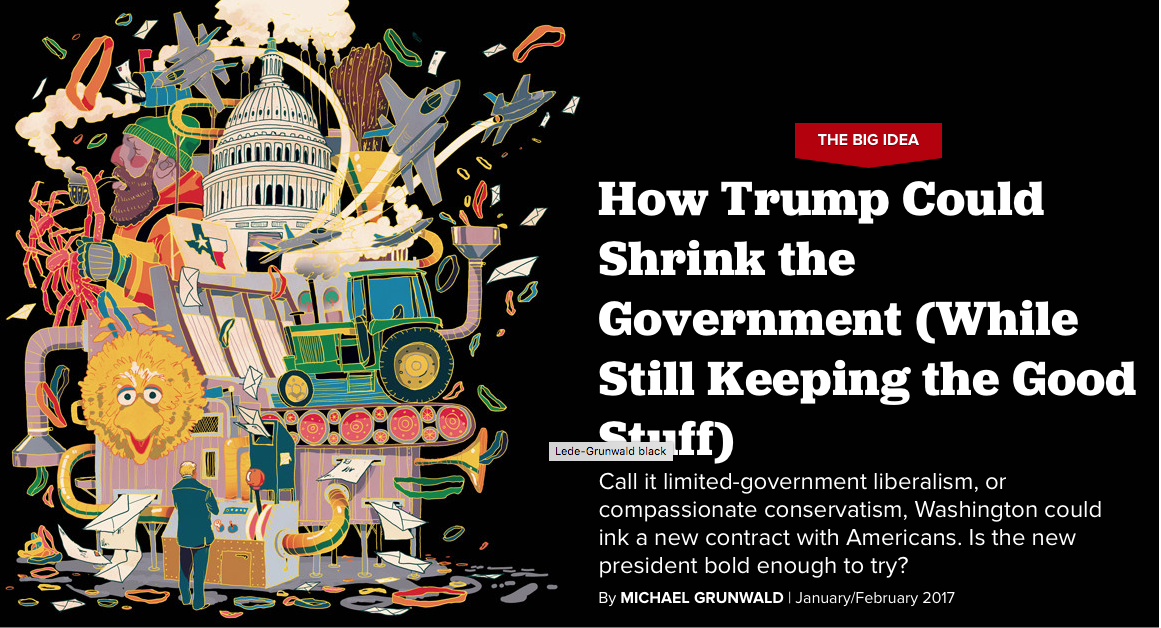
limitedgovernmentDonald Trump’s political brand is about fighting and winning, and he has promised to fight and win a war on big government. As a candidate, he often attacked the federal bureaucracy as a bloated monstrosity teeming with “waste, fraud and abuse all over the place,” and vowed to “cut so much your head will spin!” As president-elect, he continued his clamor on Twitter, pledging to save taxpayers billions on “out of control” programs like the F-35 fighter jet.

But Trump has also proclaimed his belief in an activist government, portraying himself as a kind of father-figure leader who will “take care of people.” He insisted during the Republican primary that, unlike his opponents, he would never cut a single dollar from Social Security, Medicare or Medicaid, or let Americans “die on the streets.” His agenda to Make America Great Again is in many ways a big government agenda, with bleeding-heart goals like rebuilding infrastructure and reviving inner cities, as well as get-tough goals like beefing up the military and walling up the border

Trump’s critics cite this split-screen attitude toward government as evidence that he’s running a con. And his early moves, like stocking his administration with Goldman Sachs alumni, do suggest he won’t feel constrained by his drain-the-swamp campaign talk. But if Trump’s two-sided rhetoric about government sounds like a con, it should sound like a familiar con, because Presidents Bill Clinton, George W. Bush and Barack Obama all fed us similar lines. They all argued that the federal government is too big, wastes too much money and tries to do too many things—but also that it should perform vital functions like defending the nation, supporting the elderly and providing a safety net for the vulnerable.

In fact, polls show that most Americans agree with both of those arguments, which might help explain why politicians who make them keep winning the White House. As Obama put it in The Audacity of Hope, voters “don’t expect government to solve all their problems,” but do “figure government should help.” And those dual beliefs happen to be sensible ones, not just popular ones. It’s hard to see how Americans can be assured of clean air and water, a basic level of subsistence and protection from foreign invaders without federal intervention; it’s just as hard to see why the federal government needs 200 science education programs spread across 13 separate agencies. It’s disturbing that we’re the only wealthy nation without universal health insurance, and also that our government delivers 81 billion annual pieces of junk mail. If you think about it, this amounts to a logical theory of governance that would be revolutionary in practice: Washington really should do some big stuff in a big way, while doing a lot less stuff overall. It ought to focus on policy wars of necessity rather than wars of choice—and then fight those wars with overwhelming force.

This triage approach to governance could be called “limited-government liberalism,” although Trump certainly wouldn’t use that phrase. Or perhaps, to borrow a slogan that Bush never really defined, it could go by “compassionate conservatism.” Its motto could be Clinton’s only-half-remembered 1996 declaration that “the era of big government is over—but we cannot go back to the time when our citizens were left to fend for themselves.” It’s about as close as this polarized nation has to a bipartisan political philosophy, and it’s probably the rosiest scenario, if not the likeliest scenario, for the kind of radical change Trump could bring to Washington. It would involve near-constant battles with the special interests and other insiders Trump always talks about battling; it could appeal to Trump’s self-image as a heroic disrupter of an entrenched status quo; and it could be quite popular, a quality populists tend to like. Read more…

Source: POLITICO Magazine

Top 9 ethical issues in artificial intelligence | World Economic Forum

HM_JF19_Page_37_Image_0001_0By Julie Bossmann

Optimizing logistics, detecting fraud, composing art, conducting research, providing translations: intelligent machine systems are transforming our lives for the better. As these systems become more capable, our world becomes more efficient and consequently richer.

Tech giants such as Alphabet, Amazon, Facebook, IBM and Microsoft – as well as individuals like Stephen Hawking and Elon Musk – believe that now is the right time to talk about the nearly boundless landscape of artificial intelligence. In many ways, this is just as much a new frontier for ethics and risk assessment as it is for emerging technology. So which issues and conversations keep AI experts up at night?


1. Unemployment. What happens after the end of jobs?

The hierarchy of labour is concerned primarily with automation. As we’ve invented ways to automate jobs, we could create room for people to assume more complex roles, moving from the physical work that dominated the pre-industrial globe to the cognitive labour that characterizes strategic and administrative work in our globalized society.

Look at trucking: it currently employs millions of individuals in the United States alone. What will happen to them if the self-driving trucks promised by Tesla’s Elon Musk become widely available in the next decade? But on the other hand, if we consider the lower risk of accidents, self-driving trucks seem like an ethical choice. The same scenario could happen to office workers, as well as to the majority of the workforce in developed countries.

This is where we come to the question of how we are going to spend our time. Most people still rely on selling their time to have enough income to sustain themselves and their families. We can only hope that this opportunity will enable people to find meaning in non-labour activities, such as caring for their families, engaging with their communities and learning new ways to contribute to human society.

If we succeed with the transition, one day we might look back and think that it was barbaric that human beings were required to sell the majority of their waking time just to be able to live.

2. Inequality. How do we distribute the wealth created by machines?

Our economic system is based on compensation for contribution to the economy, often assessed using an hourly wage. The majority of companies are still dependent on hourly work when it comes to products and services. But by using artificial intelligence, a company can drastically cut down on relying on the human workforce, and this means that revenues will go to fewer people. Consequently, individuals who have ownership in AI-driven companies will make all the money.

We are already seeing a widening wealth gap, where start-up founders take home a large portion of the economic surplus they create. In 2014, roughly the same revenues were generated by the three biggest companies in Detroit and the three biggest companies in Silicon Valley … only in Silicon Valley there were 10 times fewer employees.

If we’re truly imagining a post-work society, how do we structure a fair post-labour economy?

3. Humanity. How do machines affect our behaviour and interaction?

Artificially intelligent bots are becoming better and better at modelling human conversation and relationships. In 2015, a bot named Eugene Goostman won the Turing Challenge for the first time. In this challenge, human raters used text input to chat with an unknown entity, then guessed whether they had been chatting with a human or a machine. Eugene Goostman fooled more than half of the human raters into thinking they had been talking to a human being.

This milestone is only the start of an age where we will frequently interact with machines as if they are humans; whether in customer service or sales. While humans are limited in the attention and kindness that they can expend on another person, artificial bots can channel virtually unlimited resources into building relationships.

Even though not many of us are aware of this, we are already witnesses to how machines can trigger the reward centres in the human brain. Just look at click-bait headlines and video games. These headlines are often optimized with A/B testing, a rudimentary form of algorithmic optimization for content to capture our attention. This and other methods are used to make numerous video and mobile games become addictive. Tech addiction is the new frontier of human dependency.

On the other hand, maybe we can think of a different use for software, which has already become effective at directing human attention and triggering certain actions. When used right, this could evolve into an opportunity to nudge society towards more beneficial behavior. However, in the wrong hands it could prove detrimental.

4. Artificial stupidity. How can we guard against mistakes?

Intelligence comes from learning, whether you’re human or machine. Systems usually have a training phase in which they “learn” to detect the right patterns and act according to their input. Once a system is fully trained, it can then go into test phase, where it is hit with more examples and we see how it performs.

Obviously, the training phase cannot cover all possible examples that a system may deal with in the real world. These systems can be fooled in ways that humans wouldn’t be. For example, random dot patterns can lead a machine to “see” things that aren’t there. If we rely on AI to bring us into a new world of labour, security and efficiency, we need to ensure that the machine performs as planned, and that people can’t overpower it to use it for their own ends.

5. Racist robots. How do we eliminate AI bias?

Though artificial intelligence is capable of a speed and capacity of processing that’s far beyond that of humans, it cannot always be trusted to be fair and neutral. Google and its parent company Alphabet are one of the leaders when it comes to artificial intelligence, as seen in Google’s Photos service, where AI is used to identify people, objects and scenes. But it can go wrong, such as when a camera missed the mark on racial sensitivity, or when asoftware used to predict future criminals showed bias against black people.

We shouldn’t forget that AI systems are created by humans, who can be biased and judgemental. Once again, if used right, or if used by those who strive for social progress, artificial intelligence can become a catalyst for positive change.

6. Security. How do we keep AI safe from adversaries?

The more powerful a technology becomes, the more can it be used for nefarious reasons as well as good. This applies not only to robots produced to replace human soldiers, or autonomous weapons, but to AI systems that can cause damage if used maliciously. Because these fights won’t be fought on the battleground only, cybersecurity will become even more important. After all, we’re dealing with a system that is faster and more capable than us by orders of magnitude.

Proliferation of Armed Drones

7. Evil genies. How do we protect against unintended consequences?

It’s not just adversaries we have to worry about. What if artificial intelligence itself turned against us? This doesn’t mean by turning “evil” in the way a human might, or the way AI disasters are depicted in Hollywood movies. Rather, we can imagine an advanced AI system as a “genie in a bottle” that can fulfill wishes, but with terrible unforeseen consequences.

In the case of a machine, there is unlikely to be malice at play, only a lack of understanding of the full context in which the wish was made. Imagine an AI system that is asked to eradicate cancer in the world. After a lot of computing, it spits out a formula that does, in fact, bring about the end of cancer – by killing everyone on the planet. The computer would have achieved its goal of “no more cancer” very efficiently, but not in the way humans intended it.

8. Singularity. How do we stay in control of a complex intelligent system?

The reason humans are on top of the food chain is not down to sharp teeth or strong muscles. Human dominance is almost entirely due to our ingenuity and intelligence. We can get the better of bigger, faster, stronger animals because we can create and use tools to control them: both physical tools such as cages and weapons, and cognitive tools like training and conditioning.

This poses a serious question about artificial intelligence: will it, one day, have the same advantage over us? We can’t rely on just “pulling the plug” either, because a sufficiently advanced machine may anticipate this move and defend itself. This is what some call the “singularity”: the point in time when human beings are no longer the most intelligent beings on earth.

9. Robot rights. How do we define the humane treatment of AI?

While neuroscientists are still working on unlocking the secrets of conscious experience, we understand more about the basic mechanisms of reward and aversion. We share these mechanisms with even simple animals. In a way, we are building similar mechanisms of reward and aversion in systems of artificial intelligence. For example, reinforcement learning is similar to training a dog: improved performance is reinforced with a virtual reward.

Right now, these systems are fairly superficial, but they are becoming more complex and life-like. Could we consider a system to be suffering when its reward functions give it negative input? What’s more, so-called genetic algorithms work by creating many instances of a system at once, of which only the most successful “survive” and combine to form the next generation of instances. This happens over many generations and is a way of improving a system. The unsuccessful instances are deleted. At what point might we consider genetic algorithms a form of mass murder?

Once we consider machines as entities that can perceive, feel and act, it’s not a huge leap to ponder their legal status. Should they be treated like animals of comparable intelligence? Will we consider the suffering of “feeling” machines?

Some ethical questions are about mitigating suffering, some about risking negative outcomes. While we consider these risks, we should also keep in mind that, on the whole, this technological progress means better lives for everyone. Artificial intelligence has vast potential, and its responsible implementation is up to us.

Source: World Economic Forum

The Collapse of the Western Fiat Monetary System may have Begun. China, Russia and the Reemergence of Gold-Backed Currencies | Global Research

By Peter Koenig

On 19 April 2016, China was rolling out its new gold-backed yuan. Russia’s ruble has been fully supported by gold for the last couple of years. Nobody in the western media talks about it. Why would they? – A western reader may start wondering why he is constantly stressed by a US dollar based fiat monetary systems that is manipulated at will by a small elite of financial oligarchs for their benefit and to the detriment of the common people. 

In a recent Russia Insider article, Sergey Glaziev, one of Russia’s top economists and advisor to President Putin said about Russia’s currency, “The ruble Is the most gold-backed currency in the world”. He went on explaining that the amount of rubles circulating is covered by about twice the amount of gold in Russia’s Treasury.
In addition to a financial alliance, Russia and China also have developed in the past couple of years their own money transfer system, the China International Payment System, or the CIPS network which replaces the western transfer system, SWIFT, for Russian-Chinese internal trading. SWIFT, stands for the Society for Worldwide Interbank Financial Telecommunication, a network operating in 215 countries and territories and used by over 10,000 financial institutions.

Up until recently almost every international monetary transaction had to use SWIFT, a private institution, based in Belgium. ‘Private’ like in the US Federal Reserve Bank (FED), Wall Street banks and the Bank for International Settlements (BIS); all are involved in international monetary transfers and heavily influenced by the Rothschild family. No wonder that the ‘independent’ SWIFT plays along with Washington’s sanctions, for example, cutting off Iran from the international transfer system. Similarly, Washington used its arm-twisting with SWIFT to help Paul Singer’s New York Vulture Fund to extort more than 4 billion dollars from Argentina, by withholding Argentina’s regular debt payments as was agreed with 93% of all creditors. Eventually Argentina found other ways of making its payments, not to fall into disrepute and insolvency.

All of this changed for Argentina, when Mauricio Macri, the new neoliberal President put in place by Washington, appeared on the scene last December. He reopened the negotiations and is ready to pay a sizable junk of this illegal debt, despite a UN decision that a country that reaches a settlement agreement with the majority of the creditors is not to be pressured by non-conforming creditors. In the case of Argentina, the vulture lord bought the country’s default debt for a pittance and now that the nation’s economy had recovered he wants to make a fortune on the back of the population. This is how our western fraudulent monetary system functions.

China’s economy has surpassed that of the United States and this new eastern alliance is considered an existential threat to the fake western economy. CIPS, already used for trading and monetary exchange within China and Russia, is also applied by the remaining BRICS, Brazil, India and South Africa; and by the members of the Shanghai Cooperation Organization (SCO), plus India, Pakistan and Iran, as well as the Eurasian Economic Union (EEU – Armenia, Belarus, Kazakhstan, Kyrgyzstan, Russia and Tajikistan). It is said that CIPS is ready to be launched worldwide as early as September 2016. It would be a formidable alternative to the western dollar based monetary Ponzi scheme.

The new eastern monetary sovereignty is one of the major reasons why Washington tries so hard to destroy the BRICS, mainly China and Russia – and lately with a special effort of false accusations also Brazil through a Latin America type Color Revolution.

In addition, the Yuan late last year was accepted by the IMF in its SDR basket as the fifth reserve currency, the other four being the US dollar, the British pound, the euro and the Japanese yen. The SDR, or Special Drawing Right, functions like a virtual currency. It is made up of the weighted average of the five currencies and can be lent to countries at their request, as a way of reducing exchange risks. Being part of the SDR, the yuan has become an official reserve currency. In fact, in Asia the yuan is already heavily used in many countries’ treasuries, as an alternative to the ever more volatile US dollar.

It is no secret, the western dollar-led fiat monetary system is on its last leg – as eventually any Ponzi scheme will be. What does ‘fiat’ mean? It is money created out of thin air. It has no backing whatsoever; not gold, not even the economic output generated by the country or countries issuing the money, i.e. the United States of America and Europe. It is simply declared “legal tender’’ by Government decree.

No pyramid scheme is sustainable in the long run and eventually will collapse. It was invented and is used by a small invisible upper crest of elite making insane amounts of profit on the back of the 99% of us. Since these elitists are in control of the media with their lie propaganda, as well as the warmongering killing machine, US armed forces, NATO, combined with the international security and spy apparatus, CIA, MI6, Mossad, DGSE, the German Federal Intelligence Service (BND) and more, we are powerless – but powerless only as long as we ignore what’s really going on behind the curtain.

Our western monetary system is based on debt has all the hallmarks of a failing global monster octopus. The US banking system was deregulated in the 1990’s by President Clinton. The European vassals followed suit in the early 2000’s. About 97% of all the money in circulation in the western world is ‘made’ by private banks by a mouse click in the form of ‘loans’ or debt. Every loan a private bank hands out is a liability on that bank’s books; a liability that bears interest, the key generator of the banks’ profits. Profit from thin air! No work, no production, no real added value to the economy.

If and when the banks within this web of debt begin recalling their outstanding liabilities, they may set a non-stoppable avalanche in motion – leading to a chaotic end of the system. This end-run may have just begun. We have seen a gradual build-up since the end of WWII with the armament of the Cold War farce, and a high point with the manufactured sub-prime crisis of 2007 / 2008 / 2009, prompting an artificial and endless global economic crisis which may come crashing down in 2016 / 2017.

The damage may be humongous, leaving behind chaos, poverty, famine, misery – death. With the invisible ruling elite having cashed in, remaining on top and being liable to start again from scratch. – If we let them. It always boils down to the same: An uninformed people can be manipulated at will and is left in awe when hit by unexpected events, like acts of terror by bombs or banks.

Let us be crystal clear – we are all uninformed as long as we listen to and believe in the mainstream media – which are controlled by six Anglo-Zionist media giants, feeding the western public with 90% of the information, the so-called ‘news’ that we consume so eagerly every day; the barrage of lies that repeat themselves in every western country every hour on the hour – and, thus, become the truth. Period.

We must get out of our comfortable armchairs, listen to that innermost spark in the back of our minds, telling us against all avalanches of lies that there is something wrong, that we are being fed deception. We have to dig for the truth. And it is there – on internet, on alternative media, like Global Research, Information Clearing House, VNN, The Saker, NEO, Russia Today, Sputnik News, PressTV, TeleSUR – and many more credible sources of truth-seekers.

Back to the impending collapse. – The ground rules for our pyramid monetary scheme have been laid in 1913 by the creation of the FED. Again, the FED is an entirely private, Rothschild dominated banking institution that serves as the US Central Bank. It is the omnipotent dollar making machine. It was fraudulently and secretly conceived in 1910 on Jekyll Island, Georgia, and described by Jekyll Island history (http://www.jekyllislandhistory.com/federalreserve.shtml ) as the “duck hunt” which

“included Senator Nelson Aldrich, his personal secretary Arthur Shelton, former Harvard University professor of economics Dr. A. Piatt Andrew, J.P. Morgan & Co. partner Henry P. Davison, National City Bank president Frank A. Vanderlip and Kuhn, Loeb, and Co. partner Paul M. Warburg. From the start the group proceeded covertly. They began by shunning the use of their last names and met quietly at Aldrich’s private railway car in New Jersey.”

The concoction of these secretive “duck hunters” became in 1913 the privately owned Rothschild dominated Federal Reserve System, the US central bank by deceit.

After signing the FED act into existence, President Woodrow Wilson declared,

“I am a most unhappy man. I have unwittingly ruined my country. A great industrial nation is controlled by its system of credit. Our system of credit is concentrated. The growth of the nation, therefore, and all our activities are in the hands of a few men. We have come to be one of the worst ruled, one of the most completely controlled and dominated Governments in the civilized world no longer a Government by free opinion, no longer a Government by conviction and the vote of the majority, but a Government by the opinion and duress of a small group of dominant men.”

The Anglo-Saxon system had a central bank in England since way back in 1694. It was then already controlled by the Rothschilds, as was the entire banking system. Baron Nathan Mayer Rothschild once declared:

“I care not what puppet is placed upon the throne of England to rule the Empire on which the sun never sets. The man that controls Britain’s money supply controls the British Empire, and I control the British money supply.”

The Rothschild family’s fortune cannot be properly estimated, but it must be in the trillions. What Baron Nathan Mayer Rothschild may have said some 300 years ago, still holds true to this day.

No wonder, breaking loose of this sham monetary scheme is number one priority of most countries that treasure sovereignty, autonomy and freedom, though they do not dare say so openly, lest the empire lashes out at them punishing them with the very financial terror they want to escape from. And lashing out at the unaligned world the empire does, like a dying beast, attempting to pull with it much of the living world into its own shoveled grave.

Is it therefore coincidence or a rather a purposefully planned convergence of several events as a last ditch effort first to ravage then to salvage as much as possible before the collapse?

On 10 April, Zero Hedge reports “Austria Just Announced A 54% Haircut of Senior Creditors in First “Bail In” Under New European Rules”. The Austrian “bad bank”, the failed Hypo Alpe Adria, that became Heta Asset Resolution AG after the government’s nationalization, found a US$ 8.5 billion hole in its balance sheet, enough to trigger the new European ‘bail-in’ rule. Is it coincidence that also in Austria a major bank failure triggered the Great Depression also on a 10th of April – in 1931? – This is a first in Europe. Be prepared for others to follow, as over-extension of European banks is estimated in excess of a trillion dollars.

On 15 April, the New York Times reported that – Five of Wall Street’s eight largest banks are in defiance of the US banking regulator. The FED and FDIC said that “JP Morgan, Chase, Bank of America, Wells Fargo, State Street and Bank of New York, all lacked ‘credible‘ plans to enter bankruptcy in the event of a financial crisis.” These banks have until October 2016 to comply. Under the new rules a tax-payer bail-out would be unlikely. Hence ‘bail-ins’ could affect millions of depositors and shareholders, their funds being stolen in order to self-rescue the too-big-to-fail banks. After all, non-compliance with the regulator’s requests, or insolvency, can easily be manufactured as a legal base for stealing common people’s savings. No worries, the TBTF banks will not go away, but your savings may.

The CIA released Panama Papers (for who still doubts about the CIA involvement in the release of the Panama Papers,

read here http://journal-neo.org/2016/04/09/the-panama-papers-the-people-deceived/),

aimed in a most rudimentary way at defaming the ‘usual suspects’, Presidents Putin and Assad, as well as Iran, Venezuela, Brazil, of course – and others. Strangely no notable EU or US citizens or corporations were on the list. Would anybody seriously believe that Mr. Putin, a former KGB agent, would be so ignorant as to putting his fortune (even if he had any to hide) into Panama, the epitome of a US puppet state, where you can’t flush a toilet without Washington knowing it?

Some token neocons appear in the published papers, like Argentina’s new ‘Washington appointed’ President Mauricio Macri, who is running amok ruining his country. Within less than four months he has rolled Argentina’s economy back by ten years, raising poverty from below 10% in November 2015 to 34% by the end March 2016. The Empire needs him to keep gradually turning Argentina into chaos, however not too quickly, lest he may be ‘deposed’ and replaced by a US adversary – that would not at all be appreciated in Washington. For the types of Macri that made it on the list, the Panama Papers are a warning signal to keep them in-check.

The publication of the Panama Papers may also be an incentive for US citizens and corporations to bring home trillions of undeclared dollar holdings stacked away in overseas tax havens into homeland financial shelters like those in Delaware, Wyoming, South Dakota and Nevada, thereby helping strengthen the gradually decaying dollar.

Simultaneously, some European countries and Japan introduced negative interest rates, so as to increase monetary liquidity, thereby hoping stimulating an ever stagnant economy. That’s the pretext. In reality however, negative interests are but a precursor to a wholly bank controlled financial system. Normally ‘bail-ins’ and negative interest would cause a run on the banks. This has not happened yet.

In Switzerland, one of the first countries to introduce negative interests, the Swiss National Bank reported that the demand of the 1,000 franc notes – one of the world’s highest value denominations (apparently to be maintained despite ECB Draghi’s call for elimination of high denomination bank notes) – increased by 17% (by CHF 4.7 billion – US$ 4.85 billion) in December 2014, the month following the introduction of negative interests. May it be an indication that the Swiss have quietly started hoarding big-denomination cash?

Future hoarding and runs on the banks will be countered by the introduction of a cashless society, i.e. all monetary transactions will gradually become electronic. The process has already begun. In Sweden and other parts of Europe, as well as Japan, cashless supermarkets and department stores claim big success, especially with the young consumers, who happily play along paying electronic cashiers by swiping their cell phones in front of an electronic eye.

The Young and Innocent – if they only knew that the banking oligarchs want to control their money and enslave them with a ‘fun gadget’, they may decide to resist.  But well know those who control the system that the young are the drivers of the future. We, the old resistance will eventually die out. Problem solved. – But we are not dead yet. The Times are A-Changing… (Bob Dylan, 1964).

The nefarious trio – ‘bail-ins’, negative interests, and a cash free society – will make living in the industrialized ‘first world’ a sheer nuisance, a stressful dance on toes, as the emperor’s proverbial Damocles Sword hangs intimidatingly above us.

Washington may have one last joker up its sleeve – reintroducing the ‘gold standard’, the very gold standard that Nixon abandoned in 1971. The US have also been accumulating huge amounts of gold over the past 25 years. A new US dollar gold standard would most likely be set at a ratio that would wipe out all US debt, including future ‘unmet obligations’ (GAO – General Accounting Office) of about US$ 125 trillion. It would attempt to keep the western industrialized world in Washington’s orbit, but might lose most of the developing world owning natural resources coveted by the west. These countries oppressed and colonized for centuries are likely to gravitate to the new China-Russia alliance – leaving the outsourced and outwitted west alone without workforce – and with a massive but outdated military power.

To counter the build-up of this criminal last ditch sham by the western Zionist banking czars, China and Russia have been preparing over the last few years an independent financial system, delinked from the US dollar and which now incorporates the BRICS, the SCO nations, as well as the Eurasian Economic Union. This association of countries and economies account for about half the world’s population and at least one third of the globe’s economic output; a fact totally ignored by the mainstream media, for obvious reasons. The Machiavellian sinking ship does not want its passengers to jump to safety.

The 19 April 2016, announcement by China of its gold-backed yuan, no longer convertible into dollars, may just trigger an economic shift into the ‘eastern camp’. Many countries are wary and tired of western exploitation, enslavement, threats of sanctions, oppression and an ever present danger of invasion by the killing machine. The decoupling of the dollar by a third of the world economy may indeed open new horizons, creating new alliances, new hope for a more equal and just world.

Peter Koenig is an economist and geopolitical analyst. He is also a former World Bank staff and worked extensively around the world in the fields of environment and water resources. He writes regularly for Global Research, ICH, RT, Sputnik, PressTV, CounterPunch, TeleSur, The Vineyard of The Saker Blog, and other internet sites. He is the author of Implosion – An Economic Thriller about War, Environmental Destruction and Corporate Greed – fiction based on facts and on 30 years of World Bank experience around the globe. He is also a co-author of The World Order and Revolution! – Essays from the Resistance.
Tracking Global Changes | Thrive Together


ThriveTogether

By Kimberly & Foster Gamble

When I was in high school in the 1960s, I had this fabulous high school teacher who asked the students what period in history we wanted to study. We chose the Vietnam War because that was what was happening in our midst at that time. As a class, we invited in speakers from every possible perspective and we got magazines from every possible perspective. We looked at fascist, communist, socialist, left wing, right wing, I.F. Stone’s Weekly, Council on Foreign Relations/Foreign Affairs. We really would have a huge array of perspectives and then, as a class, we would discuss them. This experience opened up a world of learning to me and it especially opened up the world of tracking current events as they were unfolding, realizing that history is being made right now.

A big part of the motivation for ThriveTogether was to share that experience with our network, to help share the skills and the experience of tracking what’s going on right now in the world, whether it has to do with following the money or breakthrough technologies, or new solutions strategies, all kinds of alternative eco-communities around the world, education…any number of things. Everything is changing right now in really radical ways and we are tracking that and sharing what we’re learning with our network and learning from you.

That’s what’s happening and in our first ever live event this weekend we talked a little more about following the money and about some possible scenarios that we can imagine from our perspective. We don’t know what’s going to be happening, but we know that major global changes are going down right now, so I wanted to share some of them with you, our broader network, and to say if you can join the conversation through ThriveTogether, great! If you can’t, I highly encourage you to be tracking these things on your own because it’s really an amazing time in history and the ramifications are profound.

What’s going on right now? In 1944, after World War II, the Bretton Woods Agreement established the IMF and the World Bank and it was soon after that that the U.S. dollar was established as the sole currency for international trade. Now, for the first time since then, countries all around the world, growing numbers (every few days new countries are joining in on this) are trading not using the dollar. It includes Canada, New Zealand, Paksitan, Russia, China, Australia, India. Every day someone new is joining in on that. It’s very significant.

I think between Russia and China, nearly a trillion dollars worth of deals have been done just since this summer. It’s now November, 2014. China opened a $4.2 trillion stock market to the world also in this month. That’s going to have major ramifications on the U.S stock market. In Toronto, Canada, it was just announced there’s going to be the first off-shore hub for Chinese currency, the renminbi, of which the yuan is the basic unit. Also, there was a G-20 meeting this November 15th and 16th. I’m actually going to read the communiqué that was official that came out of there, just to get a feel that big things are happening right now and I do encourage you to be tracking it because it’s very significant.

“The implementation of the 2010 reforms remains our highest priority for the IMF and we urge the United States to ratify them. If this has not happened by year-end, we ask the IMF to build on its existing work and stand ready with options for next steps.”

So what does this mean? The 2010 reforms basically have to do with countries becoming Basel III compliant. Basel III compliance means that banks agree to have a higher percentage of reserves in the bank. The intention is supposedly to keep a crash like what happened in 2008 from having dire global consequences. It creates a little bit of a buffer between countries. That’s the idea and the United States has not agreed to be compliant with that. Now, the G-20 is organizing to say that we’re going to do something if the U.S. doesn’t agree.

The point is that the role of the United States in global affairs is changing. The role of the dollar is changing. I’m going to offer here five possible scenarios that could be unfolding with the information that we have. Like I said, we don’t know, but I really do encourage you to be tracking it. I am fortunate enough to have grandchildren, but whether you do or not, I think of it that one of these days some young person is going to come up and say, “What were you doing during these times?” So much is going on now in what could be considered the greatest fascist takeover of all times and I encourage you to do what you can so you can answer that question by saying, “I was awake and I was doing everything that I could do to help create a thriving world for you.”

So, tune in and take care to participate in these amazing, unprecedented times and here are some possible scenarios. Thanks. Read more…

Source: THRIVE TOGETHER