‘No future for dissidents’ on social media: Paul Joseph Watson reflects on Facebook ban

Popular internet pundit Paul Joseph Watson is mulling legal action after being banned from Facebook for spreading “hate,” telling RT that it’s clear social media platforms are cracking down on dissident political speech.

Facebook kicked Watson off its platform on May 2 – along with conservative commentator Laura Loomer, Infowars founder Alex Jones, and black nationalist leader Louis Farrakhan. The group was accused of spreading “hateful” content, although no warnings or concrete reasons were provided for their seemingly arbitrary bans.

Watson, who runs a YouTube channel that boasts more than 1.5 million subscribers, has become a well-known but polarizing commentator on culture and politics. A long-time Infowars contributor, Watson now has his own outlet, Summit News.

Although he’s been labeled as an “alt-right” conspiracy theorist, Watson insists that he’s been smeared – and de-platformed – simply because he holds contrarian views.

“There is clearly no future for dissident personalities on any major social media network. We will have to go back to mailing lists and websites as our primary, and perhaps only platforms for delivering content,” he said.

He told RT that he’s hired the “best media lawyers in London” who “have taken on numerous media giants in the past and won” and will advise him about what legal recourse he has against Facebook.

The first step towards suing Facebook over his ban, according to Watson, is to initiate a written request, called a Subject Access Request, which requires the company to release all information relevant to the individual’s case under Section 7 of the Data Protection Act.

The information would be needed to verify if an individual violated community standards or if the company merely made a politically-motivated decision. Watson also intends to put Facebook on notice about the harm they have caused to his reputation by putting him under the category of “dangerous individuals,” which is one of Facebook’s stated reasons for banning people under the company’s community standards.

The list Facebook has made for what counts as “dangerous individuals” includes: Terrorist activity, organized hate, mass or serial murder, human trafficking, and organized violence or criminal activity. Facebook would have to verifiably prove that the banned person engaged in any of these activities, or the decision could count as defamation of character.

The hate watchdog organization Southern Poverty Law Centre (SLPC) has publicly admitted it was behind the censorship. In its statement, the SPLC writes how the banning of these individuals shows that social media companies are responding to their “pressure,” but adds that they nonetheless haven’t done enough, claiming they “have more work to do against hateful content.”

“The SPLC is not a fact-checker, it’s a hyper-partisan political attack dog which solely exists to demonize its ideological adversaries. There is no way to hold them accountable, they are accountable only to their own agenda and bias,” Watson said.

Twitter has reportedly dropped the SPLC as a reliable source for detecting hate content online and to police its platform, but other social media giants like Facebook, Google, and Amazon have continued to use the watchdog to decide what content should be kept on their sites.

Facebook has also recently come under fire from its co-founder Chris Hughes, who wrote an exclusive op-ed in The New York Times on Thursday calling for Facebook’s monopoly to be broken up, as its CEO Mark Zuckerberg has “unilateral control over free speech,” adding that his power is “unprecedented and un-American.”

“Personally, if and when I am banned on everything, I will probably just move into the background until the environment is once again fertile and if big enough alternative platforms exist which actually support free speech,” Watson added.

Facebook isn’t the only social media platform to face accusations of shutting down political speech it doesn’t like: In April, the company banned two conservative British candidates running for European Parliament, Tommy Robinson and Carl Benjamin, less than a month before the election.

The site banned Alex Jones and all Infowars accounts in September 2018.

Source: RT.com

How 5G will change (destroy) the world | World Economic Forum

large_m297nKs9NwkwFNcZIsHG-pB8DPtURngI4QodH4rR8Rc

Editor’s Note: The unforeseen consequences of unleashing an electronic network worldwide with nowhere to hide, with a bombardment of such powerful frequencies as to disrupt every living system with proven oxygen shattering and immune suppressing technology is beginning to unfold. This article is an industry puff piece for the global leaders of industry promoting 5G as the next panacea for all our problems. My friends, this is a crisis of consciousness and will forever map the trajectory of human evolution. Only robots will survive this 5G rollout. Read it and weep!

By Don Rosenberg

It is not an easy time to be an internationalist, to seek global solutions to global problems amid what feels like one of history’s periodic inclinations toward divisiveness.

Yet, ironically, we’re on the verge of a new age of interconnectedness, when the daily lives of people across the planet will be more closely intertwined than ever. Advances in technology will usher in the age of fifth generation, or 5G, telecommunications. And, if past is prologue, this technological evolution will lead to dramatic societal changes.

The first generation of mobile communications, with brick-sized phones, brought just a handful of users expensive and often unreliable analogue voice calling. The second generation introduced digital voice service that was less likely to be dropped, available to many more people and ultimately cheaper to use. 3G ushered in the mobile internet, mobile computing, and the proliferation of apps. 4G (often called LTE) made possible all we have come to expect of mobile broadband: streaming video and audio; instantaneous ride hailing; the explosion of social media.

We take all this connectivity for granted, but the engineering inside the device in your bag or pocket today would have seemed impossible less than 20 years ago.

So, where will 5G take us?

Think about a world in which not just people but all things are connected: cars to the roads they are on; doctors to the personal medical devices of their patients; augmented reality available to help people shop and learn and explore wherever they are. This requires a massive increase in the level of connectivity.

5G is the technological answer, making possible billions of new connections, and making those connections secure and instantaneous. 5G will impact every industry – autos, healthcare, manufacturing and distribution, emergency services, just to name a few. And 5G is purposely designed so that these industries can take advantage of cellular connectivity in ways that wouldn’t have been possible before, and to scale upwards as use of 5G expands.

But generational change in mobile communications doesn’t just appear overnight. It requires significant effort in research and development and the resources necessary to support that effort. Work on 4G took nearly a decade and the challenges were not easy. Consider one of tens of thousands of problems that needed to be solved as described by an engineer at Qualcomm, where much of this technology was invented:

“When the signal leaves the base station, it can undergo a loss of up to 130 decibels before it reaches your mobile phone. To put that loss into perspective, if you consider the transmitted signal power to be roughly the size of the Earth, then the received signal power would be equivalent to the size of a tiny bacteria.”

That is a tremendous loss of power, and it requires some pretty impressive engineering to compensate for the effect of the loss on the words, pictures, and other data we send and receive across the airwaves in a transparent, seamless and instantaneous way.

But we weren’t alone. The international engineering co-operation that goes into development of a telecom standard illustrates how much can be achieved when disparate national, commercial and scientific parties work together for the common good.

Like 3G and 4G, 5G is the responsibility of the standards-setting organisation 3GPP, where the handful of companies that invent technologies come together with many, many more companies who will develop products that implement those technologies.

Think about this process for a moment: engineers from rival inventing companies, rival product makers, rival wireless network operators, all from different countries and continents, discussing, testing, striving to perfect tens of thousands of different technical solutions that ultimately make up a standard like 5G.

They judge each technical solution using a merit-based, consensus-building approach. This process has been at the foundation of a technological revolution that spawned myriad new industries, millions of new jobs and well over a $1 trillion in economic growth.

It’s the fusion of commercial self-interest with the recognition that some problems are best solved by working together. And it’s not a bad model of human behaviour if we are to meet the World Economic Forum’s goal this year to address the problems of “a fractured world”.

The benefits and advantages of 5G technology are expected to be available sometime in 2019. We believe 5G will change the world even more profoundly than 3G and 4G; that it will be as revolutionary as electricity or the automobile, benefitting entire economies and entire societies.

Developing nations have rivalled or surpassed their industrialised counterparts in benefiting from the deployment of mobile technology, and there’s every reason to think 5G will have an even bigger levelling effect than its predecessors.

Economists estimate the global economic impact of 5G in new goods and services will reach $12 trillion by 2035 as 5G moves mobile technology from connecting people to people and information, towards connecting people to everything.


Many of the benefits probably aren’t yet apparent to us. Wireless network operators initially resisted proposals to give their customers mobile access to the internet, questioning why they would want it. At the dawn of 4G’s adoption no one could have predicted the new business models that grew on the back of mobile broadband, like Uber, Spotify and Facebook.

Now, according to the European Patent Office, the number of patent applications related to “smart connected objects” has surged 54% over the last three years, suggesting new, related and as-yet unknown inventions will arrive even before 5G becomes available.

This is news that should encourage us amid glum commentaries on the state of the world. There is promise yet in what we’re capable of achieving.

Source: World Economic Forum

Tracking Global Changes | Thrive Together


ThriveTogether

By Kimberly & Foster Gamble

When I was in high school in the 1960s, I had this fabulous high school teacher who asked the students what period in history we wanted to study. We chose the Vietnam War because that was what was happening in our midst at that time. As a class, we invited in speakers from every possible perspective and we got magazines from every possible perspective. We looked at fascist, communist, socialist, left wing, right wing, I.F. Stone’s Weekly, Council on Foreign Relations/Foreign Affairs. We really would have a huge array of perspectives and then, as a class, we would discuss them. This experience opened up a world of learning to me and it especially opened up the world of tracking current events as they were unfolding, realizing that history is being made right now.

A big part of the motivation for ThriveTogether was to share that experience with our network, to help share the skills and the experience of tracking what’s going on right now in the world, whether it has to do with following the money or breakthrough technologies, or new solutions strategies, all kinds of alternative eco-communities around the world, education…any number of things. Everything is changing right now in really radical ways and we are tracking that and sharing what we’re learning with our network and learning from you.

That’s what’s happening and in our first ever live event this weekend we talked a little more about following the money and about some possible scenarios that we can imagine from our perspective. We don’t know what’s going to be happening, but we know that major global changes are going down right now, so I wanted to share some of them with you, our broader network, and to say if you can join the conversation through ThriveTogether, great! If you can’t, I highly encourage you to be tracking these things on your own because it’s really an amazing time in history and the ramifications are profound.

What’s going on right now? In 1944, after World War II, the Bretton Woods Agreement established the IMF and the World Bank and it was soon after that that the U.S. dollar was established as the sole currency for international trade. Now, for the first time since then, countries all around the world, growing numbers (every few days new countries are joining in on this) are trading not using the dollar. It includes Canada, New Zealand, Paksitan, Russia, China, Australia, India. Every day someone new is joining in on that. It’s very significant.

I think between Russia and China, nearly a trillion dollars worth of deals have been done just since this summer. It’s now November, 2014. China opened a $4.2 trillion stock market to the world also in this month. That’s going to have major ramifications on the U.S stock market. In Toronto, Canada, it was just announced there’s going to be the first off-shore hub for Chinese currency, the renminbi, of which the yuan is the basic unit. Also, there was a G-20 meeting this November 15th and 16th. I’m actually going to read the communiqué that was official that came out of there, just to get a feel that big things are happening right now and I do encourage you to be tracking it because it’s very significant.

“The implementation of the 2010 reforms remains our highest priority for the IMF and we urge the United States to ratify them. If this has not happened by year-end, we ask the IMF to build on its existing work and stand ready with options for next steps.”

So what does this mean? The 2010 reforms basically have to do with countries becoming Basel III compliant. Basel III compliance means that banks agree to have a higher percentage of reserves in the bank. The intention is supposedly to keep a crash like what happened in 2008 from having dire global consequences. It creates a little bit of a buffer between countries. That’s the idea and the United States has not agreed to be compliant with that. Now, the G-20 is organizing to say that we’re going to do something if the U.S. doesn’t agree.

The point is that the role of the United States in global affairs is changing. The role of the dollar is changing. I’m going to offer here five possible scenarios that could be unfolding with the information that we have. Like I said, we don’t know, but I really do encourage you to be tracking it. I am fortunate enough to have grandchildren, but whether you do or not, I think of it that one of these days some young person is going to come up and say, “What were you doing during these times?” So much is going on now in what could be considered the greatest fascist takeover of all times and I encourage you to do what you can so you can answer that question by saying, “I was awake and I was doing everything that I could do to help create a thriving world for you.”

So, tune in and take care to participate in these amazing, unprecedented times and here are some possible scenarios. Thanks. Read more…

Source: THRIVE TOGETHER

5 Minute Speech that Got Judge Napolitano Fired from Fox News | YouTube

Asking questions as Judge Andrew Napolitano did in a recent broadcast on his now cancelled daily show may very well be the reason behind his recent dismissal from Fox. Though specific details are hard to come by because the Judge has yet to give any interviews on the matter, it’s believed that his refusal to bow to commonly manufactured media narratives is among one of several key reasons he is no longer with the network.

The following 5-Minute Speech that Got Napolitano Fired from Fox News is one that should not only be forwarded and shared with every single man, woman and child in this country, but taught and expounded upon in every social studies, civics and government class from first grade through college.

Source: YouTube

Edward Snowden, after months of NSA revelations, says his mission’s accomplished | The Washington Post

By Barton Gellman

Snowden1MOSCOW — The familiar voice on the hotel room phone did not waste words.

“What time does your clock say, exactly?” he asked. He checked the reply against his watch and described a place to meet. “I’ll see you there,” he said.

Edward Joseph Snowden emerged at the appointed hour, alone, blending into a light crowd of locals and tourists. He cocked his arm for a handshake, then turned his shoulder to indicate a path. Before long he had guided his visitor to a secure space out of public view.

During more than 14 hours of interviews, the first he has conducted in person since arriving here in June, Snowden did not part the curtains or step outside. Russia granted him temporary asylum on Aug. 1, but Snowden remains a target of surpassing interest to the intelligence services whose secrets he spilled on an epic scale.

Late this spring, Snowden supplied three journalists, including this one, with caches of top-secret documents from the National Security Agency, where he worked as a contractor. Dozens of revelations followed, and then hundreds, as news organizations around the world picked up the story. Congress pressed for explanations, new evidence revived old lawsuits and the Obama administration was obliged to declassify thousands of pages it had fought for years to conceal.

Taken together, the revelations have brought to light a global surveillance system that cast off many of its historical restraints after the attacks of Sept. 11, 2001. Secret legal authorities empowered the NSA to sweep in the telephone, Internet and location records of whole populations. One of the leaked presentation slides described the agency’s “collection philosophy” as “Order one of everything off the menu.”

Six months after the first revelations appeared in The Washington Post and Britain’s Guardian newspaper, Snowden agreed to reflect at length on the roots and repercussions of his choice. He was relaxed and animated over two days of nearly unbroken conversation, fueled by burgers, pasta, ice cream and Russian pastry. Read more…

Source: The Washington Post

New “Freedom Act” Would Curtail the Patriot Act | Truthout

By Kelly Rucke

Two congressmen who were involved in the passage of the Patriot Act have introduced a bill that would rein in secret surveillance of Americans.

NewFreedomActAmid continuing revelations that the U.S. government not only conducted invasive surveillance on its own citizens but on world leaders — including U.S. allies — Senate Judiciary Committee Chairman Patrick Leahy (D-Vt.) and Rep. Jim Sensenbrenner (R-Wisc.) introduced a piece of legislation that would “restore Americans’ privacy rights by ending the government’s dragnet collection of phone records and requiring greater oversight, transparency, and accountability with respect to domestic surveillance authorities.”

Known as the USA FREEDOM Act, the legislation would “end the dragnet collection of Americans’ phone records under Section 215 of the USA PATRIOT Act — which allows the FBI to order any person or entity to hand over any tangible item to protect against international terrorism or clandestine intelligence activities — and ensures that other authorities cannot be used to justify similar dragnet collection.”

The bill, which has 16 co-sponsors from both sides of the aisle, would also implement safeguards to ensure that the U.S. government does not conduct warrantless surveillance.

A Special Advocate position would also be created to ensure that Americans’ privacy rights and civil liberties were protected, and detailed public reports about the type and frequency of Foreign Intelligence Surveillance Act (FISA) orders would also be required.

In a joint press release on Oct. 29, Leahy said he co-authored the legislation because “the government surveillance programs conducted under the Foreign Surveillance Intelligence Act are far broader than the American people previously understood. It is time for serious and meaningful reforms so we can restore confidence in our intelligence community.”

“Modest transparency and oversight provisions are not enough. We need real reform, which is why I join today with Congressman Sensenbrenner, as well as a bipartisan group of 15 Senators, to introduce the USA FREEDOM Act.”

Sensenbrenner added that although the U.S. Patriot Act was implemented after 9/11 to “keep Americans safe by ensuring information is shared among those responsible for defending our country and by enhancing the tools the intelligence community needs to identify and track terrorists … the balance between security and privacy was lost.”

He said it’s time for the judiciary committee members to come together again as they did with the Patriot Act, but this time pass a piece of legislation that protects American liberties.

“Washington must regain Americans’ trust in their government. The USA FREEDOM Act is an essential first step,” Sensenbrenner said.

Transparent surveillance practices

Introduction of the Freedom Act legislation comes after Rep. Justin Amash (R-Mich.) proposed a budget amendment bill this past July that would have defunded a portion of the NSA’s budget — specifically the portion of the agency’s budget that was used to surveil Americans’ phone records.

Amash’s bill failed to pass by 12 votes; the congressman has now come out in support of the Freedom Act.

Advocacy groups such as the American Civil Liberties Union, the National Rifle Association and privacy-rights group Stop Watching Us have all pledged their support for the legislation.

What is unique with this legislation is that Leahy and Sensenbrenner were both the primary authors of the Patriot Act, the specific piece of legislation that the Freedom Act seeks to alter.

In a joint opinion piece for Politico, Leahy and Sensenbrenner wrote that while there have been debates about the benefits of the Patriot Act since it was passed 12 years ago, collecting “millions of Americans’ phone records every day — whether they have any connection at all to terrorism — goes far beyond what Congress envisioned or intended to authorize.”

“Since the revelation that the National Security Agency is collecting the details of Americans’ phone calls on an unprecedented scale, it has come out that the government searches the content of huge troves of emails, collects in bulk the address books from email accounts and social networking sites, at least temporarily collected geolocation data from our cellphones, committed thousands of privacy violations and made substantial misrepresentations to courts and Congress.

“Not only do many of these programs raise serious legal questions, they have come at a high cost to Americans’ privacy rights, business interests and standing in the international community. It is time for a new approach.”

Though the legislation’s authors say the government’s surveillance techniques will cease to exist with the passage of the Freedom Act, the intelligence community will still be allowed to gather information on Americans.

But instead of the surveillance program’s activities being kept secret, the bill would create new oversight, auditing and public reporting requirements.

“No longer will the government be able to employ a carte-blanche approach to records collection or enact secret laws by covertly reinterpreting congressional intent,” the opinion piece says. “And to further promote privacy interests, our legislation establishes a special advocate to provide a counterweight to the surveillance interests in the FISA Court’s closed-door proceedings.”

Though Leahy and Sensenbrenner acknowledge the problems with the U.S. government’s surveillance practices, the two said that they believe Congress has to have some surveillance practices in order to keep the country safe:

“Congress did not enact FISA and the PATRIOT Act to give the government boundless surveillance powers that could sweep in the data of countless innocent Americans. If all of our phone records are relevant to counterterrorism investigations, what else could be?

“The intelligence community has failed to justify its expansive use of these laws. It is simply not accurate to say that the bulk collection of phone records has prevented dozens of terrorist plots. The most senior NSA officials have acknowledged as much in congressional testimony. We also know that the FISA court has admonished the government for making a series of substantial misrepresentations to the court regarding these programs. As a result, the intelligence community now faces a trust deficit with the American public that compromises its ability to do its job. It is not enough to just make minor tweaks around the edges. It is time for real, substantive reform.”

Source: Truthout

Students Told They Can’t Pass Out Constitution on Constitution Day | The Washington Free Beacon

Washington ConstitutionBy

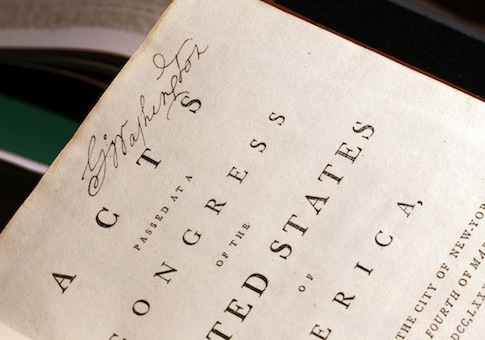
Administrators and campus security told students at California’s Modesto Junior College that they could not hand out copies of the Constitution to fellow students on Constitution Day.

The attempt by Megan Rainwater and Robert Van Tuinen to hand out copies of the Constitution was shut down on Tuesday by campus officials. They were told they would only be able to pass out the Constitution in the college’s free speech zone, and only after scheduling it ahead of time.

In the exchange that was captured on video, a campus police officer approaches the students and tells them to stop handing out the Constitution.

“Why are there rules tied to my free speech?” Van Tuinen asks the officer.

The officer responds that there is a “process” he has to go through.

Both Van Tuinen and the officer then proceed to the Student Center. He is then told by an administrator that the college has a “time, place, and manner.”

“And that’s the free speech area, and the free speech area is over there in front of the student center, in that little cement area. That’s the time, place, and manner free speech area for anybody that’s going to be on campus, which comes through my office, and they would need to fill out an application,” she told Van Tuinen.

The administrator then said she would need a photo of his ID, and he would need to read the guidelines and procedures. “We’re not telling you you can’t, you just need to follow the guidelines,” the administrator says.

Van Tuinen was then was referred to the vice president of Student Services.

Van Tuinen said he was “very surprised” at being told he couldn’t hand out copies of the Constitution this week.

“The Constitution is the highest law in the land—it allows me to talk to fellow students,” he said.

According to Van Tuinen, he gave away around 50 copies before he was shut down. He said he “didn’t know” about the restrictions nor did he “plan to get shut down.” He indicated that he didn’t fill out the paperwork because he thought it applied to holding events, and he was just handing out copies.

“The idea that I can’t pass out Constitutions is really ridiculous,” Van Tuinen said. Other students he has spoken to and who have seen the video are confused about the college’s actions, according to Van Tuinen.

“What the school did is just plain wrong,” he said.

The Foundation for Individual Rights in Education agreed with Van Tuinen.

“The video of Modesto Junior College police and administrators stubbornly denying a public college student’s right to freely pass out pamphlets to fellow students—copies of the Constitution, no less!—should send a chill down the spine of every American,” said Robert Shibley, senior vice president of FIRE.

The organization has written to Modesto Junior College President Jill Stearns demanding the school’s policy be rescinded immediately.

“That students at MJC, a public institution bound by the First Amendment, were prohibited from distributing copies of the Constitution on campus—on a day created to celebrate the Constitution, no less—is profoundly offensive to the First Amendment and shocking to the conscience,” the letter states.

FIRE’s letter told Stearns that the college’s actions are unconstitutional.

“To be clear: MJC’s requirement that students request permission to distribute printed materials on campus is unconstitutional. Its requirement that such requests be submitted a minimum of five business days in advance is unconstitutional. Finally, its exile of all approved campus expression to a single small area of the campus is unconstitutional,” the letter stated.

Stearns did not respond to a request for comment.

Shibley said Modesto Junior College is clearly in the wrong. “Your right to engage in free speech in this country is not contingent on the contents of some bureaucrat’s binder, and the fact that two people on campus are currently speaking their minds doesn’t mean you can’t,” said Shibley.

“Virtually everything that Modesto Junior College could do wrong, it did do wrong. It sent police to enforce an unconstitutional rule, said that students could not freely distribute literature, placed a waiting period on free speech, produced an artificial scarcity of room for free speech with a tiny ‘free speech area,’ and limited the number of speakers on campus to two at a time,” Shibley said.

Calling it “outrageous from start to finish,” Shibley said, “every single person at Modesto responsible for enforcing this policy should have known better.”

Van Tuinen said he doesn’t foresee handing out any other material for a while but does plan on forming a chapter of Young Americans for Liberty at the college.

Source:  The Washington Free Beacon

Edward Snowden asylum: US ‘disappointed’ by Russian decision | The Guardian

Edward Snowden's lawyer

By in Moscow, , and in Washington

Edward Snowden’s lawyer Anatoly Kucherena shows a copy of a temporary document allowing the whistleblower to cross the border into Russia. Photograph: AP

The White House expressed anger and dismay on Thursday after Russia granted temporary asylum to the American whistleblower Edward Snowden and allowed him to leave the Moscow airport where he had been holed up for over a month.

White House spokesman Jay Carney said the US was “extremely disappointed” by the decision, almost certainly taken personally by President Vladimir Putin. He said Moscow should hand Snowden back and hinted that Barack Obama might now boycott a bilateral meeting with Putin in September, due to be held when the US president travels to Russia for a G20 summit.

Carney added that Snowden had arrived in both China and Russia carrying with him thousands of top secret US documents. He said: “Simply the possession of that kind of highly sensitive classified information outside of secure areas is both a huge risk and a violation.

“As we know he’s been in Russia now for many weeks. There is a huge risk associated with … removing that information from secure areas. You shouldn’t do it, you can’t do it, it’s wrong.”

With US-Russian relations now at a cold war-style low, Snowden slipped out of Sheremetyevo airport on Thursday afternoon. His lawyer, Anatoly Kucherena, said Russia’s federal migration service had granted him temporary asylum for one year. Snowden had left the airport to stay at an undisclosed location with expatriate Americans, he added.

Putin made no immediate comment. But having weighed Russia’s options for some weeks, he appears to have decided that Snowden’s propaganda value outweighs any possible US repercussions. Obama’s already floundering attempts to “reset”, or improve, relations with Moscow are in effect over.

In a statement released by WikiLeaks, Snowden thanked the Russian authorities and accused the US of behaving illegally. He made no explicit mention of the trial of Bradley Manning, who this week was convicted of espionage and faces 136 years in jail.

Snowden said: “Over the past eight weeks we have seen the Obama administration show no respect for international or domestic law, but in the end the law is winning.”

He added: “I thank the Russian Federation for granting me asylum in accordance with its laws and international obligations.”

Snowden has been given a temporary Russian travel document, with his name in Cyrillic and a fresh passport photo. “This gave him the right to temporary asylum on the territory of the Russian Federation, Kucherena said, holding up a copy of the document. US authorities had cancelled his American passport.

Security officials said Snowden officially crossed the border into Russia from the airport’s transit zone at about 3.30pm local time. Russia had apparently not informed the US of the move in advance. The state TV channel Rossiya 24 showed a photograph of Snowden’s departure, as he clambered into a grey unmarked car.

Despite being pictured from behind Snowden was instantly recognisable wearing his trademark grey shirt and carrying a black backpack. Next to him was Sarah Harrison, the WikiLeaks representative who accompanied him last month on his flight from Hong Kong.

Kucherena declined to provide details on where Snowden was heading, citing safety concerns. “Since he is the most hunted person in the world, he will address the question of security today,” he told journalists.

The former NSA employee will himself choose his place of residence and forms of protection, he added. Previously, some speculated that the Russian government was keeping Snowden hidden, although the whistleblower and his lawyer have denied that, adding that he has had no contact with Russian security services.

The whistleblower’s father, Lon Snowden, had reportedly been planning to visit his son. Kucherena said on Wednesday that he was sending an invitation to Snowden’s father so he could obtain a Russian visa. Kucherena told Rossiya 24 on Thursday that he would be speaking to the father later in the day to arrange his visit.

US authorities have repeatedly called on Moscow to return the fugitive to face charges in America. Last week America’s attorney general, Eric Holder, sent a letter to Russia’s justice minister promising that Snowden would not be tortured and that he would not face the death penalty if handed over to the US.

Russian officials previously said they had no jurisdiction to return Snowden, as he was not officially located on Russian territory, and that the US had not filed an official extradition request.

The Kremlin did not immediately comment on Snowden’s temporary asylum. Putin has previously said repeatedly that to remain in Russia, Snowden must stop activities harming the United States. His lawyer suggested that fresh revelations published by the Guardian on Wednesday and Thursday had come from documents that Snowden had already given the paper before Putin made his comments.

Russia’s decision has emboldened hawkish critics of the White House, who have long dubbed Obama’s attempts to improve relations with Putin as naive and inappropriate. In a statement on his website, Senator John McCain said: “Russia’s action today is a disgrace and a deliberate effort to embarrass the United States. It is a slap in the face of all Americans. Now is the time to fundamentally rethink our relationship with Putin’s Russia.”

He proposed in response to expand the Magnitsky Act list of banned Russian officials, push for Georgia’s acceptance into Nato and implement US missile defence programmes in Europe.

At the White House, Carney made it clear that President Obama was frustrated by the decision by Russia to allow Snowden to enter the country, and that a planned presidential summit was now in jeopardy.

Obama is scheduled to travel to Russia in September for at meeting of G20 leaders in St Petersburg. He also planned to meet Putin for a bilateral summit during the trip in what would have been a sign of improving relations between the two powers.

That meeting is now under review. “Obviously this is not a positive development,” Carney said. “We have a wide range of interests with the Russians. We are evaluating the utility of the summit.”

Amnesty International called for the focus to switch from Snowden’s asylum plight to the “sweeping nature and unlawfulness” of the US government’s surveillance programmes.

Widney Brown, senior director for international law and policy at Amnesty, said in a statement: “Now that Edward Snowden has left the airport and has protected status in Russia, the focus really needs to be on the US government’s surveillance programs. Snowden would not have needed temporary asylum but for revealing the sweeping nature and unlawfulness of a massive system of domestic and international surveillance by the United States government.”

A survey showed that 43% of Russians supported granting Snowden asylum and 51% approved of his whistleblowing activities. Kucherena said he had received numerous letters from Russians offering Snowden lodging, protection and money, as well as from women interested in Snowden romantically.

Pavel Durov, the founder of Russia’s most popular social network, VKontakte, invited Snowden to come work as a programmer at the network, in a post on his VKontakte page on Thursday.

Source: The Guardian
The Sky Darkens for American Journalism: The future of the American media is being decided in a military court | Al Jazeera

By Chase Mader

Bradley Manning released hundreds of thousands of government documents and files to Wikileaks, most famous among them the unclassified video Wikileaks dubbed, “Collateral Murder”, a harrowing gun-sight view of an Apache helicopter slaughtering a couple of armed men and a much larger group of civilians on a Baghdad street in July, 2007.

The court-martial of Pfc. Manning, finally underway over three years after his arrest, is likely to cause a great deal of collateral destruction in its own right. In this case the victim will be American journalism.

The most serious of the charges against Manning is the capital offense of “aiding the enemy.” (Team Obama has made it clear it won’t seek the death penalty, but a life sentence is possible.) The enemy that the prosecution has in mind is not Wikileaks or the global public but Al Qaeda; because this group had access to the internet, the logic goes, they could read Manning’s disclosures just like everyone else.

The government does not have to prove Manning’s conscious intent to help Al Qaeda, but must only meet the squishier standard of proving the defendant had “specific knowledge” that the terrorists might benefit from his cache of documents.If the Aiding the Enemy charge against Bradley Manning is the outcome of his legal struggles, there will be adverse consequences for whistleblowers and for journalists in the future.

If this charge sticks, it will be a serious blow to American journalism, as it puts all kinds of confidential informants at risk of being capital cases. A soldier in Afghanistan who blogs about the lack of armoured vehicles – a common and very public complaint from the ranks in the Iraq War – could be prosecuted for tipping off the Taliban.

Whoever leaked Ambassador Karl Eikenberry’s long cable on the futility of counterinsurgency in Afghanistan could also be conceivably be put away for life, even executed. As Ben Wizner of the American Civil Liberties Union has explained, the use of this charge against sources, leakers and whistleblowers – like Bradley Manning – will criminalise a great deal of essential journalism – and not just the kind practiced by Wikileaks and various bloggers.

The Manning prosecution has asserted more than once that they would have pressed the Aiding the Enemy charge even if the private had passed his cache to the New York Times or the Washington Post (as the leaker had attempted).

This jolted the editorial classes, who do not much like imagining themselves as being implicated, however hypothetically, in terrorist acts. Op-eds in the New York Times and Los Angeles Times have blasted the Aiding the Enemy charges brought against Manning, explaining that they would not just “chill” but freeze a great deal of essential journalism.

The news media has always relied on leaks of classified material, from the Pentagon Papers and Watergate, to the preemptive disclosure of the 2007 National Intelligence Estimate holding that Iran had no nuclear weapons program, a transparent attempt by the military brass to block Bush and Cheney from launching a third war.

And contrary to widespread panic, massive leaks of classified material tend to enhance national security as the new information can prevent the kind of reckless, poorly-informed decisions that have squandered so much blood and money, from Southeast Asia to Iraq.

Who is a journalist and who gets to decide?

Aiding the Enemy is of course not the only charge against Private Manning. One of the charges, “wanton publication,” hinges in part on whether Wikileaks is a bona fide journalistic entity. But who gets to decide who is and who isn’t a journalist, and how?

Defense witness Yochai Benkler, a professor at Harvard Law School and expert on press freedom and the internet, provided an answer earlier this month. Benkler, who has published penetrating studies of the 21st century media landscape, took the stand July 11th to address the matter of who is and who isn’t a journalist.

Wikileaks is absolutely a media organization, one perfectly emblematic of the “networked fourth estate”, in which traditional news outlets like the Guardian and Der Spiegel collaborate with smaller non-profit and for-profit entities to produce news coverage. Supporters of Manning found Benkler’s testimony to be lucid, supremely well-informed and compelling – but will it convince Judge Denise Lind?

As for traditional news media, they have been largely AWOL, with the New York Times sending a correspondent to a few hearings, only after a shaming by the newspaper’s public editor. But a handful of independent correspondents, notably Kevin Gostzola of FireDogLake, independent journalist Alexa O’Brien and Bradley Manning staffer Nathan Fuller, as well as court artist Clark Stoeckley – have covered every breath of the legal proceedings.

And even as more established media have leaned heavily on these reporters for all manner of factual and logistical assistance, gracious acknowledgement of the professional debt has not always been forthcoming. Last month the New York Times rather snottily described O’Brien as a mere “activist” before being embarrassed into a correction.

Although smug torpor is Big Media’s default setting, a recent barrage of sucker-punches has shaken the Fourth Estate’s generally cosy partnership with the political class. The Obama administration has named James Rosen of Fox News as a co-conspirator in its case against State Department leaker Stephen Jin-Woo Kim; the government has also announced that it had been sifting through two months of the Associated Press’s phone records to hunt down the source of a leak.

Obama’s poison gift to journalists

Affecting a chastened air, the Obama administration now says it wants to make nice with journalists.   To strike a finer “balance” between press freedom and security, Team Obama has offered to pass a Press Shield Law-a slightly revamped version of the same bill the White House threatened to veto back in 2009. (Senator Obama had been a liberal champion of just such a bill before). This Press Shield Law is intended as conciliatory basket of fruit, sent to the media as an apology for all those investigations.

The government’s gift to journalists is poison, and should be rejected. The Press Shield Law would be more accurately titled the Media Prosecution Enhancement Bludgeon – as Trevor Timm of the Press Freedom Foundation has warned, the statute would override and erase many common-law protections currently enjoyed by reporters.

Just as with our whistleblower protection laws, the statute includes a cavernous carve-out for any leak-based reporting that affects “national security”, a term that is infinitely elastic in the hands of official Washington. (The law would not have “shielded” the Associated Press from the government’s investigation of their phone records, nor would it have protected Fox’s Rosen).

But wait: that’s not all that the new law won’t do! As the law’s primary author, Senator Chuck Schumer (D-NY) has crowed, the law would specifically exclude Wikileaks and other internet-based groups that he and his colleagues do not believe to be proper media organizations. (Bear in mind the average age in today’s United States Senate is 61). The language defining who is and who isn’t “a member of the media” is marvellously supple, to be loosened and tightened as the government sees fit.

Meanwhile, the State onslaught against American journalists continues: the dependably conservative Washington DC circuit court has ruled that James Risen of the New York Times must testify as to his sources in a story about CIA disruption of Iran’s nuclear program. (Risen has pledged he will go to jail first).

Former NSA and CIA director Michael Hayden has casually called Glenn Greenwald a co-conspirator with NSA leaker Edward Snowden. With this roiling in the background, military judge Denise Lind announced on July 18 that she would not dismiss the Aiding the Enemy charge against Bradley Manning but will instead weigh that momentous accusation on its merits.

This is not necessarily a disaster for Manning or for American journalism: if Judge Lind rules against this charge, it will establish common law precedent protecting journalists from similar legal attacks, and Bradley Manning will likely serve (a little) less time in prison. (The Judge’s verdict is expected by next Tuesday, July 30th).

On the other hand, if the Aiding the Enemy charge sticks, Pfc. Manning faces a possible life sentence – and the outcome might be only slightly less calamitous for American journalism.

Source: Common Dreams

Jimmy Carter Defends Edward Snowden, Says NSA Spying Has Compromised Nation’s Democracy | The Huffington Post

jimmy carter edward snowden

Former president Jimmy Carter speaks at dedication ceremonies for the new George W. Bush Presidential Center in Dallas, Texas, Thursday, April 25, 2013. (Paul Moseley/Fort Worth Star-Telegram/MCT via Getty Images)

Former President Jimmy Carter announced support for NSA whistleblower Edward Snowden this week, saying that his uncovering of the agency’s massive surveillance programs had proven “beneficial.”

Speaking at a closed-door event in Atlanta covered by German newspaper Der Spiegel, Carter also criticized the NSA’s domestic spying as damaging to the core of the nation’s principles.

“America does not have a functioning democracy at this point in time,” Carter said, according to a translation by Inquisitr.

No American outlets covered Carter’s speech, given at an Atlantic Bridge meeting, which has reportedly led to some skepticism over Der Spiegel’s quotes. But Carter’s stance would be in line with remarks he’s made on Snowden and the issue of civil liberties in the past.

In June, while Snowden was scrambling to send out asylum requests from an airport in Russia, Carter appeared to back the former NSA contractor’s efforts to remain out of U.S. custody.

“He’s obviously violated the laws of America, for which he’s responsible, but I think the invasion of human rights and American privacy has gone too far,” he told CNN, saying that nations were within their right to offer asylum to Snowden. “I think that the secrecy that has been surrounding this invasion of privacy has been excessive, so I think that the bringing of it to the public notice has probably been, in the long term, beneficial.”

Snowden has been hard-pressed to find support among U.S. politicians. Lawmakers on both sides of the aisle have declared Snowden a traitor who deserves to be prosecuted for his leaks. The White House has also been persistent in its attempts to bring him into custody. Last week, the administration criticized Russia for facilitating a meeting between Snowden and human rights activists. Snowden has since applied for temporary asylum in the nation, following complications surrounding transit to the Latin American nations that he’d been considering.

Source: The Huffington Post