University of BC Doctors Expose Vaccination Cover-up: Official Documents Released From The UK | Collective Evolution

vaccDr Chris Shaw, from the University of British Colombia’s (UBC)  Department of Ophthalmology, Visual Sciences, Experimental Medicine and Neuroscience published a paper in the Journal Inorganic Biochemistry along with his colleague, Dr.  Lucija Tomljenovic that revealed Government experts have known about the dangers associated with vaccinations. They investigated information exposing a 30 year scandal of official meetings by UK government vaccine committees and independent medical ‘experts’ with drug industry connections. The paper is at the bottom of the article under “sources”.

A Freedom of Information Act request filed with the CDC  seeking information on what the CDC knows about the dangers of vaccines, had by law to be responded to in 20 days. Nearly 7 years later a judge ordered the CDC to turn over the documents on September 30th, 2011. These documents were part of the study discussed in this article.

The paper has received a lot of attention. UBC even held a symposium about vaccination safety as a result in an effort to arouse more critical thinking and discussion around the topic. The response was disturbing  with a number of UBC professors upset that the discussion was taking place in the first place. It’s disturbing to know that there are those out there who wish to silence an opposition to vaccination, and not even keep an open mind to potential dangers. Much of the medical literature examined by researchers comes straight from pharmaceutical company-sponsored medical research. It’s time for us to wake up and make some obvious connections. Here is a quote from the published, peer reviewed paper.

Deliberately concealing information from parents for the sole purpose of getting them to comply with an “official” vaccination schedule could be considered as a form of ethical violation or misconduct. Official documents obtained from the UK Department of Health (DH) and the Joint Committee on Vaccination and Immunisation (JCVI) reveal that the British health authorities have been engaging in such practice for the last 30 years, apparently for the sole purpose of protecting the national vaccination program(1).

The documents reveal that vaccinations don’t work, and that they cause the disease they are supposed to prevent. They also indicate scientific fraud, that government ‘experts’ are working to conceal information. The 45 page paper was published in 2011 and presented at the BSEM scientific conference (2)

Here I present the documentation which appears to show that the JCVI made continuous efforts to withhold critical data on severe adverse reactions and contraindications to vaccinations to both parents and health practitioners in order to reach overall vaccination rates which they deemed were necessary for “herd immunity”, a concept which with regards to vaccination, and contrary to prevalent beliefs, does not rest on solid scientific evidence as will be explained. As a result of such vaccination policy promoted by the JCVI and the DH, many children have been vaccinated without their parents being disclosed the critical information about demonstrated risks of serious adverse reactions, one that the JCVI appeared to have been fully aware of. It would also appear that, by withholding this information, the JCVI/DH neglected the right of individuals to make an informed consent concerning vaccination. By doing so, the JCVI/DH may have violated not only International Guidelines for Medical Ethics. –  Dr Lucija Tomljenovic (1)

She also mentions evidence of ties between vaccine manufacturers and pharmaceutical companies.

The transcripts of the JCVI meetings also show that some of the Committee members had extensive ties to pharmaceutical companies and that the JCVI frequently co-operated with vaccine manufacturers on strategies aimed at boosting vaccine uptake. Some of the meetings at which such controversial items were discussed were not intended to be publicly available, as the transcripts were only released later, through the Freedom of Information Act (FOI). These particular meetings are denoted in the transcripts as “commercial in confidence”, and reveal a clear and disturbing lack of transparency, as some of the information was removed from the text (i.e., the names of the participants) prior to transcript release under the FOI section at the JCVI website – Dr Lucija Tomljenovic (1)

The documents go on to show that when strong evidence was presented against vaccination, they were completely ignored and overlooked by the Joint Committee on Vaccinations and Immunizations. Furthermore, the committee has constantly dismissed independent research and downplayed vaccine concerns while over inflating the benefits. They’ve also promoted and elaborated a plan for introducing new vaccines of questionable efficacy and safety into the routine pediatric schedule, on the assumption that the licenses would eventually be granted. All of these violate the JCVI’s own code of conduct.

Alternative media outlets continue to raise awareness about vaccinations and their potential dangers. With the world handing over credibility to a certain criteria, we thank all of the researchers out there who continue to examine all information, and a wide variety of sources. With the work of these researchers and doctors, the truth about vaccinations continues to spread across the planet.

Source: Collective Evolution

(1) http://www.ecomed.org.uk/wp-content/uploads/2011/09/3-tomljenovic.pdf
(2)http://www.ecomed.org.uk/publications/the-health-hazards-of-disease-prevention
(3) http://www.vancourier.com/Responses+vaccine+paper+problem+free+scientific+inquiry+expression/6073466/story.html
(4) http://nsnbc.me/2013/05/10/the-vaccine-hoax-is-over-freedom-of-information-act-documents-from-uk-reveal-30-years-of-coverup
(5) http://childhealthsafety.wordpress.com/2012/03/14/government-experts-cover-up-vaccine-hazards

Nanoparticles in your food? You’re already eating them | Grist

By Twilight Greenaway

What’s engineered in a lab, added to processed foods, and never labeled? If you thought GMOs were mysterious, try nanoparticles.

I’ve been keeping my eye on the role of nanotechnology in food for a few years now, so I was interested to see a feature-length investigation called “Eating Nano” in this month’s E Magazine. In it, E editor Brita Belli takes a deep dive into the growing role of nanotechnology in food and agriculture, the current lack of oversight and regulations, and the growing consensus that more information and transparency are both sorely needed in relation to this growing field.

Nanotechnology involves the engineering and manipulation of particles at a nano scale. Nanoparticles, as they’re called, are measured in nanometers or billionths of one meter. Another way to put it: If a nanoparticle were the size of a football, a red blood cell would be the size of the field. Although some nanoparticles have been found to exist in nature (carbon nanoparticles exist in caramelized foods, for instance, and silverware has been shown to shed nano-sized silver particles), it’s the nanoparticles that are engineered in laboratories that have environmental health advocates concerned.

Here’s the thing: It turns out most materials start behaving differently at that size. According to the British corporate accountability organization As You Sow, which has been keeping tabs on the nanotech industry for several years, “materials reduced to the nanoscale either through engineered or natural processes can suddenly show very different properties compared to what they exhibit on a macroscale, enabling unique applications such as alterations in color, electrical conductance, or permeability.”

Considering the fact that nanoparticles are now used to help deliver nutrients, keep food fresh for longer, and act as thickening and coloring agents in processed foods, these “different properties” might be cause for concern. Or — at the very least — they might be reason enough to conduct thorough research into their health impacts.

In actuality, companies are not required to disclose nano-sized ingredients, nor is there much active questioning about their safety. Instead, Belli writes, “From the government’s perspective, nano forms of silver, iron or titanium are no different, fundamentally, from their scaled-up counterparts which have already been safety tested, so the agency has ushered the particles into the food supply under the Generally Recognized as Safe provision.”

I’ve been hearing about nanoparticles in food packaging for a while now (it’s a market Belli says is expected to reach $20 billion by 2020), but I had no idea that there was nano-coating in the works for bananas. And what I was most surprised to learn is just how many food products already contain nanoparticles. As Belli writes:

Nanoparticles can be used to purify water, as anticaking and gelatin-forming agents and in packaging to protect against UV light, prevent the growth of microbes or detect contamination. Titanium dioxide is added to a huge swath of products in nano form including paints, paper and plastics but also lends white pigment to most toothpastes and many processed foods, including Mentos, Trident and Dentyne gum, M&Ms, Betty Crocker Whipped Cream Frosting, Jello Banana Cream Pudding, Vanilla Milkshake Pop Tarts and Nestlé Original Coffee Creamer. The aforementioned products were featured in a report in February 2012 in the journal Environmental Science & Technology which concluded that each of us likely consumes some amount of titanium dioxide (TiO2) nanoparticles each day, and children under 10 likely consume the greatest amounts (around 1-2 mg TiO2 per kilogram body weight per day) due to their higher intake of frosted foods, candy, gum and other sweets.

Although there is less science focused on ingested nanotech particles than on, say, the ones that are inhaled in industrial environments, Belli does point to the few studies that exist, including a recent one out of Cornell University that looked at chickens’ abilities to absorb iron after eating nanoparticles generally considered safe for human consumption. In it, researchers found that acute exposure to the particles changed the structure of the lining of the chickens’ intestinal walls, a change the lead scientist noted “serves to underscore how such particles, which have been widely studied and considered safe, cause barely detectable changes that could lead to, for example, over-absorption of other, harmful compounds.”

When it comes to questions about the health effects of eating nanoparticles, Belli quotes a guide on the American Society of Safety Engineers’ website, which reads:

Nanoparticles may be ingested through drinking water, food additives, atmospheric dust on food, toothpaste and dental fillings and implants. Ingested nanoparticles can then be absorbed through ‘Peyer’s Plaques’ or small nodules in intestinal tissue that are part of the immune defense system. If nanoparticles enter the digestive system and proceed into the bloodstream, they could move throughout the body and cause damage.

Of course, most of this — and much of the science Belli points to — is preliminary, based on very little hard science. And if that lack of a cautionary approach to science in a multibillion-dollar industry sounds familiar, that’s because — well, it is. The comparison to genetically modified foods is unavoidable.

In fact, Timothy Duncan, a research chemist from the Food and Drug Administration, admitted as much about the nanotech industry (which likely has thousands of food and food packaging products in the research and development stage) while writing in the journal Nature Nanotechnology last year.“What’s holding back the introduction of nanofoods is the hesitation of the food industry, fearing a public backlash along the lines of what happened with genetically modified foods, and public fears in some countries about tampering with nature,” Duncan wrote.

And considering how little media coverage these larger questions about nanotechnology and food have received — not to mention inclusion on the larger “food movement” laundry list — it looks like the lesson the food industry has learned from GMOs is not one about the importance of transparency, but quite the opposite.

As Tom Philpott observed in Grist in 2010, the last time big questions surfaced about nanotech in food in the media: “As with GMOs, the strategy seems to be: release into the food supply en masse first; assess risks later (if ever).”

Source: Grist & EMagazine

Legal drugs, deadly outcomes | Los Angeles Times

By Scott Glover & Lisa Girion

Prescription overdoses kill more people than heroin and cocaine. An L.A. Times review of coroners’ records finds that drugs prescribed by a
small number of doctors caused or contributed to a disproportionate number of deaths…A Los Angeles Times investigation has found that in nearly half of the accidental deaths from prescription drugs in four Southern California counties, the deceased had a doctor’s prescription for at least one drug that caused or contributed to the death.

Reporters identified a total of 3,733 deaths from prescription drugs from 2006 through 2011 in Los Angeles, Orange, Ventura and San Diego counties.

An examination of coroners’ records found that:

  • In 1,762 of those cases — 47% — drugs for which the deceased had a prescription were the sole cause or a contributing cause of death.
  • A small cadre of doctors was associated with a disproportionate number of those fatal overdoses. Seventy-one — 0.1% of all practicing doctors in the four counties — wrote prescriptions for drugs that caused or contributed to 298 deaths. That is 17% of the total linked to doctors’ prescriptions.
  • Each of those 71 physicians prescribed drugs to three or more patients who died.

Experts said the findings challenge the prevailing view of what is driving the surge in overdose deaths and should prompt closer scrutiny of doctors and their prescribing practices. Read more…

Source: Los Angeles Times

Pesticide Industry-Backed Opponents Prop 37: Caught Possible Criminal Act | Nation of Change

By Zach KaldVeer

The $36 million No on 37 campaign, bankrolled by $20 million from the world’s six largest pesticide companies, has been caught in yet another lie, this time possibly criminal.

These companies and their allies in the junk food industry know that their profit margins may suffer if consumers have a choice whether to purchase genetically engineered foods or not.  And that’s why opponents are spending nearly a million dollars per day trying to make Prop 37 complicated. But really it’s simple – we have the right to know what’s in our food.

To date, the No on 37 campaign has been able to repeat one lie after another with near impunity. But has this pattern of deceit finally caught up to it?

Yesterday, the Yes on 37 campaign sent letters to the U.S. Department of Justice requesting a criminal investigation of the No on 37 campaign for possible fraudulent misuse of the official seal of the U.S. Food and Drug Administration (FDA).

The No on 37 campaign affixed the FDA’s seal to one of the campaign’s mailers.Section 506 of the U.S. Criminal Code states: “Whoever…knowingly uses, affixes, or impresses any such fraudulently made, forged, counterfeited, mutilated, or altered seal or facsimile thereof to or upon any certificate, instrument, commission, document, or paper of any description…shall be fined under this title, or imprisoned not more than 5 years, or both.”

The letter also provides evidence that the No on 37 campaign falsely attributed a direct quote to the FDA in the campaign mailer. Alongside the FDA seal, the mailer includes this text in quotes. “The US Food and Drug Administration says a labeling policy like Prop 37 would be ‘inherently misleading.” The quote is entirely fabricated. The FDA did not make this statement and does not take a position on Prop 37. Read more…

Source: Nation of Change

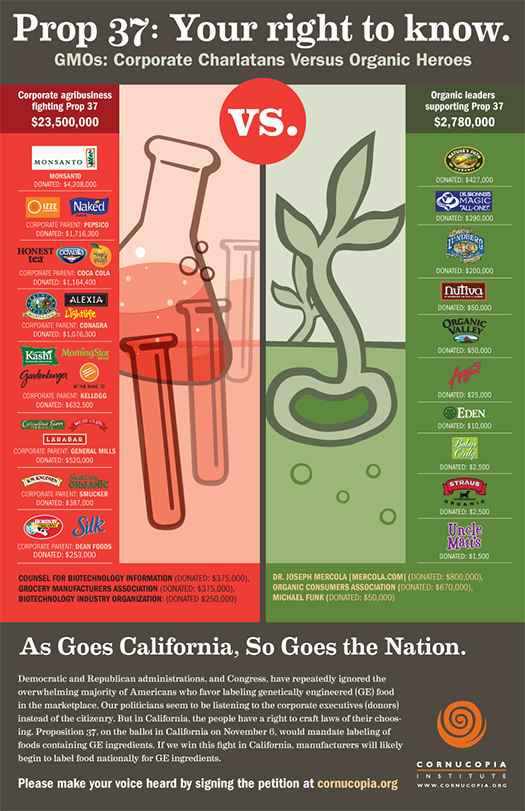
Many ‘Natural’ or “Organic’ Companies are Fighting Against the California Proposition for Labeling of GMO Foods

We were shocked to learn that many supposedly ‘natural’ or ‘organic’ companies, which have been bought out by big corporations, have joined Monsanto in giving huge donations to fight the California proposition for labeling of GMO foods. This includes popular brands like Odwalla, Naked, Gardenburger, Cascadian Farms Organic, Muir Glen, Knudsen, Santa Cruz Organic, Horizon Organic, Silk and more.

This document also gives the names of companies with more integrity that are donating to support Prop 37 for GMO labeling: Nature’s Path, Dr. Bronner’s, Lundberg, Nutiva, Organic Valley, Amy’s, Eden, Straus and others.

Since it feels important for us all to know where our food purchase dollars are going, I wanted to share this with you, in case you were not already aware of it.

Smart Meters Research & Health Warnings

Research:

Report warning about Smart Meters by Santa Cruz Public Health Advisor, Poki Namkung, MD: http://emfsafetynetwork.org/wp-content/uploads/2009/11/Health-Risks-Associated-With-SmartMeters.pdf

American Academy of Environmental Medicine calls for moratorium on Smart Meters: http://emfsafetynetwork.org/wp-content/uploads/2009/11/AAEM-Resolution.pdf

Journal of Neuroscience double-blind study showing evidence of electro-hypersensitivity (EHS): http://www.ncbi.nlm.nih.gov/pubmed/21793784

Letter from the prestigious Swedish Karolinska Institute (awards the Nobel Prize in Medicine) warning of the dangers of wireless Smart Meter technology: http://www.scribd.com/doc/59738917/Dr-Johansson-s-letter-re-SmartGrid-Smart-Meter-dangers-to-CPUC-7-9-2011

Smart Meters – Separating Fact from Fiction: http://www.es-uk.info/news/2012-02-10-fact-from-fiction.pdf

BioInitiative Report – Calls for Biological Limits to EMR/EMF (references over 2,000 studies showing biological impacts): http://www.bioinitiative.org/

Collection of scientific studies related to the health impacts of non-ionizing radiation: http://www.emfwise.com/science.php

Comprehensive explanation of why FCC limits of EMR are outdated and unsafe: http://stopsmartmeters.org/2012/03/09/a-primer-on-the-fcc-guidelines-for-the-smart-meter-age/

Videos:

Smart Phone Awareness – “Disconnect” Movie Trailers: http://vimeo.com/31336824 & http://www.youtube.com/watch?v=hXGZ7Waa44s

“Full Signal” Movie Trailer: http://vimeo.com/7625314

Headaches from Wi-Fi in Schools: http://www.youtube.com/watch?v=KN7VetsCR2I

Dirty Electricity Explained: http://www.youtube.com/watch?v=ci5GGqEPecE

“Stop Smart Meters – The Film” Trailer: http://www.indiegogo.com/smartmeterfilm

Public Health Physician Warns of Smart Meter Dangers: http://www.youtube.com/watch?v=n7L21XOC2wA

Former cell phone industry engineer/officer destroys the technology he helped build: http://www.youtube.com/watch?v=0TiOx7_DVj0

Smart Meter EMR can be higher than Cell Phone EMR: http://www.youtube.com/watch?v=aOabFJlenz4

The Dark Side of Smart Meters: http://www.youtube.com/watch?v=FLeCTaSG2-U

Tim Ferriss speaks on fertility impact of smart phones: http://www.dailymotion.com/video/xgjks7_tim-ferriss-links-cell-phones-to-male-infertility_news

Supreme Court Health Care Decision: Individual Mandate Survives | Huffington Post

Editor’s Note: This U.S. Supreme Court decision comes as yet another shocking departure from previous constitutional cases limiting federal authority in the states and over it’s respective Citizens. This wrong-headed, political decision expands even further the idea that the U.S. Congress and Executive Branch can decide for all Americans what they can and cannot do with their lives. I have lived healthy and free for over sixty years without health insurance, medicare, medicaid or any other insurance program. I for one will not be purchasing any health insurance under this government mandate. If this means I will no longer pay any federal taxes or file any returns to avoid the “penalties” the IRS will administer then so be it.

WASHINGTON – The individual health insurance mandate is constitutional, the Supreme Court ruled Thursday, upholding the central provision of President Barack Obama’s signature Affordable Care Act.

The controlling opinion, written by Chief Justice John Roberts, upheld the mandate as a tax, although concluded it was not valid as an exercise of Congress’ commerce clause power. Justices Ruth Bader Ginsburg, Stephen Breyer, Sonia Sotomayor and Elena Kagan joined in the outcome.

The decision in National Federation of Independent Business v. Sebelius comes as something of a surprise after the generally hostile reception the law received during the six hours of oral arguments held over three days in March. But by siding with the court’s four Democratic appointees, Chief Justice Roberts avoided the delegitimizing taint of politics that surrounds a party-line vote while passing Obamacare’s fate back to the elected branches. GOP candidates and incumbents will surely spend the rest of the 2012 campaign season running against the Supreme Court and for repeal of the law.

Five justices concluded that the mandate, which requires virtually all Americans to obtain minimum health insurance coverage or pay a penalty, falls within Congress’ power under the Constitution to “lay and collect taxes.”

“The individual mandate cannot be upheld as an exercise of Congress’s power under the Commerce Clause,” Roberts wrote. “That Clause authorizes Congress to regulate interstate commerce, not to order individuals to engage in it. In this case, however, it is reasonable to construe what Congress has done as increasing taxes on those who have a certain amount of income, but choose to go without health insurance. Such legislation is within Congress’s power to tax.”

Ginsburg, writing separately for the four liberals, said they would have upheld the mandate under the commerce clause too. “Unlike the market for almost any other product or service, the market for medical care is one in which all individuals inevitably participate,” she wrote. “Virtually every person residing in the United States, sooner or later, will visit a doctor or other health care professional.”

Justices Antonin Scalia, Anthony Kennedy, Clarence Thomas and Samuel Alito joined in a dissent. Together, Roberts’ controlling opinion, Ginsburg’s concurrence, the four-justice dissent and Thomas’ own dissent add up to 187 pages.

In a nod to the importance of the health care cases, Roberts, Ginsburg and Kennedy all chose to read summaries of their opinions from the bench.

In a section of his opinion joined by the liberal justices, Roberts noted that the conservative dissenters contend that the mandate cannot be upheld as a tax “because Congress did not ‘frame’ it as such. In effect, they contend that even if the Constitution permits Congress to do exactly what we interpret this statute to do, the law must be struck down because Congress used the wrong labels.”

But the majority was not persuaded by that argument. Roberts wrote that the mandate provision “need not be read to do more than impose a tax. That is sufficient to sustain it.”

On Medicaid expansion, the court upheld the expansion but with a critical caveat: The federal government may not threaten the states that don’t comply with the loss of their existing funding. Essentially, the Medicaid expansion is now optional for the states.

“As for the Medicaid expansion, that portion of the Affordable Care Act violates the Constitution by threatening existing Medicaid funding,” Roberts wrote. “Congress has no authority to order the States to regulate according to its instructions. Congress may offer the States grants and require the States to comply with accompanying conditions, but the States must have a genuine choice whether to accept the offer. The States are given no such choice in this case: They must either accept a basic change in the nature of Medicaid, or risk losing all Medicaid funding. The remedy for that constitutional violation is to preclude the Federal Government from imposing such a sanction.”

For their part, the dissenters were not impressed with Roberts’ parsing of the law. “The Court regards its strained statutory interpretation as judicial modesty. It is not. It amounts instead to a vast judicial overreaching,” wrote the four other conservatives.

They then looked to the political future: The majority’s decision, they argued, “creates a debilitated, inoperable version of health-care regulation that Congress did not enact and the public does not expect. It makes enactment of sensible health-care regulation more difficult, since Congress cannot start afresh but must take as its point of departure a jumble of now senseless provisions, provisions that certain interests favored under the Court’s new design will struggle to retain. And it leaves the public and the States to expend vast sums of money on requirements that may or may not survive the necessary congressional revision.”

Summarizing his delicate decision from the bench, Roberts reminded his listeners that it is “not our job to save the people from the consequences of their political choices.” Still, the decision appeared to do just that.

By narrowing Congress’ commerce and spending powers, Roberts moved the law in a decidedly conservative direction. Yet by invoking the taxing power, he saved not only the people but also Congress, the president and the Supreme Court itself from the consequences of their political choices that had seemed so evident at oral argument three months ago.

Careful legal parsing aside, the bottom line is: The Affordable Care Act has survived.

Source: Huffington Post

Radiation Therapy Can Make Cancers 30x More Malignant | GreenMedInfo.com

Following on the heels of recent revelations that x-ray mammography may be contributing to an epidemic of future radiation-induced breast cancers, in a new article titled, “Radiation Treatment Generates Therapy Resistant Cancer Stem Cells From Aggressive Breast Cancer Cells,” published in the journal Cancer July 1st, 2012, researchers from the Department of Radiation Oncology at the UCLA Jonsson Comprehensive Cancer Center report that radiation treatment actually drives breast cancer cells into greater malignancy.

The researchers found that even when radiation kills half of the tumor cells treated, the surviving cells which are resistant to treatment, known as induced breast cancer stem cells (iBCSCs), were up to 30 times more likely to form tumors than the nonirradiated breast cancer cells. In other words, the radiation treatment regresses the total population of cancer cells, generating the false appearance that the treatment is working, but actually increases the ratio of highly malignant to benign cells within that tumor, eventually leading to the iatrogenic (treatment-induced) death of the patient.

Last month, a related study published in the journal Stem Cells titled, “Radiation-induced reprogramming of breast cells,” found that ionizing radiation reprogrammed less malignant (more differentiated) breast cancer cells into iBCSCs, helping to explain why conventional treatment actually enriches the tumor population with higher levels of treatment-resistant cells. [i]

A growing body of research now indicts conventional cancer treatment with chemotherapy and radiation as a major contributing cause of cancer patient mortality.  The primary reason for this is the fact that cancer stem cells, which are almost exclusively resistant to conventional treatment, are not being targeted, but to the contrary, are encouraged to thrive when exposed to chemotherapy and radiotherapy.

In order to understand how conventional treatment drives the cancer into greater malignancy, we must first understand what cancer is….

cancer lymphocyte

What Are Cancer Stem Cells, And Why Are They Resistant To Treatment?

Tumors are actually highly organized assemblages of cells, which are surprisingly well-coordinated for cells that are supposed to be the result of strictly random mutation. They are capable of building their own blood supply (angiogenesis), are able to defend themselves by silencing cancer-suppression genes, secreting corrosive enzymes to move freely throughout the body, alter their metabolism to live in low oxygen and acidic environments, and know how to remove their own surface-receptor proteins to escape detection by white blood cells. In a previous article titled “Is Cancer An Ancient Survival Program Unmasked?” we delved deeper into this emerging view of cancer as an evolutionary throw-back and not a byproduct of strictly random mutation.

Because tumors are not simply the result of one or more mutated cells “going rogue” and producing exact clones of itself (multi-mutational and clonal hypotheses), but are a diverse group of cells having radically different phenotypal characteristics, chemotherapy and radiation will affect each cell type differently.

Tumors are composed of a wide range of cells, many of which are entirely benign.

The most deadly cell type within a tumor or blood cancer, known as cancer stem cells (CSCs), has the ability to give rise to all the cell types found within that cancer.

They are capable of dividing by mitosis to form either two stem cells (increasing the size of the stem population), or one daughter cell that goes on to differentiate into a variety of cell types, and one daughter cell that retains stem-cell properties.

This means CSCs are tumorigenic (tumor-forming) and should be the primary target of cancer treatment because they are capable of both initiating and sustaining cancer.  They are also increasingly recognized to be the cause of relapse and metastasis following conventional treatment.

CSCs are exceptionally resistant to conventional treatment for the following reasons

  1. CSCs account for less than 1 in 10,000 cells within a particular cancer, making them difficult to destroy without destroying the vast majority of other cells comprising the tumor.[ii]
  1. CSCs are slow to replicate, making them less likely to be destroyed by chemotherapy and radiation treatments that target cells which are more rapidly dividing.
  1. Conventional chemotherapies target differentiated and differentiating cells, which form the bulk of the tumor, but these are unable to generate new cells like the CSCs which are undifferentiated.

The existence of CSCs explains why conventional cancer treatment has completely missed the boat when it comes to targeting the root cause of tumors. One reason for this is because existing cancer treatments have mostly been developed in animal models where the goal is to shrink a tumor. Because mice are most often used and their life spans do not exceed two years, tumor relapse is very difficult, if not impossible to study.

The first round of chemotherapy never kills the entire tumor, but only a percentage. This phenomenon is called the fractional kill. The goal is to use repeated treatment cycles (usually six) to regress the tumor population down to zero, without killing the patient.

What normally occurs is that the treatment selectively kills the less harmful populations of cells (daughter cells), increasing the ratio of CSCs to benign and/or less malignant cells.  This is not unlike what happens when antibiotics are used to treat certain infections. The drug may wipe out 99.9% of the target bacteria, but .1% have or develop resistance to the agent, enabling the .1% to come back even stronger with time.

The antibiotic, also, kills the other beneficial bacteria that help the body fight infection naturally, in the same way that chemotherapy kills the patient’s immune system (white blood cells and bone marrow), ultimately supporting the underlying conditions making disease recurrence more likely.

The reality is that the chemotherapy, even though it has reduced the tumor volume, by increasing the ratio of CSCs to benign daughter cells, has actually made the cancer more malignant.

Radiotherapy has also been shown to increase cancer stem cells in the prostate, ultimately resulting in cancer recurrence and worsened prognosis.[iii] Cancer stem cells may also explain why castration therapy often fails in prostate cancer treatment.[iv]

Non-Toxic Natural Substances Which Target and Kill CSCs

Natural compounds have been shown to exhibit three properties which make them suitable alternatives to conventional chemotherapy and radiotherapy:

  1. High margin of safety: Relative to chemotherapy agents such as 5-fluorouracil natural compounds are two orders of magnitude safer
  2. Selective Cytotoxicity: The ability to target only those cells that are cancerous and not healthy cells
  3. CSCs Targeting: The ability to target the cancer stem cells within a tumor population.

The primary reason why these substances are not used in conventional treatment is because they are not patentable, nor profitable. Sadly, the criteria for drug selection are not safety, effectiveness, accessibility and affordability. If this were so, natural compounds would form an integral part of the standard of care in modern cancer treatment.

Research indicates that the following compounds (along with common dietary sources) have the ability to target CSCs:

  1. Curcumin (Turmeric)
  1. Resveratrol (Red Wine; Japanese Knotweed)
  1. Quercetin (Onion)
  1. Sulforaphane (Brocolli sprouts)
  1. Parthenolide (Butterbur)
  1. Andrographalide (Andrographis)
  1. Genistein (Cultured Soy; Coffee)
  1. Piperine (Black Pepper)

Additional research found on the GreenMedInfo.com Multidrug Resistance page indicate over 50 compounds inhibit multidrug resistance cancers in experimental models.

Source: GreenMedInfo.com

Cancer treatment is about making money…provoking thoughts…

By Rick Cantrell, PhD, MD, PsyD

The below is absolutely 100% true and as a doctor I have been telling people this for 15 years now. No one wants to listen. Folks need to wake up. Cancer treatment is about making money. It is a 120 billion dollar a year industry in the United States alone and estimated to be a 600 billion dollar a year industry worldwide.

A successful cancer case according to the American Cancer Society and the American College of Oncology and Hematology means that the person survives for 5 years. Both the American Cancer Society and the American College of Oncology and Hematology admit that a person is likely to survive cancer for 7 to 10 years even if they do absolutely NOTHING. Of course, only the doctors get those magazines – not you, the cancer patient.

Alternative medicine’s track record of curing cancer is 10 times higher than that of conventional medicine. Note that I say CURE.

Remember another thing. A TUMOR is just a symptom. It is not the cause of cancer.

Science is cause and effect. Remove the cause and the effect disappears.

I am in my third battle with cancer right now. I have not done any chemotherapy or radiation or surgery for any of my bouts with cancer. I survived leukemia, I survived Non Hodgkins Lymphoma and now I have Glioblastoma which is supposedly an incurable form of brain cancer. I was given two months to live 5 months ago.

I have been using Chinese herbs, high doses of vitamin C, acupuncture, chiropractic, homeopathy and nutritional changes. Yes, at first it got worse. It had metastasized to my lymph nodes, my lungs and my bones. As of this week, I am happy to say that there is no evidence now of any cancer in my lymph system or my bones. I had 6 tumors in my lungs, now there are only two. The tumors in my brain have shrunken tremendously. I never did any of their chemo, radiation or surgery.

Here is a very interesting statistic that you can only have access to by being a doctor. Every year more than 1,000 doctors oncologists (cancer doctors) are diagnosed with cancer. Less than 10% of them choose to do the treatment that they have been giving to their patients. Sort of like the fact that less than 25% of all pediatricians vaccinate their own children because of the fact that the risk of sudden death or serious side effects from the vaccination is higher than the risk of catching the disease one is being vaccinated for. This is not bullshit people – it is truth.

Medicine is about money, not about your health and the system traps people, especially the elderly, disabled and poor into a deadly treatment regime that puts them in an early grave. Meanwhile, all the jet set billionaires are flying off to Europe and paying big bucks for alternative treatments and getting cured.

Does alternative medicine work all the time? No. Of course not. Nothing works all the time. But there is a reason for that. You don’t die until it’s your time to die. Nothing can make you live longer than that time.

However quality of life comes into play. Those cancer patients who use alternative therapies for their cancer, yet still die from the illness, suffer a much higher quality of life. They die able to spend time with their families and even recognize their family members. They don’t become emaciated like those who do chemotherapy or radiation do and rarely is a person who goes under the treatment of chemotherapy able to recognize anyone for the last few days of their lives. Their bodies become ravaged to the point that you can’t even recognize them either. They suffer at a much much higher rate and they have one let down after another as doctors tell them, ahhh – it’s looking good, only to tell them on the next visit it’s looking worse, you need more chemo and radiation.

What is criminal about this is that YOUR DOCTORS KNOW THIS SHIT.

I took an oath as a physician. I have always followed it. That has certainly not made me successful financially as a doctor because I have consistently refused to go along with conventional medicine’s bullshit.

– Rick Cantrell, PhD, MD, PsyD

Cancer Update from Rick Cantrell:

  1. \Every person has cancer cells in the body. These cancer cells do not show up in the standard tests until they have multiplied to a few billion. When doctors tell cancer patients that there are no more cancer cells in their bodies after treatment, it just means the tests are unable to detect the cancer cells because they have not reached the detectable size.
  2. Cancer cells occur between 6 to more than 10 times in a person’s lifetime.
  3. When the person’s immune system is strong the cancer cells will be destroyed and prevented from multiplying and forming tumors.
  4. When a person has cancer it indicates the person has nutritional deficiencies. These could be due to genetic, but also to environmental, food and lifestyle factors.
  5. To overcome the multiple nutritional deficiencies, changing diet to eat more adequately and healthy, 4-5 times/day and by including supplements will strengthen the immune system.
  6. Chemotherapy involves poisoning the rapidly-growing cancer cells and also destroys rapidly-growing healthy cells in the bone marrow, gastrointestinal tract etc, and can cause organ damage, like liver, kidneys, heart, lungs etc.
  7. Radiation while destroying cancer cells also burns, scars and damages healthy cells, tissues and organs.
  8. Initial treatment with chemotherapy and radiation will often reduce tumor size. However prolonged use of chemotherapy and radiation do not result in more tumor destruction.
  9. When the body has too much toxic burden from chemotherapy and radiation the immune system is either compromised or destroyed, hence the person can succumb to various kinds of infections and complications.
  10. Chemotherapy and radiation can cause cancer cells to mutate and become resistant and difficult to destroy. Surgery can also cause cancer cells to spread to other sites.
  11. An effective way to battle cancer is to starve the cancer cells by not feeding it with the foods it needs to multiply. CANCER CELLS FEED ON:
    > Sugar substitutes like NutraSweet, Equal, Spoonful, etc are made with Aspartame and it is harmful. A better natural substitute would be Manuka honey or molasses , but only in very small amounts. Table salt has a chemical added to make it white in color Better alternative is Bragg’s aminos or sea salt.
    > Milk causes the body to produce mucus, especially in the gastro-intestinal tract. Cancer feeds on mucus. By cutting off milk and substituting with unsweetened soy milk cancer cells are being starved.
    > Cancer cells thrive in an acid environment. A meat-based diet is acidic and it is best to eat fish, and a little other meat, like chicken. Meat also contains livestock antibiotics, growth hormones and parasites, which are all harmful, especially to people with cancer.
    > A diet made of 80% fresh vegetables and juice, whole grains, seeds, nuts and a little fruits help put the body into an alkaline environment. About 20% can be from cooked food including beans. Fresh vegetable juices provide live enzymes that are easily absorbed and reach down to cellular levels within 15 minutes to nourish and enhance growth of healthy cells. To obtain live enzymes for building healthy cells try and drink fresh vegetable juice (most vegetables including bean sprouts) and eat some raw vegetables 2 or 3 times a day. Enzymes are destroyed at temperatures of 104 degrees F (40 degrees C)..
    > Avoid coffee, tea, and chocolate, which have high caffeine Green tea is a better alternative and has cancer fighting properties. Water-best to drink purified water, or filtered, to avoid known toxins and heavy metals in tap water. Distilled water is acidic, avoid it.
  12. Meat protein is difficult to digest and requires a lot of digestive enzymes. Undigested meat remaining in the intestines becomes putrefied and leads to more toxic buildup.
  13. Cancer cell walls have a tough protein covering. By refraining from or eating less meat it frees more enzymes to attack the protein walls of cancer cells and allows the body’s killer cells to destroy the cancer cells.
  14. Some supplements build up the immune system (IP6, Flor-ssence, Essiac, anti-oxidants, vitamins, minerals, EFAs etc.) to enable the bodies own killer cells to destroy cancer cells.. Other supplements like vitamin E are known to cause apoptosis, or programmed cell death, the body’s normal method of disposing of damaged, unwanted, or unneeded cells.
  15. Cancer is a disease of the mind, body, and spirit. A proactive and positive spirit will help the cancer warrior be a survivor. Anger, un-forgiveness and bitterness put the body into a stressful and acidic environment. Learn to have a loving and forgiving spirit. Learn to relax and enjoy life.
  16. Cancer cells cannot thrive in an oxygenated environment. Exercising daily, and deep breathing help  to get more oxygen down to the cellular level. Oxygen therapy is another means employed to destroy cancer cells.

Source: ICR’s Global Resource Center

Health Care Reform and the Supreme Court (Affordable Care Act) | The New York Times

By Adam Liptak

On March 26, the Supreme Court began three days of hearings on challenges to the constitutionality of the Affordable Care Act, the health care reform bill pushed by President Obama and passed by Congress in March 2010 over bitter Republican opposition.

It is one of the most significant cases heard by the court in decades, with implications for the presidential race as well as the future of health care coverage. The decision, due in late June, is also likely to be a major factor in shaping the legacy of Chief Justice John G. Roberts Jr., as well as Mr. Obama, whose signature domestic initiative is on the line.

Day Three

On the third day of health care arguments, the justices shifted their attention to a question with enormous practical implications: If they strike down a key provision of the sprawling law, what other provisions would have to fall along with it?

Justice Antonin Scalia said the whole law would have to go. “My approach would be to say that if you take the heart out of this statute,” he said, “the statute’s gone.”

Other justices considered a variety of possible approaches.

The issue took on practical urgency after some of the questioning the day before had suggested that the law’s core provision, often called the individual mandate, may be in peril. It requires most Americans to obtain insurance or pay a penalty.

Last year, the United States Court of Appeals for the 11th Circuit, in Atlanta, ruled that the mandate was unconstitutional, but it said the balance of the law survived.

The Obama administration argued for a middle ground: that if the mandate falls, two politically popular provisions must die with it — those that prohibit insurers from declining coverage or charging higher premiums because of pre-existing medical conditions.

The challengers to the law argued that the entire act must fall along with the what one lawyer called “its heart.’’ The court appointed an outside lawyer, H. Bartow Farr III, to argue the 11th Circuit’s position, that the mandate could fall alone.

The court separated the day’s arguments into two sessions. After the morning session, which focused on the effect of overturning the mandate, the afternoon’s hearing dealt with the law’s expansion of Medicaid, part of its attempt to reduce the number of Americans without health insurance.

In the second argument, the court’s more conservative justices expressed concern that the law’s Medicaid expansion was unduly coercive to states. The law would give states additional money to expand Medicaid – which covers largely lower-income households – and also add new rules about that coverage.

Justice Anthony M. Kennedy, often the swing vote on the court, wondered whether Medicaid created accountability problems because the federal government set the rules but the states operated it.

The court’s more liberal justices expressed surprise that the expanded program, financed largely with federal money, was at all questionable on constitutional grounds. Read more…